HYUNDAI SONATA HYBRID 2023 Owners Manual
Manufacturer: HYUNDAI, Model Year: 2023, Model line: SONATA HYBRID, Model: HYUNDAI SONATA HYBRID 2023Pages: 549
Page 401 of 549
06
6-111
WARNING
When using Smart Cruise Control take
the following precautions:
• If an emergency stop is necessary,
you must apply the brakes. The
vehicle cannot be stopped at every
emergency situation by using Smart
Cruise Control.
• Keep a safe distance according to
road conditions and vehicle speed.
If the headway is too close during
a high-speed driving, a serious
collision may result.
• Always maintain sufficient braking
distance and decelerate your vehicle
by applying the brakes if necessary.
• Smart Cruise Control cannot
recognize a stopped vehicle,
pedestrians or an oncoming vehicle.
Always look ahead cautiously to
prevent unexpected and sudden
situations from occurring.
• Vehicles moving in front of you with
a frequent lane change may cause
a delay in the function’s reaction
or may cause Smart Cruise Control
to react to a vehicle actually in
an adjacent lane. Always drive
cautiously to prevent unexpected
and sudden situations from
occurring.
• Always be aware of the selected
speed and headway. The driver
should not solely rely on Smart
Cruise Control but always pay
attention to driving conditions and
control your vehicle speed.
• Smart Cruise Control may not
recognize complex driving situations
so always pay attention to driving
conditions and control your vehicle
speed.
• Smart Cruise Control may recognize
a pedestrian, bicycle, motorcycle,
etc., as a vehicle. Always, look ahead
cautiously to prevent unexpected
and sudden situations from
occurring.
• Turn off Smart Cruise Control when
the vehicle is being towed.
NOTICE
Smart Cruise Control may not operate
temporarily due to:
• Electrical interference
• Modifying the suspension
• Differences of tire abrasion or tire
pressure
• Installing different type of tires
The brake control using Smart Cruise
Control may make a sound.
Information
This device complies with Part 15 of the
FCC rules.
Operation is subject to the following two
conditions:
1. This device may not cause harmful
interference.
2. This device must accept any
interference received, including
interference that may cause undesired
operation.
Page 402 of 549
While Driving
6-112
Navigation-based Smart Cruise Control
will help automatically adjust your speed
when a curved road is ahead by receiving
road information from the navigation
while the Smart Cruise Control is
operating.
WARNING
• Navigation-based Smart Cruise
Control is not a substitute for safe
driving practices, but a convenience
function. It is the responsibility of
the driver to always be aware of the
surroundings and drive safely.
• Navigation-based Smart Cruise
Control relies entirely on the
road information provided by
the navigation system and may
accelerate above speed limit. It is the
responsibility of the driver to follow
traffic laws and avoid accidents.
• For your safety, please read the
owner's manual before using the
system.
Information
• Navigation-based Smart Cruise Control
is available only on controlled access
road of certain highways.
ÃControlled access road indicates
roads with limited entrances and
exits that allow uninterrupted high
speed traffic flow. Only passenger
cars and motorcycles are allowed on
controlled access roads.
Available highway
(Controlled access road)
USA Select Interstate Highway
and U.S. (Federal) and State Highways
Canada Select Provincial and
Territorial Highways
• Additional highways may be expanded
by navigation updates.
Navigation-based Smart Cruise
Control Setting and Operation
Navigation-based Smart Cruise
Control setting
• With the Engine Start/Stop button in
the ON or START position, Navigation-
based Smart Cruise Control can
be activated by selecting 'Driver
Assistance
→ Highway Auto Curve
Slowdown' from the User Settings
mode on the infotainment system.
For detailed information, please refer
to the infotainment system manual
separately supplied.
• If the engine is turned off then on
again, the system maintains the last
setting.
NAVIGATION-BASED SMART CRUISE CONTROL (NSCC)
(IF EQUIPPED)
Page 403 of 549
06
6-113
Operating conditions
Select 'Highway Auto Curve Slowdown'
from the Settings menu in the
infotainment system screen and satisfy
the following conditions for the system
to operate.
• Driving on the highway main line
• Smart Cruise Control is operating
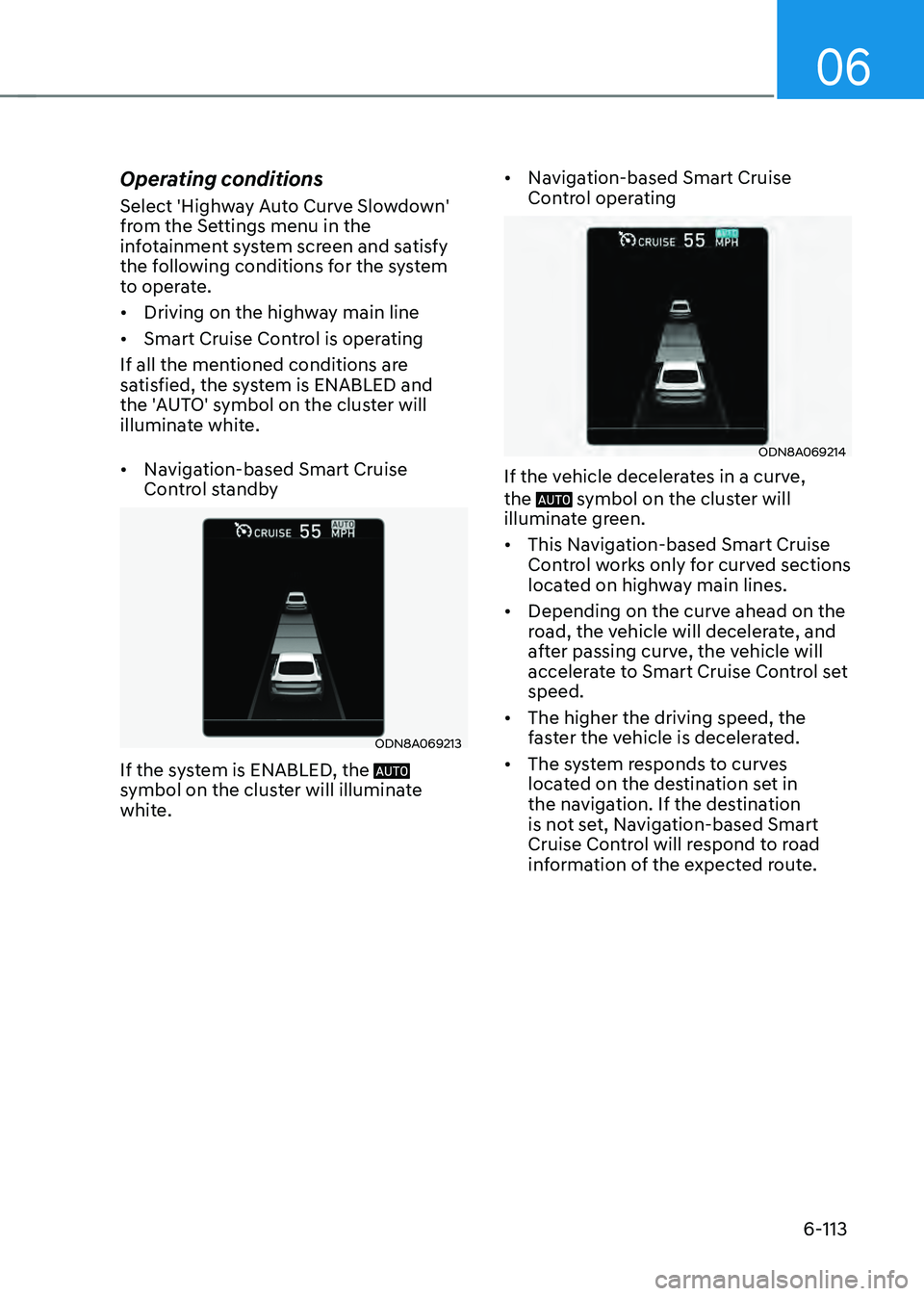
If all the mentioned conditions are
satisfied, the system is ENABLED and
the 'AUTO' symbol on the cluster will
illuminate white.
• Navigation-based Smart Cruise
Control standby
ODN8A069213ODN8A069213
If the system is ENABLED, the symbol on the cluster will illuminate
white.
• Navigation-based Smart Cruise
Control operating
ODN8A069214ODN8A069214
If the vehicle decelerates in a curve,
the
symbol on the cluster will illuminate green.
• This Navigation-based Smart Cruise
Control works only for curved sections
located on highway main lines.
• Depending on the curve ahead on the
road, the vehicle will decelerate, and
after passing curve, the vehicle will
accelerate to Smart Cruise Control set
speed.
• The higher the driving speed, the
faster the vehicle is decelerated.
• The system responds to curves
located on the destination set in
the navigation. If the destination
is not set, Navigation-based Smart
Cruise Control will respond to road
information of the expected route.
Page 404 of 549
While Driving
6-114
Information
• Navigation-based Smart Cruise Control
is limited in other countries.
• Navigation-based Smart Cruise Control
may not operate due to the existence
of leading vehicles and the driving
situations of the vehicle.
• Navigation-based Smart Cruise Control
operates regardless of whether the
sharp curve warning appears on the
navigation, but the time gap could
occur between the warning and system
operation.
• The navigation only provides curve
information within permitted speed
ranges so that the system may not
decrease its speed during extreme over-
speed driving.
• Navigation-based Smart Cruise Control
is not designed to work on highways
other than mentioned as a controlled
access road.
• Navigation-based Smart Cruise Control
automatically cancels when you leave
the highway.
• Highway Driving Assist and
Navigation-based Smart Cruise
Control uses the same
symbol that indicates the status of the system.
Therefore, even if Navigation-based
Cruise Control is off, the
symbol may be displayed.
• If there is a problem with Navigation-
based Smart Cruise Control, the system
cannot be activated in the infotainment
system screen, and the
symbol will turn off. However, if Highway Driving
Assist is activated, the
symbol will be displayed.
• After you pass through a tollgate on
a highway, Navigation-based Smart
Cruise Control operates based on the
first lane. If you enter one of the other
lanes, Navigation-based Smart Cruise
Control might not properly decelerate.
• If you over speed, Navigation-based
Smart Cruise Control may not
decelerate the vehicle in a curve.
• Deceleration by Navigation-based
Smart Cruise Control may not be
sufficient if the driver accelerates while
the system is operating,
• Deceleration by Navigation-based
Smart Cruise Control may not be
sufficient due to road conditions such
as uneven road surfaces, narrow lanes,
etc.
• If the road is controlled, due to
construction or holiday events,
Navigation-based Smart Cruise Control
might not work properly.
Page 405 of 549
06
6-115
CAUTION
Navigation-based Cruise Control may
not function properly in the following
situations:
• The navigation is not working
properly.
• The navigation is not updated.
• The real-time GPS or map
information provided has errors.
• The navigation is overloaded by
performing functions such as route
search, video playback, voice
recognition, etc., are performing
simultaneously.
• GPS signals are blocked in areas such
as a tunnel.
• The driver goes off course or the
route to the destination is changed
or canceled by resetting the
navigation.
• The vehicle enters a service station
or rest area.
• A section of the highway’s shape has
changed.
• Android Auto or Car Play is operating.
• The navigation cannot detect the
current vehicle position (for example,
elevated roads including overpass
adjacent to general roads or nearby
roads exist in a parallel way).
• The navigation is being updated
while driving.
• The navigation is being reset while
driving.
• The road is slippery due to bad
weather such as rain or snow.
Information
This device complies with Part 15 of the
FCC rules.
Operation is subject to the following three
conditions:
1. This device may not cause harmful
interference, and
2. This device must accept any
interference received, including
interference that may cause undesired
operation.
3. Changes or modifications not expressly
approved by the party responsible
for compliance could void the user's
authority to operate the device.
Information
Radio frequency radiation exposure
information:
This equipment complies with FCC
radiation exposure limits set forth for an
uncontrolled environment.
This equipment should be installed and
operated with minimum distance of 8 in.
(20 cm) between the radiator (antenna)
and your body.
This transmitter must not be co-located or
operating in conjunction with any other
antenna or transmitter.
Page 406 of 549
While Driving
6-116
Detecting Sensor
ODN8062228NODN8062228N
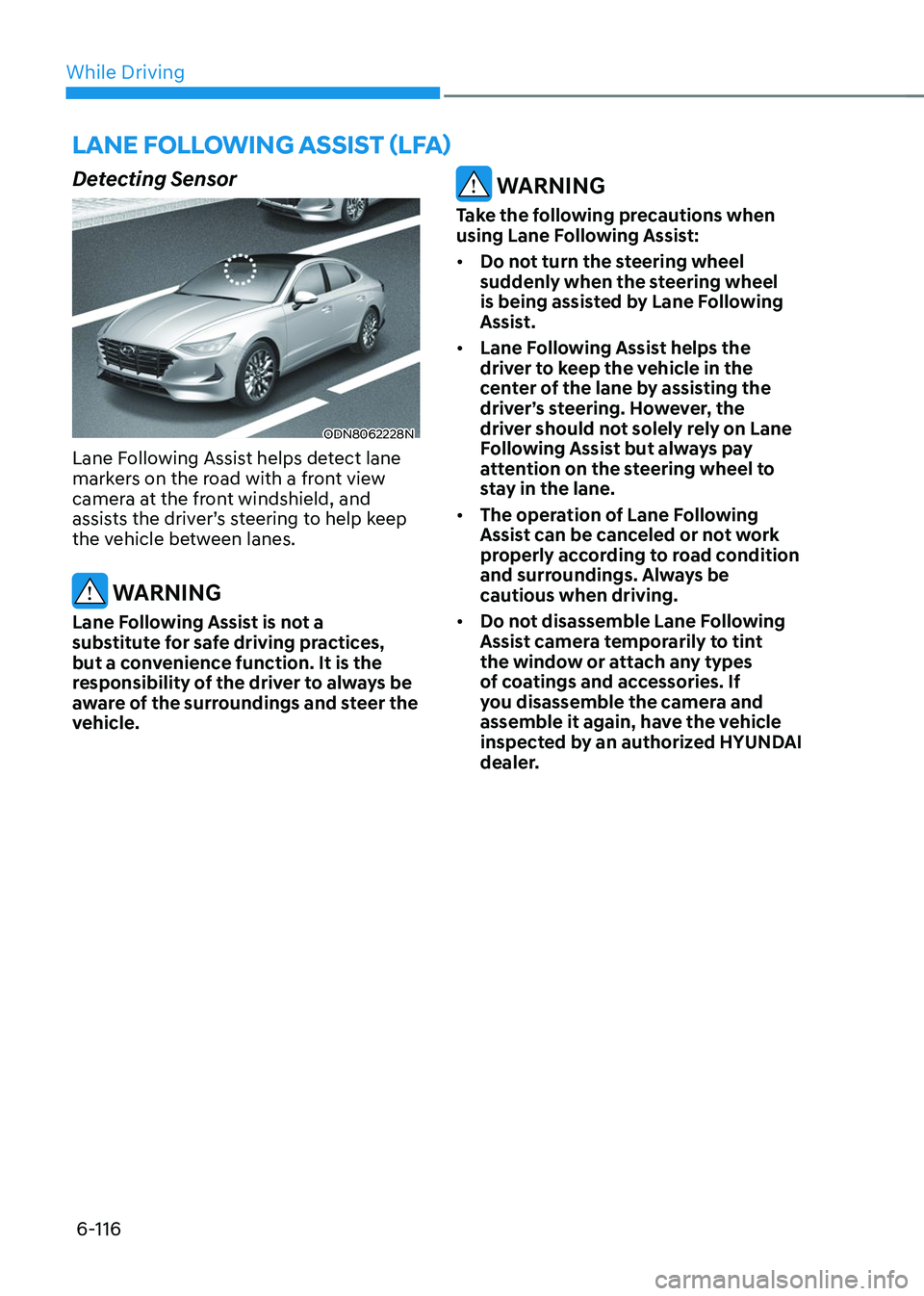
Lane Following Assist helps detect lane
markers on the road with a front view
camera at the front windshield, and
assists the driver’s steering to help keep
the vehicle between lanes.
WARNING
Lane Following Assist is not a
substitute for safe driving practices,
but a convenience function. It is the
responsibility of the driver to always be
aware of the surroundings and steer the
vehicle.
WARNING
Take the following precautions when
using Lane Following Assist:
• Do not turn the steering wheel
suddenly when the steering wheel
is being assisted by Lane Following
Assist.
• Lane Following Assist helps the
driver to keep the vehicle in the
center of the lane by assisting the
driver’s steering. However, the
driver should not solely rely on Lane
Following Assist but always pay
attention on the steering wheel to
stay in the lane.
• The operation of Lane Following
Assist can be canceled or not work
properly according to road condition
and surroundings. Always be
cautious when driving.
• Do not disassemble Lane Following
Assist camera temporarily to tint
the window or attach any types
of coatings and accessories. If
you disassemble the camera and
assemble it again, have the vehicle
inspected by an authorized HYUNDAI
dealer.
LANE FOLLOWING ASSIST (LFA)
Page 407 of 549
06
6-117
• When you replace the windshield
glass, Lane Following Assist camera
or related parts of the steering
wheel, have the vehicle inspected by
an authorized HYUNDAI dealer.
• Lane Following Assist helps
detect lane markers and controls
the steering wheel by a camera,
therefore, if the lane markers are
hard to detect, Lane Following Assist
may not work properly.
• Please refer to “Limitations of the
function”.
• Do not remove or damage the related
parts of Lane Following Assist.
• You may not hear a warning sound
of Lane Following Assist if the audio
volume is high.
• Do not place objects on the
dashboard that reflects light such as
mirrors, white paper, etc. This may
prevent Lane Following Assist from
functioning properly.
• Always have your hands on the
steering wheel while Lane Following
Assist is activated. If you continue
to drive with your hands off the
steering wheel after the “Keep hands
on steering wheel” warning message
appears, Lane Following Assist will
turn off automatically.
However, if the driver has their
hands on the steering wheel again,
the system will start controlling the
steering wheel.
• The steering wheel is not
continuously controlled so if the
vehicle speed is at a higher rate
when leaving a lane the vehicle may
not be controlled by Lane Following
Assist. The driver must always follow
the speed limit when using the
function.
• If you attach objects to the steering
wheel, the system may not assist
steering or the hands off alarm may
not work properly.
Page 408 of 549
While Driving
6-118
Lane Following Assist Operation
ODN8069079ODN8069079
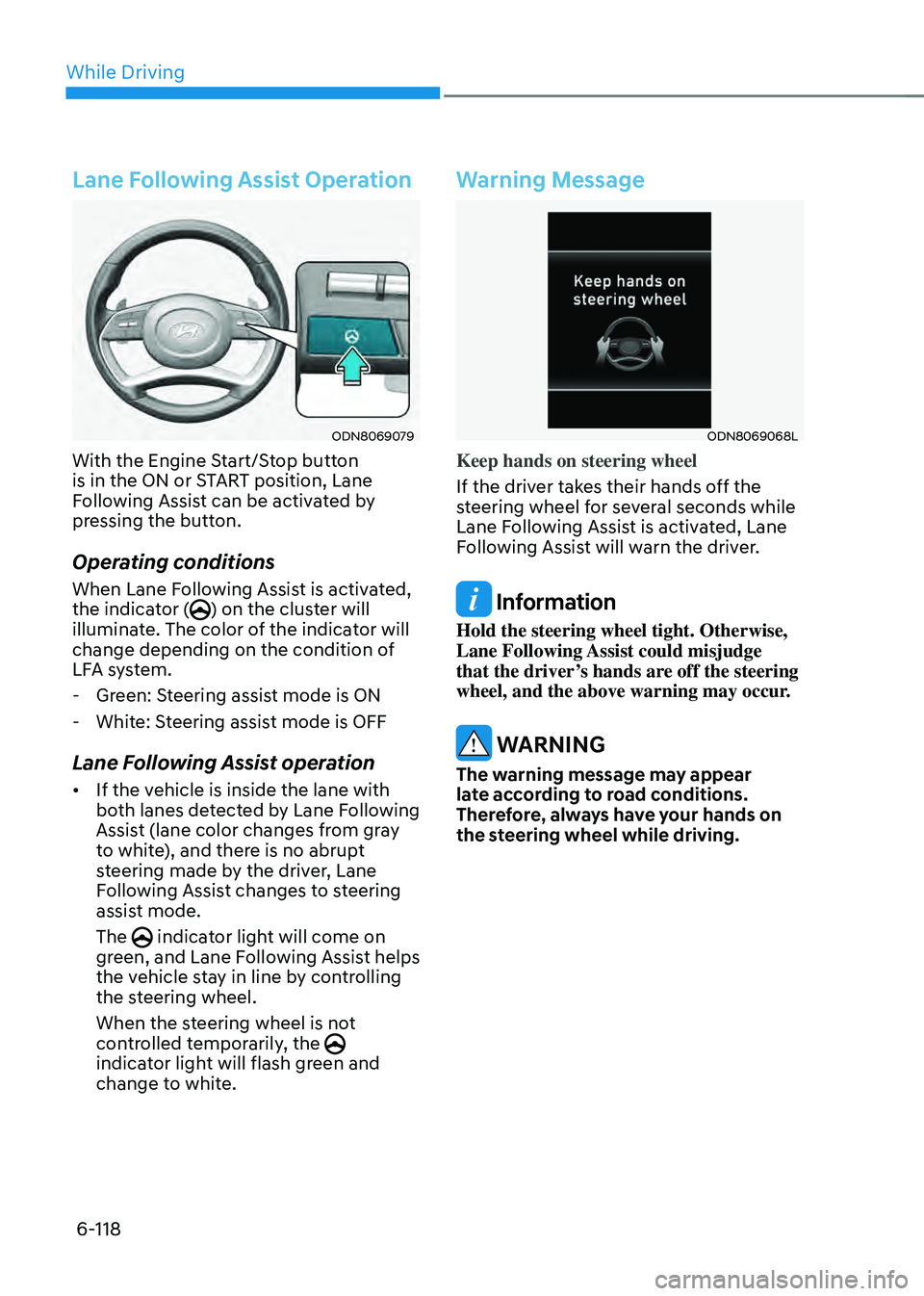
With the Engine Start/Stop button
is in the ON or START position, Lane
Following Assist can be activated by
pressing the button.
Operating conditions
When Lane Following Assist is activated,
the indicator () on the cluster will
illuminate. The color of the indicator will
change depending on the condition of
LFA system.
- Green: Steering assist mode is ON
-White: Steering assist mode is OFF
Lane Following Assist operation
• If the vehicle is inside the lane with
both lanes detected by Lane Following
Assist (lane color changes from gray
to white), and there is no abrupt
steering made by the driver, Lane
Following Assist changes to steering
assist mode.
The
indicator light will come on green, and Lane Following Assist helps
the vehicle stay in line by controlling
the steering wheel.
When the steering wheel is not
controlled temporarily, the
indicator light will flash green and
change to white.
Warning Message
ODN8069068LODN8069068L
Keep hands on steering wheel
If the driver takes their hands off the
steering wheel for several seconds while
Lane Following Assist is activated, Lane
Following Assist will warn the driver.
Information
Hold the steering wheel tight. Otherwise,
Lane Following Assist could misjudge
that the driver’s hands are off the steering
wheel, and the above warning may occur.
WARNING
The warning message may appear
late according to road conditions.
Therefore, always have your hands on
the steering wheel while driving.
Page 409 of 549
06
6-119
OOSH069079LOOSH069079L
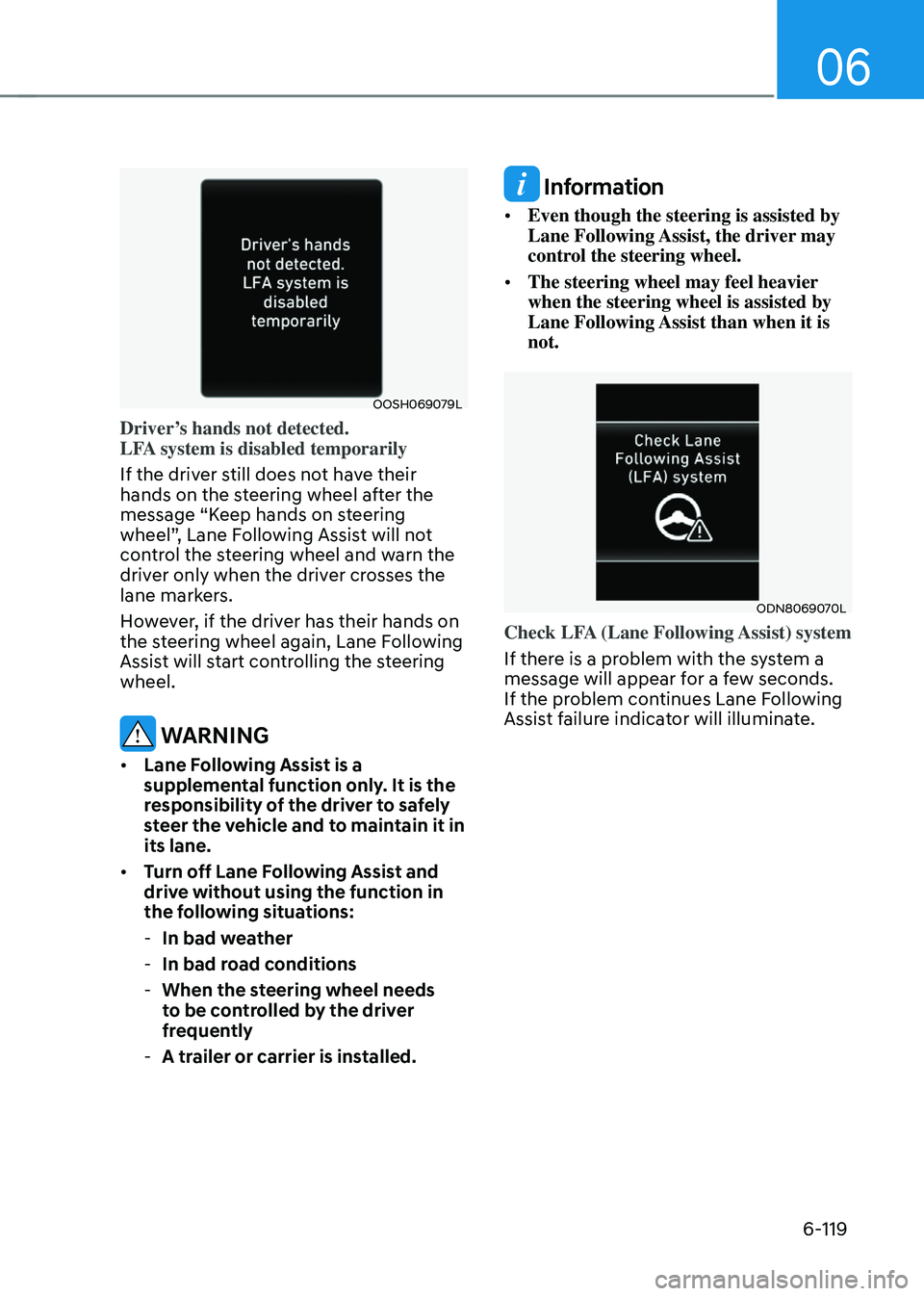
Driver’s hands not detected.
LFA system is disabled temporarily
If the driver still does not have their
hands on the steering wheel after the
message “Keep hands on steering
wheel”, Lane Following Assist will not
control the steering wheel and warn the
driver only when the driver crosses the
lane markers.
However, if the driver has their hands on
the steering wheel again, Lane Following
Assist will start controlling the steering
wheel.
WARNING
• Lane Following Assist is a
supplemental function only. It is the
responsibility of the driver to safely
steer the vehicle and to maintain it in
its lane.
• Turn off Lane Following Assist and
drive without using the function in
the following situations:
-In bad weather
-In bad road conditions
-When the steering wheel needs
to be controlled by the driver
frequently
-A trailer or carrier is installed.
Information
• Even though the steering is assisted by
Lane Following Assist, the driver may
control the steering wheel.
• The steering wheel may feel heavier
when the steering wheel is assisted by
Lane Following Assist than when it is
not.
ODN8069070LODN8069070L
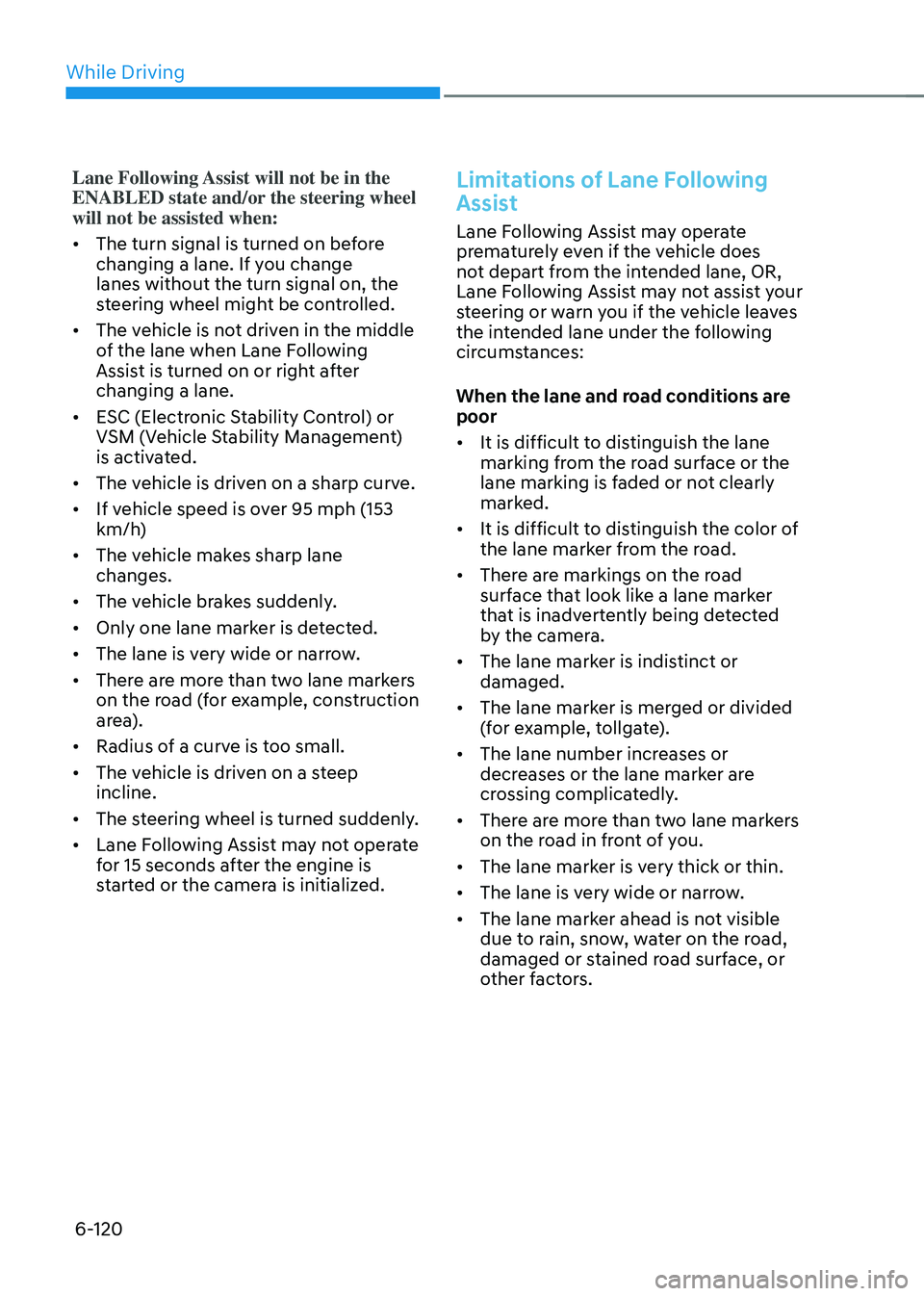
Check LFA (Lane Following Assist) system
If there is a problem with the system a
message will appear for a few seconds.
If the problem continues Lane Following
Assist failure indicator will illuminate.
Page 410 of 549
While Driving
6-120
Lane Following Assist will not be in the
ENABLED state and/or the steering wheel
will not be assisted when:
• The turn signal is turned on before
changing a lane. If you change
lanes without the turn signal on, the
steering wheel might be controlled.
• The vehicle is not driven in the middle
of the lane when Lane Following
Assist is turned on or right after
changing a lane.
• ESC (Electronic Stability Control) or
VSM (Vehicle Stability Management)
is activated.
• The vehicle is driven on a sharp curve.
• If vehicle speed is over 95 mph (153
km/h)
• The vehicle makes sharp lane
changes.
• The vehicle brakes suddenly.
• Only one lane marker is detected.
• The lane is very wide or narrow.
• There are more than two lane markers
on the road (for example, construction
area).
• Radius of a curve is too small.
• The vehicle is driven on a steep
incline.
• The steering wheel is turned suddenly.
• Lane Following Assist may not operate
for 15 seconds after the engine is
started or the camera is initialized.
Limitations of Lane Following
Assist
Lane Following Assist may operate
prematurely even if the vehicle does
not depart from the intended lane, OR,
Lane Following Assist may not assist your
steering or warn you if the vehicle leaves
the intended lane under the following
circumstances:
When the lane and road conditions are
poor
• It is difficult to distinguish the lane
marking from the road surface or the
lane marking is faded or not clearly
marked.
• It is difficult to distinguish the color of
the lane marker from the road.
• There are markings on the road
surface that look like a lane marker
that is inadvertently being detected
by the camera.
• The lane marker is indistinct or
damaged.
• The lane marker is merged or divided
(for example, tollgate).
• The lane number increases or
decreases or the lane marker are
crossing complicatedly.
• There are more than two lane markers
on the road in front of you.
• The lane marker is very thick or thin.
• The lane is very wide or narrow.
• The lane marker ahead is not visible
due to rain, snow, water on the road,
damaged or stained road surface, or
other factors.