warning HYUNDAI SONATA LIMITED 2020 Owners Manual
[x] Cancel search | Manufacturer: HYUNDAI, Model Year: 2020, Model line: SONATA LIMITED, Model: HYUNDAI SONATA LIMITED 2020Pages: 546, PDF Size: 51.21 MB
Page 421 of 546
![HYUNDAI SONATA LIMITED 2020 Owners Manual 06
6-137
OHI058316L
[A] : Structure
• Driving where there is a vehicle or
structure near
The system may not operate properly
when driving where there is a vehicle
or structure near.
In certain in](/img/35/56187/w960_56187-420.png "HYUNDAI SONATA LIMITED 2020 Owners Manual 06
6-137
OHI058316L
[A] : Structure
• Driving where there is a vehicle or
structure near
The system may not operate properly
when driving where there is a vehicle
or structure near.
In certain in")
06
6-137
OHI058316L
[A] : Structure
• Driving where there is a vehicle or
structure near
The system may not operate properly
when driving where there is a vehicle
or structure near.
In certain instances, the system may
not detect the vehicle approaching
from behind and the warning or brake
may not operate properly.
Always pay attention to your
surrounding while driving.
OHI058317L
• When the vehicle is in a complex
parking environment
The system may not operate properly
when the vehicle is in a complex
parking environment.
In certain instances, the system may
not be able to exactly determine the
risk of collision for the vehicles which
are parking or pulling out near your
vehicle (e.g. a vehicle escaping beside
your vehicle, a vehicle parking or
pulling out in the rear area, a vehicle
approaching your vehicle making a
turn, etc.).
In this case, the warning or brake may
not operate properly.
Page 422 of 546
![HYUNDAI SONATA LIMITED 2020 Owners Manual 6-138
OHI058318L
[A] : Vehicle
• When the vehicle is parked diagonally
The system may not operate properly
when the vehicle is parked diagonally.
In certain instances, when the
diagonally parked v](/img/35/56187/w960_56187-421.png "HYUNDAI SONATA LIMITED 2020 Owners Manual 6-138
OHI058318L
[A] : Vehicle
• When the vehicle is parked diagonally
The system may not operate properly
when the vehicle is parked diagonally.
In certain instances, when the
diagonally parked v")
6-138
OHI058318L
[A] : Vehicle
• When the vehicle is parked diagonally
The system may not operate properly
when the vehicle is parked diagonally.
In certain instances, when the
diagonally parked vehicle is pulled out
of the parking space, the system may
not detect the vehicle approaching
from the rear left/right of your vehicle.
In this case, the warning or brake may
not operate properly.
Always pay attention to your
surrounding while driving.
ODN8069042L
• When the vehicle is on/near a slope
The system may not operate properly
when the vehicle is on/near a slope.
In certain instances, the system may
not detect the vehicle approaching
from the rear left/right and the
warning or brake may not operate
properly.
Always pay attention to your
surrounding while driving.
While Driving
Page 423 of 546
![HYUNDAI SONATA LIMITED 2020 Owners Manual 06
6-139
OHI058319L
[A] : Structure, [B] : Wall
• Pulling into the parking space where
there is a structure
The system may not operate properly
when pulling in the vehicle to the
parking space wh](/img/35/56187/w960_56187-422.png "HYUNDAI SONATA LIMITED 2020 Owners Manual 06
6-139
OHI058319L
[A] : Structure, [B] : Wall
• Pulling into the parking space where
there is a structure
The system may not operate properly
when pulling in the vehicle to the
parking space wh")
06
6-139
OHI058319L
[A] : Structure, [B] : Wall
• Pulling into the parking space where
there is a structure
The system may not operate properly
when pulling in the vehicle to the
parking space where there is a
structure at the back or side of your
vehicle.
In certain instances, when backing
into the parking space, the system
may not detect the vehicle moving
in front of your vehicle. In this case,
the warning or brake may not operate
properly.
Always pay attention to the parking
space while driving.
OHI058320L
• When the vehicle is parked rearward
If the vehicle is parked rearward and
the radar sensor detects the another
vehicle in the rear area of the parking
space, the system can warn or control
braking. Always pay attention to the
parking space while driving.
Information
This device complies with Part 15 of the
FCC rules.
Operation is subject to the following two
conditions:
1.
This device may not cause harmful
interfer
ence.
2.
This device must accept any
interfer
ence received, including
interference that may cause undesired
operation.
Page 424 of 546
6-140
Hazardous Driving Conditions
When hazardous driving elements
are encountered such as water, snow,
ice, mud and sand, take the below
suggestions:
• Drive cautiously and keep a longer
braking distance.
• Avoid abrupt braking or steering.
• When your vehicle is stuck in
snow, mud, or sand, use second
gear. Accelerate slowly to avoid
unnecessary wheel spin.
• Put sand, rock salt, tire chains or other
non-slip materials under the wheels to
provide additional traction while the
vehicle becomes stuck in ice, snow,
or mud.
WARNING
Downshifting with an automatic
transmission while driving on slippery
surfaces can cause an accident. The
sudden change in tire speed could
cause the tires to skid. Be careful when
downshifting on slippery surfaces.
Rocking the Vehicle
If it is necessary to rock the vehicle to
free it from snow, sand, or mud, first turn
the steering wheel right and left to clear
the area around your front wheels. Then,
shift back and forth between R (Reverse)
and a forward gear.
Try to avoid spinning the wheels, and do
not race the engine.
To prevent transmission wear, wait until
the wheels stop spinning before shifting
gears. Release the accelerator pedal
while shifting, and press lightly on the
accelerator pedal while the transmission
is in gear. Slowly spinning the wheels in
forward and reverse directions causes a
rocking motion that may free the vehicle.
WARNING
If the vehicle is stuck and excessive
wheel spin occurs, the temperature
of the tires can increase very quickly.
If the tires become damaged, a tire
blow out or tire explosion can occur.
This condition is dangerous - you and
others may be injured. Do not attempt
this procedure if people or objects are
anywhere near the vehicle.
If you attempt to free the vehicle, the
vehicle can overheat quickly, possibly
causing an engine compartment fire
or other damage. Try to avoid spinning
the wheels as much as possible to
prevent overheating of either the tires
or the engine. DO NOT allow the vehicle
to spin the wheels above 35 mph (56
km/h).
Information
The ESC system must be turned OFF
before rocking the vehicle.
NOTICE
If you are still stuck after rocking the
vehicle a few times, have the vehicle
pulled out by a tow vehicle to avoid
engine overheating, possible damage to
the transmission, and tire damage. See
"Towing" in chapter 7.
SpeCI al d r I v I n G Cond I t I on S
While Driving
Page 427 of 546
06
6-143
The severe weather conditions of winter
quickly wear out tires and cause other
problems. To minimize winter driving
problems, you should take the following
suggestions:
Snow or Icy Conditions
You need to keep sufficient distance
between your vehicle and the vehicle in
front of you.
Apply the brakes gently. Speeding, rapid
acceleration, sudden brake applications,
and sharp turns are potentially
very hazardous practices. During
deceleration, use engine braking to the
fullest extent. Sudden brake applications
on snowy or icy roads may cause the
vehicle to skid.
To drive your vehicle in deep snow, it
may be necessary to use snow tires or to
install tire chains on your tires.
Always carry emergency equipment.
Some of the items you may want to carry
include tire chains, tow straps or chains,
a flashlight, emergency flares, sand, a
shovel, jumper cables, a window scraper,
gloves, ground cloth, coveralls, a blanket,
etc.
Snow tires
WARNING
Snow tires should be equivalent in size
and type to the vehicle’s standard tires.
Otherwise, the safety and handling of
your vehicle may be adversely affected.
If you mount snow tires on your vehicle,
make sure to use radial tires of the same
size and load range as the original tires.
Mount snow tires on all four wheels
to balance your vehicle’s handling in
all weather conditions. The traction
provided by snow tires on dry roads
may not be as high as your vehicle's
original equipment tires. Check with
the tire dealer for maximum speed
recommendations.
Information
Do not install studded tires without
first checking local, state and municipal
regulations for possible restrictions against
their use.
Tire chains
ODN8069077L
Since the sidewalls of radial tires are
thinner than other types of tires, they
may be damaged by mounting some
types of tire chains on them. Therefore
the use of snow tires is preferred over the
use of tire chains.
If the road and weather conditions
require the use of tire chains, be sure to
use tire chains that have been properly
selected for the size of tire on your
HYUNDAI vehicle.
Be sure to follow the guidelines and
installation instructions provided from
the tire chain manufacturer.
Damage to your vehicle caused by
improper tire chain use is not covered by
your vehicle manufacturer’s warranty.
winter Driving
Page 428 of 546
6-144
WARNING
The use of tire chains may adversely
affect vehicle handling:
• Drive less than 20 mph (30 km/h)
or the chain manufacturer's
recommended speed limit,
whichever is lower.
• Drive carefully and avoid bumps,
holes, sharp turns, and other road
hazards, which may cause the
vehicle to bounce.
• Avoid sharp turns or locked wheel
braking.
Information
• Install tire chains on both left and right
front tires. It should be noted that
installing tire chains on the tires will
provide a greater driving force, but will
not prevent side skids.
• Do not install studded tires without
first checking local, state and municipal
regulations for possible restrictions
against their use.
Chain installation
When installing tire chains, follow the
manufacturer’s instructions and mount
them as tightly possible. Drive slowly
(less than 20 mph (30 km/h)) with
chains installed. If you hear the chains
contacting the body or chassis, stop and
tighten them. If they still make contact,
slow down until the noise stops. Remove
the tire chains as soon as you begin
driving on cleared roads.
When mounting snow chains, park the
vehicle on level ground away from traffic.
Turn on the vehicle Hazard Warning
Flasher and place a triangular emergency
warning device behind the vehicle (if
available). Always place the vehicle in P
(Park), apply the parking brake and turn
off the engine before installing snow
chains.
NOTICE
When using tire chains:
• Wrong size chains or improperly
installed chains can damage your
vehicle's brake lines, suspension,
body and wheels.
• Use SAE "S" class or wire chains.
• If you hear noise caused by chains
contacting the body, retighten the
chain to prevent contact with the
vehicle body.
• To prevent body damage, retighten
the chains after driving 0.3~0.6 miles
(0.5~1.0 km).
• Do not use tire chains on vehicles
equipped with aluminum wheels. If
unavoidable, use a wire type chain.
• Use wire chains less than 0.59 inch
(15mm) wide to prevent damage to
the chain’s connection.
Winter Precautions
Use high quality ethylene glycol
coolant
Your vehicle is delivered with high
quality ethylene glycol coolant in the
cooling system. It is the only type of
coolant that should be used because it
helps prevent corrosion in the cooling
system, lubricates the water pump and
prevents freezing. Be sure to replace or
replenish your coolant in accordance
with the maintenance schedule in
chapter 8. Before winter, have your
coolant tested to assure that its freezing
point is sufficient for the temperatures
anticipated during the winter.
While Driving
Page 432 of 546
6-148
Steps for determining correct load
limit
1. Locate the statement "The combined weight of occupants and cargo should
never exceed XXX kg or XXX lbs." on
your vehicle's placard.
2.
De
termine the combined weight of
the driver and passengers that will be
riding in your vehicle.
3.
Sub
tract the combined weight of the
driver and passengers from XXX kg or
XXX lbs.
4.
The r
esulting figure equals the
available amount of cargo and
luggage load capacity. For example,
if the "XXX" amount equals 1400
lbs. and there will be five 150 lb.
passengers in your vehicle, the
amount of available cargo and
luggage load capacity is 650 lbs.
(1400 - 750 (5 x 150) = 650 lbs.)
5.
De
termine the combined weight of
luggage and cargo being loaded on
the vehicle. That weight may not
safely exceed the available cargo and
luggage load capacity calculated in
Step 4.
6.
If y
our vehicle will be towing a
trailer, load from your trailer will be
transferred to your vehicle. Consult
this manual to determine how this
reduces the available cargo and
luggage load capacity of your vehicle.
WARNING
Do not overload the vehicle as there
is a limit to the total weight, or load
limit, including occupants and cargo,
the vehicle can carry. Overloading can
shorten the life of the vehicle. If the
GVWR or the GAWR is exceeded, parts
on the vehicle can break, and it can
change the handling of your vehicle.
These could cause you to lose control
and result in an accident.
While Driving
Page 434 of 546
6-150
Certification label
OBH059070
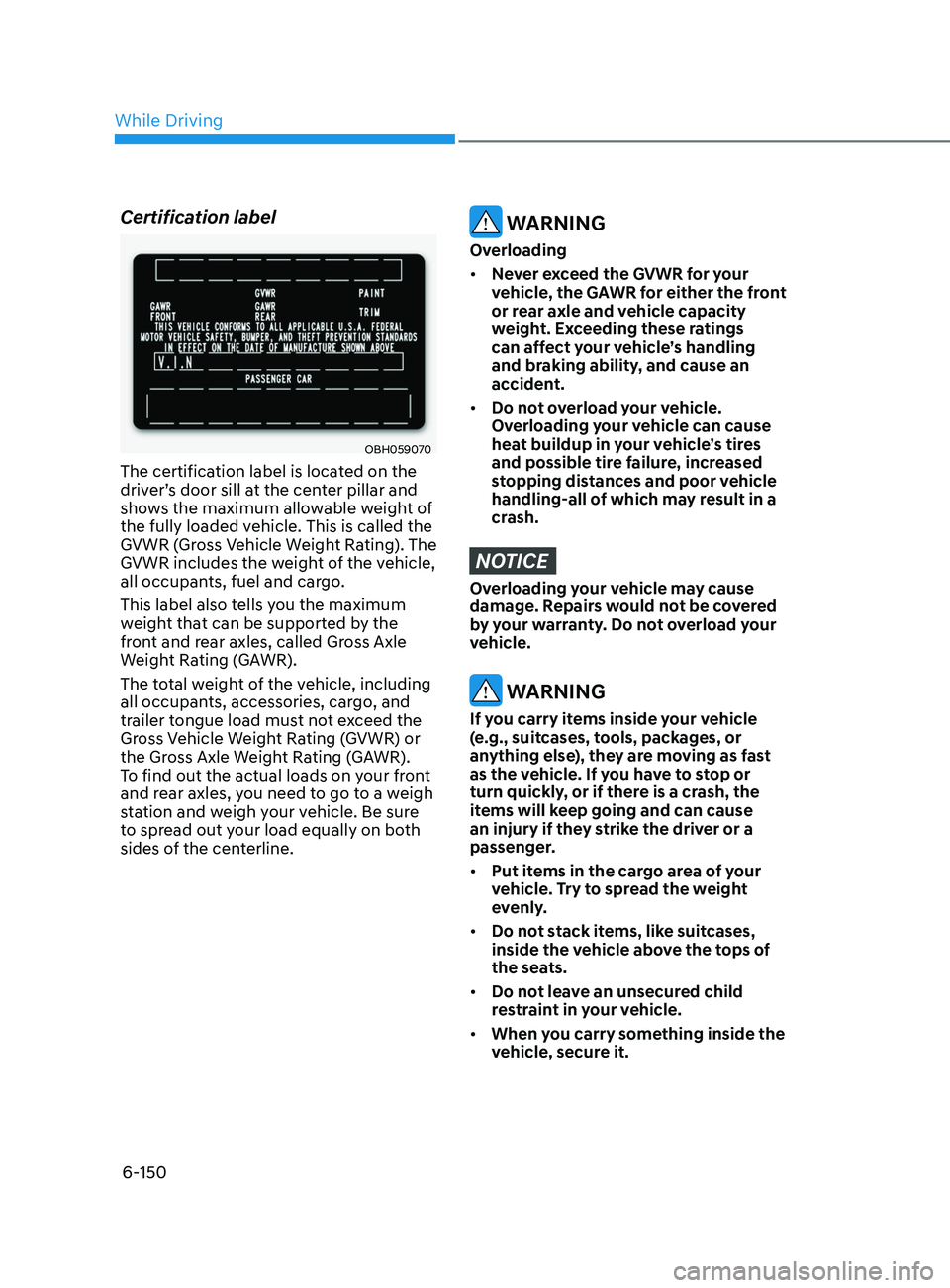
The certification label is located on the
driver’s door sill at the center pillar and
shows the maximum allowable weight of
the fully loaded vehicle. This is called the
GVWR (Gross Vehicle Weight Rating). The
GVWR includes the weight of the vehicle,
all occupants, fuel and cargo.
This label also tells you the maximum
weight that can be supported by the
front and rear axles, called Gross Axle
Weight Rating (GAWR).
The total weight of the vehicle, including
all occupants, accessories, cargo, and
trailer tongue load must not exceed the
Gross Vehicle Weight Rating (GVWR) or
the Gross Axle Weight Rating (GAWR).
To find out the actual loads on your front
and rear axles, you need to go to a weigh
station and weigh your vehicle. Be sure
to spread out your load equally on both
sides of the centerline.
WARNING
Overloading
• Never exceed the GVWR for your
vehicle, the GAWR for either the front
or rear axle and vehicle capacity
weight. Exceeding these ratings
can affect your vehicle’s handling
and braking ability, and cause an
accident.
• Do not overload your vehicle.
Overloading your vehicle can cause
heat buildup in your vehicle’s tires
and possible tire failure, increased
stopping distances and poor vehicle
handling-all of which may result in a
crash.
NOTICE
Overloading your vehicle may cause
damage. Repairs would not be covered
by your warranty. Do not overload your
vehicle.
WARNING
If you carry items inside your vehicle
(e.g., suitcases, tools, packages, or
anything else), they are moving as fast
as the vehicle. If you have to stop or
turn quickly, or if there is a crash, the
items will keep going and can cause
an injury if they strike the driver or a
passenger.
• Put items in the cargo area of your
vehicle. Try to spread the weight
evenly.
• Do not stack items, like suitcases,
inside the vehicle above the tops of
the seats.
• Do not leave an unsecured child
restraint in your vehicle.
• When you carry something inside the
vehicle, secure it.
While Driving
Page 436 of 546

Emergency Situations
Hazard Warning Flasher ........................................................................\
.........7 -2
In Case of an Emergency While Driving ........................................................7-2
If the Engine Stalls While Driving ........................................................................\
..... 7 -2
If the Engine Stalls at a Crossroad or Crossing .......................................................7-2
If you Have a Flat Tire While Driving
........................................................................\
7
-3
If the Engine Will not Start ........................................................................\
.....7 -3If the Engine Doesn’t Turn Over or Turns Over Slowly ............................................7 -3
If the Engine Turns Over Normally but Doesn’t Start ..............................................7-3
Jump Starting ........................................................................\
........................ 7- 4
If the Engine Overheats
........................................................................\
......... 7-
6
Tire Pressure Monitoring System (TPMS)
......................................................7-7
Check Tire Pressure ........................................................................\
........................... 7 -7
Tire Pressure Monitoring System ........................................................................\
.... 7-
8
Low Tire Pressure Telltale
........................................................................\
................ 7-9
Low Tire Pressure LCD Display with Position Indicator
.........................................7-9
TPMS Malfunction Indicator
........................................................................\
........... 7-10
Changing a Tire with TPMS
........................................................................\
............ 7-10
If you Have a Flat Tire (With Spare Tire) ......................................................7 -12Jack and Tools ........................................................................\
.................................7 -12
Changing Tires ........................................................................\
................................. 7-13
Towing ........................................................................\
................................... 7 -18Towing Service ........................................................................\
................................7 -18
Emergency Towing ........................................................................\
.......................... 7-19
7. Emergency Situations
7
Page 437 of 546
Emergency Situations
7-2
If the Engine Stalls While Driving
• Reduce your speed gradually, keeping
a straight line. Move cautiously off the
road to a safe place.
• Turn on your hazard warning flasher.
• Try to start the engine again. If your
vehicle will not start, contact an
authorized HYUNDAI dealer or seek
other qualified assistance.
If the Engine Stalls at a Crossroad
or Crossing
If the engine stalls at a crossroads or
crossing, if safe to do so, move the shift
button to the N (Neutral) position and
then push the vehicle to a safe location.
In Case of an emergenCy
Wh I le Dr I v I ng
ODN8079001
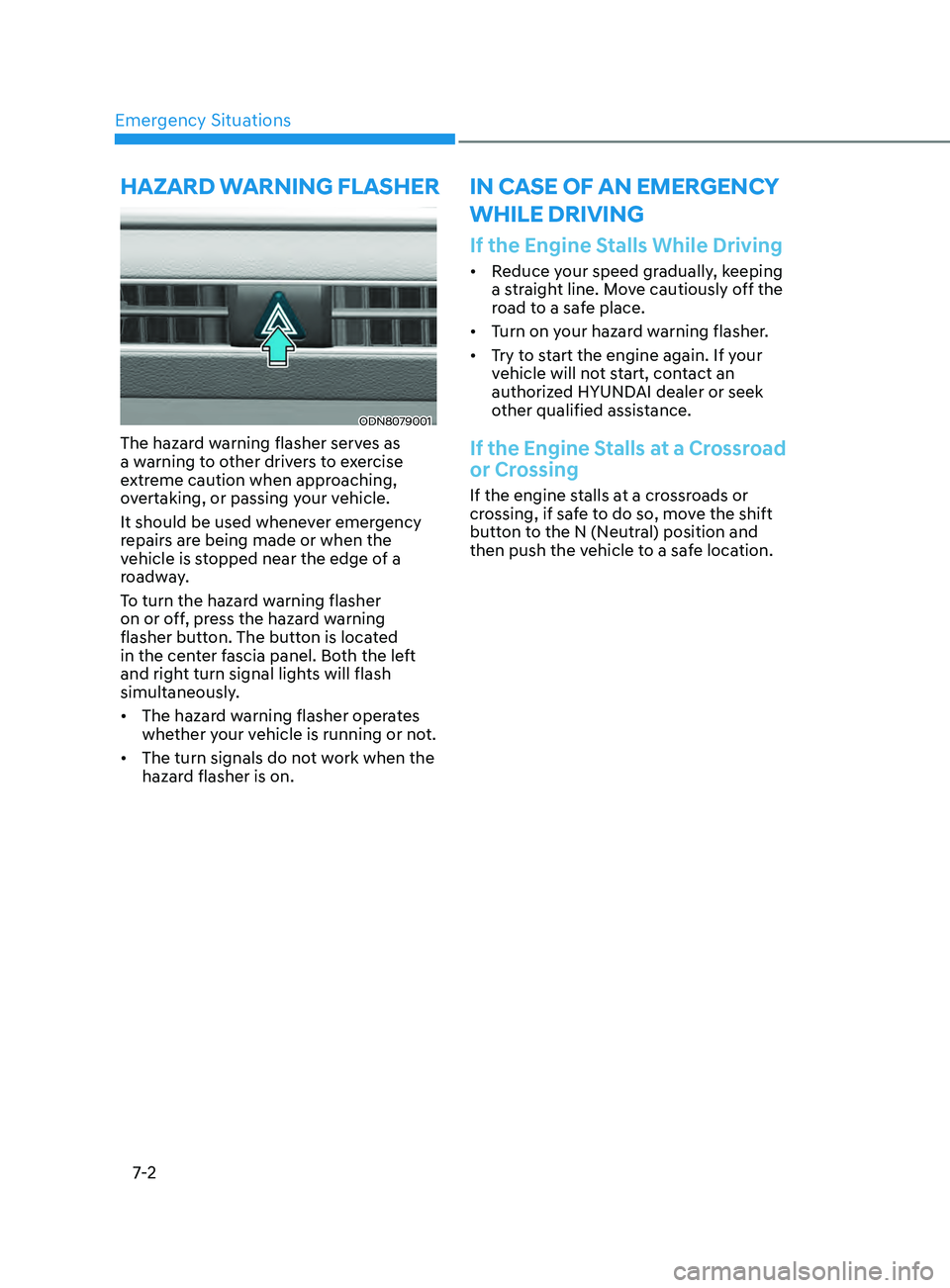
The hazard warning flasher serves as
a warning to other drivers to exercise
extreme caution when approaching,
overtaking, or passing your vehicle.
It should be used whenever emergency
repairs are being made or when the
vehicle is stopped near the edge of a
roadway.
To turn the hazard warning flasher
on or off, press the hazard warning
flasher button. The button is located
in the center fascia panel. Both the left
and right turn signal lights will flash
simultaneously.
• The hazard warning flasher operates
whether your vehicle is running or not.
• The turn signals do not work when the
hazard flasher is on.
hazarD WarnIng flasher