ECU Hyundai Terracan 2003 User Guide
[x] Cancel search | Manufacturer: HYUNDAI, Model Year: 2003, Model line: Terracan, Model: Hyundai Terracan 2003Pages: 349, PDF Size: 4.56 MB
Page 33 of 349
FEATURES OF YOUR HYUNDAI 1- 25
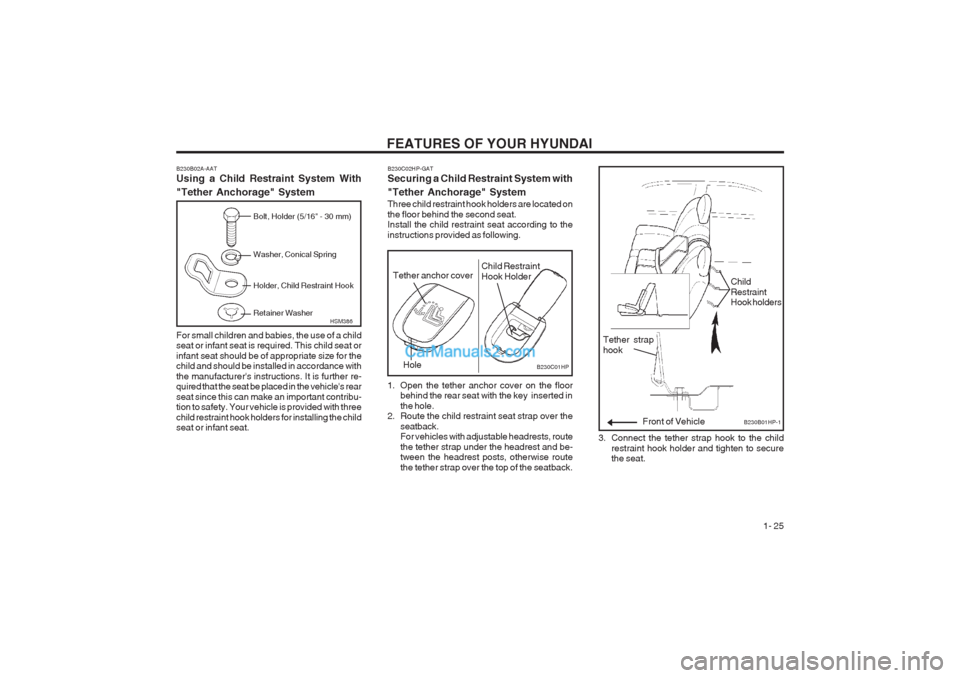
Bolt, Holder (5/16" - 30 mm) Washer, Conical Spring Holder, Child Restraint Hook Retainer Washer
HSM386
B230B02A-AAT Using a Child Restraint System With "Tether Anchorage" System For small children and babies, the use of a child seat or infant seat is required. This child seat or infant seat should be of appropriate size for the child and should be installed in accordance with the manufacturer's instructions. It is further re- quired that the seat be placed in the vehicle's rear seat since this can make an important contribu- tion to safety. Your vehicle is provided with three child restraint hook holders for installing the child seat or infant seat.
B230C01HP
Child Restraint Hook holders
Front of Vehicle
Tether strap hook
Child Restraint Hook Holder
Hole
B230B01HP-1
Tether anchor cover
B230C02HP-GAT Securing a Child Restraint System with "Tether Anchorage" System Three child restraint hook holders are located on the floor behind the second seat. Install the child restraint seat according to the instructions provided as following.
1. Open the tether anchor cover on the floor
behind the rear seat with the key inserted in the hole.
2. Route the child restraint seat strap over the
seatback. For vehicles with adjustable headrests, route the tether strap under the headrest and be- tween the headrest posts, otherwise route the tether strap over the top of the seatback. 3. Connect the tether strap hook to the child
restraint hook holder and tighten to secure the seat.
Page 34 of 349
FEATURES OF YOUR HYUNDAI
1- 26
B230F02HP
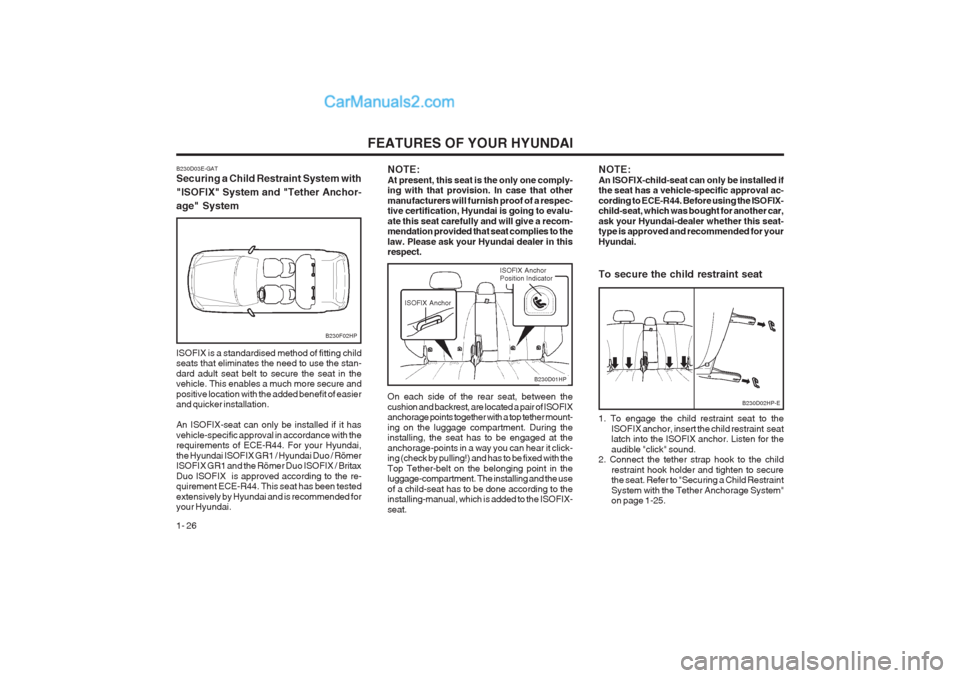
B230D03E-GAT Securing a Child Restraint System with "ISOFIX" System and "Tether Anchor-age" System ISOFIX is a standardised method of fitting child seats that eliminates the need to use the stan- dard adult seat belt to secure the seat in the vehicle. This enables a much more secure and positive location with the added benefit of easier and quicker installation. An ISOFIX-seat can only be installed if it has vehicle-specific approval in accordance with the requirements of ECE-R44. For your Hyundai, the Hyundai ISOFIX GR1 / Hyundai Duo / Römer ISOFIX GR1 and the Römer Duo ISOFIX / Britax Duo ISOFIX is approved according to the re- quirement ECE-R44. This seat has been tested extensively by Hyundai and is recommended for your Hyundai. NOTE: At present, this seat is the only one comply- ing with that provision. In case that other manufacturers will furnish proof of a respec- tive certification, Hyundai is going to evalu- ate this seat carefully and will give a recom- mendation provided that seat complies to the law. Please ask your Hyundai dealer in this respect. On each side of the rear seat, between the cushion and backrest, are located a pair of ISOFIX anchorage points together with a top tether mount- ing on the luggage compartment. During the installing, the seat has to be engaged at the anchorage-points in a way you can hear it click- ing (check by pulling!) and has to be fixed with the Top Tether-belt on the belonging point in the luggage-compartment. The installing and the use of a child-seat has to be done according to the installing-manual, which is added to the ISOFIX- seat.
B230D02HP-E
NOTE: An ISOFIX-child-seat can only be installed if the seat has a vehicle-specific approval ac- cording to ECE-R44. Before using the ISOFIX- child-seat, which was bought for another car, ask your Hyundai-dealer whether this seat- type is approved and recommended for your Hyundai. To secure the child restraint seat 1. To engage the child restraint seat to the
ISOFIX anchor, insert the child restraint seat latch into the ISOFIX anchor. Listen for the audible "click" sound.
2. Connect the tether strap hook to the child
restraint hook holder and tighten to secure the seat. Refer to "Securing a Child Restraint
System with the Tether Anchorage System" on page 1-25.
B230D01HP
ISOFIX Anchor ISOFIX Anchor Position Indicator
Page 35 of 349
FEATURES OF YOUR HYUNDAI 1- 27
WARNING:
o Do not install a child restraint seat at the
center of the rear seat using the vehicle'sISOFIX anchors. The ISOFIX anchors are only provided for the left and right out- board rear seating positions. Do not mis- use the ISOFIX anchors by attempting to attach a child restraint seat in the middle of the rear seat to the ISOFIX anchors. In a crash, the child restraint seat ISOFIX attachments may not be strong enough to secure the child restraint seat properly in the center of the rear seat and may break, causing serious injury or death.
o Do not mount more than one child re-
straint to a child restraint lower anchor- age point. The improper increased load may cause the anchorage points or tether anchor to break, causing serious injury or death.
o Attach the ISOFIX or ISOFIX-compatible
child restraint seat only to the appropriate locations shown in the illustration.
o Always follow the installation and use instructions provided by the manufacturer of the child restraint.
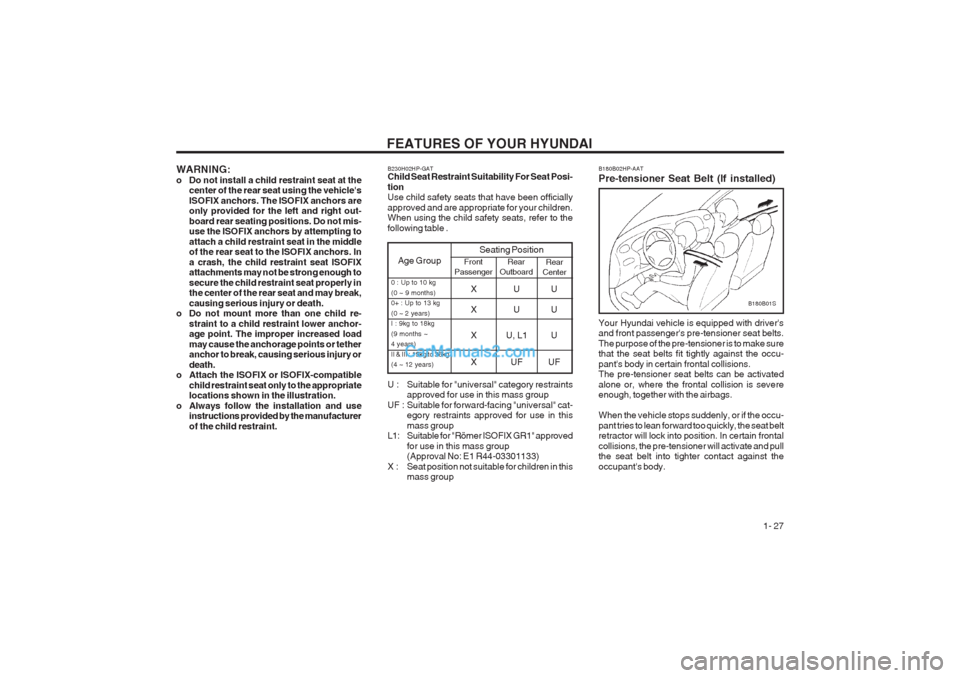
Age Group Seating PositionFront
Passenger Rear
Outboard Rear
Center
0 : Up to 10 kg (0 ~ 9 months) 0+ : Up to 13 kg (0 ~ 2 years) I : 9kg to 18kg (9 months ~ 4 years) II & III : 15kg to 36kg (4 ~ 12 years)XUU
XUU
X U, L1 U XU FUF
B230H02HP-GAT Child Seat Restraint Suitability For Seat Posi- tion Use child safety seats that have been officially approved and are appropriate for your children. When using the child safety seats, refer to the following table .
U : Suitable for "universal" category restraints
approved for use in this mass group
UF : Suitable for forward-facing "universal" cat- egory restraints approved for use in this mass group
L1: Suitable for "Römer ISOFIX GR1" approved
for use in this mass group (Approval No: E1 R44-03301133)
X : Seat position not suitable for children in this mass group Your Hyundai vehicle is equipped with driver'sand front passenger's pre-tensioner seat belts. The purpose of the pre-tensioner is to make sure that the seat belts fit tightly against the occu- pant's body in certain frontal collisions. The pre-tensioner seat belts can be activated alone or, where the frontal collision is severe enough, together with the airbags. When the vehicle stops suddenly, or if the occu- pant tries to lean forward too quickly, the seat belt retractor will lock into position. In certain frontal collisions, the pre-tensioner will activate and pull the seat belt into tighter contact against the occupant's body.
B180B02HP-AAT Pre-tensioner Seat Belt (If installed)
B180B01S
Page 66 of 349
FEATURES OF YOUR HYUNDAI
1- 58
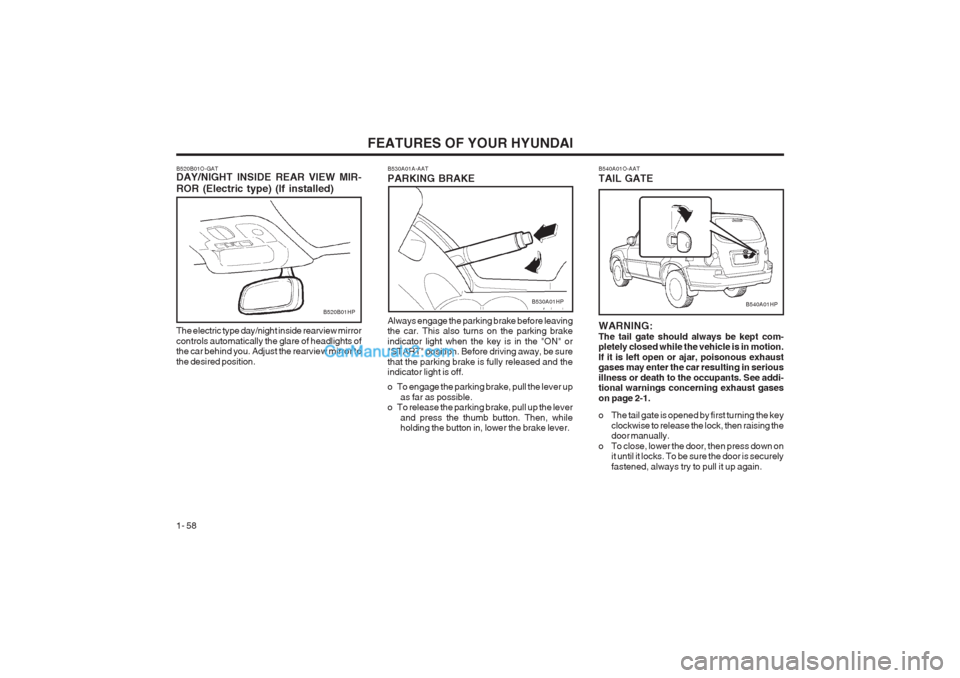
Always engage the parking brake before leaving the car. This also turns on the parking brake indicator light when the key is in the "ON" or "START" position. Before driving away, be sure that the parking brake is fully released and the indicator light is off.
o To engage the parking brake, pull the lever up as far as possible.
o To release the parking brake, pull up the lever
and press the thumb button. Then, while holding the button in, lower the brake lever.
B530A01A-AAT PARKING BRAKE
B520B01O-GAT DAY/NIGHT INSIDE REAR VIEW MIR- ROR (Electric type) (If installed)
B520B01HP
The electric type day/night inside rearview mirror controls automatically the glare of headlights of the car behind you. Adjust the rearview mirror to the desired position.B530A01HP
B540A01O-AAT TAIL GATE
B540A01HP
WARNING: The tail gate should always be kept com- pletely closed while the vehicle is in motion. If it is left open or ajar, poisonous exhaust gases may enter the car resulting in serious illness or death to the occupants. See addi- tional warnings concerning exhaust gases on page 2-1.
o The tail gate is opened by first turning the key clockwise to release the lock, then raising the door manually.
o To close, lower the door, then press down on it until it locks. To be sure the door is securely fastened, always try to pull it up again.
Page 68 of 349
FEATURES OF YOUR HYUNDAI
1- 60
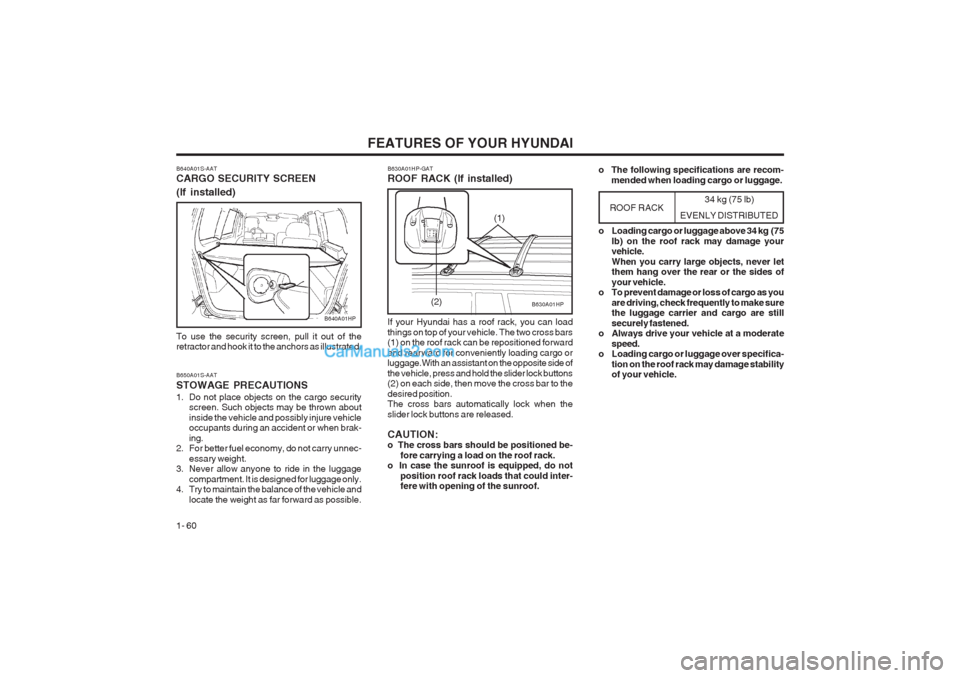
B640A01S-AAT CARGO SECURITY SCREEN (If installed)
B640A01HP
To use the security screen, pull it out of the retractor and hook it to the anchors as illustrated. B650A01S-AAT STOWAGE PRECAUTIONS
1. Do not place objects on the cargo security screen. Such objects may be thrown about inside the vehicle and possibly injure vehicle occupants during an accident or when brak- ing.
2. For better fuel economy, do not carry unnec-
essary weight.
3. Never allow anyone to ride in the luggage
compartment. It is designed for luggage only.
4. Try to maintain the balance of the vehicle and
locate the weight as far forward as possible. 34 kg (75 lb)
EVENLY DISTRIBUTED
B630A01HP
B630A01HP-GAT ROOF RACK (If installed) If your Hyundai has a roof rack, you can load things on top of your vehicle. The two cross bars (1) on the roof rack can be repositioned forward and rearward for conveniently loading cargo or luggage.With an assistant on the opposite side of the vehicle, press and hold the slider lock buttons (2) on each side, then move the cross bar to the desired position. The cross bars automatically lock when the slider lock buttons are released. CAUTION: o The cross bars should be positioned be-
fore carrying a load on the roof rack.
o In case the sunroof is equipped, do not
position roof rack loads that could inter-fere with opening of the sunroof.
ROOF RACK
(2) o Loading cargo or luggage above 34 kg (75
lb) on the roof rack may damage your vehicle. When you carry large objects, never let them hang over the rear or the sides of your vehicle.
o To prevent damage or loss of cargo as you
are driving, check frequently to make sure the luggage carrier and cargo are still securely fastened.
o Always drive your vehicle at a moderate
speed.
o Loading cargo or luggage over specifica-
tion on the roof rack may damage stability of your vehicle.
(1)
o The following specifications are recom-
mended when loading cargo or luggage.
Page 122 of 349
DRIVING YOUR HYUNDAI
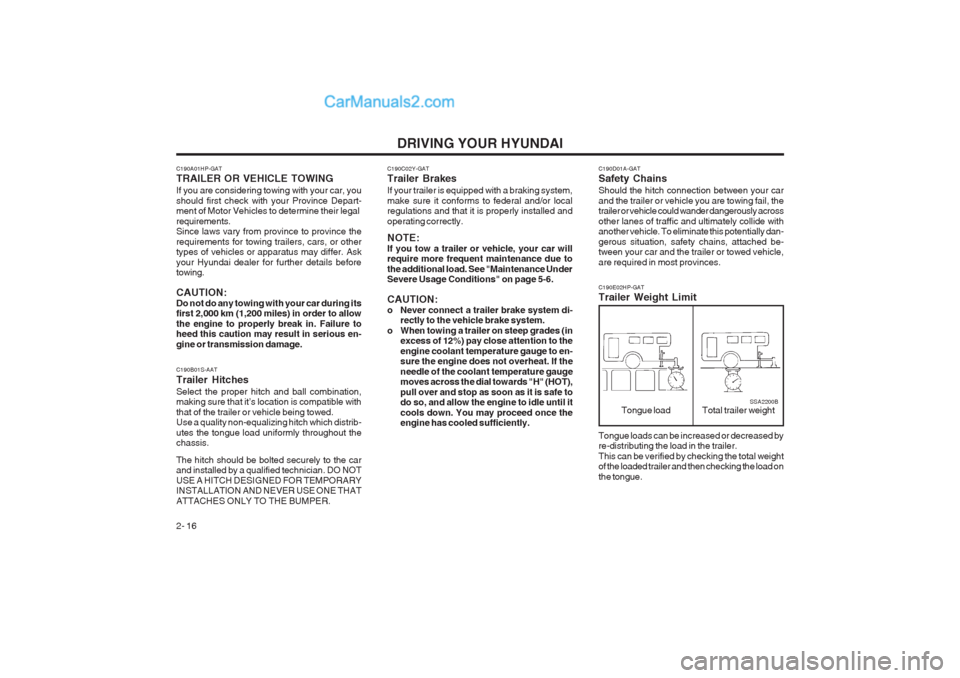
2- 16 C190D01A-GAT Safety Chains Should the hitch connection between your car and the trailer or vehicle you are towing fail, the trailer or vehicle could wander dangerously across other lanes of traffic and ultimately collide with another vehicle. To eliminate this potentially dan- gerous situation, safety chains, attached be- tween your car and the trailer or towed vehicle, are required in most provinces. C190E02HP-GAT Trailer Weight Limit
Tongue load Total trailer weightSSA2200B
Tongue loads can be increased or decreased by re-distributing the load in the trailer. This can be verified by checking the total weight of the loaded trailer and then checking the load on the tongue.
C190A01HP-GAT TRAILER OR VEHICLE TOWING If you are considering towing with your car, you should first check with your Province Depart- ment of Motor Vehicles to determine their legal requirements. Since laws vary from province to province the requirements for towing trailers, cars, or other types of vehicles or apparatus may differ. Ask your Hyundai dealer for further details before towing. CAUTION: Do not do any towing with your car during its first 2,000 km (1,200 miles) in order to allow the engine to properly break in. Failure to heed this caution may result in serious en- gine or transmission damage. C190B01S-AAT Trailer HitchesSelect the proper hitch and ball combination, making sure that it’s location is compatible with that of the trailer or vehicle being towed. Use a quality non-equalizing hitch which distrib- utes the tongue load uniformly throughout the chassis. The hitch should be bolted securely to the car and installed by a qualified technician. DO NOT USE A HITCH DESIGNED FOR TEMPORARY INSTALLATION AND NEVER USE ONE THAT ATTACHES ONLY TO THE BUMPER. C190C02Y-GAT Trailer Brakes If your trailer is equipped with a braking system, make sure it conforms to federal and/or local regulations and that it is properly installed and operating correctly. NOTE: If you tow a trailer or vehicle, your car will require more frequent maintenance due to the additional load. See "Maintenance Under Severe Usage Conditions" on page 5-6. CAUTION:
o Never connect a trailer brake system di-
rectly to the vehicle brake system.
o When towing a trailer on steep grades (in excess of 12%) pay close attention to theengine coolant temperature gauge to en- sure the engine does not overheat. If the needle of the coolant temperature gauge moves across the dial towards "H" (HOT), pull over and stop as soon as it is safe to do so, and allow the engine to idle until it cools down. You may proceed once the engine has cooled sufficiently.
Page 124 of 349
DRIVING YOUR HYUNDAI
2- 18
5. Always secure items in the trailer to prevent
load shift while driving.
6. Check the condition and air pressure of all
tires on the trailer and your car. Low tire pressure can seriously affect the handling.
Also check the spare tire.
7. The vehicle/trailer combination is more af-
fected by crosswind and buffeting. When being passed by a large vehicle, keep a constant speed and steer straight ahead. If there is too much wind buffeting slow down to get out of the other vehicle's air turbulence.
8. When parking your car and trailer, especially
on a hill, be sure to follow all the normal precautions. Turn your front wheel into the curb, set the parking brake firmly, and put the transmission in 1st or Reverse (manual) or Park (automatic). In addition, place wheel
chocks at each of the trailer's tires.
9. If the trailer has electric brakes, start your vehicle and trailer moving, and then apply the trailer brake controller by hand to be sure the brakes are working. This lets you check your
electrical connection at the same time.
10. During your trip, check occasionally to be
sure that the load is secure, and that the lights and any trailer brakes are still working.
11. Avoid jerky starts, sudden acceleration or sudden stops.
12. Avoid sharp turns and rapid lane changes.
13. Avoid holding the brake pedal down too long or too frequently. This could cause the brakes to overheat, resulting in reduced braking effi- ciency.
14. When going down a hill, shift into a lower gear
and use the engine braking effect. When ascending a long grade, downshift the trans- mission to a lower gear and reduce speed to reduce chances of engine overloading and/or overheating.
15. If you have to stop while going uphill, do not
hold the vehicle in place by pressing on the accelerator. This can cause the automatic transmission to overheat. Use the parking brake or footbrake.
NOTE: When towing, check transmission fluid more frequently. CAUTION: If overheating should occur when towing, (temperature gauge reads near red zone), taking the following action may reduce or
eliminate the problem.
1. Turn off the air conditioner.
2. Reduce highway speed.
3. Select a lower gear when going uphill.
4. While in stop and go traffic, place the gear selector in park or neutral and idle theengine at a higher speed.
Page 125 of 349
WHAT TO DO IN AN EMERGENCY 3-1
3. WHAT TO DO IN ANEMERGENCY
D010A01A-AAT IF THE ENGINE WILL NOT START WARNING: If the engine will not start, do not push or pull the car to start it. This could result in a collision or cause other damage. In addition, push or pull starting may cause the catalytic converter to be overloaded and create a fire hazard. D010B01HP-GAT If Engine Doesn’t Turn Over or Turns Over Slowly
1. If your car has an automatic transmission, be sure the gear selector lever is in "N" or "P" and the emergency brake is set. 2. Check the battery connections to be sure
they are clean and tight.
3. Turn on the interior light. If the light dims or
goes out when you operate the starter, the battery is discharged.
4. Check the starter connections to be sure they are securely tightened.
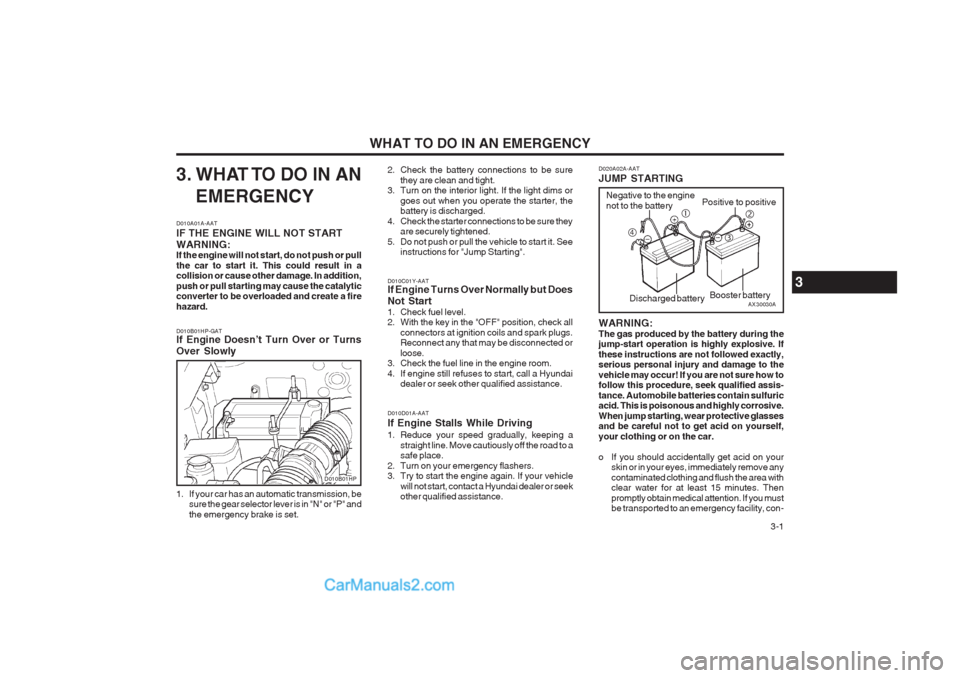
5. Do not push or pull the vehicle to start it. See instructions for "Jump Starting". D020A02A-AAT JUMP STARTING WARNING: The gas produced by the battery during the jump-start operation is highly explosive. If these instructions are not followed exactly, serious personal injury and damage to the vehicle may occur! If you are not sure how to follow this procedure, seek qualified assis- tance. Automobile batteries contain sulfuric acid. This is poisonous and highly corrosive. When jump starting, wear protective glasses and be careful not to get acid on yourself, your clothing or on the car.
o If you should accidentally get acid on your
skin or in your eyes, immediately remove any contaminated clothing and flush the area with clear water for at least 15 minutes. Then promptly obtain medical attention. If you must be transported to an emergency facility, con-
D010C01Y-AAT If Engine Turns Over Normally but Does Not Start
1. Check fuel level.
2. With the key in the "OFF" position, check all
connectors at ignition coils and spark plugs.Reconnect any that may be disconnected or loose.
3. Check the fuel line in the engine room.
4. If engine still refuses to start, call a Hyundai dealer or seek other qualified assistance.
D010D01A-AAT If Engine Stalls While Driving
1. Reduce your speed gradually, keeping a straight line. Move cautiously off the road to a safe place.
2. Turn on your emergency flashers.
3. Try to start the engine again. If your vehicle will not start, contact a Hyundai dealer or seekother qualified assistance.
AX30030A
Negative to the engine not to the battery
Positive to positive
Booster battery
c
e
f d
Discharged battery
D010B01HP
3
Page 127 of 349
WHAT TO DO IN AN EMERGENCY 3-3
7. Proceed with caution, keeping alert for fur-
ther signs of overheating. If overheating hap- pens again, call a Hyundai dealer for assis- tance.
CAUTION: Serious loss of coolant indicates there is a leak in the cooling system and this should be checked as soon as possible by a Hyundai dealer. D040A01HP-GAT SPARE TIREThe following instructions for the FULL SIZE spare tire should be observed: Check inflation pressure as soon as possible after installing the spare tire, and adjust to the specified pressure. The tire pressure should be periodically checked and maintained at the spec- ified pressure while the tire is stored.
Inflation Pressure
Tire Size
Full Size 200 kPa (29 psi)
Spare Tire Pressure
D040B01HP
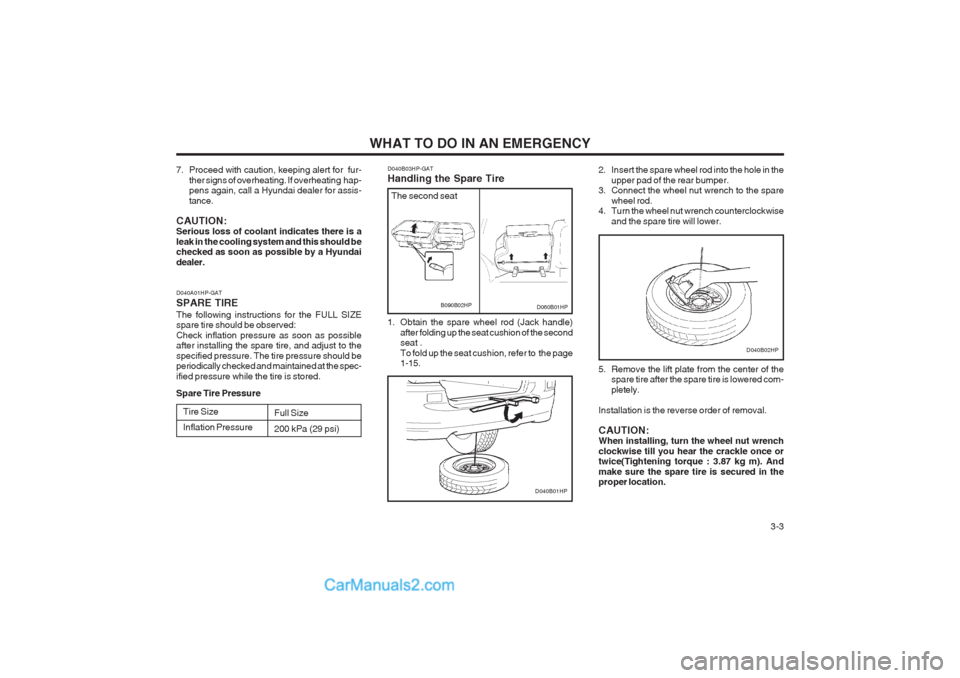
D040B03HP-GAT Handling the Spare Tire
1. Obtain the spare wheel rod (Jack handle)
after folding up the seat cushion of the second seat . To fold up the seat cushion, refer to the page 1-15. 5. Remove the lift plate from the center of the
spare tire after the spare tire is lowered com- pletely.
Installation is the reverse order of removal. CAUTION: When installing, turn the wheel nut wrench clockwise till you hear the crackle once or
twice(Tightening torque : 3.87 kg m). And make sure the spare tire is secured in the proper location.
D060B01HPB090B02HP
The second seat
D040B02HP
2. Insert the spare wheel rod into the hole in the upper pad of the rear bumper.
3. Connect the wheel nut wrench to the spare
wheel rod.
4. Turn the wheel nut wrench counterclockwise
and the spare tire will lower.
Page 133 of 349
WHAT TO DO IN AN EMERGENCY 3-9
D060J01A-AAT AFTER CHANGING WHEELS If you have a tire gauge, remove the valve cap and check the air pressure. If the pressure is lower than recommended, drive slowly to the nearest service station and inflate to the correct pressure. If it is too high, adjust it until it is correct. Always reinstall the valve cap after checking or adjusting tire pressure. If the cap is not replaced, air may leak from the tire. If you lose a valve cap, buy another and install it as soon as possible. After you have changed wheels, always secure the flat tire in its place and return the jack, jack handle, and tools to their proper storage loca- tions.
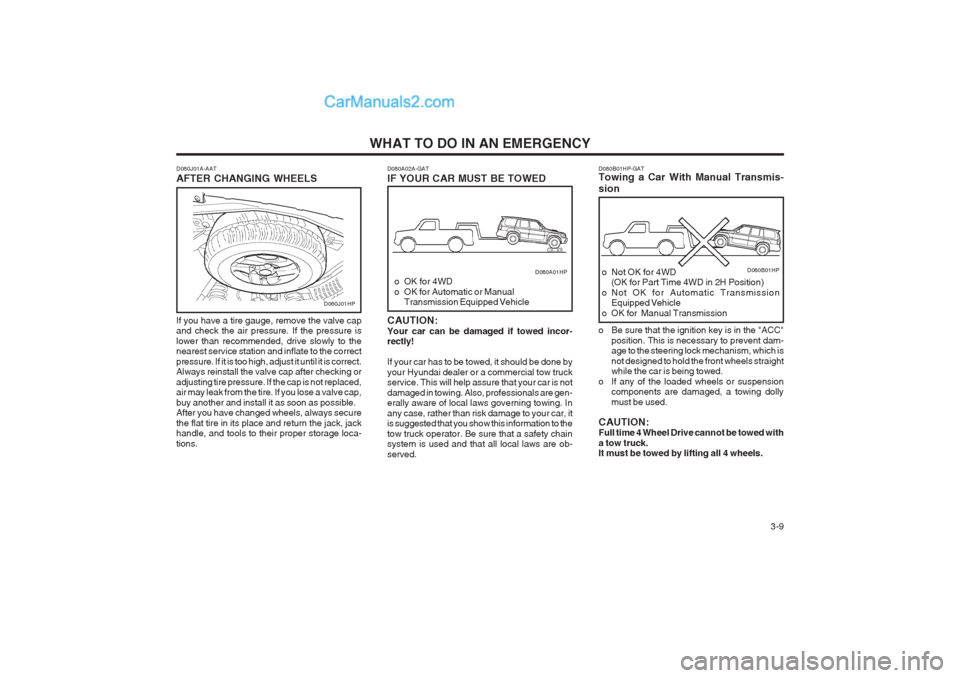
D060J01HPD080A02A-GAT IF YOUR CAR MUST BE TOWED
o OK for 4WD
o OK for Automatic or Manual
Transmission Equipped Vehicle D080A01HP
CAUTION:Your car can be damaged if towed incor- rectly! If your car has to be towed, it should be done by your Hyundai dealer or a commercial tow truck service. This will help assure that your car is not damaged in towing. Also, professionals are gen- erally aware of local laws governing towing. In any case, rather than risk damage to your car, it is suggested that you show this information to the tow truck operator. Be sure that a safety chain system is used and that all local laws are ob- served. D080B01HP-GAT Towing a Car With Manual Transmis- siono Not OK for 4WD
(OK for Part Time 4WD in 2H Position)
o Not OK for Automatic Transmission Equipped Vehicle
o OK for Manual Transmission D080B01HP
o Be sure that the ignition key is in the "ACC" position. This is necessary to prevent dam- age to the steering lock mechanism, which is not designed to hold the front wheels straight while the car is being towed.
o If any of the loaded wheels or suspension components are damaged, a towing dolly must be used.
CAUTION: Full time 4 Wheel Drive cannot be towed with a tow truck. It must be towed by lifting all 4 wheels.