ECU Hyundai Terracan 2003 Owner's Guide
[x] Cancel search | Manufacturer: HYUNDAI, Model Year: 2003, Model line: Terracan, Model: Hyundai Terracan 2003Pages: 349, PDF Size: 4.56 MB
Page 145 of 349
VEHICLE MAINTENANCE REQUIREMENTS 5-7
F060A01A-AAT EXPLANATION OF SCHEDULED MAIN- TENANCE ITEMS F060M01A-AAT o Engine Oil and FilterThe engine oil and filter should be changed at
the intervals specified in the maintenance sched- ule. If the car is being driven in severe condi- tions, more frequent oil and filter changes are required. F060B01A-AAT
o Drive BeltsInspect all drive belts for evidence of cuts, cracks, excessive wear or oil saturation and replace if necessary. Drive belts should be checked periodically for proper tension and adjusted as necessary. F060C01A-AAT
o Fuel Filter A clogged filter can limit the speed at which the vehicle may be driven, damage the emission system and cause hard starting. If an exces- sive amount of foreign matter accumulates in the fuel tank, the filter may require replacement more frequently.After installing a new filter, run the engine for several minutes, and check for leaks at the connections. Fuel filters should be installed by trained technicians.
F060D01A-AAT
o Fuel Lines, Fuel Hoses and Connec-
tions
Check the fuel lines, fuel hoses and connec- tions for leakage and damage. Have a trained technician replace any damaged or leaking parts immediately. F060E01A-AAT
o Timing BeltInspect all parts related to the timing belt for damage and deformation. Replace any dam- aged parts immediately. F060G01A-AAT
o Vapor Hose and Fuel Filler CapThe vapor hose and fuel filler cap should be inspected at those intervals specified in the maintenance schedule. Make sure that a new vapor hose or fuel filler cap is correctly re- placed. F060F01A-AAT
o Vacuum, Crankcase
Ventilation Hoses
Inspect the surface of hoses for evidence ofheat and/or mechanical damage. Hard and brit- tle rubber, cracking, tears, cuts, abrasions, and excessive swelling indicate deterioration. Par- ticular attention should be paid to examine those hose surfaces nearest to high heat sourc- es, such as the exhaust manifold. Inspect the hose routing to assure that thehoses do not come in contact with any heat source, sharp edges or moving component which might cause heat damage or mechanical wear. Inspect all hose connections, such as clamps and couplings, to make sure they are secure, and that no leaks are present. Hoses should be replaced immediately if there is any evidence of deterioration or damage. F060H01A-AAT o Air Cleaner FilterA Genuine Hyundai air cleaner filter is recom- mended when the filter is replaced. F060J01A-AAT o Spark PlugsMake sure to install new spark plugs of the correct heat range. F070C01A-AAT o Engine CoolantThe coolant should be changed at the intervals specified in the maintenance sched- ule. F070D01A-AAT o Manual Transmission OilInspect the manual transmission oil according to the maintenance schedule. NOTE: If the oil level is low, check for possible leaks before adding oil. Do not overfill.
Page 155 of 349
DO-IT-YOURSELF MAINTENANCE 6-9
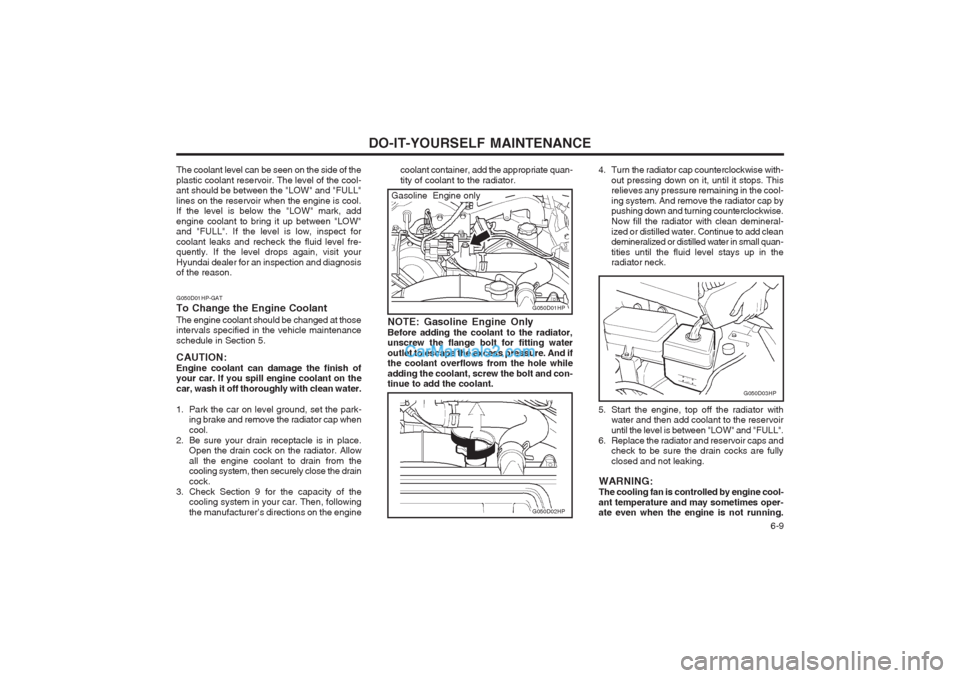
coolant container, add the appropriate quan- tity of coolant to the radiator.
G050D03HP
G050D01HP
G050D02HP
NOTE: Gasoline Engine Only Before adding the coolant to the radiator, unscrew the flange bolt for fitting water outlet to escape the excess pressure. And if the coolant overflows from the hole while adding the coolant, screw the bolt and con- tinue to add the coolant. 4. Turn the radiator cap counterclockwise with-
out pressing down on it, until it stops. Thisrelieves any pressure remaining in the cool- ing system. And remove the radiator cap by pushing down and turning counterclockwise. Now fill the radiator with clean demineral-ized or distilled water. Continue to add clean demineralized or distilled water in small quan- tities until the fluid level stays up in the radiator neck.
5. Start the engine, top off the radiator with water and then add coolant to the reservoir until the level is between "LOW" and "FULL".
6. Replace the radiator and reservoir caps and check to be sure the drain cocks are fullyclosed and not leaking.
WARNING:The cooling fan is controlled by engine cool-
ant temperature and may sometimes oper- ate even when the engine is not running.
Gasoline Engine only
The coolant level can be seen on the side of the plastic coolant reservoir. The level of the cool- ant should be between the "LOW" and "FULL" lines on the reservoir when the engine is cool. If the level is below the "LOW" mark, add engine coolant to bring it up between "LOW" and "FULL". If the level is low, inspect for coolant leaks and recheck the fluid level fre- quently. If the level drops again, visit your Hyundai dealer for an inspection and diagnosis of the reason.
G050D01HP-GAT To Change the Engine CoolantThe engine coolant should be changed at those intervals specified in the vehicle maintenance schedule in Section 5. CAUTION: Engine coolant can damage the finish of your car. If you spill engine coolant on the car, wash it off thoroughly with clean water.
1. Park the car on level ground, set the park-
ing brake and remove the radiator cap when cool.
2. Be sure your drain receptacle is in place. Open the drain cock on the radiator. Allowall the engine coolant to drain from the cooling system, then securely close the drain cock.
3. Check Section 9 for the capacity of the cooling system in your car. Then, followingthe manufacturer’s directions on the engine
Page 158 of 349
DO-IT-YOURSELF MAINTENANCE
6-12
G110D02HP-GAT
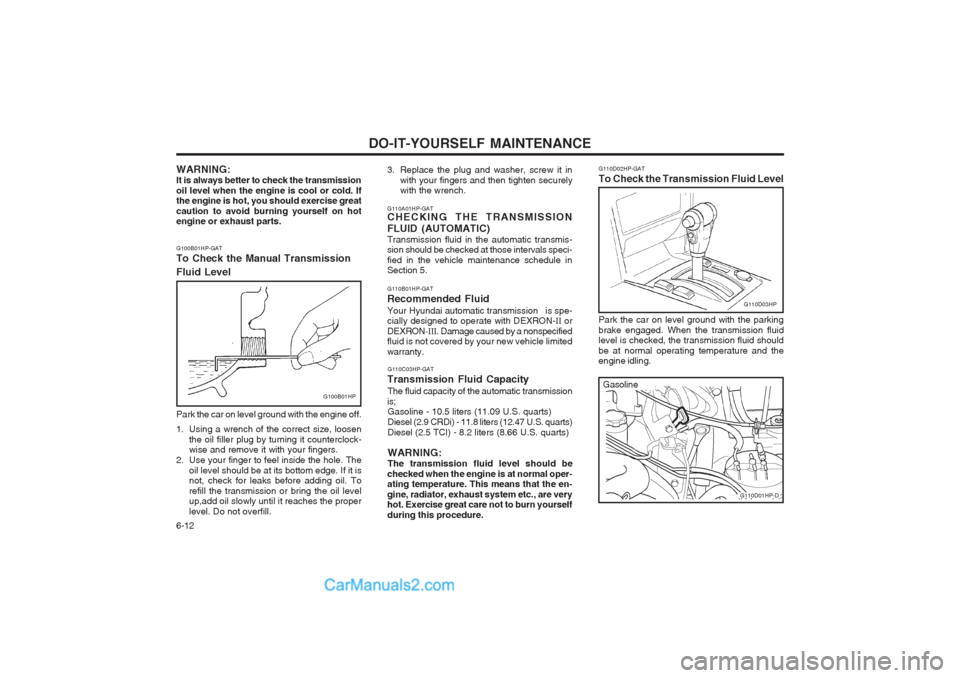
To Check the Transmission Fluid Level
G110D03HP
Park the car on level ground with the parking brake engaged. When the transmission fluid level is checked, the transmission fluid should be at normal operating temperature and the engine idling.
G110C03HP-GAT
Transmission Fluid Capacity The fluid capacity of the automatic transmission
is; Gasoline - 10.5 liters (11.09 U.S. quarts) Diesel (2.9 CRDi) - 11.8 liters (12.47 U.S. quarts)
Diesel (2.5 TCI) - 8.2 liters (8.66 U.S. quarts)
WARNING:The transmission fluid level should be
checked when the engine is at normal oper- ating temperature. This means that the en- gine, radiator, exhaust system etc., are very hot. Exercise great care not to burn yourself during this procedure.
G110A01HP-GAT
CHECKING THE TRANSMISSION FLUID (AUTOMATIC) Transmission fluid in the automatic transmis- sion should be checked at those intervals speci- fied in the vehicle maintenance schedule in Section 5. G110B01HP-GAT Recommended FluidYour Hyundai automatic transmission is spe- cially designed to operate with DEXRON- II or
DEXRON -III. Damage caused by a nonspecified
fluid is not covered by your new vehicle limited warranty.
3. Replace the plug and washer, screw it in
with your fingers and then tighten securely with the wrench.
G110D01HP-D
Gasoline
G100B01HP-GAT To Check the Manual Transmission Fluid LevelG100B01HP
WARNING: It is always better to check the transmissionoil level when the engine is cool or cold. If the engine is hot, you should exercise great caution to avoid burning yourself on hot engine or exhaust parts. Park the car on level ground with the engine off.
1. Using a wrench of the correct size, loosen
the oil filler plug by turning it counterclock- wise and remove it with your fingers.
2. Use your finger to feel inside the hole. The oil level should be at its bottom edge. If it isnot, check for leaks before adding oil. To refill the transmission or bring the oil level up,add oil slowly until it reaches the proper level. Do not overfill.
Page 184 of 349
INDEX 10-3
High-Mounted Rear Stoplight ............................................................
1-61
Hood Release ................................................................................... 1-62
Horn .................................................................................................. 1-63
I
Ignition Switch ..................................................................................... 2-2Immobilizer System .................................................................... 1-3 ~ 1-6
Limp Home Procedures ....................................... 1-3 ~ 1-4, 1-5 ~ 1-6
Key ........................................................................................... 1-3, 1-4
Instrument Cluster and Indicator ............................................ 1-34 ~ 1-37
Instrument Panel Light Control (Rheostat) .......................................1-51
Instruments and Controls ............. ..................................................... 1-33
Intermittent Wiper .............................................................................. 1-49
JJump Starting ...................................................................................... 3-1
K
Key ...................................................................................................... 1-2 If you lose your keys .................................................................... 3-10
Positions .......................................................................................... 2-2
L
Light Bulbs Replacement ............. ..................................................... 6-23
Limited-Slip Differential ..................................................................... 2-12Luggage Compartment
Cargo Security Screen .................................................................. 1-60
Light ............................................................................................... 1-59
Net ................................................................................................. 1-59
MMaintenance Intervals Explanation of scheduled maintenance items ........................ 5-7 ~ 5-8
Maintenance under severe usage conditions ................................. 5-6
Scheduled maintenance ......................................................... 5-2 ~ 5-5
Service requirements ...................................................................... 5-1
Mirrors Day-night inside rearview ................................................... 1-57 ~ 1-58
Outside rear view .......................................................................... 1-55
Multimeter ............................................................................... 1-44 ~ 1-46
Altimeter ........................................................................................ 1-45
Azimuth compass .......................................................................... 1-44
Barometer ...................................................................................... 1-46
Digital Clock .................................................................................. 1-46
Relative altimeter ........................................................................... 1-45
OOdometer .......................................................................................... 1-43
PParking Brake ................................................................................... 1-58
Part-time 4WD Operation ......................................................... 2-9 ~ 2-10
Power Driver's Seat .......................................................................... 1-13
Page 197 of 349
CONTROLS AND EQUIPMENT1- 3
The key number should be recorded and kept in
a safe place in case the need to order further keys arises. New keys are available from anyHyundai dealer by quoting the relevant key num-ber.
In the interest of security, the metal tag attached
to the keys which bears the key number shouldbe removed from the key ring after you receive
your new vehicle. In addition, key numbers can-
not be provided by Hyundai for security reasons.
If you need additional keys or if you should lose
your keys, your authorized Hyundai dealer canmake new keys if you can supply the key num-ber and ID key.
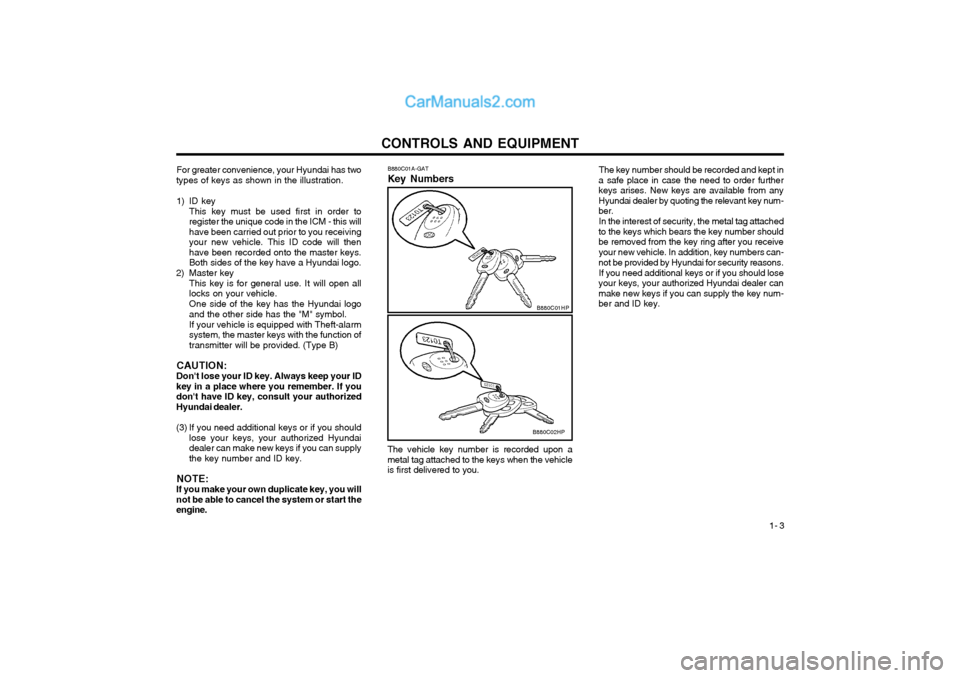
For greater convenience, your Hyundai has two
types of keys as shown in the illustration.
1) ID key This key must be used first in order toregister the unique code in the ICM - this willhave been carried out prior to you receivingyour new vehicle. This ID code will thenhave been recorded onto the master keys.Both sides of the key have a Hyundai logo.
2) Master key This key is for general use. It will open alllocks on your vehicle. One side of the key has the Hyundai logo and the other side has the "M" symbol. If your vehicle is equipped with Theft-alarm system, the master keys with the function oftransmitter will be provided. (Type B)
CAUTION:
Don't lose your ID key. Always keep your IDkey in a place where you remember. If youdon't have ID key, consult your authorizedHyundai dealer.
(3) If you need additional keys or if you should lose your keys, your authorized Hyundai dealer can make new keys if you can supplythe key number and ID key.
NOTE:
If you make your own duplicate key, you willnot be able to cancel the system or start theengine. B880C01A-GAT Key Numbers The vehicle key number is recorded upon a metal tag attached to the keys when the vehicleis first delivered to you.
B880C01HP
B880C02HP
Page 198 of 349
CONTROLS AND EQUIPMENT
1- 4 B885A01HP-EAT IMMOBILISER SYSTEM - For Diesel Engine The immobiliser system is an anti-theft device,
designed to deter automobile theft.
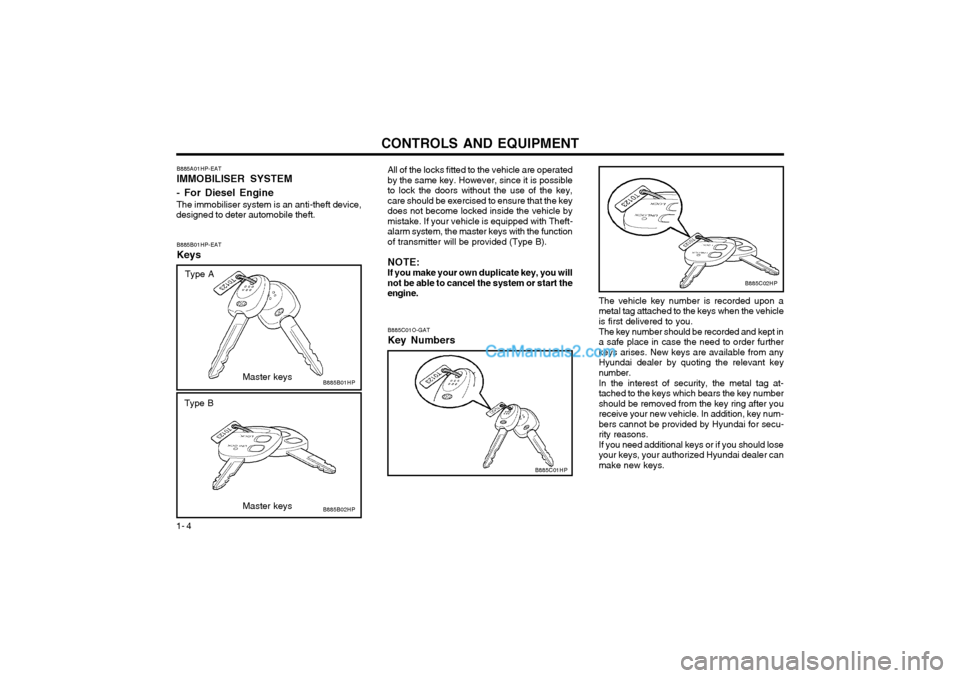
B885B01HP-EATKeys
B885B01HP
All of the locks fitted to the vehicle are operated by the same key. However, since it is possibleto lock the doors without the use of the key,care should be exercised to ensure that the keydoes not become locked inside the vehicle bymistake. If your vehicle is equipped with Theft-alarm system, the master keys with the functionof transmitter will be provided (Type B).
NOTE:If you make your own duplicate key, you willnot be able to cancel the system or start theengine.
Type A
B885B02HP
Type B
B885C01O-GAT Key Numbers
B885C01HP
B885C02HP
The vehicle key number is recorded upon a metal tag attached to the keys when the vehicleis first delivered to you. The key number should be recorded and kept in a safe place in case the need to order furtherkeys arises. New keys are available from anyHyundai dealer by quoting the relevant keynumber. In the interest of security, the metal tag at- tached to the keys which bears the key numbershould be removed from the key ring after youreceive your new vehicle. In addition, key num-bers cannot be provided by Hyundai for secu-rity reasons.If you need additional keys or if you should loseyour keys, your authorized Hyundai dealer canmake new keys.
Master keys Master keys
Page 199 of 349
CONTROLS AND EQUIPMENT1- 5
B030C01Y-EAT ILLUMINATED IGNITION SWITCH (Not all models)
B030C01E
Whenever a door is opened, the ignition switch
will be illuminated for your convenience, provid- ed the ignition switch is not in the "ON" position.The light will go off approximately 10 secondsafter closing the door or when the ignition switchis turned on.
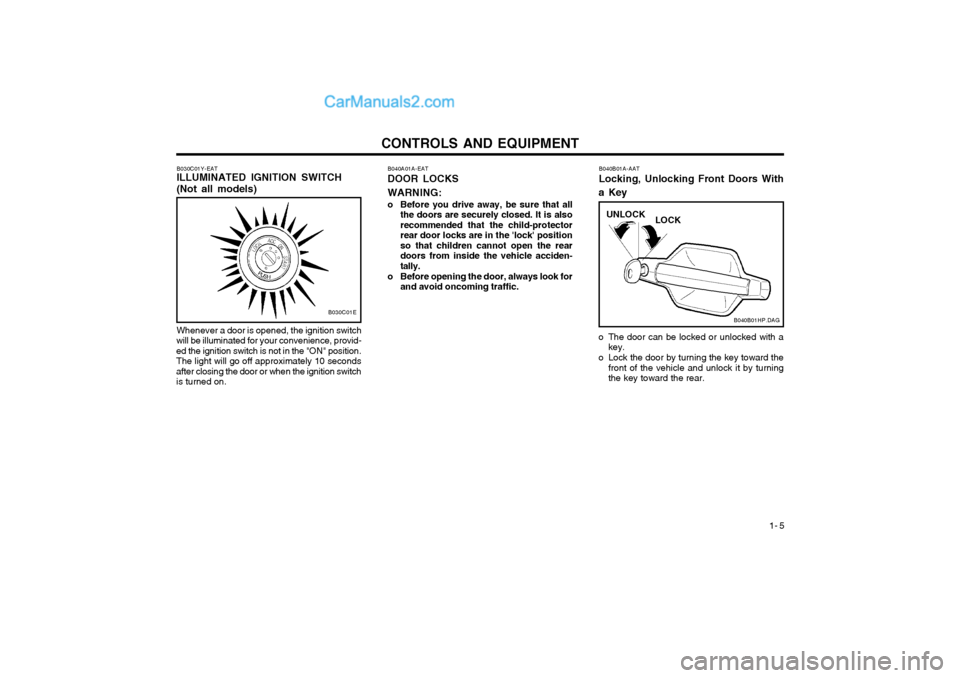
o The door can be locked or unlocked with a key.
o Lock the door by turning the key toward the front of the vehicle and unlock it by turning the key toward the rear.
B040A01A-EAT DOOR LOCKS WARNING:
o Before you drive away, be sure that all
the doors are securely closed. It is also recommended that the child-protectorrear door locks are in the 'lock' positionso that children cannot open the reardoors from inside the vehicle acciden-tally.
o Before opening the door, always look for and avoid oncoming traffic. B040B01A-AAT Locking, Unlocking Front Doors With
a Key
B040B01HP.DAG
UNLOCK
LOCK
Page 204 of 349
CONTROLS AND EQUIPMENT
1- 10
ZB060A8-E Front Seat Fore/Aft Adjustment
B080B01HP-D
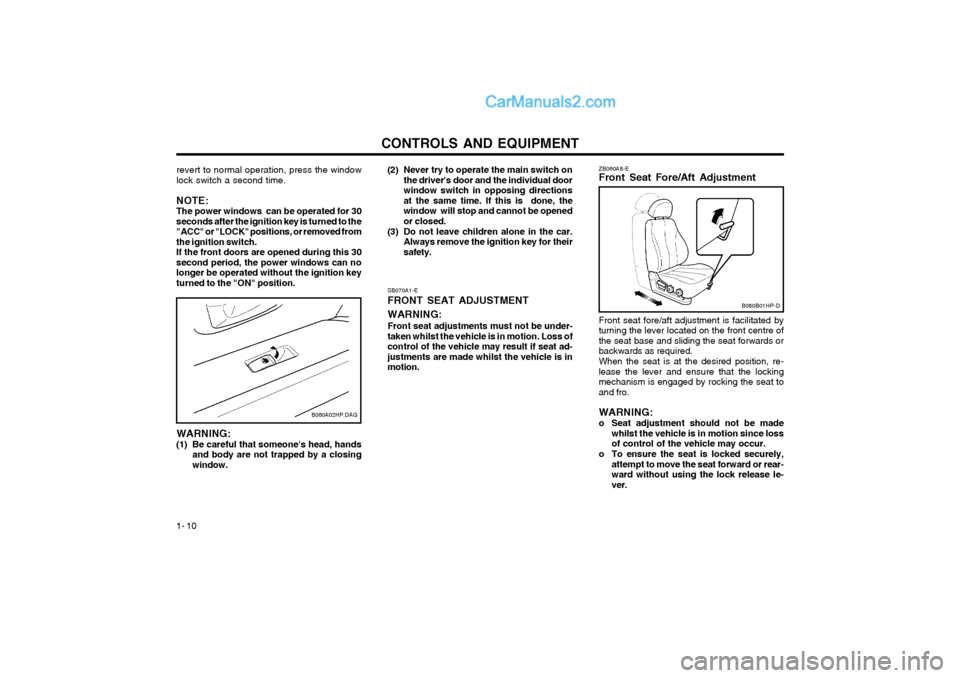
Front seat fore/aft adjustment is facilitated by turning the lever located on the front centre ofthe seat base and sliding the seat forwards orbackwards as required. When the seat is at the desired position, re- lease the lever and ensure that the lockingmechanism is engaged by rocking the seat toand fro. WARNING:
o Seat adjustment should not be made whilst the vehicle is in motion since loss of control of the vehicle may occur.
o To ensure the seat is locked securely, attempt to move the seat forward or rear-ward without using the lock release le-ver.
SB070A1-E FRONT SEAT ADJUSTMENT WARNING:
Front seat adjustments must not be under- taken whilst the vehicle is in motion. Loss ofcontrol of the vehicle may result if seat ad-justments are made whilst the vehicle is inmotion.
B060A02HP.DAG
revert to normal operation, press the window lock switch a second time.
NOTE:The power windows can be operated for 30seconds after the ignition key is turned to the"ACC" or "LOCK" positions, or removed fromthe ignition switch.If the front doors are opened during this 30second period, the power windows can nolonger be operated without the ignition keyturned to the "ON" position. (2) Never try to operate the main switch on
the driver's door and the individual doorwindow switch in opposing directionsat the same time. If this is done, thewindow will stop and cannot be openedor closed.
(3) Do not leave children alone in the car. Always remove the ignition key for theirsafety.
WARNING:
(1) Be careful that someone's head, hands and body are not trapped by a closingwindow.
Page 209 of 349
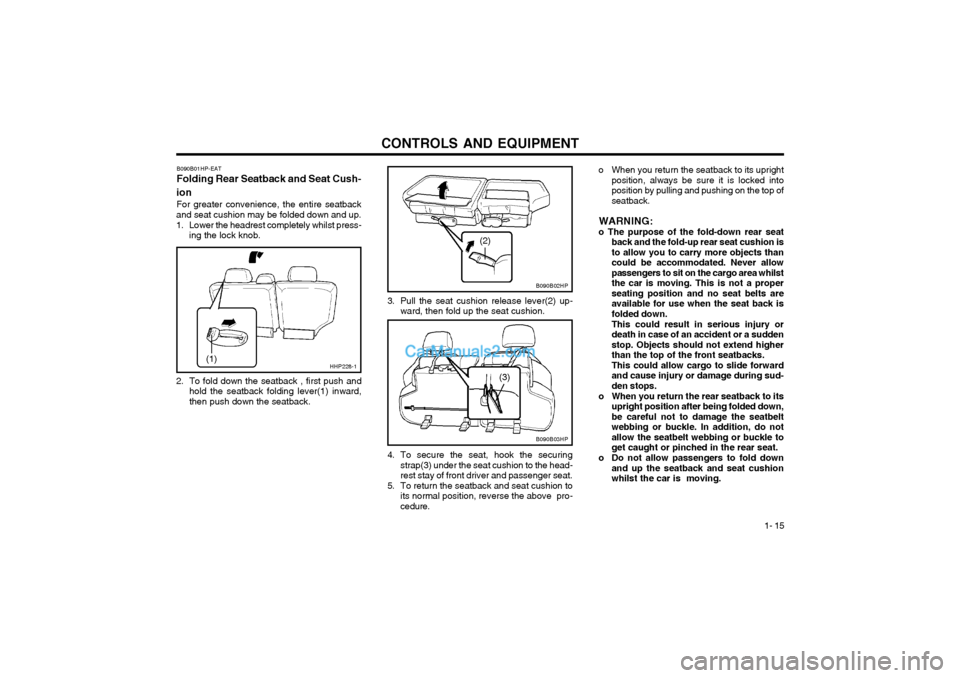
CONTROLS AND EQUIPMENT1- 15
o When you return the seatback to its uprightposition, always be sure it is locked into position by pulling and pushing on the top ofseatback.
WARNING:
o The purpose of the fold-down rear seat back and the fold-up rear seat cushion isto allow you to carry more objects thancould be accommodated. Never allowpassengers to sit on the cargo area whilstthe car is moving. This is not a properseating position and no seat belts areavailable for use when the seat back isfolded down. This could result in serious injury or death in case of an accident or a suddenstop. Objects should not extend higherthan the top of the front seatbacks.This could allow cargo to slide forwardand cause injury or damage during sud-den stops.
o When you return the rear seatback to its upright position after being folded down,be careful not to damage the seatbeltwebbing or buckle. In addition, do notallow the seatbelt webbing or buckle toget caught or pinched in the rear seat.
o Do not allow passengers to fold down and up the seatback and seat cushionwhilst the car is moving.
3. Pull the seat cushion release lever(2) up-ward, then fold up the seat cushion.
B090B02HP
(2)
B090B03HP
(3)
4. To secure the seat, hook the securing strap(3) under the seat cushion to the head- rest stay of front driver and passenger seat.
5. To return the seatback and seat cushion to its normal position, reverse the above pro-cedure.
B090B01HP-EAT Folding Rear Seatback and Seat Cush-
ion For greater convenience, the entire seatback
and seat cushion may be folded down and up.
1. Lower the headrest completely whilst press- ing the lock knob.
2. To fold down the seatback , first push and hold the seatback folding lever(1) inward, then push down the seatback.
HHP228-1(1)
Page 213 of 349
CONTROLS AND EQUIPMENT1- 19
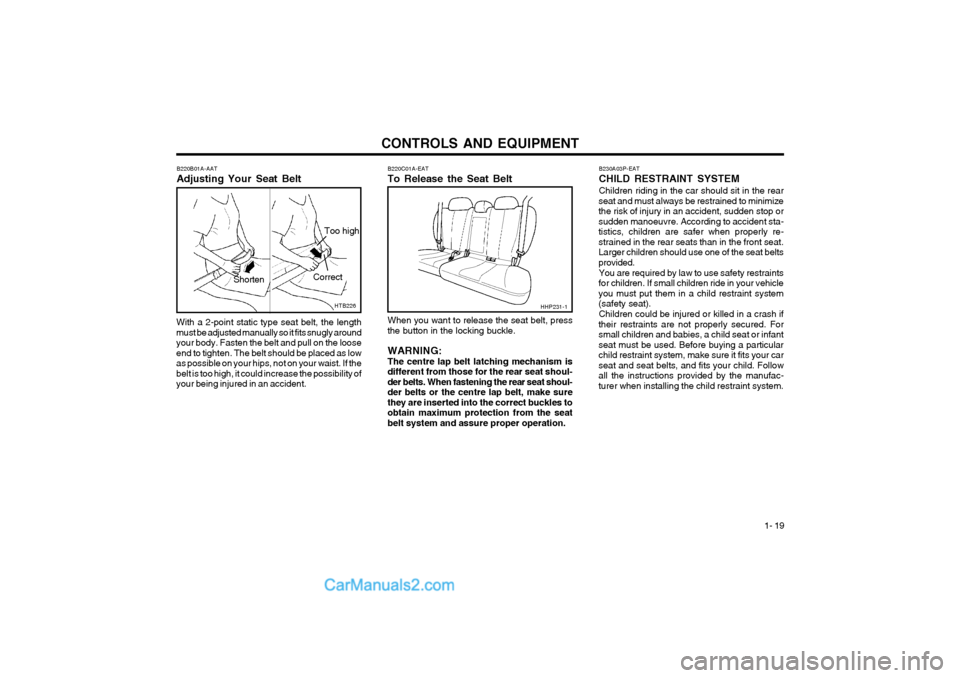
B220C01A-EAT To Release the Seat Belt When you want to release the seat belt, press
the button in the locking buckle.
WARNING: The centre lap belt latching mechanism is
different from those for the rear seat shoul-der belts. When fastening the rear seat shoul-der belts or the centre lap belt, make surethey are inserted into the correct buckles toobtain maximum protection from the seatbelt system and assure proper operation.
HHP231-1
B220B01A-AAT Adjusting Your Seat BeltHTB226
With a 2-point static type seat belt, the length must be adjusted manually so it fits snugly aroundyour body. Fasten the belt and pull on the looseend to tighten. The belt should be placed as lowas possible on your hips, not on your waist. If thebelt is too high, it could increase the possibility ofyour being injured in an accident. Correct
Shorten Too high
B230A03P-EAT CHILD RESTRAINT SYSTEMChildren riding in the car should sit in the rear
seat and must always be restrained to minimize the risk of injury in an accident, sudden stop orsudden manoeuvre. According to accident sta-tistics, children are safer when properly re-strained in the rear seats than in the front seat.Larger children should use one of the seat beltsprovided.
You are required by law to use safety restraints
for children. If small children ride in your vehicleyou must put them in a child restraint system(safety seat).
Children could be injured or killed in a crash if
their restraints are not properly secured. Forsmall children and babies, a child seat or infantseat must be used. Before buying a particularchild restraint system, make sure it fits your carseat and seat belts, and fits your child. Followall the instructions provided by the manufac-turer when installing the child restraint system.