ECU Hyundai Terracan 2003 Owner's Guide
[x] Cancel search | Manufacturer: HYUNDAI, Model Year: 2003, Model line: Terracan, Model: Hyundai Terracan 2003Pages: 349, PDF Size: 4.56 MB
Page 214 of 349
CONTROLS AND EQUIPMENT
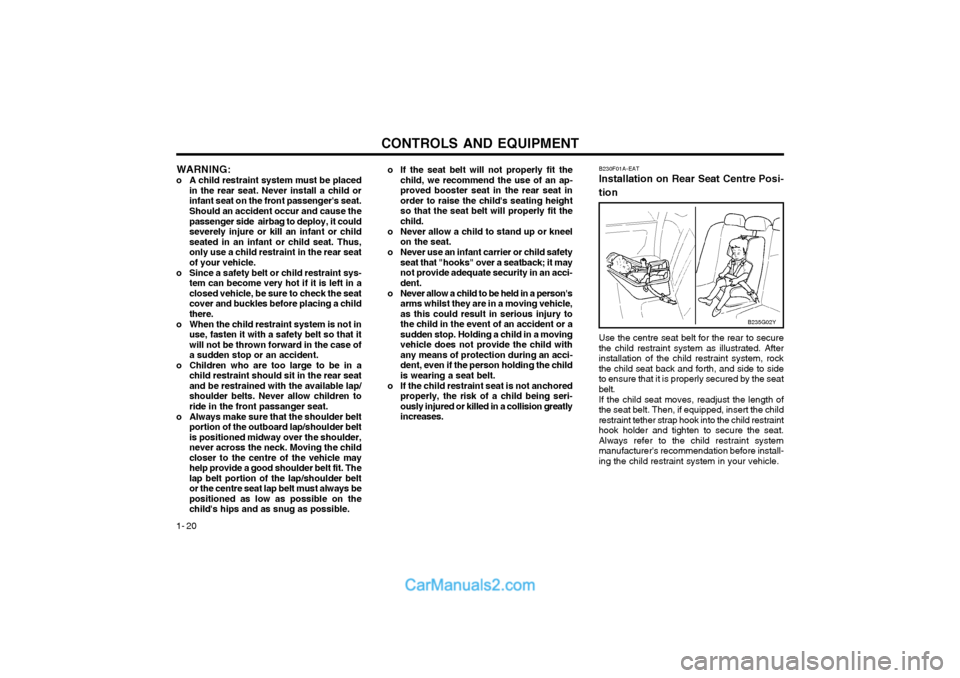
1- 20 B230F01A-EAT Installation on Rear Seat Centre Posi- tion Use the centre seat belt for the rear to secure the child restraint system as illustrated. Afterinstallation of the child restraint system, rockthe child seat back and forth, and side to sideto ensure that it is properly secured by the seatbelt. If the child seat moves, readjust the length of the seat belt. Then, if equipped, insert the childrestraint tether strap hook into the child restrainthook holder and tighten to secure the seat.Always refer to the child restraint systemmanufacturer's recommendation before install-ing the child restraint system in your vehicle.
o If the seat belt will not properly fit the
child, we recommend the use of an ap-proved booster seat in the rear seat inorder to raise the child's seating heightso that the seat belt will properly fit thechild.
o Never allow a child to stand up or kneel on the seat.
o Never use an infant carrier or child safety seat that "hooks" over a seatback; it maynot provide adequate security in an acci-dent.
o Never allow a child to be held in a person's arms whilst they are in a moving vehicle,as this could result in serious injury tothe child in the event of an accident or asudden stop. Holding a child in a movingvehicle does not provide the child withany means of protection during an acci-dent, even if the person holding the childis wearing a seat belt.
o If the child restraint seat is not anchored properly, the risk of a child being seri-ously injured or killed in a collision greatlyincreases.
WARNING:
o A child restraint system must be placed in the rear seat. Never install a child orinfant seat on the front passenger's seat. Should an accident occur and cause the passenger side airbag to deploy, it couldseverely injure or kill an infant or childseated in an infant or child seat. Thus,only use a child restraint in the rear seatof your vehicle.
o Since a safety belt or child restraint sys- tem can become very hot if it is left in aclosed vehicle, be sure to check the seatcover and buckles before placing a childthere.
o When the child restraint system is not in use, fasten it with a safety belt so that itwill not be thrown forward in the case ofa sudden stop or an accident.
o Children who are too large to be in a child restraint should sit in the rear seatand be restrained with the available lap/shoulder belts. Never allow children toride in the front passanger seat.
o Always make sure that the shoulder belt portion of the outboard lap/shoulder beltis positioned midway over the shoulder,never across the neck. Moving the childcloser to the centre of the vehicle mayhelp provide a good shoulder belt fit. Thelap belt portion of the lap/shoulder beltor the centre seat lap belt must always bepositioned as low as possible on thechild's hips and as snug as possible.
B235G02Y
Page 215 of 349
CONTROLS AND EQUIPMENT1- 21
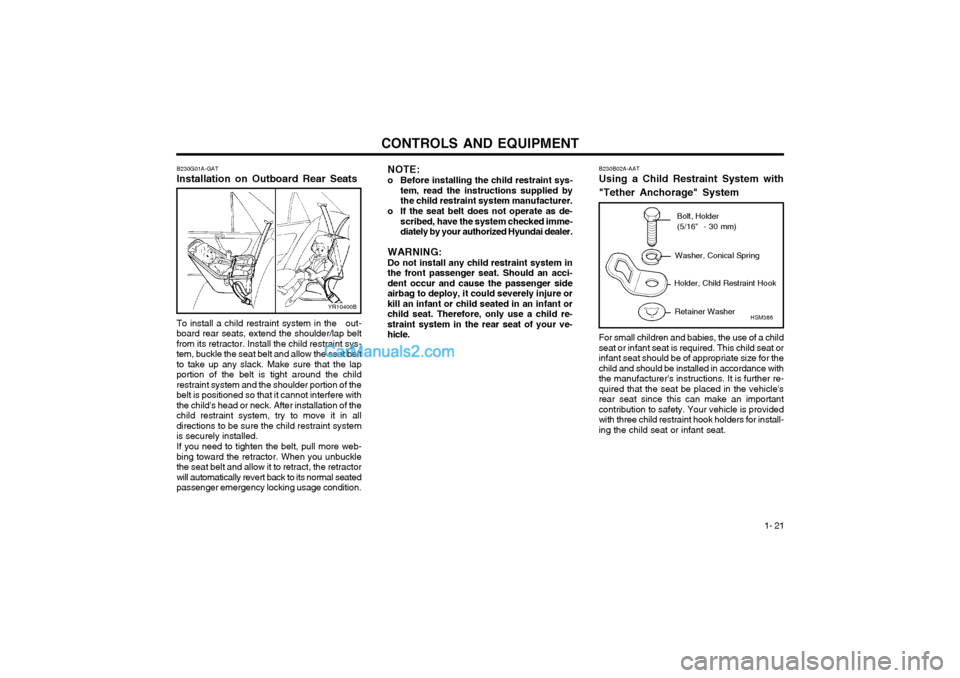
B230G01A-GAT Installation on Outboard Rear Seats To install a child restraint system in the out- board rear seats, extend the shoulder/lap beltfrom its retractor. Install the child restraint sys-tem, buckle the seat belt and allow the seat beltto take up any slack. Make sure that the lapportion of the belt is tight around the childrestraint system and the shoulder portion of thebelt is positioned so that it cannot interfere withthe child's head or neck. After installation of thechild restraint system, try to move it in alldirections to be sure the child restraint systemis securely installed. If you need to tighten the belt, pull more web- bing toward the retractor. When you unbucklethe seat belt and allow it to retract, the retractorwill automatically revert back to its normal seatedpassenger emergency locking usage condition.
NOTE:
o Before installing the child restraint sys- tem, read the instructions supplied bythe child restraint system manufacturer.
o If the seat belt does not operate as de- scribed, have the system checked imme-diately by your authorized Hyundai dealer.
WARNING:Do not install any child restraint system in
the front passenger seat. Should an acci-dent occur and cause the passenger sideairbag to deploy, it could severely injure orkill an infant or child seated in an infant orchild seat. Therefore, only use a child re-straint system in the rear seat of your ve-hicle.
YR10400B B230B02A-AAT Using a Child Restraint System with
"Tether Anchorage" System For small children and babies, the use of a child seat or infant seat is required. This child seat orinfant seat should be of appropriate size for thechild and should be installed in accordance withthe manufacturer's instructions. It is further re-quired that the seat be placed in the vehicle'srear seat since this can make an importantcontribution to safety. Your vehicle is providedwith three child restraint hook holders for install-ing the child seat or infant seat. Bolt, Holder (5/16" - 30 mm)
Washer, Conical Spring
Holder, Child Restraint Hook
Retainer WasherHSM386
Page 216 of 349
CONTROLS AND EQUIPMENT
1- 22
B230C01HP Child RestraintHook holders
Front of Vehicle
Tether strap hook
Child Restraint Hook Holder
Hole
B230B01HP-1
Tether anchor cover
B230C02HP-EAT Securing a Child Restraint System
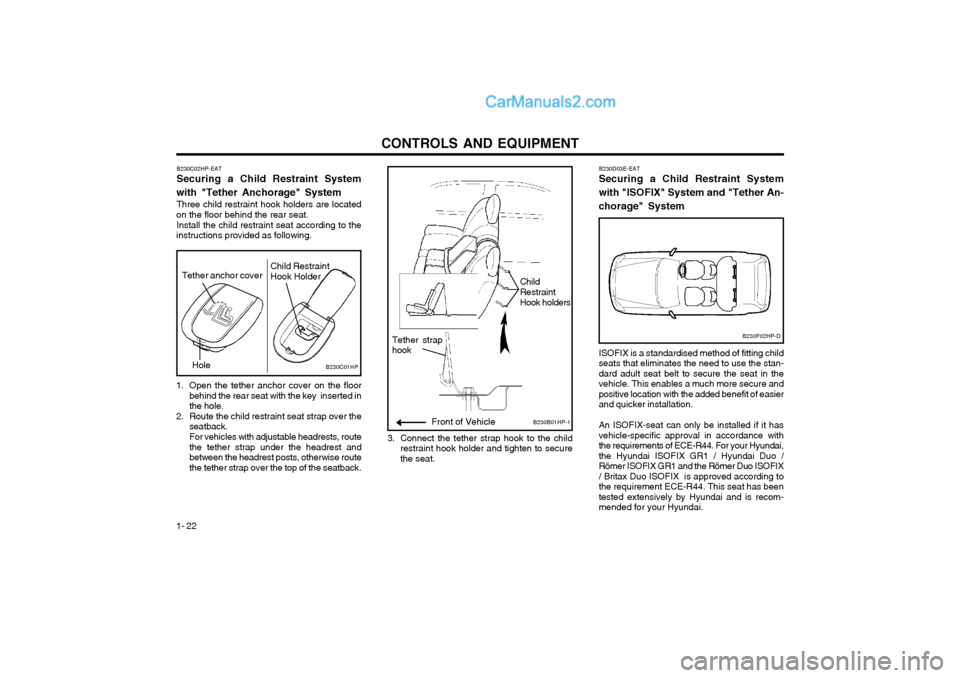
with "Tether Anchorage" System Three child restraint hook holders are located
on the floor behind the rear seat.
Install the child restraint seat according to the
instructions provided as following.
1. Open the tether anchor cover on the floor behind the rear seat with the key inserted in the hole.
2. Route the child restraint seat strap over the seatback. For vehicles with adjustable headrests, route the tether strap under the headrest andbetween the headrest posts, otherwise routethe tether strap over the top of the seatback. 3. Connect the tether strap hook to the child
restraint hook holder and tighten to securethe seat.
B230F02HP-D
B230D03E-EAT Securing a Child Restraint System with "ISOFIX" System and "Tether An-chorage" System ISOFIX is a standardised method of fitting child seats that eliminates the need to use the stan-dard adult seat belt to secure the seat in thevehicle. This enables a much more secure andpositive location with the added benefit of easierand quicker installation. An ISOFIX-seat can only be installed if it has vehicle-specific approval in accordance withthe requirements of ECE-R44. For your Hyundai,the Hyundai ISOFIX GR1 / Hyundai Duo /Römer ISOFIX GR1 and the Römer Duo ISOFIX/ Britax Duo ISOFIX is approved according tothe requirement ECE-R44. This seat has beentested extensively by Hyundai and is recom-mended for your Hyundai.
Page 217 of 349
CONTROLS AND EQUIPMENT1- 23
NOTE:
At present, this seat is the only one comply-
ing with that provision. In case that other manufacturers will furnish proof of a re-spective certification, Hyundai is going toevaluate this seat carefully and will give arecommendation provided that seat com-plies to the law. Please ask your Hyundaidealer in this respect.
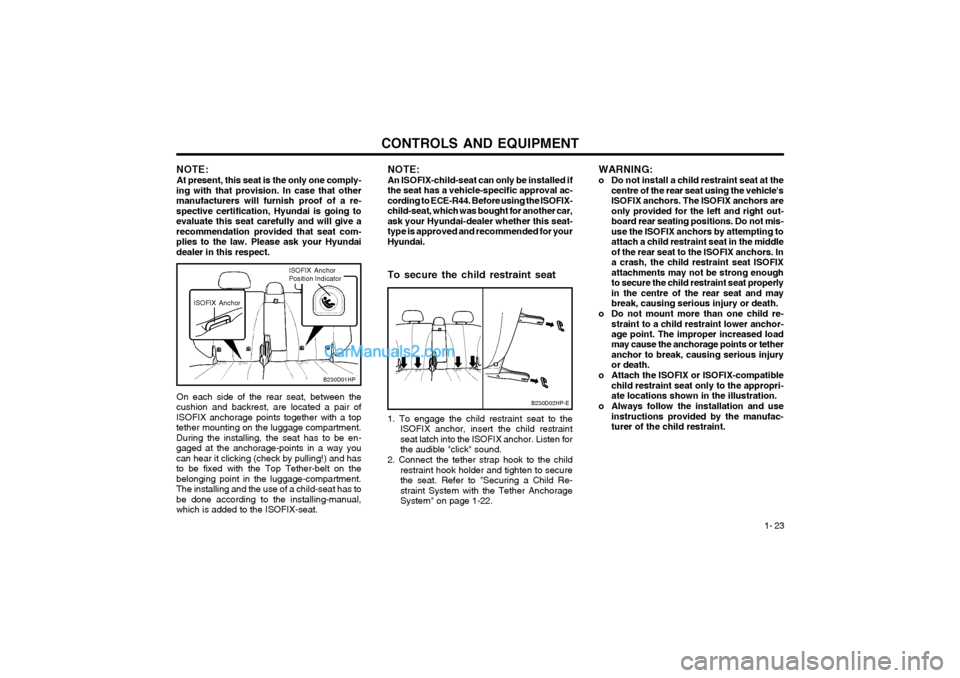
On each side of the rear seat, between the
cushion and backrest, are located a pair ofISOFIX anchorage points together with a toptether mounting on the luggage compartment.During the installing, the seat has to be en-gaged at the anchorage-points in a way youcan hear it clicking (check by pulling!) and hasto be fixed with the Top Tether-belt on thebelonging point in the luggage-compartment.The installing and the use of a child-seat has tobe done according to the installing-manual,which is added to the ISOFIX-seat.
B230D02HP-E
NOTE: An ISOFIX-child-seat can only be installed ifthe seat has a vehicle-specific approval ac-cording to ECE-R44. Before using the ISOFIX-child-seat, which was bought for another car,ask your Hyundai-dealer whether this seat-type is approved and recommended for yourHyundai. To secure the child restraint seat 1. To engage the child restraint seat to the ISOFIX anchor, insert the child restraint seat latch into the ISOFIX anchor. Listen forthe audible "click" sound.
2. Connect the tether strap hook to the child restraint hook holder and tighten to securethe seat. Refer to "Securing a Child Re-straint System with the Tether AnchorageSystem" on page 1-22. WARNING:
o Do not install a child restraint seat at the
centre of the rear seat using the vehicle's ISOFIX anchors. The ISOFIX anchors areonly provided for the left and right out-board rear seating positions. Do not mis-use the ISOFIX anchors by attempting toattach a child restraint seat in the middleof the rear seat to the ISOFIX anchors. Ina crash, the child restraint seat ISOFIXattachments may not be strong enoughto secure the child restraint seat properlyin the centre of the rear seat and maybreak, causing serious injury or death.
o Do not mount more than one child re- straint to a child restraint lower anchor-age point. The improper increased load may cause the anchorage points or tether anchor to break, causing serious injuryor death.
o Attach the ISOFIX or ISOFIX-compatible child restraint seat only to the appropri-ate locations shown in the illustration.
o Always follow the installation and use instructions provided by the manufac-turer of the child restraint.
B230D01HP
ISOFIX Anchor ISOFIX Anchor Position Indicator
Page 248 of 349
CONTROLS AND EQUIPMENT
1- 54
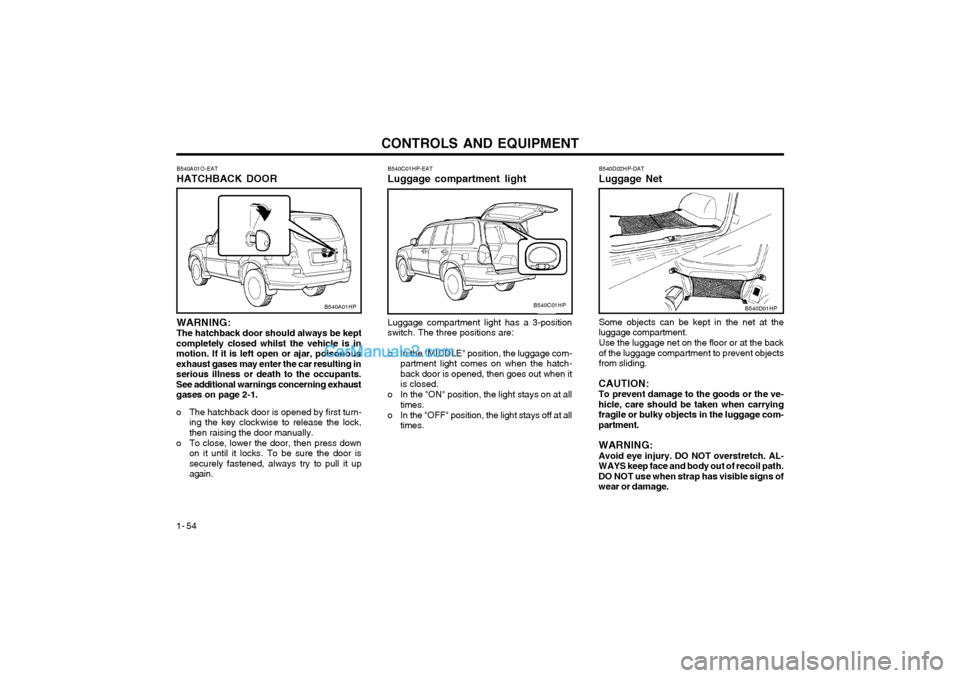
B540A01O-EAT HATCHBACK DOOR
B540A01HP
WARNING: The hatchback door should always be kept
completely closed whilst the vehicle is inmotion. If it is left open or ajar, poisonousexhaust gases may enter the car resulting inserious illness or death to the occupants.See additional warnings concerning exhaustgases on page 2-1.
o The hatchback door is opened by first turn- ing the key clockwise to release the lock, then raising the door manually.
o To close, lower the door, then press down on it until it locks. To be sure the door issecurely fastened, always try to pull it upagain.
B540C01HP-EAT Luggage compartment light Luggage compartment light has a 3-position switch. The three positions are:
o In the "MIDDLE" position, the luggage com- partment light comes on when the hatch-back door is opened, then goes out when itis closed.
o In the "ON" position, the light stays on at all times.
o In the "OFF" position, the light stays off at all times.
B540C01HPB540D01HP
B540D02HP-DAT Luggage Net Some objects can be kept in the net at the luggage compartment. Use the luggage net on the floor or at the back of the luggage compartment to prevent objectsfrom sliding.
CAUTION:To prevent damage to the goods or the ve-hicle, care should be taken when carryingfragile or bulky objects in the luggage com-partment. WARNING: Avoid eye injury. DO NOT overstretch. AL-WAYS keep face and body out of recoil path.DO NOT use when strap has visible signs ofwear or damage.
Page 249 of 349
CONTROLS AND EQUIPMENT1- 55
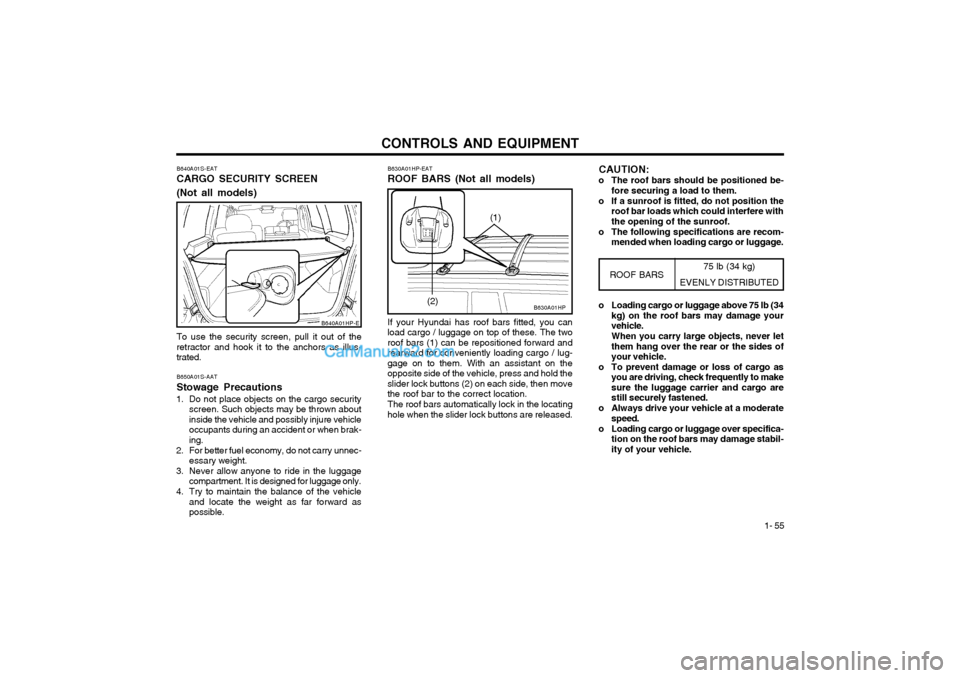
B640A01S-EAT CARGO SECURITY SCREEN (Not all models) To use the security screen, pull it out of the retractor and hook it to the anchors as illus-trated. B650A01S-AAT Stowage Precautions
1. Do not place objects on the cargo security screen. Such objects may be thrown about inside the vehicle and possibly injure vehicleoccupants during an accident or when brak-ing.
2. For better fuel economy, do not carry unnec- essary weight.
3. Never allow anyone to ride in the luggage compartment. It is designed for luggage only.
4. Try to maintain the balance of the vehicle and locate the weight as far forward aspossible.
B640A01HP-E
75 lb (34 kg)
EVENLY DISTRIBUTED
B630A01HP
B630A01HP-EAT ROOF BARS (Not all models) If your Hyundai has roof bars fitted, you can
load cargo / luggage on top of these. The two roof bars (1) can be repositioned forward andrearward for conveniently loading cargo / lug-gage on to them. With an assistant on theopposite side of the vehicle, press and hold theslider lock buttons (2) on each side, then movethe roof bar to the correct location.
The roof bars automatically lock in the locating
hole when the slider lock buttons are released.
ROOF BARS
(2) o Loading cargo or luggage above 75 lb (34
kg) on the roof bars may damage your vehicle. When you carry large objects, never let them hang over the rear or the sides ofyour vehicle.
o To prevent damage or loss of cargo as you are driving, check frequently to makesure the luggage carrier and cargo arestill securely fastened.
o Always drive your vehicle at a moderate speed.
o Loading cargo or luggage over specifica- tion on the roof bars may damage stabil-ity of your vehicle.
(1)
CAUTION:
o The roof bars should be positioned be- fore securing a load to them.
o If a sunroof is fitted, do not position the roof bar loads which could interfere with the opening of the sunroof.
o The following specifications are recom- mended when loading cargo or luggage.
Page 288 of 349
DRIVING YOUR HYUNDAI 2- 17
YC200D2-E
Safety Cables
Should the towbar connection between your car
and the trailer or vehicle you are towing fail, the trailer or vehicle could wander dangerouslyacross other lanes of traffic and ultimately leavethe roadway. To eliminate this potentially dan-gerous situation, safety cables, attached be-tween your car and the trailer or towed vehicle,are required.
Nose weight Total trailer weightSSA2200B
C190E02HP-EAT
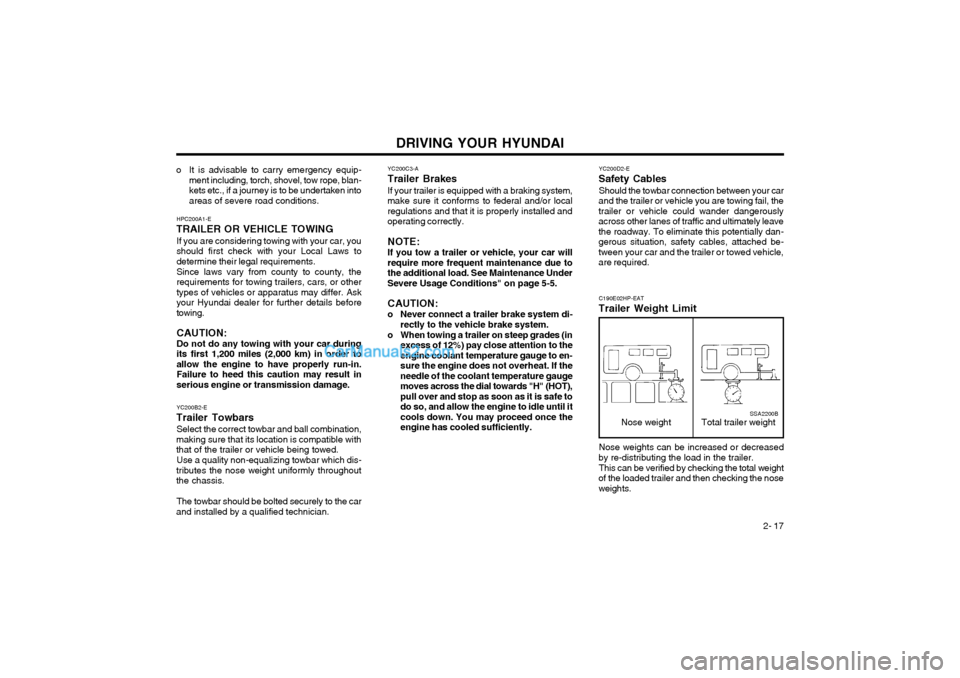
Trailer Weight Limit
Nose weights can be increased or decreased
by re-distributing the load in the trailer.
This can be verified by checking the total weight
of the loaded trailer and then checking the nose weights.
YC200C3-A
Trailer Brakes
If your trailer is equipped with a braking system,
make sure it conforms to federal and/or localregulations and that it is properly installed andoperating correctly.
NOTE: If you tow a trailer or vehicle, your car will
require more frequent maintenance due to the additional load. See Maintenance UnderSevere Usage Conditions" on page 5-5.
CAUTION:
o Never connect a trailer brake system di- rectly to the vehicle brake system.
o When towing a trailer on steep grades (in excess of 12%) pay close attention to theengine coolant temperature gauge to en-sure the engine does not overheat. If theneedle of the coolant temperature gaugemoves across the dial towards "H" (HOT),pull over and stop as soon as it is safe todo so, and allow the engine to idle until itcools down. You may proceed once theengine has cooled sufficiently.
HPC200A1-E
TRAILER OR VEHICLE TOWING
If you are considering towing with your car, youshould first check with your Local Laws todetermine their legal requirements. Since laws vary from county to county, the requirements for towing trailers, cars, or othertypes of vehicles or apparatus may differ. Askyour Hyundai dealer for further details beforetowing. CAUTION: Do not do any towing with your car duringits first 1,200 miles (2,000 km) in order toallow the engine to have properly run-in.Failure to heed this caution may result inserious engine or transmission damage. YC200B2-E
Trailer Towbars Select the correct towbar and ball combination,
making sure that its location is compatible with that of the trailer or vehicle being towed.
Use a quality non-equalizing towbar which dis-
tributes the nose weight uniformly throughoutthe chassis.
The towbar should be bolted securely to the car
and installed by a qualified technician.
o It is advisable to carry emergency equip-
ment including, torch, shovel, tow rope, blan-kets etc., if a journey is to be undertaken intoareas of severe road conditions.
Page 290 of 349
DRIVING YOUR HYUNDAI 2- 19
CAUTION: If overheating should occur when towing,
(temperature gauge reads near red zone), taking the following action may reduce oreliminate the problem.
1. Turn off the air conditioner.
2. Reduce highway speed.
3. Select a lower gear when going uphill.
4. Whilst in stop and go traffic, place the gear selector in park or neutral and idle the engine at a higher speed.
HPC200E1-E
Trailer or Vehicle Towing Tips
1. Before towing, check towbar and safety cable connections as well as proper operation of the trailer running lights, brake lights, andturn signals.
2. Always drive your vehicle at a moderate speed (Less than 60 mph)
3. Trailer towing requires more fuel than nor- mal conditions.
4. To maintain engine braking efficiency and electrical charging performance, do not usefifth gear (manual transmission).
5. Always secure items in the trailer to prevent load shift whilst driving.
6. Check the condition and air pressure of all tyres on the trailer and your car. Low tyrepressure can seriously affect the handling.Also check the spare tyre.
7. The vehicle/trailer combination is more af- fected by crosswind and buffeting. When being passed by a large vehicle, keep a constant speed and steer straight ahead.If there is too much wind buffeting slowdown to get out of the other vehicle's airturbulence.
8. When parking your car and trailer, especial- ly on a hill, be sure to follow all the normalprecautions. Turn your front wheel into thecurb, set the parking brake firmly, and putthe transmission in 1st or Reverse (manual)or Park (automatic). In addition, place wheelchocks at each of the trailer's tyres. 9. If the trailer has electric brakes, start your
vehicle and trailer moving, and then applythe trailer brake controller by hand to besure the brakes are working. This lets youcheck your electrical connection at the sametime.
10. During your trip, check occasionally to be sure that the load is secure, and that thelights and any trailer brakes are still working.
11. Avoid jerky starts, sudden acceleration or sudden stops.
12. Avoid sharp turns and rapid lane changes.
13. Avoid holding the brake pedal down too long or too frequently. This could cause the brakes to overheat, resulting in reduced brakingefficiency.
14. When going down a hill, shift into a lower gear and use the engine braking effect. When ascending a long grade, downshift the transmission to a lower gear and reducespeed to reduce chances of engine over-loading and/or overheating.
15. If you have to stop whilst going uphill, do not hold the vehicle in place by pressing on theaccelerator. This can cause the automatictransmission to overheat. Use the parkingbrake or footbrake.
NOTE: When towing, check transmission fluid more
frequently.
Page 293 of 349
IN CASE OF EMERGENCY 3-3
WARNING: Whilst the engine is running, keep hands
and clothing away from moving parts such as the fan and drive belts to prevent injury.
WARNING (Diesel only): Never work on injection system with engine
running or within 30 seconds after shutting off engine. High pressure pump, rail, injec-tors and high pressure pipes are subject tohigh pressure even after the engine stopped.The fuel jet produced by fuel leaks maycause serious injury, if it touch the body.People using pacemakers should not movethan 30cm closer to the ECU or wiring har-ness within the engine room while engine isrunning, since the high currents in the Com-mon Rail system produce considerable mag-netic fields.
5. If the water pump drive belt is broken or coolant is leaking out, stop the engine imme- diately and call the nearest Hyundai dealerfor assistance.
WARNING: Do not remove the radiator cap when the
engine is hot since steam and boiling water may be ejected from the radiator resulting inburns or scalding. YD050A1-E
SPARE TYRE For Full Size
The following instructions for the FULL SIZE
spare tyre should be observed:
Check inflation pressure as soon as possible
after installing the spare tyre, and adjust to the specified pressure. The tyre pressure shouldbe periodically checked and maintained at thespecified pressure whilst the tyre is stored.
Spare Tyre Pressure
Inflation Pressure
Tyre Size
FULL SIZE 29 psi (200 kPa)
6. If the cause of the overheating cannot be
found, wait until the engine temperature has returned to normal. Then, if coolant hasbeen lost, carefully remove the radiator capand add water to bring the fluid level in thereservoir up to the base of the radiator fillopening. Fill the coolant expansion tank tothe halfway mark.
7. Proceed with caution until it is established that the engine is operating normally. If theengine overheats repeatedly, the advice of aHyundai dealer should be sought.
CAUTION: Serious loss of coolant indicates there is a
leak in the cooling system and this should be checked as soon as possible by a Hyundaidealer.
D040B01HP
D040B03HP-EAT
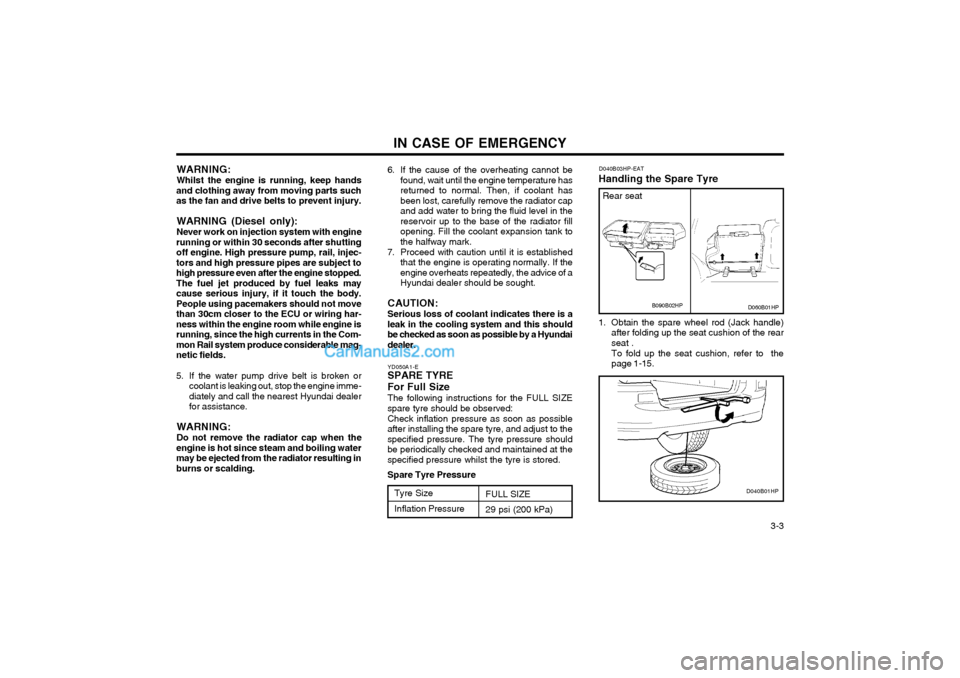
Handling the Spare Tyre
1. Obtain the spare wheel rod (Jack handle) after folding up the seat cushion of the rear seat . To fold up the seat cushion, refer to the page 1-15.
D060B01HPB090B02HP
Rear seat
Page 294 of 349
IN CASE OF EMERGENCY
3-4 SD060A1-E
IN THE EVENT OF A PUNCTURE
If a puncture occurs whilst driving the vehicle:
1. Bring the car to rest as soon as it is safe to do so and with the minimum amount of braking required which will assist in main-taining the maximum amount of control. Thevehicle should be parked wherever possibleupon firm level ground to facilitate wheelchanging.
2. If the vehicle is creating a hazard and the road conditions do not permit the wheel tobe changed safely, assistance should besought.
3. Passengers must not be allowed to remain inside the vehicle during wheel changing. Ifa puncture occurs whilst the vehicle is on amotorway, the passengers should take ref-uge on the motorway embankment to avoidthe possibility of injury occurring should thevehicle be struck by other motorway traffic.
4. Wheel changing should be performed ac- cording to the following instructions. HPD070A1-E
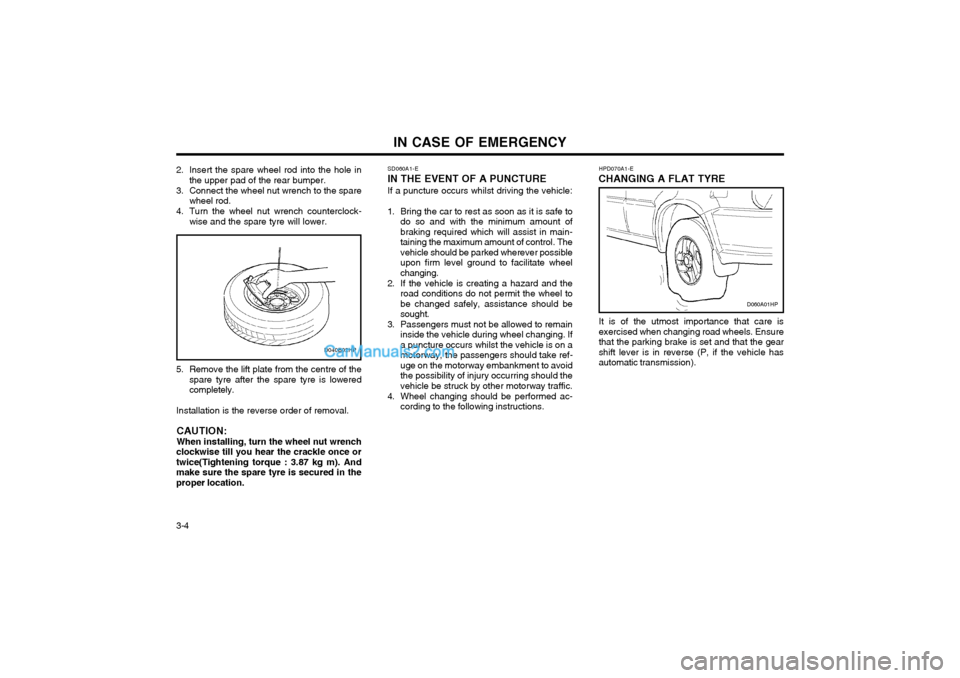
CHANGING A FLAT TYRE
It is of the utmost importance that care isexercised when changing road wheels. Ensurethat the parking brake is set and that the gearshift lever is in reverse (P, if the vehicle hasautomatic transmission).
D060A01HP
5. Remove the lift plate from the centre of the spare tyre after the spare tyre is lowered completely.
Installation is the reverse order of removal.
CAUTION: When installing, turn the wheel nut wrench
clockwise till you hear the crackle once or
twice(Tightening torque : 3.87 kg m). Andmake sure the spare tyre is secured in theproper location.
2. Insert the spare wheel rod into the hole in the upper pad of the rear bumper.
3. Connect the wheel nut wrench to the spare wheel rod.
4. Turn the wheel nut wrench counterclock- wise and the spare tyre will lower.
D040B02HP