oil Hyundai Terracan 2003 User Guide
[x] Cancel search | Manufacturer: HYUNDAI, Model Year: 2003, Model line: Terracan, Model: Hyundai Terracan 2003Pages: 349, PDF Size: 4.56 MB
Page 108 of 349
DRIVING YOUR HYUNDAI
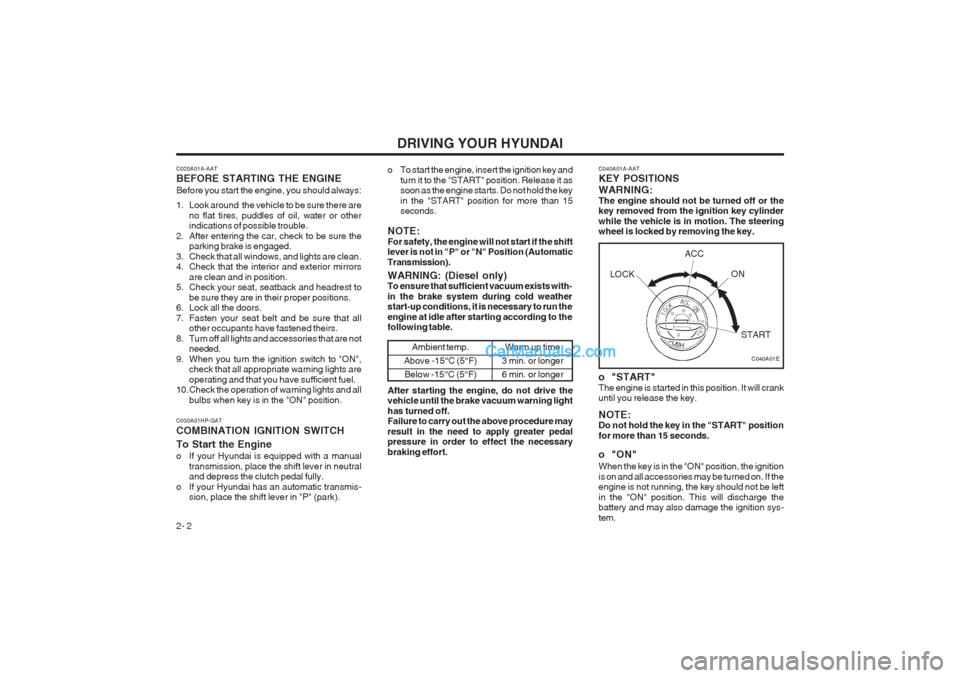
2- 2 C040A01A-AAT KEY POSITIONS WARNING: The engine should not be turned off or the key removed from the ignition key cylinder while the vehicle is in motion. The steering wheel is locked by removing the key.
o "START" The engine is started in this position. It will crank until you release the key. NOTE: Do not hold the key in the "START" position for more than 15 seconds.
o "ON" When the key is in the "ON" position, the ignition is on and all accessories may be turned on. If the engine is not running, the key should not be left in the "ON" position. This will discharge the battery and may also damage the ignition sys- tem.
C020A01A-AAT BEFORE STARTING THE ENGINE Before you start the engine, you should always:
1. Look around the vehicle to be sure there are
no flat tires, puddles of oil, water or other indications of possible trouble.
2. After entering the car, check to be sure the parking brake is engaged.
3. Check that all windows, and lights are clean.
4. Check that the interior and exterior mirrors are clean and in position.
5. Check your seat, seatback and headrest to
be sure they are in their proper positions.
6. Lock all the doors.
7. Fasten your seat belt and be sure that all other occupants have fastened theirs.
8. Turn off all lights and accessories that are not needed.
9. When you turn the ignition switch to "ON", check that all appropriate warning lights areoperating and that you have sufficient fuel.
10. Check the operation of warning lights and all
bulbs when key is in the "ON" position. o To start the engine, insert the ignition key and
turn it to the "START" position. Release it as soon as the engine starts. Do not hold the key in the "START" position for more than 15 seconds.
NOTE: For safety, the engine will not start if the shift lever is not in "P" or "N" Position (Automatic Transmission).
C030A01HP-GAT COMBINATION IGNITION SWITCH To Start the Engine
o If your Hyundai is equipped with a manual transmission, place the shift lever in neutral and depress the clutch pedal fully.
o If your Hyundai has an automatic transmis- sion, place the shift lever in "P" (park).
C040A01E
WARNING: (Diesel only) To ensure that sufficient vacuum exists with- in the brake system during cold weather start-up conditions, it is necessary to run the engine at idle after starting according to the following table.
Ambient temp.
Above -15°C (5°F) Below -15°C (5°F)Warm up time
3 min. or longer 6 min. or longer
After starting the engine, do not drive the vehicle until the brake vacuum warning light has turned off. Failure to carry out the above procedure may result in the need to apply greater pedal pressure in order to effect the necessary braking effort. LOCK
ACC
ON
START
Page 115 of 349
DRIVING YOUR HYUNDAI 2- 9
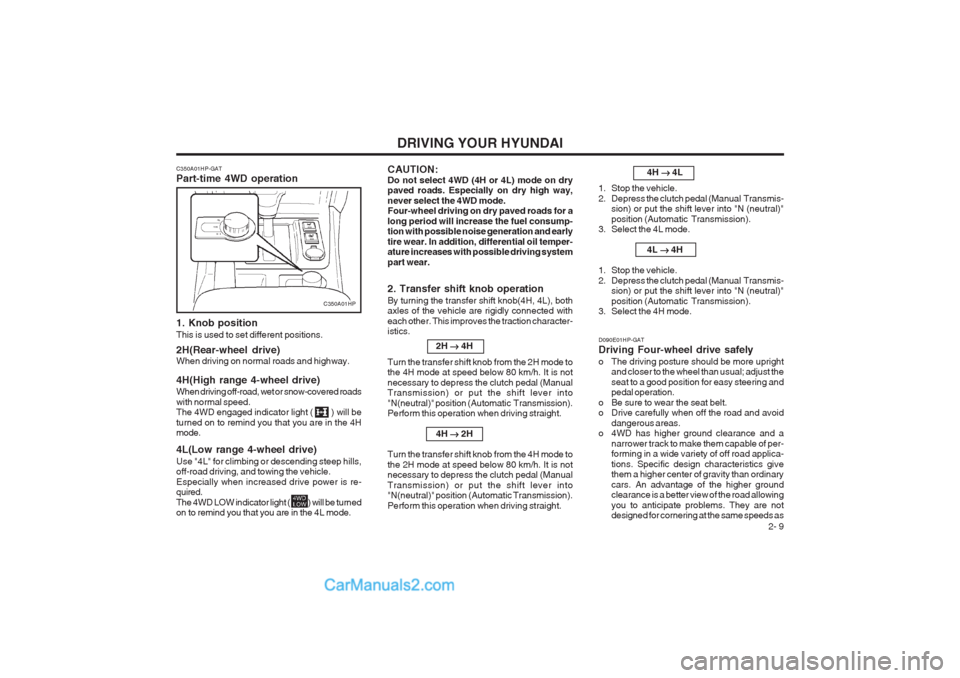
C350A01HP-GAT Part-time 4WD operation
1. Knob position This is used to set different positions. 2H(Rear-wheel drive) When driving on normal roads and highway. 4H(High range 4-wheel drive) When driving off-road, wet or snow-covered roads with normal speed. The 4WD engaged indicator light ( ) will be turned on to remind you that you are in the 4H mode. 4L(Low range 4-wheel drive) Use "4L" for climbing or descending steep hills, off-road driving, and towing the vehicle. Especially when increased drive power is re- quired. The 4WD LOW indicator light ( ) will be turned on to remind you that you are in the 4L mode.
2. Transfer shift knob operation By turning the transfer shift knob(4H, 4L), both axles of the vehicle are rigidly connected with each other. This improves the traction character- istics.2H
4H
Turn the transfer shift knob from the 2H mode tothe 4H mode at speed below 80 km/h. It is not necessary to depress the clutch pedal (Manual Transmission) or put the shift lever into "N(neutral)" position (Automatic Transmission). Perform this operation when driving straight.
4H
2H
Turn the transfer shift knob from the 4H mode to the 2H mode at speed below 80 km/h. It is not necessary to depress the clutch pedal (Manual Transmission) or put the shift lever into "N(neutral)" position (Automatic Transmission). Perform this operation when driving straight.
C350A01HP
D090E01HP-GAT Driving Four-wheel drive safely
o The driving posture should be more uprightand closer to the wheel than usual; adjust the seat to a good position for easy steering and pedal operation.
o Be sure to wear the seat belt.
o Drive carefully when off the road and avoid dangerous areas.
o 4WD has higher ground clearance and a
narrower track to make them capable of per-forming in a wide variety of off road applica- tions. Specific design characteristics give them a higher center of gravity than ordinary cars. An advantage of the higher ground clearance is a better view of the road allowing you to anticipate problems. They are not designed for cornering at the same speeds as 4H
4L
1. Stop the vehicle.
2. Depress the clutch pedal (Manual Transmis- sion) or put the shift lever into "N (neutral)"position (Automatic Transmission).
3. Select the 4L mode.
4L
4H
1. Stop the vehicle.
2. Depress the clutch pedal (Manual Transmis- sion) or put the shift lever into "N (neutral)"position (Automatic Transmission).
3. Select the 4H mode.
CAUTION: Do not select 4WD (4H or 4L) mode on dry paved roads. Especially on dry high way, never select the 4WD mode. Four-wheel driving on dry paved roads for a long period will increase the fuel consump- tion with possible noise generation and early tire wear. In addition, differential oil temper- ature increases with possible driving system part wear.
Page 120 of 349
DRIVING YOUR HYUNDAI
2- 14 C160C01A-AAT Use High Quality Ethylene Glycol Coolant Your Hyundai is delivered with high quality ethyl- ene glycol coolant in the cooling system. It is the only type of coolant that should be used because it helps prevent corrosion in the cooling system, lubricates the water pump and prevents freezing. Be sure to replace or replenish your coolant in accordance with the maintenance schedule in Section 5. Before winter, have your coolant test- ed to assure that its freezing point is sufficient for the temperatures anticipated during the winter. C160D01A-AAT Check Battery and Cables Winter puts additional burdens on the battery system. Visually inspect the battery and cables as described in Section 6. The level of charge in your battery can be checked by your Hyundai dealer or a service station. C160E01A-AAT Change to "Winter Weight" Oil if Necessary In some climates it is recommended that a lower viscosity "winter weight" oil be used during cold weather. See Section 9 for recommendations. If you aren’t sure what weight oil you should use, consult your Hyundai dealer.
o Remember, your Hyundai does not require
extended warm-up. As soon as the engine is running smoothly, you can drive away. In very cold weather, however, give your engine a slightly longer warm-up period.
o Don't "lug" or "over-rev" the engine. Lugging is driving too slowly in too high a gear result- ing in the engine bucking. If this happens, shift to a lower gear. Over-revving is racing the engine beyond its safe limit. This can be avoided by shifting at the recommended speeds.
o Use your air conditioning sparingly. The air
conditioning system is operated by engine power so your fuel economy is reduced when you use it.
C160A01A-AAT WINTER DRIVING The more severe weather conditions of winter result in greater wear and other problems. To minimize the problems of winter driving, you should follow these suggestions:
C150A01A-AAT SMOOTH CORNERING Avoid braking or gear changing in corners, espe- cially when roads are wet. Ideally, corners should always be taken under gentle acceleration. If you follow these suggestions, tire wear will be held to a minimum. C160B01A-GAT Snowy or Icy Conditions To drive your vehicle in deep snow, it may be necessary to use snow tires or to install tire chains on your tires. If snow tires are needed, it is necessary to select tires equivalent in size and type of the original equipment tires. Failure to do so may adversely affect the safety and handling of your car. Furthermore, speeding, rapid accel- eration, sudden brake applications, and sharp turns are potentially very hazardous practices. During deceleration, use engine braking to the fullest extent. Sudden brake applications on snowy or icy roads may cause skids to occur. You need to keep sufficient distance between the vehicle in operation in front and your vehicle. Also, apply the brake gently. It should be noted that installing tire chains on the tire will provide a greater driving force, but will not prevent side skids. NOTE: Tire chains are not legal in all provinces. Check province laws before fitting tire chains.
Page 121 of 349
DRIVING YOUR HYUNDAI 2- 15
C160H01A-AAT Use Approved Anti-Freeze in Window Washer System To keep the water in the window washer system from freezing, add an approved anti-freeze solu- tion in accordance with instructions on the con- tainer. Window washer anti-freeze is available from Hyundai dealers and most auto parts out- lets. Do not use engine coolant or other types of anti-freeze as these may damage the finish.
C160F01A-AAT Check Spark Plugs and Ignition System Inspect your spark plugs as described in Section 6 and replace them if necessary. Also check all ignition wiring and components to be sure they are not cracked, worn or damaged in any way.
C160G02A-GAT To Keep Locks from Freezing To keep the locks from freezing, squirt an ap- proved de-icer fluid or glycerine into the key opening. If a lock is covered with ice, squirt it with an approved de-icing fluid to remove the ice. If the lock is frozen internally, you may be able to thaw it out by using a heated key. Handle the heated key with care to avoid
injury.
NOTE: The proper temperature for using the immo- bilizer key is from -40°C (-40°F) to 80°C (176°F). If you heat the immobilizer key over 80°C (176°F) to open the frozen lock, it may cause damage to the transponder in its head. C160I01HP-GAT Don’t Let Your Parking Brake Freeze Under some conditions your parking brake can freeze in the engaged position. This is most likely to happen when there is an accumulation of snow or ice around or near the rear brakes or if the brakes are wet. If there is a risk the parking brake may freeze, apply it only temporarily while you put the gear selector lever in "P" (automatic) or in first or reverse gear (manual transmission) and block the rear wheels so the car cannot roll. Then release the parking brake. C160K01A-AAT Carry Emergency Equipment Depending on the severity of the weather where you drive your car, you should carry appropriate emergency equipment. Some of the items you may want to carry include tire chains, tow straps or chains, flashlight, emergency flares, sand, a shovel, jumper cables, a window scraper, gloves, ground cloth, coveralls, a blanket, etc.
C160J01A-AAT Don’t Let Ice and Snow Accumulate Underneath Under some conditions, snow and ice can build up under the fenders and interfere with the steer- ing. When driving in severe winter conditions where this may happen, you should periodically check underneath the car to be sure the move- ment of the front wheels and the steering compo- nents is not obstructed.
C180A01A-AAT USE OF LIGHTS Check your lights regularly for correct operation and always keep them clean. When driving dur- ing the day in conditions of poor visibility, it is helpful to drive with headlights on low beam. This enables you to be seen as well as to see.
C170A01A-AAT HIGHER SPEED MOTORING Pre-Trip Inspections 1. Tires: Adjust the tire inflation pressures to specifica- tion. Low tire inflation pressures will result in overheating and possible failure of the tires. Avoid using worn or damaged tires which may result in reduced traction or tire failure. NOTE: Never exceed the maximum tire inflation pres- sure shown on the tires. 2. Fuel, engine coolant and engine oil: High speed travel consumes more fuel than urban motoring. Do not forget to check both engine coolant and engine oil. 3. Drive belt: A loose or damaged drive belt may result in overheating of the engine.
Page 125 of 349
WHAT TO DO IN AN EMERGENCY 3-1
3. WHAT TO DO IN ANEMERGENCY
D010A01A-AAT IF THE ENGINE WILL NOT START WARNING: If the engine will not start, do not push or pull the car to start it. This could result in a collision or cause other damage. In addition, push or pull starting may cause the catalytic converter to be overloaded and create a fire hazard. D010B01HP-GAT If Engine Doesn’t Turn Over or Turns Over Slowly
1. If your car has an automatic transmission, be sure the gear selector lever is in "N" or "P" and the emergency brake is set. 2. Check the battery connections to be sure
they are clean and tight.
3. Turn on the interior light. If the light dims or
goes out when you operate the starter, the battery is discharged.
4. Check the starter connections to be sure they are securely tightened.
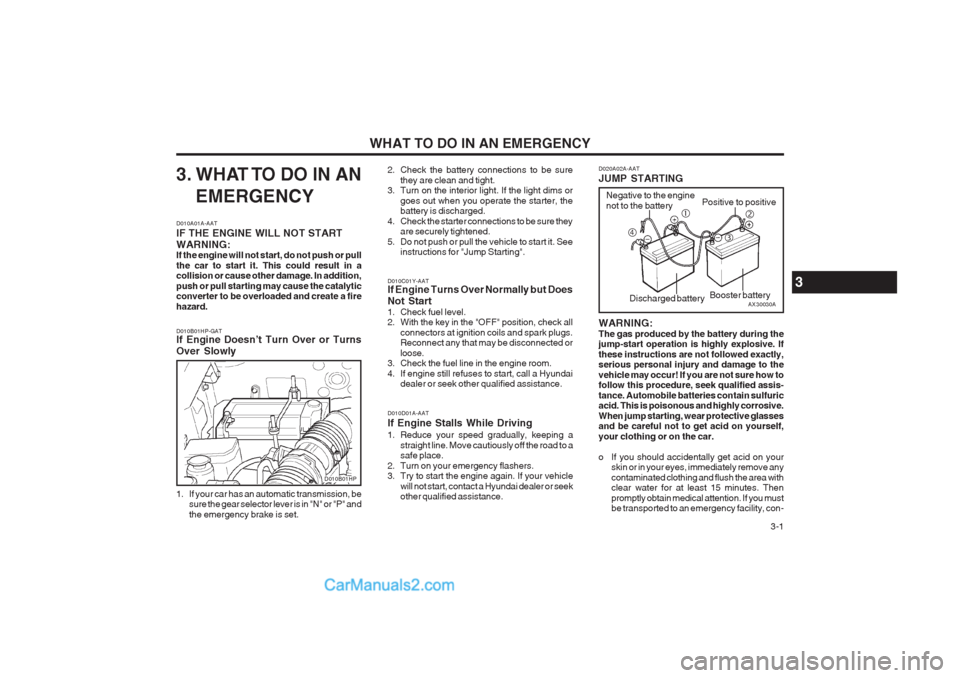
5. Do not push or pull the vehicle to start it. See instructions for "Jump Starting". D020A02A-AAT JUMP STARTING WARNING: The gas produced by the battery during the jump-start operation is highly explosive. If these instructions are not followed exactly, serious personal injury and damage to the vehicle may occur! If you are not sure how to follow this procedure, seek qualified assis- tance. Automobile batteries contain sulfuric acid. This is poisonous and highly corrosive. When jump starting, wear protective glasses and be careful not to get acid on yourself, your clothing or on the car.
o If you should accidentally get acid on your
skin or in your eyes, immediately remove any contaminated clothing and flush the area with clear water for at least 15 minutes. Then promptly obtain medical attention. If you must be transported to an emergency facility, con-
D010C01Y-AAT If Engine Turns Over Normally but Does Not Start
1. Check fuel level.
2. With the key in the "OFF" position, check all
connectors at ignition coils and spark plugs.Reconnect any that may be disconnected or loose.
3. Check the fuel line in the engine room.
4. If engine still refuses to start, call a Hyundai dealer or seek other qualified assistance.
D010D01A-AAT If Engine Stalls While Driving
1. Reduce your speed gradually, keeping a straight line. Move cautiously off the road to a safe place.
2. Turn on your emergency flashers.
3. Try to start the engine again. If your vehicle will not start, contact a Hyundai dealer or seekother qualified assistance.
AX30030A
Negative to the engine not to the battery
Positive to positive
Booster battery
c
e
f d
Discharged battery
D010B01HP
3
Page 131 of 349
WHAT TO DO IN AN EMERGENCY 3-7
D060F04HP
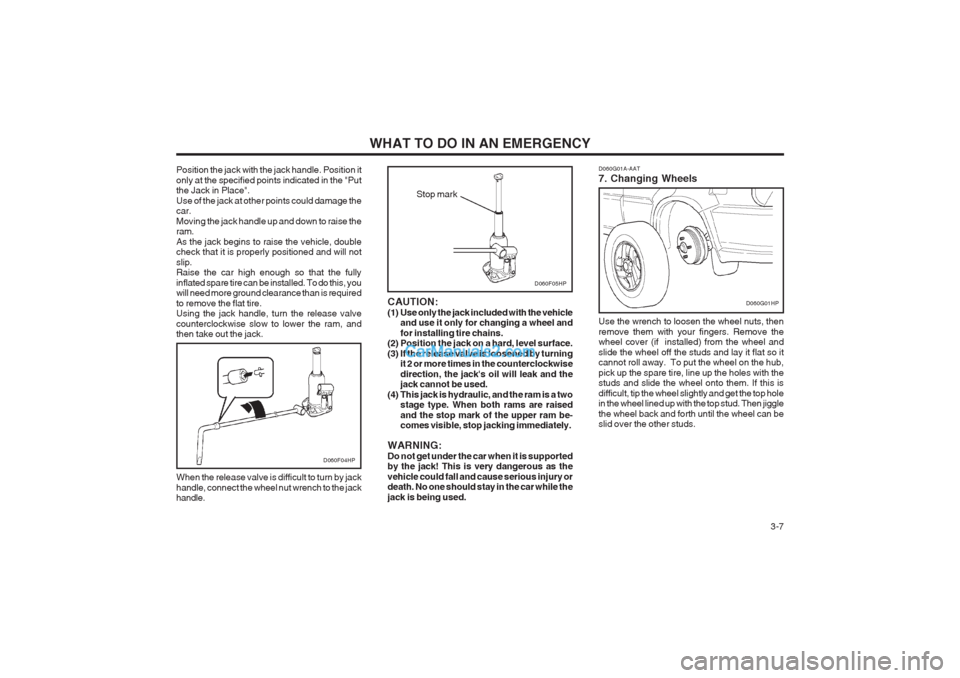
When the release valve is difficult to turn by jack handle, connect the wheel nut wrench to the jack handle. CAUTION:
(1) Use only the jack included with the vehicle
and use it only for changing a wheel andfor installing tire chains.
(2) Position the jack on a hard, level surface.
(3) If the release valve is loosened by turning it 2 or more times in the counterclockwisedirection, the jack's oil will leak and the jack cannot be used.
(4) This jack is hydraulic, and the ram is a two stage type. When both rams are raised and the stop mark of the upper ram be- comes visible, stop jacking immediately.
WARNING: Do not get under the car when it is supported by the jack! This is very dangerous as the vehicle could fall and cause serious injury or death. No one should stay in the car while the jack is being used. D060G01A-AAT 7. Changing Wheels Use the wrench to loosen the wheel nuts, then remove them with your fingers. Remove the wheel cover (if installed) from the wheel and slide the wheel off the studs and lay it flat so it cannot roll away. To put the wheel on the hub, pick up the spare tire, line up the holes with the studs and slide the wheel onto them. If this is difficult, tip the wheel slightly and get the top hole in the wheel lined up with the top stud. Then jiggle the wheel back and forth until the wheel can be slid over the other studs.
D060G01HP
D060F05HP
Position the jack with the jack handle. Position it only at the specified points indicated in the "Put the Jack in Place". Use of the jack at other points could damage the car. Moving the jack handle up and down to raise the ram. As the jack begins to raise the vehicle, double check that it is properly positioned and will not slip. Raise the car high enough so that the fully inflated spare tire can be installed. To do this, you will need more ground clearance than is required to remove the flat tire. Using the jack handle, turn the release valve counterclockwise slow to lower the ram, and then take out the jack.
Stop mark
Page 137 of 349
CORROSION PREVENTION AND APPEARANCE CARE 4-3
tion, tree resin, insects and bird droppings, when not removed immediately. If water alone is not strong enough to remove the accumulated dirt, use a mild car washing solution. Be sure to rinse the surface after washing to remove the solution. Never allow the solution to dry on the painted surfaces.
E030D01A-AAT When to Wax Again You should polish and wax the car again when water no longer beads on a clean surface but spreads out over a larger area. E030E01A-AAT Maintaining Bumpers Special precautions must be observed to pre- serve the appearance of the bumpers on your Hyundai. They are:
o Be careful not to spill battery electrolyte or
hydraulic brake fluid on the bumpers. If you do, wash it off immediately with clean water.
o Be gentle when cleaning the bumper sur- faces. They are made of soft plastic and the surface can be damaged if mistreated. Do not use abrasive cleaners. Use warm water and mild soap or car-washing solution.
o Do not expose the bumpers to high tem-
peratures. For example, if you have your car repainted, do not leave the bumpers on the car if the car is going to be placed in a high- temperature paint booth.
E040A01A-AAT CLEANING THE INTERIOR To Clean the Vinyl Upholstery To clean the vinyl upholstery, first remove loose dirt and dust with a vacuum cleaner. Then apply a solution of mild soap or detergent and water using a clean sponge or soft cloth. Allow this to stay on the surface to loosen the dirt, then wipe with a clean damp sponge or cloth. If all the dirt stains are not removed, repeat this procedure until the upholstery is clean. Do not use gasoline, solvent, paint thinner or other strong cleaners.
E030B01A-AAT Spot CleaningDon’t use gasoline, strong solvents or corrosive cleaning agents. These can damage the finish of the car. To remove road tar, use turpentine on a clean, soft cloth or commercially available bug and tar remover. Be gentle. To remove dead insects or tree sap, use warm water and mild soap or car-washing solution. Soak the spot and rub gently. If the paint has lost its luster, use a commercial car-cleaning polish. E030C01A-AAT Polishing and Waxing Always wash and dry the car before polishing or waxing or using a combination cleaner and wax. Use a good quality commercial product and follow the manufacturer’s directions on the con- tainer. Polish and wax the bright trim pieces as well as the paint. E040B01A-AAT To Clean the Leather Upholstery (If installed) In the normal course of use, leather upholsteredsurfaces will, like any material, pick-up dust and dirt. This dust and dirt must be cleaned off or it may work into the surface of the leather, causing damage. Fine leather needs care, and should be cleaned when necessary. Washing leather thoroughly with soap and water will keep your leather lus- trous, beautiful and ensure you have many years of wear. Take a piece of cheese cloth and using any mild soap and lukewarm water, work up a good lather. Thoroughly wash the leather. Wipe clean with a slightly damp cloth and dry with soft cloth. Do this as often as the leather becomes soiled. During tanning operations, sufficient oils are in- corporated through processing that none need be applied during the life of the leather. Oil applied to the finished surface will in no way help the leather and may do more harm than good. Varnishes and furniture polishes should never be used under any conditions.
Page 139 of 349
VEHICLE MAINTENANCE REQUIREMENTS 5-1
F010C01HP-GAT Specified Scheduled ProceduresThese are the procedures such as inspections, adjustments and replacements that are listed in the maintenance charts starting on page 5-2. These procedures must be performed at the intervals shown in the maintenance schedule to assure that your warranty remains in effect. Although it is strongly recommended that they be performed by the factory-trained or distribu- tor-trained technicians at your Hyundai dealer, these procedures may be performed at any qualified service facility. It is suggested that genuine Hyundai service parts be used for any required repairs or re- placements. Other parts of equivalent quality such as engine oil, engine coolant, manual or auto transmission oil, brake fluid and so on which are not supplied by Hyundai Motor Com- pany or its distributor may be used without affecting your warranty coverage but you should always be sure these are equivalent to the quality of the original Hyundai parts. Your Ser- vice Passport provides further information about your warranty coverage.
5. VEHICLE
MAINTENANCE
REQUIREMENTS F010E01A-AAT Do-It-Yourself Maintenance If you are mechanically inclined, own a few tools that are required and want to take the time to do so, you can inspect and service a number of items. For more information about doing it your- self, see Section 6.
F010D01A-AAT General ChecksThese are the regular checks you should per- form when you drive your Hyundai or you fill the fuel tank. A list of these items will be found on page 6-4.
F010A01A-GAT MAINTENANCE INTERVALS Service Requirements To assure that you receive the greatest number of kilometers of satisfying operation from your Hyundai, certain maintenance procedures must be performed. Although careful design and en- gineering have reduced these to a minimum, those that are required are of the utmost impor- tance. It is your responsibility to have these mainte-nance procedures performed to comply with the terms of the warranties covering your new Hyundai. The Service Passport supplied with your new vehicle provides further information about these warranties. F010B01A-AAT Maintenance RequirementsThe maintenance required for your Hyundai can be divided into three main areas: o Specified scheduled procedures o General checks o Do-it-yourself maintenance F010F01A-AAT A Few Tips
o Whenever you have your Hyundai serviced,
keep copies of the service records in your glove box. This will help ensure that you can document that the required procedures have been performed to keep your warranties in effect. This is especially important when service is not performed by an authorized Hyundai dealer.
o If you choose to do your own maintenance
and repairs, you may find it helpful to havean official Hyundai Shop Manual. A copy of this publication may be purchased at your Hyundai dealer's parts department.
F020A01Y-GAT SCHEDULED MAINTENANCE RE- QUIREMENTS Inspection should be performed any time a malfunction is experienced or suspected. Re- ceipts for all emission control system services should be retained to demonstrate compliance with conditions of the emissions system war- ranty. For severe usage maintenance requirements, see page 5-6 of this section.
5
Page 140 of 349

VEHICLE MAINTENANCE REQUIREMENTS
5- 2
F030A01A-GAT SCHEDULED MAINTENANCE The following maintenance services must be performed to assure good vehicle control and performance. Keep receipts for all vehi
cle services to protect
your warranty. Where both mileage and time are shown, the frequency of service is determined by whichever occurs first. F030B01HP-GAT R :Replace I : Inspect and, after Inspection, clean, adjust, repair or replace if necessary.
ENGINE CONTROL SYSTEM MAINTENANCE (GASOLINE)
ENGINE OIL AND FILTER See Note (1)DRIVE BELT (ALT, DAMPER, TENSIONER, IDLER)FUEL FILTER (MFI TYPE)FUEL LINES, FUEL HOSES AND CONNECTIONSTIMING BELTVAPOR HOSE AND FUEL FILLER CAPVACUUM AND CRANKCASE VENTILATION HOSESAIR CLEANER FILTERSPARK PLUGSSPARK PLUGS (PLATINUM COATED)
NO. DESCRIPTION
1 2 3 4 5 6 7 8 9 120
96
RRR I I I
R I105
84
R I I I90 72
R I I
R I I
RRR75 60
R I I I I60 48
R I
R I III
R45 36
R I I I
R30 24
R I II I
R I
15 12
R I I IKILOMETERS X 1000 MONTHS
Note: (1) European Community Only - API SG, SG/CD, SH OR SH/CD Except European Community - API SE OR ABOVE In case of Gasoline standard engine as recommended oil (API SE or ABOVE) is difficult to obtain in fieId, following oil recomen ded:
API SD - The engine oil and filter should be changed at every 10,000km or 6 months.
Page 141 of 349
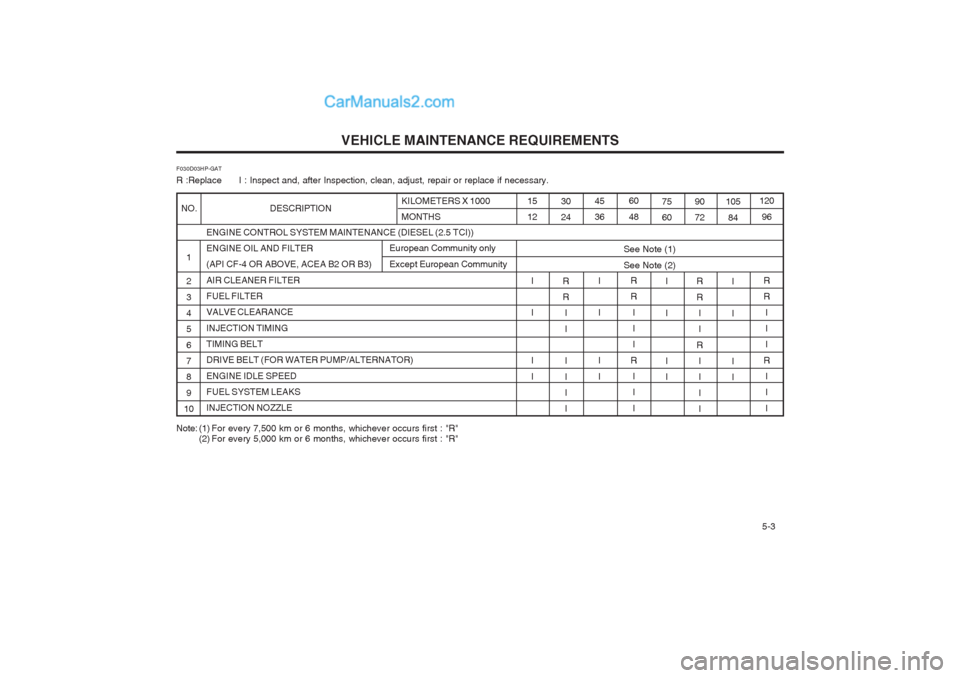
VEHICLE MAINTENANCE REQUIREMENTS 5-3
KILOMETERS X 1000 MONTHS
F030D03HP-GAT R :Replace I : Inspect and, after Inspection, clean, adjust, repair or replace if necessary.
ENGINE CONTROL SYSTEM MAINTENANCE (DIESEL (2.5 TCI)) ENGINE OIL AND FILTER(API CF-4 OR ABOVE, ACEA B2 OR B3) AIR CLEANER FILTER FUEL FILTERVALVE CLEARANCE INJECTION TIMING TIMING BELTDRIVE BELT (FOR WATER PUMP/ALTERNATOR) ENGINE IDLE SPEED FUEL SYSTEM LEAKSINJECTION NOZZLE
NO. DESCRIPTION
1 2 3 45 6 78 9
10120
96
R R III
R II I105
84
I I I I90 72R R I I
R II I I75 60
I I I I60 48R R III
R II I45 36
I I I I30 24RR I I I I II15 12
I I I I
See Note (1) See Note (2)
Note: (1) For every 7,500 km or 6 months, whichever occurs first : "R"
(2) For every 5,000 km or 6 months, whichever occurs first : "R"European Community only Except European Community