engine Hyundai Terracan 2003 Owner's Guide
[x] Cancel search | Manufacturer: HYUNDAI, Model Year: 2003, Model line: Terracan, Model: Hyundai Terracan 2003Pages: 349, PDF Size: 4.56 MB
Page 49 of 349
FEATURES OF YOUR HYUNDAI 1- 41
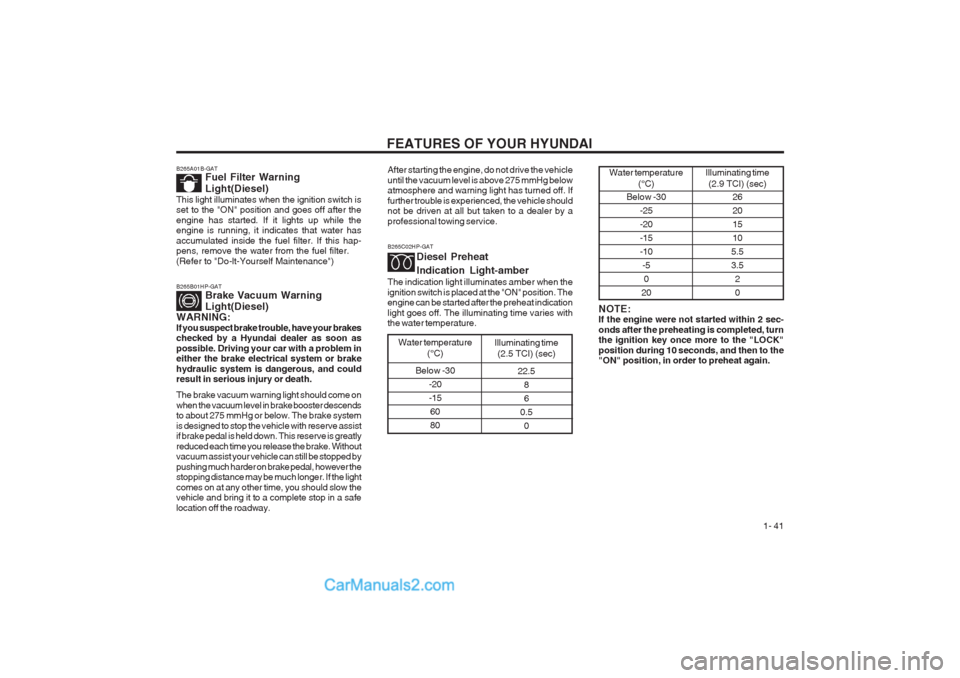
NOTE: If the engine were not started within 2 sec- onds after the preheating is completed, turn the ignition key once more to the "LOCK" position during 10 seconds, and then to the "ON" position, in order to preheat again.
After starting the engine, do not drive the vehicle until the vacuum level is above 275 mmHg below atmosphere and warning light has turned off. If further trouble is experienced, the vehicle should not be driven at all but taken to a dealer by a professional towing service. B265C02HP-GAT
Diesel Preheat Indication Light-amber
The indication light illuminates amber when the ignition switch is placed at the "ON" position. The engine can be started after the preheat indication light goes off. The illuminating time varies with the water temperature.
Water temperature (°C)
Below -30 -20 -156080 Illuminating time
(2.5 TCI) (sec)
22.586
0.5 0
B265A01B-GAT Fuel Filter Warning Light(Diesel)
This light illuminates when the ignition switch is set to the "ON" position and goes off after the engine has started. If it lights up while the engine is running, it indicates that water has accumulated inside the fuel filter. If this hap- pens, remove the water from the fuel filter. (Refer to "Do-lt-Yourself Maintenance") B265B01HP-GAT Brake Vacuum Warning Light(Diesel)
WARNING: If you suspect brake trouble, have your brakes checked by a Hyundai dealer as soon as possible. Driving your car with a problem in either the brake electrical system or brake hydraulic system is dangerous, and could result in serious injury or death. The brake vacuum warning light should come on when the vacuum level in brake booster descends to about 275 mmHg or below. The brake system is designed to stop the vehicle with reserve assist if brake pedal is held down. This reserve is greatly reduced each time you release the brake. Without vacuum assist your vehicle can still be stopped by pushing much harder on brake pedal, however the stopping distance may be much longer. If the light comes on at any other time, you should slow the vehicle and bring it to a complete stop in a safe location off the roadway.Water temperature
(°C)
Below -30
-25 -20-15-10-50
20 Illuminating time
(2.9 TCI) (sec)
26201510
5.53.5 20
Page 50 of 349
FEATURES OF YOUR HYUNDAI
1- 42
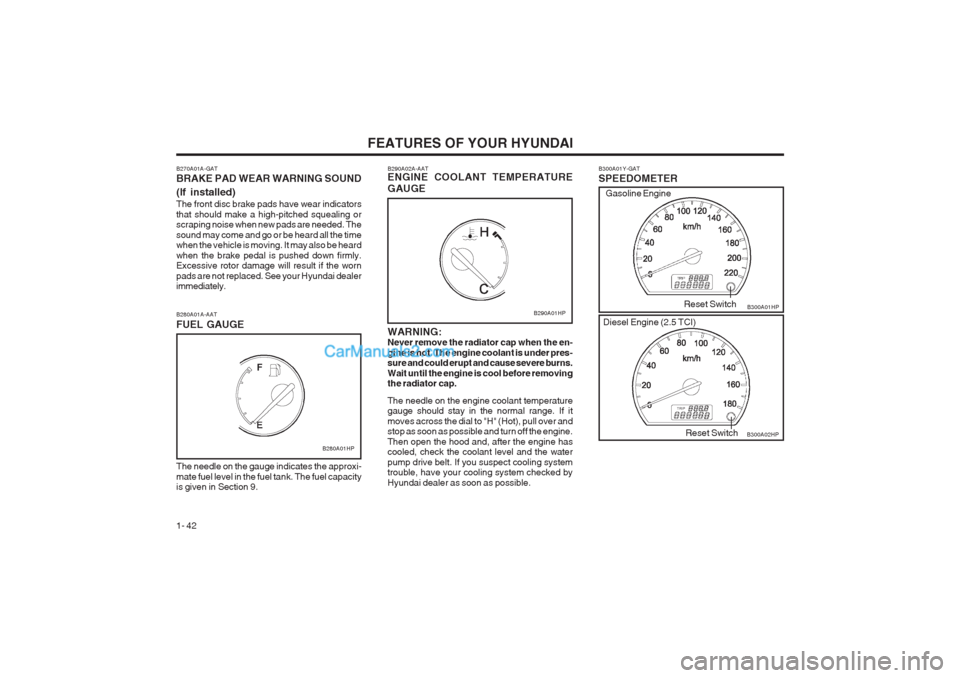
B300A01Y-GAT SPEEDOMETER B300A01HP
B300A02HP
Reset Switch
Reset Switch
Gasoline Engine
Diesel Engine (2.5 TCI)
B280A01A-AAT FUEL GAUGE
B280A01HP
The needle on the gauge indicates the approxi- mate fuel level in the fuel tank. The fuel capacity is given in Section 9. B290A02A-AAT ENGINE COOLANT TEMPERATURE GAUGE WARNING: Never remove the radiator cap when the en- gine is hot. The engine coolant is under pres- sure and could erupt and cause severe burns. Wait until the engine is cool before removing the radiator cap. The needle on the engine coolant temperature gauge should stay in the normal range. If it moves across the dial to "H" (Hot), pull over and stop as soon as possible and turn off the engine. Then open the hood and, after the engine has cooled, check the coolant level and the water pump drive belt. If you suspect cooling system trouble, have your cooling system checked by Hyundai dealer as soon as possible.
B290A01HP
B270A01A-GAT BRAKE PAD WEAR WARNING SOUND (If installed) The front disc brake pads have wear indicators that should make a high-pitched squealing or scraping noise when new pads are needed. The sound may come and go or be heard all the time when the vehicle is moving. It may also be heard when the brake pedal is pushed down firmly. Excessive rotor damage will result if the worn pads are not replaced. See your Hyundai dealer immediately.
Page 51 of 349
FEATURES OF YOUR HYUNDAI 1- 43
B330A01HP
Gasoline Engine
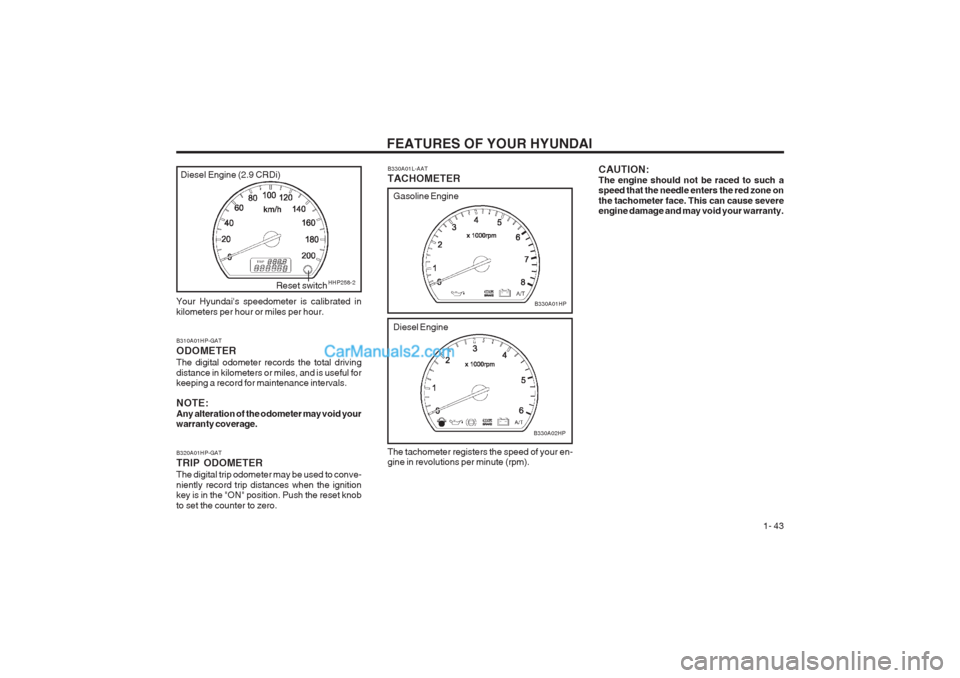
B310A01HP-GAT ODOMETER The digital odometer records the total driving distance in kilometers or miles, and is useful for keeping a record for maintenance intervals. NOTE: Any alteration of the odometer may void your warranty coverage. B320A01HP-GAT TRIP ODOMETER The digital trip odometer may be used to conve- niently record trip distances when the ignition key is in the "ON" position. Push the reset knob to set the counter to zero.
Diesel Engine
B330A02HP
Your Hyundai's speedometer is calibrated in kilometers per hour or miles per hour.
HHP258-2Reset switch B330A01L-AAT TACHOMETER The tachometer registers the speed of your en- gine in revolutions per minute (rpm). CAUTION: The engine should not be raced to such a speed that the needle enters the red zone on the tachometer face. This can cause severe engine damage and may void your warranty.
Diesel Engine (2.9 CRDi)
Page 56 of 349
FEATURES OF YOUR HYUNDAI
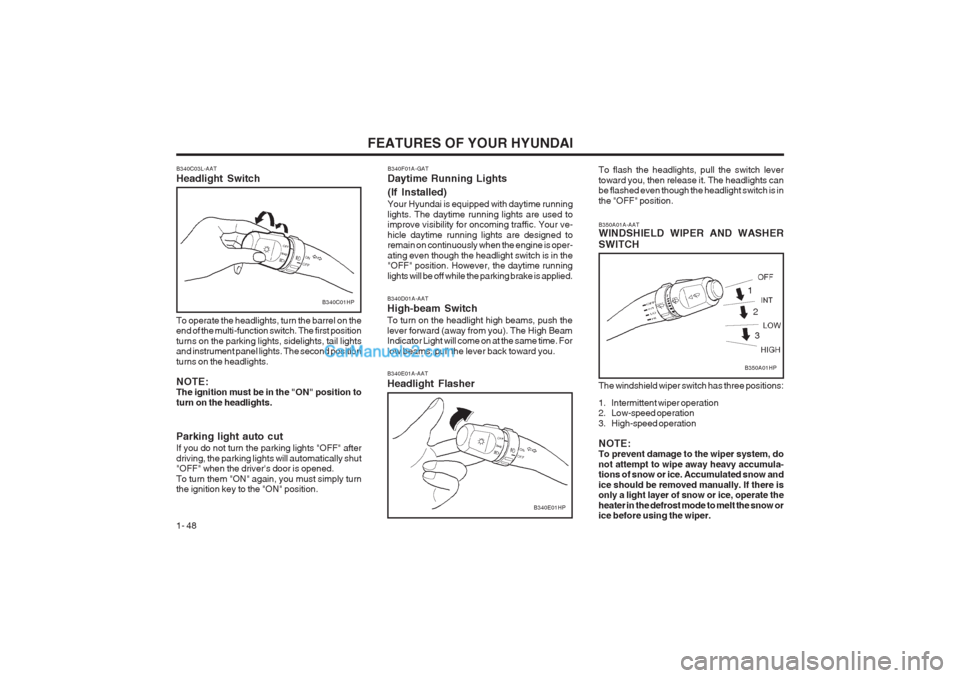
1- 48 B340D01A-AAT High-beam Switch To turn on the headlight high beams, push the lever forward (away from you). The High Beam Indicator Light will come on at the same time. For low beams, pull the lever back toward you. B340E01A-AAT Headlight Flasher
B340E01HP
B340C03L-AAT Headlight Switch
B340C01HP
To operate the headlights, turn the barrel on the end of the multi-function switch. The first position turns on the parking lights, sidelights, tail lights and instrument panel lights. The second position turns on the headlights. NOTE: The ignition must be in the "ON" position to turn on the headlights. Parking light auto cut If you do not turn the parking lights "OFF" after driving, the parking lights will automatically shut "OFF" when the driver's door is opened. To turn them "ON" again, you must simply turn the ignition key to the "ON" position. B340F01A-GAT Daytime Running Lights (If Installed) Your Hyundai is equipped with daytime running lights. The daytime running lights are used to improve visibility for oncoming traffic. Your ve- hicle daytime running lights are designed to remain on continuously when the engine is oper- ating even though the headlight switch is in the "OFF" position. However, the daytime running lights will be off while the parking brake is applied.
To flash the headlights, pull the switch levertoward you, then release it. The headlights can be flashed even though the headlight switch is in the "OFF" position. The windshield wiper switch has three positions:
1. Intermittent wiper operation
2. Low-speed operation
3. High-speed operation NOTE: To prevent damage to the wiper system, do not attempt to wipe away heavy accumula- tions of snow or ice. Accumulated snow and ice should be removed manually. If there is only a light layer of snow or ice, operate the heater in the defrost mode to melt the snow or ice before using the wiper.
B350A01A-AAT WINDSHIELD WIPER AND WASHER SWITCH
B350A01HP
1
2
3
Page 69 of 349
FEATURES OF YOUR HYUNDAI 1- 61
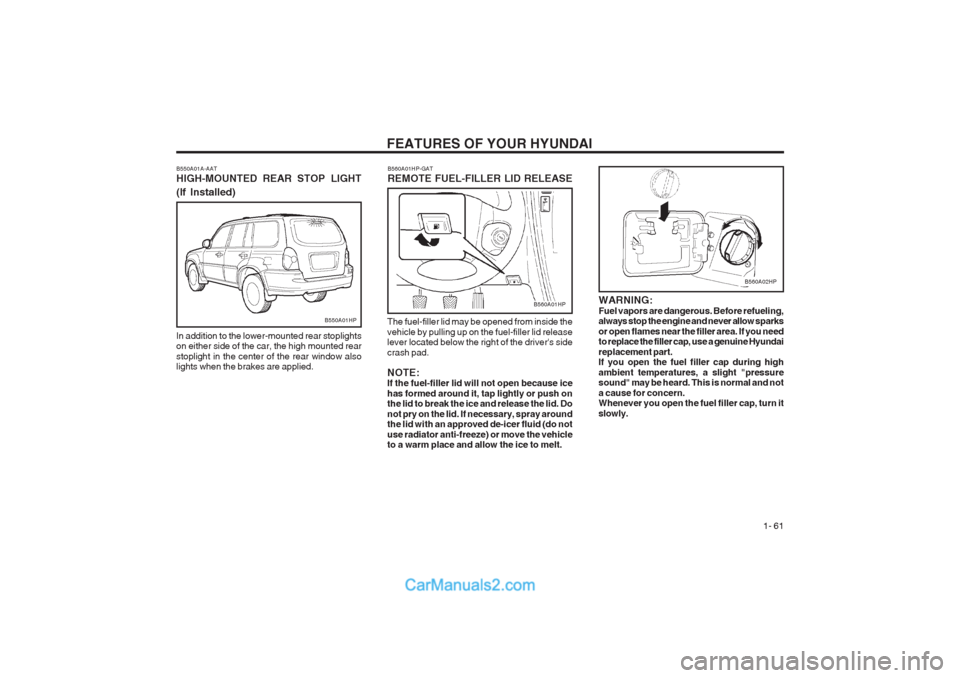
WARNING: Fuel vapors are dangerous. Before refueling, always stop the engine and never allow sparks or open flames near the filler area. If you need to replace the filler cap, use a genuine Hyundai replacement part. If you open the fuel filler cap during high ambient temperatures, a slight "pressure sound" may be heard. This is normal and not a cause for concern. Whenever you open the fuel filler cap, turn it slowly.
B550A01A-AAT HIGH-MOUNTED REAR STOP LIGHT (If Installed)
In addition to the lower-mounted rear stoplights on either side of the car, the high mounted rear stoplight in the center of the rear window also lights when the brakes are applied.
B550A01HP
B560A01HP-GAT REMOTE FUEL-FILLER LID RELEASE
The fuel-filler lid may be opened from inside the vehicle by pulling up on the fuel-filler lid release lever located below the right of the driver's side crash pad. NOTE: If the fuel-filler lid will not open because ice has formed around it, tap lightly or push on the lid to break the ice and release the lid. Do not pry on the lid. If necessary, spray around the lid with an approved de-icer fluid (do not use radiator anti-freeze) or move the vehicle to a warm place and allow the ice to melt.
B560A01HP
B560A02HP
Page 74 of 349
FEATURES OF YOUR HYUNDAI
1- 66
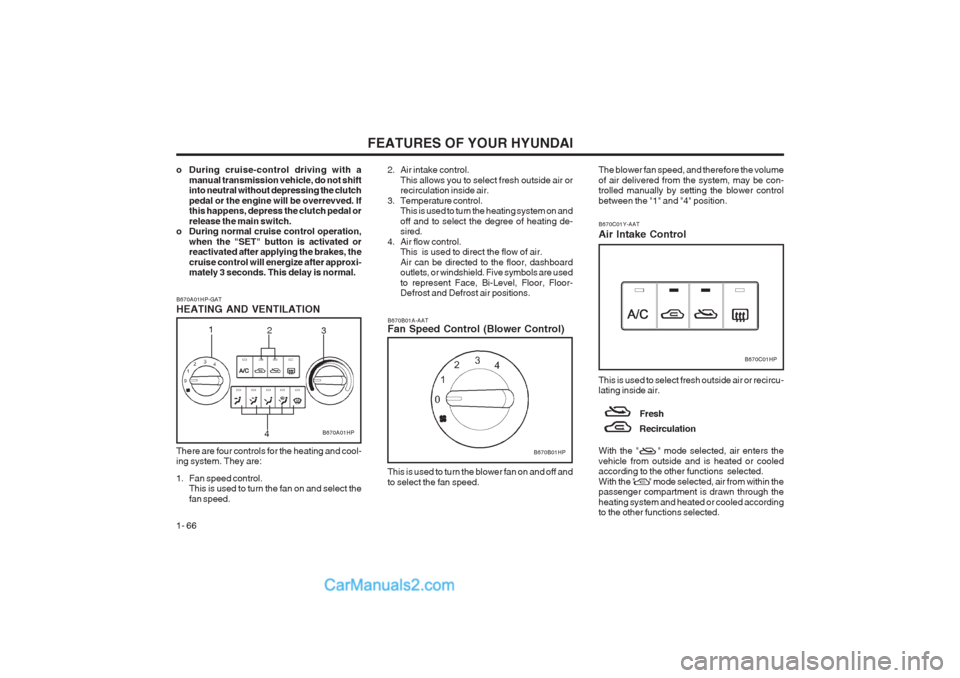
B670B01A-AAT Fan Speed Control (Blower Control)
B670B01HP
This is used to turn the blower fan on and off and to select the fan speed.
B670A01HP-GAT HEATING AND VENTILATION
B670A01HP
2
3
1
4
There are four controls for the heating and cool- ing system. They are:
1. Fan speed control. This is used to turn the fan on and select the fan speed.
2. Air intake control.
This allows you to select fresh outside air or recirculation inside air.
3. Temperature control. This is used to turn the heating system on and off and to select the degree of heating de- sired.
4. Air flow control. This is used to direct the flow of air. Air can be directed to the floor, dashboard outlets, or windshield. Five symbols are used to represent Face, Bi-Level, Floor, Floor- Defrost and Defrost air positions.o During cruise-control driving with a
manual transmission vehicle, do not shift into neutral without depressing the clutch pedal or the engine will be overrevved. If this happens, depress the clutch pedal or release the main switch.
o During normal cruise control operation,
when the "SET" button is activated or reactivated after applying the brakes, the cruise control will energize after approxi- mately 3 seconds. This delay is normal.
B670C01HP
The blower fan speed, and therefore the volume of air delivered from the system, may be con- trolled manually by setting the blower control between the "1" and "4" position.
B670C01Y-AAT Air Intake Control This is used to select fresh outside air or recircu- lating inside air.
Fresh Recirculation
With the " " mode selected, air enters the vehicle from outside and is heated or cooled according to the other functions selected. With the " " mode selected, air from within the passenger compartment is drawn through the heating system and heated or cooled according to the other functions selected.
Page 84 of 349
FEATURES OF YOUR HYUNDAI
1- 76 B980D01Y-AAT Heating and Cooling System Off Press the "OFF" button to stop the operation of the heating and cooling system.
NOTE:
o It should be noted that prolonged opera-
tion of the heating system in "Recircula-tion" mode will give rise to fogging of the windshield and side windows and the air within the passenger compartment will become stale. In addition, prolonged use of the air conditioning with the "Recircu- lation" mode selected may result in the air within the passenger compartment be- coming excessively dry.
o When the ignition switch is turned "ON",
the air intake control will change to ( )
mode (regardless of switch position). This
is normal operation. The air intake control
operates in "AUTO" mode when turning the ignition to the ON position if the "AUTO" mode was used before shutting off the engine.
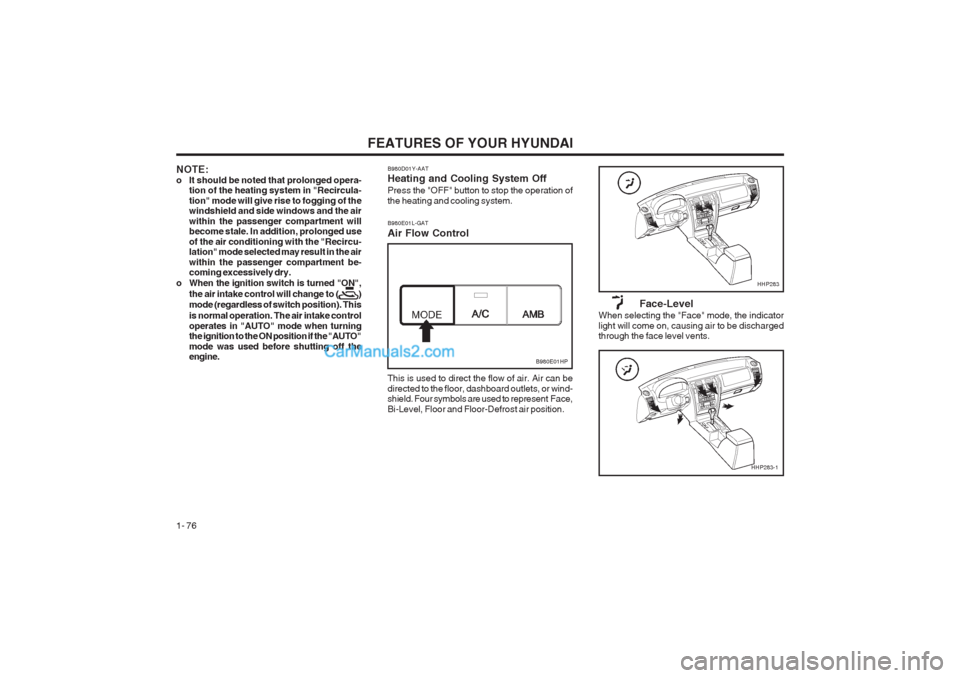
This is used to direct the flow of air. Air can be directed to the floor, dashboard outlets, or wind- shield. Four symbols are used to represent Face, Bi-Level, Floor and Floor-Defrost air position.
B980E01L-GAT Air Flow Control
Face-Level
When selecting the "Face" mode, the indicator light will come on, causing air to be discharged through the face level vents.
B980E01HP
HHP283
HHP283-1
Page 86 of 349
FEATURES OF YOUR HYUNDAI
1- 78 B740D01Y-AAT Operation Tips
o If the interior of the car is hot when you first get
in, open the windows for a few minutes to expel the hot air.
o When you are using the air conditioning sys- tem, keep all windows closed to keep hot air out.
o When moving slowly, as in heavy traffic, shift
to a lower gear. This increases engine speed, which in turn increases the speed of the air conditioning compressor.
o On steep grades, turn the air conditioning off
to avoid the possibility of the engine overheat- ing.
o During winter months or in periods when the air conditioning is not used regularly, run the air conditioning once every month for a few minutes. This will help circulate the lubricants and keep your system in peak operating condition.
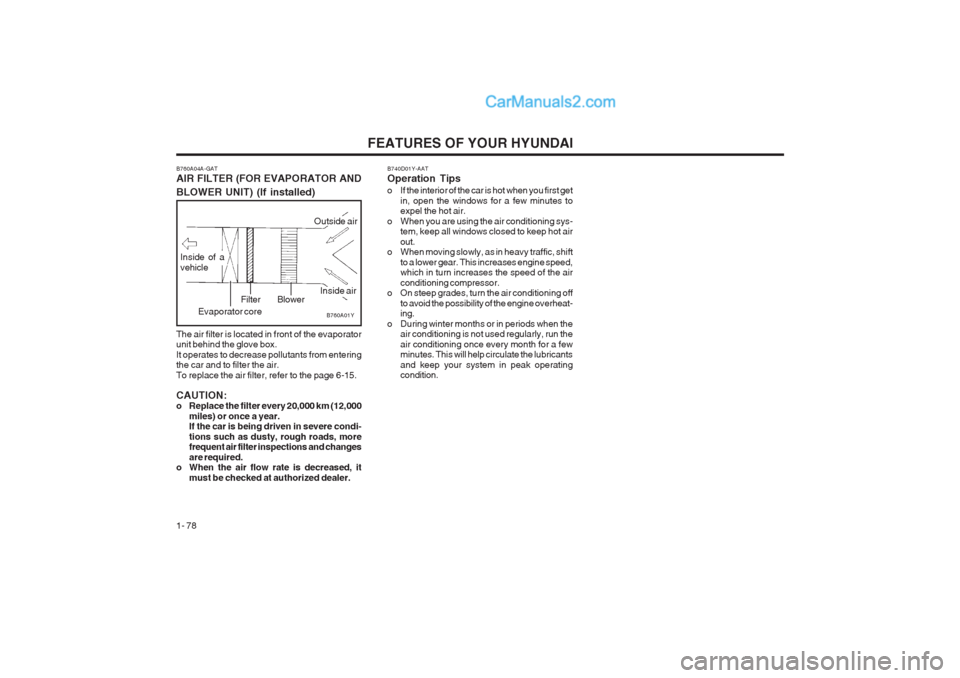
B760A04A-GAT AIR FILTER (FOR EVAPORATOR AND BLOWER UNIT) (If installed) The air filter is located in front of the evaporator unit behind the glove box. It operates to decrease pollutants from entering the car and to filter the air. To replace the air filter, refer to the page 6-15. CAUTION:
o Replace the filter every 20,000 km (12,000
miles) or once a year.If the car is being driven in severe condi- tions such as dusty, rough roads, more frequent air filter inspections and changes are required.
o When the air flow rate is decreased, it
must be checked at authorized dealer.
B760A01Y
Inside of a vehicle
Evaporator core Filter Blower
Outside air
Inside air
Page 87 of 349
FEATURES OF YOUR HYUNDAI 1- 79
MountainsBuildings
Obstructed area Iron bridges
Unobstructed area
FM radio station
SSAR012A
Ionosphere
SSAR011A
AM reception
IonosphereFM reception
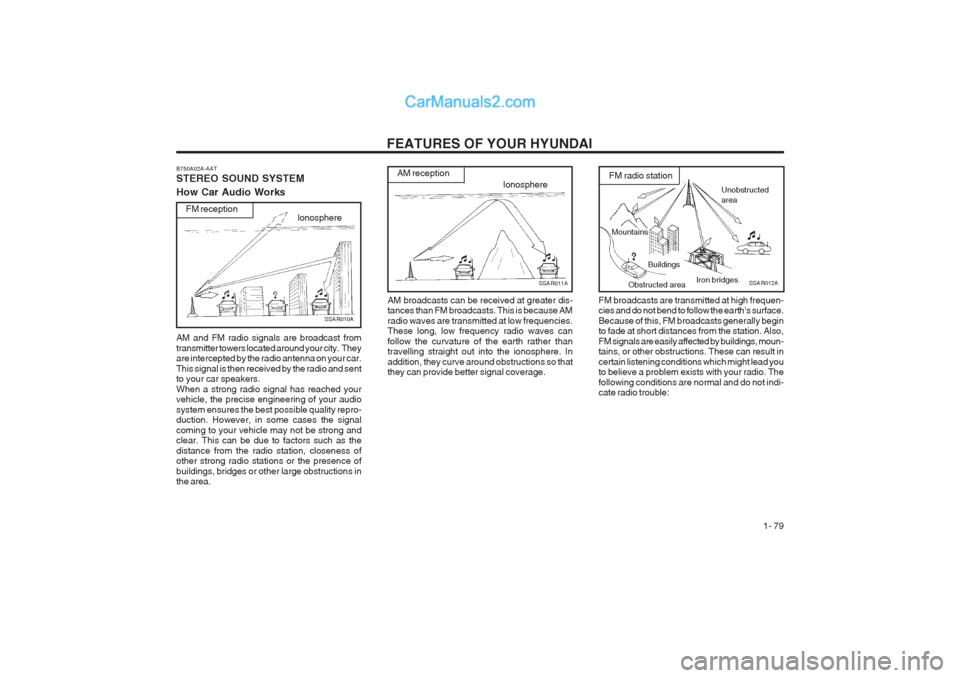
SSAR010A FM broadcasts are transmitted at high frequen- cies and do not bend to follow the earth's surface. Because of this, FM broadcasts generally begin to fade at short distances from the station. Also, FM signals are easily affected by buildings, moun- tains, or other obstructions. These can result in certain listening conditions which might lead you to believe a problem exists with your radio. The following conditions are normal and do not indi- cate radio trouble:
AM broadcasts can be received at greater dis-tances than FM broadcasts. This is because AM radio waves are transmitted at low frequencies. These long, low frequency radio waves can follow the curvature of the earth rather than travelling straight out into the ionosphere. In addition, they curve around obstructions so that they can provide better signal coverage.
B750A02A-AAT STEREO SOUND SYSTEM How Car Audio Works AM and FM radio signals are broadcast from transmitter towers located around your city. They are intercepted by the radio antenna on your car. This signal is then received by the radio and sent to your car speakers. When a strong radio signal has reached your vehicle, the precise engineering of your audio system ensures the best possible quality repro- duction. However, in some cases the signal coming to your vehicle may not be strong and clear. This can be due to factors such as the distance from the radio station, closeness of other strong radio stations or the presence of buildings, bridges or other large obstructions in the area.
Page 107 of 349
DRIVING YOUR HYUNDAI 2- 1
2. DRIVING YOUR HYUNDAI
C010A01O-AAT
WARNING: ENGINE EXHAUST CAN BE DANGEROUS!
Engine exhaust fumes can be extremely dangerous. If, at any time, you smell exhaust fumes inside the vehicle, open the windows immediately. o Do not inhale exhaust fumes. Exhaust fumes contain carbon monoxide, a colorless, odorless gas that can cause unconsciousness and death by asphyxiation. o Be sure the exhaust system does not leak. The exhaust system should be checked whenever the vehicle is raised to change the oil or for any other purpose. If you hear a change in the sound of the exhaust or if you drive over something that strikes the underneath side of the car, have the exhau st
system checked as soon as possible by your Hyundai dealer. o Do not run the engine in an enclosed area. Letting the engine idle in your garage, even with the garage door open, is a hazardous practice. Never run the engine in your garage any longer than it takes to start the engine and back the car out. o Avoid idling the engine for prolonged periods with people inside the car. If it is necessary to idle the engine for a prolonged period with people inside the car, be sure to do so only in an open area with
the air intake set at "Fresh" and fan operating at one of the higher speeds so fresh air is drawn into the interior. If you must drive with the tail gate open because you are carrying objects that make this necessary:1. Close all windows. 2. Open side vents. 3. Set the air intake control at "Fresh", the air flow control at "Floor" or "Face" and the fan at one of the higher speeds.
To assure proper operation of the ventilation system, be sure the ventilation air intakes located just in front of the windshield are kept clear of snow, ice, leaves or other obstructions.
2