run Hyundai Terracan 2003 Owner's Guide
[x] Cancel search | Manufacturer: HYUNDAI, Model Year: 2003, Model line: Terracan, Model: Hyundai Terracan 2003Pages: 349, PDF Size: 4.56 MB
Page 161 of 349
DO-IT-YOURSELF MAINTENANCE 6-15
anymore than 8.0 mm. If you have the instru- ments to check it with a force of 98N (22 lb.), the deflection should be approx. 8.0 mm (0.315 inches). If the belt is too loose, have it adjusted by your Hyundai dealer. NOTE: The compressor drive belt tension for diesel engine (2.9 CRDi only) is adjusted automati- cally.
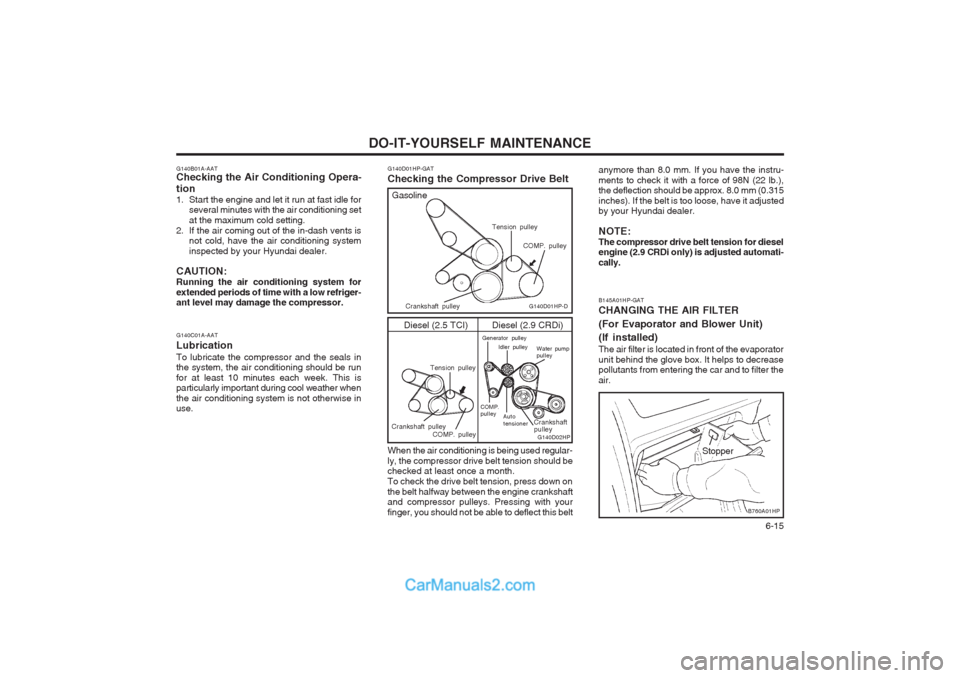
B145A01HP-GAT CHANGING THE AIR FILTER (For Evaporator and Blower Unit) (If installed) The air filter is located in front of the evaporator unit behind the glove box. It helps to decrease pollutants from entering the car and to filter the air.
B760A01HP
Stopper
Diesel (2.5 TCI)
G140D01HP-GAT Checking the Compressor Drive Belt When the air conditioning is being used regular- ly, the compressor drive belt tension should be checked at least once a month. To check the drive belt tension, press down onthe belt halfway between the engine crankshaft and compressor pulleys. Pressing with your finger, you should not be able to deflect this belt
G140D01HP-D
G140D02HP
Gasoline
Generator pulley
Idler pulley Water pump pulley
COMP.pulley Auto tensionerCOMP. pulley
Crankshaft pulley Diesel (2.9 CRDi)
Crankshaft pulleyCOMP. pulleyCrankshaft pulley
Tension pulley
Tension pulley
G140B01A-AAT Checking the Air Conditioning Opera- tion
1. Start the engine and let it run at fast idle for
several minutes with the air conditioning set at the maximum cold setting.
2. If the air coming out of the in-dash vents is not cold, have the air conditioning systeminspected by your Hyundai dealer.
CAUTION:Running the air conditioning system forextended periods of time with a low refriger- ant level may damage the compressor. G140C01A-AAT LubricationTo lubricate the compressor and the seals in the system, the air conditioning should be run for at least 10 minutes each week. This is particularly important during cool weather when the air conditioning system is not otherwise in use.
Page 164 of 349
DO-IT-YOURSELF MAINTENANCE
6-18
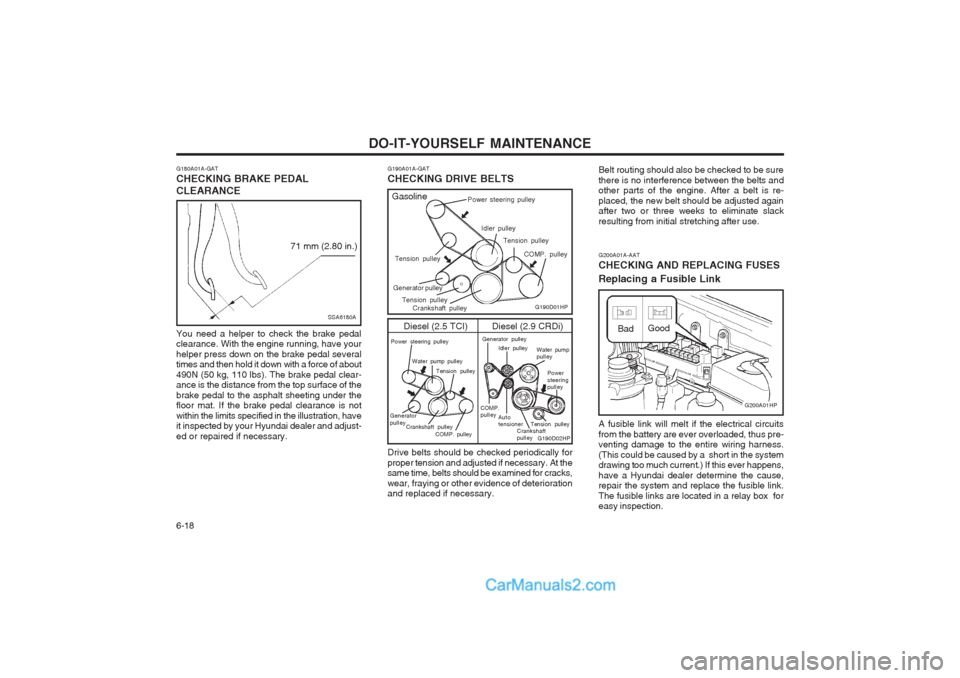
G200A01A-AAT CHECKING AND REPLACING FUSES Replacing a Fusible Link A fusible link will melt if the electrical circuits from the battery are ever overloaded, thus pre- venting damage to the entire wiring harness. (This could be caused by a short in the system drawing too much current.) If this ever happens, have a Hyundai dealer determine the cause, repair the system and replace the fusible link. The fusible links are located in a relay box for easy inspection.
G200A01HP
Bad
Good
Belt routing should also be checked to be sure there is no interference between the belts and other parts of the engine. After a belt is re- placed, the new belt should be adjusted again after two or three weeks to eliminate slack resulting from initial stretching after use.
G190A01A-GAT CHECKING DRIVE BELTS Drive belts should be checked periodically for proper tension and adjusted if necessary. At the same time, belts should be examined for cracks, wear, fraying or other evidence of deterioration and replaced if necessary. Diesel (2.5 TCI)
G190D01HP
G190D02HP
Gasoline
Generator pulley
Idler pulley Water pump pulley
COMP.pulley Autotensioner
Crankshaft pulley
Diesel (2.9 CRDi)
Crankshaft pulleyCOMP. pulley
Generator pulley Power steering pulley
Idler pulley Tension pulley
COMP. pulley
Power steering pulley
Water pump pulley Tension pulley Power steering pulley
Crankshaft pulleyTension pulleyGenerator pulley
Tension pulley
Tension pulley
G180A01A-GAT CHECKING BRAKE PEDAL CLEARANCE You need a helper to check the brake pedal clearance. With the engine running, have your helper press down on the brake pedal several times and then hold it down with a force of about 490N (50 kg, 110 lbs). The brake pedal clear- ance is the distance from the top surface of the brake pedal to the asphalt sheeting under the floor mat. If the brake pedal clearance is not within the limits specified in the illustration, have it inspected by your Hyundai dealer and adjust- ed or repaired if necessary.
SSA6180A
71 mm (2.80 in.)
Page 166 of 349
DO-IT-YOURSELF MAINTENANCE
6-20
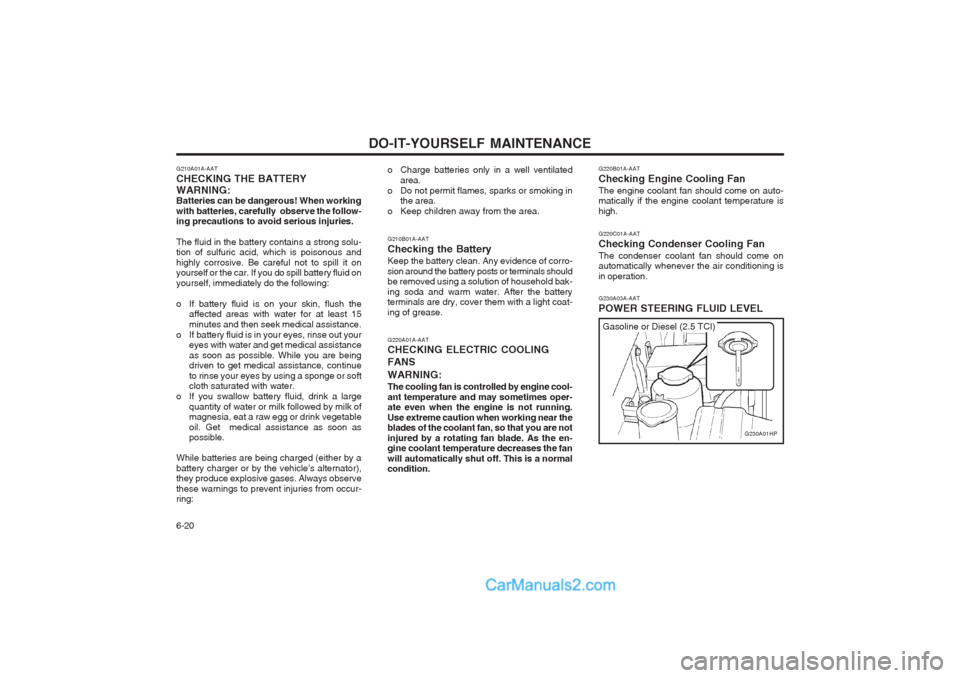
G220B01A-AAT Checking Engine Cooling FanThe engine coolant fan should come on auto- matically if the engine coolant temperature is high. G220C01A-AAT Checking Condenser Cooling FanThe condenser coolant fan should come on automatically whenever the air conditioning is in operation. G230A03A-AAT POWER STEERING FLUID LEVEL
G230A01HP
Gasoline or Diesel (2.5 TCI)
o Charge batteries only in a well ventilated
area.
o Do not permit flames, sparks or smoking in the area.
o Keep children away from the area. G210B01A-AAT Checking the BatteryKeep the battery clean. Any evidence of corro- sion around the battery posts or terminals should be removed using a solution of household bak- ing soda and warm water. After the battery terminals are dry, cover them with a light coat- ing of grease. G220A01A-AAT CHECKING ELECTRIC COOLING FANS WARNING: The cooling fan is controlled by engine cool- ant temperature and may sometimes oper- ate even when the engine is not running. Use extreme caution when working near the blades of the coolant fan, so that you are not injured by a rotating fan blade. As the en- gine coolant temperature decreases the fan will automatically shut off. This is a normal condition.
G210A01A-AAT CHECKING THE BATTERYWARNING: Batteries can be dangerous! When working with batteries, carefully observe the follow- ing precautions to avoid serious injuries. The fluid in the battery contains a strong solu- tion of sulfuric acid, which is poisonous and highly corrosive. Be careful not to spill it on yourself or the car. If you do spill battery fluid on yourself, immediately do the following:
o If battery fluid is on your skin, flush the
affected areas with water for at least 15 minutes and then seek medical assistance.
o If battery fluid is in your eyes, rinse out your eyes with water and get medical assistanceas soon as possible. While you are being driven to get medical assistance, continue to rinse your eyes by using a sponge or soft cloth saturated with water.
o If you swallow battery fluid, drink a large quantity of water or milk followed by milk ofmagnesia, eat a raw egg or drink vegetable oil. Get medical assistance as soon as possible.
While batteries are being charged (either by a battery charger or by the vehicle’s alternator), they produce explosive gases. Always observe these warnings to prevent injuries from occur- ring:
Page 173 of 349
EMISSION CONTROL SYSTEMS 7-1
7. EMISSION
CONTROL SYSTEMS
H010A01A-GAT EMISSION CONTROL SYSTEMS (If installed) Your Hyundai is equipped with an emission control system to meet all requirements of the Emission prohibition rules of your province. There are three emission control systems which are as follows. (1) Crankcase emission control system (For a Gasoline Engine)
(2) Evaporative emission control system (For a Gasoline Engine)
(3) Exhaust emission control system In order to assure the proper function of the emission control systems, it is recommended that you have your car inspected and main- tained by an authorized Hyundai dealer in ac- cordance with the maintenance schedule in this manual. H010C02Y-GAT 2. Evaporative Emission Control
System; For a Gasoline Engine
The Evaporative Emission Control System is
designed to prevent fuel vapors from escaping into the atmosphere. Canister While the engine is inoperative, fuel vapors
generated inside the fuel tank are absorbed and stored in the canister. When the engine is
running, the fuel vapors absorbed in the canis- ter are drawn into the induction system through the purge control solenoid valve. Purge Control Solenoid Valve The purge control solenoid valve is controlled
by the ECM; when the engine coolant tempera- ture is low, and during idling, it closes, so that evaporated fuel is not taken into the surge tank.
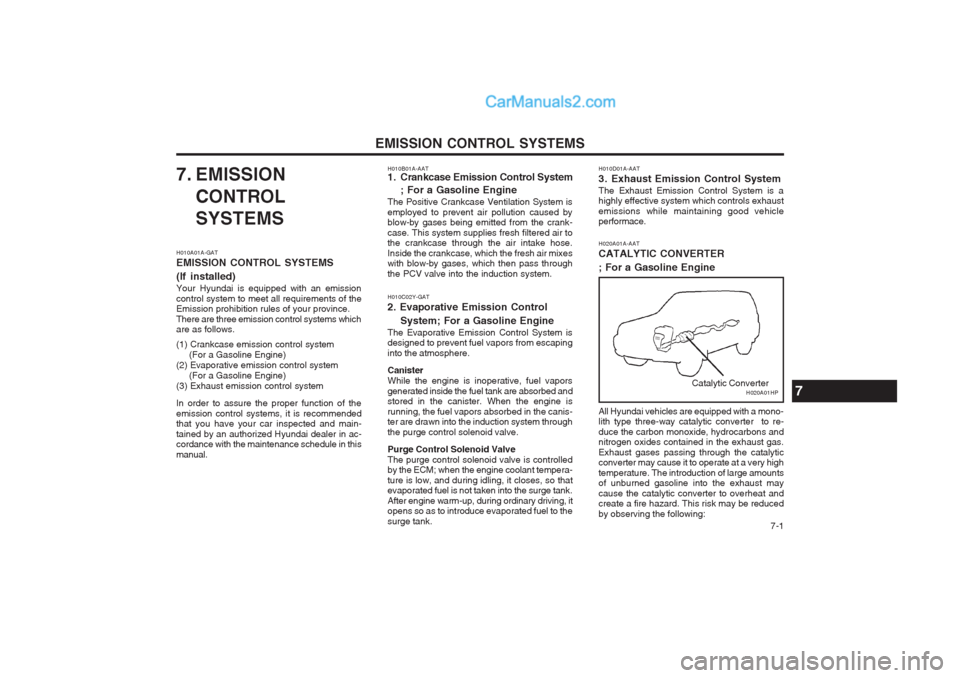
After engine warm-up, during ordinary driving, it opens so as to introduce evaporated fuel to the surge tank. H020A01A-AAT CATALYTIC CONVERTER ; For a Gasoline Engine
H020A01HP
Catalytic Converter
All Hyundai vehicles are equipped with a mono- lith type three-way catalytic converter to re- duce the carbon monoxide, hydrocarbons and nitrogen oxides contained in the exhaust gas. Exhaust gases passing through the catalytic converter may cause it to operate at a very high temperature. The introduction of large amounts of unburned gasoline into the exhaust may cause the catalytic converter to overheat and create a fire hazard. This risk may be reduced by observing the following:
H010B01A-AAT
1. Crankcase Emission Control System
; For a Gasoline Engine
The Positive Crankcase Ventilation System is employed to prevent air pollution caused by blow-by gases being emitted from the crank- case. This system supplies fresh filtered air to the crankcase through the air intake hose. Inside the crankcase, which the fresh air mixes with blow-by gases, which then pass through the PCV valve into the induction system.7
H010D01A-AAT
3. Exhaust Emission Control SystemThe Exhaust Emission Control System is a highly effective system which controls exhaust emissions while maintaining good vehicle performace.
Page 174 of 349
7-2EMISSION CONTROL SYSTEMS
WARNING:
o Use unleaded fuel only.
o Maintain the engine in good operating condition. Extremely high catalytic con-verter temperatures can result from im- proper operation of the electrical, igni- tion or multiport electronic fuel injection.
o If your engine stalls, pings, knocks, or is hard to start, have your Hyundai dealerinspect and repair the problem as soon as possible.
o Avoid driving with a very low fuel level. Running out of gasoline may cause theengine to misfire and result in damage to the catalytic converter.
o Avoid idling the engine for periods long- er than 10 minutes.
o The vehicle should not be pushed or pulled to get started. This may cause the catalytic converter to overheat and cre- ate a fire hazard.
o Do not touch the catalytic converter or any other part of the exhaust systemwhile the catalytic converter is hot. Shut off the engine, wait for at least one hour before touching the catalytic converter or any other part of the exhaust system.
o Remember that your Hyundai dealer is your best source of assistance.
o Do not stop your Hyundai over any com- bustible material such as grass, paper,leaves or rags. These materials might contact the hot catalytic converter and a fire might result. H020C01HP-GAT EGR SYSTEM ; For a Diesel Engine (If installed) This system helps control oxides of nitrogen by recirculating a part of the exhaust gas into the engine, there by reducing cylinder combustion temperature.This system can be reduced Nox of Emission used by EGR.
H020D01S-GAT CATALYTIC CONVERTER ; For a Diesel Engine (If installed) All Hyundai vehicles are equipped with oxida- tion type catalytic converter to reduce the car- bon monoxide, hydrocarbons and particulate contained in the exhaust gas.
Page 189 of 349
DA030A1-EResponsibilty For Maintenance
It is the responsibility of the vehicle owner/driver to ensure that all routine maintenance services are undertaken in line with the recommendations specified in Section 5 of thismanual. In addition, in order to ensure continued validity of the new vehicle warrantyand safe operation of the vehicle, non scheduled maintenance/running repairs shouldbe undertaken at the earliest available opportunity. Under severe operating conditions, more frequent maintenance is required. Details of the maintenance schedule for such conditions are also given in section 5. It is recommended that all maintenance operations and repairs are entrusted to a franchised Hyundai dealer to ensure that the latest repair methods, specialized toolingand genuine Hyundai parts are used to ensure the continued reliability and safety ofthe vehicle.
Page 190 of 349
A040A02P-EATFOREWORD
Hyundai Motor Company wish to take this opportunity to thank you for purchasing a Hyundai product and to welcome you to the ever increasing number of discriminating motorists who drive Hyundai vehicles. The advanced engineering and construction methods employed during both design and production of the Hyundai marque are something of which we are proud, and this commitment to providing a high quality product is supported by a comprehensive after sales andwarranty service of which we are equally proud. This owner's manual will introduce the operating and maintenance requirements for the vehicle and it is recommended that it is carefully read to ensure that the maximum performance and durability along with safe and satisfactory operationare obtained. The recommended routine maintenance servicing along with any running repairs that may be required should be entrusted to a franchised Hyundai dealer to ensure that only the latest methods and genuine Hyundai replacement parts are used for the continued reliability, safety and performance of the vehicle. Should any question or query exist regarding any aspect of your Hyundai please contact the nearest Hyundai dealer who will be only too pleased to assist wherever possible. Note: This owners manual should be considered as part of the vehicle and should be kept in the vehicle at all times for
ease of reference. In the event of the vehicle being sold please ensure that this manual is left in the vehicle for the reference of the new owner .
CAUTION: Severe engine and transmission damage may result from the use of poor quality fuels and
lubricants that do not meet Hyundai specifications. You must always use high quality fuels and lubricants that meet the specifications listed on Page 9-3 in the Vehicle Specifications section of the Owner's Manual. Copyright 2003 Hyundai Motor Company. All rights reserved. No part of this publication may be reproduced, stored in any retrieval system or transmitted in any form or by any means without the prior written permission of Hyundai MotorCompany.
Page 195 of 349
CONTROLS AND EQUIPMENT1- 1
ZB000A1-A
1. CONTROLS AND
EQUIPMENT neck. However, care must be exercised when refuelling the vehicle tank from jerry cans or bymeans of a funnel that the fuel being used isunleaded.
The use of leaded fuel in this vehicle will result
in irreversible pollution of the catalyst element.Such pollution will prevent correct operation ofthe catalyst and give rise to increased operat-ing temperatures leading to the catalyst ele-ment melting and restricting the exhaust flowalong with an increase in exhaust emissionlevels.
CAUTION: The vehicle warranty will not extend to dam-
age arising from the use of incorrect fuels.
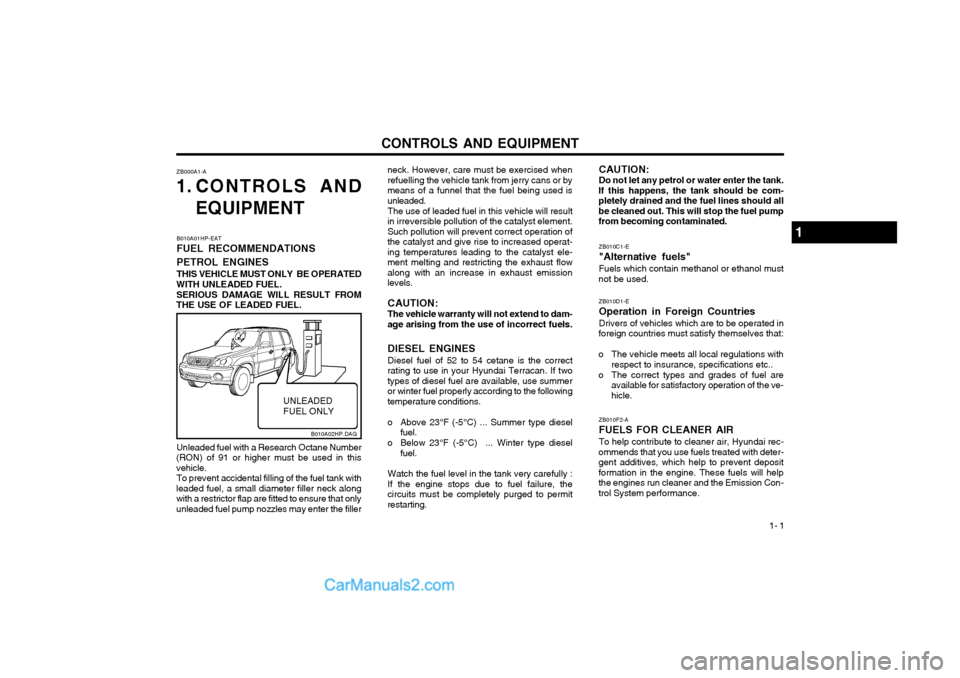
Unleaded fuel with a Research Octane Number
(RON) of 91 or higher must be used in this vehicle. To prevent accidental filling of the fuel tank with
leaded fuel, a small diameter filler neck alongwith a restrictor flap are fitted to ensure that onlyunleaded fuel pump nozzles may enter the filler
B010A02HP.DAG
UNLEADED FUEL ONLY
B010A01HP-EAT FUEL RECOMMENDATIONS PETROL ENGINES THIS VEHICLE MUST ONLY BE OPERATED
WITH UNLEADED FUEL.
SERIOUS DAMAGE WILL RESULT FROM
THE USE OF LEADED FUEL.
DIESEL ENGINESDiesel fuel of 52 to 54 cetane is the correct
rating to use in your Hyundai Terracan. If two types of diesel fuel are available, use summeror winter fuel properly according to the followingtemperature conditions.
o Above 23°F (-5°C) ... Summer type diesel fuel.
o Below 23°F (-5°C) ... Winter type diesel fuel.
Watch the fuel level in the tank very carefully :
If the engine stops due to fuel failure, the circuits must be completely purged to permitrestarting. CAUTION: Do not let any petrol or water enter the tank.
If this happens, the tank should be com- pletely drained and the fuel lines should allbe cleaned out. This will stop the fuel pumpfrom becoming contaminated.
ZB010D1-E Operation in Foreign CountriesDrivers of vehicles which are to be operated in
foreign countries must satisfy themselves that:
o The vehicle meets all local regulations with respect to insurance, specifications etc..
o The correct types and grades of fuel are available for satisfactory operation of the ve- hicle.
ZB010C1-E "Alternative fuels"Fuels which contain methanol or ethanol must
not be used.
ZB010F2-AFUELS FOR CLEANER AIRTo help contribute to cleaner air, Hyundai rec-
ommends that you use fuels treated with deter- gent additives, which help to prevent depositformation in the engine. These fuels will helpthe engines run cleaner and the Emission Con-trol System performance.
1
Page 196 of 349
CONTROLS AND EQUIPMENT
1- 2 YB020A1-E BEFORE ENTERING THE VEHICLE
o Ensure that all windows, mirrors and lamps are clean.
o Check condition of all tyres.
o Ensure that no fluid leaks are evident.
o Ensure that the area around the vehicle is clear before driving off.
YB020B1-E AFTER ENTERING THE VEHICLE
o Ensure that all occupants fasten and cor- rectly adjust seat belts.
o Ensure that seat and headrestraint positions are adjusted for optimum safety, control and comfort.
o Adjust interior and exterior rear view mir- rors.
o Verify correct operation of lamps, horn and other electrical equipment.
o Ensure that warning lamps illuminate when ignition is turned on.
NOTE: Fluid levels such as engine oil, engine cool- ant, brake and windscreen washer fluidshould be checked daily or at each refuel-ling, whichever occurs sooner. B020A01FC-EAT RUNNING IN YOUR NEW HYUNDAIThe longevity and performance of the vehicle are greatly affected by the care exercised dur-ing the first 1000 miles of motoring. Because ofmodern manufacturing techniques, rigid guide-lines regarding maximum road speeds havebecome unnecessary. However, certain pre-cautions should be observed in order to obtainthe best possible performance and useful lifefrom the vehicle.
1) Do not race the engine without a load (i.e revving the engine in neutral).
2) During the first 500 miles the maximum engine speed should be restricted to 3000rpm and gradually increased thereafter.
3) Avoid prolonged constant speed operation. The internal components of the engine willbecome run-in more quickly if the operation
speed is varied during the running in period.
4) Never allow the engine to labour. Use the gearbox freely and avoid large throttle open-ings when the engine speed is below 1500rpm.
5) Avoid rapid acceleration and maximum throttle openings.
6) Avoid harsh braking during the first 100 miles of urban motoring or 1000 miles ofmotorway driving to allow the friction facingsof the brake pads and shoes to bed againstthe discs and drums properly.
7) No trailer towing should be undertaken dur- ing the running-in period. B880A01HP-EAT IMMOBILISER SYSTEM
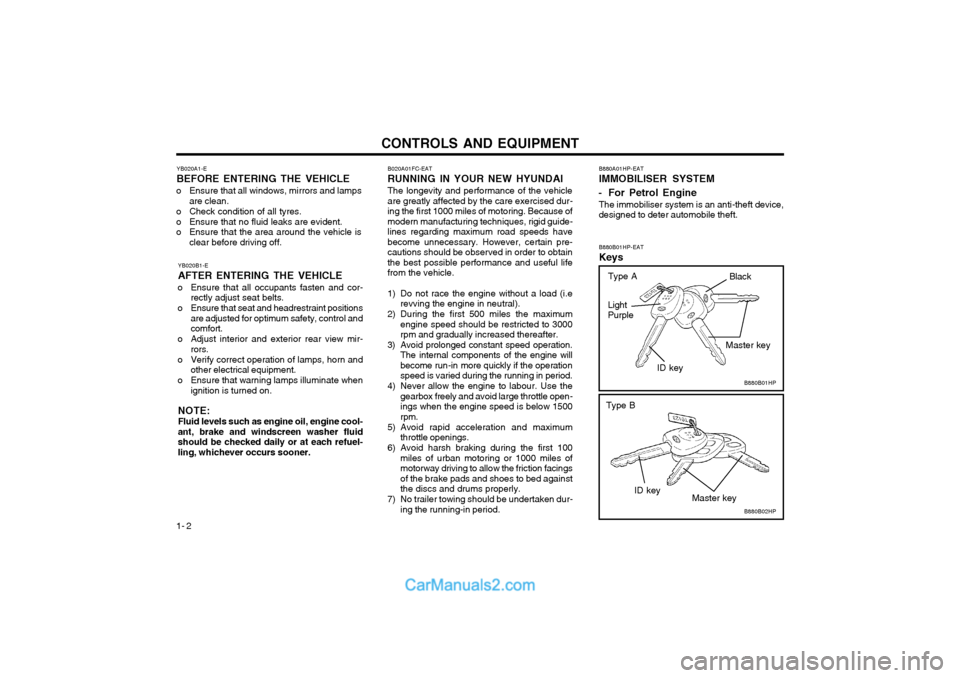
- For Petrol Engine The immobiliser system is an anti-theft device, designed to deter automobile theft. B880B01HP-EAT Keys
B880B01HP
B880B02HP
Light Purple
ID key
ID key Master key
Master key
Type B
Black
Type A
Page 229 of 349
CONTROLS AND EQUIPMENT1- 35
B260P02Y-EAT
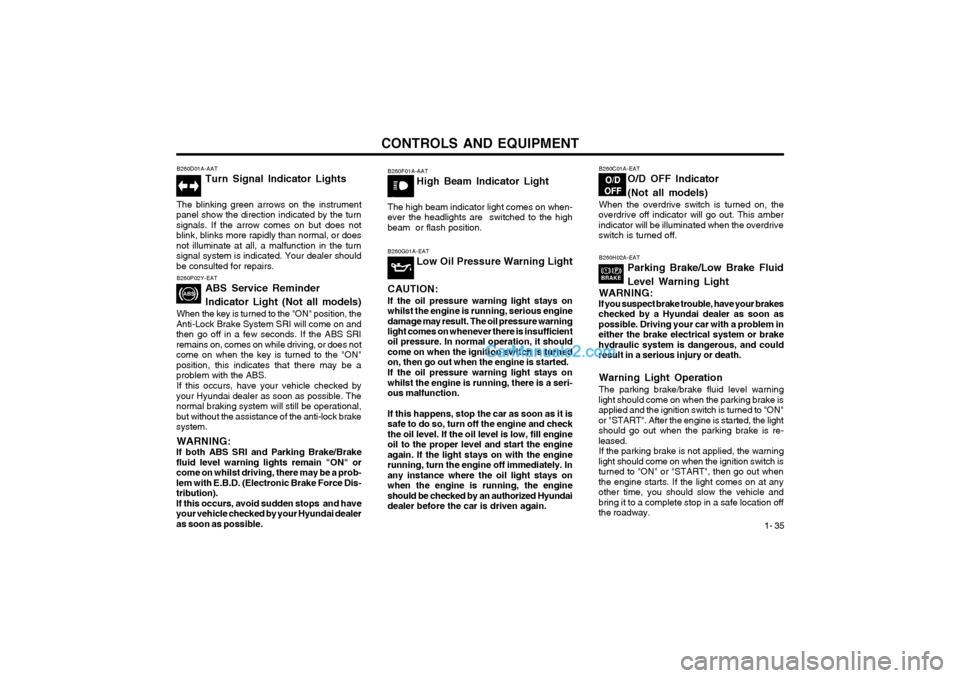
ABS Service Reminder Indicator Light (Not all models)
When the key is turned to the "ON" position, the
Anti-Lock Brake System SRI will come on and then go off in a few seconds. If the ABS SRIremains on, comes on while driving, or does notcome on when the key is turned to the "ON"position, this indicates that there may be aproblem with the ABS.
If this occurs, have your vehicle checked by
your Hyundai dealer as soon as possible. Thenormal braking system will still be operational,but without the assistance of the anti-lock brakesystem.
WARNING:
If both ABS SRI and Parking Brake/Brakefluid level warning lights remain "ON" orcome on whilst driving, there may be a prob-
lem with E.B.D. (Electronic Brake Force Dis-tribution).If this occurs, avoid sudden stops and haveyour vehicle checked by your Hyundai dealeras soon as possible. B260F01A-AAT
High Beam Indicator Light
The high beam indicator light comes on when-
ever the headlights are switched to the highbeam or flash position.
B260D01A-AAT
Turn Signal Indicator Lights
The blinking green arrows on the instrument
panel show the direction indicated by the turn signals. If the arrow comes on but does notblink, blinks more rapidly than normal, or doesnot illuminate at all, a malfunction in the turnsignal system is indicated. Your dealer shouldbe consulted for repairs. B260G01A-EAT
Low Oil Pressure Warning Light
CAUTION:
If the oil pressure warning light stays onwhilst the engine is running, serious enginedamage may result. The oil pressure warninglight comes on whenever there is insufficient oil pressure. In normal operation, it should come on when the ignition switch is turnedon, then go out when the engine is started. If the oil pressure warning light stays on
whilst the engine is running, there is a seri-ous malfunction.
If this happens, stop the car as soon as it is
safe to do so, turn off the engine and checkthe oil level. If the oil level is low, fill engineoil to the proper level and start the engineagain. If the light stays on with the enginerunning, turn the engine off immediately. Inany instance where the oil light stays onwhen the engine is running, the engineshould be checked by an authorized Hyundaidealer before the car is driven again.B260C01A-EAT
O/D OFF Indicator (Not all models)
When the overdrive switch is turned on, the
overdrive off indicator will go out. This amber indicator will be illuminated when the overdriveswitch is turned off.
B260H02A-EAT
Parking Brake/Low Brake Fluid Level Warning Light
WARNING:
If you suspect brake trouble, have your brakes checked by a Hyundai dealer as soon aspossible. Driving your car with a problem ineither the brake electrical system or brakehydraulic system is dangerous, and couldresult in a serious injury or death.
Warning Light Operation The parking brake/brake fluid level warning
light should come on when the parking brake is applied and the ignition switch is turned to "ON"or "START". After the engine is started, the lightshould go out when the parking brake is re-leased. If the parking brake is not applied, the warning
light should come on when the ignition switch isturned to "ON" or "START", then go out whenthe engine starts. If the light comes on at anyother time, you should slow the vehicle andbring it to a complete stop in a safe location offthe roadway.