run Hyundai Terracan 2003 Service Manual
[x] Cancel search | Manufacturer: HYUNDAI, Model Year: 2003, Model line: Terracan, Model: Hyundai Terracan 2003Pages: 349, PDF Size: 4.56 MB
Page 288 of 349
DRIVING YOUR HYUNDAI 2- 17
YC200D2-E
Safety Cables
Should the towbar connection between your car
and the trailer or vehicle you are towing fail, the trailer or vehicle could wander dangerouslyacross other lanes of traffic and ultimately leavethe roadway. To eliminate this potentially dan-gerous situation, safety cables, attached be-tween your car and the trailer or towed vehicle,are required.
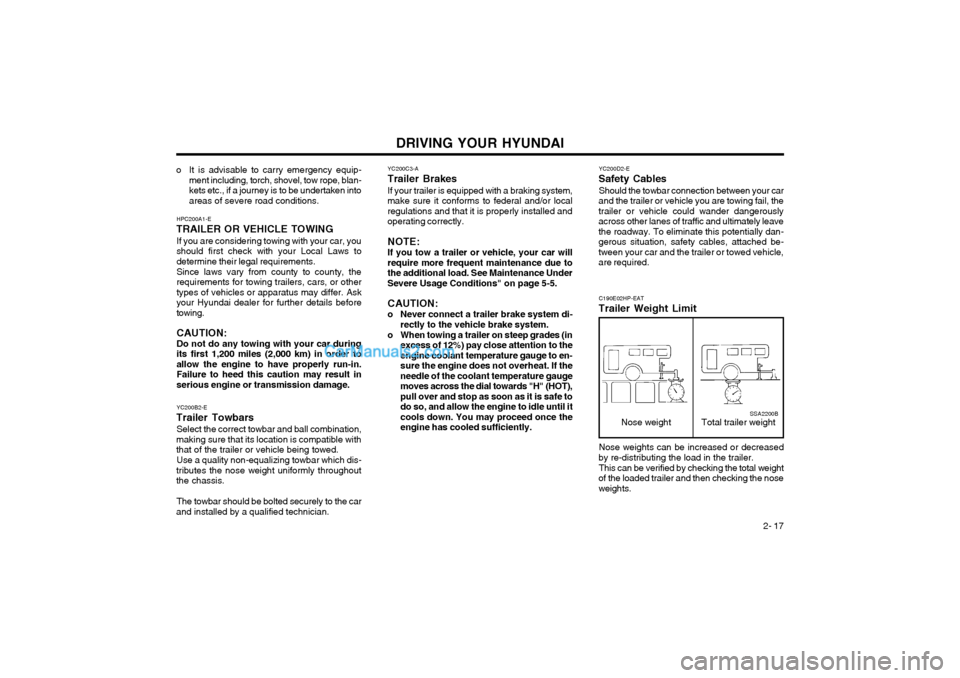
Nose weight Total trailer weightSSA2200B
C190E02HP-EAT
Trailer Weight Limit
Nose weights can be increased or decreased
by re-distributing the load in the trailer.
This can be verified by checking the total weight
of the loaded trailer and then checking the nose weights.
YC200C3-A
Trailer Brakes
If your trailer is equipped with a braking system,
make sure it conforms to federal and/or localregulations and that it is properly installed andoperating correctly.
NOTE: If you tow a trailer or vehicle, your car will
require more frequent maintenance due to the additional load. See Maintenance UnderSevere Usage Conditions" on page 5-5.
CAUTION:
o Never connect a trailer brake system di- rectly to the vehicle brake system.
o When towing a trailer on steep grades (in excess of 12%) pay close attention to theengine coolant temperature gauge to en-sure the engine does not overheat. If theneedle of the coolant temperature gaugemoves across the dial towards "H" (HOT),pull over and stop as soon as it is safe todo so, and allow the engine to idle until itcools down. You may proceed once theengine has cooled sufficiently.
HPC200A1-E
TRAILER OR VEHICLE TOWING
If you are considering towing with your car, youshould first check with your Local Laws todetermine their legal requirements. Since laws vary from county to county, the requirements for towing trailers, cars, or othertypes of vehicles or apparatus may differ. Askyour Hyundai dealer for further details beforetowing. CAUTION: Do not do any towing with your car duringits first 1,200 miles (2,000 km) in order toallow the engine to have properly run-in.Failure to heed this caution may result inserious engine or transmission damage. YC200B2-E
Trailer Towbars Select the correct towbar and ball combination,
making sure that its location is compatible with that of the trailer or vehicle being towed.
Use a quality non-equalizing towbar which dis-
tributes the nose weight uniformly throughoutthe chassis.
The towbar should be bolted securely to the car
and installed by a qualified technician.
o It is advisable to carry emergency equip-
ment including, torch, shovel, tow rope, blan-kets etc., if a journey is to be undertaken intoareas of severe road conditions.
Page 289 of 349
DRIVING YOUR HYUNDAI
2- 18 NOTE:
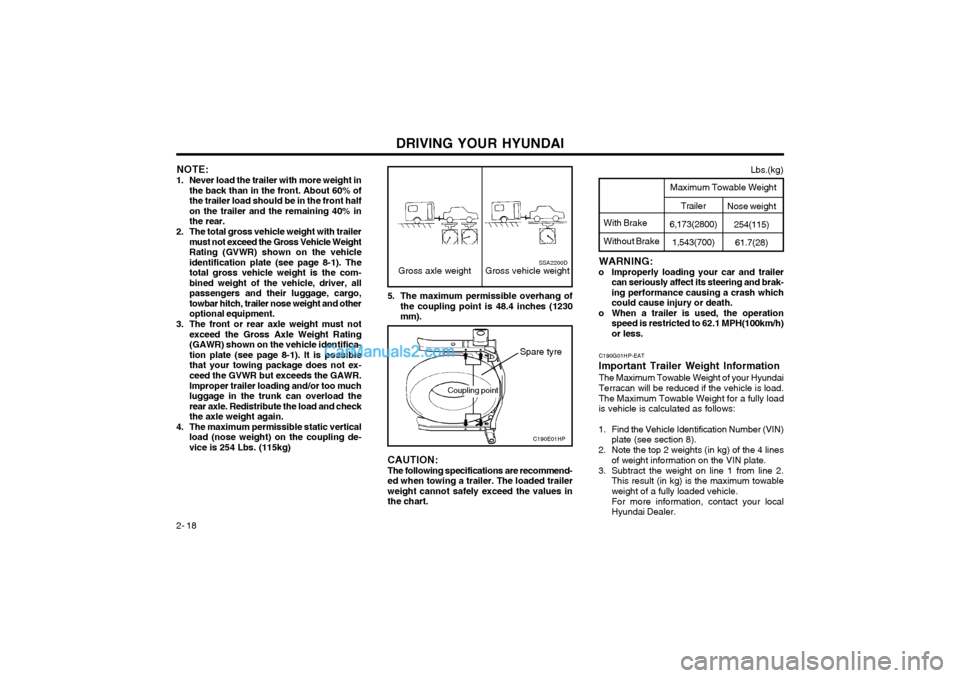
1. Never load the trailer with more weight in the back than in the front. About 60% of the trailer load should be in the front halfon the trailer and the remaining 40% inthe rear.
2. The total gross vehicle weight with trailer must not exceed the Gross Vehicle WeightRating (GVWR) shown on the vehicleidentification plate (see page 8-1). Thetotal gross vehicle weight is the com-bined weight of the vehicle, driver, allpassengers and their luggage, cargo,towbar hitch, trailer nose weight and otheroptional equipment.
3. The front or rear axle weight must not exceed the Gross Axle Weight Rating(GAWR) shown on the vehicle identifica-tion plate (see page 8-1). It is possiblethat your towing package does not ex-ceed the GVWR but exceeds the GAWR. Improper trailer loading and/or too much luggage in the trunk can overload therear axle. Redistribute the load and checkthe axle weight again.
4. The maximum permissible static vertical load (nose weight) on the coupling de-vice is 254 Lbs. (115kg) 5. The maximum permissible overhang of
the coupling point is 48.4 inches (1230mm).
Gross axle weight Gross vehicle weightSSA2200D
CAUTION: The following specifications are recommend-ed when towing a trailer. The loaded trailerweight cannot safely exceed the values inthe chart.
Lbs.(kg)
Maximum Towable Weight
With Brake Without Brake Trailer
6,173(2800) 1,543(700) Nose weight
254(115)61.7(28)
WARNING:
o Improperly loading your car and trailer can seriously affect its steering and brak- ing performance causing a crash whichcould cause injury or death.
o When a trailer is used, the operation speed is restricted to 62.1 MPH(100km/h)or less.
C190E01HP
Spare tyre
Coupling point
C190G01HP-EAT
Important Trailer Weight Information
The Maximum Towable Weight of your Hyundai Terracan will be reduced if the vehicle is load. The Maximum Towable Weight for a fully load is vehicle is calculated as follows:
1. Find the Vehicle Identification Number (VIN) plate (see section 8).
2. Note the top 2 weights (in kg) of the 4 lines of weight information on the VIN plate.
3. Subtract the weight on line 1 from line 2. This result (in kg) is the maximum towableweight of a fully loaded vehicle. For more information, contact your local Hyundai Dealer.
Page 290 of 349
DRIVING YOUR HYUNDAI 2- 19
CAUTION: If overheating should occur when towing,
(temperature gauge reads near red zone), taking the following action may reduce oreliminate the problem.
1. Turn off the air conditioner.
2. Reduce highway speed.
3. Select a lower gear when going uphill.
4. Whilst in stop and go traffic, place the gear selector in park or neutral and idle the engine at a higher speed.
HPC200E1-E
Trailer or Vehicle Towing Tips
1. Before towing, check towbar and safety cable connections as well as proper operation of the trailer running lights, brake lights, andturn signals.
2. Always drive your vehicle at a moderate speed (Less than 60 mph)
3. Trailer towing requires more fuel than nor- mal conditions.
4. To maintain engine braking efficiency and electrical charging performance, do not usefifth gear (manual transmission).
5. Always secure items in the trailer to prevent load shift whilst driving.
6. Check the condition and air pressure of all tyres on the trailer and your car. Low tyrepressure can seriously affect the handling.Also check the spare tyre.
7. The vehicle/trailer combination is more af- fected by crosswind and buffeting. When being passed by a large vehicle, keep a constant speed and steer straight ahead.If there is too much wind buffeting slowdown to get out of the other vehicle's airturbulence.
8. When parking your car and trailer, especial- ly on a hill, be sure to follow all the normalprecautions. Turn your front wheel into thecurb, set the parking brake firmly, and putthe transmission in 1st or Reverse (manual)or Park (automatic). In addition, place wheelchocks at each of the trailer's tyres. 9. If the trailer has electric brakes, start your
vehicle and trailer moving, and then applythe trailer brake controller by hand to besure the brakes are working. This lets youcheck your electrical connection at the sametime.
10. During your trip, check occasionally to be sure that the load is secure, and that thelights and any trailer brakes are still working.
11. Avoid jerky starts, sudden acceleration or sudden stops.
12. Avoid sharp turns and rapid lane changes.
13. Avoid holding the brake pedal down too long or too frequently. This could cause the brakes to overheat, resulting in reduced brakingefficiency.
14. When going down a hill, shift into a lower gear and use the engine braking effect. When ascending a long grade, downshift the transmission to a lower gear and reducespeed to reduce chances of engine over-loading and/or overheating.
15. If you have to stop whilst going uphill, do not hold the vehicle in place by pressing on theaccelerator. This can cause the automatictransmission to overheat. Use the parkingbrake or footbrake.
NOTE: When towing, check transmission fluid more
frequently.
Page 291 of 349
IN CASE OF EMERGENCY 3-1
ZD000A1-A
3. IN CASE OF EMER-
GENCY
D010A01A-EAT
If Engine Stalls Whilst Driving
1. Reduce your speed gradually, keeping a straight line. Move cautiously off the road to a safe place.
2. Turn on your emergency flashers.
3. Try starting the engine again. If your vehicle will not start, contact Hyundai dealer or seek other qualified assistance.
SD020A1-E
IF THE ENGINE WILL NOT START Seek assistance from the nearest Hyundai dealer with regard to the method of ignition and fuelsystem diagnosis.
CAUTION: If the engine refuses to start, no attempt
should be made to push or tow start the vehicle. Vehicles with automatic transmis- sion or fuel injection will not be able to be started in this manner since no drive istransmitted through the automatic trans-mission whilst the engine is not running,and in the case of fuel injected derivatives,the fuel pump will not operate under towstart conditions. In addition, if the vehicle isequipped with an exhaust catalyst, damageto the catalyst may result if the vehicle istow started. HPD020B1-E
IF THE ENGINE CANNOT BE
CRANKED
1. If the vehicle is fitted with manual transmis- sion, ensure that the clutch pedal is de-
pressed whilst cranking the engine. If thevehicle is fitted with automatic transmission,ensure that the transmission selector is atthe "P" or"N" position.
2. Check the battery terminals and connec- tions to ensure that these are clean and alsotight.
3. If the ignition warning lights dim when the engine is cranked and the battery terminalshave been checked, a discharged battery isindicated.
4. Do not attempt to push or tow start the vehicle, refer to "Jump Starting" for informa-tion regarding engine starting when the bat-tery is discharged.
G210A01HP.DAG
3
D010C02A-EAT
If Engine Turns Over Normally but Does Not Start
1. Check fuel level.
2. With the key in the "OFF" position, check all connectors at ignition coils and spark plugs(For Petrol Engine) or check all con-nectors at glow plug and glow plug relay(ForDiesel Engine). Reconnect any that may bedisconnected or loose.
3. Check fuel line in the engine compartment.
4. If engine still refuses to start, call a Hyundai dealer or seek other qualified assistance.
Page 292 of 349
IN CASE OF EMERGENCY
3-2
CAUTION:
Personal injury and damage to the vehicle
may occur if jump starting is not performed correctly. If any doubt exists as to how thisoperation should be performed, seek assis-tance from qualified personnel. WARNING:
Motor vehicle batteries contain sulphuric
acid and emit hydrogen gas. Protective cloth- ing should be worn and care exercised toprevent the acid from coming into contactwith skin or clothing and the vehicle. Nakedlights should not be permitted in the vicinityof the battery. Care should be exercised toprevent sparks occurring during connec-tion. If acid accidentally comes into contactwith skin or eyes, the affected area shouldimmediately be flushed with copious CAUTION: If the jump cable is incorrectly installed, damage to the vehicle electrical system mayoccur, in particular the electronic compo-nents such as the Fuel Injection system
computer and the Automatic Transmissioncomputer. The battery must never be dis-connected whilst the engine is running.
SD030A1-E JUMP STARTING
amounts of water and medical assistance sought.
1. Ensure that the booster battery is 12 volt type. If the booster battery is installed inanother vehicle, ensure that the two vehi-cles are not touching.
2. Turn off all unnecessary electrical equip- ment in both vehicles.
3. Ensure that the engine of the vehicle provid- ing the jump start is running prior to connec-tion of the jump cables.
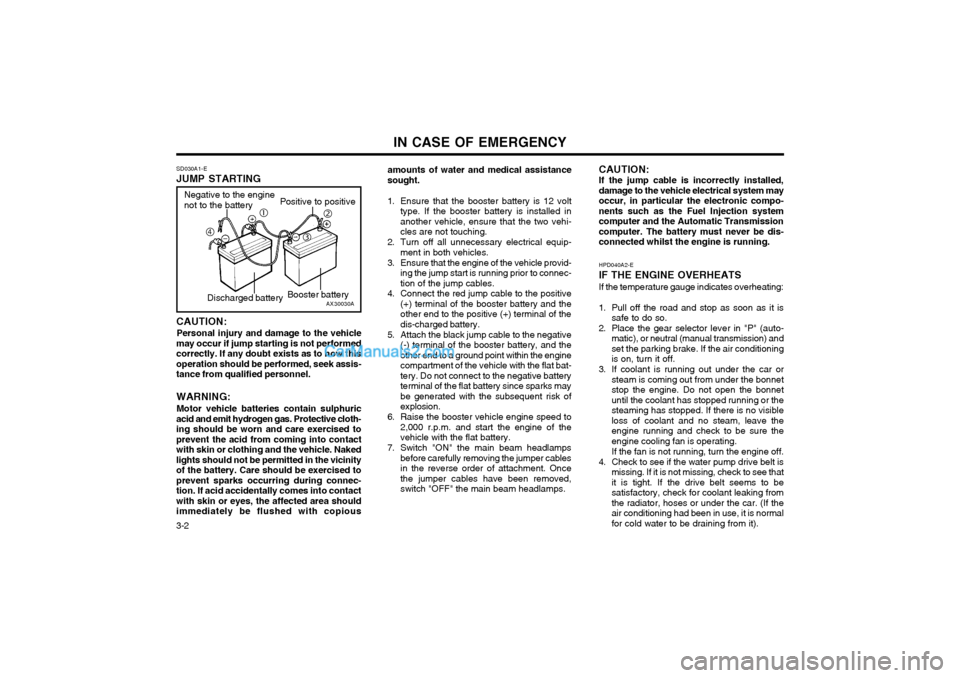
4. Connect the red jump cable to the positive (+) terminal of the booster battery and theother end to the positive (+) terminal of thedis-charged battery.
5. Attach the black jump cable to the negative (-) terminal of the booster battery, and theother end to a ground point within the enginecompartment of the vehicle with the flat bat-tery. Do not connect to the negative batteryterminal of the flat battery since sparks maybe generated with the subsequent risk ofexplosion.
6. Raise the booster vehicle engine speed to 2,000 r.p.m. and start the engine of thevehicle with the flat battery.
7. Switch "ON" the main beam headlamps before carefully removing the jumper cablesin the reverse order of attachment. Oncethe jumper cables have been removed,switch "OFF" the main beam headlamps. HPD040A2-E IF THE ENGINE OVERHEATS If the temperature gauge indicates overheating:
1. Pull off the road and stop as soon as it is
safe to do so.
2. Place the gear selector lever in "P" (auto- matic), or neutral (manual transmission) and set the parking brake. If the air conditioningis on, turn it off.
3. If coolant is running out under the car or steam is coming out from under the bonnetstop the engine. Do not open the bonnetuntil the coolant has stopped running or thesteaming has stopped. If there is no visibleloss of coolant and no steam, leave theengine running and check to be sure theengine cooling fan is operating. If the fan is not running, turn the engine off.
4. Check to see if the water pump drive belt is missing. If it is not missing, check to see that it is tight. If the drive belt seems to besatisfactory, check for coolant leaking fromthe radiator, hoses or under the car. (If theair conditioning had been in use, it is normalfor cold water to be draining from it).
AX30030A
Negative to the engine not to the battery
Positive to positive
Booster battery
c
e
f d
Discharged battery
Page 293 of 349
IN CASE OF EMERGENCY 3-3
WARNING: Whilst the engine is running, keep hands
and clothing away from moving parts such as the fan and drive belts to prevent injury.
WARNING (Diesel only): Never work on injection system with engine
running or within 30 seconds after shutting off engine. High pressure pump, rail, injec-tors and high pressure pipes are subject tohigh pressure even after the engine stopped.The fuel jet produced by fuel leaks maycause serious injury, if it touch the body.People using pacemakers should not movethan 30cm closer to the ECU or wiring har-ness within the engine room while engine isrunning, since the high currents in the Com-mon Rail system produce considerable mag-netic fields.
5. If the water pump drive belt is broken or coolant is leaking out, stop the engine imme- diately and call the nearest Hyundai dealerfor assistance.
WARNING: Do not remove the radiator cap when the
engine is hot since steam and boiling water may be ejected from the radiator resulting inburns or scalding. YD050A1-E
SPARE TYRE For Full Size
The following instructions for the FULL SIZE
spare tyre should be observed:
Check inflation pressure as soon as possible
after installing the spare tyre, and adjust to the specified pressure. The tyre pressure shouldbe periodically checked and maintained at thespecified pressure whilst the tyre is stored.
Spare Tyre Pressure
Inflation Pressure
Tyre Size
FULL SIZE 29 psi (200 kPa)
6. If the cause of the overheating cannot be
found, wait until the engine temperature has returned to normal. Then, if coolant hasbeen lost, carefully remove the radiator capand add water to bring the fluid level in thereservoir up to the base of the radiator fillopening. Fill the coolant expansion tank tothe halfway mark.
7. Proceed with caution until it is established that the engine is operating normally. If theengine overheats repeatedly, the advice of aHyundai dealer should be sought.
CAUTION: Serious loss of coolant indicates there is a
leak in the cooling system and this should be checked as soon as possible by a Hyundaidealer.
D040B01HP
D040B03HP-EAT
Handling the Spare Tyre
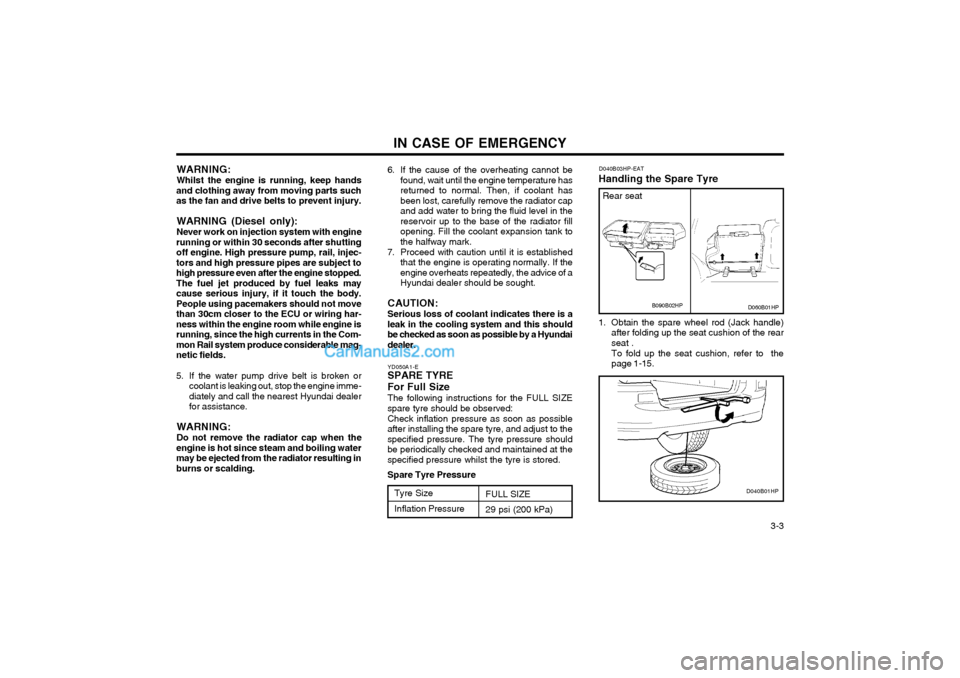
1. Obtain the spare wheel rod (Jack handle) after folding up the seat cushion of the rear seat . To fold up the seat cushion, refer to the page 1-15.
D060B01HPB090B02HP
Rear seat
Page 301 of 349
IN CASE OF EMERGENCY 3-11
D120A01A-EAT
IF YOU LOSE YOUR KEYS
Information about the key of immobiliser sys-
tem will be found on page 1-2. For emergency towing when no commercial tow vehicle is available, attach a tow cable,chain or strap to one of the towing hooks underthe front of your car. Be very careful whenattempting this procedure when the vehicle ison any unpaved surface to avoid damage toyour vehicle. Nor should towing be attempted if the wheels, drive train, axles, steering or brakes are dam-aged. Before towing, be sure the transmissionis in neutral and the key is in "ACC" (with theengine off) or in the "ON" position (with theengine running). A driver must be in the towedcar to steer it and operate the brakes. NOTE: To avoid serious damage to your 4WD ve- hicle, limit the towing to 10 mph (15 km/h)and not for more than 1 mile (1.5 km) at ANYTIME.
Page 310 of 349
VEHICLE MAINTENANCE REQUIREMENTS
5- 6
F060B01A-AAT
o Drive belts Inspect all drive belts for evidence of cuts, cracks, excessive wear or oil and replace ifnecessary. Drive belts should be checkedperiodically for proper tension and adjusted asnecessary. F060C01A-AAT
o Fuel filter A clogged filter can limit the speed at which the vehicle may be driven, damage the emissionsystem and cause hard starting. If an exces-sive amount of foreign matter accumulates inthe fuel tank, the filter may require replace-ment more frequently. After installing a new filter, run the engine for several minutes, and check for leaks at theconnections. Fuel filters should be installed bytrained technicians.
F060M01A-AAT o Engine oil and filterThe engine oil and filter should be changed at the intervals specified in the maintenanceschedule. If the car is being driven in severeconditions, more frequent oil and filter changesare required.
F060D01TB-AAT
o Fuel lines, fuel hoses and connec-
tions
Check the fuel lines, fuel hoses and connec-tions for leakage and damage. Have a trainedtechnician replace any damaged or leakingparts immediately.
WARNING (Diesel only): Never work on injection system with en-gine running or within 30 seconds aftershutting off engine. High pressure pump,rail, injectors and high pressure pipes aresubject to high pressure even after theengine stopped. The fuel jet produced byfuel leaks may cause serious injury, if ittouch the body. People using pacemak-ers should not move than 30cm closer tothe ECU or wiring harness within theengine room while engine is running,since the high currents in the CommonRail system produce considerable mag-netic fields. F060E01A-AAT
o Timing beltInspect all parts related to the timing belt for damage and deformation. Replace any dam-aged parts immediately. F060G01A-EAT
o Vapour hose and fuel filler cap The vapour hose and fuel filler cap should be inspected at those intervals specified in themaintenance schedule. Make sure that a newvapour hose or fuel filler cap is correctlyreplaced.
F060F01A-AAT
o Vacuum, crankcase
ventilation hoses
Inspect the surface of hoses for evidence of
heat and/or mechanical damage. Hard andbrittle rubber, cracking, tears, cuts, abrasions,and excessive swelling indicate deterioration.Particular attention should be paid to examinethose hose surfaces nearest to high heatsources, such as the exhaust manifold.
Inspect the hose routing to assure that the
hoses do not come in contact with any heatsource, sharp edges or moving componentwhich might cause heat damage or mechani-cal wear. Inspect all hose connections, suchas clamps and couplings, to make sure theyare secure, and that no leaks are present.Hoses should be replaced immediately if thereis any evidence of deterioration or damage.
F060A01A-AAT
EXPLANATION OF SCHEDULED MAINTENANCE ITEMS
Page 311 of 349
VEHICLE MAINTENANCE REQUIREMENTS 5-7
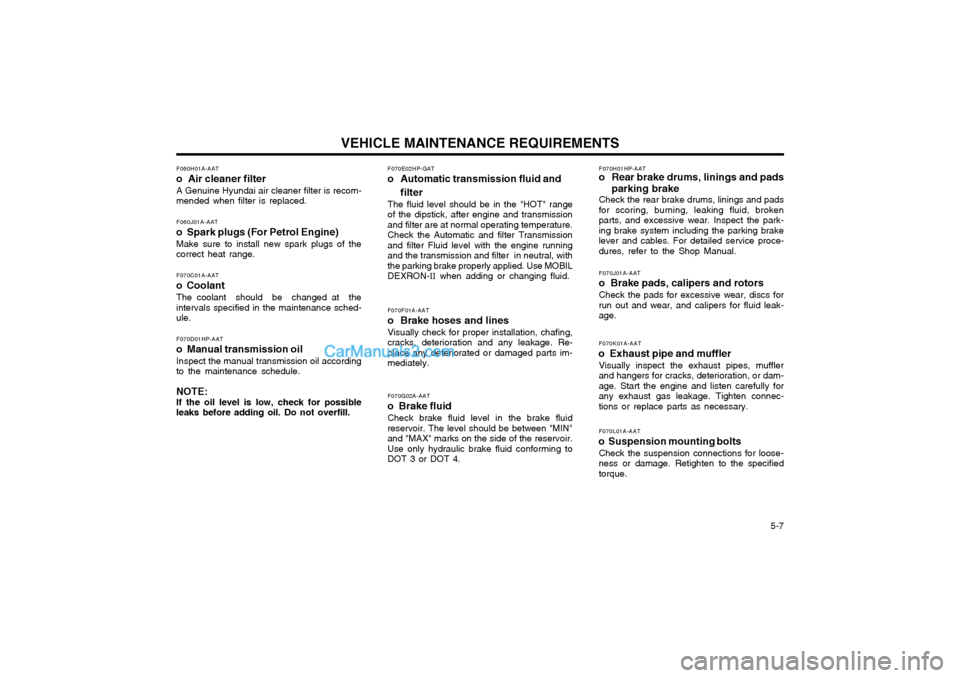
F070E02HP-GAT
o Automatic transmission fluid and
filter
The fluid level should be in the "HOT" range of the dipstick, after engine and transmissionand filter are at normal operating temperature.Check the Automatic and filter Transmissionand filter Fluid level with the engine runningand the transmission and filter in neutral, withthe parking brake properly applied. Use MOBILDEXRON- when adding or changing fluid.
F070F01A-AAT
o Brake hoses and lines Visually check for proper installation, chafing, cracks, deterioration and any leakage. Re-place any deteriorated or damaged parts im-mediately. F070G02A-AAT o Brake fluidCheck brake fluid level in the brake fluid reservoir. The level should be between "MIN"and "MAX" marks on the side of the reservoir.Use only hydraulic brake fluid conforming toDOT 3 or DOT 4. F070H01HP-AAT
o Rear brake drums, linings and pads
parking brake
Check the rear brake drums, linings and pads
for scoring, burning, leaking fluid, brokenparts, and excessive wear. Inspect the park-ing brake system including the parking brakelever and cables. For detailed service proce-dures, refer to the Shop Manual.
F070J01A-AAT
o Brake pads, calipers and rotors
Check the pads for excessive wear, discs for
run out and wear, and calipers for fluid leak-age. F070K01A-AAT
o Exhaust pipe and muffler Visually inspect the exhaust pipes, muffler and hangers for cracks, deterioration, or dam-age. Start the engine and listen carefully forany exhaust gas leakage. Tighten connec-tions or replace parts as necessary. F070L01A-AAT
o Suspension mounting bolts Check the suspension connections for loose- ness or damage. Retighten to the specifiedtorque.
F060H01A-AAT
o Air cleaner filter
A Genuine Hyundai air cleaner filter is recom-mended when filter is replaced. F060J01A-AAT
o Spark plugs (For Petrol Engine) Make sure to install new spark plugs of the
correct heat range.
F070C01A-AAT
o Coolant The coolant should be changed at the intervals specified in the maintenance sched-ule. F070D01HP-AAT
o Manual transmission oil Inspect the manual transmission oil according to the maintenance schedule.
NOTE: If the oil level is low, check for possibleleaks before adding oil. Do not overfill.
Page 320 of 349
OWNER MAINTENANCE
6-8
G050D03HP
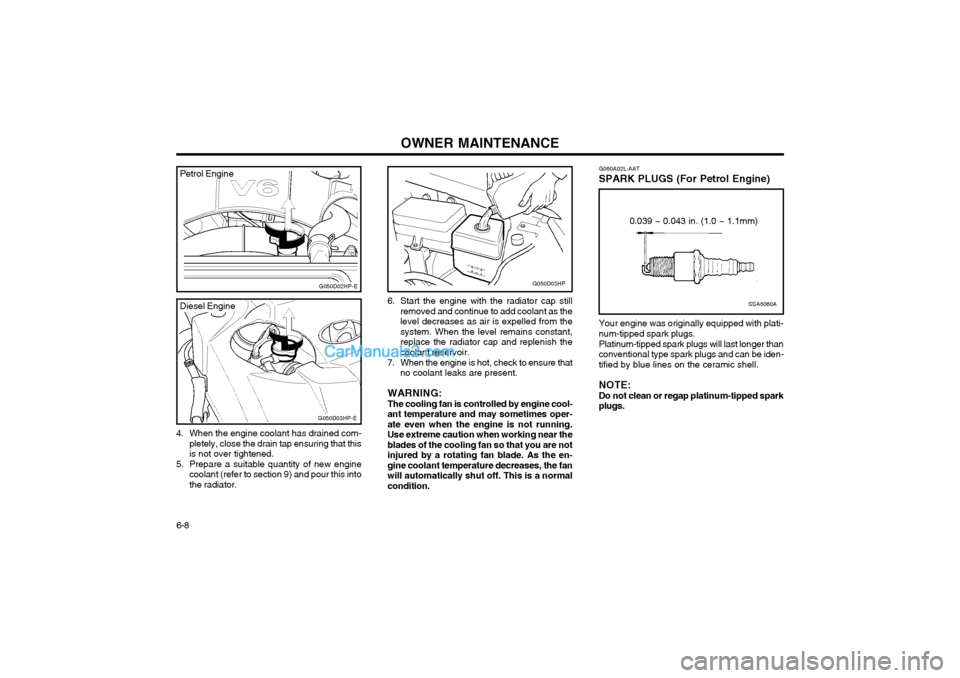
4. When the engine coolant has drained com- pletely, close the drain tap ensuring that this is not over tightened.
5. Prepare a suitable quantity of new engine coolant (refer to section 9) and pour this intothe radiator. 6. Start the engine with the radiator cap still
removed and continue to add coolant as thelevel decreases as air is expelled from thesystem. When the level remains constant,replace the radiator cap and replenish thecoolant reservoir.
7. When the engine is hot, check to ensure that no coolant leaks are present.
WARNING:The cooling fan is controlled by engine cool-
ant temperature and may sometimes oper-ate even when the engine is not running.Use extreme caution when working near theblades of the cooling fan so that you are notinjured by a rotating fan blade. As the en-gine coolant temperature decreases, the fanwill automatically shut off. This is a normalcondition. G060A02L-AAT SPARK PLUGS (For Petrol Engine)
SSA6060A
0.039 ~ 0.043 in. (1.0 ~ 1.1mm)
Your engine was originally equipped with plati- num-tipped spark plugs. Platinum-tipped spark plugs will last longer than conventional type spark plugs and can be iden-tified by blue lines on the ceramic shell. NOTE: Do not clean or regap platinum-tipped spark plugs.
G050D03HP-E
Diesel Engine
G050D02HP-E
Petrol Engine