automatic transmission Hyundai Terracan 2003 Owner's Guide
[x] Cancel search | Manufacturer: HYUNDAI, Model Year: 2003, Model line: Terracan, Model: Hyundai Terracan 2003Pages: 349, PDF Size: 4.56 MB
Page 231 of 349
CONTROLS AND EQUIPMENT1- 37
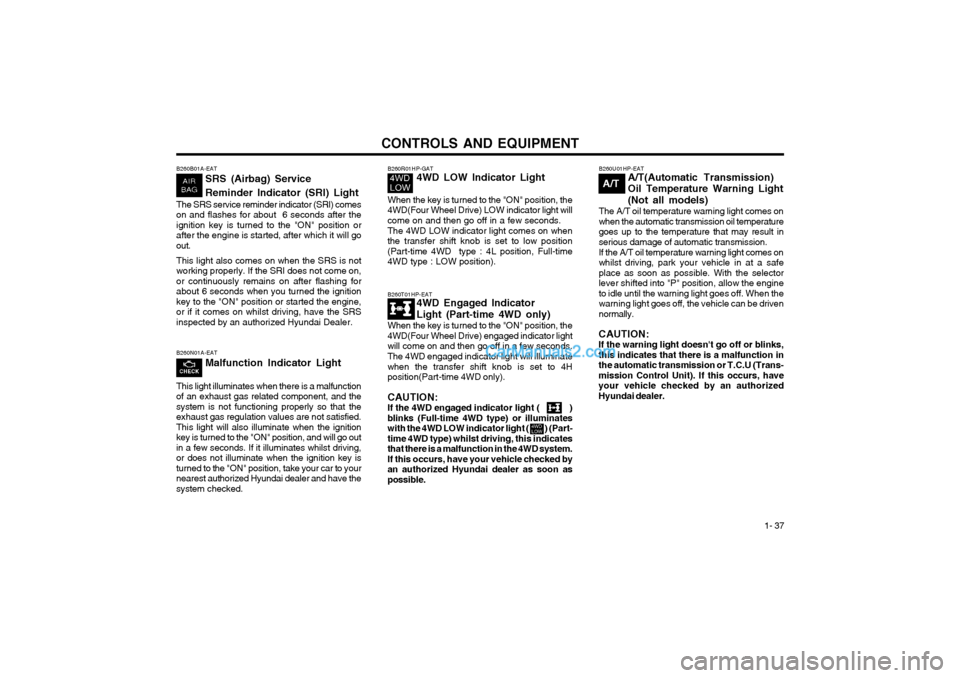
B260T01HP-EAT4WD Engaged Indicator Light (Part-time 4WD only)
When the key is turned to the "ON" position, the 4WD(Four Wheel Drive) engaged indicator lightwill come on and then go off in a few seconds. The 4WD engaged indicator light will illuminate when the transfer shift knob is set to 4Hposition(Part-time 4WD only). CAUTION: If the 4WD engaged indicator light ( )blinks (Full-time 4WD type) or illuminates
with the 4WD LOW indicator light ( ) (Part-time 4WD type) whilst driving, this indicatesthat there is a malfunction in the 4WD system.If this occurs, have your vehicle checked byan authorized Hyundai dealer as soon aspossible. B260U01HP-EAT
A/T(Automatic Transmission)
Oil Temperature Warning Light(Not all models)
The A/T oil temperature warning light comes on when the automatic transmission oil temperaturegoes up to the temperature that may result inserious damage of automatic transmission. If the A/T oil temperature warning light comes on
whilst driving, park your vehicle in at a safe
place as soon as possible. With the selectorlever shifted into "P" position, allow the engineto idle until the warning light goes off. When thewarning light goes off, the vehicle can be driven
normally.
CAUTION:If the warning light doesn't go off or blinks,this indicates that there is a malfunction inthe automatic transmission or T.C.U (Trans-mission Control Unit). If this occurs, haveyour vehicle checked by an authorizedHyundai dealer.
A/T
B260N01A-EAT Malfunction Indicator Light
This light illuminates when there is a malfunction of an exhaust gas related component, and thesystem is not functioning properly so that theexhaust gas regulation values are not satisfied.This light will also illuminate when the ignitionkey is turned to the "ON" position, and will go out
in a few seconds. If it illuminates whilst driving,or does not illuminate when the ignition key isturned to the "ON" position, take your car to yournearest authorized Hyundai dealer and have thesystem checked.
B260R01HP-GAT 4WD LOW Indicator Light
When the key is turned to the "ON" position, the
4WD(Four Wheel Drive) LOW indicator light willcome on and then go off in a few seconds.
The 4WD LOW indicator light comes on when the transfer shift knob is set to low position(Part-time 4WD type : 4L position, Full-time
4WD type : LOW position).B260B01A-EAT SRS (Airbag) Service Reminder Indicator (SRI) Light
The SRS service reminder indicator (SRI) comes on and flashes for about 6 seconds after theignition key is turned to the "ON" position orafter the engine is started, after which it will goout. This light also comes on when the SRS is not working properly. If the SRI does not come on,or continuously remains on after flashing forabout 6 seconds when you turned the ignitionkey to the "ON" position or started the engine,or if it comes on whilst driving, have the SRSinspected by an authorized Hyundai Dealer.
Page 254 of 349
CONTROLS AND EQUIPMENT
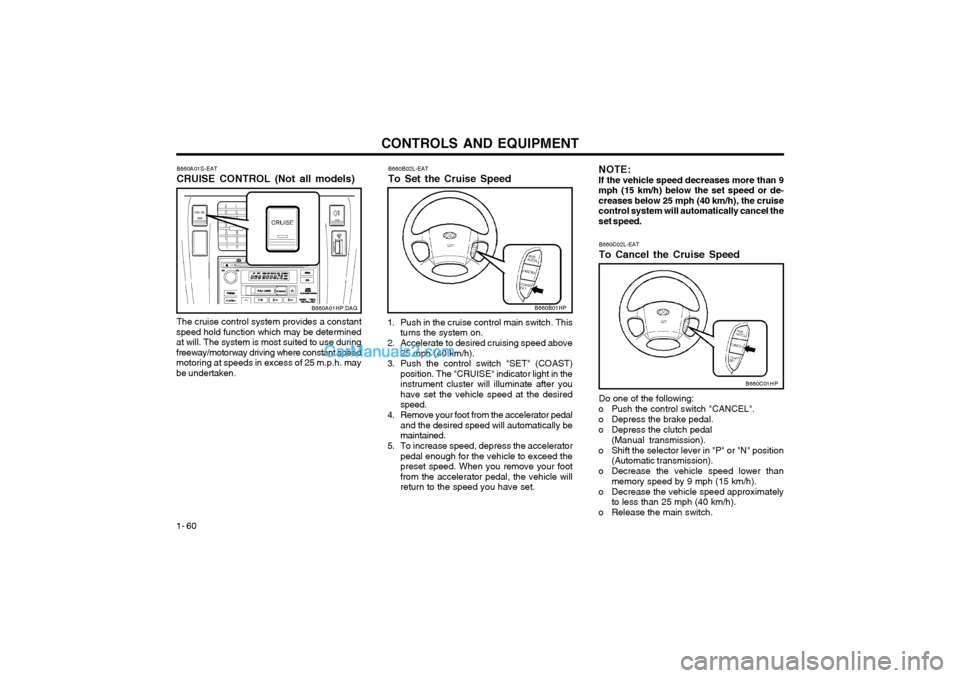
1- 60 B660A01S-EAT CRUISE CONTROL (Not all models)
B660C02L-EATTo Cancel the Cruise Speed
B660B02L-EATTo Set the Cruise Speed
The cruise control system provides a constant
speed hold function which may be determined at will. The system is most suited to use duringfreeway/motorway driving where constant speedmotoring at speeds in excess of 25 m.p.h. maybe undertaken.
B660A01HP.DAG
1. Push in the cruise control main switch. This turns the system on.
2. Accelerate to desired cruising speed above 25 mph (40 km/h).
3. Push the control switch "SET" (COAST) position. The "CRUISE" indicator light in the instrument cluster will illuminate after youhave set the vehicle speed at the desiredspeed.
4. Remove your foot from the accelerator pedal and the desired speed will automatically bemaintained.
5. To increase speed, depress the accelerator pedal enough for the vehicle to exceed thepreset speed. When you remove your footfrom the accelerator pedal, the vehicle willreturn to the speed you have set.
B660B01HP
NOTE: If the vehicle speed decreases more than 9mph (15 km/h) below the set speed or de-creases below 25 mph (40 km/h), the cruisecontrol system will automatically cancel theset speed.
Do one of the following:
o Push the control switch "CANCEL".
o Depress the brake pedal.
o Depress the clutch pedal (Manual transmission).
o Shift the selector lever in "P" or "N" position (Automatic transmission).
o Decrease the vehicle speed lower than memory speed by 9 mph (15 km/h).
o Decrease the vehicle speed approximately to less than 25 mph (40 km/h).
o Release the main switch.
B660C01HP
Page 255 of 349
CONTROLS AND EQUIPMENT1- 61
o Pay particular attention to the driving
conditions whenever using the cruise control system.
o During cruise-speed driving with manual transmission vehicle, do not shift intoneutral without depressing the clutchpedal, since the engine will be overrevved.If this happens, depress the clutch pedalor release the main switch.
o During normal cruise control operation, when the set button is activated or reac-tivated after applying the brakes, thecruise control will energize after approxi-mately 3 seconds. This delay is normal.
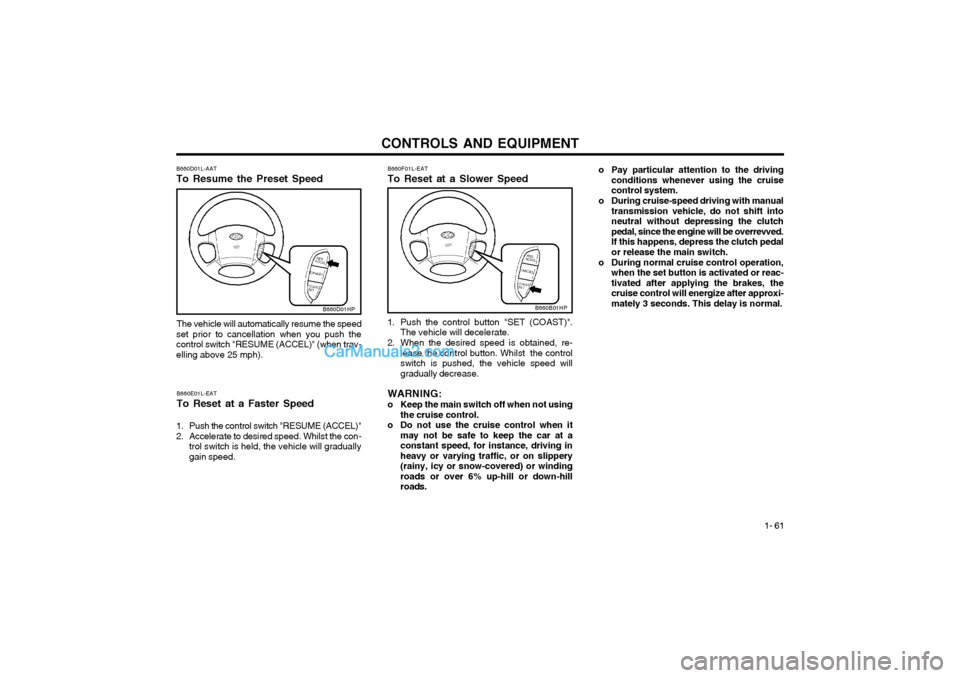
B660E01L-EAT To Reset at a Faster Speed
1. Push the control switch "RESUME (ACCEL)"
2. Accelerate to desired speed. Whilst the con- trol switch is held, the vehicle will gradually gain speed.
B660D01L-AAT To Resume the Preset Speed
The vehicle will automatically resume the speed
set prior to cancellation when you push the control switch "RESUME (ACCEL)" (when trav-elling above 25 mph).
B660D01HP
B660F01L-EAT To Reset at a Slower Speed
B660B01HP
1. Push the control button "SET (COAST)". The vehicle will decelerate.
2. When the desired speed is obtained, re- lease the control button. Whilst the control switch is pushed, the vehicle speed willgradually decrease.
WARNING:
o Keep the main switch off when not using the cruise control.
o Do not use the cruise control when it may not be safe to keep the car at a constant speed, for instance, driving inheavy or varying traffic, or on slippery(rainy, icy or snow-covered) or windingroads or over 6% up-hill or down-hillroads.
Page 273 of 349
DRIVING YOUR HYUNDAI
2- 2 C020A01A-EAT
BEFORE STARTING THE ENGINE
Before you start the engine, you should always:
1. Look around the vehicle to be sure there are no flat tyres, puddles of oil or water or other indications of possible trouble.
2. After entering the car, check to be sure the parking brake is engaged.
3. Check that all windows, and lights are clean.
4. Check that the interior and exterior mirrors are clean and in position.
5. Check your seat, seatback and headrest to be sure they are in their proper positions.
6. Close all the doors.
7. Fasten your seat belt and be sure that all other occupants have fastened theirs.
8. Turn off all lights and accessories that are not needed.
9. When you turn the ignition switch to "ON" check that all appropriate warning lights are operating and that you have sufficient fuel.
10.Check the operation of warning lights and all bulbs when key is in the "ON" position. C030A01HP-EAT COMBINATION IGNITION SWITCH AND STEERING LOCK To Start the Engine
o If your Hyundai is equipped with a manual
transmission, place the shift lever in neutral and depress the clutch pedal fully.
o If your Hyundai has an automatic transmis- sion, place the shift lever in "P" (park).
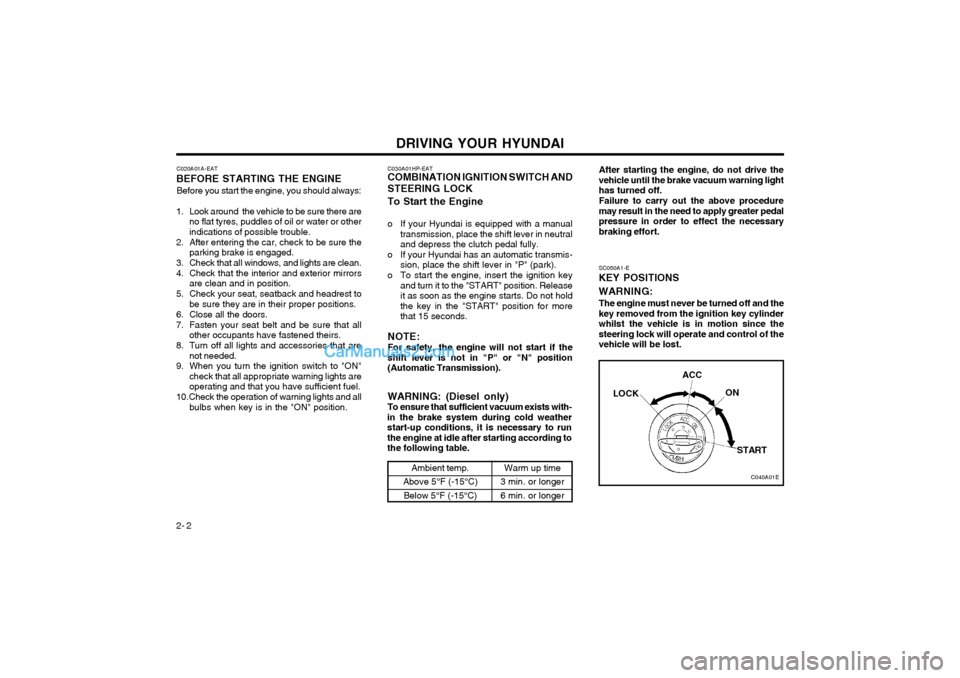
o To start the engine, insert the ignition key and turn it to the "START" position. Releaseit as soon as the engine starts. Do not holdthe key in the "START" position for morethat 15 seconds.
NOTE: For safety, the engine will not start if the shift lever is not in "P" or "N" position(Automatic Transmission). SC050A1-E
KEY POSITIONS WARNING:
The engine must never be turned off and the key removed from the ignition key cylinderwhilst the vehicle is in motion since thesteering lock will operate and control of thevehicle will be lost.
C040A01E
LOCK
ACC
ON
START
WARNING: (Diesel only) To ensure that sufficient vacuum exists with-
in the brake system during cold weatherstart-up conditions, it is necessary to runthe engine at idle after starting according tothe following table.
Ambient temp.
Above 5°F (-15°C) Below 5°F (-15°C)Warm up time
3 min. or longer 6 min. or longer After starting the engine, do not drive the vehicle until the brake vacuum warning lighthas turned off. Failure to carry out the above procedure may result in the need to apply greater pedalpressure in order to effect the necessarybraking effort.
Page 274 of 349
DRIVING YOUR HYUNDAI 2- 3
YC030A1-E
STEERING WHEEL LOCK
When the ignition key is removed, the steering
wheel lock will be activated. The lock only engages at one position of the steering wheeland therefore it will be possible to turn the wheeluntil this position is reached. It is not, however,necessary for the lock to be engaged beforeleaving the vehicle since in the event of at-tempted unauthorized removal, the lock willengage when attempts are made to steer thevehicle.
Should it be difficult to turn the key from the
"LOCK" position, it may be found that rockingthe steering wheel to and fro whilst turning thekey will assist.
CAUTION: Never remove the key from the ignition lock
whilst the vehicle is in motion since the steering mechanism lock will be activated.
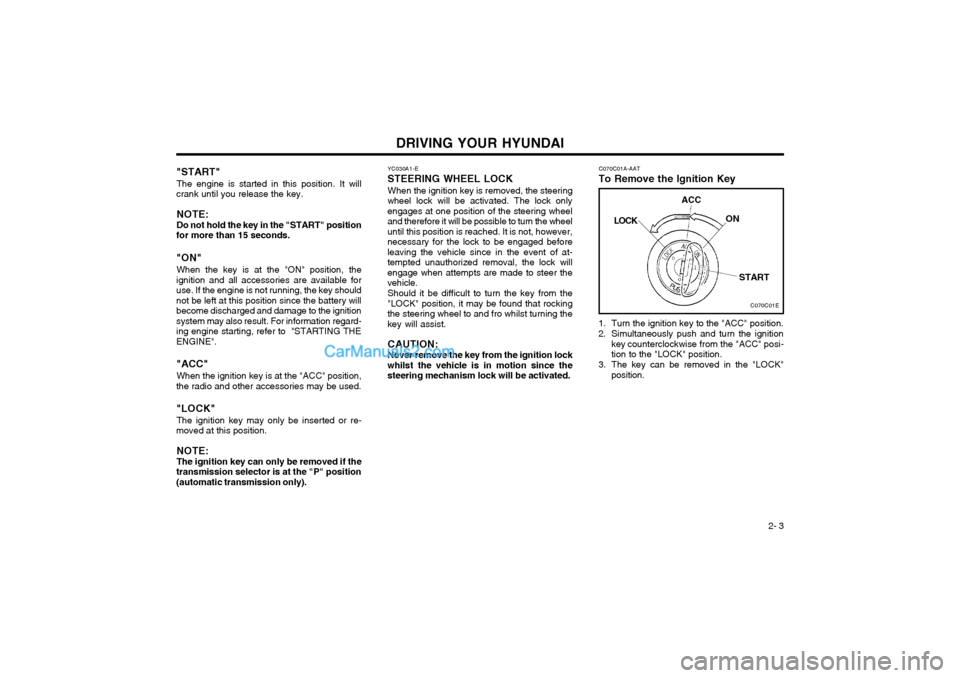
"START"
The engine is started in this position. It will
crank until you release the key.
NOTE: Do not hold the key in the "START" position
for more than 15 seconds. "ON"
When the key is at the "ON" position, the
ignition and all accessories are available for use. If the engine is not running, the key shouldnot be left at this position since the battery willbecome discharged and damage to the ignitionsystem may also result. For information regard-ing engine starting, refer to "STARTING THEENGINE". "ACC"
When the ignition key is at the "ACC" position,
the radio and other accessories may be used."LOCK"
The ignition key may only be inserted or re-
moved at this position.
NOTE: The ignition key can only be removed if the
transmission selector is at the "P" position (automatic transmission only). C070C01A-AAT
To Remove the Ignition Key
1. Turn the ignition key to the "ACC" position.
2. Simultaneously push and turn the ignition key counterclockwise from the "ACC" posi- tion to the "LOCK" position.
3. The key can be removed in the "LOCK" position.
C070C01E
LOCK
ACC
ON
START
Page 275 of 349
DRIVING YOUR HYUNDAI
2- 4 low the engine to idle for 20 seconds or so before driving the vehicle. CAUTION: Do not leave the vehicle unattended whilst idling. Never allow the vehicle to idle orwarm up in a confined space (ie garage)longer than is necessary to move the vehi-cle into an open area.
HPC060A1-E
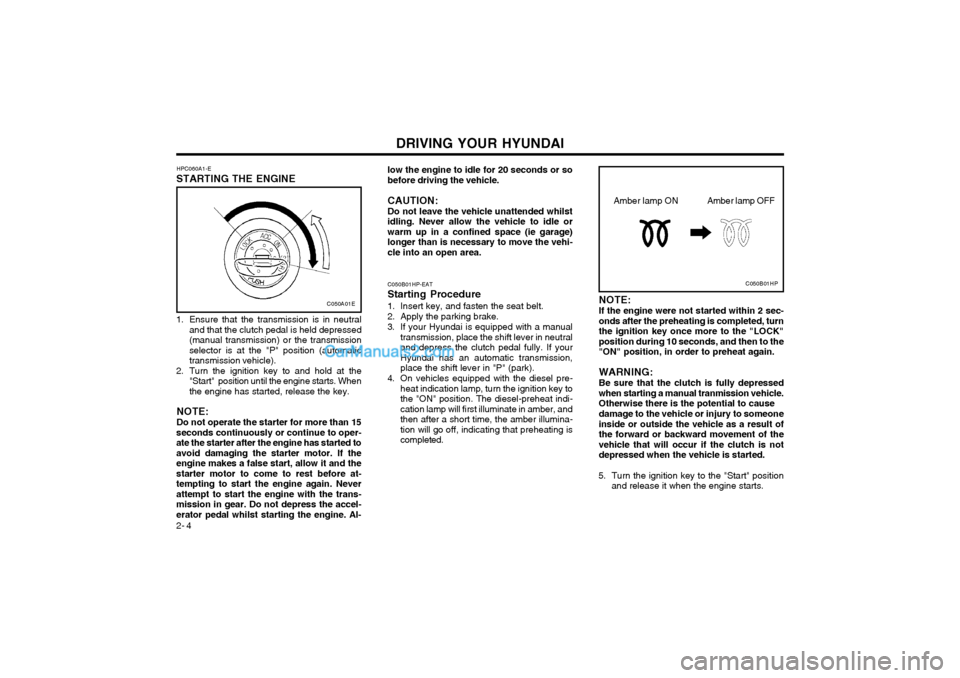
STARTING THE ENGINE
1. Ensure that the transmission is in neutral and that the clutch pedal is held depressed (manual transmission) or the transmissionselector is at the "P" position (automatictransmission vehicle).
2. Turn the ignition key to and hold at the "Start" position until the engine starts. Whenthe engine has started, release the key.
NOTE: Do not operate the starter for more than 15
seconds continuously or continue to oper- ate the starter after the engine has started toavoid damaging the starter motor. If theengine makes a false start, allow it and thestarter motor to come to rest before at-tempting to start the engine again. Neverattempt to start the engine with the trans-mission in gear. Do not depress the accel-erator pedal whilst starting the engine. Al-
C050A01E
C050B01HP-EAT
Starting Procedure
1. Insert key, and fasten the seat belt.
2. Apply the parking brake.
3. If your Hyundai is equipped with a manual transmission, place the shift lever in neutral and depress the clutch pedal fully. If yourHyundai has an automatic transmission,place the shift lever in "P" (park).
4. On vehicles equipped with the diesel pre- heat indication lamp, turn the ignition key tothe "ON" position. The diesel-preheat indi-cation lamp will first illuminate in amber, andthen after a short time, the amber illumina-tion will go off, indicating that preheating iscompleted.C050B01HP
Amber lamp OFF
Amber lamp ON
NOTE: If the engine were not started within 2 sec- onds after the preheating is completed, turnthe ignition key once more to the "LOCK"position during 10 seconds, and then to the"ON" position, in order to preheat again. WARNING: Be sure that the clutch is fully depressed when starting a manual tranmission vehicle.Otherwise there is the potential to cause damage to the vehicle or injury to someone inside or outside the vehicle as a result ofthe forward or backward movement of thevehicle that will occur if the clutch is notdepressed when the vehicle is started.
5. Turn the ignition key to the "Start" position and release it when the engine starts.
Page 277 of 349
DRIVING YOUR HYUNDAI
2- 6
o Ensure that the engine is not over-revved
by upshifting before the tachometer needle enters the red zone.
o Do not coast with the shift lever at the neutral position.
o When descending long gradients, make use of the engine braking to assist thefootbrake to avoid brake fade or over-heating.
o When slippery conditions are encoun- tered, increased caution should be exer-cised when gear changing, braking oraccelerating. Abrupt changes in speedmay cause a loss of traction or control ofthe vehicle.
o During cold weather, shifting may be dif- ficult until the transmission lubricant haswarmed up. This is normal and not harm-ful to the transmission.
o If you've come to a complete stop and it's hard to shift into 1 st
or R(Reverse), put
the shift lever in N(Neutral) position andrelease the clutch. Press the clutch pedalback down, and then shift into 1 st
or
R(Reverse) gear position.
o Do not use the shift lever as a handrest during driving, as this can result in pre-mature wear of the transmission shiftforks. C070B01A-EAT
Using the Clutch
The clutch should be pressed all the way to the
floor before shifting, then released slowly. Theclutch pedal should aways be used after fullyreturning to the original position. Do not restyour foot on the clutch pedal whilst driving. Thiscan cause unnecessary wear.
Do not partially engage the clutch to hold the
car on an incline. This causes unnecessarywear. Use the parking brake to hold the car onan incline. Do not operate the clutch pedalrapidly and repeatedly.
The shift points as shown above are recom-
mended for optimum fuel economy and per-formance. C070E03A-EAT
RECOMMENDED SHIFT POINTS
Shift
from-to
1-2 2-33-4 4-5 Recommended
mph (km/h)
15 (20)25 (40) 35 (55)45 (75)
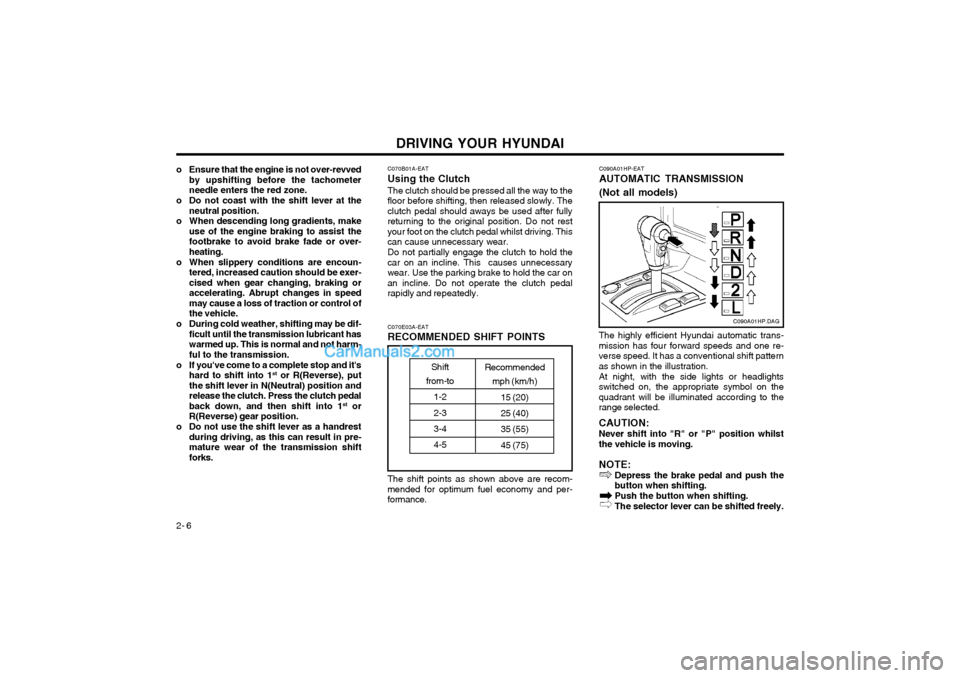
The highly efficient Hyundai automatic trans- mission has four forward speeds and one re-verse speed. It has a conventional shift patternas shown in the illustration. At night, with the side lights or headlights switched on, the appropriate symbol on thequadrant will be illuminated according to therange selected. CAUTION: Never shift into "R" or "P" position whilst the vehicle is moving. NOTE: Depress the brake pedal and push the button when shifting. Push the button when shifting. The selector lever can be shifted freely.
C090A01HP-EAT
AUTOMATIC TRANSMISSION (Not all models)
C090A01HP.DAG
Page 278 of 349
DRIVING YOUR HYUNDAI 2- 7
DC110D1-E
o N (Neutral):
With the selector in this position, no gear is
selected and no drive is transmitted from the engine. The engine may be started with theselector in this position.
CAUTION: Do not coast with the selector at the "N"
position.
DC110C1-E
o R (Reverse):
With the selector in this position, reverse gear
will be engaged. The engine may not be started with the selector in this position.
CAUTION:The selector must NEVER be shifted to the
"R" position whilst the vehicle is in motion. HPC090A1-E
SELECTOR POSITIONS o P (Park): With the selector in this position, no drive is
transmitted from the engine and the transmis- sion output and therefore the front wheels locked.The engine may be started with the selector inthis position.
CAUTION:The selector must NEVER be shifted to the
"P" position whilst the vehicle is in motion,otherwise serious transmission damage willresult. C090E01O-AAT
o D(Drive): Use for normal driving. The transmission will
automatically shift through a four gear sequence.
For optimum fuel economy, accelerate gradu-ally. The transmission will automatically shift tothe second, third and overdrive gears.
C090H01A-EAT
NOTE:
o The brake pedal should be depressed when shifting from NEUTRAL to a for- ward or reverse gear.
o The brake pedal fully depressed in order to move the shift lever from the "P"(Park) position to any of the other posi-tions.
o It is always possible to shift from "R", "N", "D", "2", "L" positions to "P" posi-tion.
DC110F1-E
o 2 (Second Gear):
With the selector in this position, first gear will
be engaged from rest. The transmission willupshift to second gear depending upon thevehicle speed and throttle position. No upshiftto third or fourth will occur. The engine may notbe started with the selector in this position.
CAUTION: Do not move the selector to the 2 position
when the vehicle speed is in excess of 60 m.p.h. DC110G2-E
o L (Low Gear):
With the selector in this position, first gear will
be engaged from rest. No upshift will occurregardless of vehicle speed and throttle open-ing. The engine may not be started with theselector in this position.
CAUTION: Do not move the selector to the L position
when the vehicle speed is in excess of 50 m.p.h.
Page 279 of 349
DRIVING YOUR HYUNDAI
2- 8
HPC120D1-E General Operating Instructions
o The button in the selector handle must be depressed before the selector can be moved.
o The engine may only be started when the selector is at position "P" or "N".
o Ensure that the footbrake is firmly applied when shifting from "P" or "N" to "D", "2" or "L" and vice versa.
o Always engage the parking brake when the vehicle is unattended, never use the "P"position in place of the parking brake.
o Under normal circumstances, the selector should be placed in the "D" position and thetransmission allowed to select the most idealratio for the circumstances. In this positionmaximum fuel economy will be achieved.
o When descending steep gradients where engine braking is required, the selectorshould be placed at the "2" or "L" positiondepending upon the vehicle speed.
o When ascending steep gradients and using large throttle openings, the transmission mayrepeatedly change between two adjacentratios. This is a normal characteristic andmay be prevented by selecting "2" or "L"depending upon the vehicle speed.
o Never move the selector to or from the "P" or "N" position with the accelerator de-pressed.
o Only with the brake pedal fully depressed, the shift lever is shifted from "P" (parking)position to other position. (Not all models)
C090I01E-EAT
CAUTION:
o Shift into "R" and "P" only when the vehicle has completely stopped.
o Do not accelerate the engine in reverse or any of the forward positions with the brakes applied.
o Always apply the footbrake when shift- ing from "P" or "N", to "R", "D", "2" or"L" position.
o Do not use the "P" (Park) position in place of the parking brake. Always setthe parking brake, shift the transmissioninto "P" (Park) and turn off the ignitionwhen you leave the vehicle, even mo-mentarily. Never leave the vehicle unat-tended whilst the engine is running.
o Check the automatic transmission fluid level regularly, and add fluid as neces-sary. SC130A1-E OVERDRIVE SWITCH
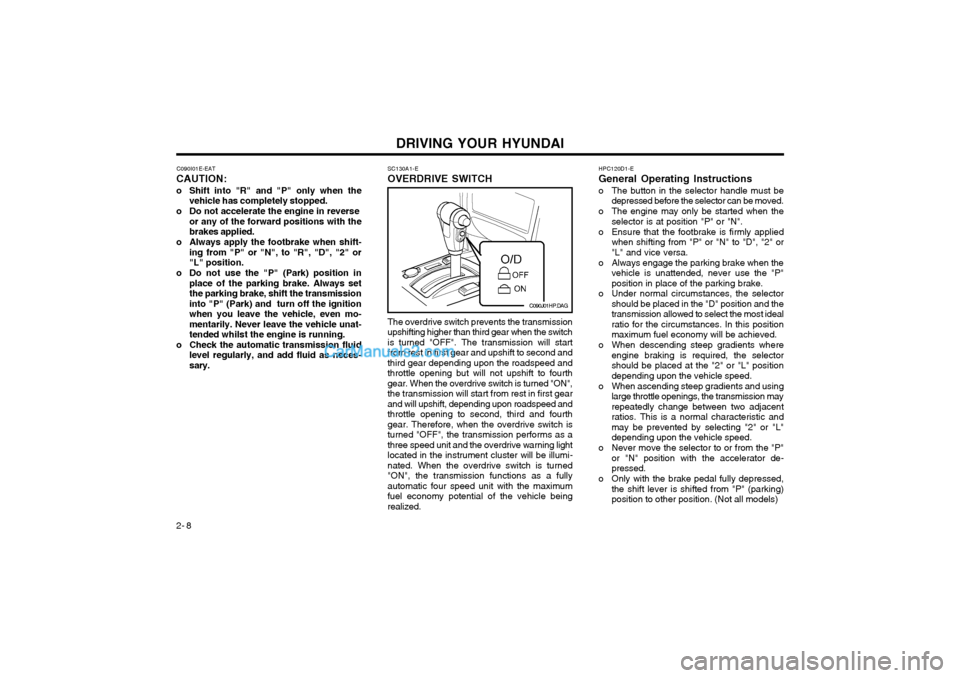
The overdrive switch prevents the transmission upshifting higher than third gear when the switchis turned "OFF". The transmission will startfrom rest in first gear and upshift to second andthird gear depending upon the roadspeed andthrottle opening but will not upshift to fourthgear. When the overdrive switch is turned "ON",the transmission will start from rest in first gearand will upshift, depending upon roadspeed andthrottle opening to second, third and fourthgear. Therefore, when the overdrive switch isturned "OFF", the transmission performs as athree speed unit and the overdrive warning lightlocated in the instrument cluster will be illumi-nated. When the overdrive switch is turned"ON", the transmission functions as a fullyautomatic four speed unit with the maximumfuel economy potential of the vehicle beingrealized.
C090J01HP.DAG
Page 280 of 349
DRIVING YOUR HYUNDAI 2- 9
o Ensure that the overdrive switch is at the
"ON" position for maximum economy.
o If rapid acceleration is required, fully de- press the accelerator pedal. In this condi- tion, the kickdown mechanism will be oper-ated and the transmission will automaticallydownshift according to the vehicle speed.
C120A02A-EAT
ANTI-LOCK BRAKE SYSTEM (Not all models)
The Anti-Lock Brake System (ABS) is designed
to prevent wheel lock-up during sudden braking or on hazardous road surfaces. The ABS con-trol module monitors the wheel speed and con-trols the pressure applied to each brake. Thus,in emergency situations or on slick roads, ABSwill increase vehicle control during braking.
NOTE: During ABS operation, a slight pulsation
may be felt in the brake pedal when the brakes are applied. Also, a noise may beheard in the engine compartment whilst brak-ing. These conditions are normal and indi-cate that the anti-lock brake system is func-tioning properly. WARNING: ABS will not prevent accidents due to im-
proper or dangerous driving manoeuvres. Even though vehicle control is improvedduring emergency braking, always maintaina safe distance between you and objectsahead. Vehicle speeds should always bereduced during extreme road conditions.
The braking distance for cars equipped with
an anti-lock braking system may be longerthan for those without it in the followingroad conditions.
o Driving on rough, gravel or snow-cov- ered roads.
o Driving with tire chains installed.
o Driving on roads where the road surface is pitted or has different surface height.
These roads should be driven at reduced
speeds. The safety features of an ABS equipped vehicle should not be tested byhigh speed driving or cornering. This couldendanger the safety of yourself or others.
C350A01HP-EAT
Part-time 4WD operation
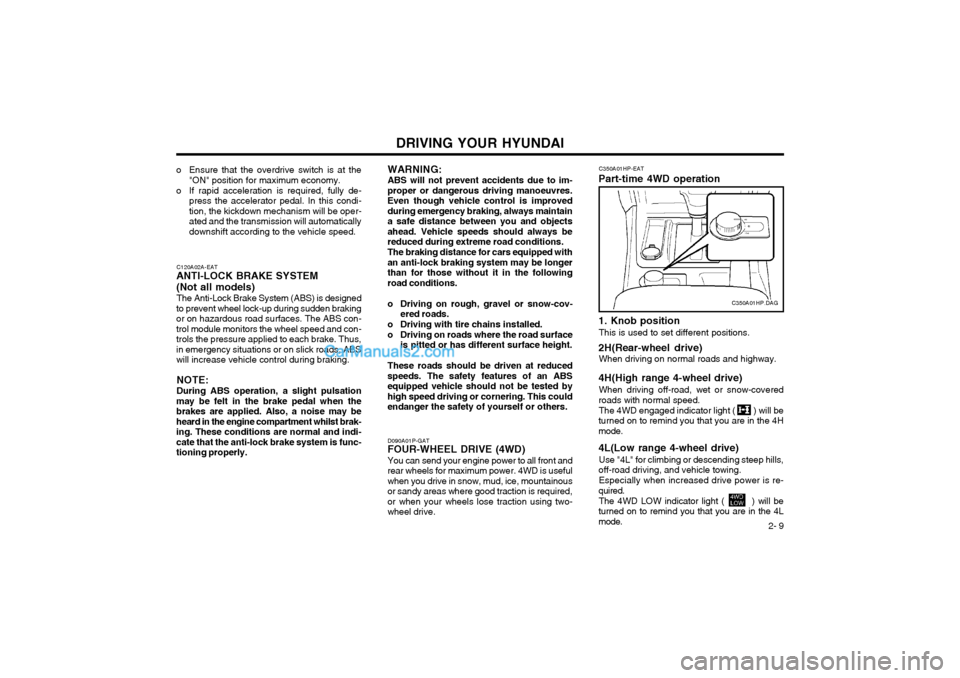
1. Knob position
This is used to set different positions.
2H(Rear-wheel drive) When driving on normal roads and highway.
4H(High range 4-wheel drive) When driving off-road, wet or snow-covered
roads with normal speed.
The 4WD engaged indicator light ( ) will be
turned on to remind you that you are in the 4H mode. 4L(Low range 4-wheel drive)
Use "4L" for climbing or descending steep hills,
off-road driving, and vehicle towing.
Especially when increased drive power is re-
quired.
The 4WD LOW indicator light ( ) will be
turned on to remind you that you are in the 4L mode.
C350A01HP.DAG
D090A01P-GAT
FOUR-WHEEL DRIVE (4WD)
You can send your engine power to all front and
rear wheels for maximum power. 4WD is useful when you drive in snow, mud, ice, mountainousor sandy areas where good traction is required,or when your wheels lose traction using two-wheel drive.