engine fan Hyundai Terracan 2005 User Guide
[x] Cancel search | Manufacturer: HYUNDAI, Model Year: 2005, Model line: Terracan, Model: Hyundai Terracan 2005Pages: 539, PDF Size: 18.03 MB
Page 269 of 539
6
DO-IT-YOURSELF MAINTENANCE
47
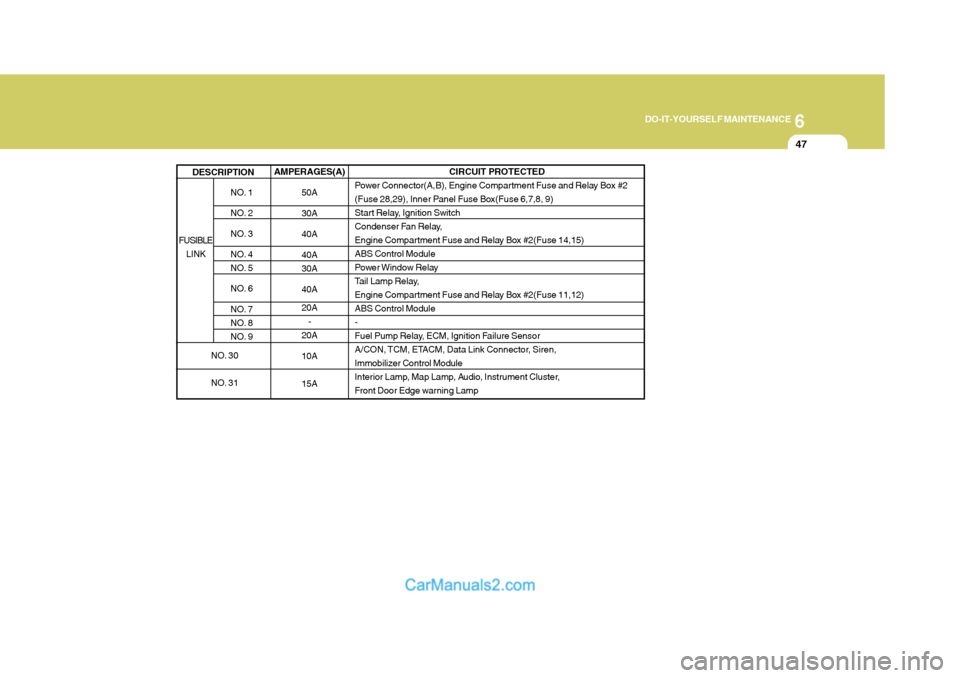
AMPERAGES(A) 50A 30A 40A 40A 30A 40A 20A-
20A 10A 15A
NO. 1
NO. 2
NO. 3
NO. 4
NO. 5
NO. 6
NO. 7
NO. 8
NO. 9
DESCRIPTION
CIRCUIT PROTECTED
Power Connector(A,B), Engine Compartment Fuse and Relay Box #2
(Fuse 28,29), Inner Panel Fuse Box(Fuse 6,7,8, 9)
Start Relay, Ignition Switch
Condenser Fan Relay,
Engine Compartment Fuse and Relay Box #2(Fuse 14,15)ABS Control Module
Power Window Relay
Tail Lamp Relay,
Engine Compartment Fuse and Relay Box #2(Fuse 11,12)ABS Control Module-
Fuel Pump Relay, ECM, Ignition Failure Sensor
A/CON, TCM, ETACM, Data Link Connector, Siren,
Immobilizer Control Module
Interior Lamp, Map Lamp, Audio, Instrument Cluster,
Front Door Edge warning Lamp
FUSIBLE LINK
NO. 30
NO. 31
Page 290 of 539
10
INDEX
3
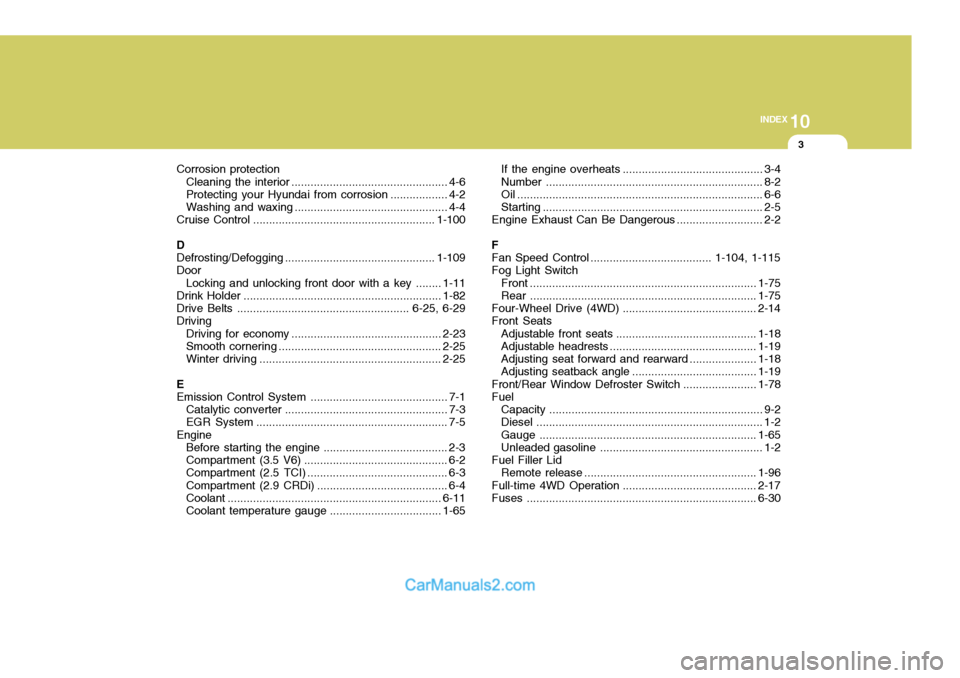
Corrosion protection Cleaning the interior ................................................. 4-6
Protecting your Hyundai from corrosion .................. 4-2
Washing and waxing ................................................ 4-4
Cruise Control ......................................................... 1-100
D Defrosting/Defogging ............................................... 1-109
Door
Locking and unlocking front door with a key ........1-11
Drink Holder .............................................................. 1-82
Drive Belts ...................................................... 6-25, 6-29
Driving
Driving for econom y ............................................... 2-23
Smooth cornering ................................................... 2-25
Winter driving ......................................................... 2-25
E Emission Control Syst em ........................................... 7-1
Catalytic converter ................................................... 7-3
EGR System ............................................................ 7-5
Engine Before starting the engine ....................................... 2-3 Compartment (3.5 V6) ............................................. 6-2
Compartment (2.5 TCI) ............................................ 6-3
Compartment (2.9 CRDi) ......................................... 6-4 Coolant ................................................................... 6-11
Coolant temper ature gauge ................................... 1-65If the engine
overheats ............................................ 3-4
Number .................................................................... 8-2
Oil ............................................................................. 6-6
Starting ..................................................................... 2-5
Engine Exhaust Can Be Dangerous ........................... 2-2
FFan Speed Control ...................................... 1-104, 1-115
Fog Light Switch
Front ....................................................................... 1-75
Rear ....................................................................... 1-75
Four-Wheel Drive (4WD) ........... ............................... 2-14
Front Seats
Adjustable front seats ............................................ 1-18
Adjustable headrest s .............................................. 1-19
Adjusting seat forward and rear ward..................... 1-18
Adjusting seatback angle .......................................1-19
Front/Rear Window Defroster Sw itch....................... 1-78
Fuel
Capacity ................................................................... 9-2
Diesel ....................................................................... 1-2
Gauge .................................................................... 1-65
Unleaded gasolin e ................................................... 1-2
Fuel Filler Lid Remote release ...................................................... 1-96
Full-time 4WD Operation ............... ........................... 2-17
Fuses ........................................................................ 6-30
Page 349 of 539
1CONTROLS AND EQUIPMENT
44
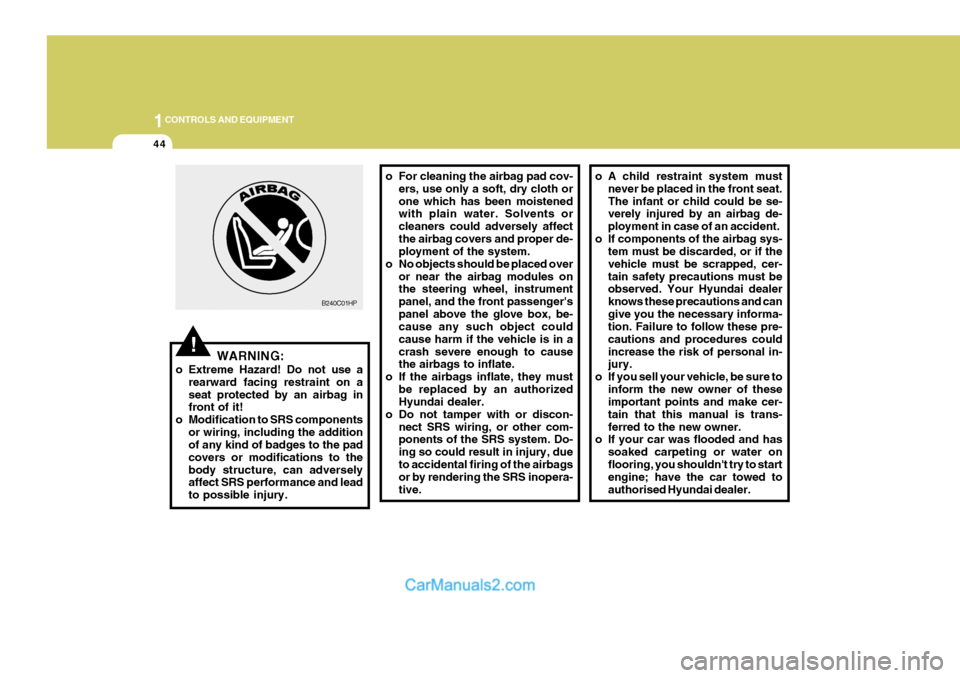
!WARNING:
o Extreme Hazard! Do not use a rearward facing restraint on a seat protected by an airbag in front of it!
o Modification to SRS components
or wiring, including the additionof any kind of badges to the pad covers or modifications to thebody structure, can adversely affect SRS performance and lead to possible injury. o For cleaning the airbag pad cov-
ers, use only a soft, dry cloth orone which has been moistened with plain water. Solvents or cleaners could adversely affectthe airbag covers and proper de- ployment of the system.
o No objects should be placed over or near the airbag modules onthe steering wheel, instrument panel, and the front passenger'spanel above the glove box, be- cause any such object could cause harm if the vehicle is in acrash severe enough to cause the airbags to inflate.
o If the airbags inflate, they must be replaced by an authorizedHyundai dealer.
o Do not tamper with or discon- nect SRS wiring, or other com-ponents of the SRS system. Do- ing so could result in injury, dueto accidental firing of the airbags or by rendering the SRS inopera- tive.
B240C01HP
o A child restraint system must
never be placed in the front seat. The infant or child could be se- verely injured by an airbag de- ployment in case of an accident.
o If components of the airbag sys- tem must be discarded, or if thevehicle must be scrapped, cer-tain safety precautions must be observed. Your Hyundai dealer knows these precautions and cangive you the necessary informa- tion. Failure to follow these pre- cautions and procedures couldincrease the risk of personal in- jury.
o If you sell your vehicle, be sure to inform the new owner of theseimportant points and make cer- tain that this manual is trans-ferred to the new owner.
o If your car was flooded and has
soaked carpeting or water onflooring, you shouldn't try to start engine; have the car towed to authorised Hyundai dealer.
Page 402 of 539
1
CONTROLS AND EQUIPMENT
97
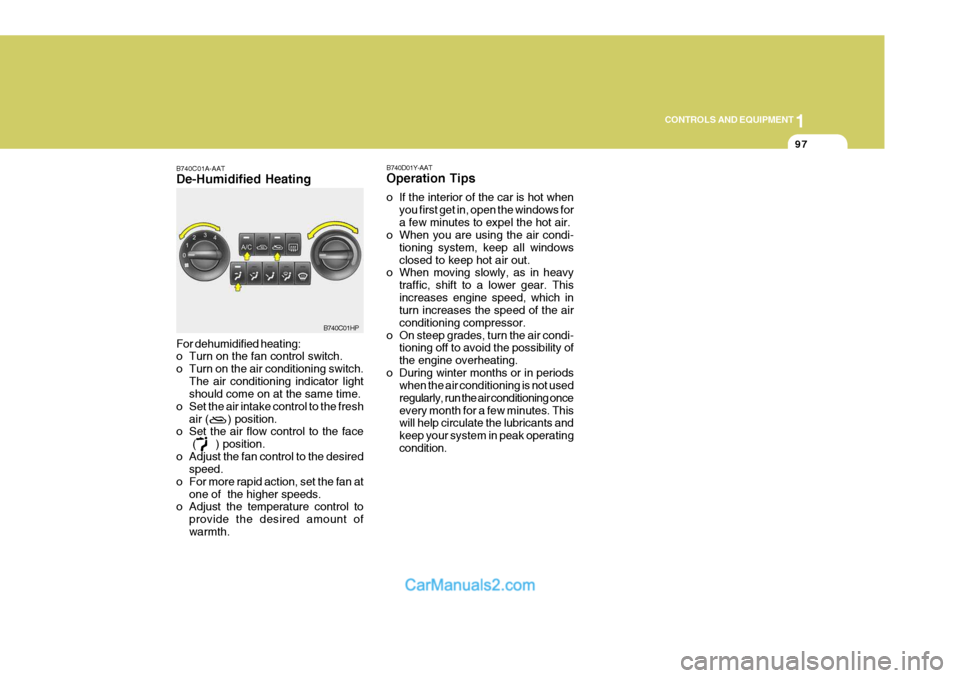
B740C01A-AAT De-Humidified Heating For dehumidified heating:
o Turn on the fan control switch.
o Turn on the air conditioning switch. The air conditioning indicator light should come on at the same time.
o Set the air intake control to the fresh air ( ) position.
o Set the air flow control to the face
( ) position.
o Adjust the fan control to the desired speed.
o For more rapid action, set the fan at one of the higher speeds.
o Adjust the temperature control to
provide the desired amount of warmth.
B740C01HP
B740D01Y-AAT Operation Tips
o If the interior of the car is hot when
you first get in, open the windows for a few minutes to expel the hot air.
o When you are using the air condi-
tioning system, keep all windowsclosed to keep hot air out.
o When moving slowly, as in heavy
traffic, shift to a lower gear. Thisincreases engine speed, which in turn increases the speed of the air conditioning compressor.
o On steep grades, turn the air condi- tioning off to avoid the possibility ofthe engine overheating.
o During winter months or in periods when the air conditioning is not usedregularly, run the air conditioning onceevery month for a few minutes. This will help circulate the lubricants and keep your system in peak operatingcondition.
Page 448 of 539
3 IN CASE OF EMERGENCY
4
!
1. Ensure that the booster battery is 12
volt type. If the booster battery is installed in another vehicle, ensure that the two vehicles are not touch- ing.
2. Turn off all unnecessary electrical equipment in both vehicles.
3. Ensure that the engine of the ve- hicle providing the jump start is run- ning prior to connection of the jump cables.
4. Connect the red jump cable to the positive (+) terminal of the boosterbattery and the other end to thepositive (+) terminal of the dis- charged battery.
5. Attach the black jump cable to the negative (-) terminal of the boosterbattery, and the other end to a ground point within the engine compartmentof the vehicle with the flat bat-tery. Do not connect to the negative bat- tery terminal of the flat battery sincesparks may be generated with the subsequent risk of explosion.
6. Raise the booster vehicle engine speed to 2,000 r.p.m. and start theengine of the vehicle with the flat battery. 7. Switch "ON" the main beam
headlamps before carefully remov-ing the jumper cables in the reverse order of attachment. Once the jumper cables have been removed,switch "OFF" the main beam headlamps.
CAUTION:
If the jump cable is incorrectly in- stalled, damage to the vehicle elec- trical system may occur, in particu- lar the electronic components suchas the Fuel Injection system com- puter and the Automatic transmis- sion computer. The battery mustnever be disconnected whilst the engine is running.
IF THE ENGINE OVERHEATS
HPD040A2-E If the temperature gauge indicates overheating:
1. Pull off the road and stop as soon as it is safe to do so.
2. Place the gear selector lever in "P"
(automatic), or neutral (manual trans- mission) and set the parking brake. If the air conditioning is on, turn it off.
3. If coolant is running out under the car or steam is coming out from underthe bonnet, stop the engine. Do not open the bonnet until the coolant hasstopped running or the steaming has stopped. If there is no visible loss of coolant and no steam, leave theengine running and check to be sure the engine cooling fan is operating. If the fan is not running, turn theengine off.
4. Check to see if the water pump drive
belt is missing. If it is not missing,check to see that it is tight. If the drive belt seems to be satisfactory, check for coolant leaking from theradiator, hoses or under the car. (If the air conditioning had been in use, it is normal for cold water to bedraining from it).
Page 449 of 539
3
IN CASE OF EMERGENCY
5
!
!
!WARNING:
Whilst the engine is running, keep hands and clothing away from mov- ing parts such as the fan and drive belts to prevent injury.
WARNING (Diesel only):
Never work on injection system withengine running or within 30 seconds after shutting off engine. High pres- sure pump, rail, injectors and highpressure pipes are subject to high pressure even after the engine stopped. The fuel jet produced byfuel leaks may cause serious in- jury, if it touch the body. People using pacemakers should not movethan 30cm closer to the ECU or wiring harness within the engine room while engine is running, sincethe high currents in the Common Rail system produce considerable magnetic fields. 5. If the water pump drive belt is broken
or coolant is leaking out, stop theengine immediately and call the near- est Hyundai dealer for assistance.
WARNING:
Do not remove the radiator cap when the engine is hot since steam andboiling water may be ejected from the radiator resulting in burns or scalding.
6. If the cause of the overheating can- not be found, wait until the engine temperature has returned to normal.Then, if coolant has been lost, care- fully remove the radiator cap and add water to bring the fluid level in thereservoir(page 6-10) up to the base of the radiator fill opening. Fill the coolant expansion tank to the half-way mark.
7. Proceed with caution until it is estab-
lished that the engine is operatingnormally. If the engine overheats repeatedly, the advice of a Hyundai dealer should be sought.! CAUTION:
Serious loss of coolant indicates there is a leak in the cooling system and this should be checked as soon as possible by a Hyundai dealer.
Page 478 of 539
Engine Compartment ................................................... 6-2
Daily Operating Checks ............................................... 6-4
Engine Oil ..................................................................... 6-4
Engine Oil and Filter Replacement .............................. 6-8
Engine Coolant Checking and Replacing .................... 6-9Spark Plug................................................................... 6-12
Changing the Air Cleaner Filte r ...................................6-13
Manual Transmission Lubricant ..................................6-16
Automatic Transmission Lubricant ..............................6-17
Brake System Checking ............................................. 6-19
Checking the Clutch Fluid ........................................... 6-20
Air Conditioning System Maintenance ........................ 6-21
Checking Engine Drive Belts ...................................... 6-24
Fusible Links ............................................................... 6-25
Battery Mai ntenance ................................................... 6-27
Checking Electric Cooling Fans .................................6-28
Fuel Filter ..................................................................... 6-30
Power Steering Fluid Level ......................................... 6-29
Replacing Headlight Bulbs .......................................... 6-31
Headlight Aiming Adjustment ...................................... 6-33
Bulb Wattages ............................................................. 6-35
Fuse Panel D escription ............................................... 6-36
OWNER MAINTENANCE
6
6
Page 488 of 539
6
OWNER MAINTENANCE
11
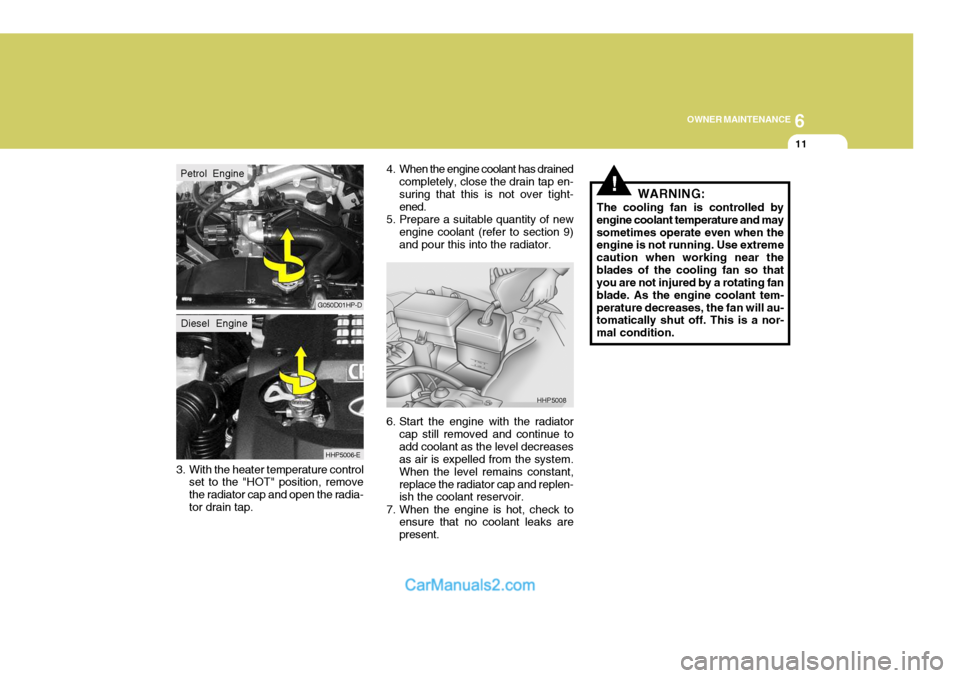
3. With the heater temperature control set to the "HOT" position, remove the radiator cap and open the radia-tor drain tap. 4. When the engine coolant has drained
completely, close the drain tap en-suring that this is not over tight- ened.
5. Prepare a suitable quantity of new engine coolant (refer to section 9)and pour this into the radiator.
6. Start the engine with the radiator cap still removed and continue to add coolant as the level decreases as air is expelled from the system. When the level remains constant,replace the radiator cap and replen- ish the coolant reservoir.
7. When the engine is hot, check to ensure that no coolant leaks are present.
G050D01HP-D
HHP5006-E
HHP5008
Petrol EngineDiesel Engine
!WARNING:
The cooling fan is controlled by engine coolant temperature and maysometimes operate even when the engine is not running. Use extreme caution when working near theblades of the cooling fan so that you are not injured by a rotating fan blade. As the engine coolant tem-perature decreases, the fan will au- tomatically shut off. This is a nor- mal condition.
Page 496 of 539
6
OWNER MAINTENANCE
19
!
!
!
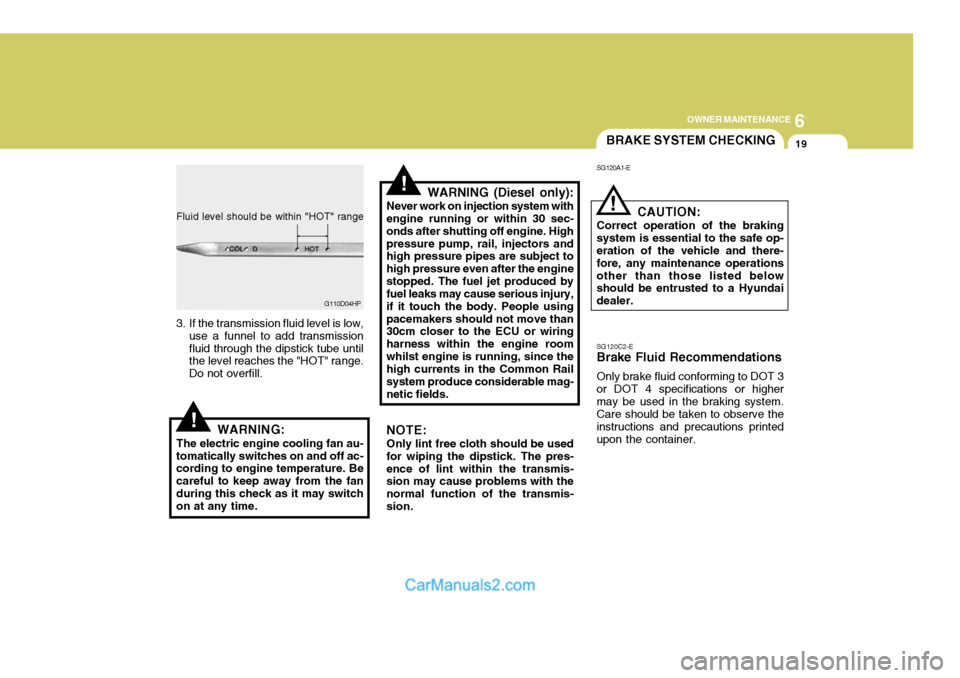
3. If the transmission fluid level is low,
use a funnel to add transmission fluid through the dipstick tube until the level reaches the "HOT" range. Do not overfill. WARNING (Diesel only):
Never work on injection system with
engine running or within 30 sec-onds after shutting off engine. Highpressure pump, rail, injectors and high pressure pipes are subject to high pressure even after the enginestopped. The fuel jet produced by fuel leaks may cause serious injury, if it touch the body. People usingpacemakers should not move than 30cm closer to the ECU or wiring harness within the engine roomwhilst engine is running, since the high currents in the Common Rail system produce considerable mag-netic fields.
WARNING:
The electric engine cooling fan au-tomatically switches on and off ac- cording to engine temperature. Be careful to keep away from the fanduring this check as it may switch on at any time. NOTE: Only lint free cloth should be used
for wiping the dipstick. The pres- ence of lint within the transmis- sion may cause problems with the normal function of the transmis-sion. CAUTION:
Correct operation of the brakingsystem is essential to the safe op- eration of the vehicle and there- fore, any maintenance operationsother than those listed below should be entrusted to a Hyundai dealer. SG120C2-E Brake Fluid Recommendations Only brake fluid conforming to DOT 3 or DOT 4 specifications or highermay be used in the braking system. Care should be taken to observe the instructions and precautions printedupon the container.
Fluid level should be within "HOT" range
G110D04HP
BRAKE SYSTEM CHECKING
SG120A1-E
Page 505 of 539
6 OWNER MAINTENANCE
28
!WARNING:
The cooling fan is controlled by engine coolant temperature and may sometimes operate even when the engine is not running. Do not touchthe radiator fan until it is completely stopped. As the coolant temperature de- creases the fan will automatically shut off. This is a normal condi-tion.
Checking Engine Cooling Fan The engine cooling fan should auto-matically come on if the engine cool- ant temperature is high.
Checking Condenser Cooling Fan The condenser cooling fan (in front of the condenser) should come on auto- matically whenever the air conditioner is in operation.
If any electrolyte gets into your eyes, flush your eyes with clean water for at least 15 minutes and get imme-diate medical attention. If possible, continue to apply water with a sponge orcloth until medical atten- tion is received. If electrolyte gets on your skin, thoroughly wash the contacted area. If you feel a pain or a burn- ing sensation, get medical attention immediately.Wear eye protection whencharging or working near abattery.Always provide ventilationwhen working in an en- closed space.o When lifting a plastic-cased bat- tery, excessive pressure on the case may cause battery acid to leak, resulting in personal injury.Lift with a battery carrier or with your hands on opposite corners.
o Never attempt to charge the bat- tery when the battery cables are connected.
o The electrical ignition system works with high voltage. Never touch these components with the engine running or the ignition switched on.
CHECKING ELECTRIC COOLING FANS
YG210A1-E