tow Hyundai Terracan 2005 Repair Manual
[x] Cancel search | Manufacturer: HYUNDAI, Model Year: 2005, Model line: Terracan, Model: Hyundai Terracan 2005Pages: 539, PDF Size: 18.03 MB
Page 410 of 539
1
CONTROLS AND EQUIPMENT
105STEREO SOUND SYSTEM
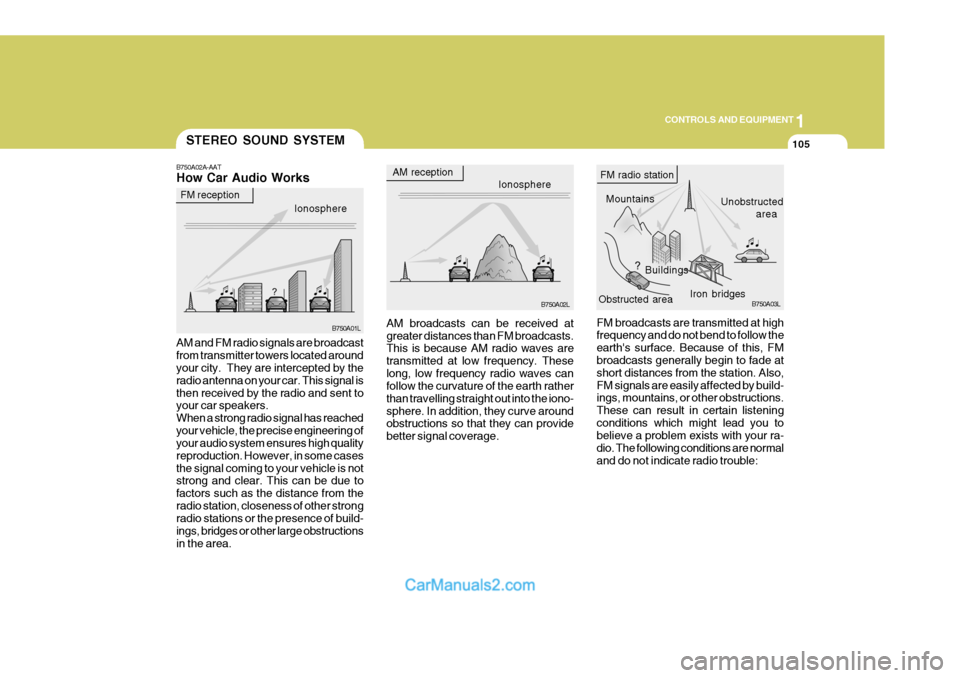
B750A02A-AAT How Car Audio Works
Ionosphere
FM reception
B750A01L
AM and FM radio signals are broadcast from transmitter towers located around your city. They are intercepted by the radio antenna on your car. This signal isthen received by the radio and sent to your car speakers. When a strong radio signal has reachedyour vehicle, the precise engineering of your audio system ensures high quality reproduction. However, in some casesthe signal coming to your vehicle is not strong and clear. This can be due to factors such as the distance from theradio station, closeness of other strong radio stations or the presence of build- ings, bridges or other large obstructionsin the area. AM broadcasts can be received atgreater distances than FM broadcasts. This is because AM radio waves are transmitted at low frequency. Theselong, low frequency radio waves can follow the curvature of the earth rather than travelling straight out into the iono-sphere. In addition, they curve around obstructions so that they can provide better signal coverage.
AM reception
Ionosphere
B750A02L
MountainsBuildings Unobstructed
area
FM radio station
B750A03L
Obstructed area Iron bridges
FM broadcasts are transmitted at high frequency and do not bend to follow the earth's surface. Because of this, FM broadcasts generally begin to fade at short distances from the station. Also,FM signals are easily affected by build- ings, mountains, or other obstructions. These can result in certain listeningconditions which might lead you to believe a problem exists with your ra- dio. The following conditions are normaland do not indicate radio trouble:
Page 414 of 539
2
Engine Exhaust Can Be Dangerous! ............................ 2-2
Before Starting the Engine ............................................ 2-3
Key Positions ................................................................ 2-4Starting ......................................................................... 2-5
Manual Transmission ................................................... 2-8
Automatic Transmission .............................................. 2-10
Four-Wheel Drive (4WD) ............................................. 2-14
Anti-Lock Brake System (ABS) ................................... 2-21
Limited-Slip Differential ................................................ 2-22
Effective Braking ......................................................... 2-22
Driving for Economy .................................................... 2-23
Smooth Cornering ........................................................ 2-24
Winter Motoring ............................................................ 2-24
Trailer and Vehicle Towi ng .......................................... 2-26
DRIVING YOUR HYUNDAI
2
Page 427 of 539
2 DRIVING YOUR HYUNDAI
14FOUR-WHEEL DRIVE (4WD)
D090A01P-GAT You can send your engine power to all front and rear wheels for maximum power. 4WD is useful when you drive in snow, mud, ice, mountainous orsandy areas where good traction is required, or when your wheels lose traction using two-wheel drive.
proximately 1,000rpm by means ofthe accelerator pedal and the selec-tor lever moved between the "D" and "R" positions to induce a rocking motion.
o Do not depress the accelerator pedal with the brakes applied and the se-lector at the "R", "D", "2" or "L"position.
o Turn the overdrive switch on for good
fuel economy and smooth driving.But if engine braking is needed in the "D" range or if repeated upshifting and downshifting between the 3rdand 4th gear is needed when climb- ing a gentle slope, it is recommended that the overdrive switch be turnedoff. Turn the overdrive switch back on immediately afterward.
!WARNING:
o Avoid high cornering speeds.
o Do not make quick steering wheel movements, such as sharp lane changes or fast, sharp turns. o Always wear your seat belts.
In a collision crash, an unbelted person is significantly more likely to die than a person wearing a seatbelt.
o The risk of rollover is greatly in- creased if you lose control of yourvehicle at highway speeds.
o Loss of control often occurs if two or more wheels drop off the road-way and the driver oversteers toreenter the roadway.
o In the event your vehicle leaves
the roadway, do not steer sharply.Instead, slow down before pulling back into the travel lanes.
o Never exceed posted speed limits.
o Excessive depressing of the accelerater pedal under the tyreslip condition such as moving outof the mud or fresh snow etc, may cause severe damage to the trans- mission. At this time, take otherway such as towing.
Page 428 of 539
2
DRIVING YOUR HYUNDAI
15
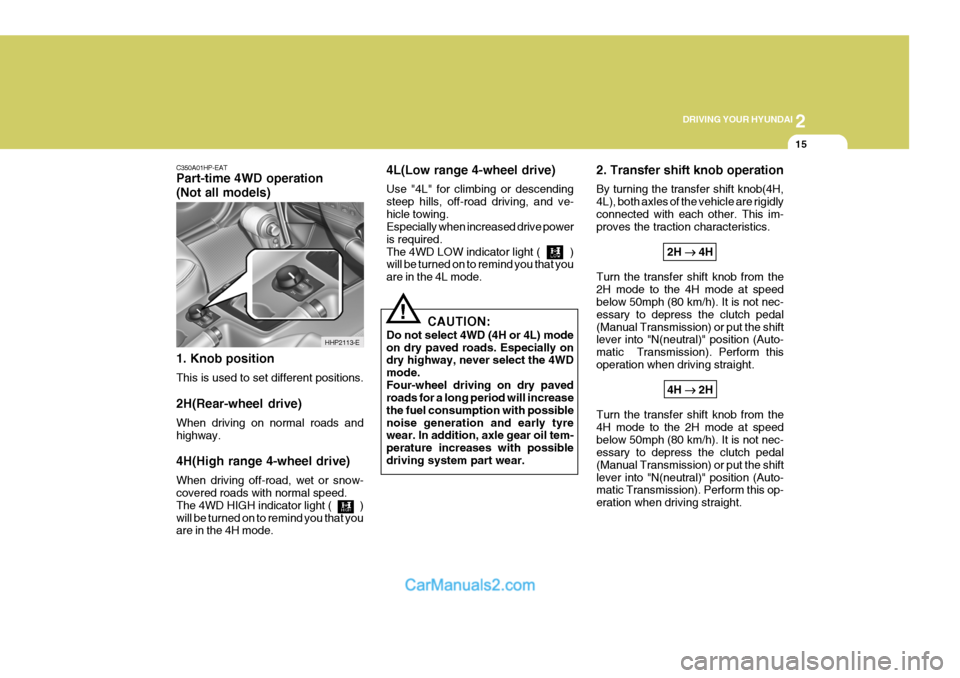
C350A01HP-EAT Part-time 4WD operation (Not all models) 1. Knob position This is used to set different positions. 2H(Rear-wheel drive) When driving on normal roads and highway. 4H(High range 4-wheel drive) When driving off-road, wet or snow- covered roads with normal speed. The 4WD HIGH indicator light ( )will be turned on to remind you that you are in the 4H mode.
!
4L(Low range 4-wheel drive) Use "4L" for climbing or descending steep hills, off-road driving, and ve-hicle towing. Especially when increased drive power is required.The 4WD LOW indicator light ( ) will be turned on to remind you that you are in the 4L mode.
2. Transfer shift knob operation By turning the transfer shift knob(4H, 4L), both axles of the vehicle are rigidlyconnected with each other. This im- proves the traction characteristics.
2H
4H
Turn the transfer shift knob from the 2H mode to the 4H mode at speed below 50mph (80 km/h). It is not nec- essary to depress the clutch pedal(Manual Transmission) or put the shift lever into "N(neutral)" position (Auto- matic Transmission). Perform thisoperation when driving straight. 4H
2H
Turn the transfer shift knob from the4H mode to the 2H mode at speedbelow 50mph (80 km/h). It is not nec- essary to depress the clutch pedal (Manual Transmission) or put the shiftlever into "N(neutral)" position (Auto- matic Transmission). Perform this op- eration when driving straight.
CAUTION:
Do not select 4WD (4H or 4L) modeon dry paved roads. Especially on dry highway, never select the 4WD mode.Four-wheel driving on dry paved roads for a long period will increase the fuel consumption with possiblenoise generation and early tyre wear. In addition, axle gear oil tem- perature increases with possibledriving system part wear.
HHP2113-E
Page 432 of 539
2
DRIVING YOUR HYUNDAI
19
!
(6) Since the driving torque is always
applied to the 4 wheels, the perfor- mance of the full-time 4WD vehicle is greatly affected by the condition of the tyres. Be sure to equip it withall four tyres of the same size and type.
o When replacement of any of the tyres or disc wheels is neces-sary, replace all of them.
o Rotate the tyres and check the tyre pressure at regular inter-vals.
WARNING:
Your vehicle is equipped with tyresdesigned to provide for safe ride and handling capability.Do not use a size and type of tyre and wheel that is different from the one that was originally installed on yourvehicle. It can affect the safety and performance of your vehicle, which could lead to handling failure orrollover and serious injury. When replacing the tyres, be sure to equip all four tyres with the tyre andwheel of the same size, type, tread, brand and load-carrying capacity. Ifyou nevertheless decide to equipyour vehicle with any tyre/wheel com- bination not recommended by Hyundai for off-road driving, youshould not use these tyres for high- way driving.
(7) The full-time 4WD vehicle cannot
be towed by an ordinary tow truck. Make sure that the vehicle is towedwith its four wheels raised off the ground.
o If the vehicle is towed with its
only two wheels raised off the ground, the 4WD system could be damaged.
o In unavoidable case, if the ve- hicle is being towed with all fourwheels on the ground, it shouldbe towed only forward direction with rope.
o Whilst towing, check the follow- ing items.
1. The ignition switch is in "ACC"
or "ON".
2. Place the shift lever in neutral (For Automatic Transmission, "N" position).
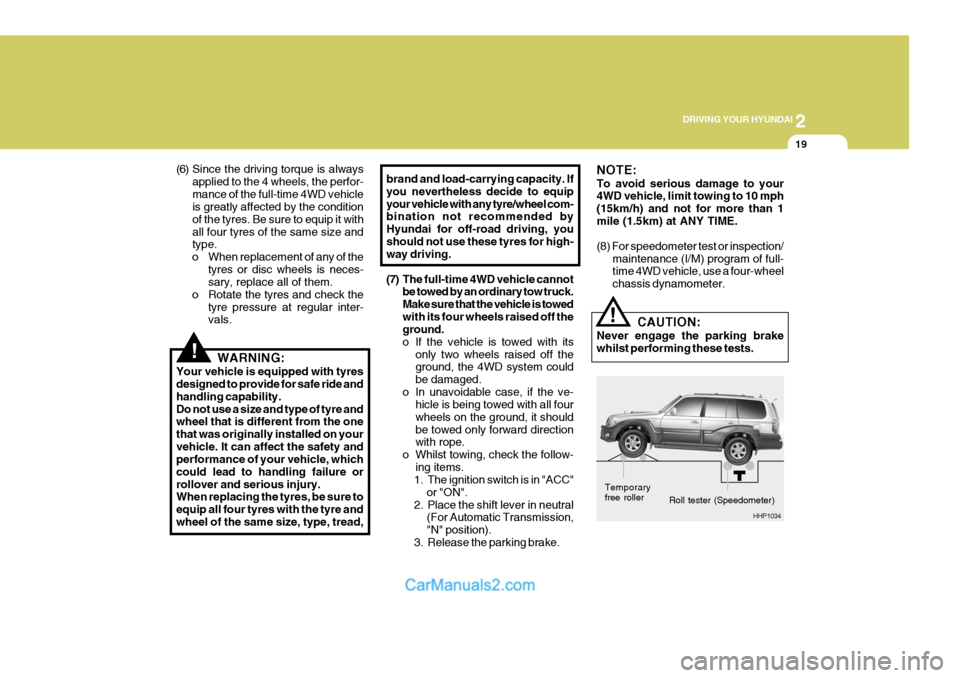
3. Release the parking brake. NOTE: To avoid serious damage to your 4WD vehicle, limit towing to 10 mph (15km/h) and not for more than 1mile (1.5km) at ANY TIME. (8) For speedometer test or inspection/
maintenance (I/M) program of full- time 4WD vehicle, use a four-wheel chassis dynamometer.
CAUTION:
Never engage the parking brakewhilst performing these tests.
Roll tester (Speedometer)
HHP1034
Temporary free roller
!
Page 435 of 539
2 DRIVING YOUR HYUNDAI
22EFFECTIVE BRAKING
HPC140A1-E Braking system performance and fric- tion material life are greatly affected by the driving style adopted. The follow- ing suggestions are made to assist inachieving the best results from the braking system.
o Anticipate the road and conditions ahead in order that heavy braking may be avoided.
o When descending long gradients, use the engine to assist in retardingthe vehicle to minimize the possibil-ity of brake fade occurring.
o When trailer towing, ensure that the
trailer brakes function correctly anduse engine braking to assist the vehicle braking system.
o Use only genuine Hyundai replace- ment brake pads and shoes to en-sure consistent friction characteris- tics and wear rates.
o After driving through deep water (e.g. fording), the brakes may becomewet and performance reduced. Al-ways check brake efficiency after emerging from the water and dry the brakes by lightly depressing theLIMITED-SLIP DIFFEREN- TIAL
D190A01HP-EAT (Not all models) A limited-slip differential, if equipped, is for the rear wheel differential only.The features of this limited-slip differ- ential are described below: Just as with a conventional differential,the wheel on one side is allowed to turn at a different speed from the wheel on the other side when the vehicle iscornering. The difference between the limited-slip differential and a conven- tional differential is that if the wheel onone side of the vehicle loses traction, a greater amount of torque is applied to the rear wheel on the other side toimprove traction.
gency braking, always maintain a safe distance between you and ob- jects ahead. Vehicle speeds should always be reduced during extremeroad conditions. The braking distance for cars equipped with an anti-lock brakingsystem may be longer than for those without it in the following road con- ditions.
o Driving on rough, gravel or snow-
covered roads.
o Driving with tire chains installed.
o Driving on roads where the road surface is pitted or has different surface height.
These roads should be driven atreduced speeds. The safety features of an ABS equipped vehicle should not be tested by high speed drivingor cornering. This could endanger the safety of yourself or others.
! CAUTION:
o Never start the engine with the gearshift lever placed in the for- ward or reverse whilst one of therear wheels is jacked up and the other in contact with the ground; doing so may cause the vehicle tojump forward.
o Use only recommended oil for
LSD in the rear axle.See page 9-5 for the recommended oil descriptions.
Page 436 of 539
2
DRIVING YOUR HYUNDAI
23
brake pedal several times whilst driv- ing slowly.
o Apply the parking brake only when the vehicle is at rest.
o Since the power assistance pro-
vided by the brake servo is derived from the engine, coasting with the engine turned off or towing of thevehicle with the engine turned off will result in greatly increased pedal pressures being required to stop thevehicle.
o Do not hold the vehicle on the up-
grade with the accelerator pedal.This can cause the transmission to overheat. Always use the brake pedal or parking brake.DRIVING FOR ECONOMY
C140A01A-EAT You can save fuel and get more miles from your car if you follow these sug-gestions:
o Drive smoothly. Accelerate at a moderate rate. Don't make "jack- rabbit" starts or full-throttle shifts and maintain a steady cruisingspeed. Don't race between stop- lights. Try to adjust your speed to that of the other traffic so you don'thave to change speeds unneces- sarily. Avoid heavy traffic whenever possible. Always maintain a safedistance from other vehicles so you can avoid unnecessary braking. This also reduces brake wear.
o Drive at a moderate speed. The faster you drive, the more fuel yourcar uses. Driving at a moderatespeed, especially on the highway, is one of the most effective ways to reduce fuel consumption.
o Don't "ride" the brake or clutch pedal. This can increase fuel consumptionand also increase wear on thesecomponents. In addition, driving with your foot resting on the brake pedal may cause the brakes to overheat, which reduces their effectivenessand may lead to more serious conse-quences.
o Take care of your tyres. Keep them
inflated to the recommended pres-sure. Incorrect inflation, either too much or too little, results in unnec- essary tyre wear. Check the tyrepressures at least once a month.
o Be sure that the wheels are aligned
correctly. Improper alignment canresult from hitting curbs or driving too fast over irregular surfaces. Poor alignment causes faster tyre wearand may also result in other prob- lems as well as greater fuel con- sumption.
o Keep your car in good condition. For better fuel economy and reducedmaintenance costs, maintain yourcar in accordance with the mainte- nance schedule in Section 5. If you drive your car in severe conditions,more frequent maintenance is re- quired (see Section 5 for details).
o Keep your car clean. For maximum service, your Hyundai should bekept clean and free of corrosive materials. It is especially importantthat mud, dirt, ice, etc. not be al-
Page 439 of 539
2 DRIVING YOUR HYUNDAI
26
YC200B2-E Trailer Towbars Select the correct towbar and ball com- bination, making sure that its location is compatible with that of the trailer or vehicle being towed.Use a quality non-equalizing towbar which distributes the nose weight uni- formly throughout the chassis. The towbar should be bolted securely to the car and installed by a qualifiedtechnician.
!
o The formation of snow or ice build
up inside the wheel arches may interfere with the roadwheels or steering mechanism. In such in- stances, unusual noises or an in-crease in steering effort may re- sult. Therefore, ensure that the wheelarches are checked peri-odically and any accumulated snow or ice removed.
o It is advisable to carry emergency equipment including, torch,shovel, tow rope, blankets etc., if a journey is to be undertakeninto areas of severe road condi- tions. CAUTION:
Do not do any towing with your carduring its first 1,000 miles in order to allow the engine to have properlyrun-in. Failure to heed this caution may result in serious engine or trans- mission damage.
TRAILER OR VEHICLE TOWING
HPC200A2-E If you are considering towing with your car, you should first check with your Local Laws to determine their legal requirements.Since laws vary from county to county, the requirements for towing trailers, cars, or other types of vehicles orapparatus may differ. Ask your Hyundai dealer for further details before towing.
Page 440 of 539
2
DRIVING YOUR HYUNDAI
27
!
YC200C3-A Trailer Brakes If your trailer is equipped with a braking system, make sure it conforms to fed-eral and/or local regulations and that it is properly installed and operating cor- rectly. NOTE: If you tow a trailer or vehicle, your car will require more frequent main-tenance due to the additional load. See Maintenance Under Severe Usage Conditions" on page 5-6. CAUTION:
o Never connect a trailer brake sys- tem directly to the vehicle brakesystem.
o When towing a trailer on steep grades (in excess of 12%) payclose attention to the engine cool-ant temperature gauge to ensure the engine does not overheat. If the needle of the coolant tem-perature gauge moves across the dial towards "H" (HOT), pull over and stop as soon as it is safe todo so, and allow the engine to idle until it cools down. You may proceed once the engine hascooled sufficiently. YC200D2-E Safety Cables Should the towbar connection between your car and the trailer or vehicle youare towing fail, the trailer or vehicle could wander dangerously across other lanes of traffic and ultimately leave theroadway. To eliminate this potentially dangerous situation, safety cables, attached between your car and thetrailer or towed vehicle, are required.
Page 441 of 539
2 DRIVING YOUR HYUNDAI
28
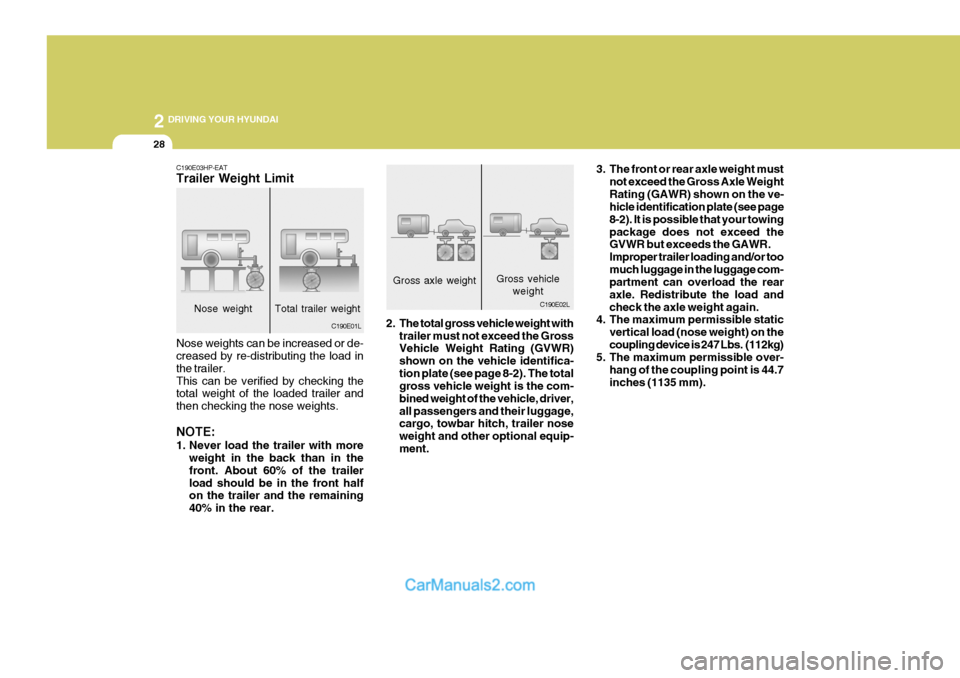
3. The front or rear axle weight mustnot exceed the Gross Axle Weight Rating (GAWR) shown on the ve- hicle identification plate (see page 8-2). It is possible that your towingpackage does not exceed the GVWR but exceeds the GAWR. Improper trailer loading and/or toomuch luggage in the luggage com- partment can overload the rear axle. Redistribute the load andcheck the axle weight again.
4. The maximum permissible static
vertical load (nose weight) on thecoupling device is 247 Lbs. (112kg)
5. The maximum permissible over-
hang of the coupling point is 44.7inches (1135 mm).
Gross axle weight
C190E02LGross vehicleweight
C190E03HP-EAT Trailer Weight Limit
2. The total gross vehicle weight withtrailer must not exceed the Gross Vehicle Weight Rating (GVWR) shown on the vehicle identifica-tion plate (see page 8-2). The total gross vehicle weight is the com- bined weight of the vehicle, driver,all passengers and their luggage, cargo, towbar hitch, trailer nose weight and other optional equip-ment.
Nose weights can be increased or de- creased by re-distributing the load in the trailer.This can be verified by checking the total weight of the loaded trailer and then checking the nose weights. NOTE:
1. Never load the trailer with more
weight in the back than in the front. About 60% of the trailerload should be in the front half on the trailer and the remaining 40% in the rear.
C190E01L
Nose weight Total trailer weight