warning light Hyundai Terracan 2005 Repair Manual
[x] Cancel search | Manufacturer: HYUNDAI, Model Year: 2005, Model line: Terracan, Model: Hyundai Terracan 2005Pages: 539, PDF Size: 18.03 MB
Page 416 of 539
2
DRIVING YOUR HYUNDAI
3
!WARNING:
Your vehicle is equipped with tyres designed to provide for safe ride and handling capability.Do not use a size and type of tyre and wheel that is different from the one that was originally installed on yourvehicle. It can affect the safety and performance of your vehicle, which could lead to handling failure orrollover and serious injury. When replacing the tyres, be sure to equip all four tyres with the tyre andwheel of the same size, type, tread, brand and load-carrying capacity. If you nevertheless decide to equipyour vehicle with any tyre/wheel com- bination not recommended by Hyundai for off-road driving, youshould not use these tyres for high- way driving.
TO START THE ENGINEBEFORE STARTING THE ENGINE
C020A01A-EAT Before you start the engine, you should always:
1. Look around the vehicle to be sure
there are no flat tyres, puddles of oil or water or other indications of pos- sible trouble.
2. After entering the car, check to be
sure the parking brake is engaged.
3. Check that all windows, and lights
are clean.
4. Check that the interior and exterior mirrors are clean and in position.
5. Check your seat, seatback and headrest to be sure they are in theirproper positions.
6. Close all the doors.
7. Fasten your seat belt and be sure that all other occupants have fas-tened theirs.
8. Turn off all lights and accessories that are not needed.
9. When you turn the ignition switch to "ON" check that all appropriate warning lights are operating and that you have sufficient fuel.
10.Check the operation of warning lights and all bulbs when key is inthe "ON" position. C030A01HP-EAT Cmbination Ignition Switch and Steering Lock
o If your Hyundai is equipped with a
manual transmission, place the shift lever in neutral and depress the clutch pedal fully.
o If your Hyundai has an automatic
transmission, place the shift lever in"P" (park).
o To start the engine, insert the igni- tion key and turn it to the "START"position. Release it as soon as the engine starts. Do not hold the key inthe "START" position for more than 15 seconds.
NOTE: For safety, the engine will not start if the shift lever is not in "P" or "N" position (Automatic Transmission).
Page 417 of 539
2 DRIVING YOUR HYUNDAI
4
!WARNING:
The engine must never be turned off and the key removed from the igni-tion key cylinder whilst the vehicle is in motion since the steering lock will operate and control of the vehiclewill be lost.
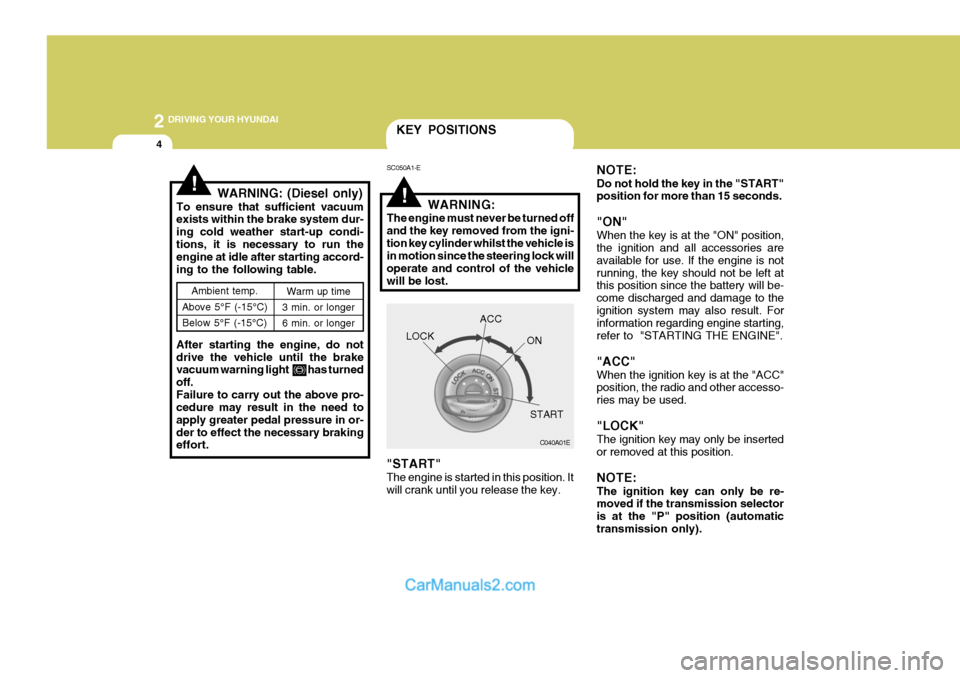
"START" The engine is started in this position. It will crank until you release the key.
Ambient temp.
Above 5°F (-15°C) Below 5°F (-15°C) Warm up time
3 min. or longer 6 min. or longer
!WARNING: (Diesel only)
To ensure that sufficient vacuum exists within the brake system dur- ing cold weather start-up condi-tions, it is necessary to run the engine at idle after starting accord- ing to the following table. After starting the engine, do not drive the vehicle until the brake vacuum warning light has turned off.Failure to carry out the above pro- cedure may result in the need to apply greater pedal pressure in or-der to effect the necessary braking effort.
KEY POSITIONS
SC050A1-E
C040A01E
LOCK
ACC
ON
START
NOTE: Do not hold the key in the "START" position for more than 15 seconds. "ON" When the key is at the "ON" position, the ignition and all accessories are available for use. If the engine is notrunning, the key should not be left at this position since the battery will be- come discharged and damage to theignition system may also result. For information regarding engine starting, refer to "STARTING THE ENGINE". "ACC" When the ignition key is at the "ACC" position, the radio and other accesso- ries may be used. "LOCK" The ignition key may only be inserted or removed at this position. NOTE: The ignition key can only be re- moved if the transmission selector is at the "P" position (automatictransmission only).
Page 425 of 539
2 DRIVING YOUR HYUNDAI
12
!
C090I01E-EAT
CAUTION:
o Shift into "R" and "P" only when the vehicle has completely stopped.
o Do not accelerate the engine in reverse or any of the forward posi-tions with the brakes applied.
o Always apply the footbrake when shifting from "P" or "N" to "R","D", "2" or "L" position.
o Do not use the "P" (Park) posi- tion in place of the parking brake.Always set the parking brake,shift the transmission into "P" (Park) and turn off the ignition when you leave the vehicle, evenmomentarily. Never leave the ve- hicle unattended whilst the en- gine is running.
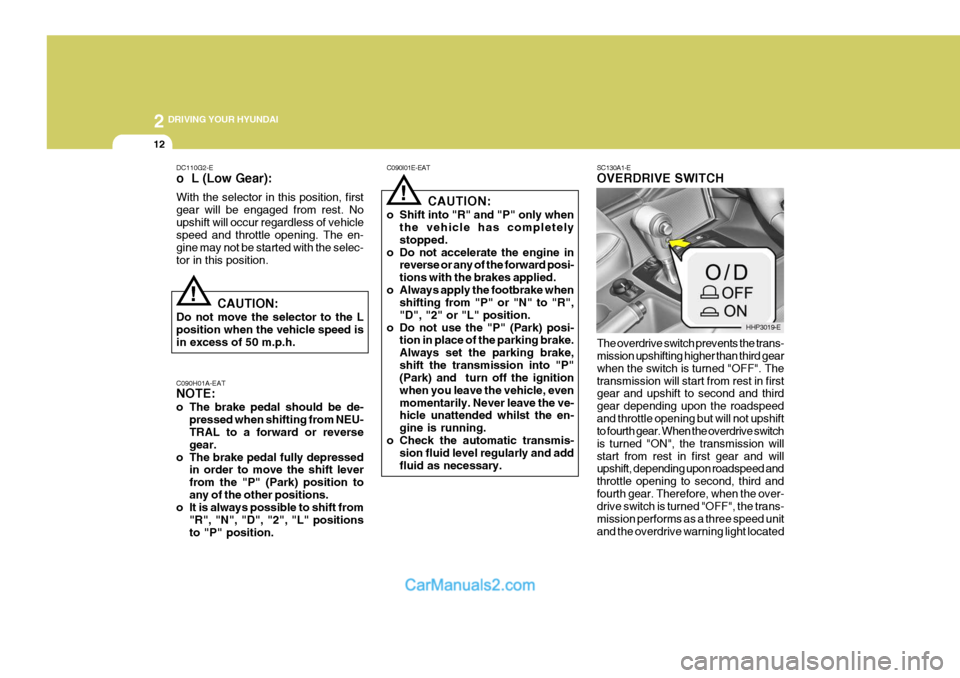
o Check the automatic transmis- sion fluid level regularly and addfluid as necessary. SC130A1-E OVERDRIVE SWITCH The overdrive switch prevents the trans- mission upshifting higher than third gear when the switch is turned "OFF". Thetransmission will start from rest in first gear and upshift to second and third gear depending upon the roadspeedand throttle opening but will not upshift to fourth gear. When the overdrive switch is turned "ON", the transmission willstart from rest in first gear and will upshift, depending upon roadspeed and throttle opening to second, third andfourth gear. Therefore, when the over- drive switch is turned "OFF", the trans- mission performs as a three speed unitand the overdrive warning light located
!
DC110G2-E o L (Low Gear): With the selector in this position, first gear will be engaged from rest. Noupshift will occur regardless of vehicle speed and throttle opening. The en- gine may not be started with the selec-tor in this position.
CAUTION:
Do not move the selector to the Lposition when the vehicle speed isin excess of 50 m.p.h. C090H01A-EAT NOTE:
o The brake pedal should be de- pressed when shifting from NEU- TRAL to a forward or reverse gear.
o The brake pedal fully depressed in order to move the shift leverfrom the "P" (Park) position toany of the other positions.
o It is always possible to shift from
"R", "N", "D", "2", "L" positionsto "P" position.
HHP3019-E
Page 434 of 539
2
DRIVING YOUR HYUNDAI
21
!
Water entering the engine air intake will cause severe engine damage. Water can wash the grease from wheel bearings, causing rusting and prema-ture failure, and may also enter the axles, transmission and transfer case, reducing the gear oil's lubricating quali-ties. CAUTION:
o Whilst the full-time 4WD vehicle is
being raised on a jack, never start the engine or cause the tyres to rotate. There is the danger that rotating tyres touching the ground couldcause the vehicle to go off the jack and to jump forward.
o If one of the front or rear wheels begins to spin in mud, snow, etc.,the vehicle can sometimes be driven out by depressing the ac-celerator pedal further; however, avoid running the engine continu- ously at high rpm because doingso could damage the 4WD system.
!WARNING:
o Avoid high cornering speeds.
o Do not make quick steering wheel movements, such as sharp lane charges or fast, sharp turns.
o The risk of rollover is greatly in-
creased if you lose control of yourvehicle at highway speeds.
o In a collision crash, an unbelted
person is significantly more likelyto die than a person wearing a seatbelt.
o Loss of control often occurs if two or more wheels drop off the road- way and the driver oversteers toreenter the roadway.
o In the event your vehicle leaves
the roadway, do not steer sharply.Instead, slow down before pulling back into the travel lanes.
!
ANTI-LOCK BRAKE SYSTEM (ABS)
C120A02A-EAT (Not all models) The Anti-Lock Brake System (ABS) is designed to prevent wheel lock-upduring sudden braking or on hazard- ous road surfaces. The ABS control module monitors the wheel speed andcontrols the pressure applied to each brake. Thus, in emergency situations or on slick roads, ABS will increasevehicle control during braking. NOTE: During ABS operation, a slight pul- sation may be felt in the brake pedal when the brakes are applied. Also, a noise may be heard in the enginecompartment whilst braking. These conditions are normal and indicate that the anti-lock brake system isfunctioning properly.
WARNING:
ABS will not prevent accidents due to improper or dangerous driving manoeuvres. Even though vehiclecontrol is improved during emer-
Page 446 of 539
3 IN CASE OF EMERGENCY
2
!WARNING:
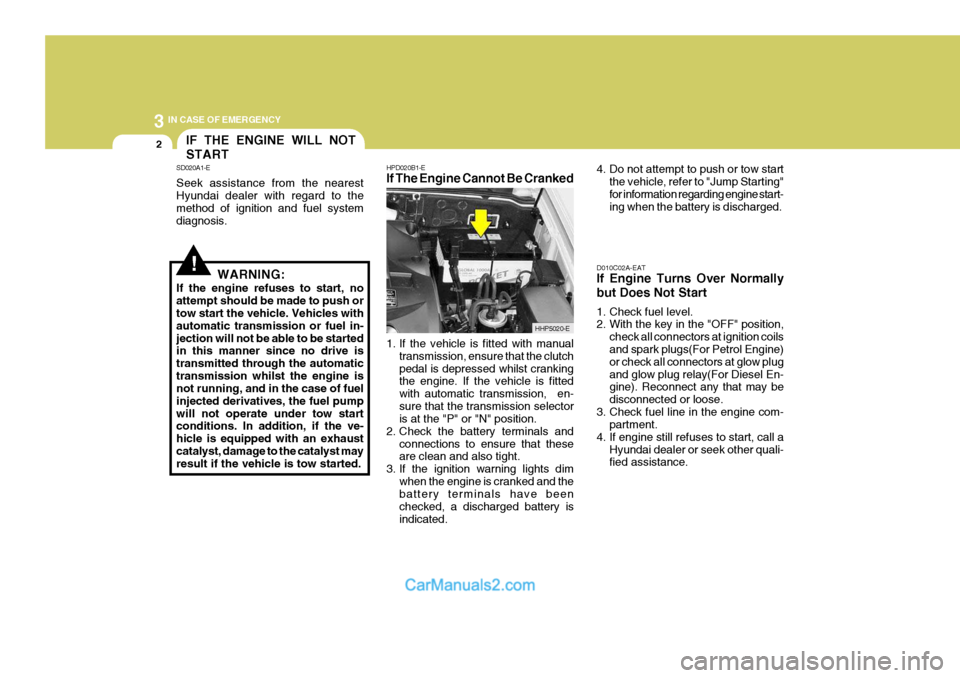
If the engine refuses to start, no attempt should be made to push or tow start the vehicle. Vehicles with automatic transmission or fuel in-jection will not be able to be started in this manner since no drive is transmitted through the automatictransmission whilst the engine is not running, and in the case of fuel injected derivatives, the fuel pumpwill not operate under tow start conditions. In addition, if the ve- hicle is equipped with an exhaustcatalyst, damage to the catalyst may result if the vehicle is tow started. HPD020B1-E If The Engine Cannot Be Cranked
1. If the vehicle is fitted with manual
transmission, ensure that the clutch pedal is depressed whilst cranking the engine. If the vehicle is fitted with automatic transmission, en-sure that the transmission selector is at the "P" or "N" position.
2. Check the battery terminals and
connections to ensure that theseare clean and also tight.
3. If the ignition warning lights dim
when the engine is cranked and thebattery terminals have been checked, a discharged battery isindicated. 4. Do not attempt to push or tow start
the vehicle, refer to "Jump Starting"for information regarding engine start- ing when the battery is discharged.
D010C02A-EAT If Engine Turns Over Normally but Does Not Start
1. Check fuel level.
2. With the key in the "OFF" position, check all connectors at ignition coilsand spark plugs(For Petrol Engine) or check all connectors at glow plugand glow plug relay(For Diesel En- gine). Reconnect any that may be disconnected or loose.
3. Check fuel line in the engine com- partment.
4. If engine still refuses to start, call a Hyundai dealer or seek other quali- fied assistance.
IF THE ENGINE WILL NOT START
SD020A1-E Seek assistance from the nearest Hyundai dealer with regard to the method of ignition and fuel system diagnosis.
HHP5020-E
Page 447 of 539
3
IN CASE OF EMERGENCY
3
!
D010A01A-EAT If Engine Stalls Whilst Driving
1. Reduce your speed gradually, keep-
ing a straight line. Move cautiously off the road to a safe place.
2. Turn on your emergency flashers.
3. Try starting the engine again. If your
vehicle will not start, contact Hyundai dealer or seek other qualified assis- tance.
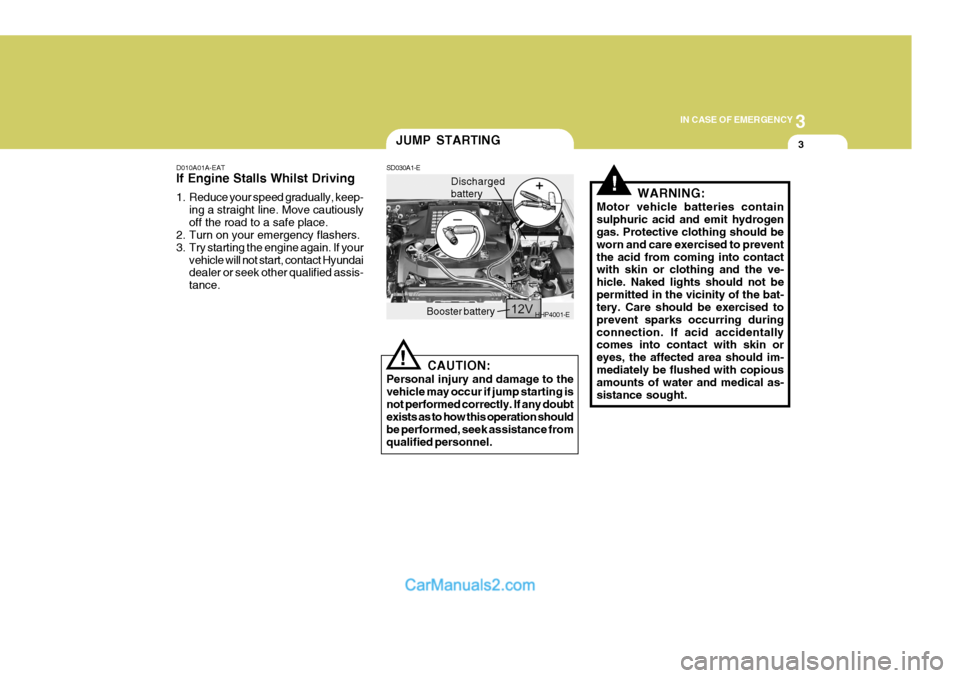
CAUTION:
Personal injury and damage to thevehicle may occur if jump starting isnot performed correctly. If any doubt exists as to how this operation should be performed, seek assistance fromqualified personnel. WARNING:
Motor vehicle batteries containsulphuric acid and emit hydrogen gas. Protective clothing should be worn and care exercised to preventthe acid from coming into contact with skin or clothing and the ve- hicle. Naked lights should not bepermitted in the vicinity of the bat- tery. Care should be exercised to prevent sparks occurring duringconnection. If acid accidentally comes into contact with skin or eyes, the affected area should im- mediately be flushed with copious amounts of water and medical as-sistance sought.
!
JUMP STARTING
SD030A1-E
HHP4001-EBooster battery Discharged battery
Page 481 of 539
6 OWNER MAINTENANCE
4
G030B03HP-EAT
Recommended Oil
1. Petrol Engine
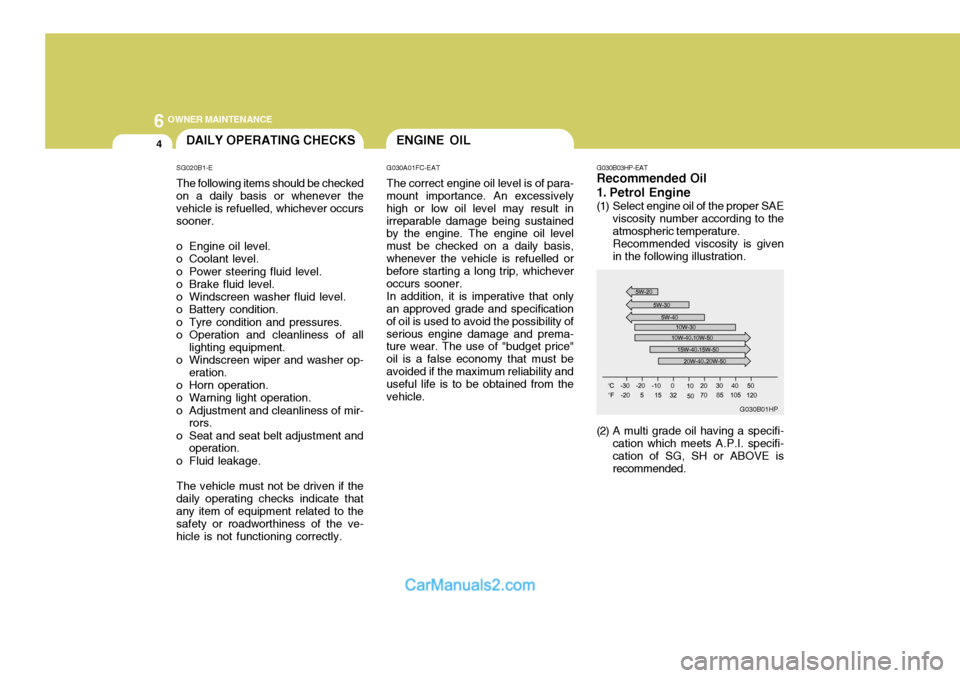
(1) Select engine oil of the proper SAE
viscosity number according to the atmospheric temperature.Recommended viscosity is givenin the following illustration.
(2) A multi grade oil having a specifi- cation which meets A.P.I. specifi-cation of SG, SH or ABOVE isrecommended.DAILY OPERATING CHECKS
SG020B1-E The following items should be checked on a daily basis or whenever the vehicle is refuelled, whichever occurssooner.
o Engine oil level.
o Coolant level.
o Power steering fluid level.
o Brake fluid level.
o Windscreen washer fluid level.
o Battery condition.
o Tyre condition and pressures.
o Operation and cleanliness of all lighting equipment.
o Windscreen wiper and washer op-
eration.
o Horn operation.
o Warning light operation.
o Adjustment and cleanliness of mir- rors.
o Seat and seat belt adjustment and operation.
o Fluid leakage. The vehicle must not be driven if the daily operating checks indicate that any item of equipment related to the safety or roadworthiness of the ve-hicle is not functioning correctly.ENGINE OIL
G030A01FC-EAT The correct engine oil level is of para-
mount importance. An excessively high or low oil level may result inirreparable damage being sustained by the engine. The engine oil level must be checked on a daily basis,whenever the vehicle is refuelled or before starting a long trip, whichever occurs sooner.
In addition, it is imperative that only
an approved grade and specificationof oil is used to avoid the possibility ofserious engine damage and prema- ture wear. The use of "budget price" oil is a false economy that must beavoided if the maximum reliability and useful life is to be obtained from the vehicle.
G030B01HP
Page 497 of 539
6 OWNER MAINTENANCE
20
!
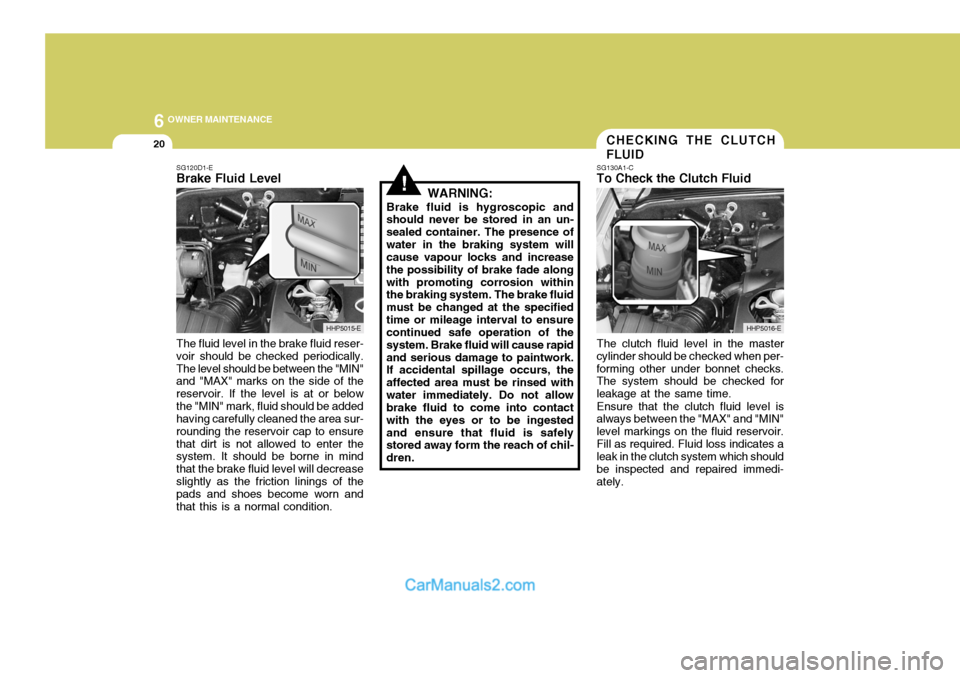
SG120D1-E Brake Fluid Level The fluid level in the brake fluid reser- voir should be checked periodically.The level should be between the "MIN" and "MAX" marks on the side of the reservoir. If the level is at or belowthe "MIN" mark, fluid should be added having carefully cleaned the area sur- rounding the reservoir cap to ensurethat dirt is not allowed to enter the system. It should be borne in mind that the brake fluid level will decreaseslightly as the friction linings of the pads and shoes become worn and that this is a normal condition. WARNING:
Brake fluid is hygroscopic and
should never be stored in an un-sealed container. The presence ofwater in the braking system will cause vapour locks and increase the possibility of brake fade alongwith promoting corrosion within the braking system. The brake fluid must be changed at the specifiedtime or mileage interval to ensure continued safe operation of the system. Brake fluid will cause rapidand serious damage to paintwork. If accidental spillage occurs, the affected area must be rinsed withwater immediately. Do not allow brake fluid to come into contact with the eyes or to be ingestedand ensure that fluid is safely stored away form the reach of chil- dren. The clutch fluid level in the master
cylinder should be checked when per-forming other under bonnet checks. The system should be checked for leakage at the same time.
Ensure that the clutch fluid level is
always between the "MAX" and "MIN"level markings on the fluid reservoir.Fill as required. Fluid loss indicates a leak in the clutch system which should be inspected and repaired immedi-ately.
HHP5015-E
CHECKING THE CLUTCH FLUID
SG130A1-C
To Check the Clutch Fluid
HHP5016-E
Page 503 of 539
6 OWNER MAINTENANCE
26
!
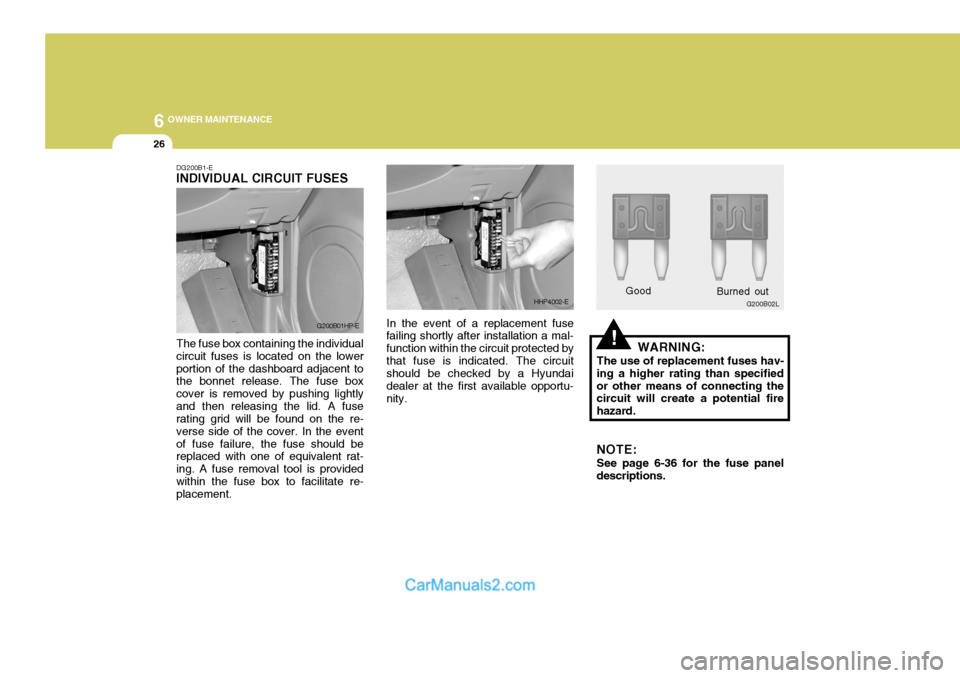
DG200B1-E INDIVIDUAL CIRCUIT FUSES The fuse box containing the individual circuit fuses is located on the lowerportion of the dashboard adjacent to the bonnet release. The fuse box cover is removed by pushing lightlyand then releasing the lid. A fuse rating grid will be found on the re- verse side of the cover. In the eventof fuse failure, the fuse should be replaced with one of equivalent rat- ing. A fuse removal tool is providedwithin the fuse box to facilitate re- placement. In the event of a replacement fuse
failing shortly after installation a mal- function within the circuit protected bythat fuse is indicated. The circuit should be checked by a Hyundai dealer at the first available opportu-nity. WARNING:
The use of replacement fuses hav-
ing a higher rating than specifiedor other means of connecting the circuit will create a potential fire hazard.
NOTE: See page 6-36 for the fuse panel
descriptions.
G200B01HP-E
HHP4002-EGood G200B02L
Burned out
Page 504 of 539
6
OWNER MAINTENANCE
27
!WARNING:
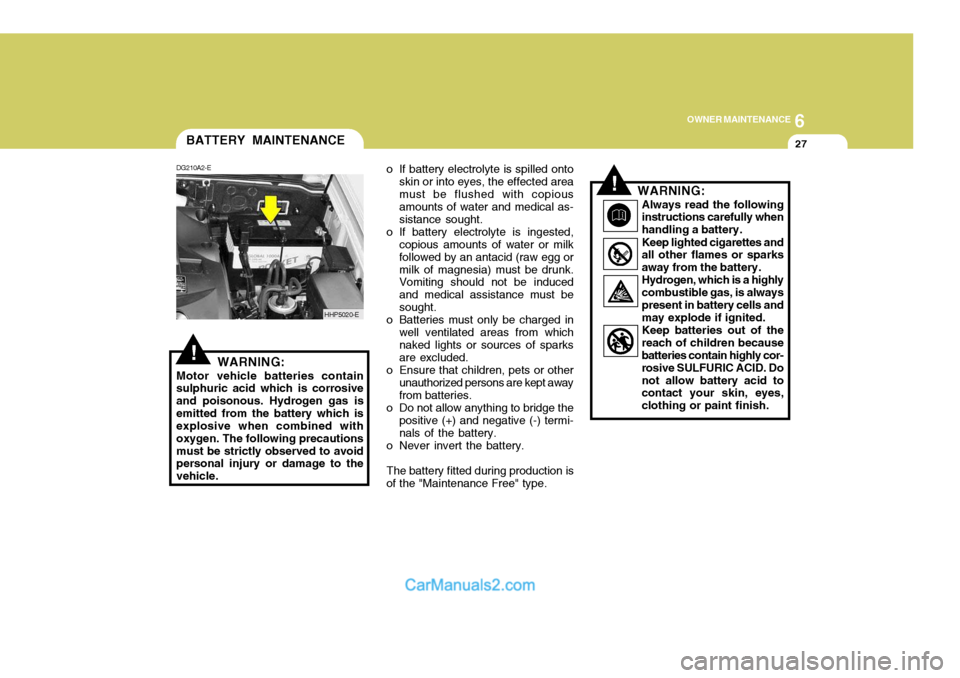
Motor vehicle batteries contain sulphuric acid which is corrosive and poisonous. Hydrogen gas isemitted from the battery which is explosive when combined with oxygen. The following precautionsmust be strictly observed to avoid personal injury or damage to the vehicle. o If battery electrolyte is spilled onto
skin or into eyes, the effected areamust be flushed with copious amounts of water and medical as- sistance sought.
o If battery electrolyte is ingested, copious amounts of water or milkfollowed by an antacid (raw egg ormilk of magnesia) must be drunk. Vomiting should not be induced and medical assistance must besought.
o Batteries must only be charged in well ventilated areas from which naked lights or sources of sparks are excluded.
o Ensure that children, pets or other unauthorized persons are kept awayfrom batteries.
o Do not allow anything to bridge the
positive (+) and negative (-) termi-nals of the battery.
o Never invert the battery.
The battery fitted during production is
of the "Maintenance Free" type.
BATTERY MAINTENANCE
DG210A2-E
HHP5020-E
!WARNING: Always read the following instructions carefully when handling a battery. Keep lighted cigarettes and all other flames or sparks away from the battery.Hydrogen, which is a highlycombustible gas, is alwayspresent in battery cells and may explode if ignited. Keep batteries out of the reach of children because batteries contain highly cor- rosive SULFURIC ACID. Donot allow battery acid to contact your skin, eyes, clothing or paint finish.