warning Hyundai Terracan 2006 Owner's Manual
[x] Cancel search | Manufacturer: HYUNDAI, Model Year: 2006, Model line: Terracan, Model: Hyundai Terracan 2006Pages: 539, PDF Size: 18.11 MB
Page 339 of 539
1
CONTROLS AND EQUIPMENT
31
!
B220D04HP
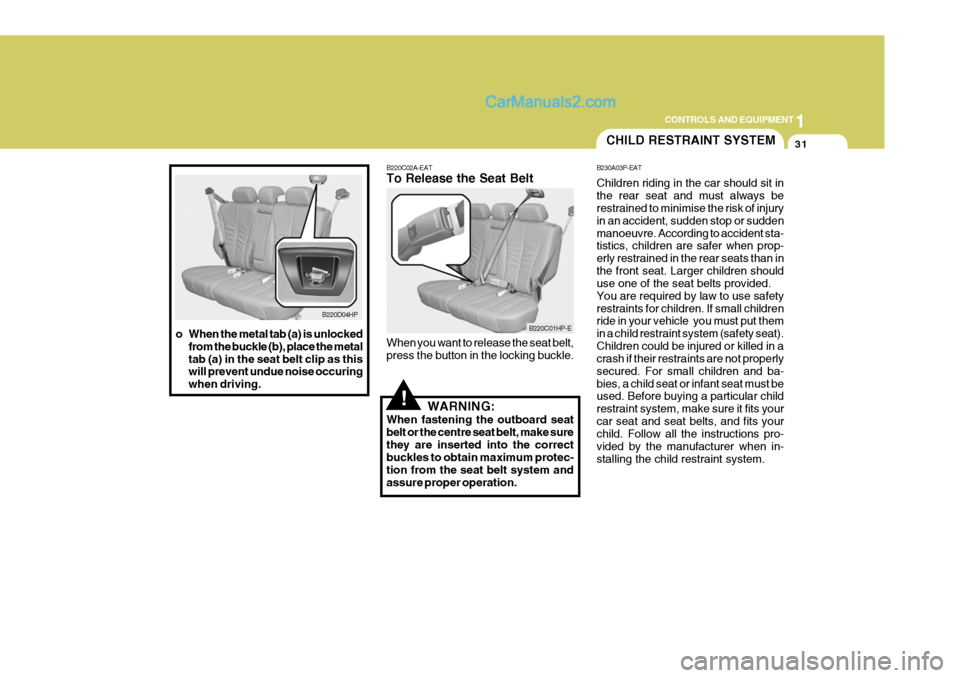
o When the metal tab (a) is unlocked from the buckle (b), place the metal tab (a) in the seat belt clip as this will prevent undue noise occuring when driving. B220C02A-EAT To Release the Seat Belt When you want to release the seat belt, press the button in the locking buckle.
WARNING:
When fastening the outboard seatbelt or the centre seat belt, make surethey are inserted into the correct buckles to obtain maximum protec- tion from the seat belt system andassure proper operation.
B220C01HP-E
CHILD RESTRAINT SYSTEM
B230A03P-EAT Children riding in the car should sit in the rear seat and must always be restrained to minimise the risk of injury in an accident, sudden stop or suddenmanoeuvre. According to accident sta- tistics, children are safer when prop- erly restrained in the rear seats than inthe front seat. Larger children should use one of the seat belts provided. You are required by law to use safetyrestraints for children. If small children ride in your vehicle you must put them in a child restraint system (safety seat).Children could be injured or killed in a crash if their restraints are not properly secured. For small children and ba-bies, a child seat or infant seat must be used. Before buying a particular child restraint system, make sure it fits yourcar seat and seat belts, and fits your child. Follow all the instructions pro- vided by the manufacturer when in-stalling the child restraint system.
Page 340 of 539
1CONTROLS AND EQUIPMENT
32
!WARNING:
o A child restraint system must be placed in the rear seat. Never install a child or infant seat on the front passenger's seat. Should an accident occur andcause the passenger side airbag to deploy, it could severely in- jure or kill an infant or child seatedin an infant or child seat. Thus, only use a child restraint in the rear seat of your vehicle.
o Since a safety belt or child re-
straint system can become veryhot if it is left in a closed vehicle, be sure to check the seat cover and buckles before placing achild there.
o When the child restraint system
is not in use, fasten it with asafety belt so that it will not be thrown forward in the case of a sudden stop or an accident. o Children who are too large to be in
a child restraint should sit in the rear seat and be restrained with the available lap/shoulder belts.Never allow children to ride in the front passanger seat.
o Always make sure that the shoul- der belt portion of the outboardlap/shoulder belt is positioned midway over the shoulder, neveracross the neck. Moving the child closer to the centre of the vehicle may help provide a good shoul-der belt fit. The lap belt portion of the lap/shoulder belt or the cen- tre seat lap belt must always bepositioned as low as possible on the child's hips and as snug as possible.
o If the seat belt will not properly fit the child, we recommend the useof an approved booster seat inthe rear seat in order to raise the child's seating height so that the seat belt will properly fit the child.
o Never allow a child to stand up or kneel on the seat. o Never use an infant carrier or child
safety seat that "hooks" over aseatback; it may not provide ad-equate security in an accident.
o Never allow a child to be held in a
person's arms whilst they are in amoving vehicle, as this could re- sult in serious injury to the child in the event of an accident or asudden stop. Holding a child in a moving vehicle does not provide the child with any means of pro-tection during an accident, even if the person holding the child is wearing a seat belt.
o If the child restraint seat is not
anchored properly, the risk of achild being seriously injured or killed in a collision greatly in- creases.
Page 342 of 539
1CONTROLS AND EQUIPMENT
34
!WARNING:
Do not install any child restraint system in the front passenger seat. Should an accident occur and cause the passenger side airbag to de-ploy, it could severely injure or kill an infant or child seated in an infant or child seat. Therefore, only use achild restraint system in the rear seat of your vehicle. B230B02A-AAT Using a Child Restraint System with "Tether Anchorage" Sys-tem For small children and babies, the use of a child seat or infant seat is required. This child seat or infant seat should be of appropriate size for the child andshould be installed in accordance with the manufacturer's instructions. It is further required that the seat be placedin the vehicle's rear seat since this can make an important contribution to safety. Your vehicle is provided withthree child restraint hook holders for installing the child seat or infant seat.B230C02HP-EAT Securing a Child Restraint Sys- tem with "Tether Anchorage"System Three child restraint hook holders are located on the floor behind the rear seat. Install the child restraint seat accord-ing to the instructions provided as fol- lowing.
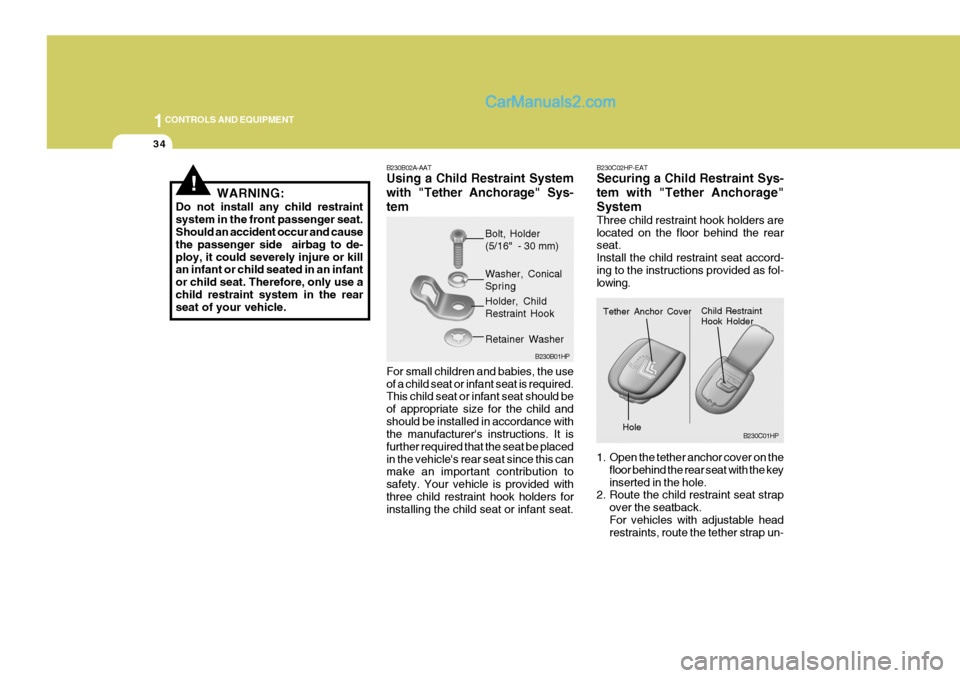
1. Open the tether anchor cover on the
floor behind the rear seat with the key inserted in the hole.
2. Route the child restraint seat strap
over the seatback.For vehicles with adjustable head restraints, route the tether strap un-
B230B01HP
Bolt, Holder (5/16" - 30 mm)
Washer, ConicalSpring Holder, Child Restraint Hook
Retainer Washer
B230C01HP
Tether Anchor Cover
Child Restraint Hook HolderHole
Page 344 of 539
1CONTROLS AND EQUIPMENT
36
!
During the installation, the seat has to be engaged at the anchorage-points insuch a way whereby you can hear it clicks (check by pulling!) and has to be fixed with the Top Tether-belt to theappropriate top tether mounting point on the seatback behind rear seats. The installing and the use of a child-seathas to be done according to the instal- lation manual for the ISOFIX seat. NOTE: An ISOFIX-child-seat can only be installed if the seat has a vehicle- specific approval according to ECE-R44. Before using the ISOFIX-child- seat, which was bought for another car, ask your Hyundai authorisedrepairer whether this seat-type is ap- proved and recommended for your Hyundai. To secure the child restraint seat 1. To engage the child restraint seat to
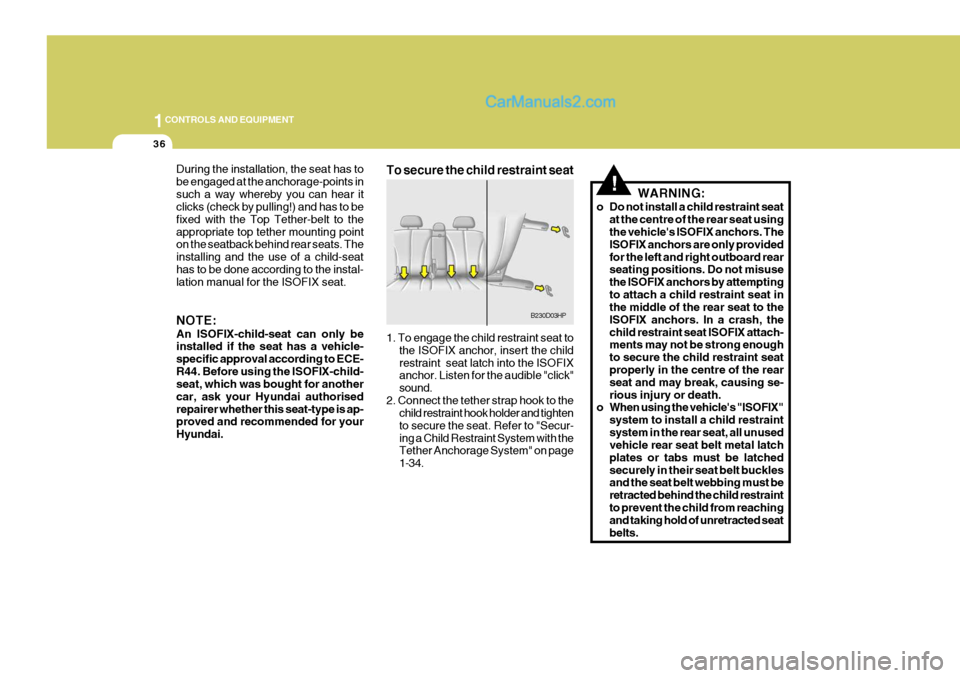
the ISOFIX anchor, insert the child restraint seat latch into the ISOFIX anchor. Listen for the audible "click" sound.
2. Connect the tether strap hook to the child restraint hook holder and tightento secure the seat. Refer to "Secur-ing a Child Restraint System with the Tether Anchorage System" on page 1-34. WARNING:
o Do not install a child restraint seat at the centre of the rear seat using the vehicle's ISOFIX anchors. The ISOFIX anchors are only providedfor the left and right outboard rear seating positions. Do not misuse the ISOFIX anchors by attemptingto attach a child restraint seat in the middle of the rear seat to the ISOFIX anchors. In a crash, thechild restraint seat ISOFIX attach- ments may not be strong enough to secure the child restraint seat properly in the centre of the rear seat and may break, causing se-rious injury or death.
o When using the vehicle's "ISOFIX"
system to install a child restraintsystem in the rear seat, all unused vehicle rear seat belt metal latch plates or tabs must be latchedsecurely in their seat belt buckles and the seat belt webbing must be retracted behind the child restraintto prevent the child from reaching and taking hold of unretracted seat belts.
B230D03HP
Page 346 of 539
1CONTROLS AND EQUIPMENT
38
!
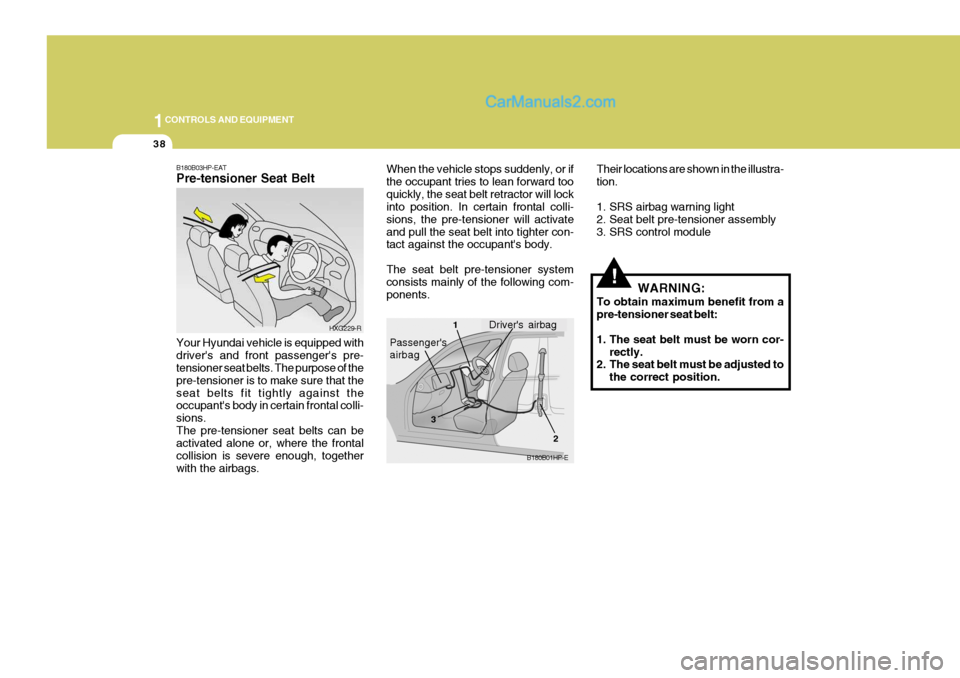
B180B03HP-EAT Pre-tensioner Seat Belt Your Hyundai vehicle is equipped with driver's and front passenger's pre- tensioner seat belts. The purpose of the pre-tensioner is to make sure that theseat belts fit tightly against the occupant's body in certain frontal colli- sions.The pre-tensioner seat belts can be activated alone or, where the frontal collision is severe enough, togetherwith the airbags. When the vehicle stops suddenly, or ifthe occupant tries to lean forward tooquickly, the seat belt retractor will lock into position. In certain frontal colli- sions, the pre-tensioner will activateand pull the seat belt into tighter con- tact against the occupant's body. The seat belt pre-tensioner system consists mainly of the following com- ponents.
WARNING:
To obtain maximum benefit from apre-tensioner seat belt:
1. The seat belt must be worn cor- rectly.
2. The seat belt must be adjusted to
the correct position.
HXG229-R
B180B01HP-E
Driver's airbag1
2
3
Passenger's airbag Their locations are shown in the illustra- tion.
1. SRS airbag warning light
2. Seat belt pre-tensioner assembly
3. SRS control module
Page 347 of 539
1
CONTROLS AND EQUIPMENT
39
NOTE:
o Both the driver's and front passenger's pre-tensioner seat belts will be activated in certainfrontal collisions. The pre- tensioner seat belts can be acti- vated alone or, where the frontalcollision is severe enough, to- gether with the airbags.
o When the pre-tensioner seat belts are activated, a loud noise may beheard and fine dust, which may appear to be smoke, may be vis-ible in the passenger compart- ment. These are normal operating conditions and are not hazard-ous.
o Although it is harmless, the fine
dust may cause skin irritation andshould not be breathed for pro- longed periods. Wash your hands and face thoroughly after an acci-dent in which the pre-tensioner seat belts were activated.
!!CAUTION:
o Because the sensor that activates the SRS airbag is connected with pre-tensioner seat belt, the SRS airbag warning light on theinstrument panel will blink for ap- proximately 6 seconds after the ignition key has been turned to the"ON" position or after the engine is started, and then it should turn off.
o If a pre-tensioner seat belt is not working properly, this warninglight will illuminate even if there isno malfunction of the SRS airbag. If the SRS airbag warning light does not blink for about 6 secondswhen the ignition key is turned to "ON" or the engine is started, or if it remains illuminated after blink-ing for approximately 6 seconds, or if it illuminates whilst the ve- hicle is being driven, please havea Hyundai authorised repairer in- spect the pre-tensioner seat belts and SRS airbag system as soon aspossible. WARNING:
o Pre-tensioners are designed to operate only one time. After acti- vation, pre-tensioner seat belts must be replaced. All seat belts,of any type, should always be replaced after they have been worn during a collision.
o The pre-tensioner seat belt as- sembly mechanisms become hotduring activation. Do not touchthe pre-tensioner seat belt as- semblies for several minutes af- ter they have been activated.
o Do not attempt to inspect or re-
place the pre-tensioner seat beltsyourself. This must be done by a Hyundai authorised repairer.
o Do not strike the pre-tensioner seat belt assemblies.
o Do not attempt to service or re-
pair the pre-tensioner seat belt system in any manner.
AIR
BAG
Page 348 of 539
1CONTROLS AND EQUIPMENT
40
o Improper handling of the pre-
tensioner seat belt assemblies, and failure to heed the warnings to not strike, modify, inspect, replace, service or repair the pretensionerseat belt assemblies may lead to improper operation or inadvertent activation and serious injury.
o Always wear seat belts when driv- ing or riding in a motor vehicle. belt system alone, in case of a frontalimpact of sufficient severity. NOTE: Be sure to read information about the SRS on the labels provided in the front of the sun visor and in the glovebox.
SUPPLEMENTAL RESTRAINT (AIRBAG) SYSTEM
B240A01HP-EAT
B240A01HP
Your Hyundai is equipped with a Supplemental Restraint (Airbag) Sys- tem. The indications of the system's presence are the letters "SRS AIRBAG" embossed on the airbag pad cover in the steering wheel and the passenger's side front panel pad abovethe glove box. The Hyundai SRS consists of airbags installed under the pad covers in the centre of the steering wheel and the passenger's side front panel above theglove box. The purpose of the SRS is to provide the vehicle's driver and/or the front passenger with additional pro-tection than that offered by the seat
!WARNING:
o As its name implies, the SRS is designed to work with, and be supplemental to, the driver's andthe passenger's three point seat belt systems and is not a substi- tute for them. Therefore your seatbelts must be worn at all times whilst the vehicle is in motion. The airbags deploy only in certainfrontal impact conditions severe enough to likely cause significant injury to the vehicle occupants.
o The SRS is designed to deploy the airbags only when an impact issufficiently severe and when theimpact angle is less than 30° from the forward longitudinal axis of the vehicle and will not deploy in
Page 351 of 539
1
CONTROLS AND EQUIPMENT
43
!WARNING:
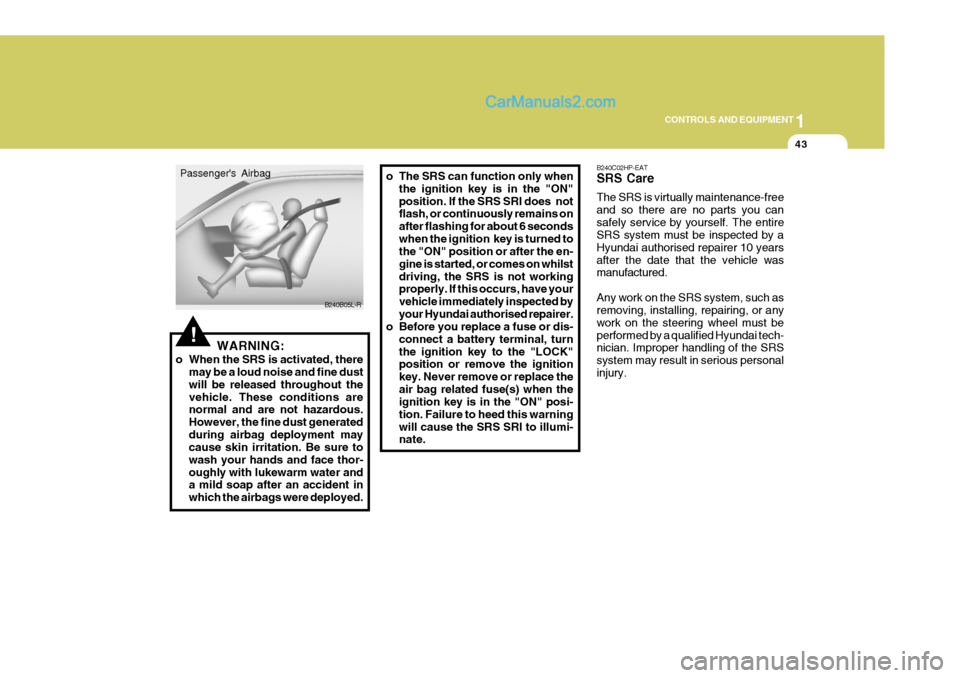
o When the SRS is activated, there may be a loud noise and fine dust will be released throughout thevehicle. These conditions are normal and are not hazardous. However, the fine dust generatedduring airbag deployment may cause skin irritation. Be sure to wash your hands and face thor-oughly with lukewarm water and a mild soap after an accident in which the airbags were deployed. o The SRS can function only when
the ignition key is in the "ON"position. If the SRS SRI does not flash, or continuously remains on after flashing for about 6 secondswhen the ignition key is turned to the "ON" position or after the en- gine is started, or comes on whilstdriving, the SRS is not working properly. If this occurs, have your vehicle immediately inspected byyour Hyundai authorised repairer.
o Before you replace a fuse or dis-
connect a battery terminal, turnthe ignition key to the "LOCK" position or remove the ignition key. Never remove or replace theair bag related fuse(s) when the ignition key is in the "ON" posi- tion. Failure to heed this warningwill cause the SRS SRI to illumi- nate. B240C02HP-EAT SRS Care The SRS is virtually maintenance-free and so there are no parts you cansafely service by yourself. The entire SRS system must be inspected by a Hyundai authorised repairer 10 yearsafter the date that the vehicle was manufactured. Any work on the SRS system, such as removing, installing, repairing, or any work on the steering wheel must beperformed by a qualified Hyundai tech- nician. Improper handling of the SRS system may result in serious personalinjury.
B240B05L-R
Passenger's Airbag
Page 352 of 539
1CONTROLS AND EQUIPMENT
44
!WARNING:
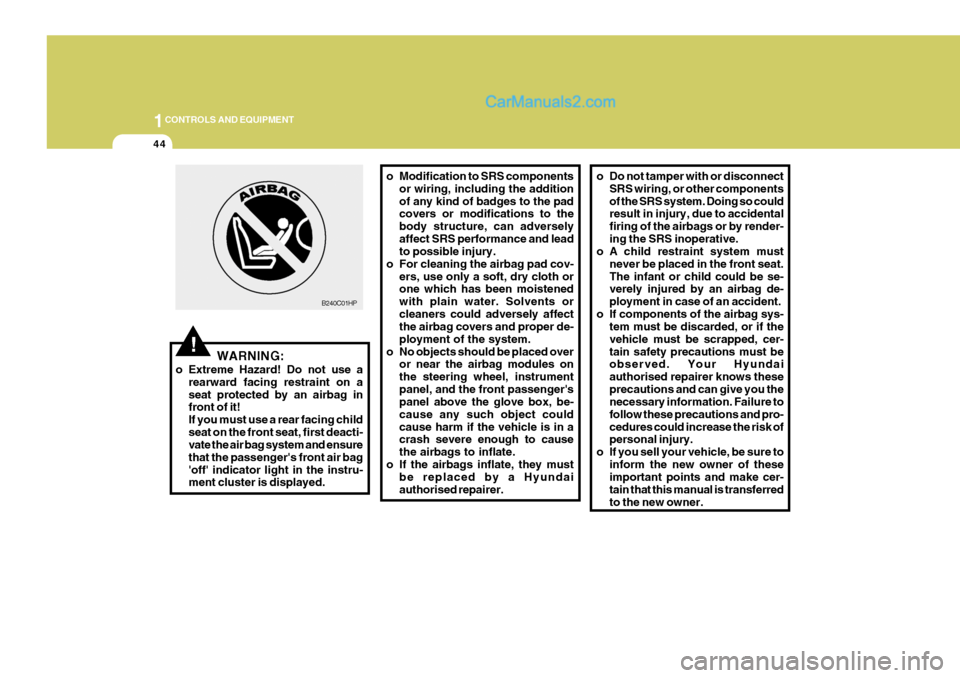
o Extreme Hazard! Do not use a rearward facing restraint on a seat protected by an airbag in front of it! If you must use a rear facing childseat on the front seat, first deacti- vate the air bag system and ensure that the passenger's front air bag'off' indicator light in the instru- ment cluster is displayed. o Modification to SRS components
or wiring, including the addition of any kind of badges to the pad covers or modifications to the body structure, can adverselyaffect SRS performance and lead to possible injury.
o For cleaning the airbag pad cov- ers, use only a soft, dry cloth orone which has been moistened with plain water. Solvents orcleaners could adversely affect the airbag covers and proper de- ployment of the system.
o No objects should be placed over or near the airbag modules onthe steering wheel, instrumentpanel, and the front passenger's panel above the glove box, be- cause any such object couldcause harm if the vehicle is in a crash severe enough to cause the airbags to inflate.
o If the airbags inflate, they must be replaced by a Hyundaiauthorised repairer.
B240C01HP
o Do not tamper with or disconnect
SRS wiring, or other components of the SRS system. Doing so could result in injury, due to accidental firing of the airbags or by render-ing the SRS inoperative.
o A child restraint system must
never be placed in the front seat.The infant or child could be se- verely injured by an airbag de- ployment in case of an accident.
o If components of the airbag sys- tem must be discarded, or if thevehicle must be scrapped, cer-tain safety precautions must be observed. Your Hyundai authorised repairer knows theseprecautions and can give you the necessary information. Failure to follow these precautions and pro-cedures could increase the risk of personal injury.
o If you sell your vehicle, be sure to inform the new owner of theseimportant points and make cer- tain that this manual is transferredto the new owner.
Page 355 of 539
1
CONTROLS AND EQUIPMENT
47
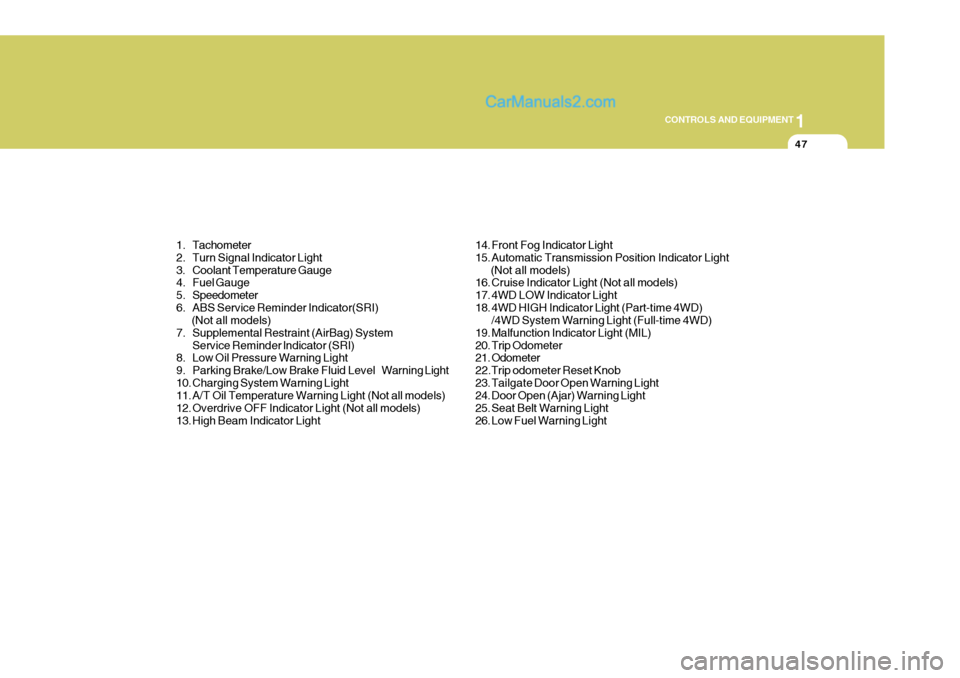
1. Tachometer
2. Turn Signal Indicator Light
3. Coolant Temperature Gauge
4. Fuel Gauge
5. Speedometer
6. ABS Service Reminder Indicator(SRI) (Not all models)
7. Supplemental Restraint (AirBag) System Service Reminder lndicator (SRI)
8. Low Oil Pressure Warning Light
9. Parking Brake/Low Brake Fluid LevelWarning Light
10. Charging System Warning Light
11. A/T Oil Temperature Warning Light (Not all models)
12. Overdrive OFF Indicator Light (Not all models)
13. High Beam Indicator Light 14. Front Fog Indicator Light
15. Automatic Transmission Position Indicator Light (Not all models)
16. Cruise Indicator Light (Not all models)
17. 4WD LOW Indicator Light
18. 4WD HIGH Indicator Light (Part-time 4WD)
/4WD System Warning Light (Full-time 4WD)
19. Malfunction Indicator Light (MIL)
20. Trip Odometer
21. Odometer 22.Trip odometer Reset Knob
23. Tailgate Door Open Warning Light
24. Door Open (Ajar) Warning Light
25. Seat Belt Warning Light
26. Low Fuel Warning Light