warning Hyundai Terracan 2006 Owner's Manual
[x] Cancel search | Manufacturer: HYUNDAI, Model Year: 2006, Model line: Terracan, Model: Hyundai Terracan 2006Pages: 539, PDF Size: 18.11 MB
Page 392 of 539
1CONTROLS AND EQUIPMENT
84SUN VISOR
HHP2017-1
!
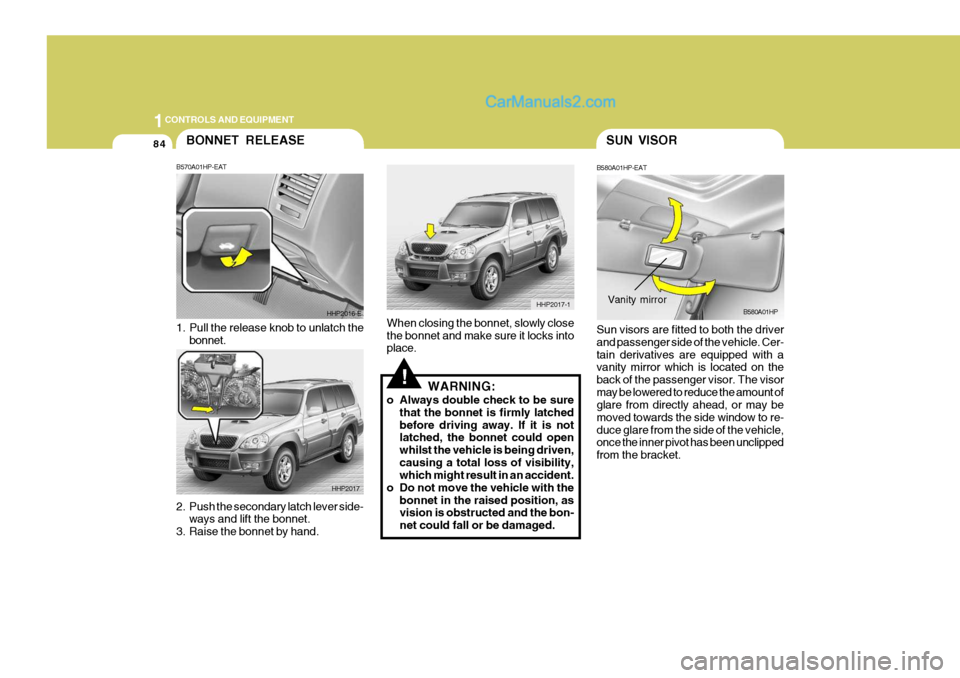
When closing the bonnet, slowly close the bonnet and make sure it locks into place.
WARNING:
o Always double check to be sure that the bonnet is firmly latched before driving away. If it is not latched, the bonnet could open whilst the vehicle is being driven,causing a total loss of visibility, which might result in an accident.
o Do not move the vehicle with the bonnet in the raised position, asvision is obstructed and the bon- net could fall or be damaged. B580A01HP-EAT Sun visors are fitted to both the driver and passenger side of the vehicle. Cer-tain derivatives are equipped with a vanity mirror which is located on the back of the passenger visor. The visormay be lowered to reduce the amount of glare from directly ahead, or may be moved towards the side window to re-duce glare from the side of the vehicle, once the inner pivot has been unclipped from the bracket.
B580A01HPVanity mirror
BONNET RELEASE
2. Push the secondary latch lever side-
ways and lift the bonnet.
3. Raise the bonnet by hand.
B570A01HP-EAT
1. Pull the release knob to unlatch the
bonnet. HHP2016-E
HHP2017
Page 393 of 539
1
CONTROLS AND EQUIPMENT
85
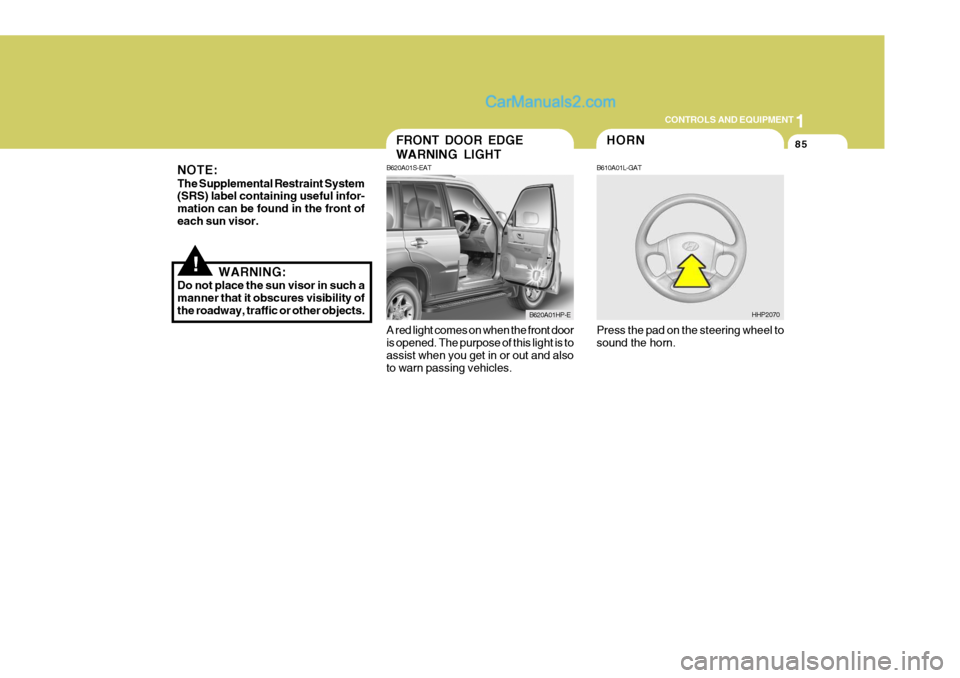
A red light comes on when the front door is opened. The purpose of this light is to assist when you get in or out and also to warn passing vehicles.FRONT DOOR EDGE WARNING LIGHT
B620A01S-EAT
B620A01HP-E
!
NOTE: The Supplemental Restraint System (SRS) label containing useful infor- mation can be found in the front ofeach sun visor.
WARNING:
Do not place the sun visor in such amanner that it obscures visibility ofthe roadway, traffic or other objects.
Press the pad on the steering wheel tosound the horn.
HHP2070
HORN
B610A01L-GAT
Page 394 of 539
1CONTROLS AND EQUIPMENT
86
!
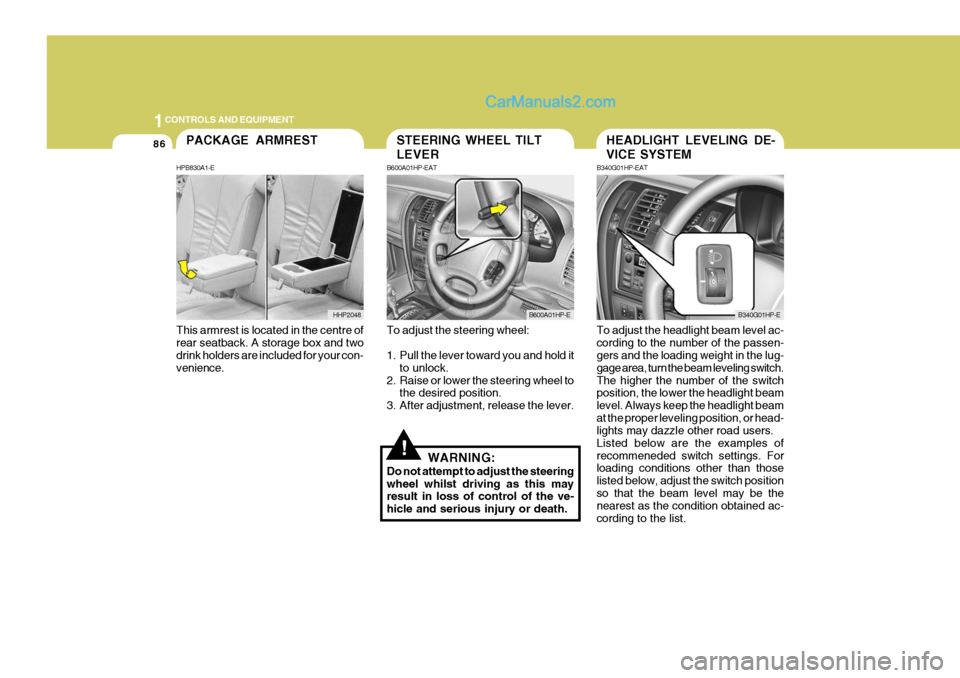
To adjust the steering wheel:
1. Pull the lever toward you and hold it
to unlock.
2. Raise or lower the steering wheel to the desired position.
3. After adjustment, release the lever.
WARNING:
Do not attempt to adjust the steering wheel whilst driving as this may result in loss of control of the ve- hicle and serious injury or death. To adjust the headlight beam level ac-cording to the number of the passen- gers and the loading weight in the lug- gage area, turn the beam leveling switch.The higher the number of the switch position, the lower the headlight beam level. Always keep the headlight beamat the proper leveling position, or head- lights may dazzle other road users. Listed below are the examples ofrecommeneded switch settings. For loading conditions other than those listed below, adjust the switch positionso that the beam level may be the nearest as the condition obtained ac- cording to the list.
STEERING WHEEL TILT LEVER
B600A01HP-EAT
B600A01HP-E
HEADLIGHT LEVELING DE- VICE SYSTEM
B340G01HP-EAT
B340G01HP-E
This armrest is located in the centre of rear seatback. A storage box and two drink holders are included for your con- venience.
PACKAGE ARMREST
HPB830A1-E
HHP2048
Page 397 of 539
1
CONTROLS AND EQUIPMENT
89
!
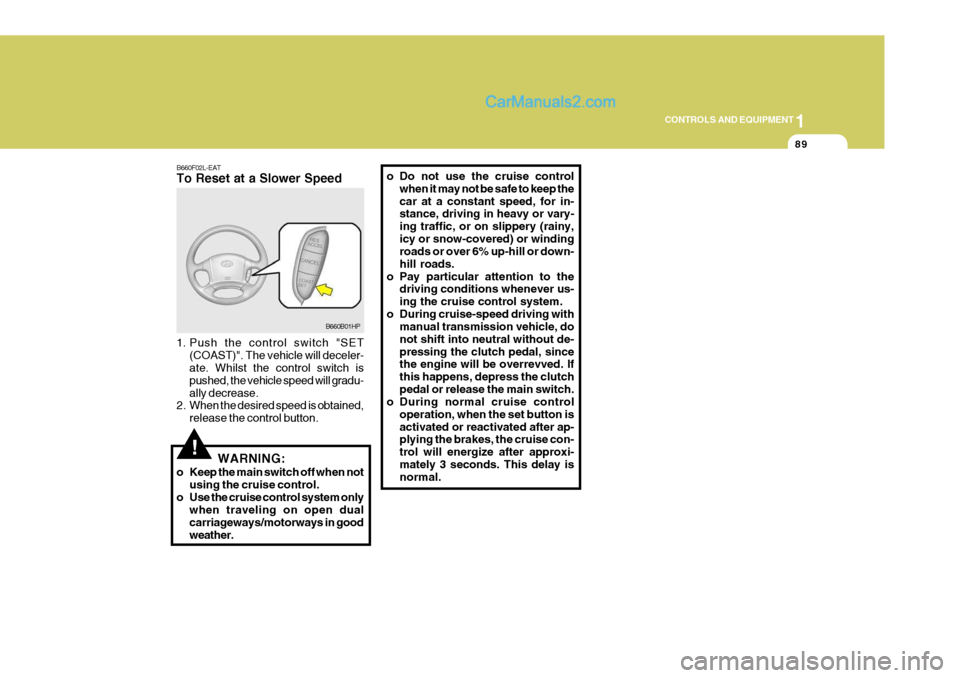
B660F02L-EAT To Reset at a Slower Speed
1. Push the control switch "SET
(COAST)". The vehicle will deceler- ate. Whilst the control switch is pushed, the vehicle speed will gradu-ally decrease.
2. When the desired speed is obtained,
release the control button. o Do not use the cruise control
when it may not be safe to keep thecar at a constant speed, for in- stance, driving in heavy or vary- ing traffic, or on slippery (rainy,icy or snow-covered) or winding roads or over 6% up-hill or down- hill roads.
o Pay particular attention to the driving conditions whenever us-ing the cruise control system.
o During cruise-speed driving with manual transmission vehicle, donot shift into neutral without de-pressing the clutch pedal, since the engine will be overrevved. If this happens, depress the clutchpedal or release the main switch.
o During normal cruise control
operation, when the set button isactivated or reactivated after ap- plying the brakes, the cruise con- trol will energize after approxi-mately 3 seconds. This delay is normal.
WARNING:
o Keep the main switch off when not using the cruise control.
o Use the cruise control system only when traveling on open dual carriageways/motorways in goodweather.
B660B01HP
Page 415 of 539
1
CONTROLS AND EQUIPMENT
107
!
B750B02Y-EAT Using a cellular phone or a two- way radio When a cellular phone is used inside the vehicle, noise may be producedfrom the audio equipment. This does not mean that something is wrong with the audio equipment. In such a case,use the cellular phone at a place as far as possible from the audio equipment.
CAUTION:
When using a communication sys- tem such a mobile phone or a radio set inside the vehicle, a separate external antenna must be fitted. Whena mobile phone or a radio set is used with an internal antenna alone, it may interfere with the vehicle's elec-trical system and adversely affect safe operation of the vehicle.
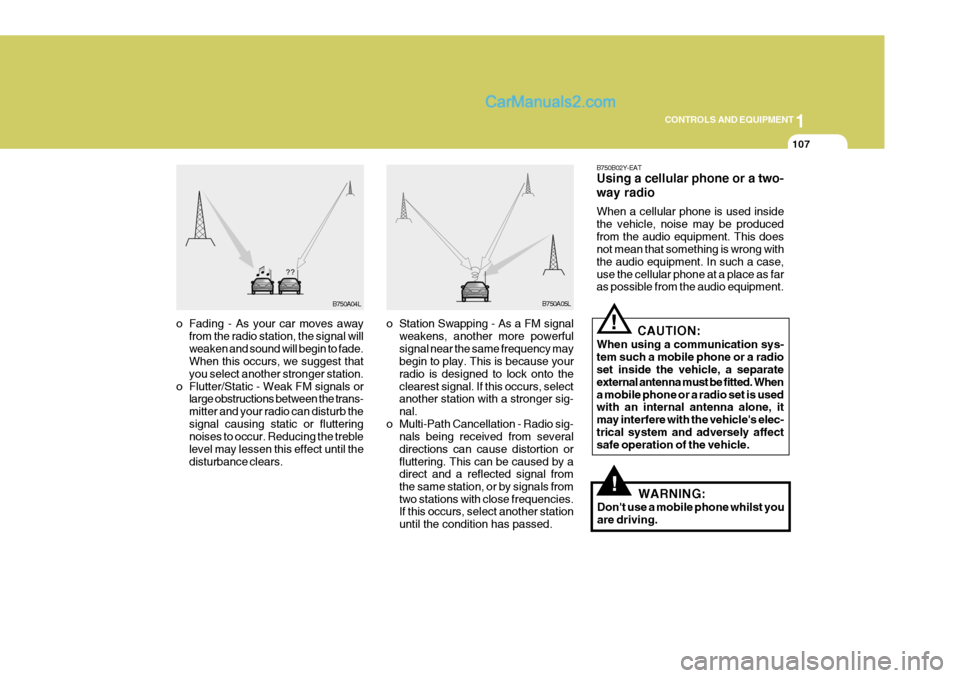
o Fading - As your car moves away
from the radio station, the signal will weaken and sound will begin to fade. When this occurs, we suggest that you select another stronger station.
o Flutter/Static - Weak FM signals or large obstructions between the trans-mitter and your radio can disturb thesignal causing static or fluttering noises to occur. Reducing the treble level may lessen this effect until thedisturbance clears. o Station Swapping - As a FM signal
weakens, another more powerfulsignal near the same frequency may begin to play. This is because your radio is designed to lock onto theclearest signal. If this occurs, select another station with a stronger sig- nal.
o Multi-Path Cancellation - Radio sig- nals being received from severaldirections can cause distortion orfluttering. This can be caused by a direct and a reflected signal from the same station, or by signals fromtwo stations with close frequencies. If this occurs, select another station until the condition has passed.
B750A04L B750A05L
!WARNING:
Don't use a mobile phone whilst you are driving.
Page 418 of 539
2 DRIVING YOUR HYUNDAI
2
C010A01HP-EAT
WARNING: ENGINE EXHAUST CAN BE DANGEROUS!
Engine exhaust gases are potentially lethal. If at any time engine exhaust gas is detected within the passenger compartment, move the vehicle to an open area and open all windows. o Never inhale exhaust gas. Exhaust gases contain Carbon Monoxide which is colourless and odourless. Carbon Monoxide is poisonous and can cause unconsciousness and death by asphyxiation. o Exhaust System Maintenance. Ensure that the exhaust system is maintained in good condition and is free from excessive corrosion and damage which may result in leakage. If the vehicle is driven over an object which strikes the exhaust system,ensure that the exhaust system is inspected at the first available opportunity to ensure that no leakage exists. o Confined Areas. Do not run the engine in confined spaces, allowing the engine to idle in a garage, even when the doors are open is dangerous practice. Only start the engine immediately prior to moving the vehicle out of the garage. o Prolonged Idling. If it is necessary to allow the vehicle to idle for prolonged periods, ensure that the heating system air intake control is set to the "Fresh" position, the blower is set to high speed operation and that the vehicle is standing in an open area. o Load Carrying. If it is necessary to carry long objects which do not permit the tailgate door to be fully closed, the side windows must remain closed and the heating air intake control set to the "Fresh" position with the blower running at the highest speed setting. To ensure correct operation of the heater system, the air intake grilles at the base of the windscreen must not be obstructed by snow leaves etc..
!
Page 419 of 539
2
DRIVING YOUR HYUNDAI
3
!WARNING:
Your vehicle is equipped with tyres designed to provide for safe ride and handling capability.Do not use a size and type of tyre and wheel that is different from the one that was originally installed on yourvehicle. It can affect the safety and performance of your vehicle, which could lead to handling failure orrollover and serious injury. When replacing the tyres, be sure to equip all four tyres with the tyre andwheel of the same size, type, tread, brand and load-carrying capacity. If you nevertheless decide to equipyour vehicle with any tyre/wheel com- bination not recommended by Hyundai for off-road driving, youshould not use these tyres for high- way driving.
BEFORE STARTING THE ENGINE
C020A02A-EAT Before you start the engine, you should always:
1. Look around the vehicle to be sure
there are no flat tyres, puddles of oil or water or other indications of pos- sible trouble.
2. After entering the car, check to be
sure the parking brake is engaged.
3. Check that all windows, and lights
are clean.
4. Check that the interior and exterior mirrors are clean and in position.
5. Check your seat, seatback and headrest to be sure they are in theirproper positions.
6. Close all the doors.
7. Fasten your seat belt and be sure that all other occupants have fas-tened theirs.
8. Turn off all lights and accessories that are not needed.
9. When you turn the ignition switch to "ON" check that all appropriate warning lights are operating and that you have sufficient fuel.
10.Check the operation of warning lights and all bulbs when key is inthe "ON" position. WARNING:
Always wear appropriate shoes when operating your vehicle. Unsuitable shoes (high heels, skiboots, etc.) may interfere with your ability to use the brake and accelera- tor pedal, and the clutch (Not allmodels).
!
Page 420 of 539
2 DRIVING YOUR HYUNDAI
4
!WARNING:
The engine must never be turned off and the key removed from the igni-tion key cylinder whilst the vehicle is in motion since the steering lock will operate and control of the vehiclewill be lost.
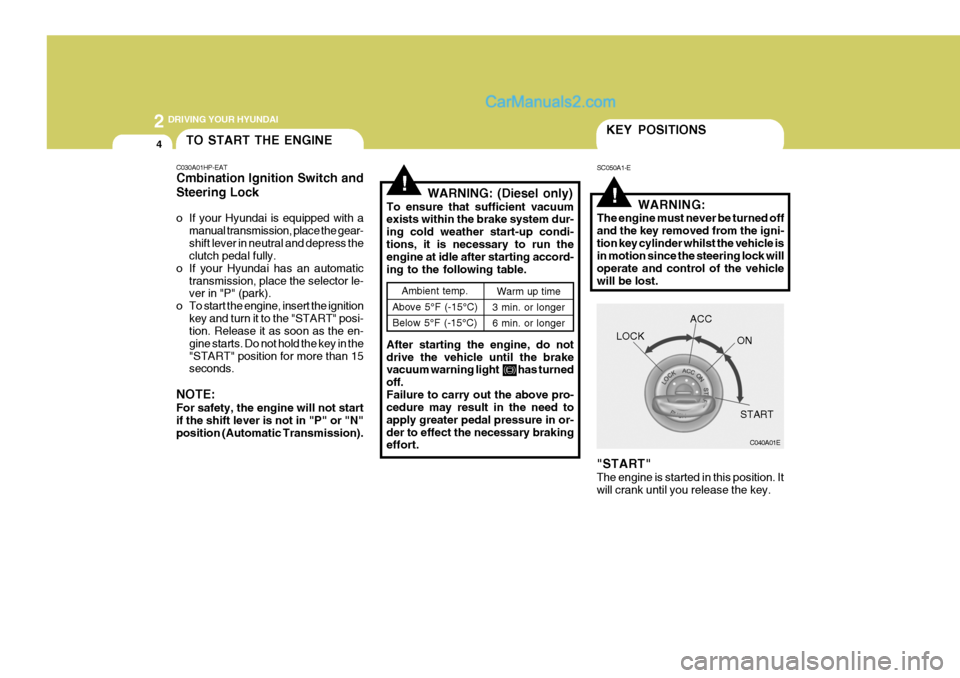
"START" The engine is started in this position. It will crank until you release the key.
Ambient temp.
Above 5°F (-15°C) Below 5°F (-15°C) Warm up time
3 min. or longer 6 min. or longer
!WARNING: (Diesel only)
To ensure that sufficient vacuum exists within the brake system dur- ing cold weather start-up condi-tions, it is necessary to run the engine at idle after starting accord- ing to the following table. After starting the engine, do not drive the vehicle until the brake vacuum warning light has turned off.Failure to carry out the above pro- cedure may result in the need to apply greater pedal pressure in or-der to effect the necessary braking effort.
KEY POSITIONS
SC050A1-E
C040A01E
LOCK
ACC
ON
START
TO START THE ENGINE
C030A01HP-EAT Cmbination Ignition Switch and Steering Lock
o If your Hyundai is equipped with a manual transmission, place the gear- shift lever in neutral and depress the clutch pedal fully.
o If your Hyundai has an automatic transmission, place the selector le-ver in "P" (park).
o To start the engine, insert the ignition
key and turn it to the "START" posi-tion. Release it as soon as the en- gine starts. Do not hold the key in the"START" position for more than 15 seconds.
NOTE: For safety, the engine will not start if the shift lever is not in "P" or "N" position (Automatic Transmission).
Page 423 of 539
2
DRIVING YOUR HYUNDAI
7
!
NOTE: If the engine has not been started within 2 seconds after the preheating is completed, turn the ignition keyonce more to the "LOCK" position during 10 seconds, and then to the "ON" position, in order to preheatagain.
WARNING:
Be sure that the clutch is fully de-pressed when starting a manualtransaxle vehicle. This will prevent sudden movement occuring should the vehicle be started in gear withoutthe clutch depressed. Otherwise there is the potential to cause damage to the vehicle or injury to a personinside or outside of the vehicle as a result of this sudden vehicle move- ment.
5. Turn the ignition key to the "START" position and release it when the en- gine starts.
!
C055B02HP-EAT STARTING AND STOPPING THE ENGINE FOR TURBOCHARGER INTERCOOLER(Diesel Engine)
(1) Do not race the engine or suddenly accelerate the engine immediately after starting it. If the engine is cold,allow the engine to idle for several seconds before it is driven to ensure sufficient lubrication of the turbocharger unit.
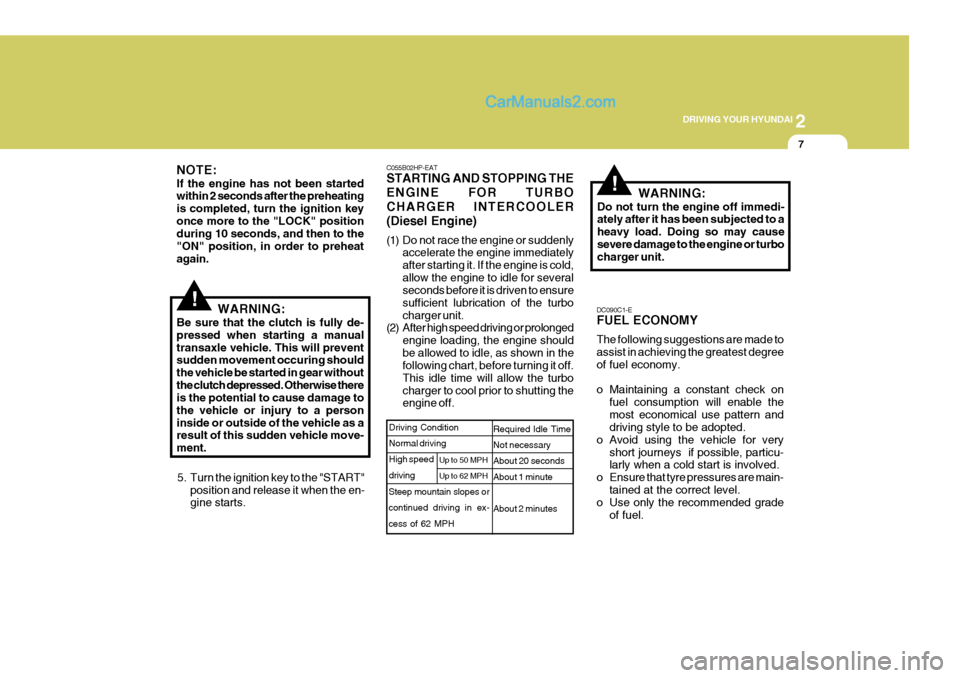
(2) After high speed driving or prolonged
engine loading, the engine shouldbe allowed to idle, as shown in the following chart, before turning it off. This idle time will allow the turbocharger to cool prior to shutting the engine off. WARNING:
Do not turn the engine off immedi-ately after it has been subjected to a heavy load. Doing so may causesevere damage to the engine or turbo charger unit.
DC090C1-E FUEL ECONOMY The following suggestions are made to assist in achieving the greatest degree of fuel economy.
o Maintaining a constant check on fuel consumption will enable the most economical use pattern and driving style to be adopted.
o Avoid using the vehicle for very short journeys if possible, particu-larly when a cold start is involved.
o Ensure that tyre pressures are main- tained at the correct level.
o Use only the recommended grade
of fuel.
Steep mountain slopes or continued driving in ex-
cess of 62 MPH Required Idle Time Not necessary About 20 secondsAbout 1 minute About 2 minutes
Driving Condition Normal driving High speed driving
Up to 50 MPH Up to 62 MPH
Page 425 of 539
2
DRIVING YOUR HYUNDAI
9
o When slippery conditions are en-
countered, increased caution should be exercised when gear changing, braking or accelerat- ing. Abrupt changes in speed maycause a loss of traction or control of the vehicle.
o During cold weather, shifting may be difficult until the transmis-sion lubricant has warmed up. This is normal and not harmful tothe transmission.
o If you've come to a complete stop
and it's hard to shift into 1st orR(Reverse), put the gearshift lever in N(Neutral) position and release the clutch. Press the clutch pedalback down, and then shift into 1st or R(Reverse) gear position.
o Do not use the gearshift lever as a handrest during driving, as thiscan result in premature wear of the transmission shift forks. C070B01A-EAT Using the Clutch The clutch should be pressed all the way to the floor before shifting, then released slowly. The clutch pedal should aways be used after fully re-turning to the original position. Do not rest your foot on the clutch pedal whilst driving. This can cause unnecessarywear. Do not partially engage the clutch to hold the car on an incline. This causesunnecessary wear. Use the parking brake to hold the car on an incline. Do not operate the clutch pedal rapidlyand repeatedly.
!WARNING:
o Avoid high cornering speeds.
o Do not make quick steering wheel movements, such as sharp lane changes or fast, sharp turns.
o Always wear your seat belts.
In a collision crash, an unbeltedperson is significantly more likely to die than a person wearing a seatbelt.
o The risk of rollover is greatly in- creased if you lose control of yourvehicle at motorway speeds.
o Loss of control often occurs if two or more wheels drop off the road-way and the driver oversteers toreenter the roadway.
o In the event your vehicle leaves
the roadway, do not steer sharply.Instead, slow down before pulling back into the travel lanes.
o Never exceed posted speed limits.