engine Hyundai Terracan 2006 Owner's Manual
[x] Cancel search | Manufacturer: HYUNDAI, Model Year: 2006, Model line: Terracan, Model: Hyundai Terracan 2006Pages: 539, PDF Size: 18.11 MB
Page 310 of 539
1CONTROLS AND EQUIPMENT
2
CAUTION:
The vehicle warranty will not extend to damage arising from the use ofincorrect fuels.
To prevent accidental filling of the fueltank with leaded fuel, a small diameterfiller neck along with a restrictor flap are fitted to ensure that only unleaded fuel pump nozzles may enter the filler neck.However, care must be exercised when refuelling the vehicle tank from fuel can or by means of a funnel that the fuelbeing used is unleaded. The use of leaded fuel in this vehicle will result in irreversible pollution of thecatalyst element. Such pollution will prevent correct operation of the cata- lyst and give rise to increased operatingtemperatures leading to the catalyst element melting and restricting the ex- haust flow along with an increase inexhaust emission levels.
DIESEL ENGINES Diesel fuel of 52 to 54 cetane is the correct rating to use in your HyundaiTerracan. If two types of diesel fuel are available, use summer or winter fuel properly according to the following tem-perature conditions.
o Above 23°F (-5°C) ... Summer type
diesel fuel.
o Below 23°F (-5°C) ... Winter type diesel fuel.
Watch the fuel gauge (page 47 number4) very carefully: If the engine stops due to fuel failure, the circuits must becompletely purged to permit restarting.FUEL RECOMMENDATIONS
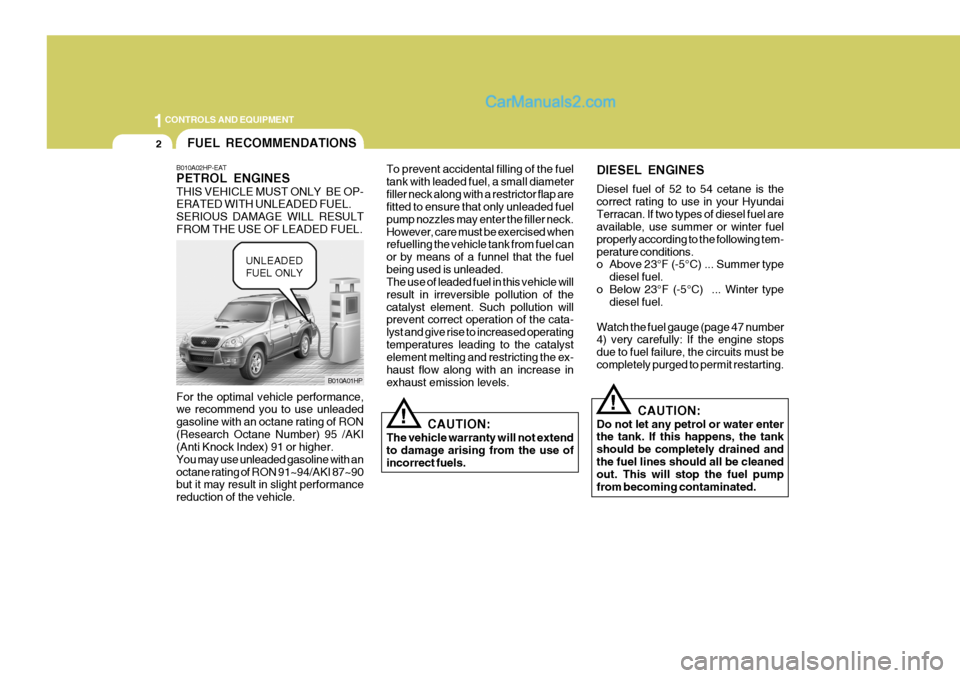
B010A02HP-EAT PETROL ENGINES THIS VEHICLE MUST ONLY BE OP- ERATED WITH UNLEADED FUEL. SERIOUS DAMAGE WILL RESULTFROM THE USE OF LEADED FUEL. For the optimal vehicle performance, we recommend you to use unleaded gasoline with an octane rating of RON(Research Octane Number) 95 /AKI (Anti Knock Index) 91 or higher. You may use unleaded gasoline with anoctane rating of RON 91~94/AKI 87~90 but it may result in slight performance reduction of the vehicle.
B010A01HP
!
!
UNLEADED FUEL ONLY
CAUTION:
Do not let any petrol or water enter the tank. If this happens, the tank should be completely drained andthe fuel lines should all be cleaned out. This will stop the fuel pump from becoming contaminated.
Page 311 of 539
1
CONTROLS AND EQUIPMENT
3
ZB010C1-E "Alternative fuels" Fuels which contain methanol or etha- nol must not be used. ZB010D1-E Operation in Foreign Countries Drivers of vehicles which are to be operated in foreign countries must satisfy themselves that:
o The vehicle meets all local regula- tions with respect to insurance, speci- fications etc..
o The correct types and grades of fuel
are available for satisfactory opera-tion of the vehicle.
ZB010F2-A FUELS FOR CLEANER AIR To help contribute to cleaner air, Hyundai recommends that you use fuels treated with detergent additives, which help to prevent deposit forma-tion in the engine. These fuels will help the engines run cleaner and increase the Emission Control System perfor-mance.BEFORE ENTERING THE VE- HICLE
YB020A1-E
o Ensure that all windows, mirrors
and lamps are clean.
o Check condition of all tyres.
o Ensure that no fluid leaks are evi-
dent.
o Ensure that the area around the
vehicle is clear before driving off.AFTER ENTERING THE VE- HICLE
YB020B1-E
o Ensure that all occupants fasten
and correctly adjust seat belts.
o Ensure that seat and head restraint
positions are adjusted for optimum safety, control and comfort.
o Adjust interior and exterior rearview
mirrors.
o Verify correct operation of lamps, horn and other electrical equipment.
o Ensure that warning lamps illumi- nate when ignition is turned on.
NOTE: Fluid levels such as engine oil, en- gine coolant, brake and windscreenwasher fluid should be checked daily or at each refuelling, whichever occurs sooner.
Page 312 of 539
1CONTROLS AND EQUIPMENT
4 RUNNING IN YOUR NEW HYUNDAI
B020A02FC-EAT PETROL ENGINE The longevity and performance of the vehicle are greatly affected by the careexercised during the first 1000 miles of motoring. Because of modern manu- facturing techniques, rigid guidelinesregarding maximum road speeds have become unnecessary. However, cer- tain precautions should be observed inorder to obtain the best possible per- formance and useful life from the ve- hicle.
1) Do not race the engine without a
load (i.e revving the engine in neu- tral).
2) During the first 500 miles the maxi-
mum engine speed should be re-stricted to 3000 rpm and gradually increased thereafter.
3) Avoid prolonged constant speed operation. The internal componentsof the engine will become more quickly run in if the operation speedis varied during the running in pe- riod. 4) Never allow the engine to labour. Use
the gearbox freely and avoid large throttle openings when the engine speed is below 1500 rpm.
5) Avoid rapid acceleration and maxi- mum throttle openings.
6) Avoid harsh braking during the first
100 miles of urban motoring or 1000 miles of motorway driving to allow the friction facings of the brake pads and shoes to bed against the discsand drums properly.
7) No trailer/caravan towing should be
undertaken during the 1000 mile run-ning-in period. 1) Do not race the engine without a load
(i.e revving the engine in neutral).
2) During the first 600 miles the maxi- mum engine speed should be re-stricted to 3000 rpm and graduallyincreased thereafter. And while driv- ing, keep under three quarters of maximum vehicle speed.
3) Avoid prolonged constant speed operation. The internal componentsof the engine will become morequickly run in if the operation speed is varied during the running in pe- riod.
4) Never allow the engine to labour. Use the gearbox freely and avoidlarge throttle openings when theengine speed is below 1500 rpm.
5) Avoid rapid acceleration and maxi-
mum throttle openings.
6) Avoid harsh braking during the first 100 miles of urban motoring or 1000miles of motorway driving to allowthe friction facings of the brake pads and shoes to bed against the discs and drums properly.
7) No trailer/caravan towing should be undertaken during the 1000 mile run-ning-in period.
B020B02FC-EAT DIESEL ENGINE The longevity and performance of the vehicle are greatly affected by the care exercised during the first 1000 miles of motoring. Because of modern manu-facturing techniques, rigid guidelines regarding maximum road speeds have become unnecessary. However, cer-tain precautions should be observed in order to obtain the best possible per- formance and useful life from the ve-hicle.
Page 313 of 539
1
CONTROLS AND EQUIPMENT
5
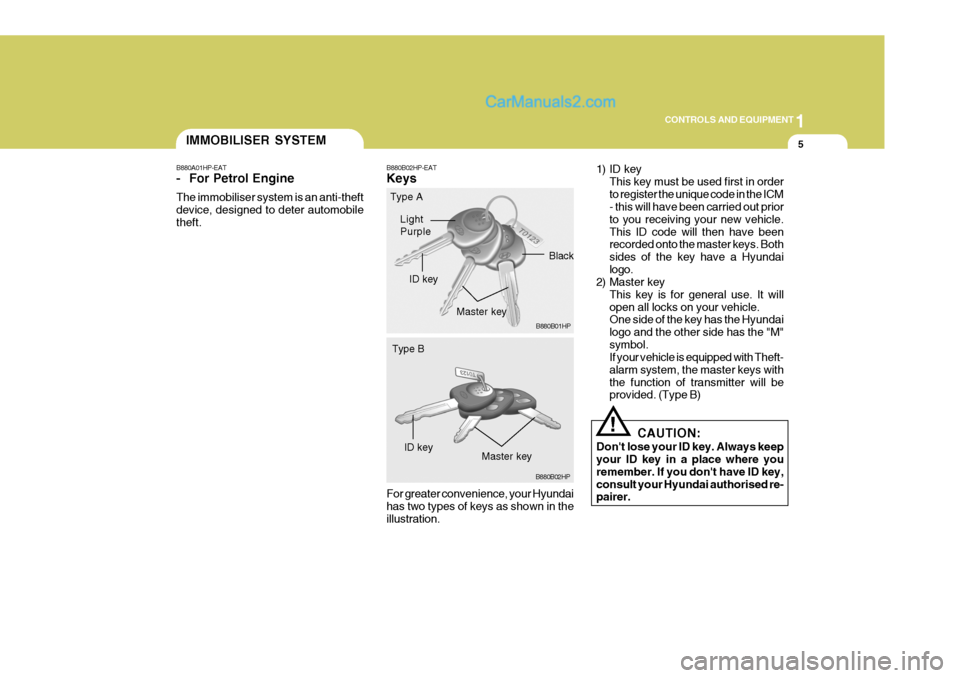
B880B02HP-EAT Keys For greater convenience, your Hyundai has two types of keys as shown in the illustration. 1) ID key
This key must be used first in order to register the unique code in the ICM - this will have been carried out prior to you receiving your new vehicle.This ID code will then have been recorded onto the master keys. Both sides of the key have a Hyundailogo.
2) Master key
This key is for general use. It willopen all locks on your vehicle. One side of the key has the Hyundai logo and the other side has the "M"symbol. If your vehicle is equipped with Theft- alarm system, the master keys withthe function of transmitter will be provided. (Type B)
CAUTION:
Don't lose your ID key. Always keepyour ID key in a place where you remember. If you don't have ID key,consult your Hyundai authorised re- pairer.IMMOBILISER SYSTEM
B880B01HP
Light Purple
ID key Master key Black
Type A
B880B02HP
ID key
Master key
Type B
!
B880A01HP-EAT
- For Petrol Engine The immobiliser system is an anti-theft device, designed to deter automobiletheft.
Page 314 of 539
1CONTROLS AND EQUIPMENT
6
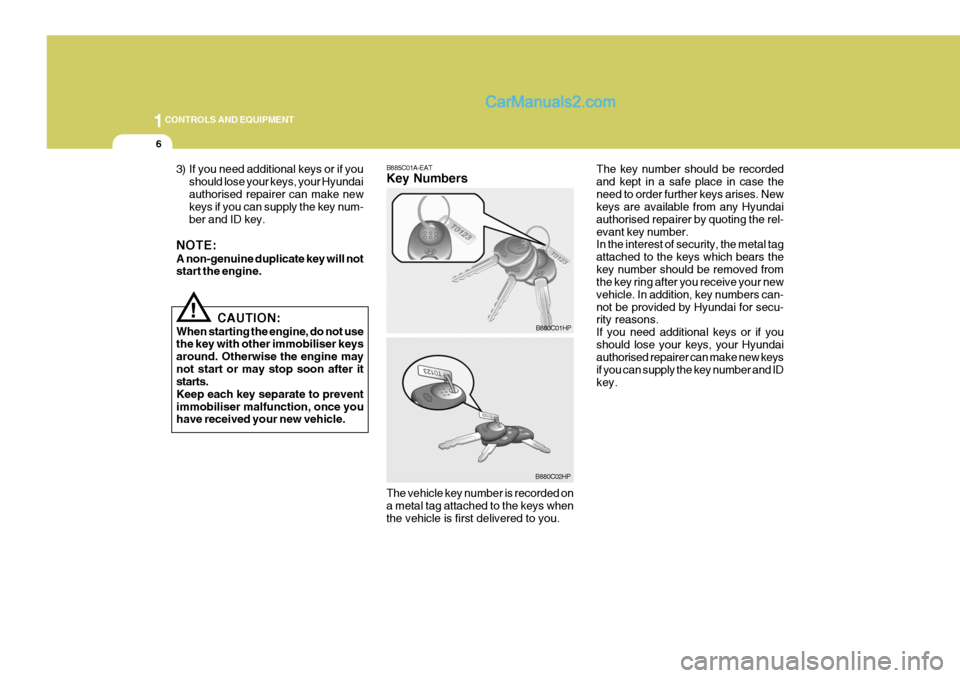
B885C01A-EAT Key Numbers The vehicle key number is recorded on a metal tag attached to the keys when the vehicle is first delivered to you.The key number should be recordedand kept in a safe place in case theneed to order further keys arises. New keys are available from any Hyundai authorised repairer by quoting the rel-evant key number. In the interest of security, the metal tag attached to the keys which bears thekey number should be removed from the key ring after you receive your new vehicle. In addition, key numbers can-not be provided by Hyundai for secu- rity reasons. If you need additional keys or if youshould lose your keys, your Hyundai authorised repairer can make new keys if you can supply the key number and IDkey.
B880C01HP
B880C02HP
3) If you need additional keys or if you
should lose your keys, your Hyundai authorised repairer can make new keys if you can supply the key num- ber and ID key.
NOTE: A non-genuine duplicate key will not start the engine.
! CAUTION:
When starting the engine, do not use the key with other immobiliser keys around. Otherwise the engine maynot start or may stop soon after it starts. Keep each key separate to preventimmobiliser malfunction, once you have received your new vehicle.
Page 315 of 539
1
CONTROLS AND EQUIPMENT
7
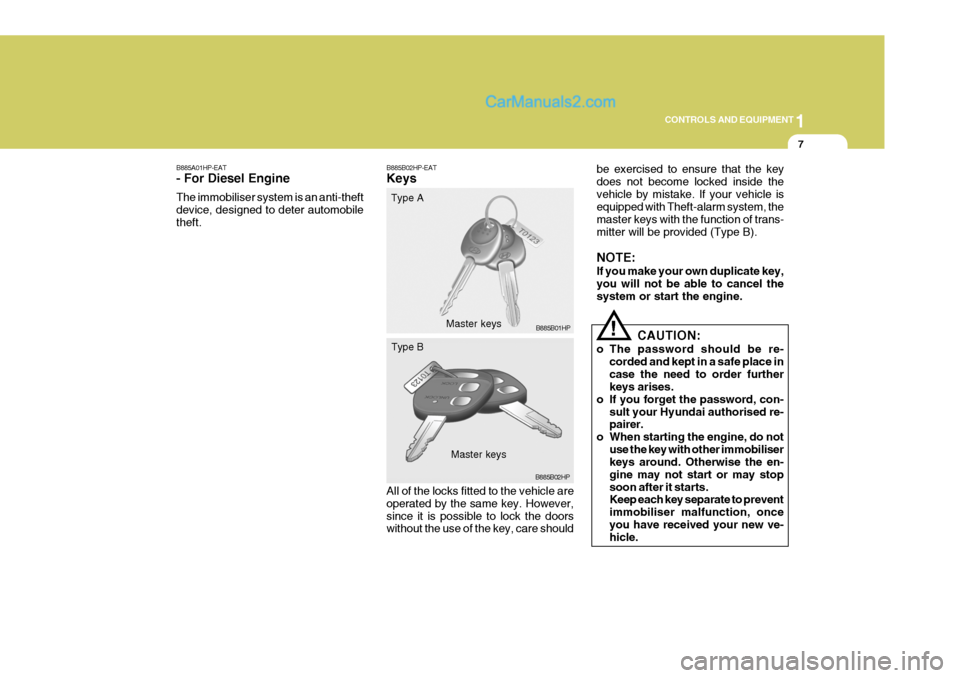
B885A01HP-EAT - For Diesel Engine The immobiliser system is an anti-theft device, designed to deter automobiletheft. B885B02HP-EAT Keys All of the locks fitted to the vehicle are operated by the same key. However,since it is possible to lock the doors without the use of the key, care shouldbe exercised to ensure that the key does not become locked inside thevehicle by mistake. If your vehicle is equipped with Theft-alarm system, the master keys with the function of trans-mitter will be provided (Type B). NOTE: If you make your own duplicate key, you will not be able to cancel thesystem or start the engine.
CAUTION:
o The password should be re- corded and kept in a safe place incase the need to order further keys arises.
o If you forget the password, con- sult your Hyundai authorised re-pairer.
o When starting the engine, do not use the key with other immobiliserkeys around. Otherwise the en- gine may not start or may stopsoon after it starts. Keep each key separate to prevent immobiliser malfunction, onceyou have received your new ve- hicle.
B885B01HP
Type A
Master keys
Master keys B885B02HP
Type B
!
Page 319 of 539
1
CONTROLS AND EQUIPMENT
11
The child proof lock mechanism may be activated by opening the door andmoving the lever located by the door latch to the "
" locked position. Move
the lever to the "
" unlocked position
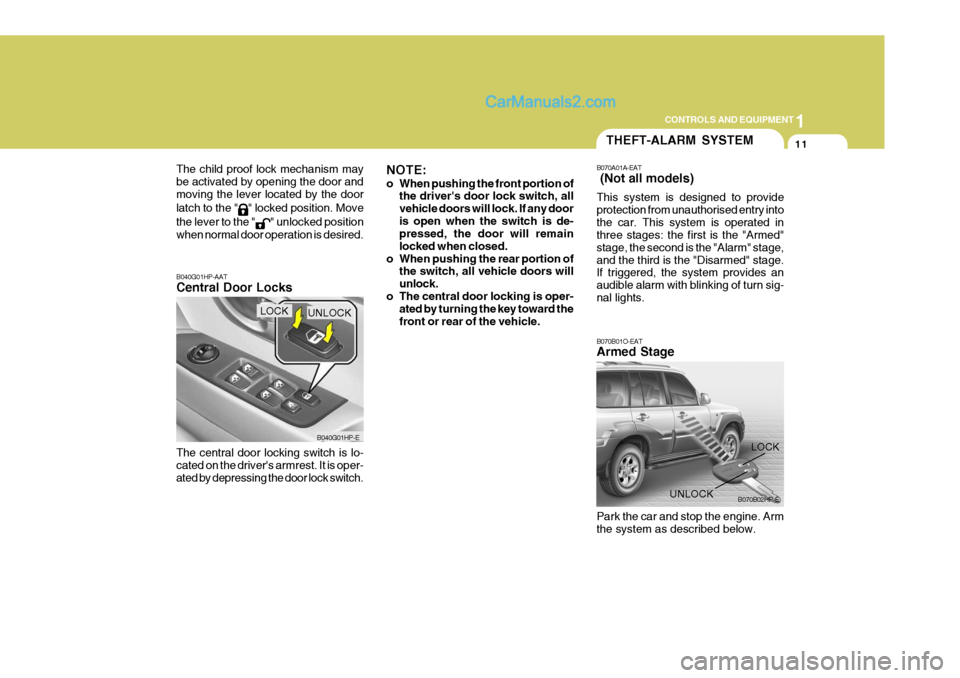
when normal door operation is desired. B040G01HP-AAT Central Door Locks The central door locking switch is lo- cated on the driver's armrest. It is oper- ated by depressing the door lock switch.
B040G01HP-E
LOCKUNLOCK NOTE:
o When pushing the front portion of
the driver's door lock switch, all vehicle doors will lock. If any dooris open when the switch is de- pressed, the door will remain locked when closed.
o When pushing the rear portion of the switch, all vehicle doors willunlock.
o The central door locking is oper- ated by turning the key toward thefront or rear of the vehicle.
THEFT-ALARM SYSTEM
B070A01A-EAT (Not all models) This system is designed to provide protection from unauthorised entry intothe car. This system is operated in three stages: the first is the "Armed" stage, the second is the "Alarm" stage,and the third is the "Disarmed" stage. If triggered, the system provides an audible alarm with blinking of turn sig-nal lights. B070B01O-EAT Armed Stage Park the car and stop the engine. Arm the system as described below.
LOCK
UNLOCK B070B02HP-E
Page 320 of 539
1CONTROLS AND EQUIPMENT
12
!
1) Remove the ignition key from the
ignition switch.
2) Make sure that the bonnet, doors and tailgate door are closed and latched.
3) Lock the doors using the transmitter of the keyless entry system.
After completion of the steps above, the turn signal lights will blink once to indicate that the system is armed. NOTE:
1) If any door, tailgate door or engine bonnet remains open, the system will not be armed.
2) If this happens, rearm the system as previously described.
CAUTION:
Do not arm the system until all pas-sengers have left the car. If the sys- tem is armed whilst a passenger(s) remains in the car, the alarm may beactivated when the remaining passenger(s) leaves the car.
!
B070C01HP-EAT Alarm Stage The alarm will be activated if any of the following occurs whilst the car is parked and the system is armed.
1) A front or rear door is opened with-
out using the transmitter.
2) The tailgate door is opened without using the transmitter.
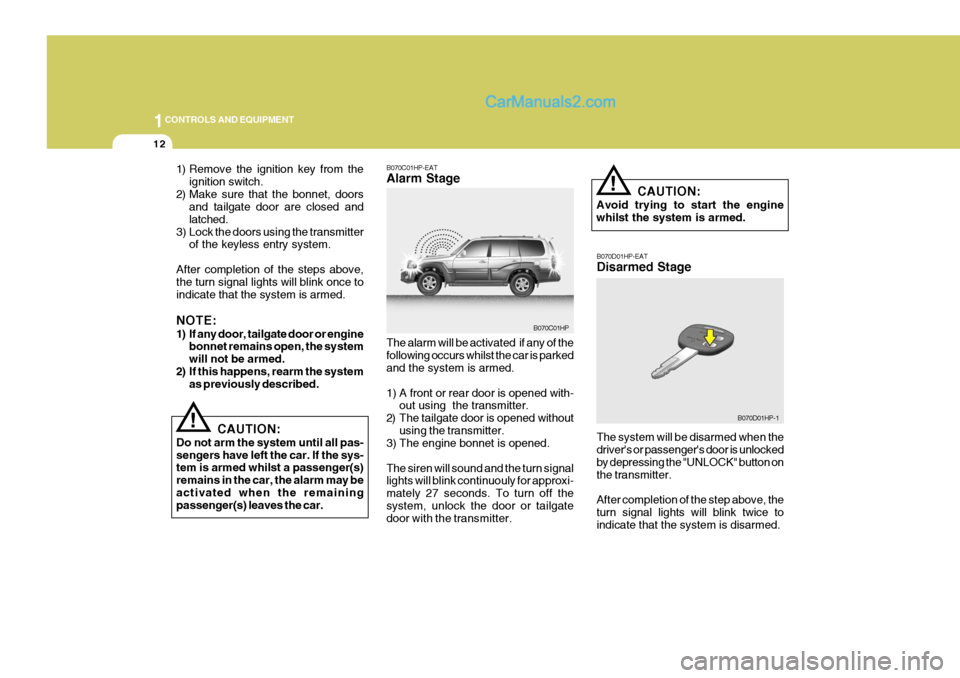
3) The engine bonnet is opened.The siren will sound and the turn signal lights will blink continuouly for approxi- mately 27 seconds. To turn off thesystem, unlock the door or tailgate door with the transmitter. CAUTION:
Avoid trying to start the engine whilst the system is armed.
B070C01HP B070D01HP-EAT Disarmed Stage The system will be disarmed when the driver's or passenger's door is unlocked by depressing the "UNLOCK" button onthe transmitter. After completion of the step above, the turn signal lights will blink twice to indicate that the system is disarmed.
B070D01HP-1
Page 321 of 539
1
CONTROLS AND EQUIPMENT
13
!
NOTE: If any door,
tailgate door or engine
bonnet is not opened within 30 sec- onds, the system will be rearmedand all doors re-locked.
CAUTION:
Only the transmitter can disarm thearmed stage. If the transmitter doesnot disarm the system, it is neces- sary to take the following steps;
1. Unlock the door with the key, which will cause, the alarm to be acti- vated.
2. Insert the key in the ignition key cylinder and turn the ignition keyto "ON" position.
3. Wait for 30 seconds. After completion of the steps above, the system will be disarmed. B070F02A-EAT Keyless Entry System (Not all models) Locking doors
1. Close all doors.
2. Push the "LOCK" button on the trans-
mitter.
3. At the same time, all doors lock and the turn signal lights will blink once to indicate that the system is armed.
Unlocking doors
1. Push the "UNLOCK" button on the transmitter.
2. At the same time, all doors unlock and the turn signal lights will blink twice to indicate that the system isdisarmed.
NOTE: The transmitter will not work if any of following occur:
- The ignition key is in ignition switch.
- You exceed the operating distance limit (10 m). - The battery in the transmitter is
weak.
- Other vehicles or objects may be blocking the signal.
- The weather is extremely cold.
- The transmitter is close to a radio transmitter such as a radio stationor an airport which can interferewith normal operation of the trans- mitter.
When the transmitter does not work correctly, open and close the door with the ignition key. If you have a problem with the transmitter, con-tact an authorised Hyundai repairer. NOTE: Keep the transmitter away from wa- ter or any liquid. If the keyless entrysystem is inoperative due to expo- sure to water or liquids, it will not be covered by your manufacturer ve-hicle warranty.
Page 347 of 539
1
CONTROLS AND EQUIPMENT
39
NOTE:
o Both the driver's and front passenger's pre-tensioner seat belts will be activated in certainfrontal collisions. The pre- tensioner seat belts can be acti- vated alone or, where the frontalcollision is severe enough, to- gether with the airbags.
o When the pre-tensioner seat belts are activated, a loud noise may beheard and fine dust, which may appear to be smoke, may be vis-ible in the passenger compart- ment. These are normal operating conditions and are not hazard-ous.
o Although it is harmless, the fine
dust may cause skin irritation andshould not be breathed for pro- longed periods. Wash your hands and face thoroughly after an acci-dent in which the pre-tensioner seat belts were activated.
!!CAUTION:
o Because the sensor that activates the SRS airbag is connected with pre-tensioner seat belt, the SRS airbag warning light on theinstrument panel will blink for ap- proximately 6 seconds after the ignition key has been turned to the"ON" position or after the engine is started, and then it should turn off.
o If a pre-tensioner seat belt is not working properly, this warninglight will illuminate even if there isno malfunction of the SRS airbag. If the SRS airbag warning light does not blink for about 6 secondswhen the ignition key is turned to "ON" or the engine is started, or if it remains illuminated after blink-ing for approximately 6 seconds, or if it illuminates whilst the ve- hicle is being driven, please havea Hyundai authorised repairer in- spect the pre-tensioner seat belts and SRS airbag system as soon aspossible. WARNING:
o Pre-tensioners are designed to operate only one time. After acti- vation, pre-tensioner seat belts must be replaced. All seat belts,of any type, should always be replaced after they have been worn during a collision.
o The pre-tensioner seat belt as- sembly mechanisms become hotduring activation. Do not touchthe pre-tensioner seat belt as- semblies for several minutes af- ter they have been activated.
o Do not attempt to inspect or re-
place the pre-tensioner seat beltsyourself. This must be done by a Hyundai authorised repairer.
o Do not strike the pre-tensioner seat belt assemblies.
o Do not attempt to service or re-
pair the pre-tensioner seat belt system in any manner.
AIR
BAG