engine Hyundai Terracan 2006 Owner's Manual
[x] Cancel search | Manufacturer: HYUNDAI, Model Year: 2006, Model line: Terracan, Model: Hyundai Terracan 2006Pages: 539, PDF Size: 18.11 MB
Page 423 of 539
2
DRIVING YOUR HYUNDAI
7
!
NOTE: If the engine has not been started within 2 seconds after the preheating is completed, turn the ignition keyonce more to the "LOCK" position during 10 seconds, and then to the "ON" position, in order to preheatagain.
WARNING:
Be sure that the clutch is fully de-pressed when starting a manualtransaxle vehicle. This will prevent sudden movement occuring should the vehicle be started in gear withoutthe clutch depressed. Otherwise there is the potential to cause damage to the vehicle or injury to a personinside or outside of the vehicle as a result of this sudden vehicle move- ment.
5. Turn the ignition key to the "START" position and release it when the en- gine starts.
!
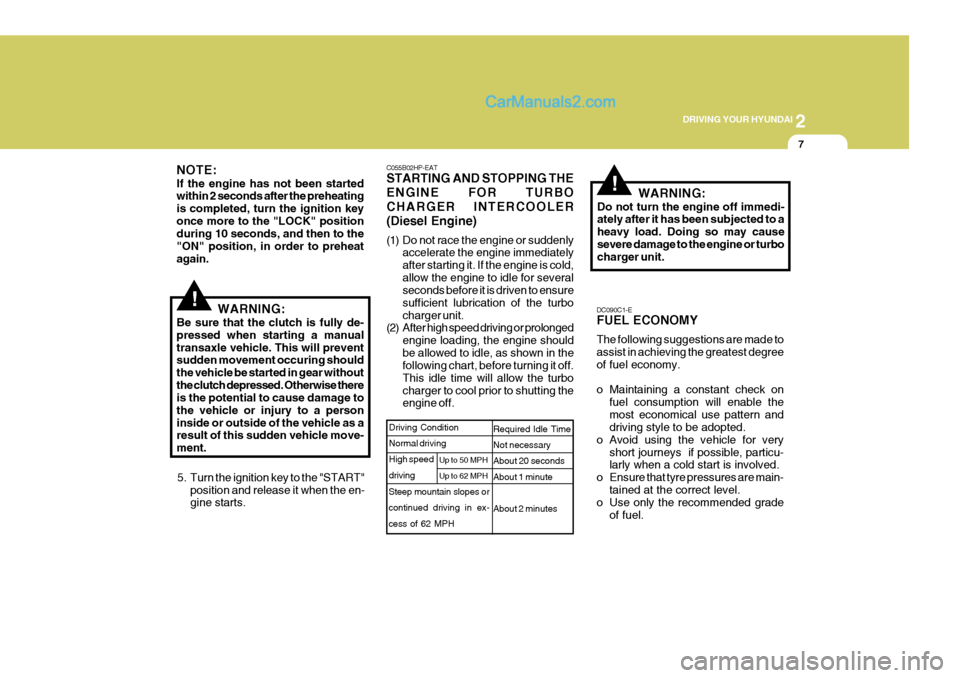
C055B02HP-EAT STARTING AND STOPPING THE ENGINE FOR TURBOCHARGER INTERCOOLER(Diesel Engine)
(1) Do not race the engine or suddenly accelerate the engine immediately after starting it. If the engine is cold,allow the engine to idle for several seconds before it is driven to ensure sufficient lubrication of the turbocharger unit.
(2) After high speed driving or prolonged
engine loading, the engine shouldbe allowed to idle, as shown in the following chart, before turning it off. This idle time will allow the turbocharger to cool prior to shutting the engine off. WARNING:
Do not turn the engine off immedi-ately after it has been subjected to a heavy load. Doing so may causesevere damage to the engine or turbo charger unit.
DC090C1-E FUEL ECONOMY The following suggestions are made to assist in achieving the greatest degree of fuel economy.
o Maintaining a constant check on fuel consumption will enable the most economical use pattern and driving style to be adopted.
o Avoid using the vehicle for very short journeys if possible, particu-larly when a cold start is involved.
o Ensure that tyre pressures are main- tained at the correct level.
o Use only the recommended grade
of fuel.
Steep mountain slopes or continued driving in ex-
cess of 62 MPH Required Idle Time Not necessary About 20 secondsAbout 1 minute About 2 minutes
Driving Condition Normal driving High speed driving
Up to 50 MPH Up to 62 MPH
Page 424 of 539
2 DRIVING YOUR HYUNDAI
8
!
o Avoid carrying unnecessary weight,
and if a roof rack is in use, remove it as soon as possible after use.
o Anticipate the road and conditions
ahead to enable adjustments inspeed to be made smoothly. Avoid heavy acceleration and sharp brak- ing.
o Avoid cruising at unnecessary high speeds.
o Always ensure that the periodic main- tenance services are performed by a Hyundai authorised repairer at the time and/or mileage intervals speci-fied.
o Use the air conditioner only when
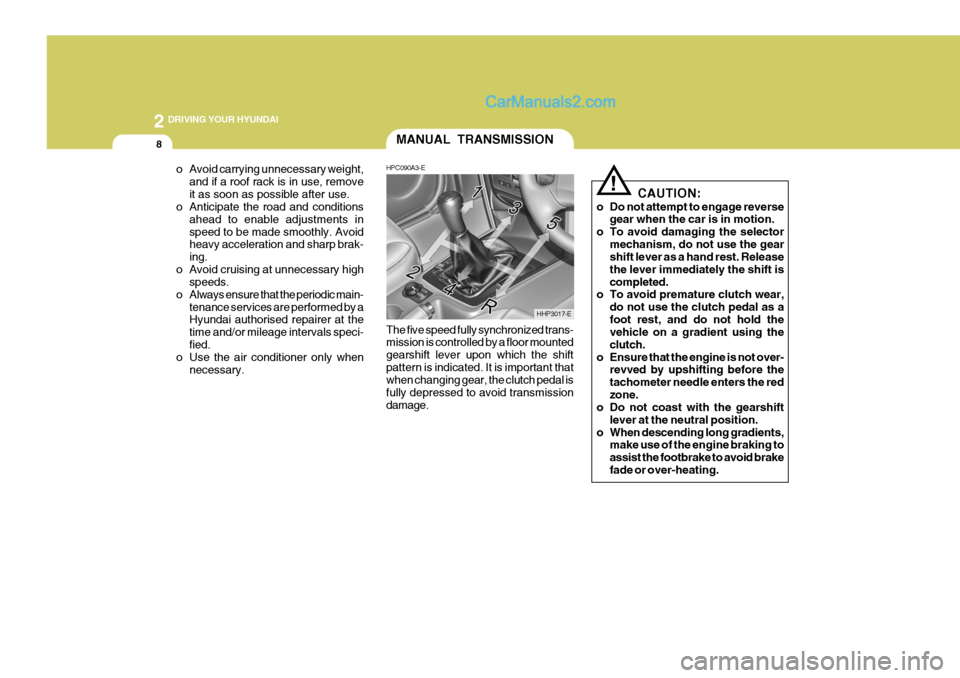
necessary. The five speed fully synchronized trans- mission is controlled by a floor mounted gearshift lever upon which the shiftpattern is indicated. It is important that when changing gear, the clutch pedal is fully depressed to avoid transmissiondamage. CAUTION:
o Do not attempt to engage reverse gear when the car is in motion.
o To avoid damaging the selector mechanism, do not use the gear shift lever as a hand rest. Release the lever immediately the shift iscompleted.
o To avoid premature clutch wear,
do not use the clutch pedal as afoot rest, and do not hold the vehicle on a gradient using the clutch.
o Ensure that the engine is not over- revved by upshifting before thetachometer needle enters the redzone.
o Do not coast with the gearshift
lever at the neutral position.
o When descending long gradients, make use of the engine braking toassist the footbrake to avoid brakefade or over-heating.
MANUAL TRANSMISSION
HHP3017-E
HPC090A3-E
Page 427 of 539
2
DRIVING YOUR HYUNDAI
11
!
HPC090A1-E SELECTOR POSITIONS o P (Park): With the selector lever in this position, no drive is transmitted from the engine and the transmission output and there- fore the front wheels locked. The en-gine may be started with the selector lever in this position.
CAUTION:
The selector lever must NEVER be shifted to the "P" position whilst thevehicle is in motion, otherwise seri- ous transmission damage will re- sult.
!
!
!
DC110C1-E o R (Reverse): With the selector lever in this position, reverse gear will be engaged. The en-gine may not be started with the selec- tor lever in this position.
CAUTION:
The selector lever must NEVER beshifted to the "R" position whilst the vehicle is in motion. DC110D1-E o N (Neutral): With the selector lever in this position, no gear is selected and no drive is transmitted from the engine. The en- gine may be started with the selectorlever in this position.
CAUTION:
Do not coast with the selector lever at the "N" position. C090E01O-AAT
o D (Drive): Use for normal driving. The transmis- sion will automatically shift through afour gear sequence. DC110F1-E o 2 (Second Gear): With the selector in this position, first gear will be engaged from rest. The transmission will upshift to second geardepending upon the vehicle speed and throttle position. No upshift to third or fourth will occur. The engine may notbe started with the selector in this position.
CAUTION:
Do not move the selector to the 2 position when the vehicle speed is in excess of 60 m.p.h.
Page 428 of 539
2 DRIVING YOUR HYUNDAI
12
!
C090I01E-EAT
CAUTION:
o Shift into "R" and "P" only when the vehicle has completely stopped.
o Do not accelerate the engine in reverse or any of the forward posi-tions with the brakes applied.
o Always apply the footbrake when shifting from "P" or "N" to "R","D", "2" or "L" position.
o Do not use the "P" (Park) posi- tion in place of the parking brake.Always set the parking brake,shift the transmission into "P" (Park) and turn off the ignition when you leave the vehicle, evenmomentarily. Never leave the ve- hicle unattended whilst the en- gine is running.
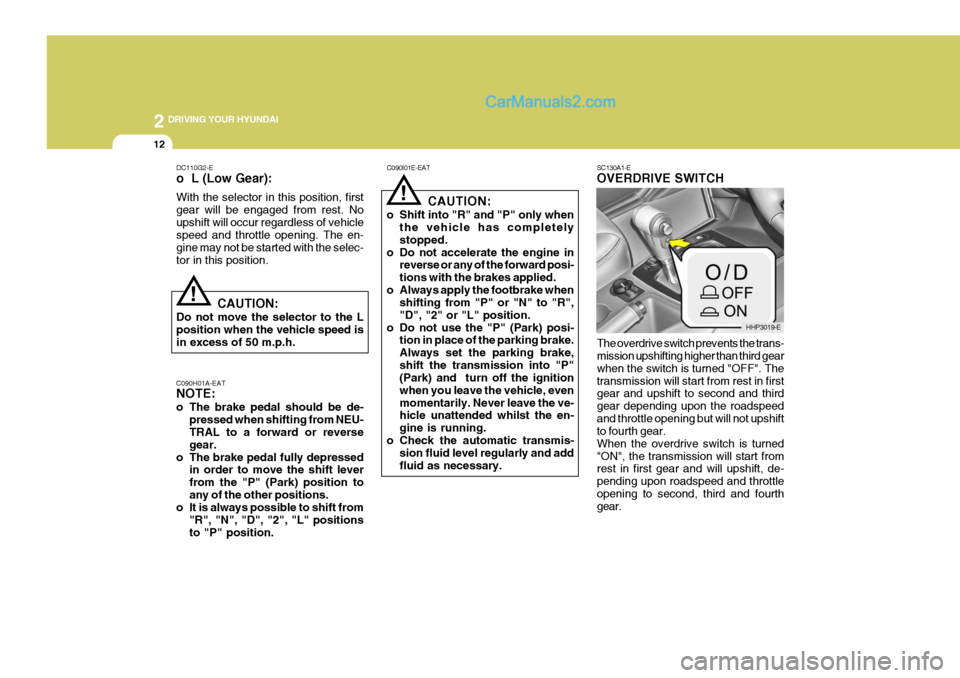
o Check the automatic transmis- sion fluid level regularly and addfluid as necessary. SC130A1-E OVERDRIVE SWITCH The overdrive switch prevents the trans- mission upshifting higher than third gear when the switch is turned "OFF". Thetransmission will start from rest in first gear and upshift to second and third gear depending upon the roadspeedand throttle opening but will not upshift to fourth gear. When the overdrive switch is turned"ON", the transmission will start from rest in first gear and will upshift, de- pending upon roadspeed and throttleopening to second, third and fourth gear.
!
DC110G2-E o L (Low Gear): With the selector in this position, first gear will be engaged from rest. Noupshift will occur regardless of vehicle speed and throttle opening. The en- gine may not be started with the selec-tor in this position.
CAUTION:
Do not move the selector to the Lposition when the vehicle speed isin excess of 50 m.p.h. C090H01A-EAT NOTE:
o The brake pedal should be de- pressed when shifting from NEU- TRAL to a forward or reverse gear.
o The brake pedal fully depressed in order to move the shift leverfrom the "P" (Park) position toany of the other positions.
o It is always possible to shift from
"R", "N", "D", "2", "L" positionsto "P" position.
HHP3019-E
Page 429 of 539

2
DRIVING YOUR HYUNDAI
13
Therefore, when the overdrive switch is turned "OFF", the transmission per-forms as a three speed unit and the overdrive warning light located in the instrument cluster will be illuminated.When the overdrive switch is turned "ON", the transmission functions as a fully automatic four speed unit with themaximum fuel economy potential of the vehicle being realized. HPC120D2-E General Operating Instructions
o The button in the selector handle
must be depressed before the selec- tor lever can be moved.
o The engine may only be started
when the selector is at position "P"or "N".
o Ensure that the footbrake is firmly
applied when shifting from "P" or"N" to "D", "2" or "L" and vice versa.
o Always engage the parking brake
when the vehicle is unattended,never use the "P" position in place of the parking brake.
o Under normal circumstances, the selector lever should be placed in the"D" position and the transmission allowed to select the most ideal ratiofor the circumstances. In this posi- tion maximum fuel economy will be achieved.
o When descending steep gradients where engine braking is required,the selector lever should be placedat the "2" or "L" position depending upon the vehicle speed. o When climbing steep gradients us-
ing large throttle openings, the trans- mission may repeatedly change be- tween two adjacent ratios. This is a normal characteristic and may beprevented by cancelling the over- drive facility if the shifting occurs between third and fourth ratios, se-lecting position "2" if the shifting occurs between third and second ratios or selecting position "1" if theshifting occurs between first and second ratios.
o Never move the selector lever to or from the "P" or "N" position with theaccelerator depressed.
o Ensure that the overdrive switch is at the "ON" position for maximumeconomy.
o If rapid acceleration is required, fully depress the accelerator pedal. Inthis condition, the kickdown mecha- nism will be operated and the trans-mission will automatically downshift according to the vehicle speed.
o The automatic transaxle may be used to great effect if the vehicle becomesstuck in snow or mud by allowing the vehicle to be rocked to and fro.
Page 430 of 539
2 DRIVING YOUR HYUNDAI
14FOUR-WHEEL DRIVE (4WD)
D090A01P-GAT You can send your engine power to all front and rear wheels for maximum power. 4WD is useful when you drive in snow, mud, ice, mountainous orsandy areas where good traction is required, or when your wheels lose traction using two-wheel drive.
The engine speed should be held atapproximately 1,000rpm by meansof the accelerator pedal and the se- lector lever moved between the "D" and "R" positions to induce a rockingmotion.
o Do not depress the accelerator pedal
with the brakes applied and the se-lector at the "R", "D", "2" or "L" position.
o Turn the overdrive switch on for good fuel economy and smooth driving.But if engine braking is needed in the "D" range or if repeated upshiftingand downshifting between the 3rd and 4th gear is needed when climb- ing a gentle slope, it is recommendedthat the overdrive switch be turned off. Turn the overdrive switch back on immediately afterward.
!WARNING:
o Avoid high cornering speeds.
o Do not make quick steering wheel movements, such as sharp lanechanges or fast, sharp turns. o Always wear your seat belts.
In a collision crash, an unbeltedperson is significantly more likelyto die than a person wearing a seatbelt.
o The risk of rollover is greatly in- creased if you lose control of yourvehicle at motorway speeds.
o Loss of control often occurs if two
or more wheels drop off the road-way and the driver oversteers to reenter the roadway.
o In the event your vehicle leaves the roadway, do not steer sharply.Instead, slow down before pullingback into the travel lanes.
o Never exceed posted speed limits.
o Excessive depressing of the
accelerater pedal under the tyre slip condition such as moving out of the mud or fresh snow etc, maycause severe damage to the trans- mission. At this time, take other way such as towing.
Page 433 of 539
2
DRIVING YOUR HYUNDAI
17
C355A04HP-EAT Full-time 4WD operation (Not all models) 1. Knob position This is used to set different positions.
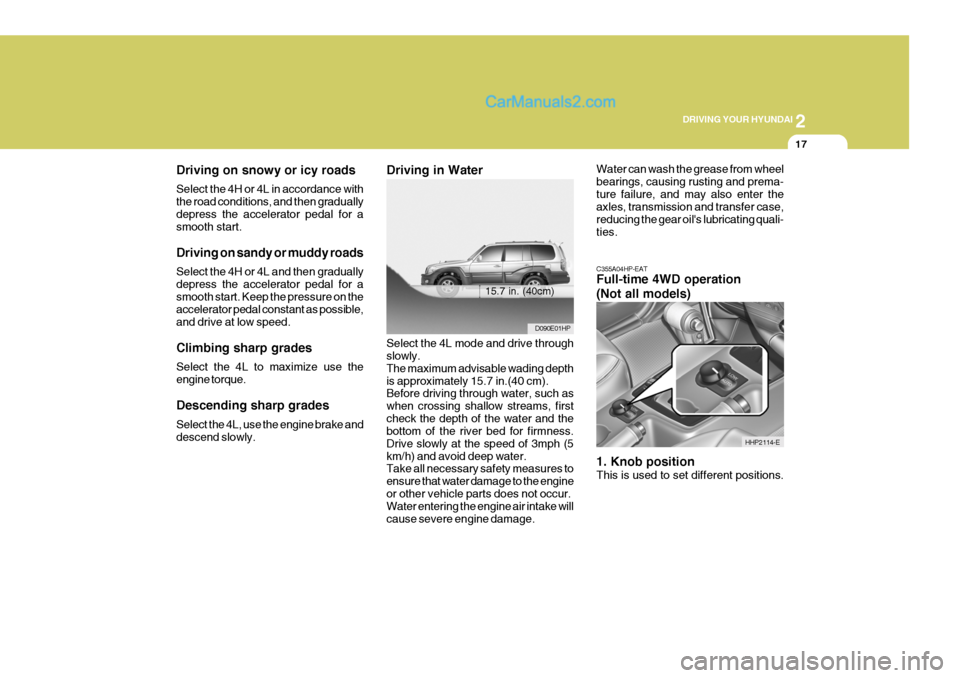
15.7 in. (40cm) D090E01HP
HHP2114-E
Driving on snowy or icy roads Select the 4H or 4L in accordance with the road conditions, and then graduallydepress the accelerator pedal for a smooth start. Driving on sandy or muddy roads Select the 4H or 4L and then gradually depress the accelerator pedal for asmooth start. Keep the pressure on the accelerator pedal constant as possible, and drive at low speed. Climbing sharp grades Select the 4L to maximize use the engine torque. Descending sharp grades Select the 4L, use the engine brake and descend slowly.
Driving in Water
Water can wash the grease from wheelbearings, causing rusting and prema-ture failure, and may also enter the axles, transmission and transfer case, reducing the gear oil's lubricating quali-ties.
Select the 4L mode and drive through slowly. The maximum advisable wading depthis approximately 15.7 in.(40 cm). Before driving through water, such as when crossing shallow streams, firstcheck the depth of the water and the bottom of the river bed for firmness. Drive slowly at the speed of 3mph (5km/h) and avoid deep water. Take all necessary safety measures to ensure that water damage to the engineor other vehicle parts does not occur. Water entering the engine air intake will cause severe engine damage.
Page 436 of 539
2 DRIVING YOUR HYUNDAI
20
!
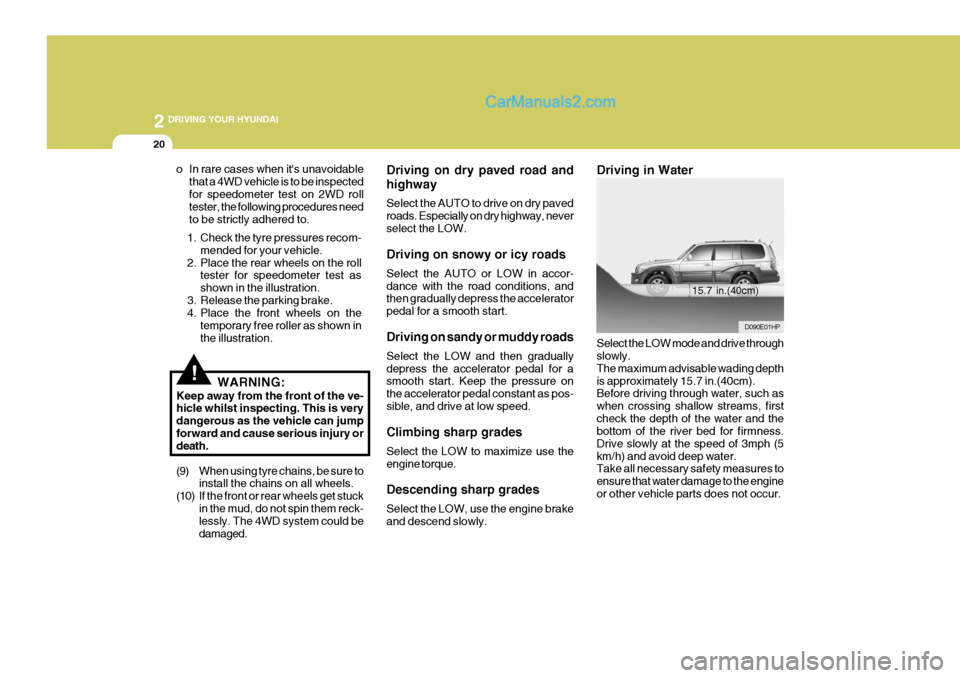
Driving in Water Select the LOW mode and drive through slowly. The maximum advisable wading depthis approximately 15.7 in.(40cm). Before driving through water, such as when crossing shallow streams, firstcheck the depth of the water and the bottom of the river bed for firmness. Drive slowly at the speed of 3mph (5km/h) and avoid deep water. Take all necessary safety measures to ensure that water damage to the engineor other vehicle parts does not occur.
o In rare cases when it's unavoidable
that a 4WD vehicle is to be inspectedfor speedometer test on 2WD roll tester, the following procedures need to be strictly adhered to. Driving on dry paved road and highway Select the AUTO to drive on dry paved roads. Especially on dry highway, neverselect the LOW. Driving on snowy or icy roads Select the AUTO or LOW in accor- dance with the road conditions, and then gradually depress the accelerator pedal for a smooth start. Driving on sandy or muddy roads Select the LOW and then gradually depress the accelerator pedal for a smooth start. Keep the pressure on the accelerator pedal constant as pos-sible, and drive at low speed. Climbing sharp grades Select the LOW to maximize use the engine torque. Descending sharp grades Select the LOW, use the engine brake and descend slowly.
D090E01HP
15.7 in.(40cm)
1. Check the tyre pressures recom-
mended for your vehicle.
2. Place the rear wheels on the roll tester for speedometer test as shown in the illustration.
3. Release the parking brake.
4. Place the front wheels on the
temporary free roller as shown in the illustration.
WARNING:
Keep away from the front of the ve- hicle whilst inspecting. This is very dangerous as the vehicle can jumpforward and cause serious injury or death.
(9) When using tyre chains, be sure to install the chains on all wheels.
(10) If the front or rear wheels get stuck in the mud, do not spin them reck- lessly. The 4WD system could be damaged.
Page 437 of 539
2
DRIVING YOUR HYUNDAI
21
!
Water entering the engine air intake will cause severe engine damage. Water can wash the grease from wheel bearings, causing rusting and prema-ture failure, and may also enter the axles, transmission and transfer case, reducing the gear oil's lubricating quali-ties. CAUTION:
o Whilst the full-time 4WD vehicle is
being raised on a jack, never start the engine or cause the tyres to rotate. There is the danger that rotating tyres touching the ground couldcause the vehicle to move off the jack and jump forward.
o If one of the front or rear wheels begins to spin in mud, snow, etc.,the vehicle can sometimes be driven out by depressing the ac-celerator pedal further; however, avoid running the engine continu- ously at high rpm because doingso could damage the 4WD system.
!WARNING:
o Avoid high cornering speeds.
o Do not make quick steering wheel movements, such as sharp lane charges or fast, sharp turns.
o The risk of rollover is greatly in-
creased if you lose control of yourvehicle at motorway speeds.
o In a collision crash, an unbelted
person is significantly more likelyto die than a person wearing a seatbelt.
o Loss of control often occurs if two or more wheels drop off the road- way and the driver oversteers tore-enter the roadway.
o In the event your vehicle leaves
the roadway, do not steer sharply.Instead, slow down before pulling back into the travel lanes.
ANTI-LOCK BRAKE SYSTEM
C120A02A-EAT The Anti-Lock Brake System (ABS) is designed to prevent wheel lock-up dur- ing sudden braking or on hazardous road surfaces. The ABS control modulemonitors the wheel speed and controls the pressure applied to each brake. Thus, in emergency situations or onslick roads, ABS will increase vehicle control during braking. NOTE: During ABS operation, a slight pul- sation may be felt in the brake pedal when the brakes are applied. Also, a noise may be heard in the enginecompartment while braking. These conditions are normal and indicate that the anti-lock brake system isfunctioning properly.
Page 438 of 539
2 DRIVING YOUR HYUNDAI
22
!
EFFECTIVE BRAKING
HPC141A1-E Braking system performance and fric- tion material life are greatly affected by the driving style adopted. The follow- ing suggestions are made to assist inachieving the best results from the braking system.
o Anticipate the road and conditions ahead in order that heavy braking may be avoided.
o When descending long gradients,
use the engine to assist in retardingthe vehicle to minimise the possibil- ity of brake fade occurring.
o When trailer towing, ensure that the trailer brakes function correctly anduse engine braking to assist the vehicle braking system.
o Use only genuine Hyundai replace- ment brake pads and shoes to en-sure consistent friction characteris-tics and wear rates.
o After driving through deep water (e.g.
fording), the brakes may becomewet and performance reduced. Al- ways check brake efficiency after emerging from the water and dry thebrakes by lightly depressing the brake pedal several times whilst driv- ing slowly.LIMITED-SLIP DIFFEREN- TIAL (LSD)
D190A01HP-EAT (Not all models) A limited-slip differential, if equipped, is for the rear wheel differential only.The features of this limited-slip differ- ential are described below: Just as with a conventional differential,the wheel on one side is allowed to turn at a different speed from the wheel on the other side when the vehicle iscornering. The difference between the limited-slip differential and a conven- tional differential is that if the wheel onone side of the vehicle loses traction, a greater amount of torque is applied to the rear wheel on the other side toimprove traction.
WARNING:
ABS will not prevent accidents dueto improper or dangerous drivingmanoeuvres. Even though vehicle control is improved during emer- gency braking, always maintain asafe distance between you and ob- jects ahead. Vehicle speeds should always be reduced during extremeroad conditions. The braking distance for cars equipped with an anti-lock braking system may be longer than for those without it, in the following road con-ditions. These roads should be driven at reduced speeds.
o Rough, gravel or snow-covered roads.
o With tyre chains installed.
o On roads where the road surface is pitted or has different surfaceheight.
The safety features of an ABSequipped vehicle should not be testedby high speed driving or cornering. This could endanger the safety of yourself or others.
! CAUTION:
o Never start the engine with the gearshift lever placed in the for- ward or reverse whilst one of therear wheels is jacked up and the other in contact with the ground; doing so may cause the vehicle tojump forward.
o Use only recommended oil for
LSD in the rear axle.See page 9-4 for the recommended oil descriptions.