air bag Hyundai Terracan 2006 User Guide
[x] Cancel search | Manufacturer: HYUNDAI, Model Year: 2006, Model line: Terracan, Model: Hyundai Terracan 2006Pages: 539, PDF Size: 18.11 MB
Page 55 of 539
1
FEATURES OF YOUR HYUNDAI
41
!
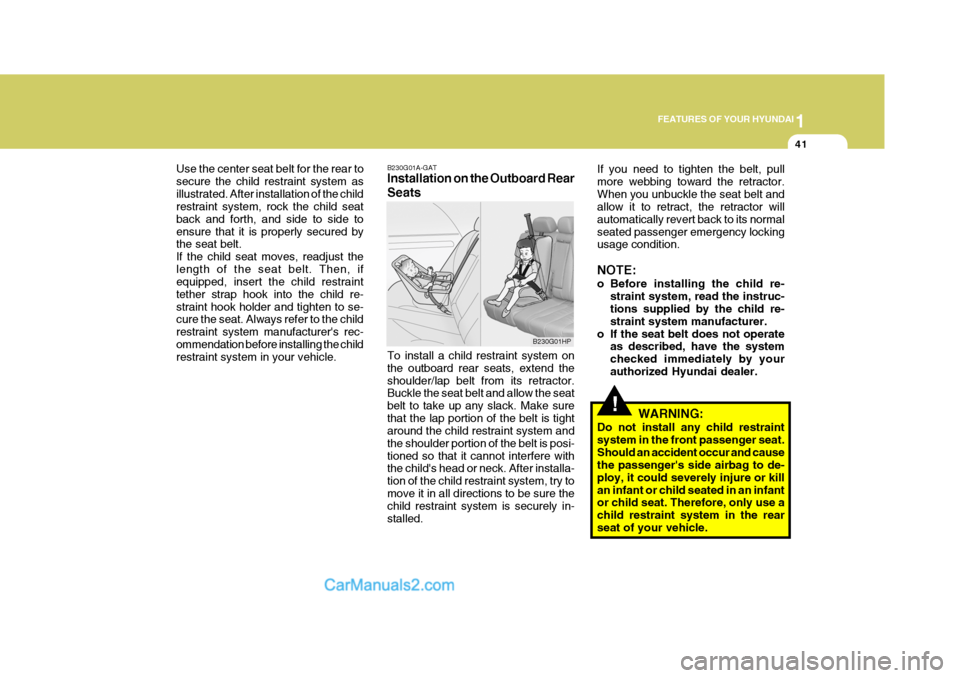
Use the center seat belt for the rear to secure the child restraint system asillustrated. After installation of the child restraint system, rock the child seat back and forth, and side to side toensure that it is properly secured by the seat belt. If the child seat moves, readjust thelength of the seat belt. Then, if equipped, insert the child restraint tether strap hook into the child re-straint hook holder and tighten to se- cure the seat. Always refer to the child restraint system manufacturer's rec-ommendation before installing the child restraint system in your vehicle. B230G01A-GAT Installation on the Outboard Rear Seats To install a child restraint system on the outboard rear seats, extend theshoulder/lap belt from its retractor. Buckle the seat belt and allow the seat belt to take up any slack. Make surethat the lap portion of the belt is tight around the child restraint system and the shoulder portion of the belt is posi-tioned so that it cannot interfere with the child's head or neck. After installa- tion of the child restraint system, try tomove it in all directions to be sure the child restraint system is securely in- stalled.If you need to tighten the belt, pullmore webbing toward the retractor.When you unbuckle the seat belt and allow it to retract, the retractor will automatically revert back to its normalseated passenger emergency locking usage condition. NOTE:
o Before installing the child re-
straint system, read the instruc- tions supplied by the child re- straint system manufacturer.
o If the seat belt does not operate as described, have the systemchecked immediately by yourauthorized Hyundai dealer.
WARNING:
Do not install any child restraintsystem in the front passenger seat.Should an accident occur and cause the passenger's side airbag to de- ploy, it could severely injure or killan infant or child seated in an infant or child seat. Therefore, only use a child restraint system in the rearseat of your vehicle.
B230G01HP
Page 59 of 539
1
FEATURES OF YOUR HYUNDAI
45
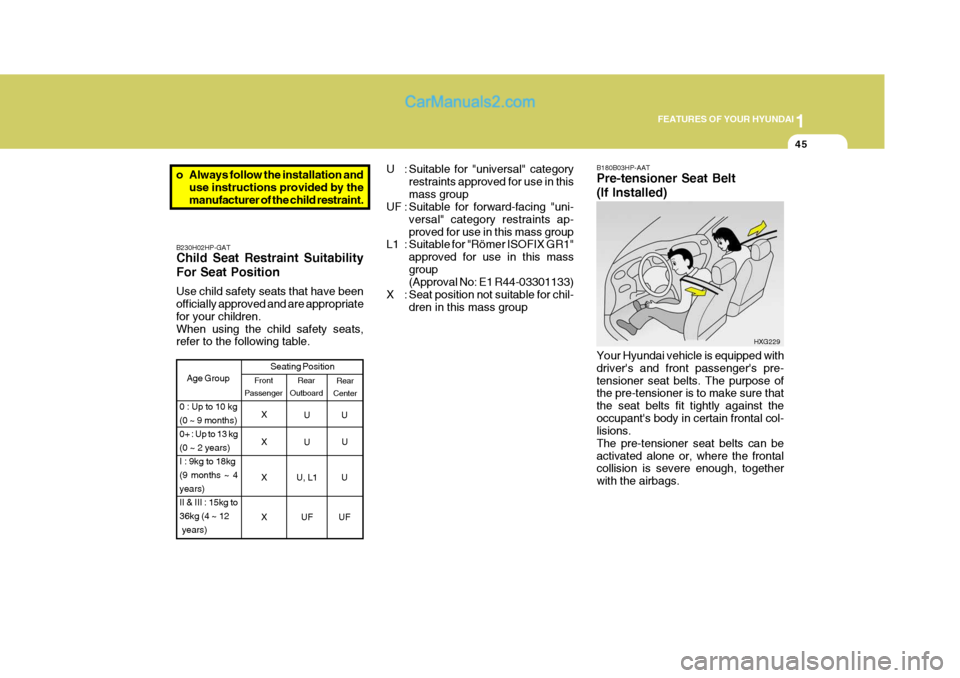
B230H02HP-GAT Child Seat Restraint Suitability For Seat Position Use child safety seats that have been officially approved and are appropriate for your children.When using the child safety seats, refer to the following table.
Rear
Center
Age Group Seating Position
UU
X UU
Rear
Outboard
Front
Passenger
0 : Up to 10 kg (0 ~ 9 months)0+ : Up to 13 kg(0 ~ 2 years)I : 9kg to 18kg(9 months ~ 4years)II & III : 15kg to36kg (4 ~ 12 years) X
X U, L1 U XU
FUF
U : Suitable for "universal" category
restraints approved for use in this mass group
UF : Suitable for forward-facing "uni-
versal" category restraints ap-proved for use in this mass group
L1 : Suitable for "Römer ISOFIX GR1"
approved for use in this massgroup (Approval No: E1 R44-03301133)
X : Seat position not suitable for chil- dren in this mass group B180B03HP-AAT Pre-tensioner Seat Belt (If Installed) Your Hyundai vehicle is equipped with driver's and front passenger's pre-tensioner seat belts. The purpose of the pre-tensioner is to make sure that the seat belts fit tightly against theoccupant's body in certain frontal col- lisions. The pre-tensioner seat belts can beactivated alone or, where the frontal collision is severe enough, together with the airbags.
HXG229
o Always follow the installation and
use instructions provided by the manufacturer of the child restraint.
Page 60 of 539
1FEATURES OF YOUR HYUNDAI
46
!
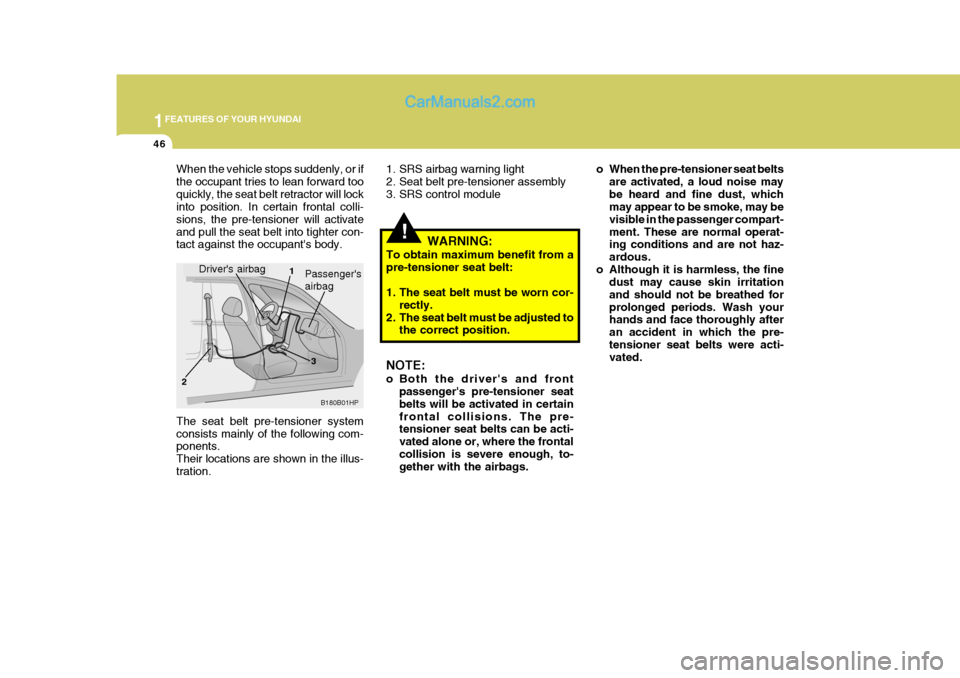
1. SRS airbag warning light
2. Seat belt pre-tensioner assembly
3. SRS control module o When the pre-tensioner seat belts
are activated, a loud noise maybe heard and fine dust, which may appear to be smoke, may be visible in the passenger compart-ment. These are normal operat- ing conditions and are not haz- ardous.
o Although it is harmless, the fine dust may cause skin irritationand should not be breathed forprolonged periods. Wash your hands and face thoroughly after an accident in which the pre-tensioner seat belts were acti- vated.
WARNING:
To obtain maximum benefit from a pre-tensioner seat belt:
1. The seat belt must be worn cor- rectly.
2. The seat belt must be adjusted to the correct position.
NOTE:
o Both the driver's and front passenger's pre-tensioner seat belts will be activated in certainfrontal collisions. The pre- tensioner seat belts can be acti- vated alone or, where the frontalcollision is severe enough, to- gether with the airbags.
When the vehicle stops suddenly, or if the occupant tries to lean forward tooquickly, the seat belt retractor will lock into position. In certain frontal colli- sions, the pre-tensioner will activateand pull the seat belt into tighter con- tact against the occupant's body.
B180B01HP
The seat belt pre-tensioner system consists mainly of the following com- ponents. Their locations are shown in the illus-tration.
Driver's airbag1
2 3Passenger's airbag
Page 61 of 539
1
FEATURES OF YOUR HYUNDAI
47
!WARNING:
o Pre-tensioners are designed to operate only one time. After acti- vation, pre-tensioner seat belts must be replaced. All seat belts,of any type, should always be replaced after they have been worn during a collision.
o The pre-tensioner seat belt as- sembly mechanisms become hotduring activation. Do not touchthe pre-tensioner seat belt as- semblies for several minutes af- ter they have been activated.
o Do not attempt to inspect or re- place the pre-tensioner seat beltsyourself. This must be done byan authorized Hyundai dealer.
o Do not strike the pre-tensioner
seat belt assemblies.
o Do not attempt to service or re- pair the pre-tensioner seat beltsystem in any manner.! CAUTION:
o Because the sensor that activates the SRS airbag is connected with pre-tensioner seat belt, the SRS airbag warning light on the instrument panel will blink for approximately 6 seconds after the ignition key has been turned to the "ON" position or after the engine is started, and then it should turn off.
o If pre-tensioner seat belt is not working properly, this warning light will illuminate even if there is no malfunction of the SRS airbag. If the SRS airbag warning light does not blink for about 6 seconds when the ignition key is turned to "ON" or the engine is started, or if it remains illumi- nated after blinking for approxi- mately 6 seconds, or if it illumi- nates while the vehicle is being driven, please have an authorized Hyundai dealer inspect the pre- tensioner seat belts and SRS airbag system as soon as pos- sible.
AIR
BAG
o Improper handling of the pre-
tensioner seat belt assemblies, and failure to heed the warnings to not strike, modify, inspect, re-place, service or repair the pre- tensioner seat belt assemblies may lead to improper operationor inadvertent activation and se- rious injury.
o Always wear seat belts when driv-
ing or riding in a motor vehicle.
Page 62 of 539
1FEATURES OF YOUR HYUNDAI
48
!
The Hyundai SRS consists of airbags installed under the pad covers in thecenter of the steering wheel and the passenger's side front panel above the glove box. The purpose of the SRSis to provide the vehicle's driver and/or the front passenger with additional pro- tection than that offered by the seat-belt system alone, in case of a frontal impact of sufficient severity. NOTE: Be sure to read information about the SRS on the labels provided on the front of the sun visor and in the glove box. WARNING:
o As its name implies, the SRS is designed to work with, and be supplemental to, the driver's and the passenger's three point seatbelt systems and is not a substi- tute for them. Therefore, your seat belts must be worn at all timeswhile the vehicle is in motion. The airbags deploy only in cer- tain frontal impact conditionssevere enough to likely cause significant injury to the vehicle occupants.
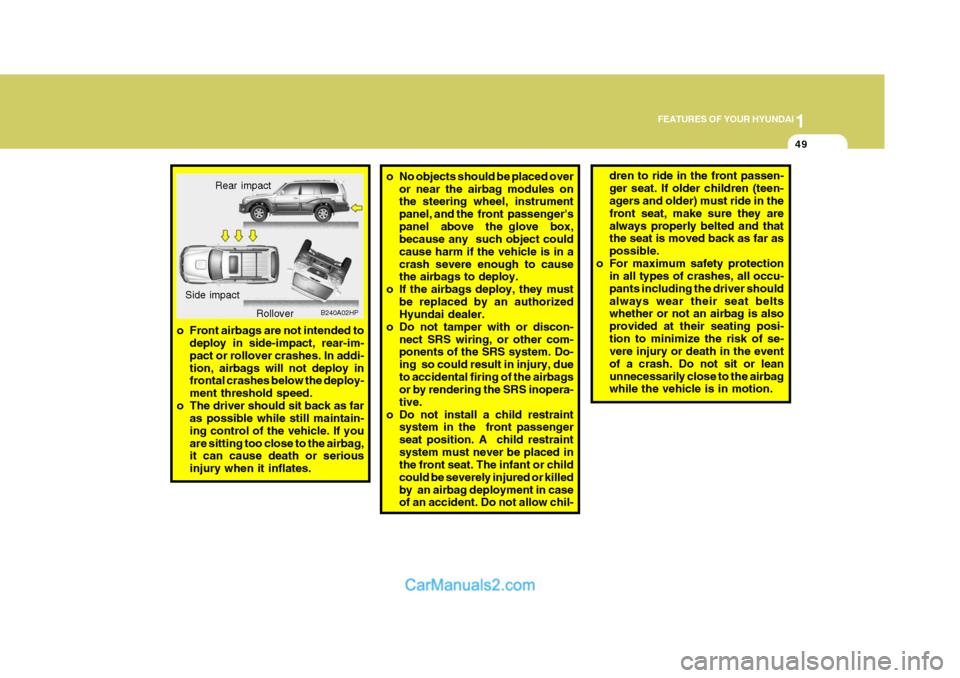
o The SRS is designed to deploy the airbags only when an impactis sufficiently severe and whenthe impact angle is less than 30° from the forward longitudinal axis of the vehicle and will not deployin side, rear or rollover impacts. Additionally, the airbags will only deploy once. Thus, seat beltsmust be worn at all times.
o Front airbags are not intended to
deploy in light collisions in whichprotection can be provided by the seat belt alone.
SUPPLEMENTAL RESTRAINT (AIRBAG) SYSTEM
B240A01HP-AAT (If Installed)
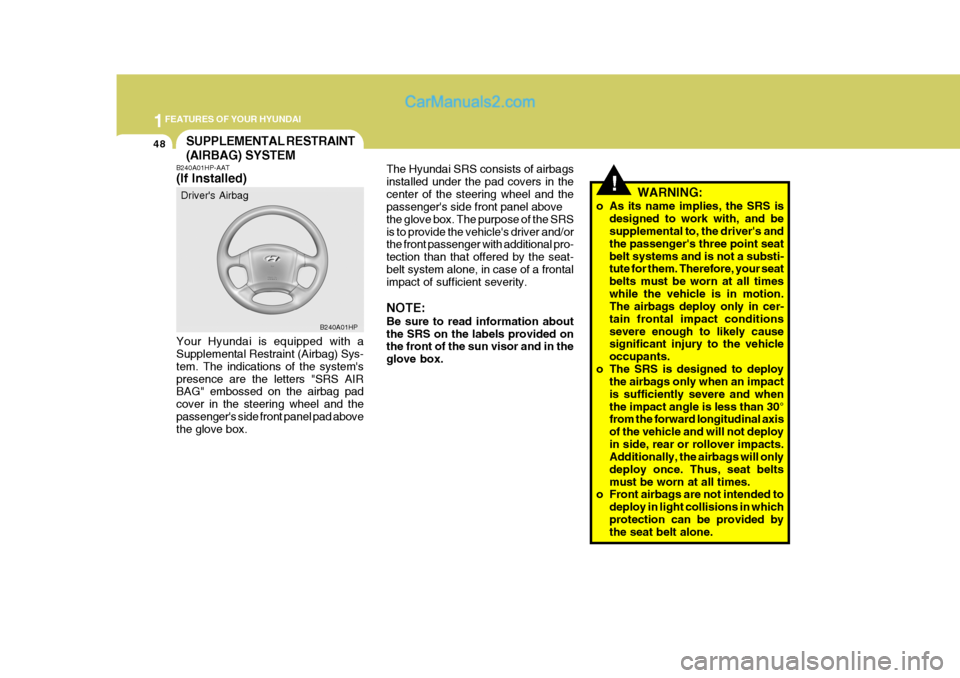
Your Hyundai is equipped with a Supplemental Restraint (Airbag) Sys- tem. The indications of the system'spresence are the letters "SRS AIR BAG" embossed on the airbag pad cover in the steering wheel and thepassenger's side front panel pad above the glove box. Driver's Airbag
B240A01HP
Page 63 of 539
1
FEATURES OF YOUR HYUNDAI
49
o No objects should be placed over
or near the airbag modules on the steering wheel, instrument panel, and the front passenger'spanel above the glove box, because any such object could cause harm if the vehicle is in acrash severe enough to cause the airbags to deploy.
o If the airbags deploy, they must be replaced by an authorizedHyundai dealer.
o Do not tamper with or discon- nect SRS wiring, or other com-ponents of the SRS system. Do- ing so could result in injury, dueto accidental firing of the airbags or by rendering the SRS inopera- tive.
o Do not install a child restraint system in the front passengerseat position. A child restraintsystem must never be placed in the front seat. The infant or child could be severely injured or killedby an airbag deployment in case of an accident. Do not allow chil- dren to ride in the front passen- ger seat. If older children (teen- agers and older) must ride in the front seat, make sure they arealways properly belted and that the seat is moved back as far as possible.
o For maximum safety protection in all types of crashes, all occu-pants including the driver shouldalways wear their seat belts whether or not an airbag is also provided at their seating posi-tion to minimize the risk of se- vere injury or death in the event of a crash. Do not sit or leanunnecessarily close to the airbag while the vehicle is in motion.
o Front airbags are not intended to
deploy in side-impact, rear-im- pact or rollover crashes. In addi-tion, airbags will not deploy in frontal crashes below the deploy- ment threshold speed.
o The driver should sit back as far as possible while still maintain-ing control of the vehicle. If youare sitting too close to the airbag, it can cause death or serious injury when it inflates. Rear impact
B240A02HP
Side impact
Rollover
Page 64 of 539
1FEATURES OF YOUR HYUNDAI
50
The SRS service reminder indicator (SRI) on the instrument panel will blinkfor about 6 seconds after the ignition key is turned to the "ON" position or after the engine is started, after whichthe SRI should go out.
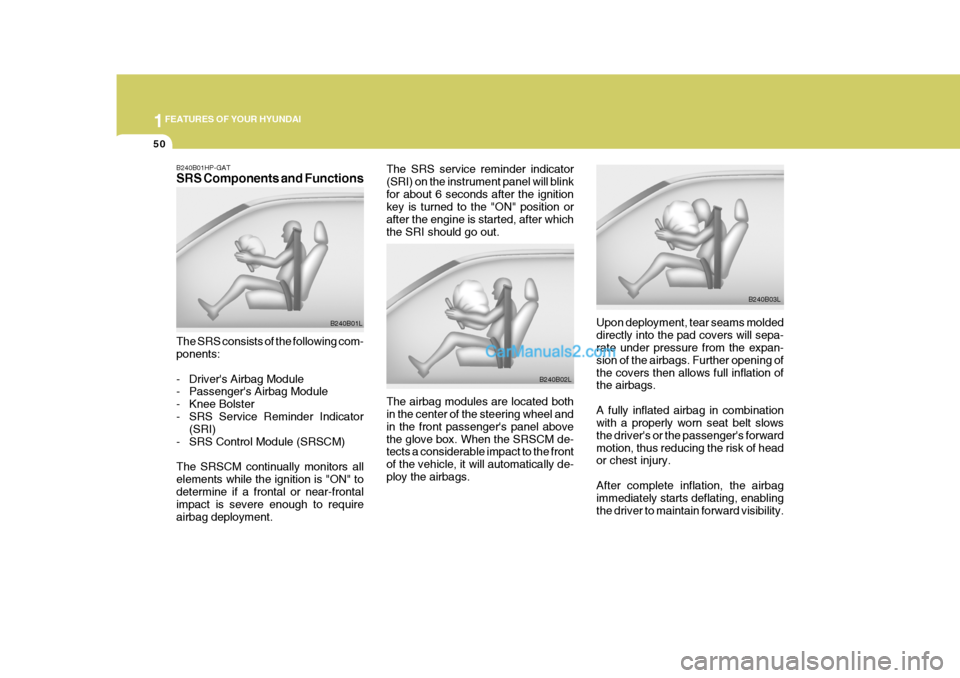
Upon deployment, tear seams moldeddirectly into the pad covers will sepa- rate under pressure from the expan- sion of the airbags. Further opening ofthe covers then allows full inflation of the airbags. A fully inflated airbag in combination with a properly worn seat belt slows the driver's or the passenger's forwardmotion, thus reducing the risk of head or chest injury. After complete inflation, the airbag immediately starts deflating, enabling the driver to maintain forward visibility.
The airbag modules are located both in the center of the steering wheel and in the front passenger's panel abovethe glove box. When the SRSCM de- tects a considerable impact to the front of the vehicle, it will automatically de-ploy the airbags.
B240B02L
B240B03L
B240B01HP-GAT SRS Components and Functions The SRS consists of the following com- ponents:
- Driver's Airbag Module
- Passenger's Airbag Module
- Knee Bolster
- SRS Service Reminder Indicator
(SRI)
- SRS Control Module (SRSCM) The SRSCM continually monitors all elements while the ignition is "ON" todetermine if a frontal or near-frontal impact is severe enough to require airbag deployment. B240B01L
Page 65 of 539
1
FEATURES OF YOUR HYUNDAI
51
!WARNING:
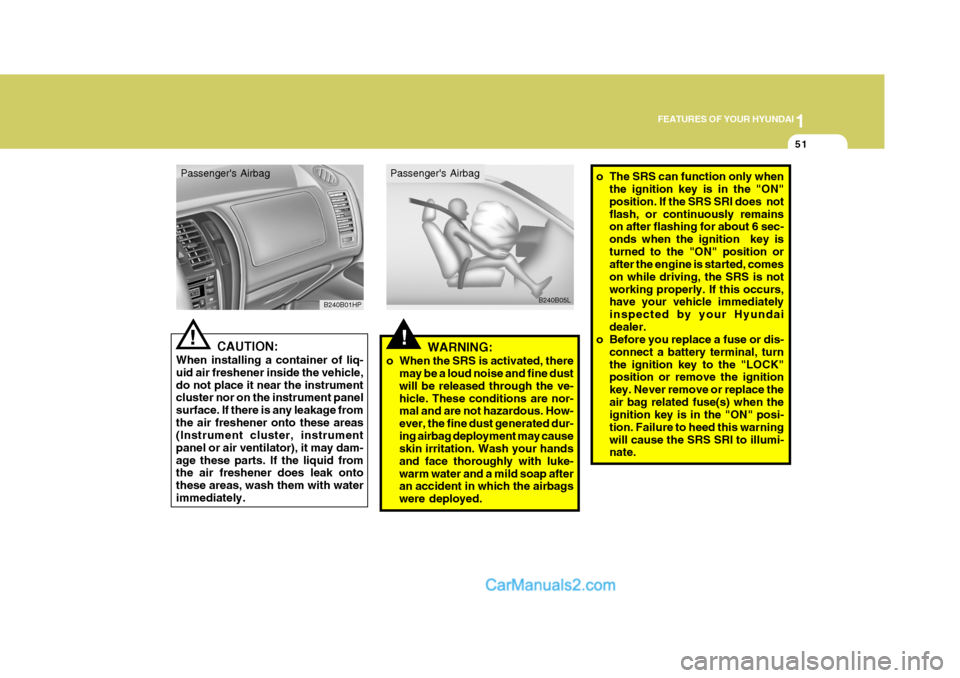
o When the SRS is activated, there may be a loud noise and fine dust will be released through the ve-hicle. These conditions are nor- mal and are not hazardous. How- ever, the fine dust generated dur-ing airbag deployment may cause skin irritation. Wash your hands and face thoroughly with luke-warm water and a mild soap after an accident in which the airbags were deployed. o The SRS can function only when
the ignition key is in the "ON"position. If the SRS SRI does notflash, or continuously remains on after flashing for about 6 sec- onds when the ignition key isturned to the "ON" position or after the engine is started, comes on while driving, the SRS is notworking properly. If this occurs, have your vehicle immediately inspected by your Hyundaidealer.
o Before you replace a fuse or dis-
connect a battery terminal, turnthe ignition key to the "LOCK" position or remove the ignition key. Never remove or replace theair bag related fuse(s) when the ignition key is in the "ON" posi- tion. Failure to heed this warningwill cause the SRS SRI to illumi- nate.! CAUTION:
When installing a container of liq- uid air freshener inside the vehicle,do not place it near the instrument cluster nor on the instrument panel surface. If there is any leakage fromthe air freshener onto these areas (Instrument cluster, instrument panel or air ventilator), it may dam-age these parts. If the liquid from the air freshener does leak onto these areas, wash them with waterimmediately. B240B01HP
B240B05L
Passenger's Airbag Passenger's Airbag
Page 66 of 539
1FEATURES OF YOUR HYUNDAI
52
o For cleaning the airbag pad cov-
ers, use only a soft, dry cloth or one which has been moistened with plain water. Solvents orcleaners could adversely affect the airbag covers and proper deployment of the system.
o No objects should be placed over or near the airbag modules onthe steering wheel, instrumentpanel, and the front passenger's panel above the glove box, be- cause any such object couldcause harm if the vehicle is in a crash severe enough to cause the airbags to inflate.
o If the airbags inflate, they must be replaced by an authorizedHyundai dealer.
o Do not tamper with or discon- nect SRS wiring, or other com-ponents of the SRS system. Do-ing so could result in injury, due to accidental firing of the airbags or by rendering the SRS inopera-tive.
!WARNING:
o Extreme Hazard! Do not use a rearward facing child restraint on a seat protected by an airbag in front of it.
o Modification to SRS components or wiring, including the additionof any kind of badges to the padcovers or modifications to the body structure, can adversely affect SRS performance and leadto possible injury. B240C01HP
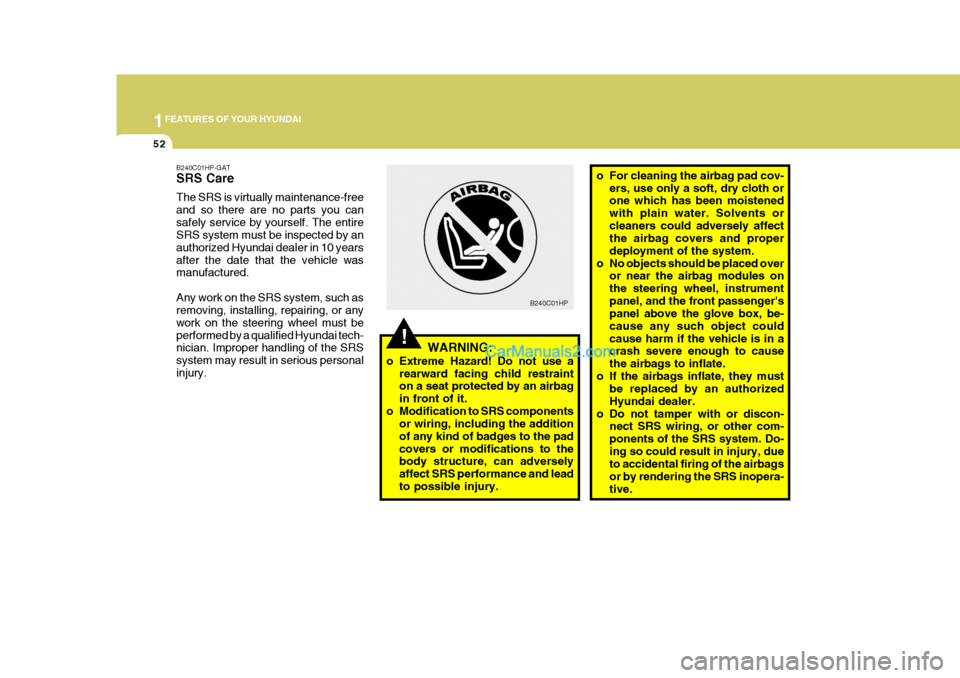
B240C01HP-GAT SRS Care The SRS is virtually maintenance-free and so there are no parts you cansafely service by yourself. The entire SRS system must be inspected by an authorized Hyundai dealer in 10 yearsafter the date that the vehicle was manufactured. Any work on the SRS system, such as removing, installing, repairing, or any work on the steering wheel must beperformed by a qualified Hyundai tech- nician. Improper handling of the SRS system may result in serious personalinjury.
Page 67 of 539
1
FEATURES OF YOUR HYUNDAI
53
o Do not install a child restraint
system in the front passenger seat position.
o A child restraint system must
never be placed in the front seat.The infant or child could be se- verely injured by an airbag de- ployment in case of an accident.
o If components of the airbag sys- tem must be discarded, or if thevehicle must be scrapped, cer-tain safety precautions must be observed. Your Hyundai dealer knows these precautions and cangive you the necessary informa- tion. Failure to follow these pre- cautions and procedures couldincrease the risk of personal in- jury.
o If you sell your vehicle, make certain that this manual is trans-ferred to the new owner.
o If your car was flooded and has soaked carpeting or water onflooring, you shouldn't try to start engine; have the car towed toauthorized Hyundai dealer.o Do not replace the bumper or thebumper guard with the one other than the Hyundai genuine parts. Otherwise, it can adversely af- fect SRS performance and leadto unexpected injury.