engine overheat Hyundai Terracan 2006 Owner's Guide
[x] Cancel search | Manufacturer: HYUNDAI, Model Year: 2006, Model line: Terracan, Model: Hyundai Terracan 2006Pages: 539, PDF Size: 18.11 MB
Page 447 of 539
3
If the Engine Will Not Start .......................................... 3-2
Jump Starting .............................................................. 3-3
If the Engine Overheats ............................................... 3-4
Spare Tyre ................................................................... 3-6
In the Event of a Puncture ........................................... 3-7
Changing a Flat Tyre ................................................... 3-7
If Your Vehicle Must Be Towed ..................................3-14
Emergency Towing ..................................................... 3-15
If You Lose Your K eys ................................................ 3-16
IN CASE OF EMERGENCY
3
Page 450 of 539
3 IN CASE OF EMERGENCY
4
!
1. Ensure that the booster battery is 12
volt type. If the booster battery is installed in another vehicle, ensure that the two vehicles are not touch- ing.
2. Turn off all unnecessary electrical equipment in both vehicles.
3. Ensure that the engine of the ve- hicle providing the jump start is run- ning prior to connection of the jump cables.
4. Connect the red jump cable to the positive (+) terminal of the boosterbattery and the other end to thepositive (+) terminal of the dis- charged battery.
5. Attach the black jump cable to the negative (-) terminal of the boosterbattery, and the other end to a ground point within the engine compartmentof the vehicle with the flat bat-tery. Do not connect to the negative bat- tery terminal of the flat battery sincesparks may be generated with the subsequent risk of explosion.
6. Raise the booster vehicle engine speed to 2,000 r.p.m. and start theengine of the vehicle with the flat battery. 7. Switch "ON" the main beam
headlamps before carefully remov-ing the jumper cables in the reverse order of attachment. Once the jumper cables have been removed,switch "OFF" the main beam headlamps.
CAUTION:
If the jump cables are incorrectly installed, damage to the vehicle elec- trical system may occur, in particu- lar the electronic components suchas the Fuel Injection system com- puter and the Automatic transmis- sion computer. The battery mustnever be disconnected whilst the engine is running.
IF THE ENGINE OVERHEATS
HPD040A2-E If the temperature gauge indicates overheating:
1. Pull off the road and stop as soon as it is safe to do so.
2. Place the gear selector lever in "P"
(automatic), or neutral (manual trans- mission) and set the parking brake. If the air conditioning is on, turn it off.
3. If coolant is running out under the car or steam is coming out from underthe bonnet, stop the engine. Do not open the bonnet until the coolant hasstopped running or the steaming has stopped. If there is no visible loss of coolant and no steam, leave theengine running and check to be sure the engine cooling fan is operating. If the fan is not running, turn theengine off.
4. Check to see if the water pump drive
belt is broken. If it is not missing,check to see that it is tight. If the drive belt seems to be satisfactory, check for coolant leaking from theradiator, hoses or under the car. (If the air conditioning had been in use, it is normal for cold water to bedraining from it).
Page 451 of 539
3
IN CASE OF EMERGENCY
5
!
!
!WARNING:
Whilst the engine is running, keep hands and clothing away from mov- ing parts such as the fan and drive belts to prevent injury.
WARNING (Diesel only):
Never work on injection system withengine running or within 30 seconds after shutting off engine. High pres- sure pump, rail, injectors and highpressure pipes are subject to high pressure even after the engine stopped. The fuel jet produced byfuel leaks may cause serious in- jury, if it contacts the body. People using pacemakers should ensure thatthey keep a distance of 30cm from the ECU or wiring harness within the engine room while engine is run-ning, since the high currents in the Common Rail system produce con- siderable magnetic fields. 5. If the water pump drive belt is broken
or coolant is leaking out, stop theengine immediately and call the near- est Hyundai authorised repairer for assistance.
WARNING:
Do not remove the radiator cap when the engine is hot since steam and boiling water may be ejected fromthe radiator resulting in burns or scalding.
6. If the cause of the overheating can- not be found, wait until the engine temperature has returned to normal. Then, if coolant has been lost, care-fully remove the radiator cap and add water to bring the fluid level in the reservoir(page 6-10) up to the baseof the radiator fill opening. Fill the coolant expansion tank to the half- way mark.
7. Proceed with caution until it is estab- lished that the engine is operatingnormally. If the engine overheatsrepeatedly, the advice of a Hyundai authorised repairer should be sought.! CAUTION:
Serious loss of coolant indicates there is a leak in the cooling system and this should be checked as soon as possible by a Hyundai authorisedrepairer.
Page 487 of 539
6
OWNER MAINTENANCE
9
!
!
engine and ensure that no oil leaks exist. Turn off the engine and aftera couple minutes, recheck the oil level.
CAUTION:
Slowly pour the recommended oil by using a funnel. Do not overfill to prevent engine damage.
WARNING:
Prolonged and repeated contact withused engine oils may result in seri- ous skin disorders including der-matitis and cancer. Avoid contact with skin as far as possible and always wash thoroughly after anycontact. Keep used oils out of reach of children. It is illegal to pollute drains, water courses and soil. Useonly authorisedwaste collection fa- cilities including civic amenity sites and garages for the disposalof used oil and oil filters. If in doubt, contact the local authority for dis- posal instructions. WARNING:
Do not remove the radiator cap when
the engine is hot, since the system is pressurised and coolant may be ejected from the radiator resultingin scalding.
SG050B1-E
Coolant recommendations
Only ethylene glycol based coolant
with a corrosion inhibitor suited toaluminium alloy engine componentsshould be used in the cooling system. No further additives or inhibitors should be used. The coolant specificgravity should be checked as pre- scribed in the maintenance schedule to ensure adequate frost and corro-sion protection. In addition, the en- gine coolant must be replaced at the specified interval since the corrosioninhibitor properties deteriorate with time.
ENGINE COOLANT CHECK- ING AND REPLACING
SG050A1-E
! It is important to note that whilst an increase in the concentration of antifreeze gives an increase in the level of frost protection, a solution which is in excess of 65% anti freeze will resultin reduced frost protection and engine overheating. Therefore the recom- mended concentration of 50% shouldnot be exceeded for general use.The use of methanol based anti freezecompounds may result in engine over-heating and will invalidate the vehicle warranty. NOTE: It is imperative that vehicles fitted with an air conditioning systemhave a coolant concentration of the recommended strength at all times. The use of the air condition-ing system when the cooling sys- tem is filled with water only will result in the heater matrix freezingand subsequently bursting.
Page 522 of 539
7EMISSION CONTROL SYSTEMS
4
YH040B1-E About the Catalytic Converter
- For a Petrol Engine Exhaust gases passing through the catalytic converter cause it to operate at very high temperatures. As a re- sult, the introduction of large amountsof unburned petrol may cause it to overheat and create a fire hazard. This can be avoided by observing thefollowing: H020D01HP-GAT
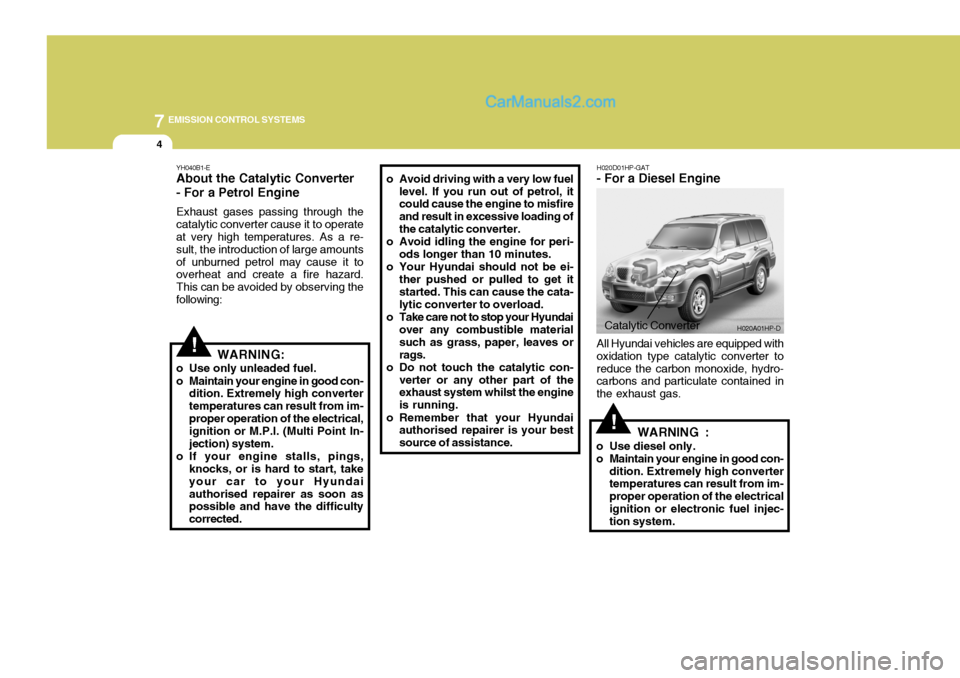
- For a Diesel Engine
!WARNING:
o Use only unleaded fuel.
o Maintain your engine in good con- dition. Extremely high converter temperatures can result from im-proper operation of the electrical, ignition or M.P.I. (Multi Point In- jection) system.
o If your engine stalls, pings, knocks, or is hard to start, takeyour car to your Hyundaiauthorised repairer as soon as possible and have the difficulty corrected. o Avoid driving with a very low fuel
level. If you run out of petrol, it could cause the engine to misfire and result in excessive loading ofthe catalytic converter.
o Avoid idling the engine for peri- ods longer than 10 minutes.
o Your Hyundai should not be ei- ther pushed or pulled to get itstarted. This can cause the cata- lytic converter to overload.
o Take care not to stop your Hyundai over any combustible material such as grass, paper, leaves orrags.
o Do not touch the catalytic con- verter or any other part of the exhaust system whilst the engine is running.
o Remember that your Hyundai authorised repairer is your bestsource of assistance.
Catalytic Converter H020A01HP-D
!
All Hyundai vehicles are equipped with oxidation type catalytic converter toreduce the carbon monoxide, hydro- carbons and particulate contained in the exhaust gas.
WARNING :
o Use diesel only.
o Maintain your engine in good con- dition. Extremely high converter temperatures can result from im- proper operation of the electricalignition or electronic fuel injec- tion system.
Page 536 of 539
10
INDEX
3
Coolant temperature gauge .....................................1-57
If the engine overheats ............................................. 3-4
Number ..................................................................... 8-2
Oil ............................................................................. 6-4 Starting ..................................................................... 2-5
Engine Exhaust Can Be Dangerous! ........................... 2-2
Exhaust Gas Warning .................................................. 7-2
F Fan Speed Control ................. .........................1-91, 1-102
Fog Light Switch
Front ....................................................................... 1-62
Rear ........................................................................ 1-62
Four-Wheel Drive(4WD) ............................................. 2-14
Front Door Edge Warning Light ................................. 1-85
Front Seats Adjustable head restraints ...................................... 1-17
Adjusting seatback angle ....................................... 1-17
Driver's seat lumbar support control .......................1-18
Seat adjust ment ..................................................... 1-16
Seat cushion height adjustment ............................. 1-19
Seat fore/aft adjustment ......................................... 1-16
Fuel
Capacity ................................................................... 9-2
Gauge ..................................................................... 1-57
Recommendations .................................................... 1-2
Fuel-Filler Flap
Remote release ...................................................... 1-82
Full-time 4WD Operation ............................................ 2-17
Fusible Links ............................................................. 6-25G
Glove Box ................................................................. 1-73
H Hatchback Door ......................................................... 1-78
Hazard Warning System ............................................ 1-65
Headlight Aiming Adjustment..................................... 6-33
Headlight Bulbs Replacement ....................................6-31
Headlight Leveling Device S ystem ............................1-86
Heated Front/Rear Window .. ......................................1-65
Heating and Cooling Control ......................................1-90
Heating and Ventilation
Air flow control ............................................. 1-92, 1-103
Air intake control ......................................... 1-92, 1-102
Defrosting/Defogging ............................................... 1-96
Fan speed control ........................................ 1-91, 1-102
Temperature control ................................................ 1-94
High-Mounted Rear Stop Light ...................................1-82
Horn ........................................................................... 1-85
I Ignition Switch ............................................................. 2-4
Illuminated ignition switch ......................................... 1-8
Immobiliser System ..................................................... 1-5
Indicator and Warning Lights ..................................... 1-50
Instrument Cluster and Indicator Lights ..................... 1-46
Interior Light ............................................................... 1-72
Interior Rearview Mirror .............................................. 1-77
Intermittent Wi pe Facility ........................................... 1-64