adjust Hyundai Terracan 2006 Owner's Guide
[x] Cancel search | Manufacturer: HYUNDAI, Model Year: 2006, Model line: Terracan, Model: Hyundai Terracan 2006Pages: 539, PDF Size: 18.11 MB
Page 147 of 539
1
FEATURES OF YOUR HYUNDAI
133
!
o Do not add any oil to the rotating
parts. Keep magnets, screwdriv- ers and other metallic objects away from the tape mechanism and head.
o This equipment is designed to be used only in a 12 volt DCbattery system with negativeground.
o This unit is made of precision
parts. Do not attempt to disas-semble or adjust any parts.
o When driving your vehicle, be
sure to keep the volume of theunit set low enough to allow you to hear sounds coming from the outside.
o Do not expose this equipment (including the speakers and tape)to water or excessive moisture. CAUTION:
o Do not insert warped or poor quality discs into the CD player as damage to the unit may occur.
o Do not insert anything like coins into the player slot as damage tothe unit may occur.
o Do not place beverages close to
the audio system. The playbackmechanism may be damaged if you spill them.
o Do not impact on the audio sys- tem, or the playback mechanismcould be damaged.
o Driving on the off-roads or other vibrations may skip your com-pact disc. Do not use the audiosystem on off-roads as the discs could be scratched and damaged.
o Do not grip or pull out the disc
with your hand while the disc isbeing pulled into the unit by the self loading mechanism. Thesecan cause poor disc scratching to occur or trouble in the com- pact disc player. o Avoid using CD-Recordable or CD-
Rewritable as the player could not be operated in recording way of the CD maker. When using thecompact disc player, genuine CDs are recommended.
Page 150 of 539
1FEATURES OF YOUR HYUNDAI
136
NOTE:
o When replacing the fuse, replaceit with a fuse having the correct capacity.
o This equipment is designed to be used only in a 12 volt DCbattery system with negativeground.
o This unit is made of precision
parts. Do not attempt to disas-semble or adjust any parts.
o When driving your vehicle, be
sure to keep the volume of theunit set low enough to allow you to hear sounds coming from the outside. CAUTION:
o Do not insert warped or poor quality discs into the CD changeras damage to the unit may occur.
o Do not insert anything like coins into the changer slot as damageto the unit may occur.
o Do not place beverages close to the audio system. The playbackmechanism may be damaged ifyou spill them.
o Do not impact on the audio sys-
tem, or the playback mechanismcould be damaged.
o Driving on the off-roads or other
vibrations may skip your com-pact disc. Do not use the audio system on off-roads as the discs could be scratched and damaged.
o Do not grip or pull out the disc with your hand while the disc isbeing pulled into the unit by theself loading mechanism. These can cause poor disc scratching to occur or trouble in the com-pact disc player.
!
o Avoid using CD-Recordable or CD-
Rewritable as the player could not be operated in recording way of the CD maker. When using the compact disc changer, genuineCDs are recommended.
Page 170 of 539
2
DRIVING YOUR HYUNDAI
15
2. Transfer shift knob operation By turning the transfer shift knob(4H, 4L), both axles of the vehicle are rigidlyconnected with each other. This im- proves the traction characteristics. 2H
4H
Turn the transfer shift knob from the 2H mode to the 4H mode at speed below 80 km/h. It is not necessary to depress the clutch pedal (ManualTransmission) or put the shift lever into "N(neutral)" position (Automatic Trans- mission). Perform this operation whendriving straight. 4H
2H
Turn the transfer shift knob from the4H mode to the 2H mode at speedbelow 80 km/h. It is not necessary to depress the clutch pedal (Manual Transmission) or put the shift lever into"N(neutral)" position (Automatic Trans- mission). Perform this operation when driving straight. 4H
4L
1. Stop the vehicle.
2. Depress the clutch pedal (Manual Transmission) or put the shift lever into "N (neutral)" position (Automatic Transmission).
3. Select the 4L mode.
4L
4H
1. Stop the vehicle.
2. Depress the clutch pedal (Manual Transmission) or put the shift lever into "N (neutral)" position (Automatic Transmission).
3. Select the 4H mode.
D090E02HP-GAT Driving Four-wheel drive safely
o The driving posture should be more
upright and closer to the wheel than usual; adjust the seat to a good position for easy steering and pedal operation.
o Be sure to wear the seat belt.
o Drive carefully when off the road
and avoid dangerous areas.
o 4WD has higher ground clearance and a narrower track to make them capable of performing in a widevariety of off road applications. Spe- cific design characteristics give them a higher center of gravity than ordi-nary cars. An advantage of the higher ground clearance is a better view of the road allowing you toanticipate problems. They are not designed for cornering at the same speeds as conventional 2-wheeldrive vehicles any more than low- slung sports cars are designed to perform satisfactorily under off-roadconditions. If at all possible, avoid sharp turns or abrupt maneuvers.
Page 178 of 539
2
DRIVING YOUR HYUNDAI
23
o Don't coast down hills with the car out of gear. This is extremely haz- ardous. Keep the car in gear at all times, use the brakes to slow down, then shift to a lower gear so thatengine braking will help you main- tain a safe speed.
o Don't "ride" the brake pedal. Rest- ing your foot on the brake pedalwhile driving can be dangerous be- cause it can result in the brakesoverheating and losing their effec- tiveness. It also increases the wear of thebrake components.
o If a tire goes flat while you are
driving, apply the brakes gently andkeep the car pointed straight ahead while you slow down. When you are moving slowly enough for it to besafe to do so, pull off the road and stop in a safe place.
o If your car is equipped with an auto- matic transmission, don't let yourcar creep forward. To avoid creep- ing forward, keep your foot firmly onthe brake pedal when the car is stopped.
o Use caution when parking on a hill. Engage the parking brake and place the gear selector lever in "P" (auto- matic transmission) or in first orreverse gear (manual transmission). If your car is facing downhill, turn the front wheels into the curb to helpkeep the car from rolling. If your car is facing uphill, turn the front wheels away from the curb to help keep thecar from rolling. If there is no curb or if it is required by other conditions to keep the car from rolling, block thewheels.
o Under some conditions your park-
ing brake can freeze in the engagedposition. This is most likely to hap- pen when there is an accumulation of snow or ice around or near therear brakes or if the brakes are wet. If there is a risk that the parking brake may freeze, apply it only tem-porarily while you put the gear se- lector lever in "P" (automatic) or in first or reverse gear (manual trans-mission) and block the rear wheels so the car cannot roll. Then release the parking brake.
o Do not hold the vehicle on the up- grade with the accelerator pedal.This can cause the transmission tooverheat. Always use the brake pedal or parking brake.DRIVING FOR ECONOMY
C140A02A-AAT You can save fuel and get more miles from your car if you follow these sug- gestions:
o Drive smoothly. Accelerate at a moderate rate. Don't make "jack- rabbit" starts or full-throttle shiftsand maintain a steady cruising speed. Don't race between stop- lights. Try to adjust your speed tothat of the other traffic so you don't have to change speeds unneces- sarily. Avoid heavy traffic wheneverpossible. Always maintain a safe distance from other vehicles so you can avoid unnecessary braking. Thisalso reduces brake wear.
o Drive at a moderate speed. The
faster you drive, the more fuel yourcar uses. Driving at a moderate speed, especially on the highway, is one of the most effective ways toreduce fuel consumption.
Page 182 of 539
2
DRIVING YOUR HYUNDAI
27
C160H01A-AAT Use Approved Anti-Freeze in Window Washer System To keep the water in the window washer system from freezing, add an approvedanti-freeze solution in accordance with instructions on the container. Window washer anti-freeze is available fromHyundai dealers and most auto parts outlets. Do not use engine coolant or other types of anti-freeze as thesemay damage the finish. C160I01HP-GAT Don't Let Your Parking Brake Freeze Under some conditions your parking brake can freeze in the engaged posi- tion. This is most likely to happen whenthere is an accumulation of snow or ice around or near the rear brakes or if the brakes are wet. If there is a risk theparking brake may freeze, apply it only temporarily while you put the gear selec- tor lever in "P" (automatic) or in first orreverse gear (manual transmission) and block the rear wheels so the car cannot roll. Then release the parking brake. C160K01A-AAT Carry Emergency Equipment Depending on the severity of the weather where you drive your car, you should carry appropriate emergencyequipment. Some of the items you may want to carry include tire chains, tow straps or chains, flashlight, emer-gency flares, sand, a shovel, jumper cables, a window scraper, gloves, ground cloth, coveralls, a blanket, etc.HIGHER SPEED MOTORING
C170A01A-AAT Pre-Trip Inspections 1. Tires: Adjust the tire inflation pressures to specification. Low tire inflation pres- sures will result in overheating and possible failure of the tires.Avoid using worn or damaged tires which may result in reduced traction or tire failure. NOTE: Never exceed the maximum tire in- flation pressure shown on the tires.
2. Fuel, engine coolant and engine oil:
High speed travel consumes more fuel than urban motoring. Do not forget to check both engine coolant and engineoil. 3. Drive belt: A loose or damaged drive belt may result in overheating of the engine.
C160J01A-AAT Don't Let Ice and Snow Accumu- late Underneath Under some conditions, snow and ice can build up under the fenders andinterfere with the steering. When driv- ing in severe winter conditions where this may happen, you should periodi-cally check underneath the car to be sure the movement of the front wheels and the steering components is notobstructed.
Page 192 of 539
3
WHAT TO DO IN AN EMERGENCY
5SPARE TIRE
!
!!WARNING (Diesel only):
Never work on injection system with engine running or within 30 sec- onds after shutting off engine. High pressure pump, rail, injectors andhigh pressure pipes are subject to high pressure even after the engine stopped. The fuel jet produced byfuel leaks may cause serious in- jury, if it touch the body. People using pacemakers should not movethan 30cm closer to the ECU or wiring harness within the engine room while engine is running, sincethe high currents in the Common Rail system produce considerable magnetic fields. WARNING:
Do not remove the radiator cap whenthe engine is hot. This can allowcoolant to be blown out of the open- ing and cause serious burns.
5. If the water pump drive belt is bro- ken or coolant is leaking out, stop the engine immediately and call the nearest Hyundai dealer for assis- tance. 6. If you cannot find the cause of the
overheating, wait until the enginetemperature has returned to nor-mal. Then, if coolant has been lost, carefully add coolant to the reser- voir (Page 6-12) to bring the fluidlevel in the reservoir up to the half- way mark.
7. Proceed with caution, keeping alert for further signs of overheating. Ifoverheating happens again, call a Hyundai dealer for assistance.
CAUTION:
Serious loss of coolant indicates there is a leak in the cooling system and this should be checked as soonas possible by a Hyundai dealer. D040A01HP-GAT The following instructions for the FULL SIZE spare tire should be observed: Check inflation pressure as soon as possible after installing the spare tire,and adjust to the specified pressure. The tire pressure should be periodi- cally checked and maintained at thespecified pressure while the tire is stored. Spare Tire Pressure
Tire Size Inflation Pressure Full Size 200 kPa (29 psi)
Page 200 of 539
3
WHAT TO DO IN AN EMERGENCY
13
D060I02HP-GAT 9. Lower Vehicle and Tighten
Nuts
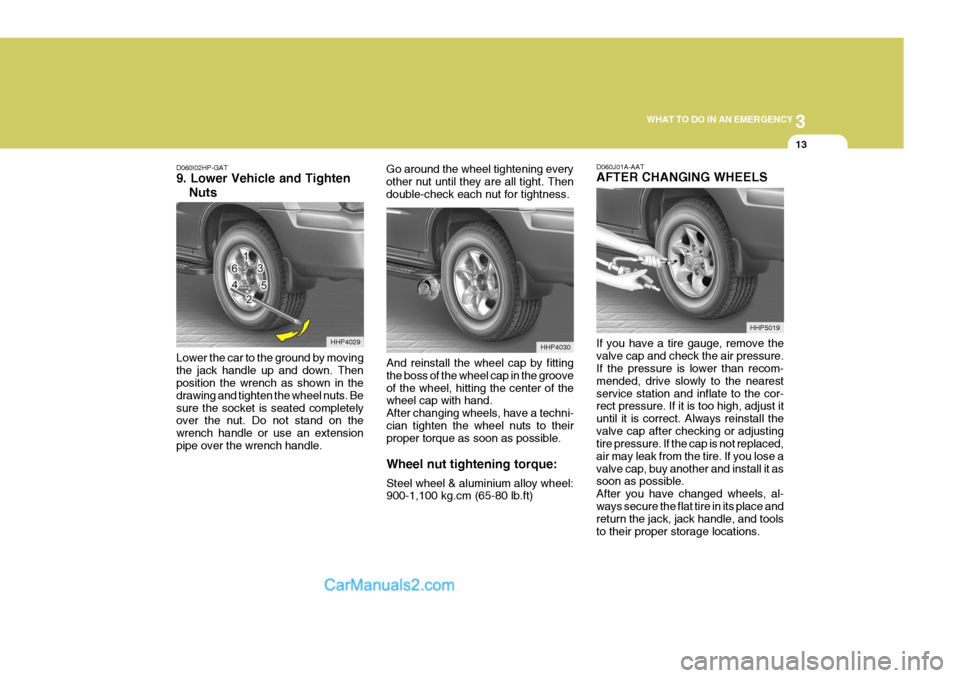
Lower the car to the ground by moving the jack handle up and down. Then position the wrench as shown in the drawing and tighten the wheel nuts. Besure the socket is seated completely over the nut. Do not stand on the wrench handle or use an extensionpipe over the wrench handle. Go around the wheel tightening everyother nut until they are all tight. Thendouble-check each nut for tightness.
D060J01A-AAT AFTER CHANGING WHEELS If you have a tire gauge, remove the valve cap and check the air pressure. If the pressure is lower than recom- mended, drive slowly to the nearestservice station and inflate to the cor- rect pressure. If it is too high, adjust it until it is correct. Always reinstall thevalve cap after checking or adjusting tire pressure. If the cap is not replaced, air may leak from the tire. If you lose avalve cap, buy another and install it as soon as possible. After you have changed wheels, al-ways secure the flat tire in its place and return the jack, jack handle, and tools to their proper storage locations.
HHP4029
HHP5019
And reinstall the wheel cap by fittingthe boss of the wheel cap in the grooveof the wheel, hitting the center of the wheel cap with hand. After changing wheels, have a techni-cian tighten the wheel nuts to their proper torque as soon as possible. Wheel nut tightening torque: Steel wheel & aluminium alloy wheel: 900-1,100 kg.cm (65-80 lb.ft) HHP4030
Page 205 of 539
5VEHICLE MAINTENANCE REQUIREMENTS
2MAINTENANCE INTERVALS
F010C01HP-GAT
Specified Scheduled Procedures
These are the procedures such as
inspections, adjustments and replace- ments that are listed in the mainte-nance charts starting on page 5-4. These procedures must be performed at the intervals shown in the mainte-nance schedule to assure that your warranty remains in effect. Although it is strongly recommended that they beperformed by the factory-trained or distributor-trained technicians at your Hyundai dealer, these procedures maybe performed at any qualified service facility. F010D01A-AAT
General Checks
These are the regular checks youshould perform when you drive your Hyundai or you fill the fuel tank. A listof these items will be found on page 6- 5.
F010A01A-GAT Service Requirements To assure that you receive the great- est number of kilometers of satisfying operation from your Hyundai, certain maintenance procedures must be per-formed. Although careful design and engineering have reduced these to a minimum, those that are required areof the utmost importance.It is your responsibility to have thesemaintenance procedures performed to comply with the terms of the warran- ties covering your new Hyundai. TheService Passport supplied with your new vehicle provides further informa- tion about these warranties.
F010B01A-AAT
Maintenance Requirements
The maintenance required for your
Hyundai can be divided into three main areas: o Specified scheduled procedures o General checks o Do-it-yourself maintenance It is suggested that genuine Hyundai
service parts be used for any requiredrepairs or replacements. Other parts of equivalent quality such as engine oil, engine coolant, manual or auto trans-mission oil, brake fluid and so on which are not supplied by Hyundai Motor Company or its distributor maybe used without affecting your war- ranty coverage but you should always be sure these are equivalent to thequality of the original Hyundai parts. Your Service Passport provides fur- ther information about your warrantycoverage.
hpflene-5.p65 3/9/2005, 1:38 PM
2
Page 207 of 539
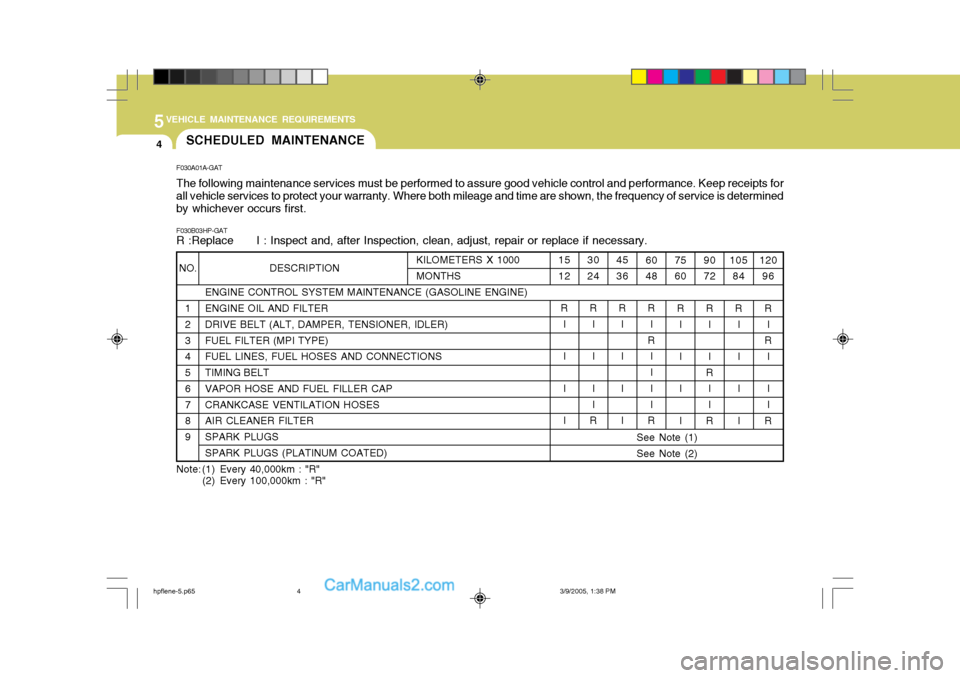
5VEHICLE MAINTENANCE REQUIREMENTS
4
NO.
1 2 3 4 5 6 7 8 9 DESCRIPTION
ENGINE CONTROL SYSTEM MAINTENANCE (GASOLINE ENGINE)ENGINE OIL AND FILTER DRIVE BELT (ALT, DAMPER, TENSIONER, IDLER) FUEL FILTER (MPI TYPE) FUEL LINES, FUEL HOSES AND CONNECTIONS TIMING BELT VAPOR HOSE AND FUEL FILLER CAP CRANKCASE VENTILATION HOSES AIR CLEANER FILTER SPARK PLUGS SPARK PLUGS (PLATINUM COATED)
F030A01A-GAT The following maintenance services must be performed to assure good vehicle control and performance. Keep receipts for all vehicle services to protect your warranty. Where both mileage and time are shown, the frequency of service is determined by whichever occurs first. F030B03HP-GAT R :Replace I : Inspect and, after Inspection, clean, adjust, repair or replace if necessary.105
84
R I I II 120
96
R I
R
II I
R
90 72
R I I
R I I
R
75 60
R I I II
60 48
R I
R
I I I I
R
45 36
R I I II
30 24
R I I I I
R
15 12
R I I II
KILOMETERS X 1000 MONTHS
Note: (1) Every
40,000km : "R"
(2) Every 100,000km : "R"
SCHEDULED MAINTENANCE
See Note (1) See Note (2)
hpflene-5.p65
3/9/2005, 1:38 PM
4
Page 208 of 539
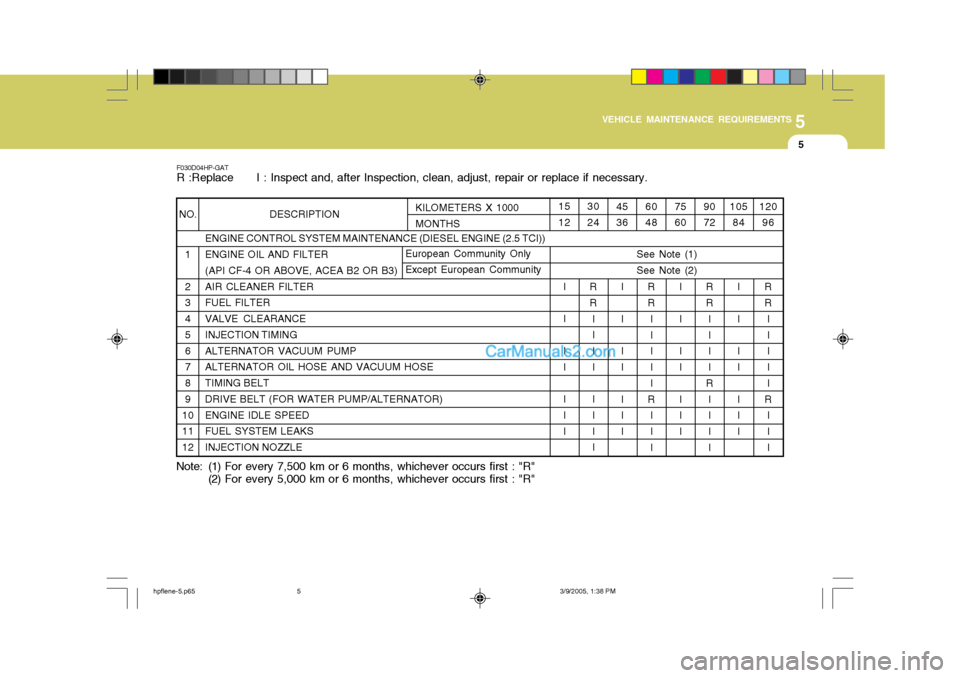
5
VEHICLE MAINTENANCE REQUIREMENTS
5
Note: (1) For every 7,500 km or 6 months, whichever occurs first : "R"
(2) For every 5,000 km or 6 months, whichever occurs first : "R"
F030D04HP-GAT R :Replace I : Inspect and, after Inspection, clean, adjust, repair or replace if necessary.
NO.
1 2 3 4 5 6 7 8 9
1011 12 DESCRIPTION
ENGINE CONTROL SYSTEM MAINTENANCE (DIESEL ENGINE (2.5 TCI))ENGINE OIL AND FILTER (API CF-4 OR ABOVE, ACEA B2 OR B3) AIR CLEANER FILTER FUEL FILTER VALVE CLEARANCE INJECTION TIMING ALTERNATOR VACUUM PUMP ALTERNATOR OIL HOSE AND VACUUM HOSE TIMING BELT DRIVE BELT (FOR WATER PUMP/ALTERNATOR) ENGINE IDLE SPEED FUEL SYSTEM LEAKS INJECTION NOZZLE
105 84
I II I I I I 120
96
RR II I I I
R I I I
9072
R R II I I
R
I I I I
7560
I II I I I I
60 48
R R II I I I
R I I I
4536
I II I I I I
30 24
R R II I I I I I I
1512
I II I I I I
KILOMETERS X 1000MONTHS
See Note (1) See Note (2)
European Community Only Except European Community
hpflene-5.p65
3/9/2005, 1:38 PM
5