wheel Hyundai Tiburon 2003 Owner's Guide
[x] Cancel search | Manufacturer: HYUNDAI, Model Year: 2003, Model line: Tiburon, Model: Hyundai Tiburon 2003Pages: 169, PDF Size: 3.04 MB
Page 153 of 169
EMISSION CONTROL SYSTEMS
7-1
7. EMISSION CON-
TROL SYSTEMSH010B01A-AAT1. Crankcase Emission Control
System
The Positive Crankcase Ventilation System is
employed to prevent air pollution caused by
blow-by gases being emitted from the crank-
case. This system supplies fresh filtered air to
the crankcase through the air intake hose.
Inside the crankcase, the fresh air mixes with
blow-by gases, which then pass through the
PCV valve and into the induction system.
H010C01S-AAT2. Evaporative Emission Control (In-
cluding ORVR: Onboard Refueling
Vapor Recovery) System
The Evaporative Emission Control System is
designed to prevent fuel vapors from escaping
into the atmosphere.
(The ORVR system is designed to allow the
vapors from the fuel tank to be loaded into
a canister while refueling at the gas station,
preventing the escape of fuel vapors into
the atmosphere.)
Canister
Fuel vapors generated inside the fuel tank are
absorbed and stored in the onboard canister.
When the engine is running, the fuel vapors
absorbed in the canister are drawn into the
induction system through the purge control so-
lenoid valve.
Purge Control Solenoid Valve (PCSV)
The purge control solenoid valve is controlled
by the Engine Control Module (ECM); when the
engine coolant temperature is low during idling,
the PCSV closes so that evaporated fuel is not
taken into the engine. After the engine warms-
up during ordinary driving, the PCSV opens to
introduce evaporated fuel to the engine.
H010D01A-AAT
3. Exhaust Emission Control System
The Exhaust Emission Control System is a
highly effective system which controls exhaust
emissions while maintaining good vehicle per-
formance.
H010A01GK-AAT
EMISSION CONTROL SYSTEM
Your Hyundai is equipped with an emission
control system to meet all requirements of the
U.S. Environmental Protection Agency or Cali-
fornia Air Resources Board.
There are three emission control systems which
are as follows.
1) Crankcase Emission Control System
2) Evaporative Emission Control System
3) Exhaust Emission Control System
In order to ensure the proper function of the
emission control systems, it is recommended
that you have your car inspected and main-
tained by an authorized Hyundai dealer in ac-
cordance with the maintenance schedule in this
manual.
Caution for Inspection and Maintenance Test
(Vehicle with Traction Control System)
o To prevent the vehicle from misfiring
during dynamometer testing, disconnect
the ABS connector located inside of the
wheel guard (driver side).
o For more information, see shop manual
(BR Group, Wheel Speed Sensor).
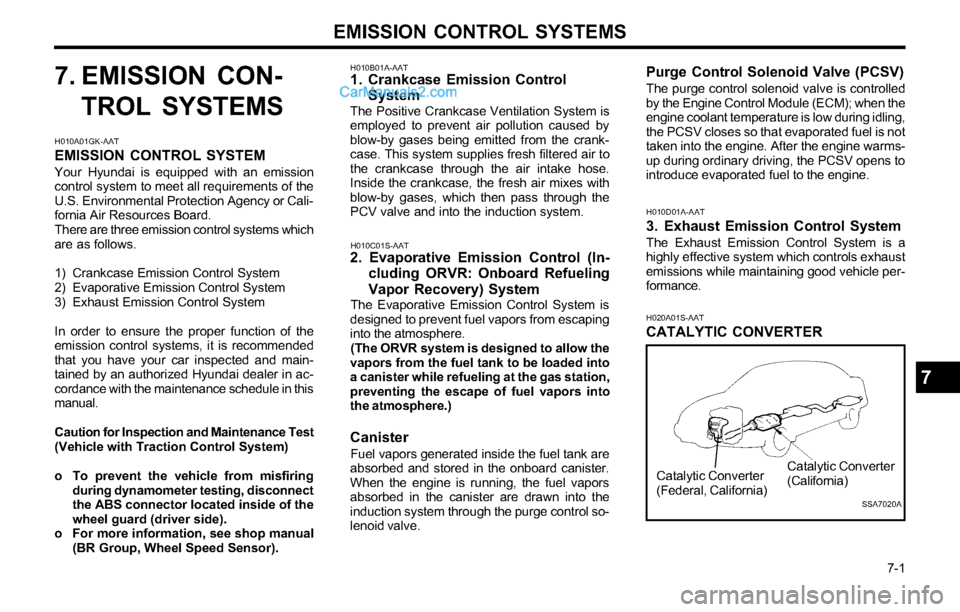
H020A01S-AAT
CATALYTIC CONVERTER
Catalytic Converter
(California)
SSA7020A
Catalytic Converter
(Federal, California)
7
Page 156 of 169
CONSUMER INFORMATION & REPORTING SAFETY DEFECTS
8-2 o Lower-than-recommended tire pressures
cause uneven tread wear and poor han-
dling.
o Higher-than-recommended tire pressures
increase the chance of damage from im-
pacts and cause uneven tread wear.
CAUTION:Always observe the following:
o Check pressures when the tires are cold.
That is, after the car has been parked for
at least three hours and hasn't been driv-
en more than one mile or 1.6 km since
starting up.
o Check the pressure of your spare tire
each time you check the pressure of
other tires.
o Never overload your car. Be especially
careful about overloading if you equip
your car with a luggage rack or car top
carrier.mum pressure shown on the tire sidewall which-
ever is less.
Do not drive faster than 75 mph (120 km/h)
when your car is equipped with snow tires.
I050A02GK-AAT
TIRE CHAINS
Tire chains, if necessary, should be installed on
the front wheels. Be sure that the chains are the
proper size and that they are installed in accor-
dance with the manufacturer's instructions. Refer
to the following information.
To minimize tire and chain wear, do not contin-
ue to use tire chains when they are no longer
needed.
WARNING:o When driving on roads covered with snow
or ice, drive at less than 20 mph (30 km/
h).
o Use tire chains less than 0.39 in. (10mm)
for "16, and "17 tire.
o Avoid sudden stop and turn.
o Tighten firmly to avoid contact with the
vertical body, if you have noise caused
by chaws contacting the body, remove
the chains for damage protection.Tire size
205/55 R 16
215/45 R 17
Snow Chain Thickness
Max. 0.39 in. (10 mm)
Max. 0.39 in. (10 mm)
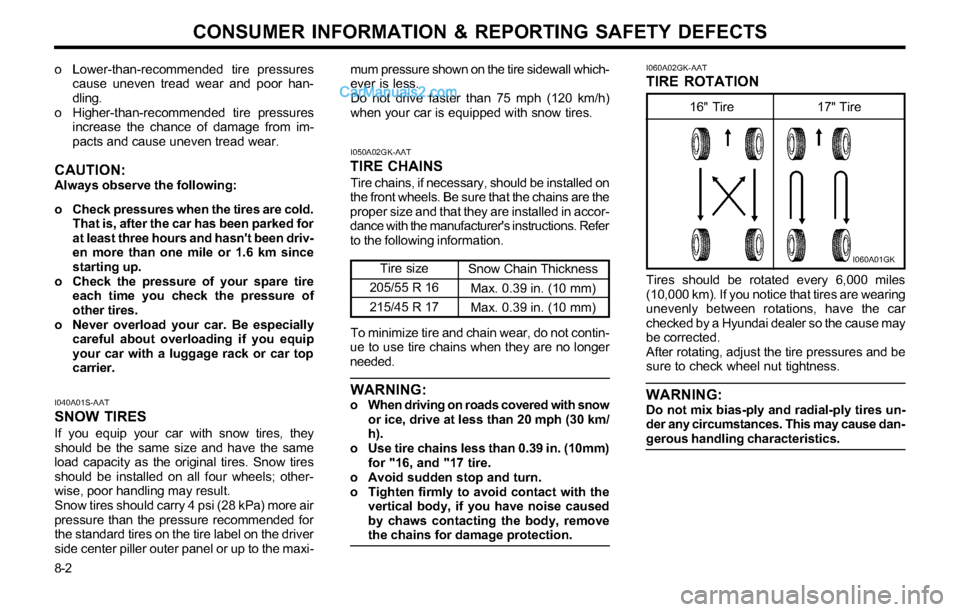
I060A02GK-AATTIRE ROTATION
Tires should be rotated every 6,000 miles
(10,000 km). If you notice that tires are wearing
unevenly between rotations, have the car
checked by a Hyundai dealer so the cause may
be corrected.
After rotating, adjust the tire pressures and be
sure to check wheel nut tightness.
WARNING:Do not mix bias-ply and radial-ply tires un-
der any circumstances. This may cause dan-
gerous handling characteristics.
I060A01GK
16" Tire17" Tire
I040A01S-AAT
SNOW TIRES
If you equip your car with snow tires, they
should be the same size and have the same
load capacity as the original tires. Snow tires
should be installed on all four wheels; other-
wise, poor handling may result.
Snow tires should carry 4 psi (28 kPa) more air
pressure than the pressure recommended for
the standard tires on the tire label on the driver
side center piller outer panel or up to the maxi-
Page 157 of 169
CONSUMER INFORMATION & REPORTING SAFETY DEFECTS
8-3
I090A01A-AAT
WHEN TO REPLACE TIRES
WARNING:
Driving on worn-out tires is dangerous!
Worn-out tires can cause loss of braking
effectiveness, steering control and traction.
When replacing tires, never mix radial and
bias ply tires on the same car. If you replace
radial tires with bias-ply tires, they must be
installed in sets of four.
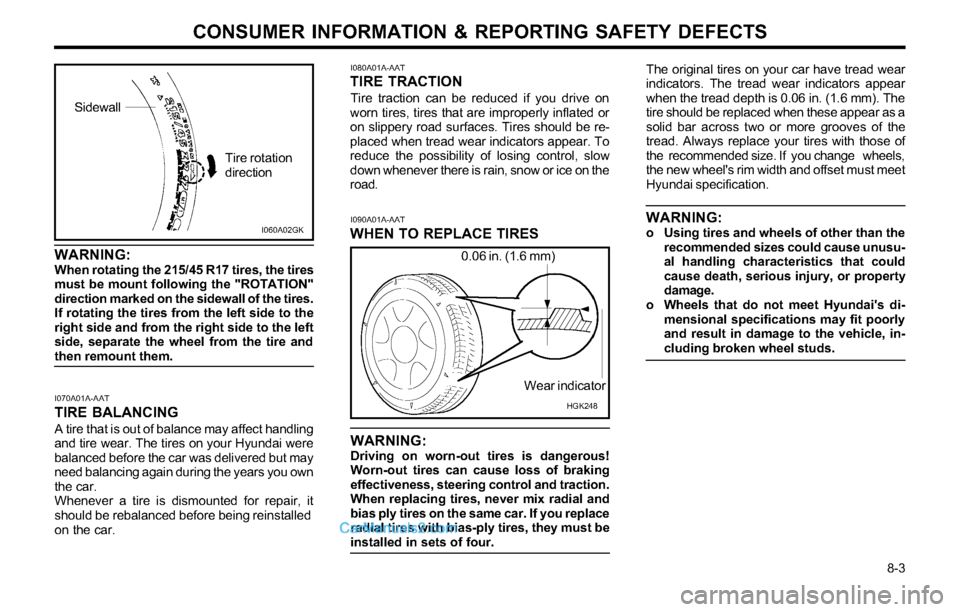
I060A02GK
WARNING:When rotating the 215/45 R17 tires, the tires
must be mount following the "ROTATION"
direction marked on the sidewall of the tires.
If rotating the tires from the left side to the
right side and from the right side to the left
side, separate the wheel from the tire and
then remount them.Sidewall
Tire rotation
direction
I070A01A-AAT
TIRE BALANCING
A tire that is out of balance may affect handling
and tire wear. The tires on your Hyundai were
balanced before the car was delivered but may
need balancing again during the years you own
the car.
Whenever a tire is dismounted for repair, it
should be rebalanced before being reinstalled
on the car.
I080A01A-AATTIRE TRACTION
Tire traction can be reduced if you drive on
worn tires, tires that are improperly inflated or
on slippery road surfaces. Tires should be re-
placed when tread wear indicators appear. To
reduce the possibility of losing control, slow
down whenever there is rain, snow or ice on the
road.
The original tires on your car have tread wear
indicators. The tread wear indicators appear
when the tread depth is 0.06 in. (1.6 mm). The
tire should be replaced when these appear as a
solid bar across two or more grooves of the
tread. Always replace your tires with those of
the recommended size. If you change wheels,
the new wheel's rim width and offset must meet
Hyundai specification.
WARNING:o Using tires and wheels of other than the
recommended sizes could cause unusu-
al handling characteristics that could
cause death, serious injury, or property
damage.
o Wheels that do not meet Hyundai's di-
mensional specifications may fit poorly
and result in damage to the vehicle, in-
cluding broken wheel studs.
Wear indicator 0.06 in. (1.6 mm)
HGK248
Page 158 of 169
CONSUMER INFORMATION & REPORTING SAFETY DEFECTS
8-4
I130A01A-AATCONSUMER INFORMATION
This consumer information has been prepared
in accordance with regulations issued by the
National Highway Traffic Safety Administration
of the U.S. Department of Transportation. It
provides the purchasers and/or prospective
purchasers of Hyundai automobiles with infor-
mation on uniform tire quality grading. Your
Hyundai dealer will help answer any questions
you may have as you read this information.
I130B02A-AATUniform tire quality grading
Department of Transportation quality grades -
All passenger vehicle tires must conform to
Federal Safety Standards in addition to these
grades. These quality grades are molded on the
sidewall.
Treadwear - The tread wear grade is a com-
parative rating based on the wear rate of the tire
when tested under controlled conditions on a
specified government test course. For exam-
ple, a tire graded 150 would wear one and a half
(1 - 1/2) times as well on the government
course as a tire graded 100. The relative perfor-
mance of tires depends upon the actual condi-
tions of their use, however, and may depart
significantly from the norm due to variations in
driving habits, service practices and differenc-
es in road characteristics and climate.
Traction AA, A, B, C - The traction grades,
from highest to lowest, are AA, A, B, and C.
Those grades represent the tire's ability to stop
on wet pavement as measured under controlled
conditions on specified government test surfac-
es of asphalt and concrete. A tire marked C
may have poor traction performance.
WARNING:The traction grade assigned to this tire is
based on straight-ahead braking traction
tests, and does not include acceleration,
cornering, hydroplaning, or peak traction
characteristics.
I110A01A-AAT
SHOP MANUAL
A Hyundai Shop Manual is available from your
authorized Hyundai dealer. It's written for pro-
fessional technicians, but is simple enough for
most mechanically-inclined owners to under-
stand.
I120A02A-AATWARRANTIES FOR YOUR HYUNDAI
VEHICLE
o New vehicle 60 Months/60,000 Miles Limit-
ed Warranty.
o New vehicle 120 Months/100,000 Miles Lim-
ited Powertrain Warranty (first owner only).
o Anti-Perforation Limited Warranty
o Emission Defect Warranty - Federal Vehicle
o California Emission Control System War-
ranty (if applicable)
o Emission Performance Warranty Federal
vehicle
o Replacement Parts and Accessories Limit-
ed Warranty
NOTE:Detailed warranty information is provided in
your Hyundai Owner's Handbook.
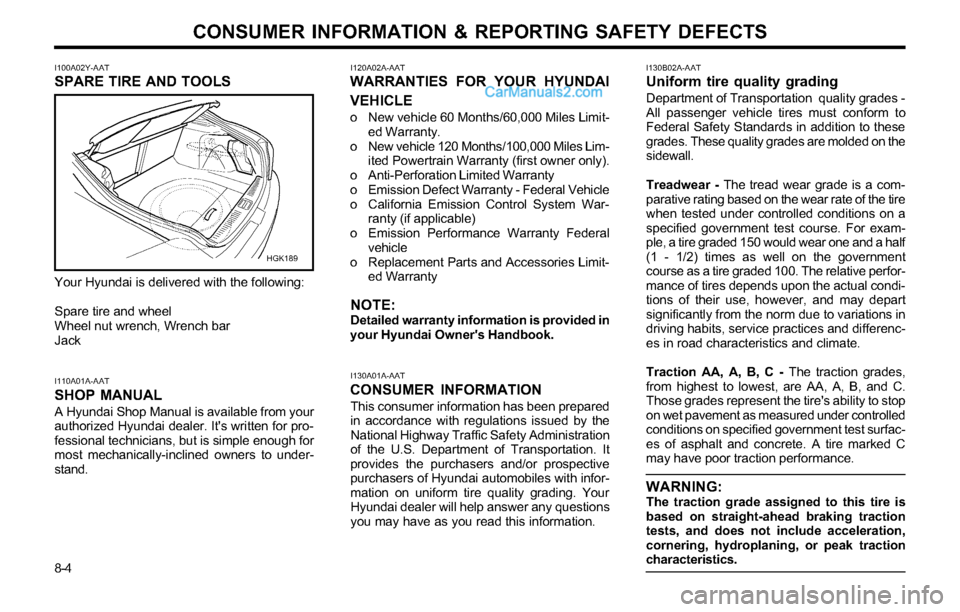
I100A02Y-AATSPARE TIRE AND TOOLS
Your Hyundai is delivered with the following:
Spare tire and wheel
Wheel nut wrench, Wrench bar
Jack
HGK189
Page 159 of 169
CONSUMER INFORMATION & REPORTING SAFETY DEFECTS
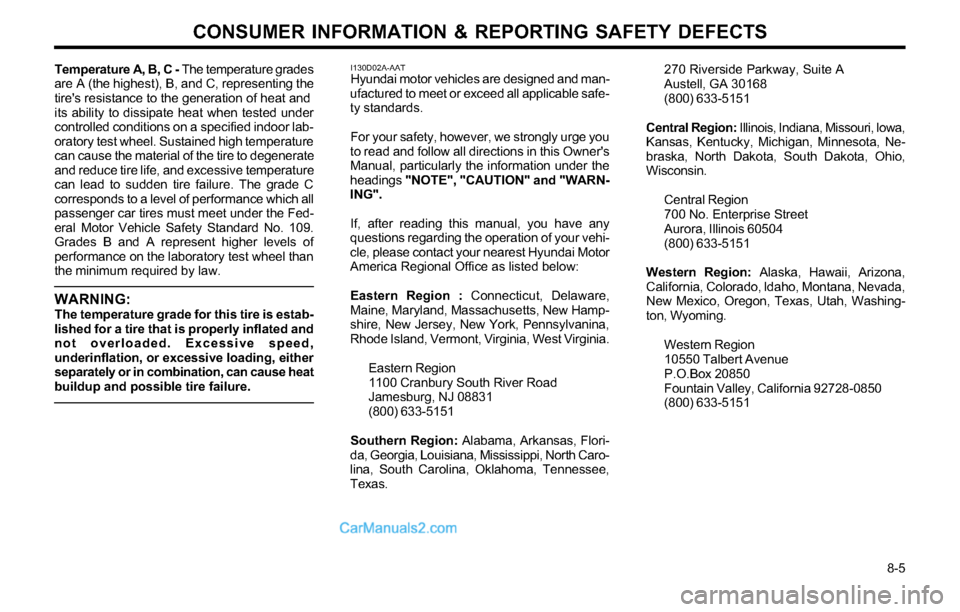
8-5 Temperature A, B, C - The temperature grades
are A (the highest), B, and C, representing the
tire's resistance to the generation of heat and
its ability to dissipate heat when tested under
controlled conditions on a specified indoor lab-
oratory test wheel. Sustained high temperature
can cause the material of the tire to degenerate
and reduce tire life, and excessive temperature
can lead to sudden tire failure. The grade C
corresponds to a level of performance which all
passenger car tires must meet under the Fed-
eral Motor Vehicle Safety Standard No. 109.
Grades B and A represent higher levels of
performance on the laboratory test wheel than
the minimum required by law.
WARNING:The temperature grade for this tire is estab-
lished for a tire that is properly inflated and
not overloaded. Excessive speed,
underinflation, or excessive loading, either
separately or in combination, can cause heat
buildup and possible tire failure.
I130D02A-AATHyundai motor vehicles are designed and man-
ufactured to meet or exceed all applicable safe-
ty standards.
For your safety, however, we strongly urge you
to read and follow all directions in this Owner's
Manual, particularly the information under the
headings "NOTE", "CAUTION" and "WARN-
ING".
If, after reading this manual, you have any
questions regarding the operation of your vehi-
cle, please contact your nearest Hyundai Motor
America Regional Office as listed below:
Eastern Region : Connecticut, Delaware,
Maine, Maryland, Massachusetts, New Hamp-
shire, New Jersey, New York, Pennsylvanina,
Rhode Island, Vermont, Virginia, West Virginia.
Eastern Region
1100 Cranbury South River Road
Jamesburg, NJ 08831
(800) 633-5151
Southern Region: Alabama, Arkansas, Flori-
da, Georgia, Louisiana, Mississippi, North Caro-
lina, South Carolina, Oklahoma, Tennessee,
Texas.270 Riverside Parkway, Suite A
Austell, GA 30168
(800) 633-5151
Central Region: Illinois, Indiana, Missouri, lowa,
Kansas, Kentucky, Michigan, Minnesota, Ne-
braska, North Dakota, South Dakota, Ohio,
Wisconsin.
Central Region
700 No. Enterprise Street
Aurora, Illinois 60504
(800) 633-5151
Western Region: Alaska, Hawaii, Arizona,
California, Colorado, ldaho, Montana, Nevada,
New Mexico, Oregon, Texas, Utah, Washing-
ton, Wyoming.
Western Region
10550 Talbert Avenue
P.O.Box 20850
Fountain Valley, California 92728-0850
(800) 633-5151
Page 161 of 169
VEHICLE SPECIFICATIONS
9-1 Liter
55
9
J030A01GK-AATTIRE
Dual hydraulic with brake booster
Ventilated disc
Solid Disc
Cable
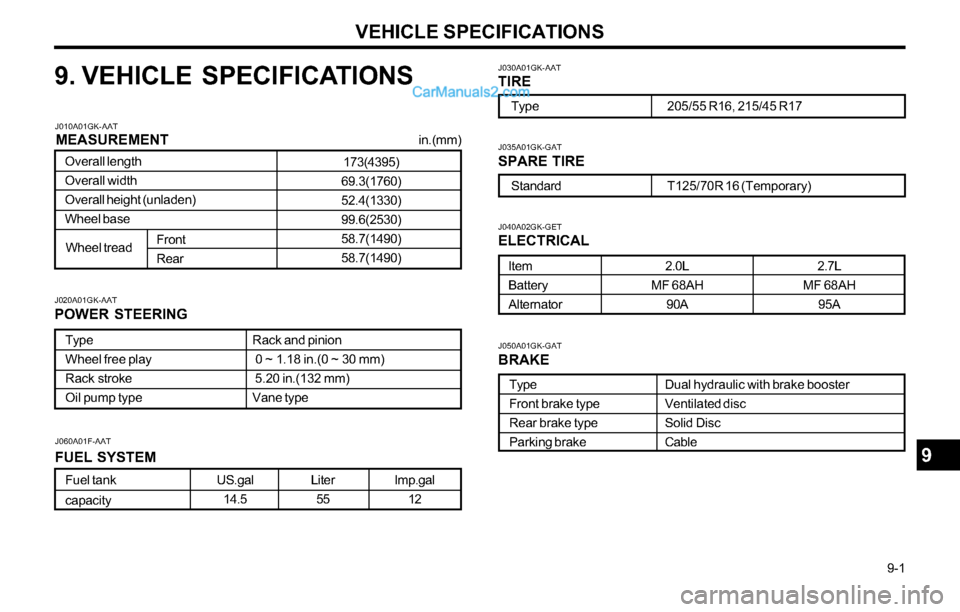
9. VEHICLE SPECIFICATIONS
J010A01GK-AATMEASUREMENT
J060A01F-AAT
FUEL SYSTEM
Type
Wheel free play
Rack stroke
Oil pump typeRack and pinion
0 ~ 1.18 in.(0 ~ 30 mm)
5.20 in.(132 mm)
Vane type
205/55 R16, 215/45 R17 Type
Overall length
Overall width
Overall height (unladen)
Wheel base
Front
Rear
173(4395)
69.3(1760)
52.4(1330)
99.6(2530)
58.7(1490)
58.7(1490) Wheel tread in.(mm)
J020A01GK-AATPOWER STEERING
Fuel tank
capacityUS.gal
14.5Imp.gal
12
J050A01GK-GATBRAKE
Type
Front brake type
Rear brake type
Parking brake
J035A01GK-GATSPARE TIRE
T125/70R 16 (Temporary) Standard
J040A02GK-GETELECTRICAL
Item
Battery
Alternator2.0L
MF 68AH
90A2.7L
MF 68AH
95A
Page 166 of 169
INDEX
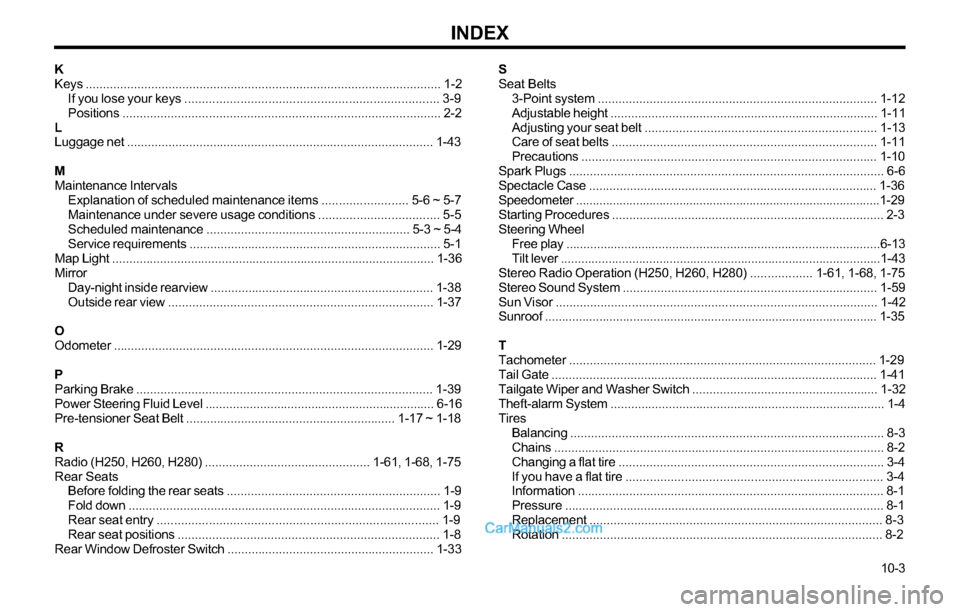
10-3 S
Seat Belts
3-Point system ................................................................................. 1-12
Adjustable height .............................................................................. 1-11
Adjusting your seat belt ................................................................... 1-13
Care of seat belts ............................................................................. 1-11
Precautions ...................................................................................... 1-10
Spark Plugs ........................................................................................... 6-6
Spectacle Case .................................................................................... 1-36
Speedometer ...........................................................................................1-29
Starting Procedures ............................................................................... 2-3
Steering Wheel
Free play ............................................................................................6-13
Tilt lever ..............................................................................................1-43
Stereo Radio Operation (H250, H260, H280) .................. 1-61, 1-68, 1-75
Stereo Sound System .......................................................................... 1-59
Sun Visor ............................................................................................. 1-42
Sunroof .................................................................................................. 1-35
T
Tachometer ......................................................................................... 1-29
Tail Gate ............................................................................................... 1-41
Tailgate Wiper and Washer Switch ...................................................... 1-32
Theft-alarm System ................................................................................ 1-4
Tires
Balancing ........................................................................................... 8-3
Chains ................................................................................................ 8-2
Changing a flat tire ............................................................................. 3-4
If you have a flat tire .......................................................................... 3-4
Information ......................................................................................... 8-1
Pressure ............................................................................................. 8-1
Replacement ..................................................................................... 8-3
Rotation ............................................................................................. 8-2 K
Keys ....................................................................................................... 1-2
If you lose your keys ......................................................................... 3-9
Positions ............................................................................................ 2-2
L
Luggage net ......................................................................................... 1-43
M
Maintenance Intervals
Explanation of scheduled maintenance items ......................... 5-6 ~ 5-7
Maintenance under severe usage conditions ................................... 5-5
Scheduled maintenance ........................................................... 5-3 ~ 5-4
Service requirements ......................................................................... 5-1
Map Light .............................................................................................. 1-36
Mirror
Day-night inside rearview ................................................................. 1-38
Outside rear view ............................................................................. 1-37
O
Odometer ............................................................................................. 1-29
P
Parking Brake ...................................................................................... 1-39
Power Steering Fluid Level ................................................................... 6-16
Pre-tensioner Seat Belt ............................................................. 1-17 ~ 1-18
R
Radio (H250, H260, H280) ................................................ 1-61, 1-68, 1-75
Rear Seats
Before folding the rear seats .............................................................. 1-9
Fold down ........................................................................................... 1-9
Rear seat entry ................................................................................. 1-9
Rear seat positions ............................................................................ 1-8
Rear Window Defroster Switch ............................................................ 1-33