steering Hyundai Tiburon 2006 User Guide
[x] Cancel search | Manufacturer: HYUNDAI, Model Year: 2006, Model line: Tiburon, Model: Hyundai Tiburon 2006Pages: 266, PDF Size: 10.94 MB
Page 80 of 266
1FEATURES OF YOUR HYUNDAI68
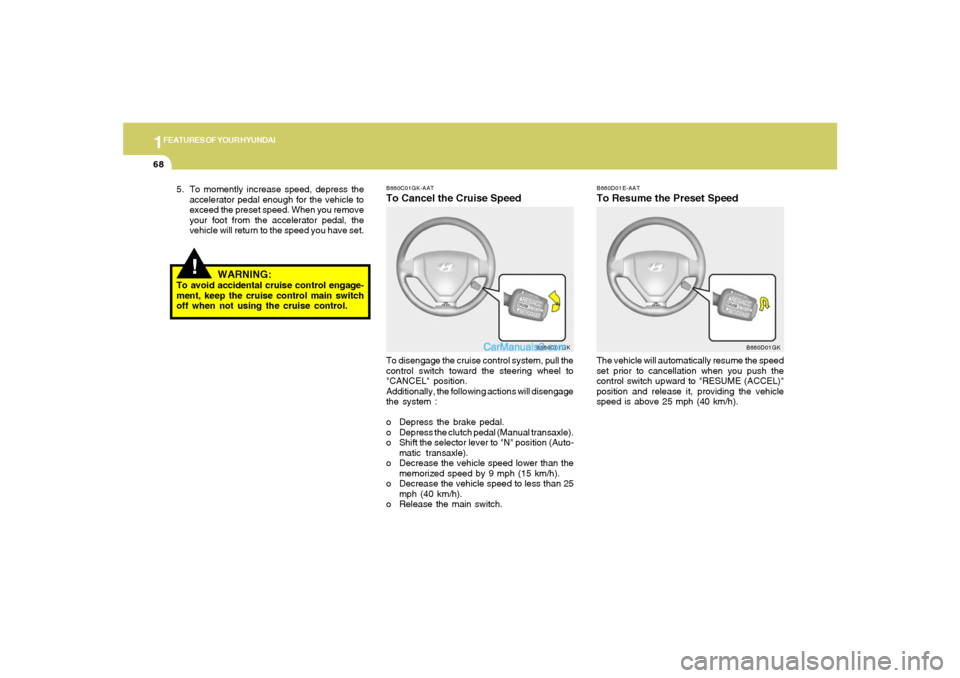
B660D01E-AATTo Resume the Preset SpeedThe vehicle will automatically resume the speed
set prior to cancellation when you push the
control switch upward to "RESUME (ACCEL)"
position and release it, providing the vehicle
speed is above 25 mph (40 km/h).
B660D01GK
B660C01GK-AATTo Cancel the Cruise SpeedTo disengage the cruise control system, pull the
control switch toward the steering wheel to
"CANCEL" position.
Additionally, the following actions will disengage
the system :
o Depress the brake pedal.
o Depress the clutch pedal (Manual transaxle).
o Shift the selector lever to "N" position (Auto-
matic transaxle).
o Decrease the vehicle speed lower than the
memorized speed by 9 mph (15 km/h).
o Decrease the vehicle speed to less than 25
mph (40 km/h).
o Release the main switch.
B660C01GK
!
5. To momently increase speed, depress the
accelerator pedal enough for the vehicle to
exceed the preset speed. When you remove
your foot from the accelerator pedal, the
vehicle will return to the speed you have set.
WARNING:
To avoid accidental cruise control engage-
ment, keep the cruise control main switch
off when not using the cruise control.
Page 82 of 266
1FEATURES OF YOUR HYUNDAI70
SEEK (UP / ) SwitchPress the SEEK UP ( ) switch 1 sec. or more.1. RADIO modeWhen the SEEK UP ( ) switch is pressed, the
unit will automatically tune to the next higher
frequency.2. TAPE modePressing the SEEK UP ( ) switch will play the
beginning of the next music segment.3. CD (compact disc)/CDC
(compact disc changer) modePress the SEEK UP ( ) switch once to skip
forward to the beginning of the next track.VOL ( / ) Switcho Press the VOL ( ) button to increase
volume.
o Press the VOL ( ) button to decease
volume.
AUDIO REMOTE CONTROL
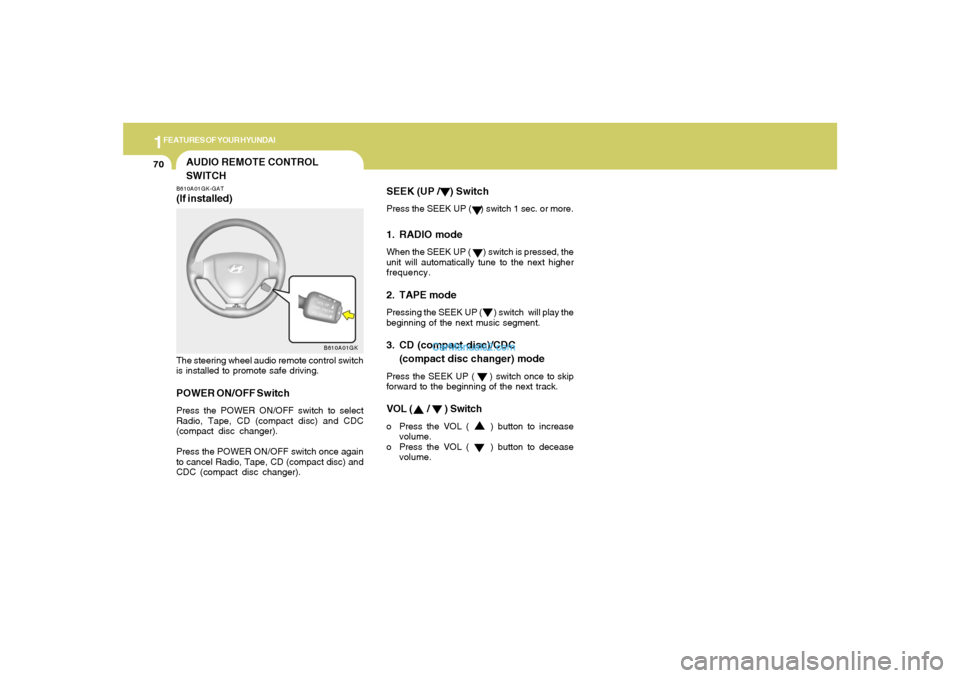
SWITCHB610A01GK-GAT(If installed)The steering wheel audio remote control switch
is installed to promote safe driving.POWER ON/OFF SwitchPress the POWER ON/OFF switch to select
Radio, Tape, CD (compact disc) and CDC
(compact disc changer).
Press the POWER ON/OFF switch once again
to cancel Radio, Tape, CD (compact disc) and
CDC (compact disc changer).
B610A01GK
Page 143 of 266
2
DRIVING YOUR HYUNDAI
4
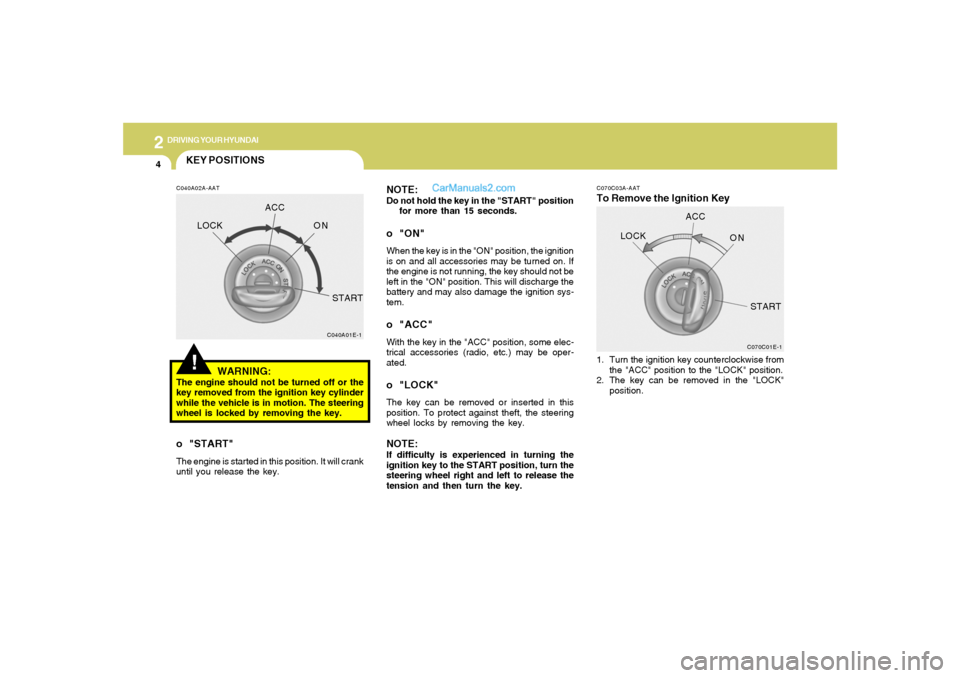
C070C03A-AATTo Remove the Ignition Key NOTE:
Do not hold the key in the "START" position
for more than 15 seconds.o "ON"When the key is in the "ON" position, the ignition
is on and all accessories may be turned on. If
the engine is not running, the key should not be
left in the "ON" position. This will discharge the
battery and may also damage the ignition sys-
tem.o "ACC"With the key in the "ACC" position, some elec-
trical accessories (radio, etc.) may be oper-
ated.o "LOCK"The key can be removed or inserted in this
position. To protect against theft, the steering
wheel locks by removing the key.NOTE:If difficulty is experienced in turning the
ignition key to the START position, turn the
steering wheel right and left to release the
tension and then turn the key.1. Turn the ignition key counterclockwise from
the "ACC" position to the "LOCK" position.
2. The key can be removed in the "LOCK"
position.
C070C01E-1
LOCKACC
ON
START
!KEY POSITIONSC040A02A-AAT
WARNING:
The engine should not be turned off or the
key removed from the ignition key cylinder
while the vehicle is in motion. The steering
wheel is locked by removing the key.o "START"The engine is started in this position. It will crank
until you release the key.
C040A01E-1
LOCKACC
ON
START
Page 146 of 266
2
DRIVING YOUR HYUNDAI
7
C070B01A-AATUsing the ClutchThe clutch should be pressed all the way to the
floor before shifting, then released slowly. The
clutch pedal should always be fully returned to
the original position. Do not rest your foot on the
clutch pedal while driving. This can cause un-
necessary wear.
Do not partially engage the clutch to hold the car
on an incline. This causes unnecessary wear.
Use the foot brake or parking brake to hold the
car on an incline. Do not operate the clutch pedal
rapidly and repeatedly.
C070D04A-AATGood Driving Practiceso Never take the car out of gear and coast
down a hill. This is extremely hazardous.
Always leave the car in gear.
o Don't "ride" the brakes. This can cause them
to overheat and malfunction. Instead, when
you are driving down a long hill, slow down
and shift to a lower gear. When you do this,
engine braking will help slow the car.
o Slow down before shifting to a lower gear.
This will help avoid over-revving the engine,
which can cause damage.
o Slow down when you encounter cross winds.
This gives you much better control of your
car.
o Be sure the car is completely stopped before
you attempt to shift into reverse. The
transaxle can be damaged if you do not. To
shift into reverse, depress the clutch, move
the shift lever to neutral, wait three seconds,
then shift to the reverse position.
o Exercise extreme caution when driving on a
slippery surface. Be especially careful when
braking, accelerating or shifting gears. On a
slippery surface, an abrupt change in ve-
hicle speed can cause the drive wheels to
lose traction and the vehicle to go out of
control.
!
WARNING:
o Always buckle-up! In a collision, an
unbelted occupant is significantly more
likely to be seriously injured or killed
than a properly belted occupant.
o Avoid high speeds when cornering or
turning.
o Do not make quick steering wheel move-
ments, such as sharp lane changes or
fast, sharp turns.
o The risk of rollover is greatly increased if
you lose control of your vehicle at high-
way speeds.
o Loss of control often occurs if two or
more wheels drop off the roadway and
the driver oversteers to reenter the road-
way.
o In the event your vehicle leaves the road-
way, do not steer sharply. Instead, slow
down before pulling back into the travel
lanes.
o Never exceed posted speed limits.
Page 150 of 266
2
DRIVING YOUR HYUNDAI
11
C090N05O-AATGood Driving Practiceso Never move the gear selector lever from "P"
or "N" to any other position with the accelera-
tor pedal depressed.
o Never move the gear selector lever into "P"
when the vehicle is in motion.
o Be sure the car is completely stopped before
you attempt to shift into "R".
o Never take the car out of gear and coast
down a hill. This may be extremely hazard-
ous. Always leave the car in gear when
moving.
o Do not "ride" the brakes. This can cause
them to overheat and malfunction. Instead,
when you are driving down a long hill, slow
down and shift to a lower gear. When you do
this, engine braking will help slow the car.
o Slow down before shifting to a lower gear.
Otherwise, the lower gear may not be en-
gaged.
o Always use the parking brake. Do not de-
pend on placing the transaxle in "P" to keep
the car from moving.
o Exercise extreme caution when driving on a
slippery surface. Be especially careful when
braking, accelerating or shifting gears. On a
slippery surface, an abrupt change in ve-
hicle speed can cause the drive wheels to
lose traction and the vehicle to go out of
control.
!
WARNING:
o Always buckle-up! In a collision, an
unbelted occupant is significantly more
likely to be seriously injured or killed
than a properly belted occupant.
o Avoid high speeds when cornering or
turning.
o Do not make quick steering wheel move-
ments, such as sharp lane changes or
fast, sharp turns.
o The risk of rollover is greatly increased if
you lose control of your vehicle at high-
way speeds.
o Loss of control often occurs if two or
more wheels drop off the roadway and
the driver oversteers to reenter the road-
way.
o In the event your vehicle leaves the road-
way, do not steer sharply. Instead, slow
down before pulling back into the travel
lanes.
o Never exceed posted speed limits. o Optimum vehicle performance and economy
is obtained by smoothly depressing and
releasing the accelerator pedal.
WARNING:
If your vehicle becomes stuck in snow,
mud, sand, etc., then you may attempt to
rock the vehicle free by moving it forward
and backward. Do not attempt this proce-
dure if people or objects are anywhere near
the vehicle. During the rocking operation
the vehicle may suddenly move forward or
backward as it becomes unstuck, causing
injury or damage to nearby people or ob-
jects.
!
Page 153 of 266
2
DRIVING YOUR HYUNDAI
14
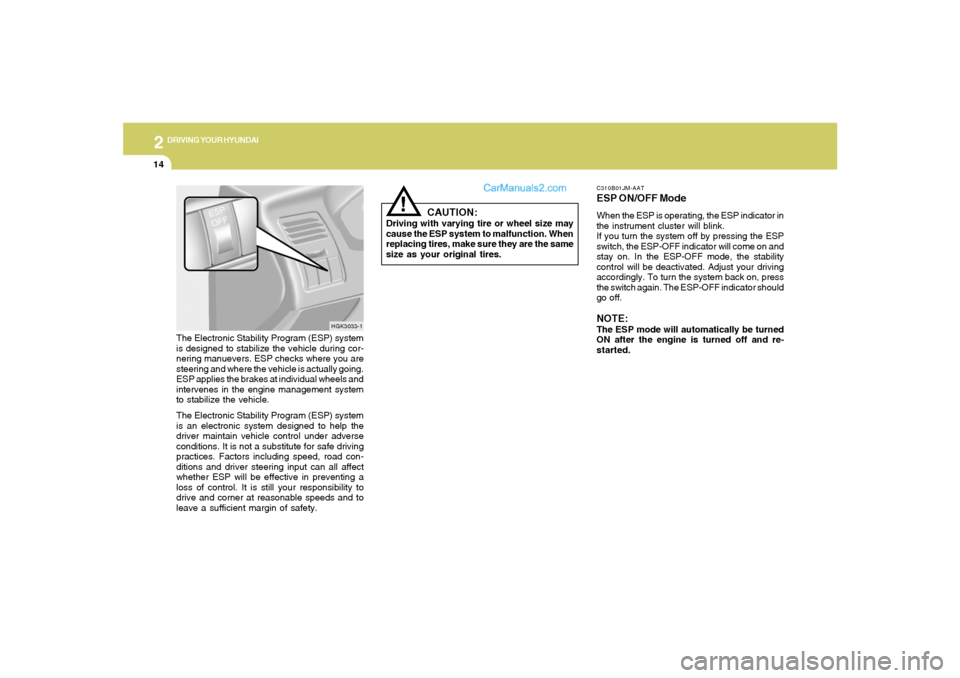
HGK3033-1
The Electronic Stability Program (ESP) system
is designed to stabilize the vehicle during cor-
nering manuevers. ESP checks where you are
steering and where the vehicle is actually going.
ESP applies the brakes at individual wheels and
intervenes in the engine management system
to stabilize the vehicle.
The Electronic Stability Program (ESP) system
is an electronic system designed to help the
driver maintain vehicle control under adverse
conditions. It is not a substitute for safe driving
practices. Factors including speed, road con-
ditions and driver steering input can all affect
whether ESP will be effective in preventing a
loss of control. It is still your responsibility to
drive and corner at reasonable speeds and to
leave a sufficient margin of safety.
CAUTION:
Driving with varying tire or wheel size may
cause the ESP system to malfunction. When
replacing tires, make sure they are the same
size as your original tires.
!
C310B01JM-AATESP ON/OFF ModeWhen the ESP is operating, the ESP indicator in
the instrument cluster will blink.
If you turn the system off by pressing the ESP
switch, the ESP-OFF indicator will come on and
stay on. In the ESP-OFF mode, the stability
control will be deactivated. Adjust your driving
accordingly. To turn the system back on, press
the switch again. The ESP-OFF indicator should
go off.NOTE:The ESP mode will automatically be turned
ON after the engine is turned off and re-
started.
Page 157 of 266
2
DRIVING YOUR HYUNDAI
18
HIGHER SPEED MOTORING
C160J01A-AATDon’t Let Ice and Snow Accumulate
UnderneathUnder some conditions, snow and ice can build
up under the fenders and interfere with the
steering. When driving in severe winter condi-
tions where this may happen, you should peri-
odically check underneath the car to be sure the
movement of the front wheels and the steering
components is not obstructed.C160K01A-AATCarry Emergency EquipmentDepending on the severity of the weather where
you drive your car, you should carry appropri-
ate emergency equipment. Some of the items
you may want to carry include tire chains, tow
straps or chains, flashlight, emergency flares,
sand, a shovel, jumper cables, a window scraper,
gloves, ground cloth, coveralls, a blanket, etc.
C170A02A-AATPre-Trip Inspections1. Tires:
Adjust the tire inflation pressures to specifica-
tion. Low tire inflation pressures will result in
overheating and possible failure of the tires.
Avoid using worn or damaged tires which may
result in reduced traction or tire failure.NOTE:Never exceed the maximum tire inflation
pressure shown on the tires.2. Fuel, engine coolant and engine oil:
High speed travel consumes more fuel than
urban motoring. Do not forget to check both
engine coolant and engine oil.
3. Drive belt:
A loose or damaged drive belt may result in
overheating of the engine.
!
WARNING:
o Underinflated or overinflated tires can
cause poor handling, loss of vehicle
control, and sudden tire failure leading
to accidents, injuries, and even death.
Always check tires are properly inflated
before driving. Refer to pages 8-2~8-3
for proper tire pressures and further
information.
o Driving on tires with no or insufficient
tread is dangerous. Worn-out tires can
result in loss of vehicle control, colli-
sions, injury, and even death. Worn-out
tires should be replaced as soon as
possible and should never be used for
driving. Always check tire tread before
driving your car.
Page 160 of 266
2
DRIVING YOUR HYUNDAI
21
(automatic). In addition, place wheel chocks
at each of the trailer's tires.
9. If the trailer has electric brakes, start your
vehicle and trailer moving, and then apply the
trailer brake controller by hand to be sure the
brakes are working. This lets you check
your electrical connection at the same time.
10.During your trip, occasionally check to be
sure that the load is secure, and that the
lights and any trailer brakes are still working.
11.Avoid jerky starts, sudden acceleration or
sudden stops.
12.Avoid sharp turns and rapid lane changes.
13.Avoid holding the brake pedal down too long
or too frequently. This could cause the brakes
to overheat, resulting in reduced braking
efficiency.
14.When going down a hill, shift into a lower gear
and use the engine braking effect.
When ascending a long grade, downshift the
transaxle to a lower gear and reduce speed
to reduce chances of engine overloading
and/or overheating.
15.If you have to stop while going uphill, do not
hold the vehicle in place by pressing on the
accelerator. This can cause the automatic
transaxle to overheat. Use the parking brake
or footbrake.
NOTE:When towing check transaxle fluid more
frequently.
CAUTION:
The following specifications are recom-
mended when towing a trailer. The loaded
trailer weight cannot safely exceed the val-
ues in the chart below.
!!
WARNING:
o Improperly loading your vehicle and
trailer can seriously affect its steering
and braking performance causing a
crash which could cause serious injury
or death.
o Towing a trailer affected vehicle han-
dling and braking.
o Drive more slowly when towing a trailer
and allow more distance when braking.
o Be careful when driving in slippery and
windy conditions.
o Be careful when turning and while driv-
ing up and down hills.Lbs. (kg)
Maximum Towable Weight
Trailer
1000 (453)Tongue
100 (45)
C190F01S-AATTrailer or Vehicle Towing Tips1. Before towing, check hitch and safety chain
connections as well as proper operation of
the trailer running lights, brake lights, and
turn signals.
2. Always drive your vehicle at a moderate
speed. (Less than 60 mph)
3. Trailer towing requires more fuel than normal
conditions.
4. To maintain engine braking efficiency and
electrical charging performance, do not use
fifth gear (manual transaxle) or overdrive
(automatic transaxle).
5. Always secure items in the trailer to prevent
load shift while driving.
6. Check the condition and air pressure of all
tires on the trailer and your car. Low tire
pressure can seriously affect the handling.
Also check the spare tire.
7. The vehicle/trailer combination is more af-
fected by crosswind and buffeting.
When being passed by a large vehicle, keep
a constant speed and steer straight ahead.
If there is too much wind buffeting, slow down
to get out of the other vehicle's air turbulence.
8. When parking your car and trailer, especially
on a hill, be sure to follow all the normal
precautions. Turn your front wheel into the
curb, set the parking brake firmly, and put the
transaxle in 1st or Reverse (manual) or Park
Page 177 of 266
312
WHAT TO DO IN AN EMERGENCY
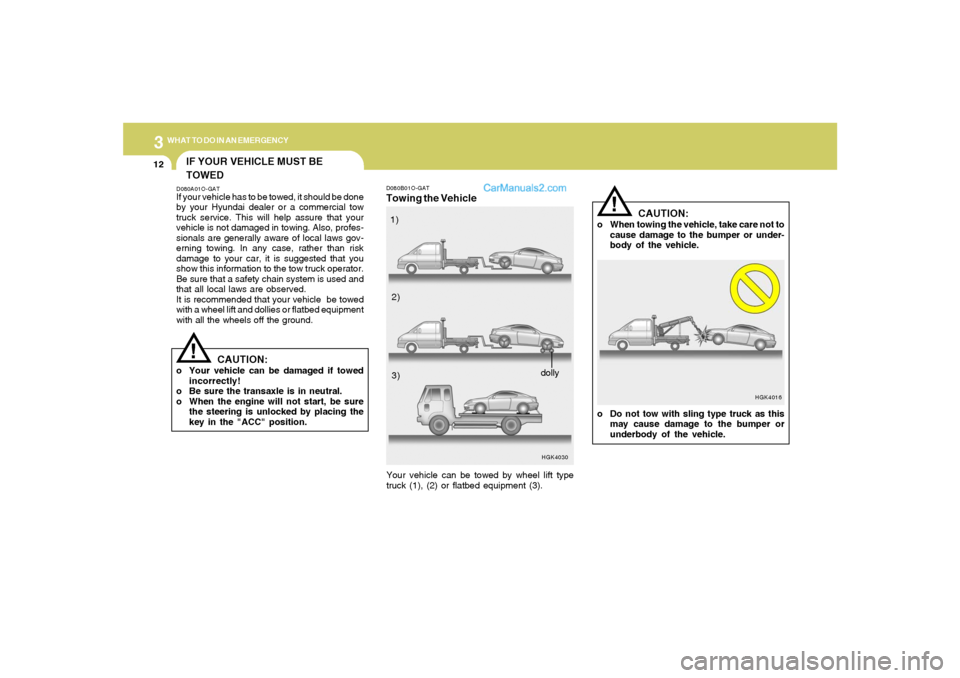
D080B01O-GATTowing the Vehicle
HGK4030
Your vehicle can be towed by wheel lift type
truck (1), (2) or flatbed equipment (3).1)
2)
3)
dolly
!
HGK4016
CAUTION:
o When towing the vehicle, take care not to
cause damage to the bumper or under-
body of the vehicle.
o Do not tow with sling type truck as this
may cause damage to the bumper or
underbody of the vehicle.
IF YOUR VEHICLE MUST BE
TOWEDD080A01O-GATIf your vehicle has to be towed, it should be done
by your Hyundai dealer or a commercial tow
truck service. This will help assure that your
vehicle is not damaged in towing. Also, profes-
sionals are generally aware of local laws gov-
erning towing. In any case, rather than risk
damage to your car, it is suggested that you
show this information to the tow truck operator.
Be sure that a safety chain system is used and
that all local laws are observed.
It is recommended that your vehicle be towed
with a wheel lift and dollies or flatbed equipment
with all the wheels off the ground.
!
CAUTION:
o Your vehicle can be damaged if towed
incorrectly!
o Be sure the transaxle is in neutral.
o When the engine will not start, be sure
the steering is unlocked by placing the
key in the "ACC" position.
Page 178 of 266
3
WHAT TO DO IN AN EMERGENCY
13
!
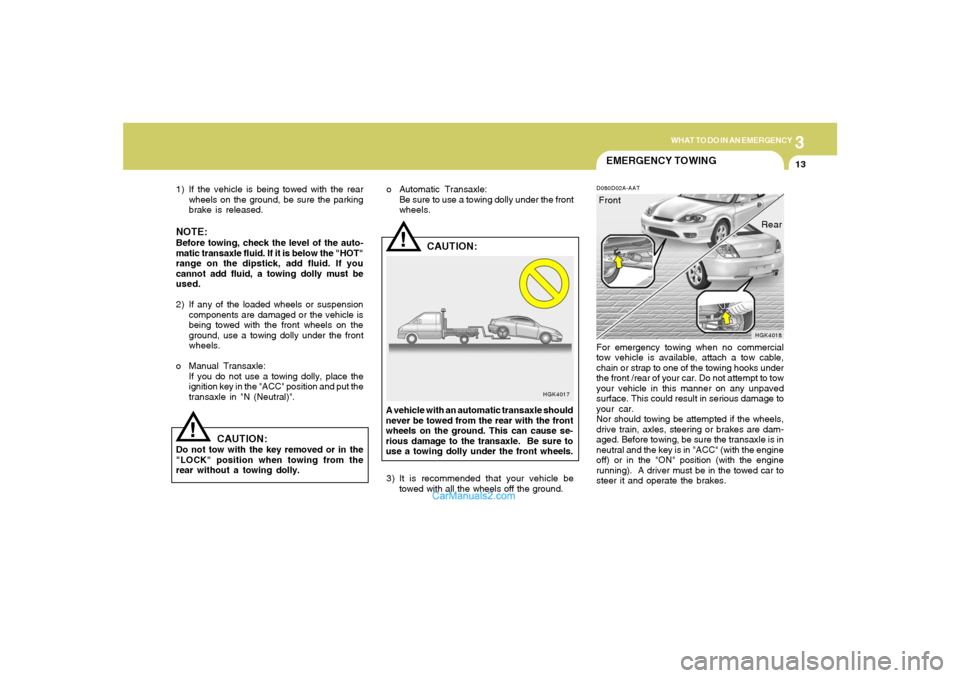
1) If the vehicle is being towed with the rear
wheels on the ground, be sure the parking
brake is released.NOTE:Before towing, check the level of the auto-
matic transaxle fluid. If it is below the "HOT"
range on the dipstick, add fluid. If you
cannot add fluid, a towing dolly must be
used.
2) If any of the loaded wheels or suspension
components are damaged or the vehicle is
being towed with the front wheels on the
ground, use a towing dolly under the front
wheels.
o Manual Transaxle:
If you do not use a towing dolly, place the
ignition key in the "ACC" position and put the
transaxle in "N (Neutral)".
HGK4017
CAUTION:
A vehicle with an automatic transaxle should
never be towed from the rear with the front
wheels on the ground. This can cause se-
rious damage to the transaxle. Be sure to
use a towing dolly under the front wheels.
EMERGENCY TOWINGD080D02A-AATFor emergency towing when no commercial
tow vehicle is available, attach a tow cable,
chain or strap to one of the towing hooks under
the front /rear of your car. Do not attempt to tow
your vehicle in this manner on any unpaved
surface. This could result in serious damage to
your car.
Nor should towing be attempted if the wheels,
drive train, axles, steering or brakes are dam-
aged. Before towing, be sure the transaxle is in
neutral and the key is in "ACC" (with the engine
off) or in the "ON" position (with the engine
running). A driver must be in the towed car to
steer it and operate the brakes.
HGK4018
Front
Rear
CAUTION:
Do not tow with the key removed or in the
"LOCK" position when towing from the
rear without a towing dolly.
!
o Automatic Transaxle:
Be sure to use a towing dolly under the front
wheels.
3) It is recommended that your vehicle be
towed with all the wheels off the ground.