airbag HYUNDAI TUCSON 2009 Owner's Manual
[x] Cancel search | Manufacturer: HYUNDAI, Model Year: 2009, Model line: TUCSON, Model: HYUNDAI TUCSON 2009Pages: 273, PDF Size: 10.29 MB
Page 54 of 273
1
FEATURES OF YOUR HYUNDAI
43
!
!
NOTE:The PASSENGER AIR BAG "OFF" indi-
cator illuminates for about 4 seconds
after the ignition key is turned to the
"ON" position or after the engine is
started. If the front passenger seat is
occupied, the occupant classification
sensor will then classify the front pas-
senger after several more seconds.
CAUTION:
If the occupant classification system is
not working properly, the SRS airbag
warning light on the instrument panel
will illuminate because the passenger's
front airbags are connected with the
occupant classification system. If there
is a malfunction of the occupant classi-
fication system, the PASSENGER AIR
BAG "OFF" indicator will illuminate and
the passenger's front airbags will not
inflate in frontal impact crashes even if
there is adult occupant in the front
passenger's seat. If the SRS airbag warn-
ing light does not illuminate when the
ignition key is turned to the "ON" posi-
tion, remains illuminated after approxi-
mately 6 seconds when the ignition key
is turned to the "ON" position, or if it
illuminates while the vehicle is being
driven, have an authorized Hyundai
dealer inspect the occupant classifica-
tion system and the SRS airbag system
as soon as possible.
WARNING:
Do not allow an adult passenger to ride
in the front seat when the PASSENGER
AIRBAG "OFF" indicator is illuminated,
because the airbag will not deploy in the
event of a crash. If the PASSENGER AIR
BAG "OFF" indicator remains illumi-
nated after the passenger repositions
themselves properly and the car is re-
started, Hyundai recommends that pas-
senger move to the rear seat because
the passenger's front airbag will not de-
ploy.
Front seat passengers must stay prop-
erly seated to avoid serious injury from
a deploying airbag. For more informa-
tion see page 1-38. When an adult is seated in the front passen-
ger seat, if the PASSENGER AIR BAG "OFF"
indicator is on, turn the ignition key to "LOCK"
and ask the passenger to sit properly (sitting
upright with the seat back in an upright
position, centered on the seat cushion with
their seat belt on, legs comfortably extended
and their feet on the floor). Restart the
engine and have the person remain in that
position. This will allow the system to detect
the person and to enable the passenger
airbag. If the PASSENGER AIR BAG "OFF"
indicator is still on, ask the passenger to
move to the rear seat.
!
WARNING:
o Even though your vehicle is equipped
with the occupation classification sys-
tem, never install a child restraint
system in the front passenger's seat.
A deploying airbag can forcefully
strike a child resulting in serious inju-
ries or death. Any child under 13
years of age should ride in the rear
seat. Children too large for child re-
straints should use the available lap/
shoulder belts. No matter what type
of crash, children of all ages are safer
when restrained in the rear seat.
o If the PASSENGER AIR BAG "OFF"
indicator is illuminated when the front
passenger's seat is occupied by an
adult and he/she sits properly (sitting
upright with the seatback in an upright
position, centered on the seat cush-
ion with their seat belt on, legs com-
fortably extended and their feet on the
floor), have that person sit in the rear
seat.
o Do not modify or replace the front
passenger seat. Don't place anything
on or attach anything such as a blan-
ket or after market seat heater to the
front passenger seat. This can ad-
versely affect the occupant classifi-
cation system.
Page 55 of 273
1FEATURES OF YOUR HYUNDAI44
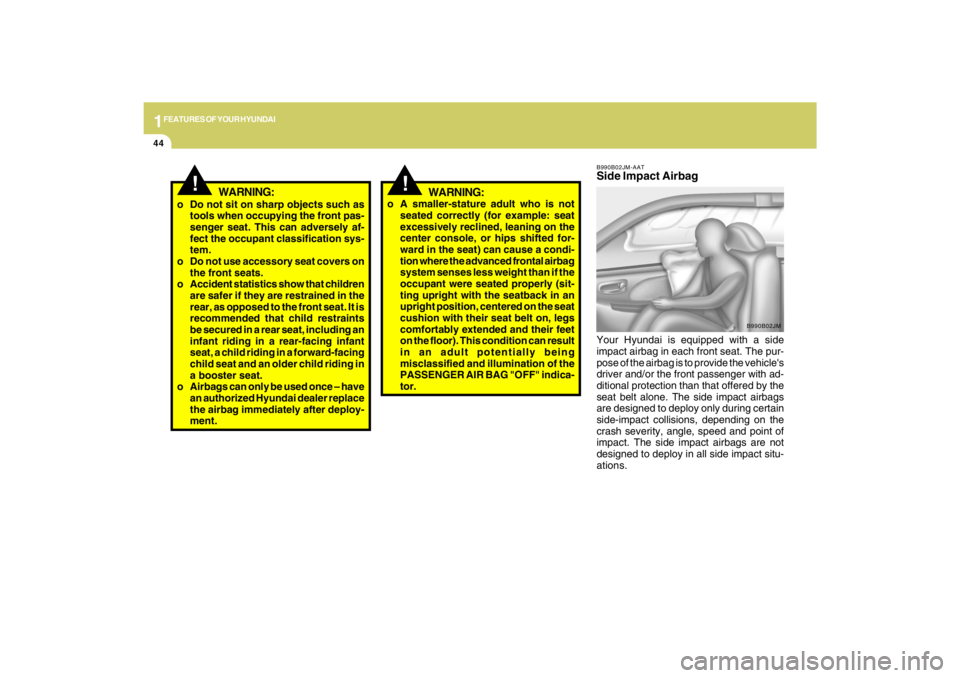
B990B02JM-AATSide Impact AirbagYour Hyundai is equipped with a side
impact airbag in each front seat. The pur-
pose of the airbag is to provide the vehicle's
driver and/or the front passenger with ad-
ditional protection than that offered by the
seat belt alone. The side impact airbags
are designed to deploy only during certain
side-impact collisions, depending on the
crash severity, angle, speed and point of
impact. The side impact airbags are not
designed to deploy in all side impact situ-
ations.
B990B02JM
!
WARNING:
o Do not sit on sharp objects such as
tools when occupying the front pas-
senger seat. This can adversely af-
fect the occupant classification sys-
tem.
o Do not use accessory seat covers on
the front seats.
o Accident statistics show that children
are safer if they are restrained in the
rear, as opposed to the front seat. It is
recommended that child restraints
be secured in a rear seat, including an
infant riding in a rear-facing infant
seat, a child riding in a forward-facing
child seat and an older child riding in
a booster seat.
o Airbags can only be used once – have
an authorized Hyundai dealer replace
the airbag immediately after deploy-
ment.
!
WARNING:
o A smaller-stature adult who is not
seated correctly (for example: seat
excessively reclined, leaning on the
center console, or hips shifted for-
ward in the seat) can cause a condi-
tion where the advanced frontal airbag
system senses less weight than if the
occupant were seated properly (sit-
ting upright with the seatback in an
upright position, centered on the seat
cushion with their seat belt on, legs
comfortably extended and their feet
on the floor). This condition can result
in an adult potentially being
misclassified and illumination of the
PASSENGER AIR BAG "OFF" indica-
tor.
Page 56 of 273
1
FEATURES OF YOUR HYUNDAI
45
!
WARNING:
WARNING:
o The side impact airbag is supplemen-
tal to the driver's and the passenger's
seat belt systems and is not a substi-
tute for them. Your seat belts must be
worn at all times while the vehicle is in
motion. The airbags deploy only in
certain side impact conditions severe
enough to cause significant injury to
the vehicle occupants.
!
HTB072
Side airbag
sensor
o For best protection from the side im-
pact airbag system and to avoid being
injured by the deploying side impact
airbag, both front seat occupants
should sit in an upright position with
the seat belt properly fastened. The
driver's hands should be placed on
the steering wheel at the 9:00 and
3:00 o'clock positions. The
passenger's arms and hands should
be placed on their laps.
o Do not use any accessory seat covers.
o Use of seat covers could reduce or pre-
vent the effectiveness of the system.
o Do not install any accessories on or
near the side impact airbag.
o Do not place any objects over the airbag
or between the airbag and yourself.
o Do not place any objects (an umbrella,
bag, etc.) between the front door and
the front seat. Such objects may be-
come dangerous projectiles and
cause injury if the supplemental side
impact air bag inflates.
o To prevent unexpected deployment of
the side impact air bag that may result
in personal injury, avoid impact to the
side airbag sensor when the ignition
key is on.
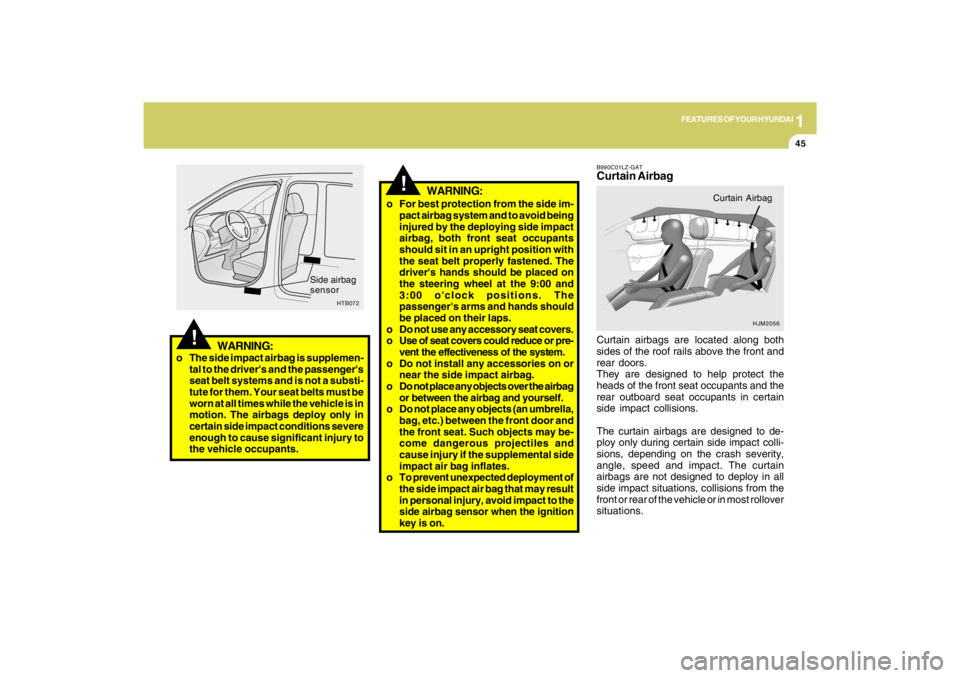
B990C01LZ-GATCurtain AirbagCurtain airbags are located along both
sides of the roof rails above the front and
rear doors.
They are designed to help protect the
heads of the front seat occupants and the
rear outboard seat occupants in certain
side impact collisions.
The curtain airbags are designed to de-
ploy only during certain side impact colli-
sions, depending on the crash severity,
angle, speed and impact. The curtain
airbags are not designed to deploy in all
side impact situations, collisions from the
front or rear of the vehicle or in most rollover
situations.
HJM2056
Curtain Airbag
Page 57 of 273
1FEATURES OF YOUR HYUNDAI46
!
o If components of the airbag system
must be discarded, or if the vehicle
must be scrapped, certain safety pre-
cautions must be observed. Your
Hyundai dealer knows these precau-
tions and can give you the necessary
information. Failure to follow these
precautions and procedures could
increase the risk of personal injury.
o If your car was flooded and has soaked
carpeting or water on the floor, don't
try to start the engine; have the car
towed to an authorized Hyundai dealer.
o Do not replace the bumper or the
bumper guard with the one other than
the Hyundai genuine parts. Otherwise,
it can adversely affect SRS perfor-
mance and lead to an increased risk
of injury.
WARNING:
o For cleaning the airbag pad covers,
use only a soft, dry cloth or one which
has been moistened with plain water.
Solvents or cleaners could adversely
affect the airbag covers and proper
deployment of the system.
o No objects should be placed over or
near the airbag modules on the steer-
ing wheel, instrument panel, and the
front passenger's panel above the
glove box, because any such object
could cause harm if the vehicle is in a
crash severe enough to cause the
airbags to inflate.
o If the airbags inflate, they must be
replaced by an authorized Hyundai
dealer.
o Do not tamper with or disconnect SRS
wiring, or other components of the
SRS system. Doing so could result in
injury, due to accidental inflation of
the airbags or by rendering the SRS
inoperative.
!
WARNING:
!
WARNING:
o Do not install a child restraint system
in the front passenger seat position.
A child restraint system must never
be placed in the front seat. The infant
or child could be severely injured or
killed by an airbag deployment in
case of an accident.
o Modification to SRS components or
wir-ing, including the addition of any
kind of badges to the pad covers or
modifications to the body structure,
can adversely affect SRS perfor-
mance and lead to possible injury.B240C02JM-AATSRS Careo The SRS is virtually maintenance free
and there are no parts you can safely
service by yourself. If the SRS SRI (Ser-
vice Reminder Indicator) does not illu-
minate, or continuously remains on,
have your vehicle immediately in-
spected by your Hyundai dealer.
o Any work on the SRS system, such as
removing, installing, repairing, or any
work on the steering wheel must be
performed by a qualified Hyundai tech-
nician. Improper handling of the airbag
system may result in serious personal
injury.
Page 58 of 273
1
FEATURES OF YOUR HYUNDAI
47
B240D02JM-AATAdditional Safety PrecautionsoNever let passengers ride in the cargo
area (trunk) or on top of a folded-down
back seat. All occupants should sit
upright, fully back in their seats with
their seat belts on and their feet on the
floor.
oPassengers should not move out of or
change seats while the vehicle is mov-
ing. A passenger who is not wearing a
seat belt during a crash or emergency
stop can be thrown against the inside of
the vehicle, against other occupants, or
out of the vehicle.
oEach seat belt is designed to restrain
one occupant. If more than one person
uses the same seat belt, they could be
seriously injured or killed in a collision.
oDo not use any accessories on seat
belts. Devices claiming to improve oc-
cupant comfort or reposition the seat
belt can reduce the protection provided
by the seat belt and increase the chance
of serious injury in a crash.
oPassengers should not place hard or
sharp objects between themselves
and the airbags. Carrying hard or sharp
objects on your lap or in your mouth can
result in injuries if an airbag inflates.oKeep occupants away from the airbag
covers. All occupants should sit up-
right, fully back in their seats with their
seat belts on and their feet on the floor.
If occupants are too close to the airbag
covers, they could be injured if the
airbags inflate.
oDo not attach or place objects on or
near the airbag covers. Any object
attached to or placed on the front or side
impact airbag covers could interfere
with the proper operation of the airbags.
oDo not modify the front seats. Modifi-
cation of the front seats could interfere
with the operation of the supplemental
restraint system sensing components
or side impact airbags.
oDo not place items under the front
seats. Placing items under the front
seats could interfere with the operation
of the supplemental restraint system
sensing components and wiring har-
nesses.
oNever hold an infant or child on your
lap. The infant or child could be seri-
ously injured or killed in the event of a
crash. All infants and children should
be properly restrained in appropriate
child safety seats or seat belts in the rear
seat.
!
WARNING:
o Sitting improperly or out of position
can cause occupants to be shifted too
close to a deploying airbag, strike the
interior structure or be thrown from
the vehicle resulting in serious injury
or death.
o Always sit upright with the seatback
in an upright position, centered on the
seat cushion with your seat belt on,
legs comfortably extended and your
feet on the floor.Adding Equipment to or Modifying
Your Airbag-Equipped Vehicle.If you modify your vehicle by changing
your vehicle's frame, bumper system, front
end or side sheet metal or ride height, this
may affect the operation of your vehicle's
airbag system.
Page 60 of 273
1
FEATURES OF YOUR HYUNDAI
49
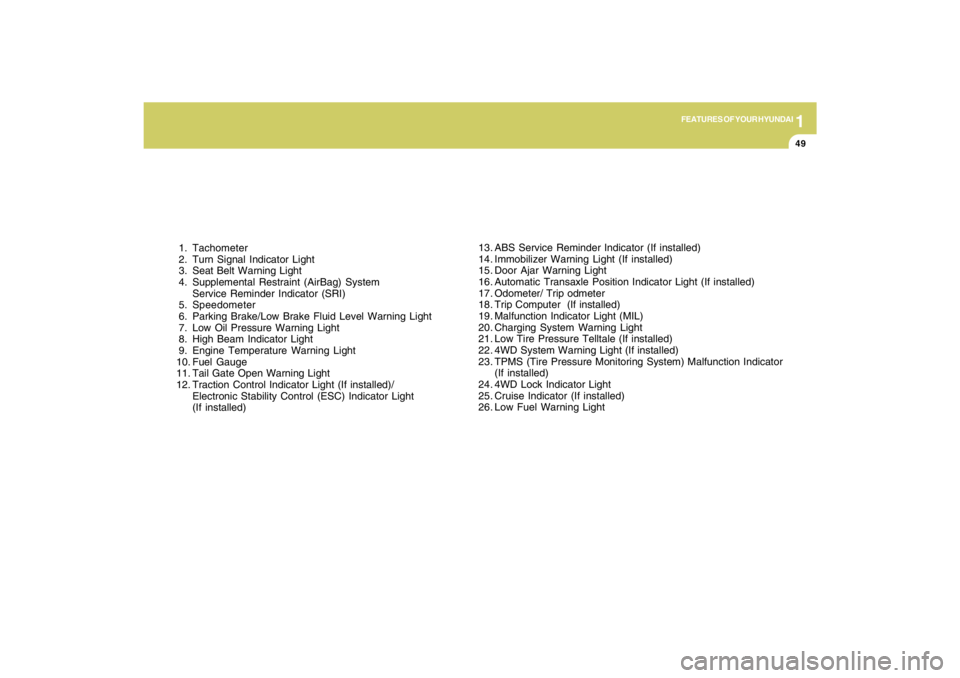
1. Tachometer
2. Turn Signal Indicator Light
3. Seat Belt Warning Light
4. Supplemental Restraint (AirBag) System
Service Reminder Indicator (SRI)
5. Speedometer
6. Parking Brake/Low Brake Fluid Level Warning Light
7. Low Oil Pressure Warning Light
8. High Beam Indicator Light
9. Engine Temperature Warning Light
10. Fuel Gauge
11. Tail Gate Open Warning Light
12. Traction Control Indicator Light (If installed)/
Electronic Stability Control (ESC) Indicator Light
(If installed)13. ABS Service Reminder Indicator (If installed)
14. Immobilizer Warning Light (If installed)
15. Door Ajar Warning Light
16. Automatic Transaxle Position Indicator Light (If installed)
17. Odometer/ Trip odmeter
18. Trip Computer (If installed)
19. Malfunction Indicator Light (MIL)
20. Charging System Warning Light
21. Low Tire Pressure Telltale (If installed)
22. 4WD System Warning Light (If installed)
23. TPMS (Tire Pressure Monitoring System) Malfunction Indicator
(If installed)
24. 4WD Lock Indicator Light
25. Cruise Indicator (If installed)
26. Low Fuel Warning Light
Page 61 of 273
1FEATURES OF YOUR HYUNDAI50
WARNING AND INDICATOR
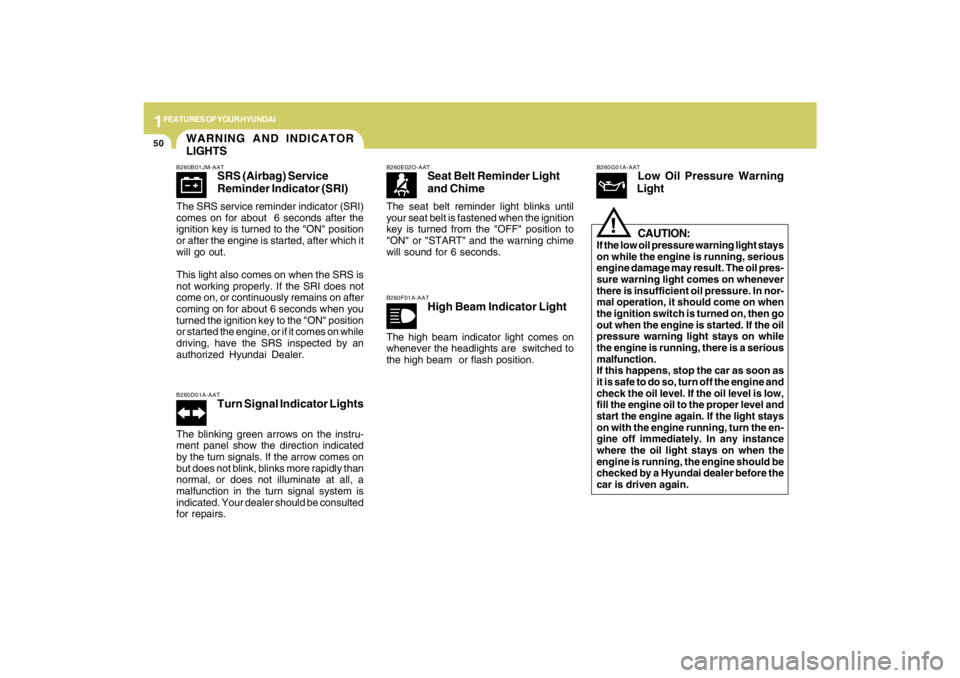
LIGHTSB260B01JM-AAT
SRS (Airbag) Service
Reminder Indicator (SRI)
The SRS service reminder indicator (SRI)
comes on for about 6 seconds after the
ignition key is turned to the "ON" position
or after the engine is started, after which it
will go out.
This light also comes on when the SRS is
not working properly. If the SRI does not
come on, or continuously remains on after
coming on for about 6 seconds when you
turned the ignition key to the "ON" position
or started the engine, or if it comes on while
driving, have the SRS inspected by an
authorized Hyundai Dealer.B260D01A-AAT
Turn Signal Indicator Lights
The blinking green arrows on the instru-
ment panel show the direction indicated
by the turn signals. If the arrow comes on
but does not blink, blinks more rapidly than
normal, or does not illuminate at all, a
malfunction in the turn signal system is
indicated. Your dealer should be consulted
for repairs.
B260E02O-AAT
Seat Belt Reminder Light
and Chime
The seat belt reminder light blinks until
your seat belt is fastened when the ignition
key is turned from the "OFF" position to
"ON" or "START" and the warning chime
will sound for 6 seconds.B260F01A-AAT
High Beam Indicator Light
The high beam indicator light comes on
whenever the headlights are switched to
the high beam or flash position.
B260G01A-AAT
Low Oil Pressure Warning
Light
CAUTION:
If the low oil pressure warning light stays
on while the engine is running, serious
engine damage may result. The oil pres-
sure warning light comes on whenever
there is insufficient oil pressure. In nor-
mal operation, it should come on when
the ignition switch is turned on, then go
out when the engine is started. If the oil
pressure warning light stays on while
the engine is running, there is a serious
malfunction.
If this happens, stop the car as soon as
it is safe to do so, turn off the engine and
check the oil level. If the oil level is low,
fill the engine oil to the proper level and
start the engine again. If the light stays
on with the engine running, turn the en-
gine off immediately. In any instance
where the oil light stays on when the
engine is running, the engine should be
checked by a Hyundai dealer before the
car is driven again.
!
Page 204 of 273

5
VEHICLE MAINTENANCE REQUIREMENTS
10
CALIFORNIA PERCHLORATE NOTICEF080A02NF-AATPerchlorate Material-special handling may
apply, See www.dtsc.ca.gov/
hazardouswaste/perchlorate.
Notice to California Vehicle Dismantlers:
Perchlorate containing materials, such as
airbag inflators, seatbelt pretensioners and
keyless remote entry batteries, must be
disposed of according to Title 22 Califor-
nia Code of Regulations Section 67384.10
(a).