engine HYUNDAI TUCSON 2009 Workshop Manual
[x] Cancel search | Manufacturer: HYUNDAI, Model Year: 2009, Model line: TUCSON, Model: HYUNDAI TUCSON 2009Pages: 273, PDF Size: 10.29 MB
Page 170 of 273
If the Engine will not Start .............................................. 3-2
Jump Starting ................................................................ 3-3
If the Engine Overheats ................................................ 3-4
Tire Pressure Monitoring System (TPMS) .................... 3-5
Spare Tire ..................................................................... 3-9
If You Have a Flat Tire ................................................3-10
Changing a Flat Tire ....................................................3-11
If Your Car Must be Towed.........................................3-16
Emergency Towing.....................................................3-18
If You Lose Your Keys................................................3-19
3
3
WHAT TO DO IN AN EMERGENCY
Page 171 of 273
32WHAT TO DO IN AN EMERGENCY
IF THE ENGINE WILL NOT START!
D010A01A-AAT D010B02A-AAT
If Engine Doesn't Turn Over or Turns
Over Slowly
D010C02Y-AATIf Engine Turns Over Normally but
Does Not Start1. Check fuel level.
2. With the key in the "OFF" position, check
all connectors at ignition, coil and spark
plugs. Reconnect any that may be dis-
connected or loose.
3. Check the fuel line in the engine com-
partment.
4. If the engine still does not start, call a
Hyundai dealer or seek other qualified
assistance.D010D01A-AATIf Engine Stalls While Driving1. Reduce your speed gradually, keeping
a straight line. Move cautiously off the
road to a safe place.
2. Turn on your emergency flashers.
3. Try to start the engine again. If your ve-
hicle will not start, contact a Hyundai
dealer or seek other qualified assistance.
WARNING:
If the engine will not start, do not push or
pull the car to start it. This could result in
a collision or cause other damage. In
addition, push or pull starting may cause
the catalytic converter to be overloaded
and create a fire hazard.
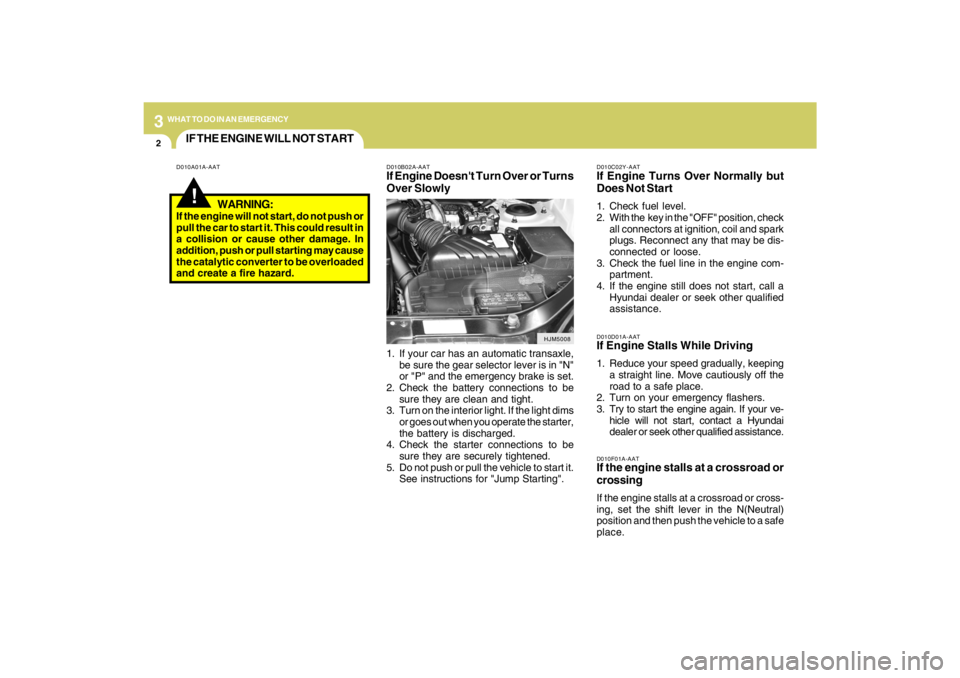
1. If your car has an automatic transaxle,
be sure the gear selector lever is in "N"
or "P" and the emergency brake is set.
2. Check the battery connections to be
sure they are clean and tight.
3. Turn on the interior light. If the light dims
or goes out when you operate the starter,
the battery is discharged.
4. Check the starter connections to be
sure they are securely tightened.
5. Do not push or pull the vehicle to start it.
See instructions for "Jump Starting".
HJM5008
D010F01A-AAT
If the engine stalls at a crossroad or
crossingIf the engine stalls at a crossroad or cross-
ing, set the shift lever in the N(Neutral)
position and then push the vehicle to a safe
place.
Page 172 of 273
3
WHAT TO DO IN AN EMERGENCY
3
JUMP STARTING!
o If you should accidentally get acid on
your skin or in your eyes, immediately
remove any contaminated clothing and
flush the area with clear water for at
least 15 minutes. Then promptly obtain
medical attention. If you must be trans-
ported to an emergency facility, con-
tinue to apply water to the affected area
with a sponge or cloth.
o The gas produced by the battery during
the jump-start operation is highly explo-
sive. Do not smoke or allow a spark or
an open flame in the vicinity.
o The battery being used to provide the
jump start must be 12-volt. If you cannot
determine that it is a 12-volt battery, do
not attempt to use it for the jump start.
o To jump start a car with a discharged
battery, follow this procedure exactly:
1. If the booster battery is installed in an-
other vehicle, be sure the two vehicles
are not touching.
2. Turn off all unnecessary lights and
acces-sories in both vehicles.
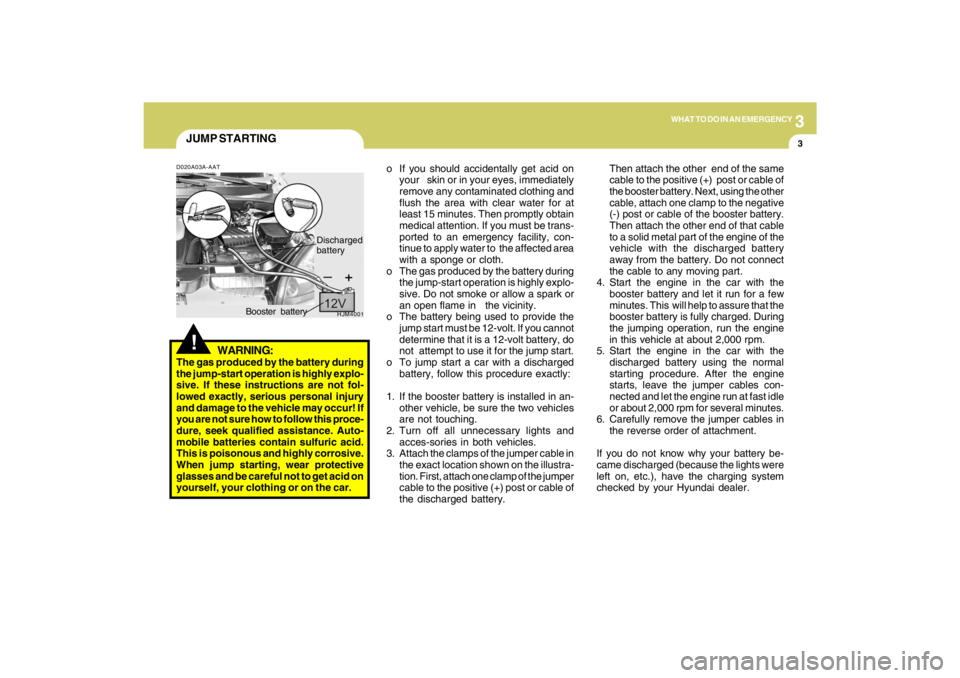
3. Attach the clamps of the jumper cable in
the exact location shown on the illustra-
tion. First, attach one clamp of the jumper
cable to the positive (+) post or cable of
the discharged battery.Then attach the other end of the same
cable to the positive (+) post or cable of
the booster battery. Next, using the other
cable, attach one clamp to the negative
(-) post or cable of the booster battery.
Then attach the other end of that cable
to a solid metal part of the engine of the
vehicle with the discharged battery
away from the battery. Do not connect
the cable to any moving part.
4. Start the engine in the car with the
booster battery and let it run for a few
minutes. This will help to assure that the
booster battery is fully charged. During
the jumping operation, run the engine
in this vehicle at about 2,000 rpm.
5. Start the engine in the car with the
discharged battery using the normal
starting procedure. After the engine
starts, leave the jumper cables con-
nected and let the engine run at fast idle
or about 2,000 rpm for several minutes.
6. Carefully remove the jumper cables in
the reverse order of attachment.
If you do not know why your battery be-
came discharged (because the lights were
left on, etc.), have the charging system
checked by your Hyundai dealer.
D020A03A-AAT
WARNING:
The gas produced by the battery during
the jump-start operation is highly explo-
sive. If these instructions are not fol-
lowed exactly, serious personal injury
and damage to the vehicle may occur! If
you are not sure how to follow this proce-
dure, seek qualified assistance. Auto-
mobile batteries contain sulfuric acid.
This is poisonous and highly corrosive.
When jump starting, wear protective
glasses and be careful not to get acid on
yourself, your clothing or on the car.
HJM4001
Booster batteryDischarged
battery
Page 173 of 273
34WHAT TO DO IN AN EMERGENCY
IF THE ENGINE OVERHEATS
!!
!
WARNING:
While the engine is running, keep hair,
hands and clothing away from moving
parts such as the fan and drive belts to
prevent injury.
5. If the water pump drive belt is broken or
engine coolant is leaking out, stop the
engine immediately and call the near-
est Hyundai dealer for assistance.
WARNING:
Do not remove the radiator cap when the
engine is hot. This can allow coolant to be
blown out of the opening and cause se-
rious burns.6. If you cannot find the cause of the over-
heat-ing, wait until the engine tempera-
ture has returned to normal. Then, if
coolant has been lost, carefully add
coolant to the reservoir (page 6-9) to
bring the fluid level in the reservoir up to
the halfway mark.
7. Proceed with caution, keeping alert for
further signs of overheating. If over-
heating happens again, call a Hyundai
dealer for assistance.
CAUTION:
Serious loss of coolant indicates there is
a leak in the cooling system and this
should be checked as soon as possible
by a Hyundai dealer.
D030A02A-AATIf your temperature gauge indicates over-
heating, you experience a loss of power, or
hear loud pinging or knocking, the engine
is probably too hot. If this happens, you
should:
1. Pull off the road and stop as soon as it
is safe to do so.
2. Place the gear selector lever in "P"
(auto-matic), or neutral (manual
transaxle) and set the parking brake. If
the air conditioning is on, turn it off.
3. If engine coolant is running out under
the car or steam is coming out from the
hood, stop the engine. Do not open the
hood until the coolant has stopped
running or the steaming has stopped. If
there is no visible loss of engine coolant
and no steam, leave the engine running
and check to be sure the engine cooling
fan is operating. If the fan is not running,
turn the engine off.
4. Check to see if the water pump drive belt
is missing. If it is not missing, check to
see that it is tight. If the drive belt seems
to be satisfactory, check for coolant
leaking from the radiator, hoses or un-
der the car. (If the air conditioning had
been in use, it is normal for cold water
to be draining from it when you stop).
Page 185 of 273
316
WHAT TO DO IN AN EMERGENCY
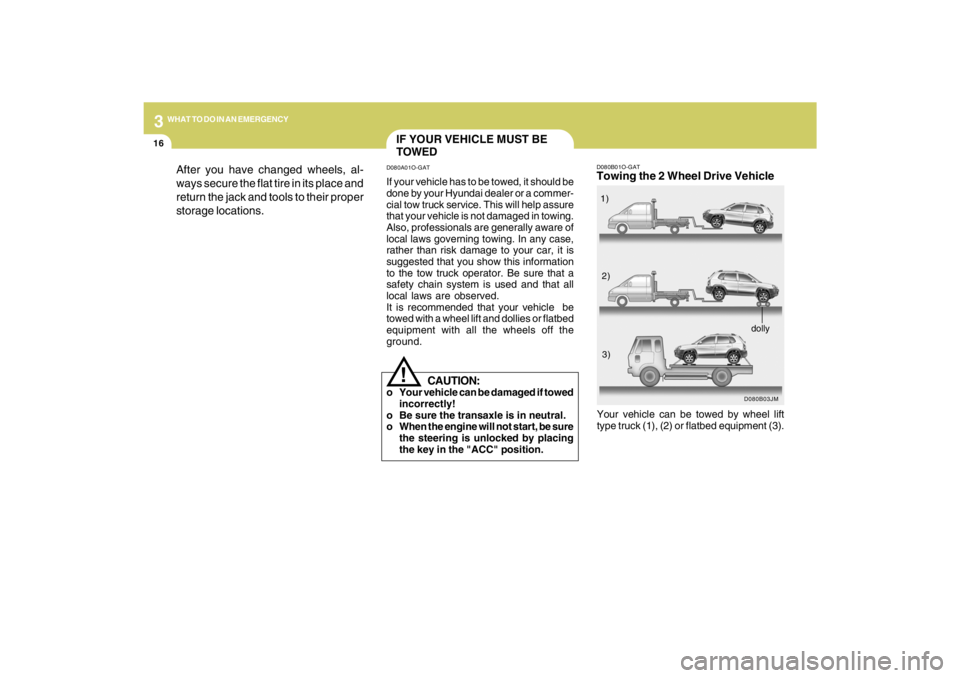
D080B01O-GATTowing the 2 Wheel Drive Vehicle
D080B03JM
Your vehicle can be towed by wheel lift
type truck (1), (2) or flatbed equipment (3).1)
2)
3)
dolly
After you have changed wheels, al-
ways secure the flat tire in its place and
return the jack and tools to their proper
storage locations.
IF YOUR VEHICLE MUST BE
TOWEDD080A01O-GATIf your vehicle has to be towed, it should be
done by your Hyundai dealer or a commer-
cial tow truck service. This will help assure
that your vehicle is not damaged in towing.
Also, professionals are generally aware of
local laws governing towing. In any case,
rather than risk damage to your car, it is
suggested that you show this information
to the tow truck operator. Be sure that a
safety chain system is used and that all
local laws are observed.
It is recommended that your vehicle be
towed with a wheel lift and dollies or flatbed
equipment with all the wheels off the
ground.
!
CAUTION:
o Your vehicle can be damaged if towed
incorrectly!
o Be sure the transaxle is in neutral.
o When the engine will not start, be sure
the steering is unlocked by placing
the key in the "ACC" position.
Page 188 of 273
3
WHAT TO DO IN AN EMERGENCY
19
IF YOU LOSE YOUR KEYSD120A01A-AATIf you lose your keys, many Hyundai deal-
ers can make you a new key if you have
your key number. If you lock the keys inside
your car and you cannot obtain a new key,
many Hyundai dealers can use special
tools to open the door for you. For emergency towing when no commer-
cial tow vehicle is available, attach a tow
cable, chain or strap to one of the towing
hooks under the front/rear of your vehicle.
Be very careful when attempting this pro-
cedure when the vehicle is on any un-
paved surface to avoid damage to your
vehicle.
Nor should towing be attempted if the
wheels, drive train, axles, steering or
brakes are damaged. Before towing, be
sure the transaxle is in neutral and the key
is in "ACC" (with the engine off) or in the
"ON" position (with the engine running). A
driver must be in the towed vehicle to steer
it and operate the brakes.
NOTE:o To avoid serious damage to your 4WD
vehicle, limit the towing to 15 km/h (10
mph) and not for more than 1.5 km (1
mile) at ANY TIME.
o Before towing, check the level of the
automatic transaxle fluid. If it is below
the "75°C" range on the dipstick, add
fluid. If you cannot add fluid, a towing
dolly must be used.
CAUTION:
If the Engine is not running, the power
assist for the brakes and steering will
not work so steering and braking will be
much harder than usual.
CAUTION:
If the car is being towed with all four
wheels on the ground, it can be towed
only from the front. Be sure that the
transaxle is in neutral. Do not tow at
speeds greater than 50 km/h (30 mph)
and for more than 25 km (15 miles).
Be sure the steering is unlocked by plac-
ing the key in the "ACC" position. A
driver must be in the towed vehicle to
operate the steering and brakes.
!!
Page 192 of 273
4
CORROSION PREVENTION AND APPEARANCE CARE4
After rinsing, dry the car using a damp
chamois or soft, absorbent cloth. The rea-
son for drying the car is to remove water
from the car so it will dry without water
spots. Don't rub, this can damage the fin-
ish.
If you find any nicks or scratches in the
paint, use touch-up paint to cover them to
prevent corrosion. To protect the paintwork
of the car against corrosion, you must
clean your Hyundai (at least once a month).
Give special attention
to the removal of salt, mud and other sub-
stances on the underside of the
splashboards of the car. Make sure that the
outlets and the underside of the doors are
open. Paint damage can be caused by
small accumulation of tar, industrial pre-
cipitation, tree resin, insects and bird drop-
pings, when not removed immediately. If
water alone is not strong enough to re-
move the accumulated dirt, use a mild car
washing solution. Be sure to rinse the
surface after washing to remove the solu-
tion. Never allow the solution to dry on the
painted surfaces. Use a clean sponge or cloth, rinse it fre-
quently and don't damage the finish by
rubbing too hard. For stubborn spots,
dampen them frequently and remove them
a little at a time.
To clean whitewall tires, use a stiff brush or
soapy steel-wool scouring pad.
To clean plastic wheel covers, use a clean
sponge or soft cloth and water.
To clean cast aluminum alloy wheels, use
a mild soap or neutral detergent. Do not
use abrasive cleaners. Protect the bare-
metal surfaces by cleaning, polishing and
waxing. Because aluminum is subject to
corrosion, be sure to give aluminum alloy
wheels special attention in winter. If you
drive on salted roads, clean the wheels
thoroughly afterwards.
After washing, be sure to rinse thoroughly.
If soapy water dries on the finish, streaking
will result.
When the weather is warm and the humid-
ity low, you may find it necessary to rinse
each section immediately after washing to
avoid streaking.
CAUTION:
!
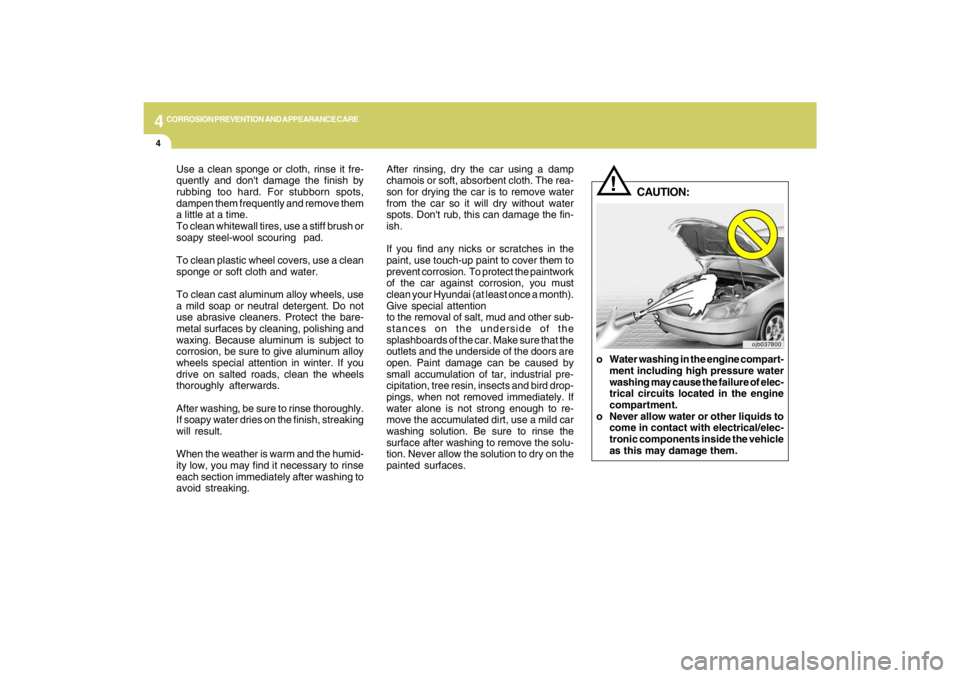
o Water washing in the engine compart-
ment including high pressure water
washing may cause the failure of elec-
trical circuits located in the engine
compartment.
o Never allow water or other liquids to
come in contact with electrical/elec-
tronic components inside the vehicle
as this may damage them.
ojb037800
Page 196 of 273
5
VEHICLE MAINTENANCE REQUIREMENTS2
F010C01A-AATSpecified Scheduled ProceduresThese are the procedures such as inspec-
tions, adjustments and replacements that
are listed in the maintenance charts start-
ing on page 5-4. These procedures must
be performed at the intervals shown in the
maintenance schedule to assure that your
warranty remains in effect. Although it is
strongly recommended that they be per-
formed by the trained technicians at your
Hyundai dealer, these procedures may be
performed at any qualified service facility.
It is suggested that genuine Hyundai ser-
vice parts be used for any required repairs
or replacements. Other parts of equivalent
quality such as engine oil, engine coolant,
manual or auto transaxle oil, brake fluid
and so on which are not supplied by
Hyundai Motor Company or its distributor
may be used without affecting your war-
ranty coverage but you should always be
sure these are equivalent to the quality of
the original Hyundai parts. Your Owner's
Handbook provides further information
about your warranty coverage.
F010A01A-AATService RequirementsTo ensure that you receive the greatest
number of miles of satisfying operation
from your Hyundai, certain maintenance
procedures must be performed. Although
careful design and engineering have re-
duced these to a minimum, those that are
required are of the utmost importance.
It is your responsibility to have these main-
tenance procedures performed to comply
with the terms of the warranties covering
your new Hyundai. The Owner's Hand-
book supplied with your new vehicle pro-
vides further information about these war-
ranties.
F010B01A-AATMaintenance RequirementsThe maintenance required for your
Hyundai can be divided into three main
areas:
o Specified scheduled procedures
o General checks
o Do-it-yourself maintenance
MAINTENANCE INTERVALS
Page 198 of 273
5
VEHICLE MAINTENANCE REQUIREMENTS4
R: 100.000 miles / 120 months
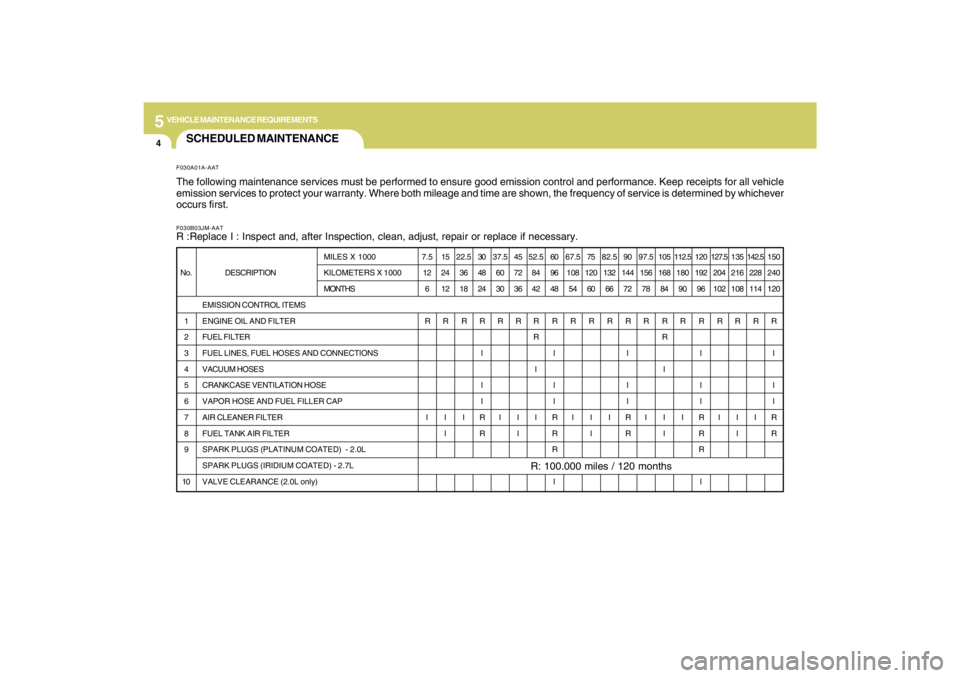
SCHEDULED MAINTENANCEF030B03JM-AATR :Replace I : Inspect and, after Inspection, clean, adjust, repair or replace if necessary.
DESCRIPTION
EMISSION CONTROL ITEMS
ENGINE OIL AND FILTER
FUEL FILTER
FUEL LINES, FUEL HOSES AND CONNECTIONS
VACUUM HOSES
CRANKCASE VENTILATION HOSE
VAPOR HOSE AND FUEL FILLER CAP
AIR CLEANER FILTER
FUEL TANK AIR FILTER
SPARK PLUGS (PLATINUM COATED) - 2.0L
SPARK PLUGS (IRIDIUM COATED) - 2.7L
VALVE CLEARANCE (2.0L only) No.
1
2
3
4
5
6
7
8
9
10MILES X 1000
KILOMETERS X 1000
MONTHS7.5
12
6
R
I15
24
12
R
I
I22.5
36
18
R
I30
48
24
R
I
I
I
R
R37.5
60
30
R
I45
72
36
R
I
I52.5
84
42
R
R
I
I60
96
48
R
I
I
I
R
R
R
I67.5
108
54
R
I75
120
60
R
I
I82.5
132
66
R
I90
144
72
R
I
I
I
R
R97.5
156
78
R
I105
168
84
R
R
I
I
I112.5
180
90
R
I120
192
96
R
I
I
I
R
R
R
I127.5
204
102
R
I135
216
108
R
I
I142.5
228
114
R
I150
240
120
R
I
I
I
R
R
F030A01A-AATThe following maintenance services must be performed to ensure good emission control and performance. Keep receipts for all vehicle
emission services to protect your warranty. Where both mileage and time are shown, the frequency of service is determined by whichever
occurs first.
Page 200 of 273
5
VEHICLE MAINTENANCE REQUIREMENTS6
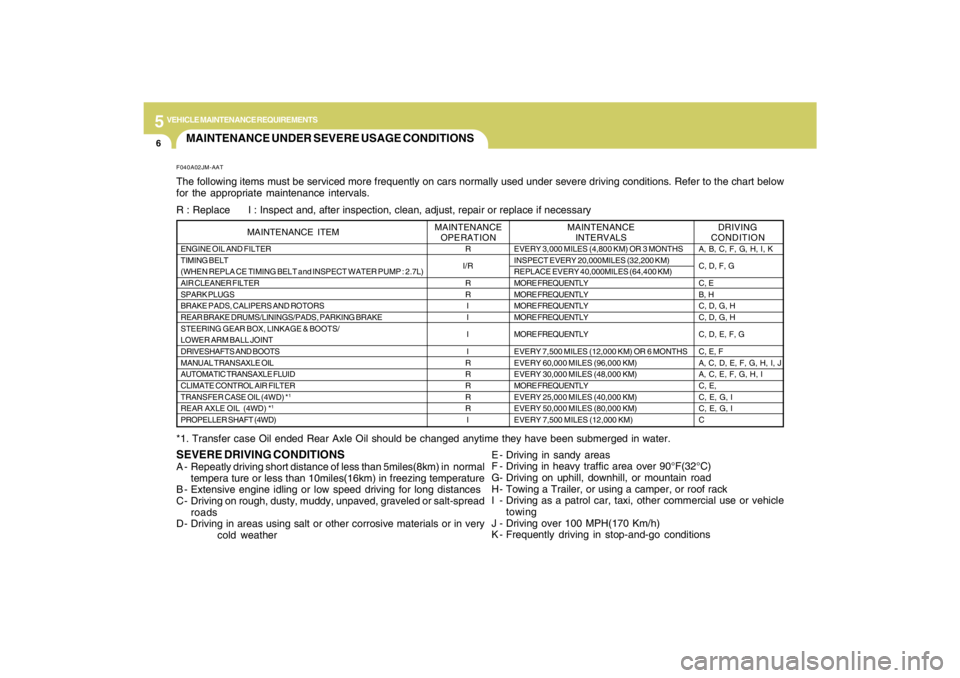
MAINTENANCE UNDER SEVERE USAGE CONDITIONS
SEVERE DRIVING CONDITIONSA - Repeatly driving short distance of less than 5miles(8km) in normal
tempera ture or less than 10miles(16km) in freezing temperature
B - Extensive engine idling or low speed driving for long distances
C- Driving on rough, dusty, muddy, unpaved, graveled or salt-spread
roads
D- Driving in areas using salt or other corrosive materials or in very
cold weatherF040A02JM-AATThe following items must be serviced more frequently on cars normally used under severe driving conditions. Refer to the chart below
for the appropriate maintenance intervals.
R : Replace I : Inspect and, after inspection, clean, adjust, repair or replace if necessary
*1. Transfer case Oil ended Rear Axle Oil should be changed anytime they have been submerged in water.
E - Driving in sandy areas
F - Driving in heavy traffic area over 90°F(32°C)
G- Driving on uphill, downhill, or mountain road
H - Towing a Trailer, or using a camper, or roof rack
I - Driving as a patrol car, taxi, other commercial use or vehicle
towing
J - Driving over 100 MPH(170 Km/h)
K - Frequently driving in stop-and-go conditionsENGINE OIL AND FILTER
TIMING BELT
(WHEN REPLA CE TIMING BELT and INSPECT WATER PUMP : 2.7L)
AIR CLEANER FILTER
SPARK PLUGS
BRAKE PADS, CALIPERS AND ROTORS
REAR BRAKE DRUMS/LININGS/PADS, PARKING BRAKE
STEERING GEAR BOX, LINKAGE & BOOTS/
LOWER ARM BALL JOINT
DRIVESHAFTS AND BOOTS
MANUAL TRANSAXLE OIL
AUTOMATIC TRANSAXLE FLUID
CLIMATE CONTROL AIR FILTER
TRANSFER CASE OIL (4WD) *
1
REAR AXLE OIL (4WD) *
1
PROPELLER SHAFT (4WD)
MAINTENANCE ITEM
R
I/R
R
R
I
I
I
I
R
R
R
R
R
I
EVERY 3,000 MILES (4,800 KM) OR 3 MONTHS
INSPECT EVERY 20,000MILES (32,200 KM)
REPLACE EVERY 40,000MILES (64,400 KM)
MORE FREQUENTLY
MORE FREQUENTLY
MORE FREQUENTLY
MORE FREQUENTLY
MORE FREQUENTLY
EVERY 7,500 MILES (12,000 KM) OR 6 MONTHS
EVERY 60,000 MILES (96,000 KM)
EVERY 30,000 MILES (48,000 KM)
MORE FREQUENTLY
EVERY 25,000 MILES (40,000 KM)
EVERY 50,000 MILES (80,000 KM)
EVERY 7,500 MILES (12,000 KM)
DRIVING
CONDITION MAINTENANCE
INTERVALS MAINTENANCE
OPERATION
A, B, C, F, G, H, I, K
C, D, F, G
C, E
B, H
C, D, G, H
C, D, G, H
C, D, E, F, G
C, E, F
A, C, D, E, F, G, H, I, J
A, C, E, F, G, H, I
C, E,
C, E, G, I
C, E, G, I
C