warm up HYUNDAI TUCSON 2016 Owners Manual
[x] Cancel search | Manufacturer: HYUNDAI, Model Year: 2016, Model line: TUCSON, Model: HYUNDAI TUCSON 2016Pages: 642, PDF Size: 9.78 MB
Page 12 of 642
F12F12
Exterior overview ..................................................1-2
Interior overview ....................................................1-4
Instrument panel overview ...................................1-5
Engine compartment .............................................1-6
Important Safety Precautions ..............................2-2
Always Wear Your Seat Belt ..........................................2-2
Restrain All Children .........................................................2-2
Air Bag Hazards .................................................................2-2
Driver Distraction ..............................................................2-2
Control Your Speed ...........................................................2-3
Keep Your Vehicle in Safe Condition ............................2-3
Seats ........................................................................2-4
Safety Precautions ...........................................................2-5
Front Seats .........................................................................2-6
Rear Seats.........................................................................2-12
Head restraints ................................................................2-15
Seat warmers and air ventilation seats.....................2-19
Seat Belts ..............................................................2-23
Seat Belt Safety Precautions .......................................2-23
Seat Belt Warning Light ................................................2-24
Seat Belt Restraint System...........................................2-26
Additional Seat Belt Safety Precautions ...................2-33
Care of Seat Belts...........................................................2-36
Child Restraint System (CRS) .............................2-37
Children Always in the Rear .........................................2-37
Selecting a Child Restraint System (CRS) .................2-38
Installing a Child Restraint System (CRS)..................2-40
Air Bag -
Advanced Supplemental Restraint System.......2-48
Where Are the Air Bags? ..............................................2-50
How Does the Air Bag System Operate?..................2-53
What to Expect After an Air Bag Inflates ................2-58
Occupant Classification System (OCS).......................2-59
Why Didn't My Air Bag Go Off in a Collision? ........2-64
SRS Care ..........................................................................2-69
Additional Safety Precautions .....................................2-70
Air Bag Warning Labels .................................................2-71
1Your vehicle at a glance
2Safety system of your vehicle
Page 28 of 642
Safety system of your vehicle
Important Safety Precautions ..............................2-2
Always Wear Your Seat Belt ..........................................2-2
Restrain All Children .........................................................2-2
Air Bag Hazards .................................................................2-2
Driver Distraction ..............................................................2-2
Control Your Speed ...........................................................2-3
Keep Your Vehicle in Safe Condition ............................2-3
Seats ........................................................................2-4
Safety Precautions ...........................................................2-5
Front Seats .........................................................................2-6
Rear Seats.........................................................................2-12
Head restraints ................................................................2-15
Seat warmers and air ventilation seats.....................2-19
Seat Belts ..............................................................2-23
Seat Belt Safety Precautions .......................................2-23
Seat Belt Warning Light ................................................2-24
Seat Belt Restraint System...........................................2-26
Additional Seat Belt Safety Precautions ...................2-33
Care of Seat Belts...........................................................2-36
Child Restraint System (CRS) .............................2-37
Children Always in the Rear .........................................2-37
Selecting a Child Restraint System (CRS) .................2-38
Installing a Child Restraint System (CRS)..................2-40
Air Bag -
Advanced Supplemental Restraint System.......2-48
Where Are the Air Bags? ..............................................2-50
How Does the Air Bag System Operate?..................2-53
What to Expect After an Air Bag Inflates ................2-58
Occupant Classification System (OCS).......................2-59
Why Didn't My Air Bag Go Off in a Collision? ........2-64
SRS Care ..........................................................................2-69
Additional Safety Precautions .....................................2-70
Air Bag Warning Labels .................................................2-71
This chapter provides you with important information about how to protect yourself and your passengers.
It explains how to properly use your seats and seat belts, and how your air bags work.
Additionally, this chapter explains how to properly restrain infants and children in your vehicle.
2
Page 31 of 642
2-4
SSEE AA TTSS
Safety system of your vehicle
OTL035001L
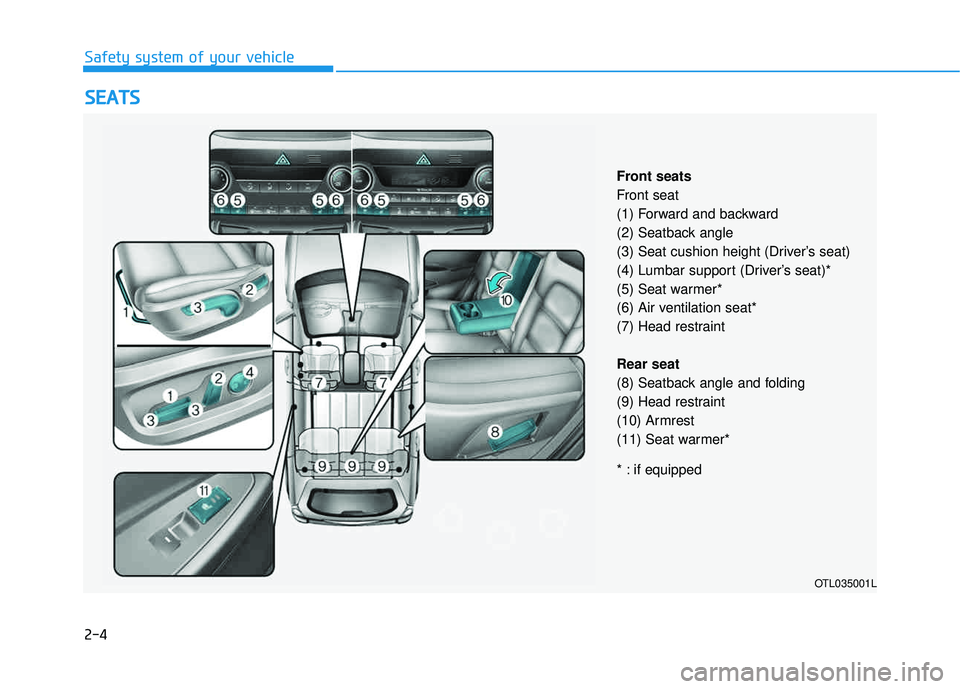
Front seats
Front seat
(1) Forward and backward
(2) Seatback angle
(3) Seat cushion height (Driver’s seat)
(4) Lumbar support (Driver’s seat)*
(5) Seat warmer*
(6) Air ventilation seat*
(7) Head restraint Rear seat
(8) Seatback angle and folding
(9) Head restraint
(10) Armrest
(11) Seat warmer*
* : if equipped
Page 46 of 642
2-19
Safety system of your vehicle
2
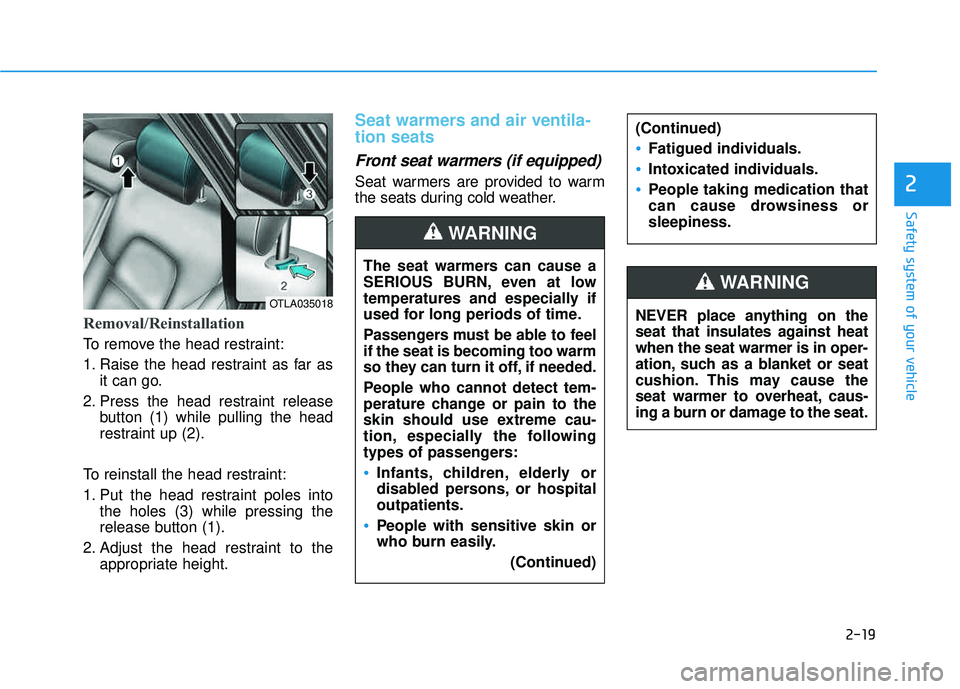
Removal/Reinstallation
To remove the head restraint:
1. Raise the head restraint as far asit can go.
2. Press the head restraint release button (1) while pulling the head
restraint up (2).
To reinstall the head restraint:
1. Put the head restraint poles into the holes (3) while pressing the
release button (1).
2. Adjust the head restraint to the appropriate height.
Seat warmers and air ventila- tion seats
Front seat warmers (if equipped)
Seat warmers are provided to warm
the seats during cold weather.
OTLA035018
The seat warmers can cause a
SERIOUS BURN, even at low
temperatures and especially if
used for long periods of time.
Passengers must be able to feel if the seat is becoming too warm
so they can turn it off, if needed.
People who cannot detect tem-
perature change or pain to the
skin should use extreme cau-
tion, especially the following
types of passengers:
Infants, children, elderly or
disabled persons, or hospitaloutpatients.
People with sensitive skin or
who burn easily.
(Continued)
(Continued)
Fatigued individuals.
Intoxicated individuals.
People taking medication that
can cause drowsiness orsleepiness.
WARNING
NEVER place anything on the
seat that insulates against heatwhen the seat warmer is in oper-
ation, such as a blanket or seat
cushion. This may cause the
seat warmer to overheat, caus-
ing a burn or damage to the seat.
WARNING
Page 47 of 642
2-20
Safety system of your vehicle
To prevent damage to the seat
warmers and seats:
Never use a solvent such aspaint thinner, benzene, alcohol
or gasoline to clean the seats.
Do not place heavy or sharp objects on seats equipped with
seat warmers.
Do not change the seat cover. It may damage the seat warmer orair ventilation system.
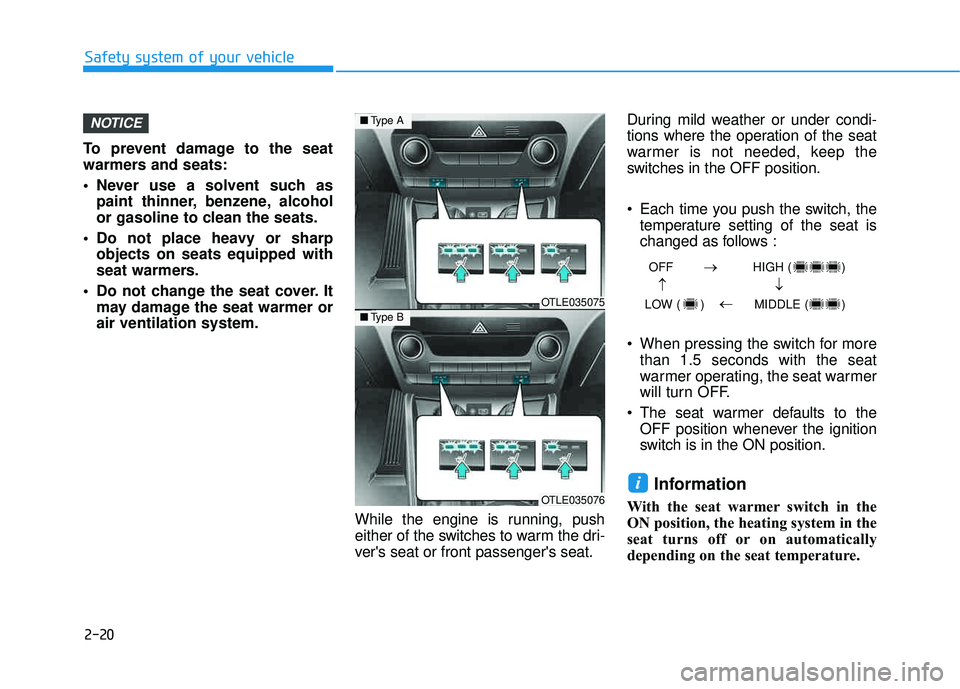
While the engine is running, push
either of the switches to warm the dri-
ver's seat or front passenger's seat. During mild weather or under condi-
tions where the operation of the seat
warmer is not needed, keep the
switches in the OFF position.
Each time you push the switch, the
temperature setting of the seat is
changed as follows :
When pressing the switch for more than 1.5 seconds with the seat
warmer operating, the seat warmer
will turn OFF.
The seat warmer defaults to the OFF position whenever the ignition
switch is in the ON position.
Information
With the seat warmer switch in the
ON position, the heating system in the
seat turns off or on automatically
depending on the seat temperature.
i
NOTICE
OTLE035075
OTLE035076
■Type A
■Type B
OFF HIGH ( )
LOW ( ) MIDDLE ( )
Page 49 of 642
2-22
Rear seat warmers (if equipped)
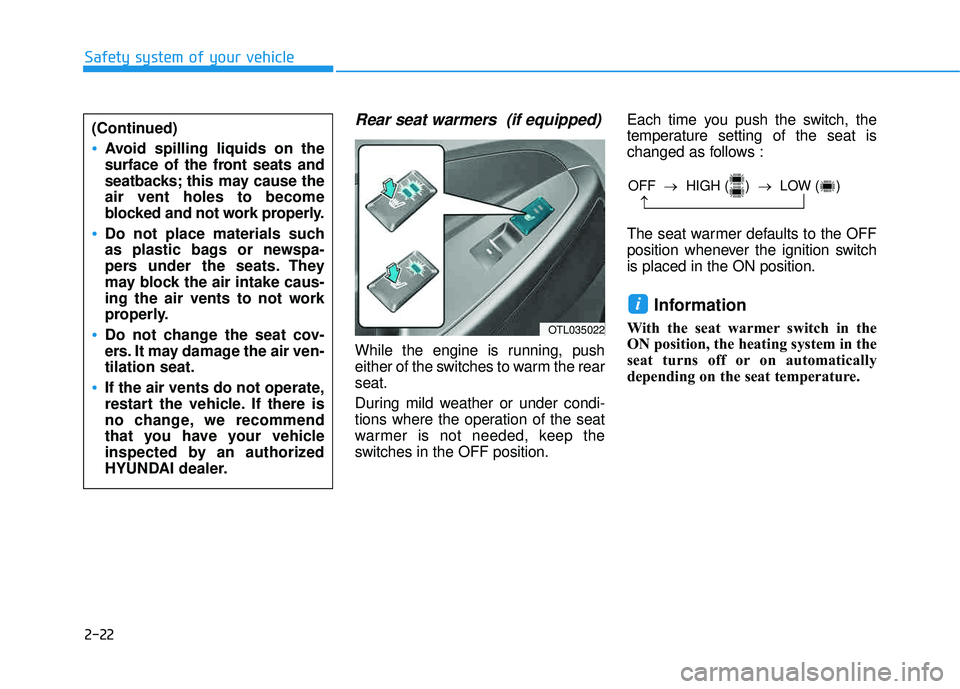
While the engine is running, push
either of the switches to warm the rearseat.
During mild weather or under condi-
tions where the operation of the seat
warmer is not needed, keep the
switches in the OFF position.Each time you push the switch, the
temperature setting of the seat is
changed as follows :
The seat warmer defaults to the OFF
position whenever the ignition switchis placed in the ON position.
Information
With the seat warmer switch in the
ON position, the heating system in the
seat turns off or on automatically
depending on the seat temperature.
i
Safety system of your vehicle
(Continued)
Avoid spilling liquids on the
surface of the front seats and
seatbacks; this may cause theair vent holes to become
blocked and not work properly.
Do not place materials such
as plastic bags or newspa-
pers under the seats. They
may block the air intake caus-
ing the air vents to not work
properly.
Do not change the seat cov-
ers. It may damage the air ven-tilation seat.
If the air vents do not operate,
restart the vehicle. If there is
no change, we recommend
that you have your vehicle
inspected by an authorized
HYUNDAI dealer.
OFF
HIGH ( ) LOW ( )
OTL035022
Page 63 of 642
2-36
Safety system of your vehicle
Care of Seat Belts
Seat belt systems should never be
disassembled or modified. In addi-
tion, care should be taken to assure
that seat belts and belt hardware are
not damaged by seat hinges, doors
or other abuse.
Periodic inspection
All seat belts should be inspected
periodically for wear or damage of
any kind. Any damaged parts should
be replaced as soon as possible by
an authorized HYUNDAI dealer.
Keep belts clean and dry
Seat belts should be kept clean and
dry. If belts become dirty, they can be
cleaned by using a mild soap solu-
tion and warm water. Bleach, dye,
strong detergents or abrasives
should not be used because they
may damage and weaken the fabric.
When to replace seat belts
The entire seat belt assembly or
assemblies should be replaced if the
vehicle has been involved in an acci-
dent. This should be done even if no
damage is visible. Additional ques-
tions concerning seat belt operation
should be directed to an authorized
HYUNDAI dealer.
NEVER ride with a reclined
seatback when the vehicle is
moving.
Riding with a reclined seatback
increases your chance of seri-
ous or fatal injuries in the event
of a collision or sudden stop.
Drivers and passengers should
always sit well back in their
seats, properly belted, and with
the seatbacks upright.
WARNING
Page 85 of 642
2-58
Safety system of your vehicle
What to Expect After an Air
Bag Inflates
After a frontal or side air bag inflates,
it will deflate very quickly. Air bag
inflation will not prevent the driverfrom seeing out of the windshield or
being able to steer. Curtain air bags
may remain partially inflated for
some time after they deploy.
Noise and smoke from inflatingair bag
When the air bags inflate, they make
a loud noise and may produce
smoke and powder in the air inside of
the vehicle. This is normal and is aresult of the ignition of the air bag
inflator. After the air bag inflates, you
may feel substantial discomfort inbreathing because of the contact of
your chest with both the seat belt and
the air bag, as well as from breathing
the smoke and powder. The powder
may aggravate asthma for some
people. If you experience breathing
problems after an air bag deploy-ment, seek medical attention imme-
diately.
Though the smoke and powder are
nontoxic, they may cause irritation to
the skin, eyes, nose, throat, etc. If
this is the case, wash and rinse with
cold water immediately and seekmedical attention if the symptomspersist.
After an air bag inflates, take
the following precautions:
Open your windows and doors
as soon as possible after
impact to reduce prolonged
exposure to the smoke and
powder released by the inflat-
ing air bag.
Do not touch the air bag stor-
age area's internal compo-
nents immediately after an air
bag has inflated. The partsthat come into contact with an
inflating air bag may be veryhot.
(Continued)
WARNING
(Continued)
Always wash exposed skin
areas thoroughly with luke-warm water and mild soap.
Always have an authorized
HYUNDAI dealer replace the air
bag immediately after deploy-
ment. Air bags are designed to
be used only once.
Page 120 of 642
3-22
Convenient features of your vehicle
Heated Steering Wheel (if equipped)
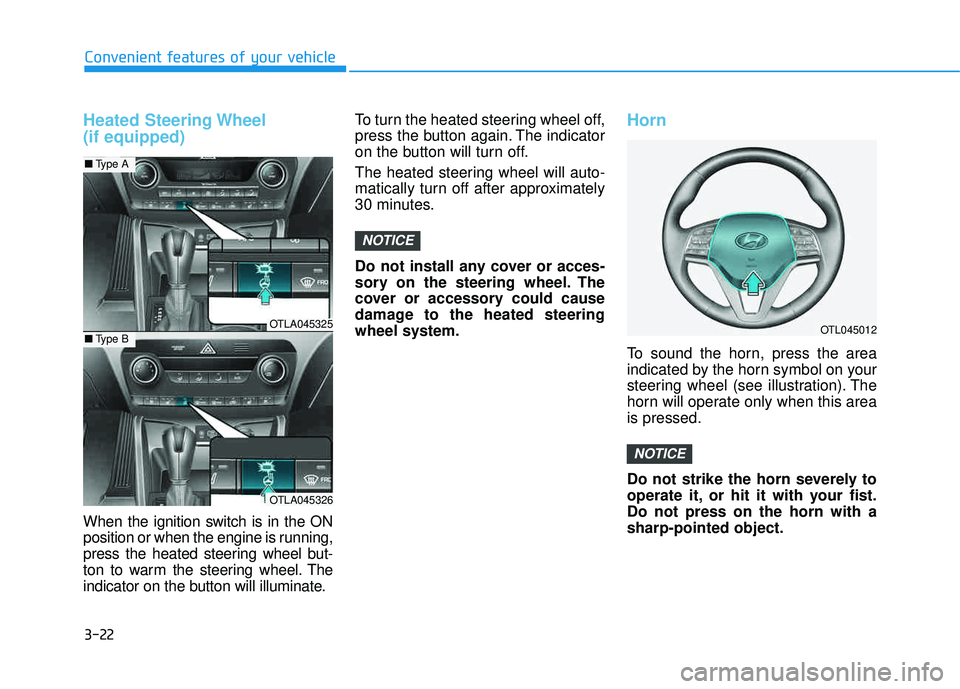
When the ignition switch is in the ON
position or when the engine is running,
press the heated steering wheel but-
ton to warm the steering wheel. The
indicator on the button will illuminate.To turn the heated steering wheel off,
press the button again. The indicator
on the button will turn off.
The heated steering wheel will auto-
matically turn off after approximately
30 minutes.
Do not install any cover or acces-
sory on the steering wheel. The
cover or accessory could cause
damage to the heated steeringwheel system.
Horn
To sound the horn, press the area
indicated by the horn symbol on your
steering wheel (see illustration). The
horn will operate only when this areais pressed.
Do not strike the horn severely to
operate it, or hit it with your fist.Do not press on the horn with asharp-pointed object.
NOTICE
NOTICE
OTL045012OTLA045325
OTLA045326
■
Type A
■Type B
Page 134 of 642
3-36
Convenient features of your vehicle
Use the rear view mirror inside the
vehicle or direct observation to deter-
mine the actual distance of following
vehicles when changing lanes.Blind Spot Mirror (if equipped)
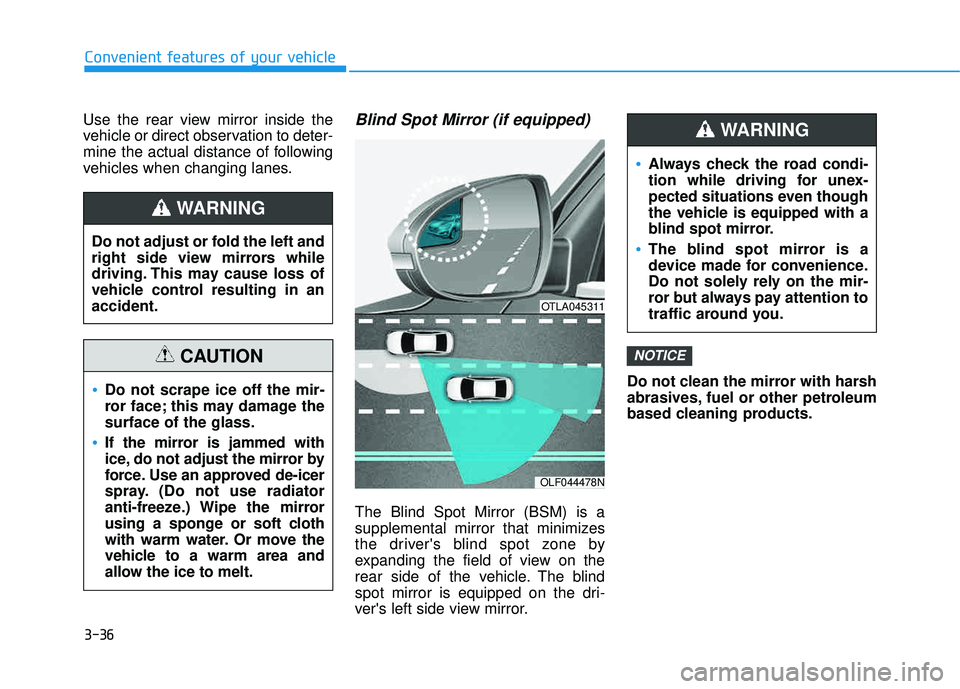
The Blind Spot Mirror (BSM) is a
supplemental mirror that minimizes
the driver's blind spot zone by
expanding the field of view on the
rear side of the vehicle. The blind
spot mirror is equipped on the dri-
ver's left side view mirror.Do not clean the mirror with harsh
abrasives, fuel or other petroleum
based cleaning products.
NOTICE
Do not adjust or fold the left and
right side view mirrors while
driving. This may cause loss of
vehicle control resulting in anaccident.
WARNING
Do not scrape ice off the mir-
ror face; this may damage thesurface of the glass.
If the mirror is jammed with
ice, do not adjust the mirror by
force. Use an approved de-icer
spray. (Do not use radiator
anti-freeze.) Wipe the mirror
using a sponge or soft cloth
with warm water. Or move the
vehicle to a warm area and
allow the ice to melt.
CAUTION
OTLA045311
OLF044478N
Always check the road condi-
tion while driving for unex-
pected situations even though
the vehicle is equipped with a
blind spot mirror.
The blind spot mirror is a
device made for convenience.
Do not solely rely on the mir-
ror but always pay attention to
traffic around you.
WARNING