Fluid HYUNDAI TUCSON LIMITED 2017 Owner's Guide
[x] Cancel search | Manufacturer: HYUNDAI, Model Year: 2017, Model line: TUCSON LIMITED, Model: HYUNDAI TUCSON LIMITED 2017Pages: 642, PDF Size: 9.78 MB
Page 541 of 642
7-28
Maintenance
Automatic Transmission Fluid (if equipped)
Automatic transmission fluid should
not be checked under normal usage
conditions. But in severe conditions,the fluid should be changed at an
authorized HYUNDAI dealer inaccordance to the scheduled mainte-nance at the beginning of this chap-
ter.
Automatic transmission fluid
color is basically red.
As the vehicle is driven, the auto- matic transmission fluid will begin
to look darker. This is a normal
condition and you should not
judge the need to replace the fluid
based upon the changed color.
Ecoshift dual clutch transmis- sion Fluid (if equipped)
Inspect the Ecoshift dual clutch
transmission fluid according to the
maintenance schedule.
Brake Hoses and Lines
Visually check for proper installation,
chafing, cracks, deterioration and
any leakage. Replace any deteriorat-
ed or damaged parts immediately.
Brake Fluid
Check brake fluid level in the brake
fluid reservoir. The level should be
between the MIN and the MAX
marks on the side of the reservoir.
Use only hydraulic brake fluid con-
forming to DOT 3 or DOT 4 specifi-cation.
NOTICE
The use of a non-specified fluid could result in transmission
malfunction and failure. Use
only the specified automatic
transmission fluid (refer to"Recommended Lubricants and
Capacities" in chapter 8).
CAUTION
Page 542 of 642
7-29
7
Maintenance
Parking Brake
Inspect the parking brake system
including the parking brake pedal
and cables.
Brake Discs, Pads, Calipers
and Rotors
Check the pads for excessive wear,
discs for run out and wear, and
calipers for fluid leakage.
Exhaust Pipe and Muffler
Visually inspect the exhaust pipes,
muffler and hangers for cracks, dete-
rioration, or damage. Start the
engine and listen carefully for any
exhaust gas leakage. Tighten con-
nections or replace parts as neces-
sary.
Suspension Mounting Bolts
Check the suspension connections
for looseness or damage. Retighten
to the specified torque.
Steering Gear Box, Linkage &
Boots/Lower Arm Ball Joint
With the vehicle stopped and the
engine off, check for excessive free-
play in the steering wheel. Check the
linkage for bends or damage. Check
the dust boots and ball joints for
deterioration, cracks, or damage.
Replace any damaged parts.
Drive Shafts and Boots
Check the drive shafts, boots and
clamps for cracks, deterioration, or
damage. Replace any damaged
parts and, if necessary, repack the
grease.
Air Conditioning Refrigerant
Check the air conditioning lines and
connections for leakage and dam-
age.
Page 548 of 642
7-35
7
Maintenance
Changing Engine Coolant
Have coolant changed by an author-
ized HYUNDAI dealer according tothe Maintenance Schedule at the
beginning of this chapter.To prevent damage to engine
parts, put a thick towel around the
coolant cap before refilling the
coolant to prevent the coolant
from overflowing into engine
parts, such as the generator.
NOTICE
Do not use engine coolant or
antifreeze in the washer fluid
reservoir.
Engine coolant can severely
obscure visibility when sprayed
on the windshield and may
cause loss of vehicle controlresulting in an accident.
Engine coolant may also cause
damage to paint and body trim.
WARNING
Page 549 of 642
7-36
Maintenance
BBRRAA KKEE FF LLUU IIDD
Checking the Brake Fluid
Level
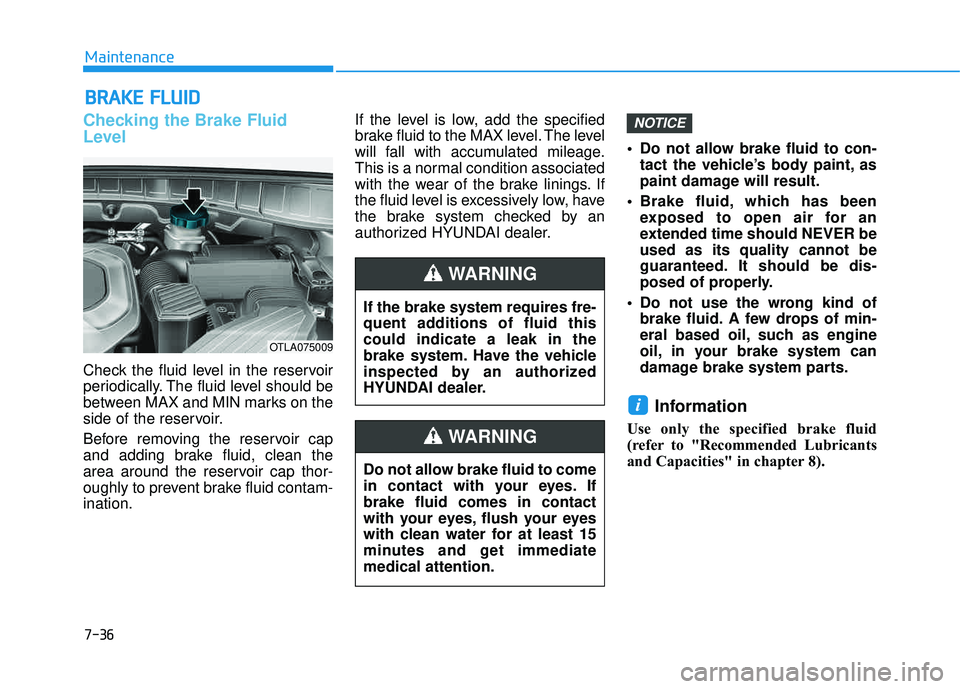
Check the fluid level in the reservoir
periodically. The fluid level should be
between MAX and MIN marks on the
side of the reservoir.
Before removing the reservoir cap
and adding brake fluid, clean the
area around the reservoir cap thor-
oughly to prevent brake fluid contam-ination. If the level is low, add the specified
brake fluid to the MAX level. The level
will fall with accumulated mileage.
This is a normal condition associated
with the wear of the brake linings. If
the fluid level is excessively low, have
the brake system checked by an
authorized HYUNDAI dealer.
Do not allow brake fluid to con-
tact the vehicle’s body paint, as
paint damage will result.
Brake fluid, which has been exposed to open air for an
extended time should NEVER beused as its quality cannot be
guaranteed. It should be dis-
posed of properly.
Do not use the wrong kind of brake fluid. A few drops of min-
eral based oil, such as engine
oil, in your brake system can
damage brake system parts.
Information
Use only the specified brake fluid
(refer to "Recommended Lubricants
and Capacities" in chapter 8).
i
NOTICE
If the brake system requires fre-
quent additions of fluid thiscould indicate a leak in the
brake system. Have the vehicle
inspected by an authorized
HYUNDAI dealer.
WARNING
Do not allow brake fluid to come
in contact with your eyes. Ifbrake fluid comes in contact
with your eyes, flush your eyes
with clean water for at least 15
minutes and get immediatemedical attention.
WARNING
OTLA075009
Page 550 of 642
7-37
7
Maintenance
WWAASSHH EERR FF LLUU IIDD
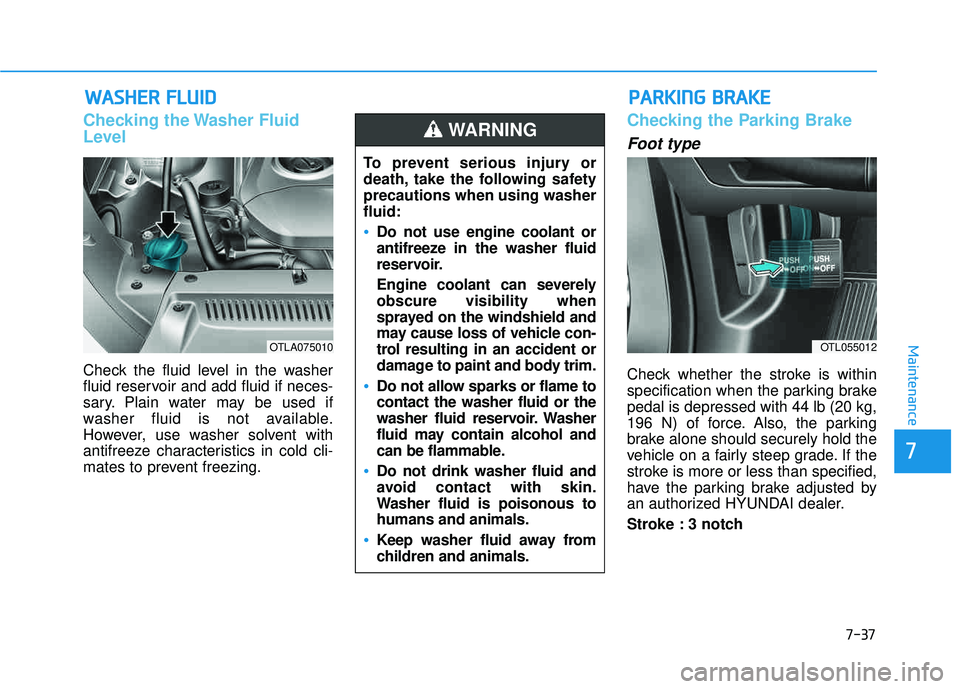
Checking the Washer Fluid
Level
Check the fluid level in the washer
fluid reservoir and add fluid if neces-
sary. Plain water may be used if
washer fluid is not available.
However, use washer solvent with
antifreeze characteristics in cold cli-
mates to prevent freezing.
Checking the Parking Brake
Foot type
Check whether the stroke is within
specification when the parking brakepedal is depressed with 44 lb (20 kg,
196 N) of force. Also, the parking
brake alone should securely hold the
vehicle on a fairly steep grade. If the
stroke is more or less than specified,
have the parking brake adjusted by
an authorized HYUNDAI dealer.
Stroke : 3 notch
OTLA075010OTL055012
PP AA RRKK IINN GG BB RRAA KKEE
To prevent serious injury or
death, take the following safetyprecautions when using washerfluid:
Do not use engine coolant or
antifreeze in the washer fluid
reservoir.
Engine coolant can severely obscure visibility when
sprayed on the windshield and
may cause loss of vehicle con-
trol resulting in an accident or
damage to paint and body trim.
Do not allow sparks or flame to contact the washer fluid or the
washer fluid reservoir. Washer
fluid may contain alcohol and
can be flammable.
Do not drink washer fluid and
avoid contact with skin.
Washer fluid is poisonous tohumans and animals.
Keep washer fluid away from
children and animals.
WARNING
Page 555 of 642
7-42
Maintenance
WWIIPP EERR BB LLAA DDEESS
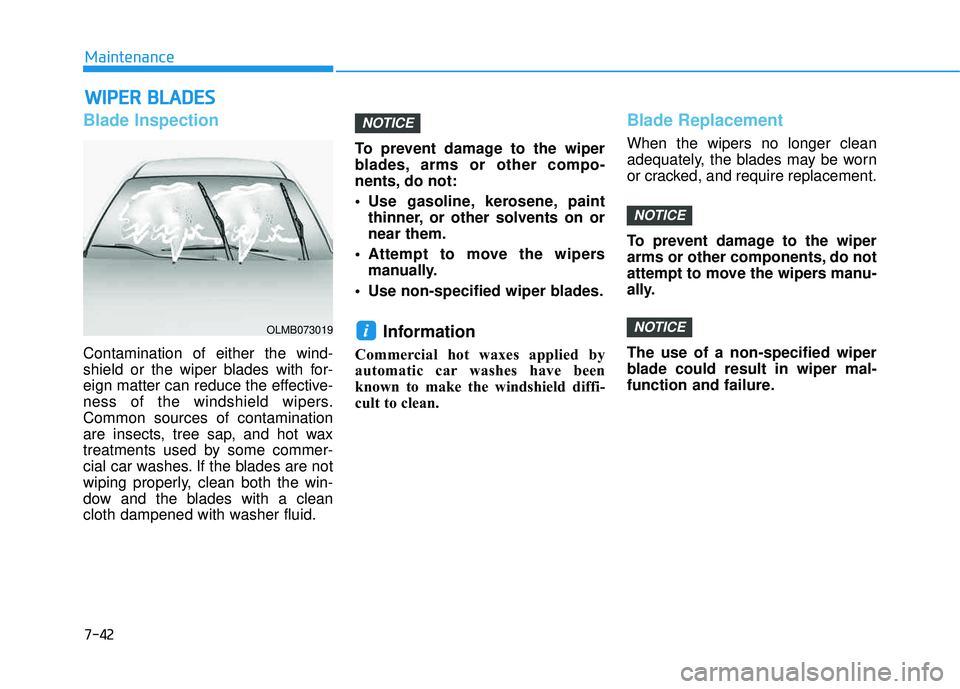
Blade Inspection
Contamination of either the wind-
shield or the wiper blades with for-
eign matter can reduce the effective-
ness of the windshield wipers.Common sources of contamination
are insects, tree sap, and hot wax
treatments used by some commer-
cial car washes. If the blades are not
wiping properly, clean both the win-
dow and the blades with a clean
cloth dampened with washer fluid. To prevent damage to the wiper
blades, arms or other compo-
nents, do not:
Use gasoline, kerosene, paint
thinner, or other solvents on or near them.
Attempt to move the wipers manually.
Use non-specified wiper blades.
Information
Commercial hot waxes applied by
automatic car washes have been
known to make the windshield diffi-
cult to clean.
Blade Replacement
When the wipers no longer clean
adequately, the blades may be worn
or cracked, and require replacement.
To prevent damage to the wiper
arms or other components, do not
attempt to move the wipers manu-
ally. The use of a non-specified wiper
blade could result in wiper mal-
function and failure.
NOTICE
NOTICE
i
NOTICE
OLMB073019
Page 573 of 642
7-60
Maintenance
Pneumatic tire
A mechanical device made of rubber,
chemicals, fabric and steel or other
materials, that, when mounted on an
automotive wheel provides the trac-tion and contains the gas or fluid thatsustains the load.
Pneumatic options weight
The combined weight of installed
regular production options weighing
over 5 lb. (2.3 kg) in excess of the
standard items which they replace,
not previously considered in curb
weight or accessory weight, includ-
ing heavy duty breaks, ride levelers,
roof rack, heavy duty battery, and
special trim.
Recommended InflationPressure
Vehicle manufacturer’s recommend-
ed tire inflation pressure as shownon the tire placard.
Radial Ply Tire
A pneumatic tire in which the ply
cords that extend to the beads are
laid at 90 degrees to the centerline ofthe tread.
Rim
A metal support for a tire and uponwhich the tire beads are seated.
Sidewall
The portion of a tire between thetread and the bead.
Speed Rating
An alphanumeric code assigned to a
tire indicating the maximum speed at
which a tire can operate.
Traction
The friction between the tire and the
road surface. The amount of grip pro-vided.
Tread
The portion of a tire that comes intocontact with the road.
Treadwear Indicators
Narrow bands, sometimes called
"wear bars", that show across thetread of a tire when only 1/16 inch of
tread remains.
UTQGS
Uniform Tire Quality Grading
Standards is a tire information sys-
tem that provides consumers with
ratings for a tire’s traction, tempera-
ture and treadwear. Ratings are
determined by tire manufacturers
using government testing proce-
dures. The ratings are molded into
the sidewall of the tire.
Vehicle Capacity Weight
The number of designated seating
positions multiplied by 150 lbs. (68
kg) plus the rated cargo and luggageload.
Page 616 of 642
7-103
7
Maintenance
Do not operate the engine in con-fined or closed areas (such as
garages) any more than what is
necessary to move the vehicle in orout of the area.
When the vehicle is stopped in an open area for more than a short
time with the engine running,
adjust the ventilation system (as
needed) to draw outside air into the
vehicle.
Never sit in a parked or stopped vehicle for any extended time with
the engine running.
When the engine stalls or fails to start, excessive attempts to restart
the engine may cause damage tothe emission control system.Operating precautions for cat-
alytic converters (if equipped)
The exhaust system and cat-
alytic converter are very hot
during and immediately after
the engine has been running. To
avoid SERIOUS INJURY or
DEATH:
Do not park, idle, or drive the
vehicle over or near flamma-
ble objects, such as grass,
vegetation, paper, leaves, etc.
A hot exhaust system can
ignite flammable items under
your vehicle.
Keep away from the exhaust
system and catalytic convert-
er or you may get burned.
Also, Do not remove the heat
sink around the exhaust sys-
tem, do not seal the bottom of
the vehicle, and do not coat
the vehicle for corrosion con-
trol. It may present a fire risk
under certain conditions.
WARNING CALIFORNIA PROPOSITION 65
WARNING
Engine exhaust and a wide vari- ety of automobile components
and parts, including compo-
nents found in the interior fur-
nishings in a vehicle, contain or
emit chemicals known to the
State of California to cause can-
cer and birth defects and repro-
ductive harm. In addition, cer-
tain fluids contained in vehicles
and certain products of compo-
nent wear contain or emit chem-
icals known to the State of
California to cause cancer and
birth defects or other reproduc-tive harm.
WARNING
Page 625 of 642
8-7
88
Specifications, Consumer information and Reporting safety defects
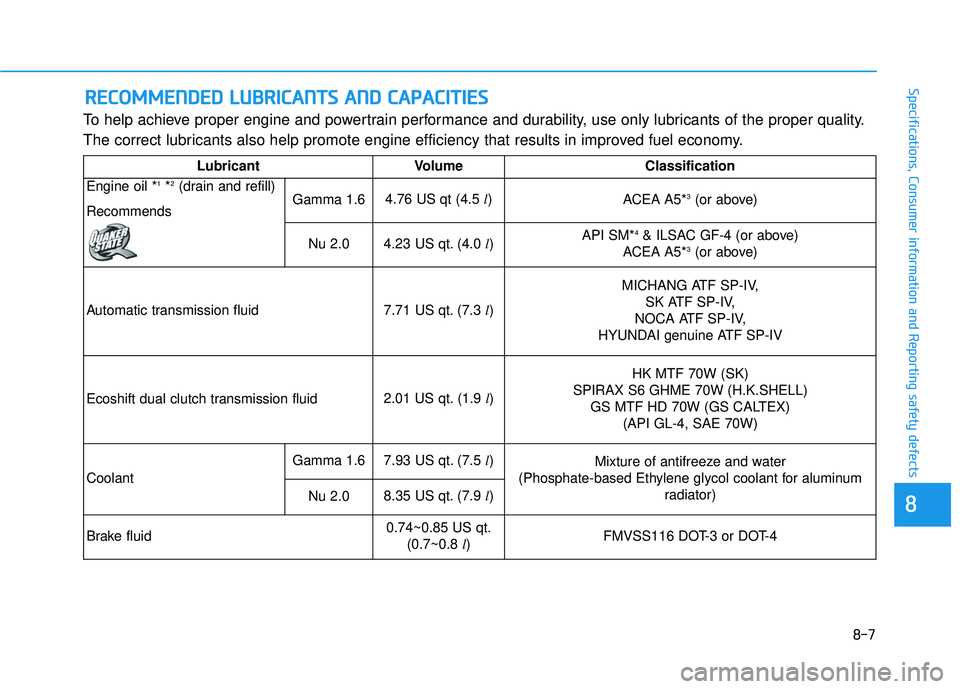
To help achieve proper engine and powertrain performance and durability, use only lubricants of the proper quality.
The correct lubricants also help promote engine efficiency that results in improved fuel economy.
RREECCOO MM MMEENN DDEEDD LL UU BBRRIICC AA NN TTSS AA NN DD CC AA PPAA CCIITT IIEE SS
Lubricant Volume Classification
Engine oil * 1
*2
(drain and refill)
Recommends Gamma 1.6
4.76 US qt (4.5
l)
ACEA A5*3
(or above)
Nu 2.0 4.23 US qt. (4.0
l) API SM*
4
& ILSAC GF-4 (or above)
ACEA A5* 3
(or above)
Automatic transmission fluid 7.71 US qt. (7.3
l) MICHANG ATF SP-IV,
SK ATF SP-IV,
NOCA ATF SP-IV,
HYUNDAI genuine ATF SP-IV
Ecoshift dual clutch transmission fluid 2.01 US qt. (1.9
l) HK MTF 70W (SK)
SPIRAX S6 GHME 70W (H.K.SHELL) GS MTF HD 70W (GS CALTEX) (API GL-4, SAE 70W)
Coolant Gamma 1.6
7.93 US qt. (7.5
l)
Mixture of antifreeze and water
(Phosphate-based Ethylene glycol coolant for aluminum radiator)
Nu 2.08.35 US qt. (7.9 l)
Brake fluid 0.74~0.85 US qt.
(0.7~0.8 l) FMVSS116 DOT-3 or DOT-4
Page 633 of 642
I-2
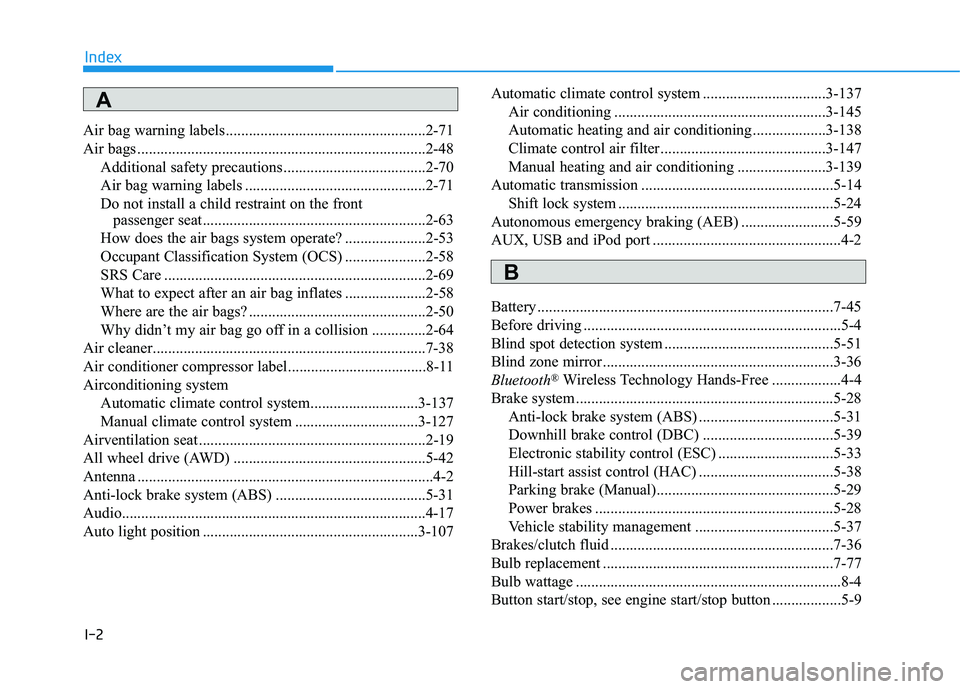
Air bag warning labels....................................................2-71
Air bags ...........................................................................2-48Additional safety precautions .....................................2-70
Air bag warning labels ...............................................2-71
Do not install a child restraint on the front passenger seat..........................................................2-63
How does the air bags system operate? .....................2-53
Occupant Classification System (OCS) .....................2-58
SRS Care ....................................................................2-69
What to expect after an air bag inflates .....................2-58
Where are the air bags? ..............................................2-50
Why didn’t my air bag go off in a collision ..............2-64
Air cleaner.......................................................................7-38
Air conditioner compressor label....................................8-11
Airconditioning system Automatic climate control system............................3-137
Manual climate control system ................................3-127
Airventilation seat ...........................................................2-19
All wheel drive (AWD) ..................................................5-42
Antenna .............................................................................4-2
Anti-lock brake system (ABS) .......................................5-31
Audio...............................................................................4-17
Auto light position ........................................................3-107 Automatic climate control system ................................3-137
Air conditioning .......................................................3-145
Automatic heating and air conditioning ...................3-138
Climate control air filter ...........................................3-147
Manual heating and air conditioning .......................3-139
Automatic transmission ..................................................5-14 Shift lock system ........................................................5-24
Autonomous emergency braking (AEB) ........................5-59
AUX, USB and iPod port .................................................4-2
Battery .............................................................................7-45
Before driving ...................................................................5-4
Blind spot detection system ............................................5-51
Blind zone mirror............................................................3-36
Bluetooth
®Wireless Technology Hands-Free ..................4-4
Brake system ...................................................................5-28 Anti-lock brake system (ABS) ...................................5-31
Downhill brake control (DBC) ..................................5-39
Electronic stability control (ESC) ..............................5-33
Hill-start assist control (HAC) ...................................5-38
Parking brake (Manual)..............................................5-29
Power brakes ..............................................................5-28
Vehicle stability management ....................................5-37
Brakes/clutch fluid ..........................................................7-36
Bulb replacement ............................................................7-77
Bulb wattage .....................................................................8-4
Button start/stop, see engine start/stop button ..................5-9
Index
A
B