check engine HYUNDAI VELOSTER 2013 Workshop Manual
[x] Cancel search | Manufacturer: HYUNDAI, Model Year: 2013, Model line: VELOSTER, Model: HYUNDAI VELOSTER 2013Pages: 372, PDF Size: 22.04 MB
Page 312 of 372
747
Maintenance
Battery recharging
Your vehicle has a maintenance-free,
calcium-based battery.
If the battery becomes discharged in a
short time (because, for example the
headlights or interior lights were left on
while vehicle was not in use) jump start
the vehicle from another battery and run
the engine at least 20 minutes at idle
before driving. Do not turn off the engine
for 30 minutes total of idle and/or driving
as the battery may not have sufficient
recharge to start.CALIFORNIA PROPOSI-
TION 65 WARNING
Battery posts, terminals, and relat-
ed accessories contain lead and
lead compounds, chemicals known
to the State of California to cause
cancer, birth defects and reproduc-
tive harm. Batteries also contain
other chemicals known to the State
of California to cause cancer. Wash
hands after handling.
CAUTION
When you don’t use the vehicle
for a long time in the low temper-
ature, remove the battery and
store it indoors.
Always charge the battery fully to
prevent the battery case from
being damaged in low tempera-
tures.
If you connect unauthorized elec-
tronic devices to the battery, the
battery may be discharged. Never
use unauthorized devices.
WARNING- Recharging
battery
When recharging the battery,
observe the following precautions:
The battery must be removed
from the vehicle and placed in an
area with good ventilation.
Do not allow cigarettes, sparks,
or flame near the battery.
Watch the battery during charg-
ing, and stop or reduce the charg-
ing rate if the battery cells begin
gassing (boiling) violently or if
the temperature of the electrolyte
of any cell exceeds 120°F (49°C).
Wear eye protection when check-
ing the battery during charging.
Disconnect the battery charger in
the following order.
1. Turn off the battery charger main
switch.
2. Unhook the negative clamp from
the negative battery terminal.
3. Unhook the positive clamp from
the positive battery terminal.
Page 327 of 372
Maintenance
62 7
FUSES
A vehicle’s electrical system is protected
from electrical overload damage by
fuses.
This vehicle has 2 fuse panels, one locat-
ed in the driver’s side panel bolster, the
other in the engine compartment.
If any of your vehicle’s lights, acces-
sories, or controls do not work, check the
appropriate circuit fuse. If a fuse has
blown, the element inside the fuse will be
melted.
If the electrical system does not work,
first check the driver’s side fuse panel.
Always replace a blown fuse with one of
the same rating.
Before replacing a blown fuse, discon-
nect the negative battery cable.
If the replacement fuse blows, this indi-
cates an electrical problem. Avoid using
the system involved and immediately
consult an authorized HYUNDAI dealer.
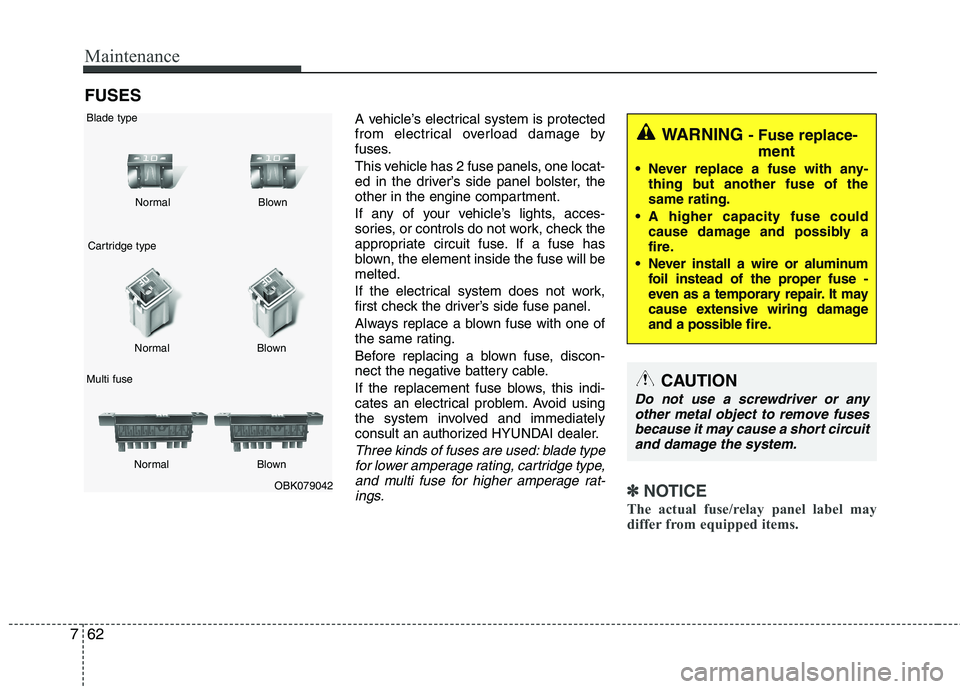
Three kinds of fuses are used: blade type
for lower amperage rating, cartridge type,
and multi fuse for higher amperage rat-
ings.
✽ ✽
NOTICE
The actual fuse/relay panel label may
differ from equipped items.
WARNING - Fuse replace-
ment
Never replace a fuse with any-
thing but another fuse of the
same rating.
A higher capacity fuse could
cause damage and possibly a
fire.
Never install a wire or aluminum
foil instead of the proper fuse -
even as a temporary repair. It may
cause extensive wiring damage
and a possible fire.
CAUTION
Do not use a screwdriver or any
other metal object to remove fuses
because it may cause a short circuit
and damage the system.
OBK079042 NormalNormal Blade type
Cartridge type
Multi fuseBlown
Blown
Normal Blown
Page 328 of 372
763
Maintenance
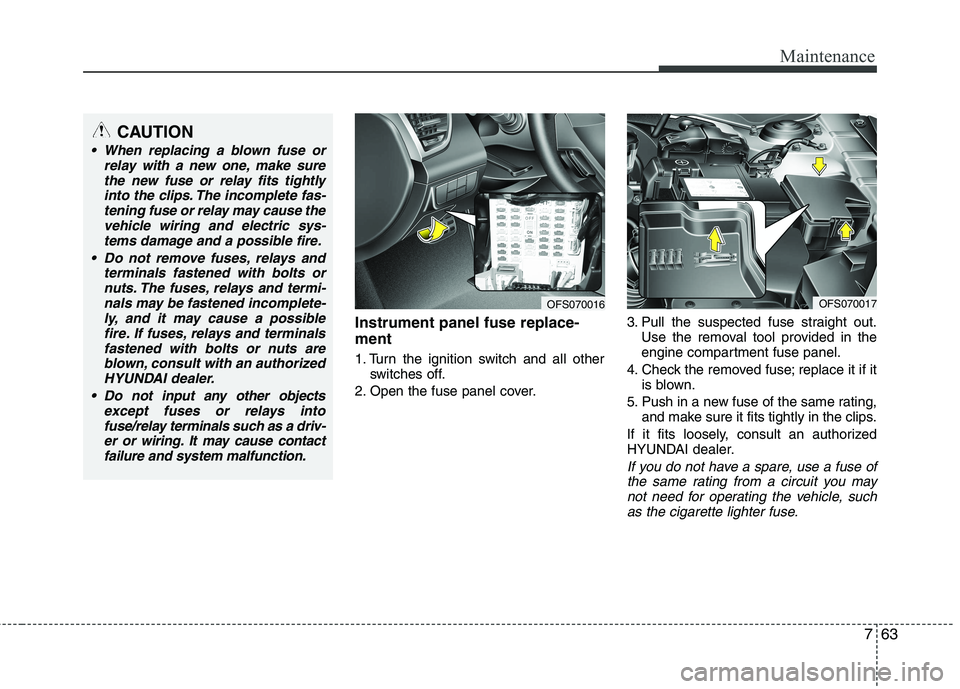
Instrument panel fuse replace-
ment
1. Turn the ignition switch and all other
switches off.
2. Open the fuse panel cover.3. Pull the suspected fuse straight out.
Use the removal tool provided in the
engine compartment fuse panel.
4. Check the removed fuse; replace it if it
is blown.
5. Push in a new fuse of the same rating,
and make sure it fits tightly in the clips.
If it fits loosely, consult an authorized
HYUNDAI dealer.
If you do not have a spare, use a fuse of
the same rating from a circuit you may
not need for operating the vehicle, such
as the cigarette lighter fuse.
OFS070016OFS070017
CAUTION
When replacing a blown fuse or
relay with a new one, make sure
the new fuse or relay fits tightly
into the clips. The incomplete fas-
tening fuse or relay may cause the
vehicle wiring and electric sys-
tems damage and a possible fire.
Do not remove fuses, relays and
terminals fastened with bolts or
nuts. The fuses, relays and termi-
nals may be fastened incomplete-
ly, and it may cause a possible
fire. If fuses, relays and terminals
fastened with bolts or nuts are
blown, consult with an authorized
HYUNDAI dealer.
Do not input any other objects
except fuses or relays into
fuse/relay terminals such as a driv-
er or wiring. It may cause contact
failure and system malfunction.
Page 329 of 372
Maintenance
64 7
If the headlights or other electrical com-
ponents do not work and the fuses are
OK, check the fuse panel in the engine
compartment. If a fuse is blown, it must
be replaced.
Fuse switch
Always, put the fuse switch at the ON
position.
If you move the switch to the OFF posi-
tion, some items must be reset and
transmitter (or smart key) may not work
properly.
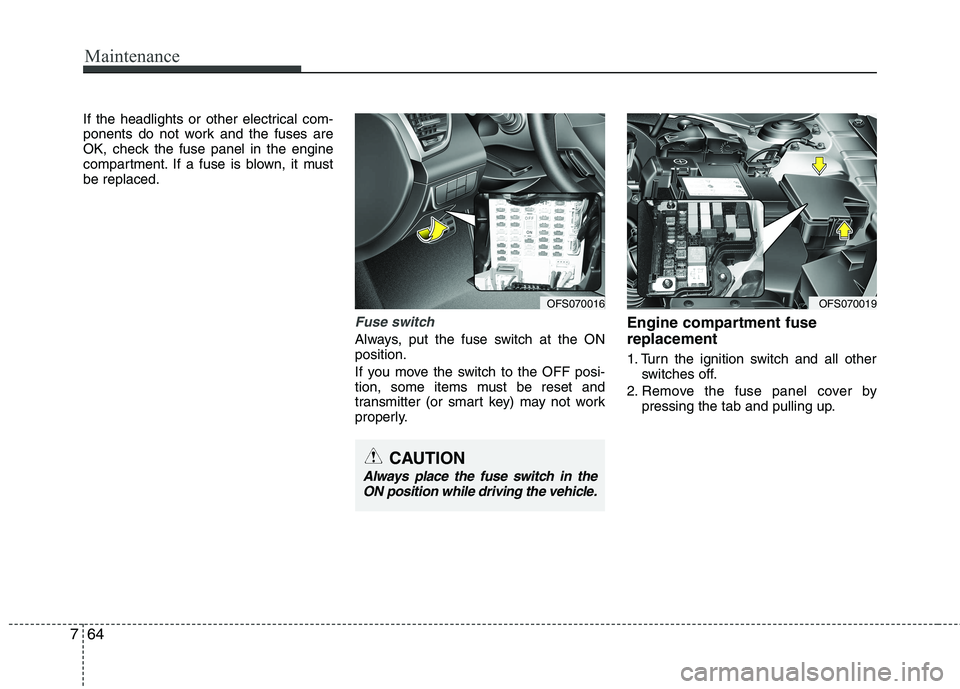
Engine compartment fuse
replacement
1. Turn the ignition switch and all other
switches off.
2. Remove the fuse panel cover by
pressing the tab and pulling up.
OFS070016OFS070019
CAUTION
Always place the fuse switch in the
ON position while driving the vehicle.
Page 330 of 372
765
Maintenance
3. Check the removed fuse; replace it if it
is blown. To remove or insert the fuse,
use the fuse puller in the engine com-
partment fuse panel.
4. Push in a new fuse of the same rating,
and make sure it fits tightly in the clips.
If it fits loosely, consult an authorized
HYUNDAI dealer.
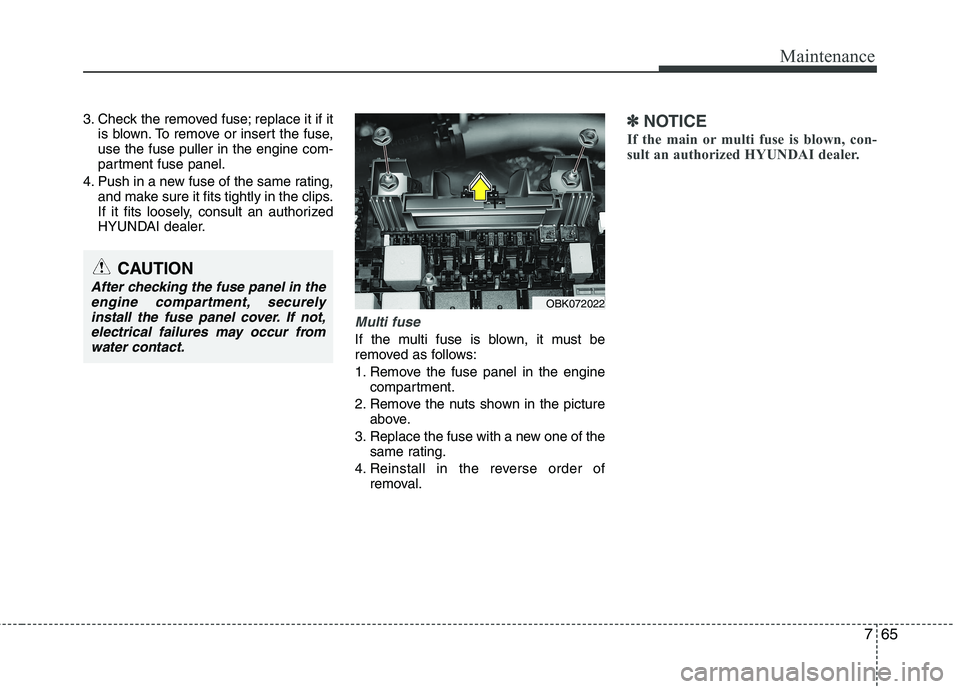
Multi fuse
If the multi fuse is blown, it must be
removed as follows:
1. Remove the fuse panel in the engine
compartment.
2. Remove the nuts shown in the picture
above.
3. Replace the fuse with a new one of the
same rating.
4. Reinstall in the reverse order of
removal.
✽ ✽
NOTICE
If the main or multi fuse is blown, con-
sult an authorized HYUNDAI dealer.
CAUTION
After checking the fuse panel in the
engine compartment, securely
install the fuse panel cover. If not,
electrical failures may occur from
water contact.
OBK072022
Page 332 of 372
767
Maintenance
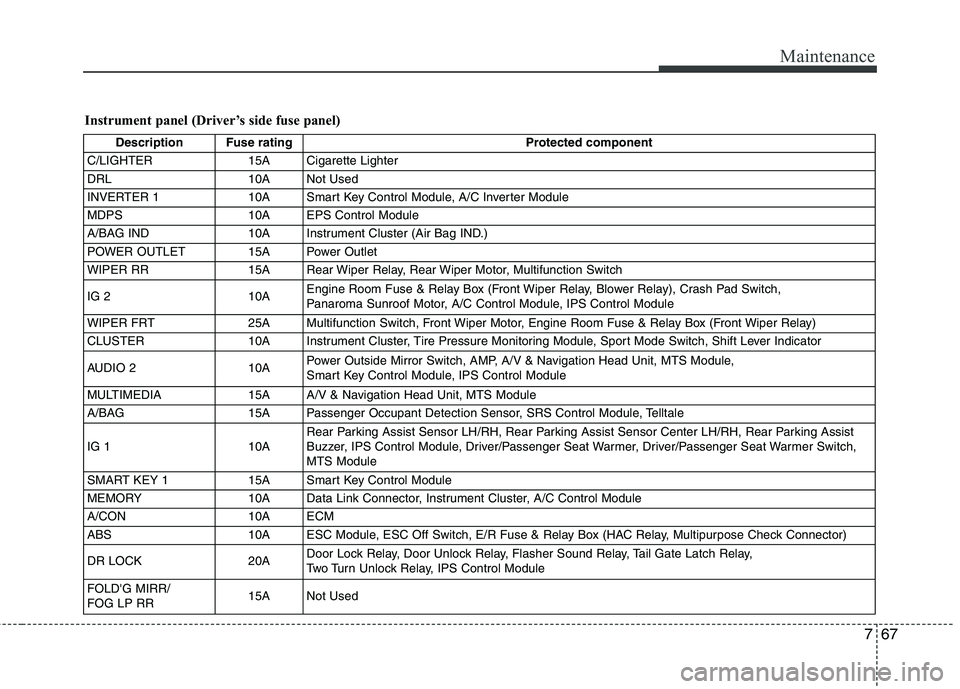
Instrument panel (Driver’s side fuse panel)
Description Fuse rating Protected component
C/LIGHTER 15A Cigarette Lighter
DRL 10A Not Used
INVERTER 1 10A Smart Key Control Module, A/C Inverter Module
MDPS 10A EPS Control Module
A/BAG IND 10A Instrument Cluster (Air Bag IND.)
POWER OUTLET 15A Power Outlet
WIPER RR 15A Rear Wiper Relay, Rear Wiper Motor, Multifunction Switch
IG 2 10AEngine Room Fuse & Relay Box (Front Wiper Relay, Blower Relay), Crash Pad Switch,
Panaroma Sunroof Motor, A/C Control Module, IPS Control Module
WIPER FRT 25A Multifunction Switch, Front Wiper Motor, Engine Room Fuse & Relay Box (Front Wiper Relay)
CLUSTER 10A Instrument Cluster, Tire Pressure Monitoring Module, Sport Mode Switch, Shift Lever Indicator
AUDIO 2 10APower Outside Mirror Switch, AMP, A/V & Navigation Head Unit, MTS Module,
Smart Key Control Module, IPS Control Module
MULTIMEDIA 15A A/V & Navigation Head Unit, MTS Module
A/BAG 15A Passenger Occupant Detection Sensor, SRS Control Module, Telltale
IG 1 10ARear Parking Assist Sensor LH/RH, Rear Parking Assist Sensor Center LH/RH, Rear Parking Assist
Buzzer, IPS Control Module, Driver/Passenger Seat Warmer, Driver/Passenger Seat Warmer Switch,
MTS Module
SMART KEY 1 15A Smart Key Control Module
MEMORY 10A Data Link Connector, Instrument Cluster, A/C Control Module
A/CON 10A ECM
ABS 10A ESC Module, ESC Off Switch, E/R Fuse & Relay Box (HAC Relay, Multipurpose Check Connector)
DR LOCK 20ADoor Lock Relay, Door Unlock Relay, Flasher Sound Relay, Tail Gate Latch Relay,
Two Turn Unlock Relay, IPS Control Module
FOLD'G MIRR/
FOG LP RR15A Not Used
Page 335 of 372
Maintenance
70 7
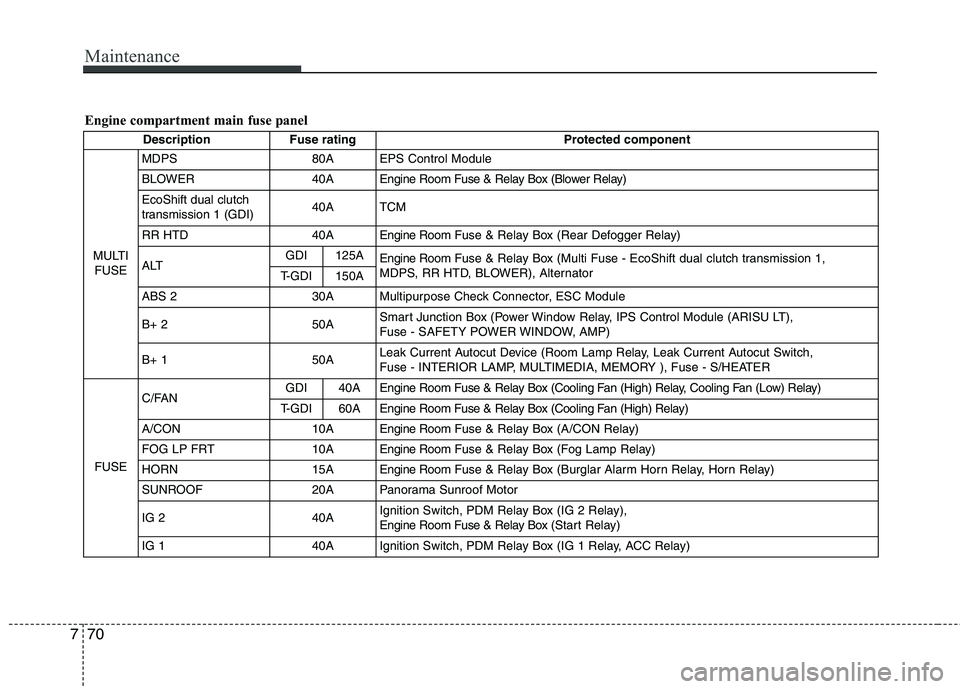
Engine compartment main fuse panel
Description Fuse rating Protected component
MULTI
FUSEMDPS 80A EPS Control Module
BLOWER 40A Engine Room Fuse & Relay Box (Blower Relay)
EcoShift dual clutch
transmission 1 (GDI)40A TCM
RR HTD 40A Engine RoomFuse & Relay Box (Rear Defogger Relay)
ALTGDI 125A
Engine RoomFuse & Relay Box (Multi Fuse - EcoShift dual clutch transmission 1,
MDPS, RR HTD, BLOWER), Alternator
T-GDI 150A
ABS 2 30A Multipurpose Check Connector, ESC Module
B+ 2 50ASmart Junction Box (Power Window Relay, IPS Control Module (ARISU LT),
Fuse - SAFETY POWER WINDOW, AMP)
B+ 150ALeak Current Autocut Device (Room Lamp Relay, Leak Current Autocut Switch,
Fuse - INTERIOR LAMP, MULTIMEDIA, MEMORY ), Fuse - S/HEATER
FUSEC/FANGDI 40A Engine Room Fuse & Relay Box (Cooling Fan (High) Relay, Cooling Fan (Low) Relay)
T-GDI 60AEngine Room Fuse & Relay Box (Cooling Fan (High) Relay)
A/CON 10AEngine RoomFuse & Relay Box (A/CON Relay)
FOG LP FRT 10AEngine RoomFuse & Relay Box (Fog Lamp Relay)
HORN 15AEngine RoomFuse & Relay Box (Burglar Alarm Horn Relay, Horn Relay)
SUNROOF 20A Panorama Sunroof Motor
IG 2 40AIgnition Switch, PDM Relay Box (IG 2 Relay),
Engine Room Fuse & Relay Box (Start Relay)
IG 1 40A Ignition Switch, PDM Relay Box (IG 1 Relay, ACC Relay)
Page 351 of 372
Maintenance
86 7
3. Exhaust emission control
system
The Exhaust Emission Control System is
a highly effective system which controls
exhaust emissions while maintaining
good vehicle performance.
Vehicle modifications
This vehicle should not be modified.
Modification of your vehicle could affect
its performance, safety or durability and
may even violate governmental safety
and emissions regulations.
In addition, damage or performance
problems resulting from any modification
may not be covered under warranty.
If you use unauthorized electronic
devices, it may cause the vehicle to oper-
ate abnormally, wire damage, battery
discharge and fire. For your safety, do not
use unauthorized electronic devices.
Engine exhaust gas precautions
(carbon monoxide)
Carbon monoxide can be present with
other exhaust fumes. Therefore, if you
smell exhaust fumes of any kind inside
your vehicle, have it inspected and
repaired immediately. If you ever sus-
pect exhaust fumes are coming into
your vehicle, drive it only with all the
windows fully open. Have your vehicle
checked and repaired immediately.
WARNING- Exhaust
Engine exhaust gases contain car-
bon monoxide (CO). Though color-
less and odorless, it is dangerous
and could be lethal if inhaled.
Follow the instructions on this
page to avoid CO poisoning.
CALIFORNIA PROPOSI-
TION 65 WARNING
Engine exhaust and a wide variety
of automobile components and
parts, including components found
in the interior furnishings in a vehi-
cle, contain or emit chemicals
known to the State of California to
cause cancer and birth defects and
reproductive harm. In addition, cer-
tain fluids contained in vehicles
and certain products of component
wear contain or emit chemicals
known to the State of California to
cause cancer and birth defects or
other reproductive harm.
CAUTION
If you use unauthorized electric
devices, it may cause the vehicle to
operate abnormally, wire damage,
battery discharge and fire. For your
safety. Be careful not to install after-
market devices that may affect vehi-
cle operation.
Page 360 of 372
87
Specifications, Consumer information, Reporting safety defects
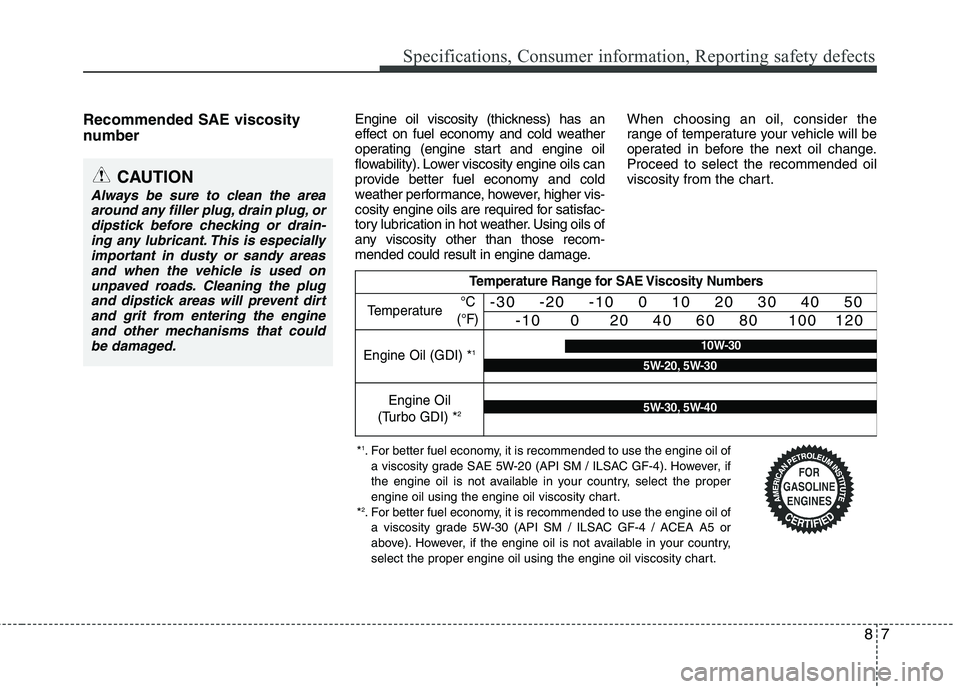
Recommended SAE viscosity
numberEngine oil viscosity (thickness) has an
effect on fuel economy and cold weather
operating (engine start and engine oil
flowability). Lower viscosity engine oils can
provide better fuel economy and cold
weather performance, however, higher vis-
cosity engine oils are required for satisfac-
tory lubrication in hot weather. Using oils of
any viscosity other than those recom-
mended could result in engine damage.When choosing an oil, consider the
range of temperature your vehicle will be
operated in before the next oil change.
Proceed to select the recommended oil
viscosity from the chart.
CAUTION
Always be sure to clean the area
around any filler plug, drain plug, or
dipstick before checking or drain-
ing any lubricant. This is especially
important in dusty or sandy areas
and when the vehicle is used on
unpaved roads. Cleaning the plug
and dipstick areas will prevent dirt
and grit from entering the engine
and other mechanisms that could
be damaged.
*1. For better fuel economy, it is recommended to use the engine oil of
a viscosity grade SAE 5W-20 (API SM / ILSAC GF-4). However, if
the engine oil is not available in your country, select the proper
engine oil using the engine oil viscosity chart.
*
2. For better fuel economy, it is recommended to use the engine oil of
a viscosity grade 5W-30 (API SM / ILSAC GF-4 / ACEA A5 or
above). However, if the engine oil is not available in your country,
select the proper engine oil using the engine oil viscosity chart.
Temperature Range for SAE Viscosity Numbers
Temperature -30 -20 -10 0 10 20 30 40 50
-10 0 20 40 60 80 100 120
Engine Oil (GDI) *1
Engine Oil
(Turbo GDI) *2
10W-30
5W-20, 5W-30
5W-30, 5W-40
°C
(°F)
Page 366 of 372
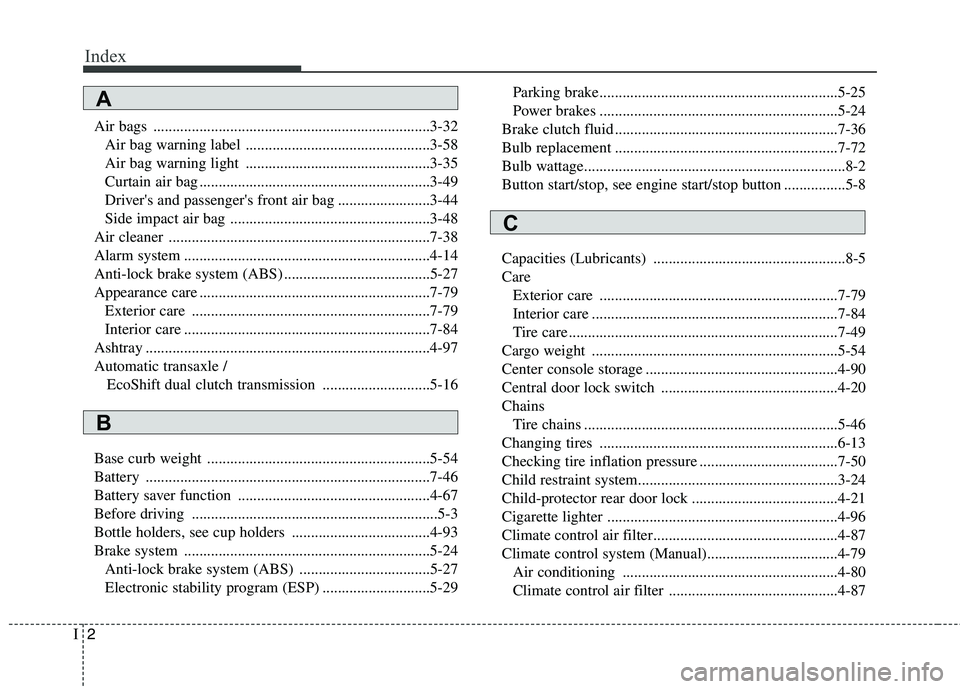
Index
2I
Air bags ........................................................................3-32
Air bag warning label ................................................3-58
Air bag warning light ................................................3-35
Curtain air bag ............................................................3-49
Driver's and passenger's front air bag ........................3-44
Side impact air bag ....................................................3-48
Air cleaner ....................................................................7-38
Alarm system ................................................................4-14
Anti-lock brake system (ABS) ......................................5-27
Appearance care ............................................................7-79
Exterior care ..............................................................7-79
Interior care ................................................................7-84
Ashtray ..........................................................................4-97
Automatic transaxle /
EcoShift dual clutch transmission ............................5-16
Base curb weight ..........................................................5-54
Battery ..........................................................................7-46
Battery saver function ..................................................4-67
Before driving ................................................................5-3
Bottle holders, see cup holders ....................................4-93
Brake system ................................................................5-24
Anti-lock brake system (ABS) ..................................5-27
Electronic stability program (ESP) ............................5-29Parking brake..............................................................5-25
Power brakes ..............................................................5-24
Brake clutch fluid ..........................................................7-36
Bulb replacement ..........................................................7-72
Bulb wattage....................................................................8-2
Button start/stop, see engine start/stop button ................5-8
Capacities (Lubricants) ..................................................8-5
Care
Exterior care ..............................................................7-79
Interior care ................................................................7-84
Tire care ......................................................................7-49
Cargo weight ................................................................5-54
Center console storage ..................................................4-90
Central door lock switch ..............................................4-20
Chains
Tire chains ..................................................................5-46
Changing tires ..............................................................6-13
Checking tire inflation pressure ....................................7-50
Child restraint system....................................................3-24
Child-protector rear door lock ......................................4-21
Cigarette lighter ............................................................4-96
Climate control air filter................................................4-87
Climate control system (Manual)..................................4-79
Air conditioning ........................................................4-80
Climate control air filter ............................................4-87
A
B
C