warning HYUNDAI VELOSTER 2022 Owners Manual
[x] Cancel search | Manufacturer: HYUNDAI, Model Year: 2022, Model line: VELOSTER, Model: HYUNDAI VELOSTER 2022Pages: 446, PDF Size: 7.37 MB
Page 304 of 446
5-110
Driving your vehicle
Information
• You may change settings from the
instrument cluster (User Settings),
refer to ‘LCD display’ section in
chapter 3.
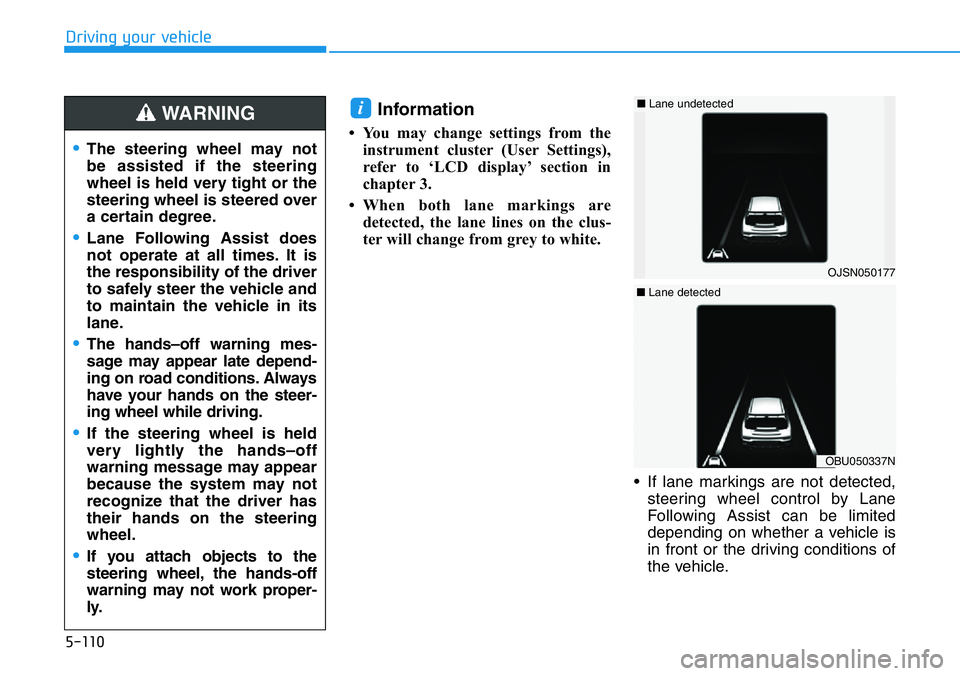
• When both lane markings are
detected, the lane lines on the clus-
ter will change from grey to white.
• If lane markings are not detected,
steering wheel control by Lane
Following Assist can be limited
depending on whether a vehicle is
in front or the driving conditions of
the vehicle.
i
OJSN050177
■Lane undetected
OBU050337N
■Lane detected
•The steering wheel may not
be assisted if the steering
wheel is held very tight or the
steering wheel is steered over
a certain degree.
•Lane Following Assist does
not operate at all times. It is
the responsibility of the driver
to safely steer the vehicle and
to maintain the vehicle in its
lane.
•The hands–off warning mes-
sage may appear late depend-
ing on road conditions. Always
have your hands on the steer-
ing wheel while driving.
•If the steering wheel is held
very lightly the hands–off
warning message may appear
because the system may not
recognize that the driver has
their hands on the steering
wheel.
•If you attach objects to the
steering wheel, the hands-off
warning may not work proper-
ly.
WARNING
Page 305 of 446
5-111
Driving your vehicle
5
• Even though the steering is assist-
ed by Lane Following Assist, the
driver may control the steering
wheel.
• The steering wheel may feel heav-
ier or lighter when the steering
wheel is assisted by Lane
Following Assist than when it is
not.System malfunction and limi-
tations
System malfunction
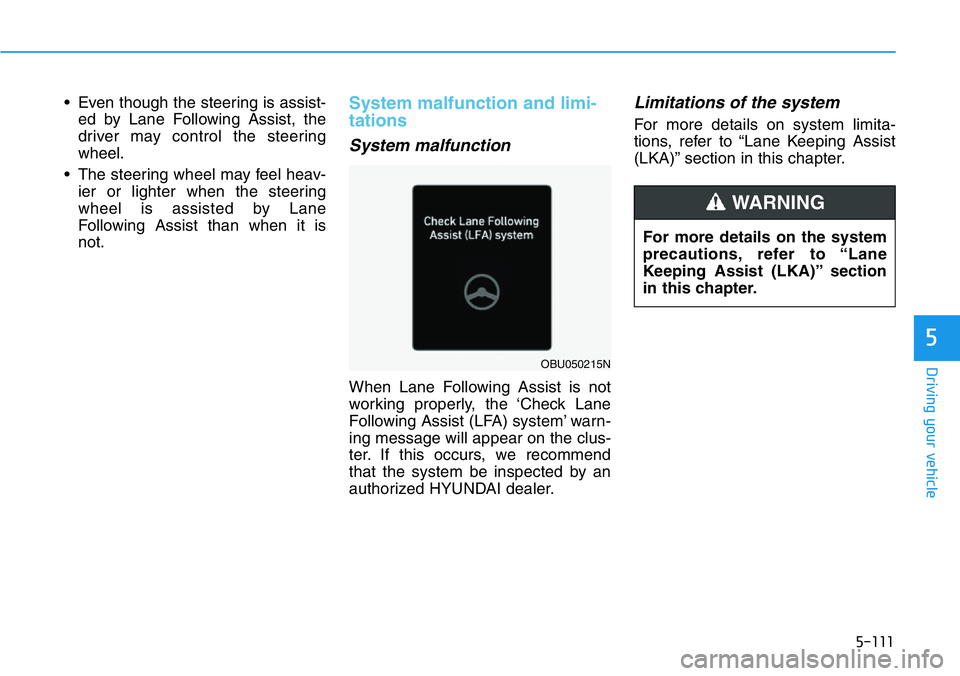
When Lane Following Assist is not
working properly, the ‘Check Lane
Following Assist (LFA) system’ warn-
ing message will appear on the clus-
ter. If this occurs, we recommend
that the system be inspected by an
authorized HYUNDAI dealer.
Limitations of the system
For more details on system limita-
tions, refer to “Lane Keeping Assist
(LKA)” section in this chapter.
OBU050215N
For more details on the system
precautions, refer to “Lane
Keeping Assist (LKA)” section
in this chapter.
WARNING
Page 306 of 446
5-112
Driving your vehicle
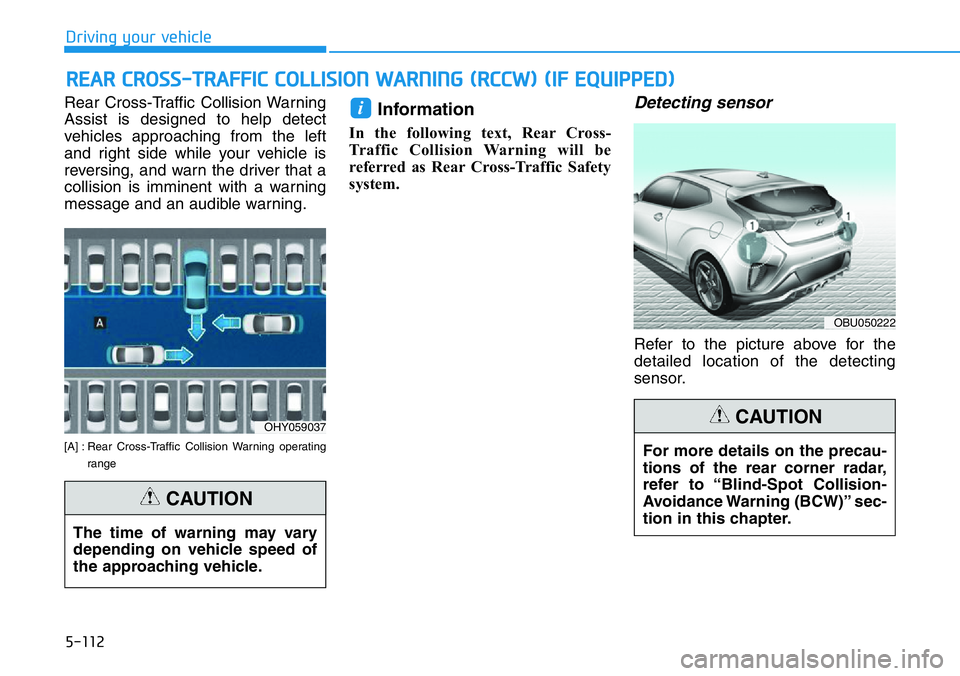
Rear Cross-Traffic Collision Warning
Assist is designed to help detect
vehicles approaching from the left
and right side while your vehicle is
reversing, and warn the driver that a
collision is imminent with a warning
message and an audible warning.
[A] : Rear Cross-Traffic Collision Warning operating
range
Information
In the following text, Rear Cross-
Traffic Collision Warning will be
referred as Rear Cross-Traffic Safety
system.
Detecting sensor
Refer to the picture above for the
detailed location of the detecting
sensor.
i
REAR CROSS-TRAFFIC COLLISION WARNING (RCCW) (IF EQUIPPED)
OHY059037
OBU050222
The time of warning may vary
depending on vehicle speed of
the approaching vehicle.
CAUTION
For more details on the precau-
tions of the rear corner radar,
refer to “Blind-Spot Collision-
Avoidance Warning (BCW)” sec-
tion in this chapter.
CAUTION
Page 307 of 446
5-113
Driving your vehicle
5
System settings
Setting functions for the system
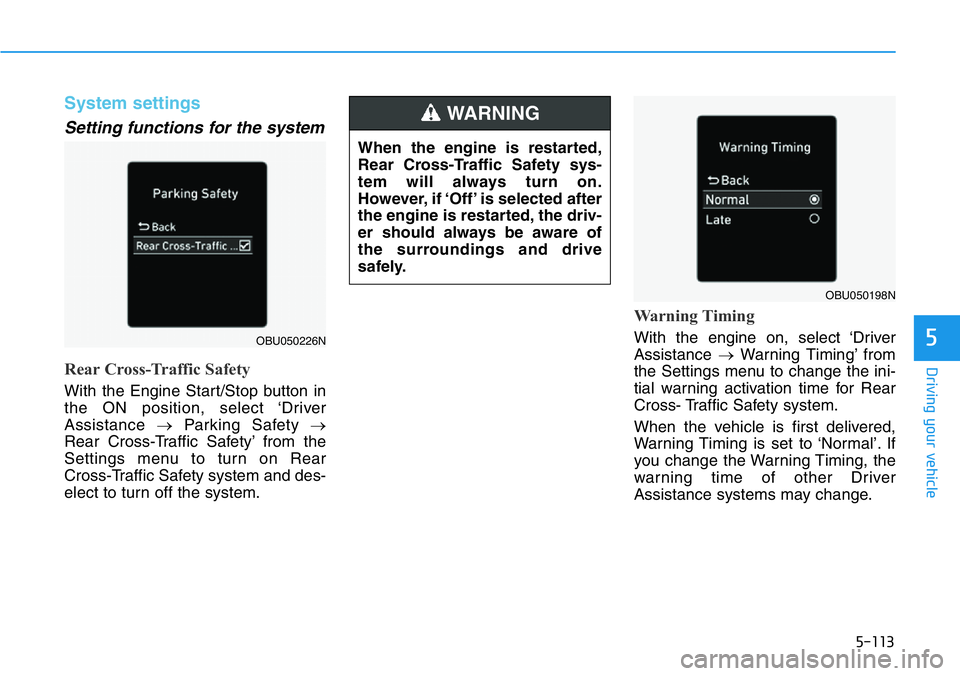
Rear Cross-Traffic Safety
With the Engine Start/Stop button in
the ON position, select ‘Driver
Assistance →Parking Safety →
Rear Cross-Traffic Safety’ from the
Settings menu to turn on Rear
Cross-Traffic Safety system and des-
elect to turn off the system.
Warning Timing
With the engine on, select ‘Driver
Assistance →Warning Timing’ from
the Settings menu to change the ini-
tial warning activation time for Rear
Cross- Traffic Safety system.
When the vehicle is first delivered,
Warning Timing is set to ‘Normal’. If
you change the Warning Timing, the
warning time of other Driver
Assistance systems may change.OBU050226N
When the engine is restarted,
Rear Cross-Traffic Safety sys-
tem will always turn on.
However, if ‘Off’ is selected after
the engine is restarted, the driv-
er should always be aware of
the surroundings and drive
safely.
WARNING
OBU050198N
Page 308 of 446
5-114
Driving your vehicle
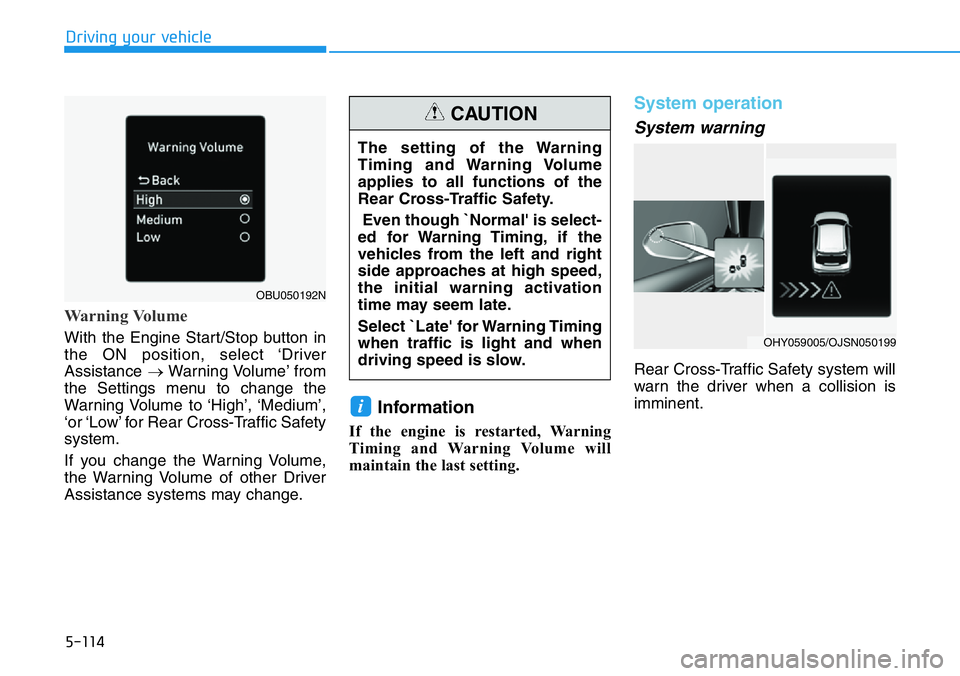
Warning Volume
With the Engine Start/Stop button in
the ON position, select ‘Driver
Assistance →Warning Volume’ from
the Settings menu to change the
Warning Volume to ‘High’, ‘Medium’,
‘or ‘Low’ for Rear Cross-Traffic Safety
system.
If you change the Warning Volume,
the Warning Volume of other Driver
Assistance systems may change.
Information
If the engine is restarted, Warning
Timing and Warning Volume will
maintain the last setting.
System operation
System warning
Rear Cross-Traffic Safety system will
warn the driver when a collision is
imminent.
i
The setting of the Warning
Timing and Warning Volume
applies to all functions of the
Rear Cross-Traffic Safety.
Even though `Normal' is select-
ed for Warning Timing, if the
vehicles from the left and right
side approaches at high speed,
the initial warning activation
time may seem late.
Select `Late' for Warning Timing
when traffic is light and when
driving speed is slow.
CAUTION
OBU050192N
OHY059005/OJSN050199
Page 309 of 446
5-115
Driving your vehicle
5
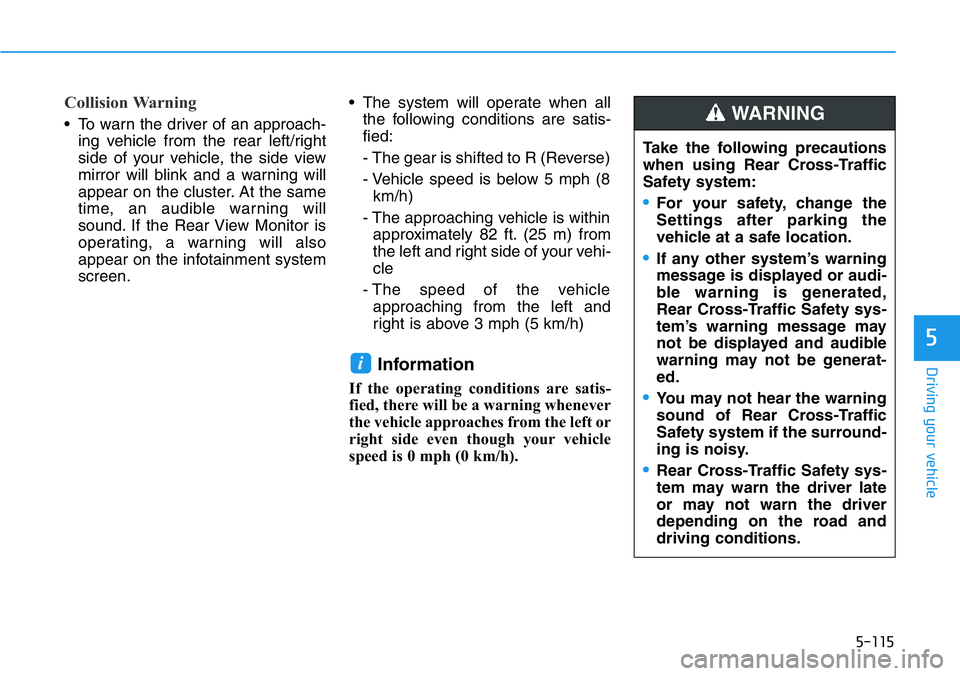
Collision Warning
• To warn the driver of an approach-
ing vehicle from the rear left/right
side of your vehicle, the side view
mirror will blink and a warning will
appear on the cluster. At the same
time, an audible warning will
sound. If the Rear View Monitor is
operating, a warning will also
appear on the infotainment system
screen.• The system will operate when all
the following conditions are satis-
fied:
- The gear is shifted to R (Reverse)
- Vehicle speed is below 5 mph (8
km/h)
- The approaching vehicle is within
approximately 82 ft. (25 m) from
the left and right side of your vehi-
cle
- The speed of the vehicle
approaching from the left and
right is above 3 mph (5 km/h)
Information
If the operating conditions are satis-
fied, there will be a warning whenever
the vehicle approaches from the left or
right side even though your vehicle
speed is 0 mph (0 km/h).
i
Take the following precautions
when using Rear Cross-Traffic
Safety system:
•For your safety, change the
Settings after parking the
vehicle at a safe location.
•If any other system’s warning
message is displayed or audi-
ble warning is generated,
Rear Cross-Traffic Safety sys-
tem’s warning message may
not be displayed and audible
warning may not be generat-
ed.
•You may not hear the warning
sound of Rear Cross-Traffic
Safety system if the surround-
ing is noisy.
•Rear Cross-Traffic Safety sys-
tem may warn the driver late
or may not warn the driver
depending on the road and
driving conditions.
WARNING
Page 310 of 446
5-116
Driving your vehicle
System malfunction and limi-
tations
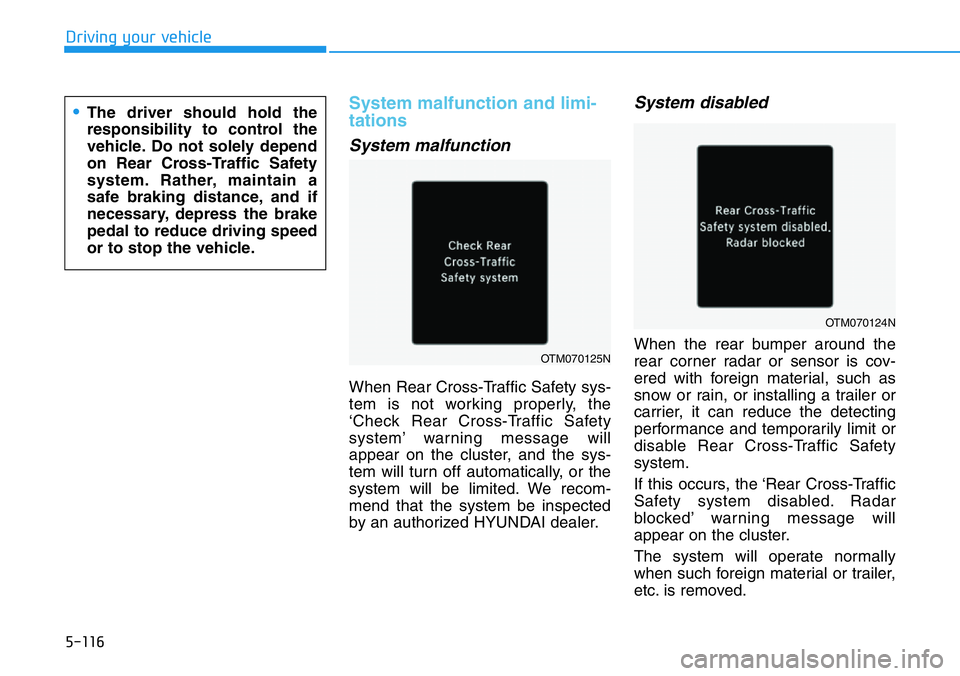
System malfunction
When Rear Cross-Traffic Safety sys-
tem is not working properly, the
‘Check Rear Cross-Traffic Safety
system’ warning message will
appear on the cluster, and the sys-
tem will turn off automatically, or the
system will be limited. We recom-
mend that the system be inspected
by an authorized HYUNDAI dealer.
System disabled
When the rear bumper around the
rear corner radar or sensor is cov-
ered with foreign material, such as
snow or rain, or installing a trailer or
carrier, it can reduce the detecting
performance and temporarily limit or
disable Rear Cross-Traffic Safety
system.
If this occurs, the ‘Rear Cross-Traffic
Safety system disabled. Radar
blocked’ warning message will
appear on the cluster.
The system will operate normally
when such foreign material or trailer,
etc. is removed.OTM070125N
OTM070124N
•The driver should hold the
responsibility to control the
vehicle. Do not solely depend
on Rear Cross-Traffic Safety
system. Rather, maintain a
safe braking distance, and if
necessary, depress the brake
pedal to reduce driving speed
or to stop the vehicle.
Page 311 of 446
5-117
Driving your vehicle
5
If the system does not operate nor-
mally after it is removed, we recom-
mend that the system be inspected
by an authorized HYUNDAI dealer.Limitations of the system
Rear Cross-Traffic Safety system
may not operate normally, or the sys-
tem may operate unexpectedly
under the following circumstances:
• Departing from where trees or
grass are overgrown
• Departing from where roads are
wet
• Speed of the approaching vehicle
is fast or slow
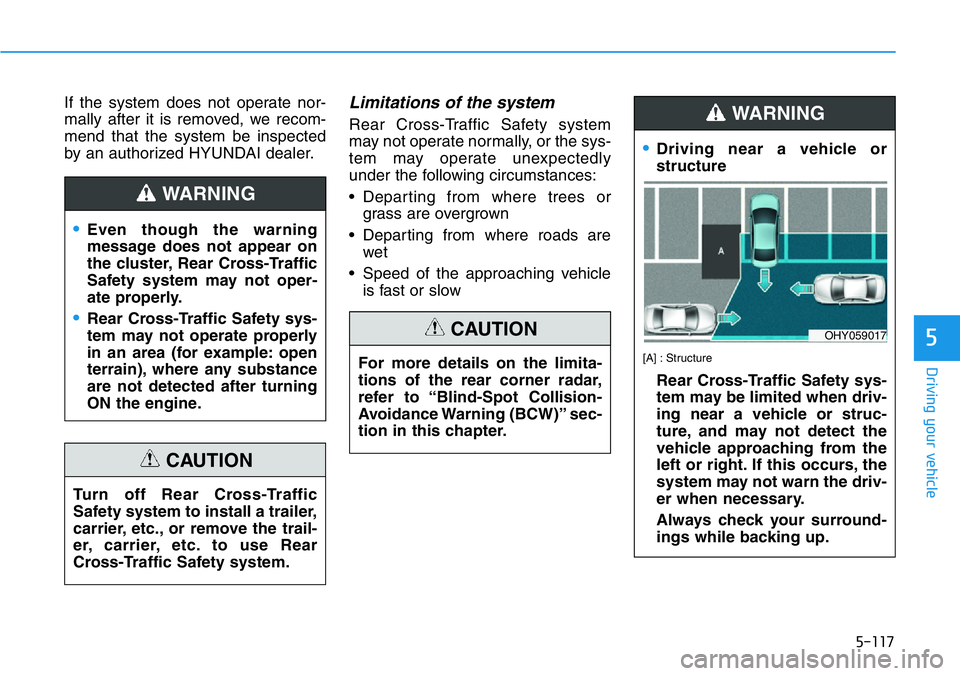
•Driving near a vehicle or
structure
[A] : Structure
Rear Cross-Traffic Safety sys-
tem may be limited when driv-
ing near a vehicle or struc-
ture, and may not detect the
vehicle approaching from the
left or right. If this occurs, the
system may not warn the driv-
er when necessary.
Always check your surround-
ings while backing up.
WARNING
For more details on the limita-
tions of the rear corner radar,
refer to “Blind-Spot Collision-
Avoidance Warning (BCW)” sec-
tion in this chapter.
CAUTIONOHY059017
•Even though the warning
message does not appear on
the cluster, Rear Cross-Traffic
Safety system may not oper-
ate properly.
•Rear Cross-Traffic Safety sys-
tem may not operate properly
in an area (for example: open
terrain), where any substance
are not detected after turning
ON the engine.
WARNING
Turn off Rear Cross-Traffic
Safety system to install a trailer,
carrier, etc., or remove the trail-
er, carrier, etc. to use Rear
Cross-Traffic Safety system.
CAUTION
Page 313 of 446
5-119
Driving your vehicle
5Information
This device complies with Part 15 of
the FCC rules.
Operation is subject to the following
two conditions:
1. This device may not cause harmful
interference.
2. This device must accept any inter-
ference received, including interfer-
ence that may cause undesired
operation.
i
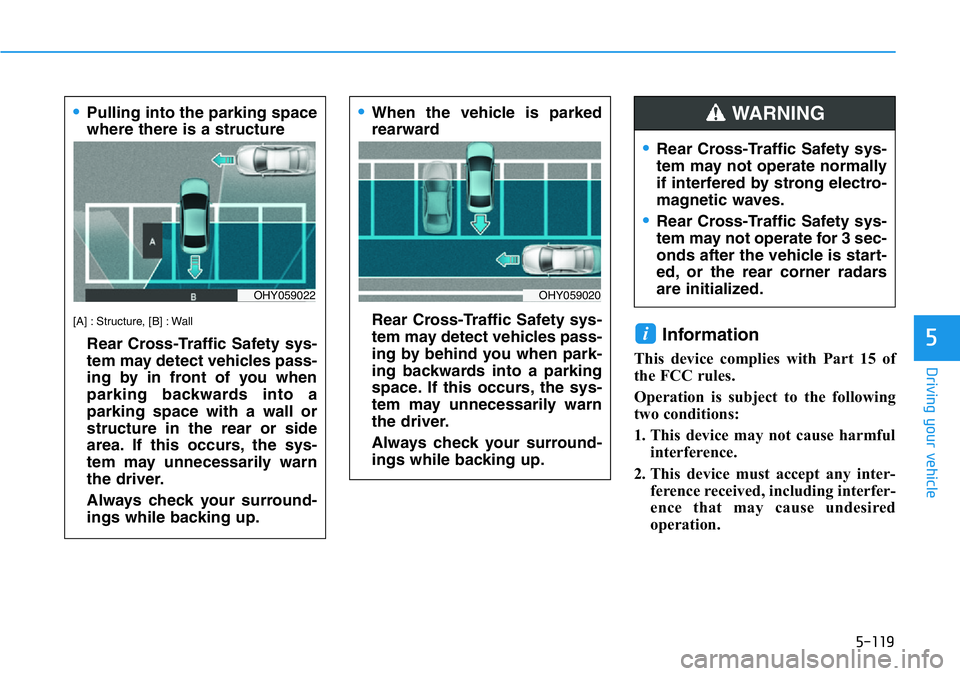
•When the vehicle is parked
rearward
Rear Cross-Traffic Safety sys-
tem may detect vehicles pass-
ing by behind you when park-
ing backwards into a parking
space. If this occurs, the sys-
tem may unnecessarily warn
the driver.
Always check your surround-
ings while backing up.
OHY059020
•Rear Cross-Traffic Safety sys-
tem may not operate normally
if interfered by strong electro-
magnetic waves.
•Rear Cross-Traffic Safety sys-
tem may not operate for 3 sec-
onds after the vehicle is start-
ed, or the rear corner radars
are initialized.
WARNING •Pulling into the parking space
where there is a structure
[A] : Structure, [B] : Wall
Rear Cross-Traffic Safety sys-
tem may detect vehicles pass-
ing by in front of you when
parking backwards into a
parking space with a wall or
structure in the rear or side
area. If this occurs, the sys-
tem may unnecessarily warn
the driver.
Always check your surround-
ings while backing up.
OHY059022
Page 314 of 446
5-120
Driving your vehicle
Hazardous Driving Conditions
When hazardous driving elements
are encountered such as water,
snow, ice, mud and sand, take the
below suggestions:
• Drive cautiously and keep a longer
braking distance.
• Avoid abrupt braking or steering.
• When your vehicle is stuck in snow,
mud, or sand, use second gear.
Accelerate slowly to avoid unnec-
essary wheel spin.
• Put sand, rock salt, tire chains or
other non-slip materials under the
wheels to provide additional trac-
tion while the vehicle becomes
stuck in ice, snow, or mud.
Rocking the Vehicle
If it is necessary to rock the vehicle
to free it from snow, sand, or mud,
first turn the steering wheel right and
left to clear the area around your
front wheels. Then, shift back and
forth between R (Reverse) and a for-
ward gear.
Try to avoid spinning the wheels, and
do not race the engine.
To prevent transmission wear, wait
until the wheels stop spinning before
shifting gears. Release the accelera-
tor pedal while shifting, and press
lightly on the accelerator pedal while
the transmission is in gear. Slowly
spinning the wheels in forward and
reverse directions causes a rocking
motion that may free the vehicle.
SPECIAL DRIVING CONDITIONS
If the vehicle is stuck and
excessive wheel spin occurs,
the temperature in the tires can
increase very quickly. If the tires
become damaged, a tire blow
out or tire explosion can occur.
This condition is dangerous -
you and others may be injured.
Do not attempt this procedure if
people or objects are anywhere
near the vehicle.
If you attempt to free the vehicle,
the vehicle can overheat quickly,
possibly causing damage to the
engine and other components.
Try to avoid spinning the wheels
as much as possible to prevent
overheating of either the tires or
the engine. DO NOT allow the
vehicle to spin the wheels above
35 mph (56 km/h).
WARNING