display HYUNDAI VELOSTER TURBO 2016 Owner's Manual
[x] Cancel search | Manufacturer: HYUNDAI, Model Year: 2016, Model line: VELOSTER TURBO, Model: HYUNDAI VELOSTER TURBO 2016Pages: 406, PDF Size: 7.83 MB
Page 233 of 406
525
Driving your vehicle
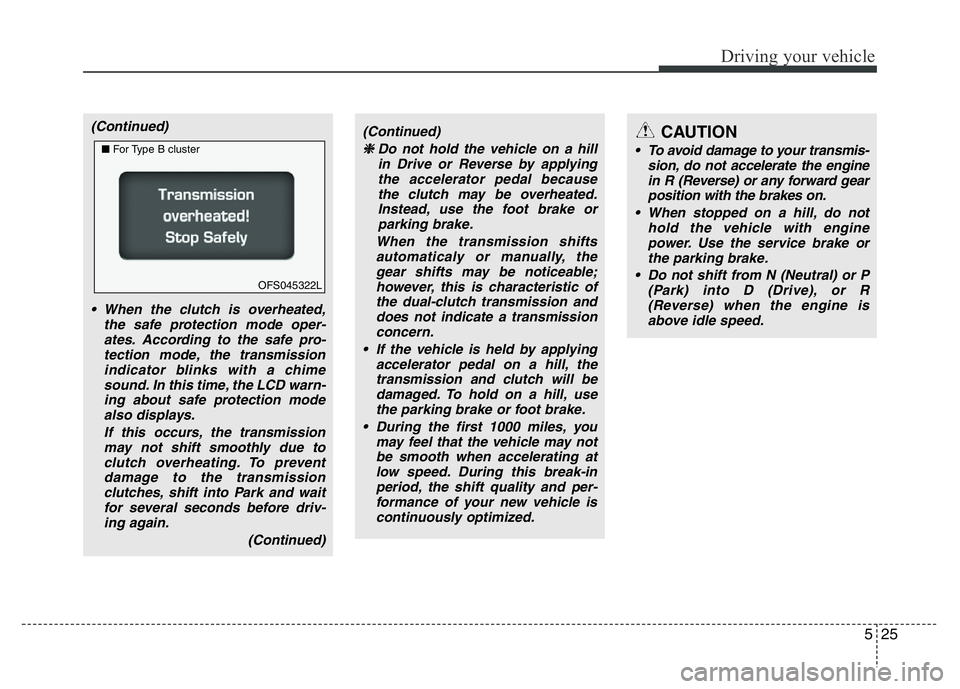
(Continued)
• When the clutch is overheated,
the safe protection mode oper-
ates. According to the safe pro-
tection mode, the transmission
indicator blinks with a chime
sound. In this time, the LCD warn-
ing about safe protection mode
also displays.
If this occurs, the transmission
may not shift smoothly due to
clutch overheating. To prevent
damage to the transmission
clutches, shift into Park and wait
for several seconds before driv-
ing again.
(Continued)(Continued)
❈Do not hold the vehicle on a hill
in Drive or Reverse by applying
the accelerator pedal because
the clutch may be overheated.
Instead, use the foot brake or
parking brake.
When the transmission shifts
automaticaly or manually, the
gear shifts may be noticeable;
however, this is characteristic of
the dual-clutch transmission and
does not indicate a transmission
concern.
Page 241 of 406
533
Driving your vehicle
CAUTION
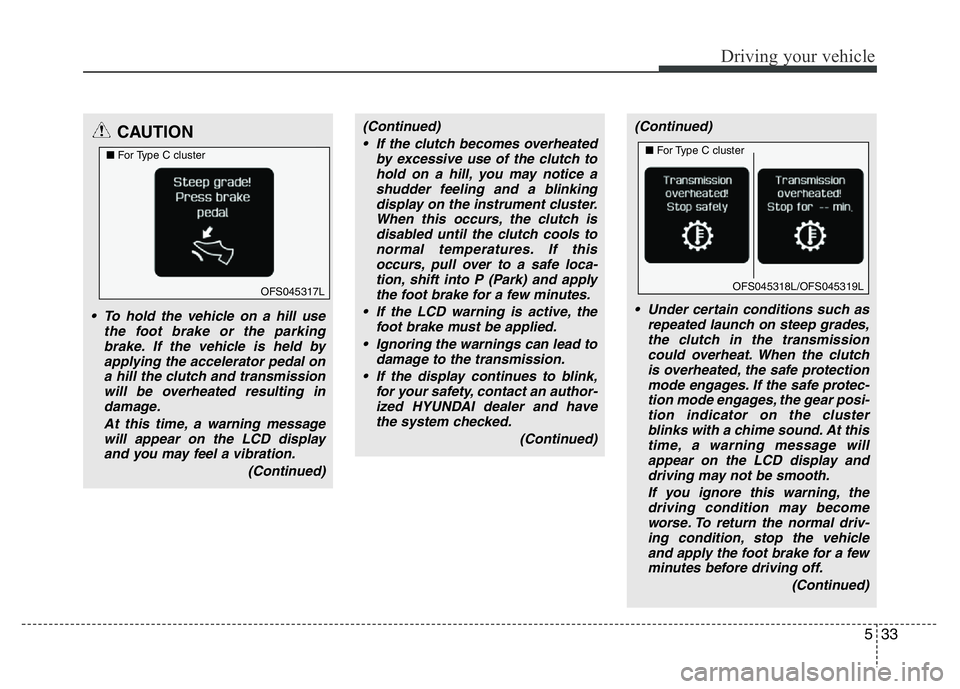
• To hold the vehicle on a hill use
the foot brake or the parking
brake. If the vehicle is held by
applying the accelerator pedal on
a hill the clutch and transmission
will be overheated resulting in
damage.
At this time, a warning message
will appear on the LCD display
and you may feel a vibration.
(Continued)
(Continued)
• If the clutch becomes overheated
by excessive use of the clutch to
hold on a hill, you may notice a
shudder feeling and a blinking
display on the instrument cluster.
When this occurs, the clutch is
disabled until the clutch cools to
normal temperatures. If this
occurs, pull over to a safe loca-
tion, shift into P (Park) and apply
the foot brake for a few minutes.
• If the LCD warning is active, the
foot brake must be applied.
• Ignoring the warnings can lead to
damage to the transmission.
• If the display continues to blink,
for your safety, contact an author-
ized HYUNDAI dealer and have
the system checked.
(Continued)(Continued)
• Under certain conditions such as
repeated launch on steep grades,
the clutch in the transmission
could overheat. When the clutch
is overheated, the safe protection
mode engages. If the safe protec-
tion mode engages, the gear posi-
tion indicator on the cluster
blinks with a chime sound. At this
time, a warning message will
appear on the LCD display and
driving may not be smooth.
If you ignore this warning, the
driving condition may become
worse. To return the normal driv-
ing condition, stop the vehicle
and apply the foot brake for a few
minutes before driving off.
(Continued)
OFS045317L
■For Type C cluster
OFS045318L/OFS045319L
■For Type C cluster
Page 242 of 406
Driving your vehicle
34 5
Transmission ranges
The indicator in the instrument cluster
displays the shift lever position when the
ignition switch is in the ON position.
P (Park)
Always come to a complete stop before
shifting into P (Park).
To shift from P (Park), you must depress
firmly on the brake pedal and make sure
your foot is off the accelerator pedal.
The shift lever must be in P (Park) before
turning the engine off.R (Reverse)
Use this position to drive the vehicle
backward.(Continued)
• Gear shifts may be more notice-
able than a conventional automat-
ic transmission. This is a normal
characteristic of this type of
EcoShift dual clutch transmis-
sion.
• During the first 1,000 miles, you
may feel that the vehicle may not
be smooth when accelerating at
low speed. During this break-in
period, the shift quality and per-
formance of your new vehicle is
continuously optimized.
• Always come to a complete stop
before shifting into D (Drive) or R
(Reverse).
• Do not put the shift lever in N
(Neutral) while driving.
WARNING
• Shifting into P (Park) while the
vehicle is in motion may cause
you to lose control of the vehicle.
• After the vehicle has stopped,
always make sure the shift lever
is in P (Park), apply the parking
brake, and turn the engine off.
• Do not use the P (Park) position
in place of the parking brake.
CAUTION
Always come to a complete stop
before shifting into or out of R
(Reverse); you may damage the
transmission if you shift into R
(Reverse) while the vehicle is in
motion.
Page 301 of 406
623
What to do in an emergency
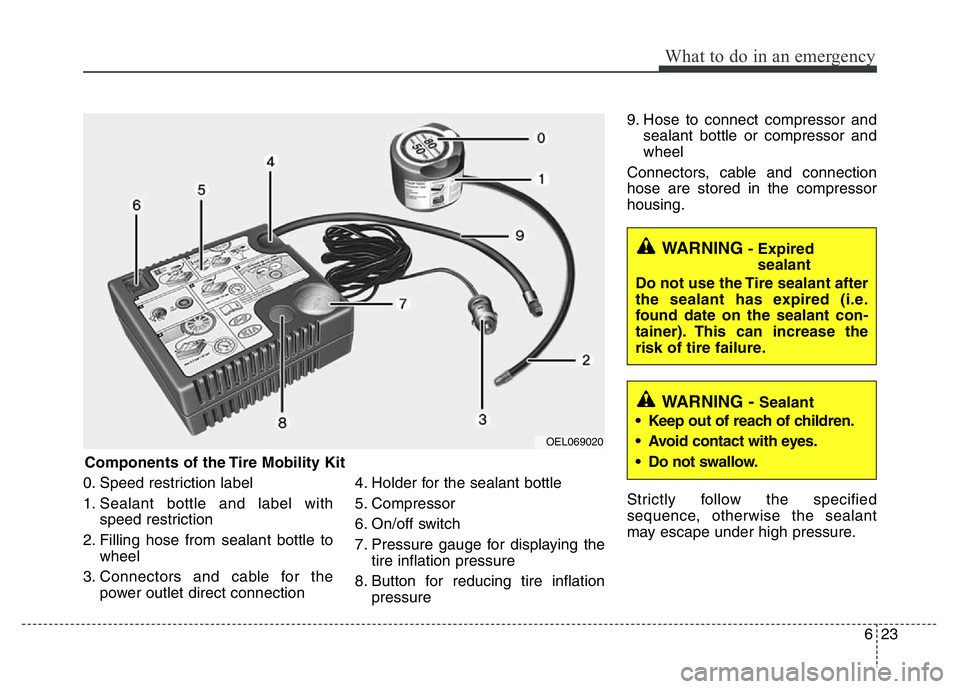
0. Speed restriction label
1. Sealant bottle and label with
speed restriction
2. Filling hose from sealant bottle to
wheel
3. Connectors and cable for the
power outlet direct connection4. Holder for the sealant bottle
5. Compressor
6. On/off switch
7. Pressure gauge for displaying the
tire inflation pressure
8. Button for reducing tire inflation
pressure9. Hose to connect compressor and
sealant bottle or compressor and
wheel
Connectors, cable and connection
hose are stored in the compressor
housing.
Strictly follow the specified
sequence, otherwise the sealant
may escape under high pressure.
WARNING- Expired
sealant
Do not use the Tire sealant after
the sealant has expired (i.e.
found date on the sealant con-
tainer). This can increase the
risk of tire failure.
WARNING - Sealant
• Keep out of reach of children.
• Avoid contact with eyes.
• Do not swallow.
Components of the Tire Mobility Kit
OEL069020
Page 366 of 406
Maintenance
56 7
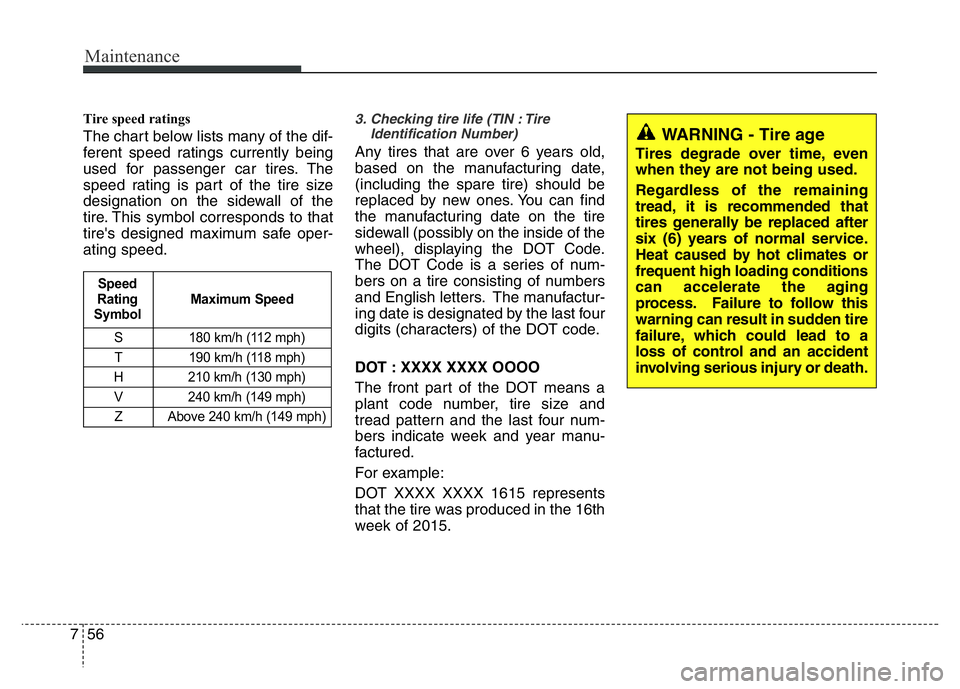
Tire speed ratings
The chart below lists many of the dif-
ferent speed ratings currently being
used for passenger car tires. The
speed rating is part of the tire size
designation on the sidewall of the
tire. This symbol corresponds to that
tire's designed maximum safe oper-
ating speed.
3. Checking tire life (TIN : Tire
Identification Number)
Any tires that are over 6 years old,
based on the manufacturing date,
(including the spare tire) should be
replaced by new ones. You can find
the manufacturing date on the tire
sidewall (possibly on the inside of the
wheel), displaying the DOT Code.
The DOT Code is a series of num-
bers on a tire consisting of numbers
and English letters. The manufactur-
ing date is designated by the last four
digits (characters) of the DOT code.
DOT : XXXX XXXX OOOO
The front part of the DOT means a
plant code number, tire size and
tread pattern and the last four num-
bers indicate week and year manu-
factured.
For example:
DOT XXXX XXXX 1615 represents
that the tire was produced in the 16th
week of 2015.
S 180 km/h (112 mph)
T 190 km/h (118 mph)
H 210 km/h (130 mph)
V 240 km/h (149 mph)
Z Above 240 km/h (149 mph)
Maximum Speed Speed
Rating
Symbol
WARNING - Tire age
Tires degrade over time, even
when they are not being used.
Regardless of the remaining
tread, it is recommended that
tires generally be replaced after
six (6) years of normal service.
Heat caused by hot climates or
frequent high loading conditions
can accelerate the aging
process. Failure to follow this
warning can result in sudden tire
failure, which could lead to a
loss of control and an accident
involving serious injury or death.