ignition HYUNDAI VELOSTER TURBO 2016 Owners Manual
[x] Cancel search | Manufacturer: HYUNDAI, Model Year: 2016, Model line: VELOSTER TURBO, Model: HYUNDAI VELOSTER TURBO 2016Pages: 406, PDF Size: 7.83 MB
Page 15 of 406
23
Your vehicle at a glance
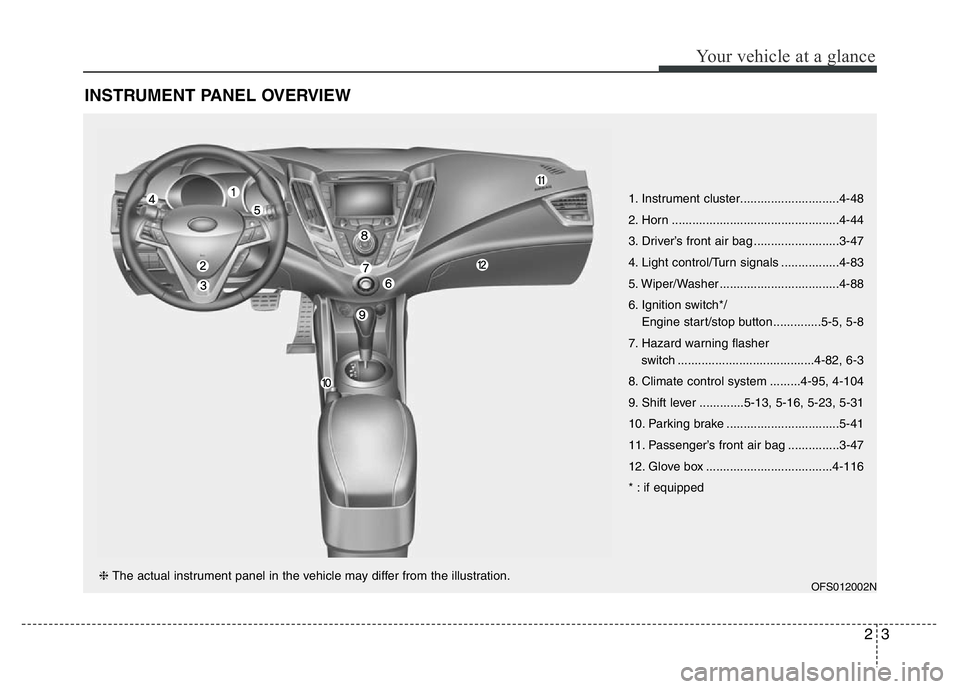
INSTRUMENT PANEL OVERVIEW
OFS012002N
1. Instrument cluster.............................4-48
2. Horn .................................................4-44
3. Driver’s front air bag .........................3-47
4. Light control/Turn signals .................4-83
5. Wiper/Washer ...................................4-88
6. Ignition switch*/
Engine start/stop button ..............5-5, 5-8
7. Hazard warning flasher
switch ........................................4-82, 6-3
8. Climate control system .........4-95, 4-104
9. Shift lever .............5-13, 5-16, 5-23, 5-31
10. Parking brake .................................5-41
11. Passenger’s front air bag ...............3-47
12. Glove box .....................................4-116
* : if equipped
❈ The actual instrument panel in the vehicle may differ from the illustration.
Page 24 of 406
Safety features of your vehicle
8 3
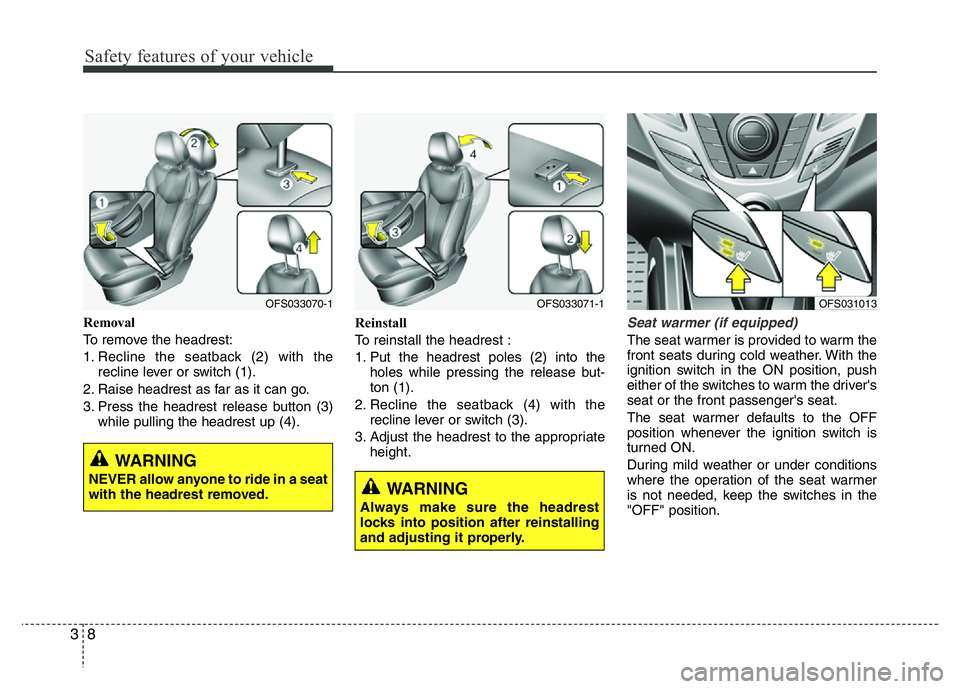
Removal
To remove the headrest:
1. Recline the seatback (2) with the
recline lever or switch (1).
2. Raise headrest as far as it can go.
3. Press the headrest release button (3)
while pulling the headrest up (4).Reinstall
To reinstall the headrest :
1. Put the headrest poles (2) into the
holes while pressing the release but-
ton (1).
2. Recline the seatback (4) with the
recline lever or switch (3).
3. Adjust the headrest to the appropriate
height.Seat warmer (if equipped)
The seat warmer is provided to warm the
front seats during cold weather. With the
ignition switch in the ON position, push
either of the switches to warm the driver's
seat or the front passenger's seat.
The seat warmer defaults to the OFF
position whenever the ignition switch is
turned ON.
During mild weather or under conditions
where the operation of the seat warmer
is not needed, keep the switches in the
"OFF" position.
OFS031013OFS033071-1
WARNING
Always make sure the headrest
locks into position after reinstalling
and adjusting it properly.
OFS033070-1
WARNING
NEVER allow anyone to ride in a seat
with the headrest removed.
Page 32 of 406
Safety features of your vehicle
16 3
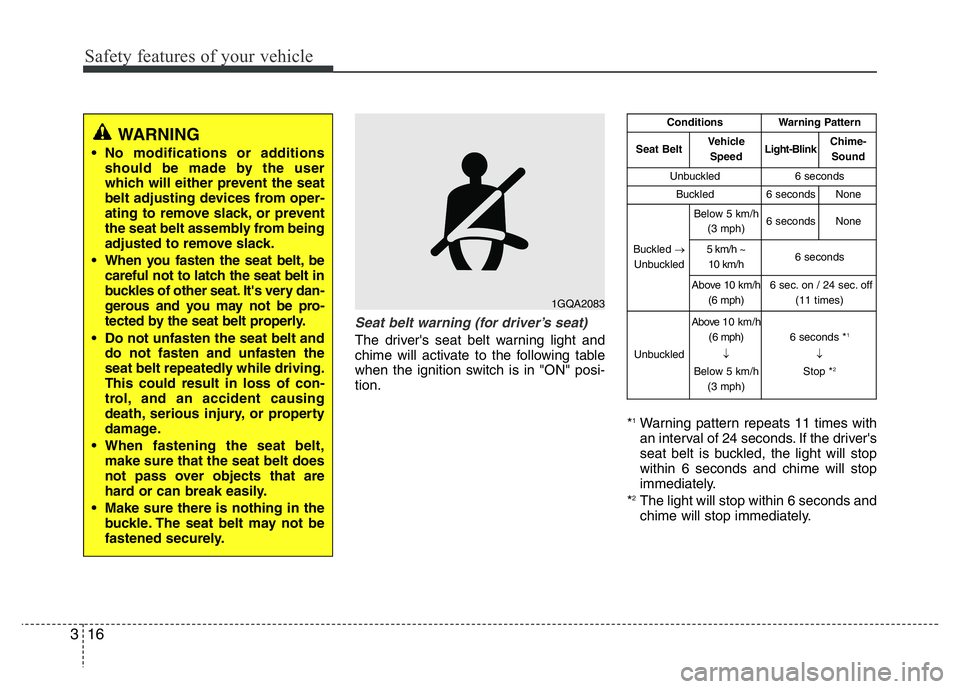
Seat belt warning (for driver’s seat)
The driver's seat belt warning light and
chime will activate to the following table
when the ignition switch is in "ON" posi-
tion.
*
1Warning pattern repeats 11 times with
an interval of 24 seconds. If the driver's
seat belt is buckled, the light will stop
within 6 seconds and chime will stop
immediately.
*
2The light will stop within 6 seconds and
chime will stop immediately.
WARNING
• No modifications or additions
should be made by the user
which will either prevent the seat
belt adjusting devices from oper-
ating to remove slack, or prevent
the seat belt assembly from being
adjusted to remove slack.
• When you fasten the seat belt, be
careful not to latch the seat belt in
buckles of other seat. It's very dan-
gerous and you may not be pro-
tected by the seat belt properly.
• Do not unfasten the seat belt and
do not fasten and unfasten the
seat belt repeatedly while driving.
This could result in loss of con-
trol, and an accident causing
death, serious injury, or property
damage.
• When fastening the seat belt,
make sure that the seat belt does
not pass over objects that are
hard or can break easily.
• Make sure there is nothing in the
buckle. The seat belt may not be
fastened securely.
1GQA2083
ConditionsWarning Pattern
Seat BeltVehicle
SpeedLight-BlinkChime-
Sound
Unbuckled6 seconds
Buckled6 secondsNone
Buckled →
Unbuckled
Below 5 km/h
(3 mph)6 secondsNone
5 km/h ~
10 km/h6 seconds
Above 10 km/h
(6 mph)6 sec. on / 24 sec. off
(11 times)
Unbuckled
Above 10 km/h
(6 mph)
↓
Below 5 km/h
(3 mph)6 seconds *1
↓
Stop *2
Page 36 of 406
Safety features of your vehicle
20 3
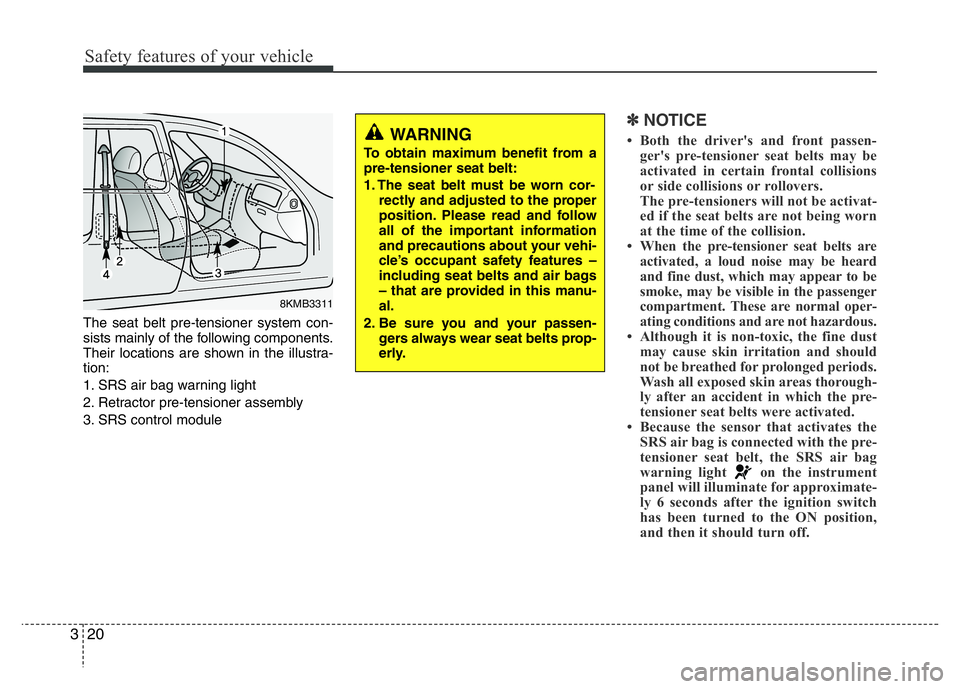
The seat belt pre-tensioner system con-
sists mainly of the following components.
Their locations are shown in the illustra-
tion:
1. SRS air bag warning light
2. Retractor pre-tensioner assembly
3. SRS control module
✽NOTICE
• Both the driver's and front passen-
ger's pre-tensioner seat belts may be
activated in certain frontal collisions
or side collisions or rollovers.
The pre-tensioners will not be activat-
ed if the seat belts are not being worn
at the time of the collision.
• When the pre-tensioner seat belts are
activated, a loud noise may be heard
and fine dust, which may appear to be
smoke, may be visible in the passenger
compartment. These are normal oper-
ating conditions and are not hazardous.
• Although it is non-toxic, the fine dust
may cause skin irritation and should
not be breathed for prolonged periods.
Wash all exposed skin areas thorough-
ly after an accident in which the pre-
tensioner seat belts were activated.
• Because the sensor that activates the
SRS air bag is connected with the pre-
tensioner seat belt, the SRS air bag
warning light on the instrument
panel will illuminate for approximate-
ly 6 seconds after the ignition switch
has been turned to the ON position,
and then it should turn off.
8KMB3311
WARNING
To obtain maximum benefit from a
pre-tensioner seat belt:
1. The seat belt must be worn cor-
rectly and adjusted to the proper
position. Please read and follow
all of the important information
and precautions about your vehi-
cle’s occupant safety features –
including seat belts and air bags
– that are provided in this manu-
al.
2. Be sure you and your passen-
gers always wear seat belts prop-
erly.
Page 37 of 406
321
Safety features of your vehicle
CAUTION
If the pre-tensioner seat belt is not
working properly, this warning light
will illuminate even if there is no
malfunction of the SRS air bag. If
the SRS air bag warning light does
not illuminate when the ignition
switch is turned ON, or if it remains
illuminated after illuminating for
approximately 6 seconds, or if it
illuminates while the vehicle is
being driven, have an authorized
HYUNDAI dealer inspect the pre-
tensioner seat belt and SRS air bag
system as soon as possible.WARNING
• Pre-tensioners are designed to
operate only one time. After acti-
vation, pre-tensioner seat belts
must be replaced. All seat belts,
of any type, should always be
replaced after they have been
worn during a collision.
• The pre-tensioner seat belt
assembly mechanisms become
hot during activation. Do not
touch the pre-tensioner seat belt
assemblies for several minutes
after they have been activated.
• Do not attempt to inspect or
replace the pre-tensioner seat
belts yourself. This must be done
by an authorized HYUNDAI deal-
er.
• Do not strike the pre-tensioner
seat belt assemblies.
• Do not attempt to service or
repair the pre-tensioner seat belt
system in any manner.
(Continued)
(Continued)
• Improper handling of the pre-ten-
sioner seat belt assemblies, and
failure to heed the warnings not
to strike, modify, inspect, replace,
service or repair the pre-tension-
er seat belt assemblies may lead
to improper operation or inadver-
tent activation and serious injury.
• Always wear the seat belts when
driving or riding in a motor vehi-
cle.
• If the vehicle or pre-tensioner
seat belt must be discarded, con-
tact an authorized HYUNDAI deal-
er.
Page 51 of 406
335
Safety features of your vehicle
How does the air bag system
operate
• Air bags are activated (able to inflate if
necessary) only when the ignition switch
is turned to the ON or START position.
• Air bags inflate instantly in the event of
serious frontal or side collision in order
to help protect the occupants from seri-
ous physical injury.
• There is no single speed at which the air
bags will inflate.
Generally, air bags are designed to
inflate based upon the severity of a colli-
sion and its direction. These two factors
determine whether the sensors produce
an electronic deployment/ inflation sig-
nal.
• Air bag deployment depends on a num-
ber of factors including vehicle speed,
angles of impact and the density and
stiffness of the vehicles or objects which
your vehicle hits in the collision. The
determining, factors are not limited to
those mentioned above.
• The front air bags will completely inflate
and deflate in an instant.
It is virtually impossible for you to see
the air bags inflate during an accident.
It is much more likely that you will simply
see the deflated air bags hanging out of
their storage compartments after the
collision.• In addition to inflating in certain side
collisions, vehicles equipped with a
rollover sensor, side air bags and cur-
tain air bags will inflate if the sensing
system detects a rollover.
When a rollover is detected, side air
bags and curtain air bags will remain
inflated longer to help provide protec-
tion from ejection, especially when
used in conjunction with the seat belts.
• In order to help provide protection in a
severe collision, the air bags must
inflate rapidly. The speed of air bag
inflation is a consequence of extreme-
ly short time in which a collision occurs
and the need to get the air bag
between the occupant and the vehicle
structures before the occupant impacts
those structures. This speed of inflation
reduces the risk of serious or life-
threatening injuries in a severe colli-
sion and is thus a necessary part of air
bag design.
However, air bag inflation can also
cause injuries which can include facial
abrasions, bruises and broken bones
because the inflation speed also caus-
es the air bags to expand with a great
deal of force.• There are even circumstances
under which contact with the steer-
ing wheel air bag can cause fatal
injuries, especially if the occupant
is positioned excessively close to
the steering wheel.
WARNING
• To avoid severe personal injury
or death caused by deploying air
bags in a collision, the driver
should sit as far back from the
steering wheel air bag as possible
(at least 250 mm (10 inches)
away). The front passenger should
always move their seat as far
back as possible and sit back in
their seat.
• Air bag inflates instantly in an
event of a collision, passengers
may be injured by the air bag
expansion force if they are not in
a proper position.
• Air bag inflation may cause
injuries including facial or bodily
abrasions, injuries from broken
glasses or burns.
Page 53 of 406
337
Safety features of your vehicle
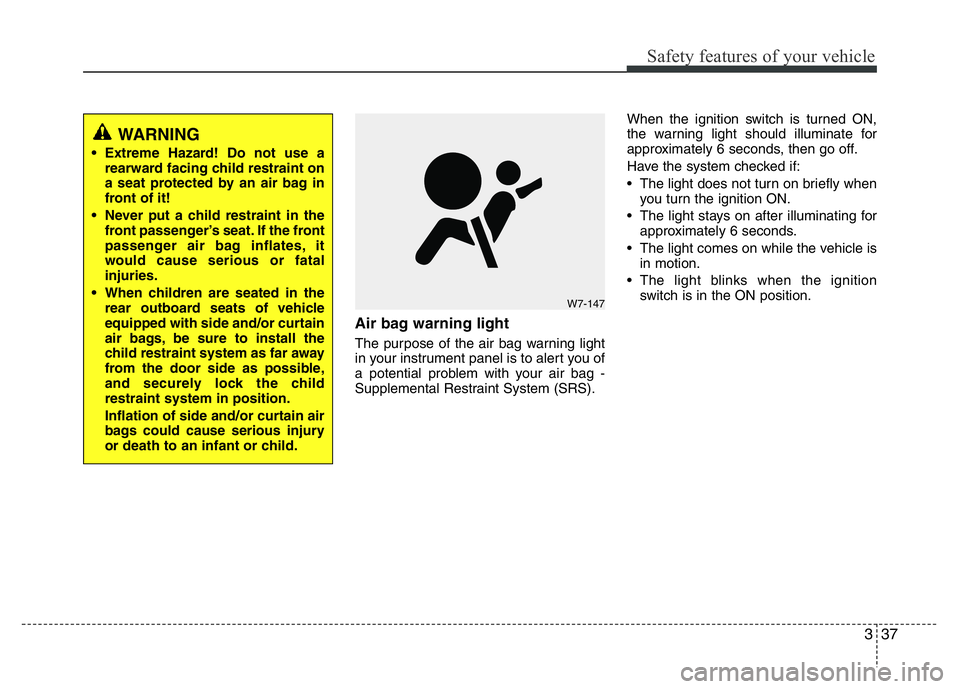
Air bag warning light
The purpose of the air bag warning light
in your instrument panel is to alert you of
a potential problem with your air bag -
Supplemental Restraint System (SRS).When the ignition switch is turned ON,
the warning light should illuminate for
approximately 6 seconds, then go off.
Have the system checked if:
• The light does not turn on briefly when
you turn the ignition ON.
• The light stays on after illuminating for
approximately 6 seconds.
• The light comes on while the vehicle is
in motion.
• The light blinks when the ignition
switch is in the ON position.
WARNING
• Extreme Hazard! Do not use a
rearward facing child restraint on
a seat protected by an air bag in
front of it!
• Never put a child restraint in the
front passenger’s seat. If the front
passenger air bag inflates, it
would cause serious or fatal
injuries.
• When children are seated in the
rear outboard seats of vehicle
equipped with side and/or curtain
air bags, be sure to install the
child restraint system as far away
from the door side as possible,
and securely lock the child
restraint system in position.
Inflation of side and/or curtain air
bags could cause serious injury
or death to an infant or child.
W7-147
Page 54 of 406
Safety features of your vehicle
38 3
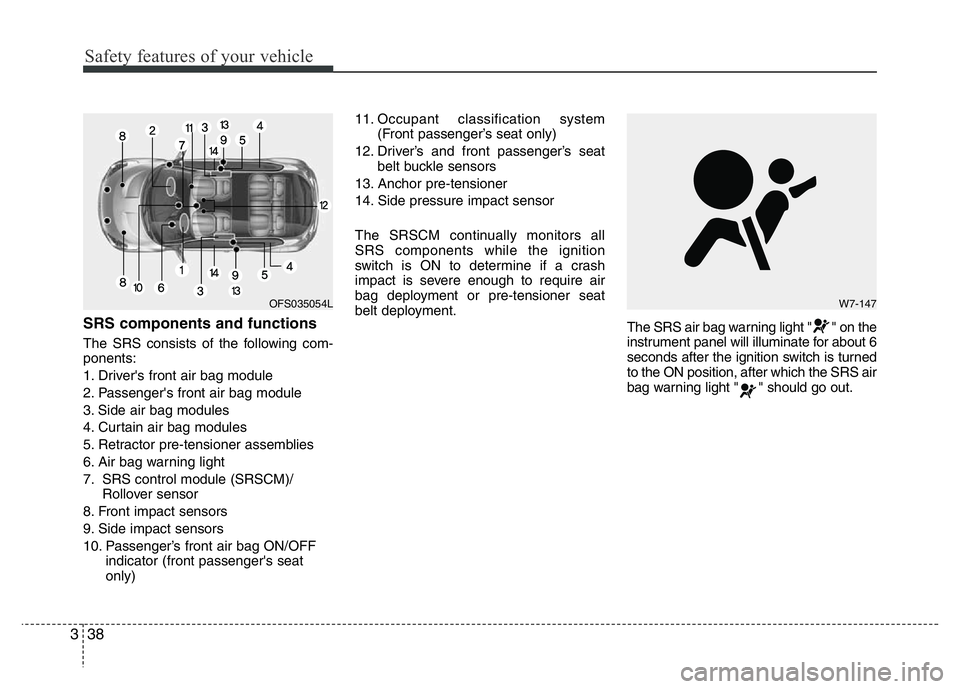
SRS components and functions
The SRS consists of the following com-
ponents:
1. Driver's front air bag module
2. Passenger's front air bag module
3. Side air bag modules
4. Curtain air bag modules
5. Retractor pre-tensioner assemblies
6. Air bag warning light
7. SRS control module (SRSCM)/
Rollover sensor
8. Front impact sensors
9. Side impact sensors
10. Passenger’s front air bag ON/OFF
indicator (front passenger's seat
only)11. Occupant classification system
(Front passenger’s seat only)
12. Driver’s and front passenger’s seat
belt buckle sensors
13. Anchor pre-tensioner
14. Side pressure impact sensor
The SRSCM continually monitors all
SRS components while the ignition
switch is ON to determine if a crash
impact is severe enough to require air
bag deployment or pre-tensioner seat
belt deployment.
The SRS air bag warning light " " on the
instrument panel will illuminate for about 6
seconds after the ignition switch is turned
to the ON position, after which the SRS air
bag warning light " " should go out.
OFS035054L
●●●
●
●
W7-147
Page 55 of 406
339
Safety features of your vehicle
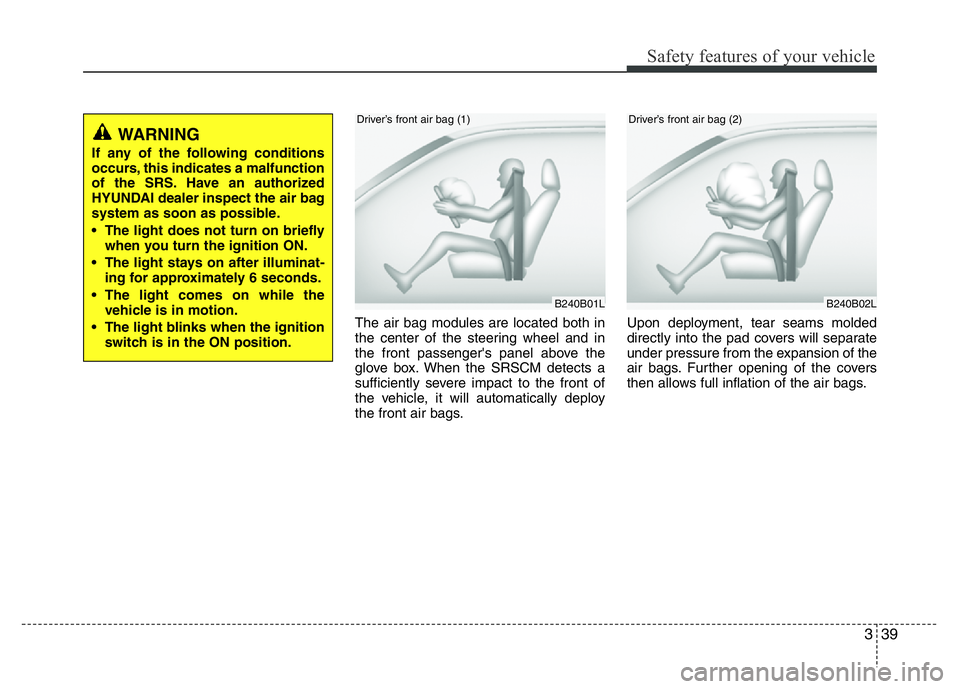
The air bag modules are located both in
the center of the steering wheel and in
the front passenger's panel above the
glove box. When the SRSCM detects a
sufficiently severe impact to the front of
the vehicle, it will automatically deploy
the front air bags.Upon deployment, tear seams molded
directly into the pad covers will separate
under pressure from the expansion of the
air bags. Further opening of the covers
then allows full inflation of the air bags.
B240B01L
Driver’s front air bag (1)
WARNING
If any of the following conditions
occurs, this indicates a malfunction
of the SRS. Have an authorized
HYUNDAI dealer inspect the air bag
system as soon as possible.
• The light does not turn on briefly
when you turn the ignition ON.
• The light stays on after illuminat-
ing for approximately 6 seconds.
• The light comes on while the
vehicle is in motion.
• The light blinks when the ignition
switch is in the ON position.
B240B02L
Driver’s front air bag (2)
Page 56 of 406
Safety features of your vehicle
40 3
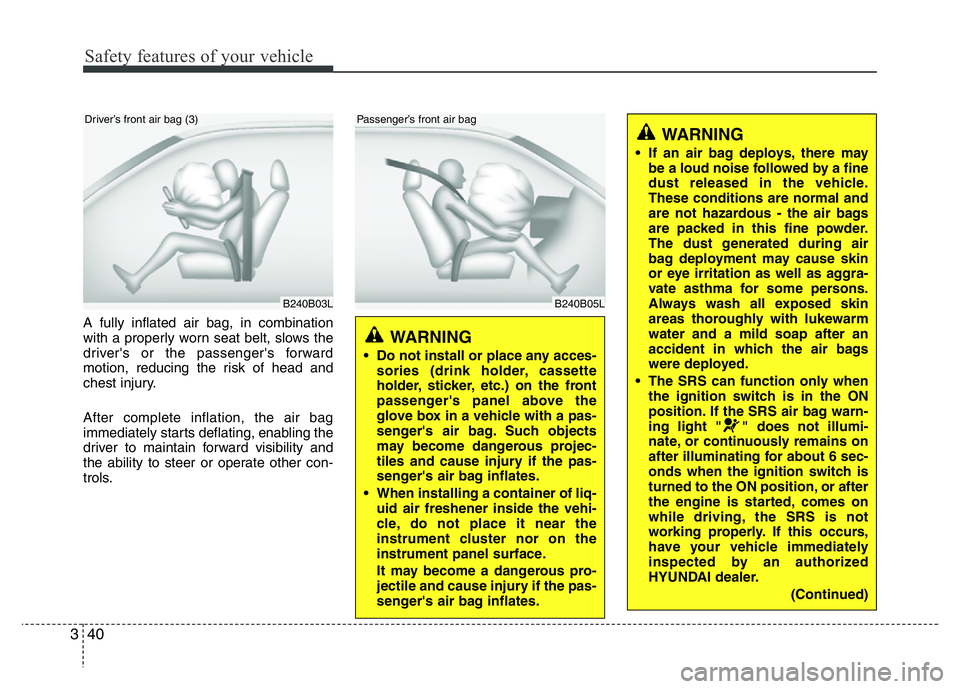
A fully inflated air bag, in combination
with a properly worn seat belt, slows the
driver's or the passenger's forward
motion, reducing the risk of head and
chest injury.
After complete inflation, the air bag
immediately starts deflating, enabling the
driver to maintain forward visibility and
the ability to steer or operate other con-
trols.
WARNING
• If an air bag deploys, there may
be a loud noise followed by a fine
dust released in the vehicle.
These conditions are normal and
are not hazardous - the air bags
are packed in this fine powder.
The dust generated during air
bag deployment may cause skin
or eye irritation as well as aggra-
vate asthma for some persons.
Always wash all exposed skin
areas thoroughly with lukewarm
water and a mild soap after an
accident in which the air bags
were deployed.
• The SRS can function only when
the ignition switch is in the ON
position. If the SRS air bag warn-
ing light " " does not illumi-
nate, or continuously remains on
after illuminating for about 6 sec-
onds when the ignition switch is
turned to the ON position, or after
the engine is started, comes on
while driving, the SRS is not
working properly. If this occurs,
have your vehicle immediately
inspected by an authorized
HYUNDAI dealer.
(Continued)
B240B03L
Driver’s front air bag (3)
WARNING
• Do not install or place any acces-
sories (drink holder, cassette
holder, sticker, etc.) on the front
passenger's panel above the
glove box in a vehicle with a pas-
senger's air bag. Such objects
may become dangerous projec-
tiles and cause injury if the pas-
senger's air bag inflates.
• When installing a container of liq-
uid air freshener inside the vehi-
cle, do not place it near the
instrument cluster nor on the
instrument panel surface.
It may become a dangerous pro-
jectile and cause injury if the pas-
senger's air bag inflates.
B240B05L
Passenger’s front air bag