cooling INFINITI FX35 2008 User Guide
[x] Cancel search | Manufacturer: INFINITI, Model Year: 2008, Model line: FX35, Model: INFINITI FX35 2008Pages: 3924, PDF Size: 81.37 MB
Page 424 of 3924

REFRIGERATION SYSTEMATC-19
< SERVICE INFORMATION >
C
DE
F
G H
I
K L
M A
B
AT C
N
O P
Operation
1. Control Valve
- By changing high-pressure valve lift amount, built-in electronic control valve executes the following:
Controls high-pressure valve discharge amount.
Changes crankcase pressure in compressor.
Changes angle of wobble (swash) plate.
- Amount of high-pressure valve lift is determined by factors below.
Low-pressure applied to diaphragm
Spring load of set spring
Balance of magnetic force generated in magnet coil
- Electronic control valve (ECV) magnet coil receives
electric signal (duty control) from unified meter and A/
C amp. Then, magnetic force generated by electric cu rrent is changed to control high-pressure valve lift
amount.
2. Maximum Cooling
High-pressure valve is closed by magnetic force gener ated by electric signal sent from unified meter and
A/C amp. At this time, cylinder moves full stroke due to pressure balance between inside crankcase (Pc)
and suction line (Ps).
Under this condition, the wobble (swash) plat e is set to the maximum stroke position.
3. Capacity Control When no electric signal is sent from unified meter and A/C amp. (current: OFF), high-pressure valve is
opened by spring force.
Since suction pressure is low, it makes the su ction port close and the discharge port open. Thus, crank-
case pressure becomes high as high-pressure enters the crankcase.
- The force acts around the journal pin near the wobble (swash) plate, and is generated by the pressure dif-
ference before and behind the piston.
- The drive lug and journal pin are located where t he piston generates the highest pressure. Piston pres-
sure is between suction pressure Ps and discharge pressu re Pd, which is close to suction pressure Ps. If
crankcase pressure Pc rises due to capacity contro l, the force around the journal pin makes the wobble
(swash) plate angle decrease and also the piston stroke decrease. In other words, crankcase pressure
SJIA0547E
3AA93ABC3ACD3AC03ACA3AC03AC63AC53A913A773A893A873A873A8E3A773A983AC73AC93AC03AC3
3A893A873A873A8F3A773A9D3AAF3A8A3A8C3A863A9D3AAF3A8B3A8C
Page 427 of 3924

ATC-22
< SERVICE INFORMATION >
LUBRICANT
LUBRICANT
Maintenance of Lubricant Quantity in CompressorINFOID:0000000001328166
The lubricant in the compressor circulates through the system with the refrigerant. Add lubricant to compres-
sor when replacing any component or after a large refriger ant leakage occurred. It is important to maintain the
specified amount.
If lubricant quantity is not maintained properly, the following malfunctions may result:
Lack of lubricant: May lead to a seized compressor.
Excessive lubricant: Inadequate cooling (thermal exchange interference)
LUBRICANT
LUBRICANT RETURN OPERATION
Adjust the lubricant quantity according to the test group shown below.
1.CHECK LUBRICANT RETURN OPERATION
Can lubricant return operation be performed?
A/C system works properly.
There is no evidence of a lar ge amount of lubricant leakage.
CAUTION:
If excessive lubricant leakage is noted, never perform the lubricant return operation.
OK or NG
OK >> GO TO 2.
NG >> GO TO 3.
2.PERFORM LUBRICANT RETURN OPERATION, PROCEEDING AS FOLLOWS
1. Start the engine, and set to the following conditions:
- Engine speed: Idling to 1,200 rpm
- A/C switch: ON
- Blower speed: Max. position
- Temp. control: Optional [Set so that intake air temperature is 25 to 30 °C (77 to 86 °F).]
- Intake position: Recirculation (REC)
2. Perform lubricant return operation for about 10 minutes.
3. Stop the engine.
>> GO TO 3.
3.CHECK REPLACEMENT PART
Should the compressor be replaced?
YES >> Go to "LUBRICANT ADJUSTING PROCEDURE FOR COMPRESSOR REPLACEMENT".
NO >> Go to "LUBRICANT ADJUSTING PROCEDURE FOR COMPONENTS REPLACEMENT EXCEPT COMPRESSOR".
LUBRICANT ADJUSTING PROCEDURE FOR COMPONENTS REPLACEMENT EXCEPT COM-
PRESSOR
After replacing any of the followi ng major components, add the correct am ount of lubricant to the system.
Amount of lubricant to be added: Name : NISSAN A/C System Oil Type S
Part replaced
Lubricant to be added to system
Remarks
Amount of lubricant
m (US fl oz., Imp fl oz.)
Evaporator 75 (2.5, 2.6) —
Condenser 35 (1.2, 1.2) —
Liquid tank 10 (0.3, 0.4) —
3AA93ABC3ACD3AC03ACA3AC03AC63AC53A913A773A893A873A873A8E3A773A983AC73AC93AC03AC3
3A893A873A873A8F3A773A9D3AAF3A8A3A8C3A863A9D3AAF3A8B3A8C
Page 438 of 3924

TROUBLE DIAGNOSISATC-33
< SERVICE INFORMATION >
C
DE
F
G H
I
K L
M A
B
AT C
N
O P
Intake door does not change. Go to Trouble Diagnosis Procedure for Intake Door Motor. (LAN) AT C - 6 2 , "Intake
Door Motor Circuit"Intake door motor does not operate normally.
Blower motor operation is malfunctioning. Go to Trouble Diagnosis Procedure for Blower Motor.
AT C - 6 4 , "
Blower
Motor Circuit"
Magnet clutch does not engage. Go to Trouble Diagnosis Procedure for Magnet Clutch.AT C - 6 9 , "Magnet
Clutch Circuit"
Insufficient cooling Go to Trouble Diagnosis Procedure for Insufficient Cooling.
AT C - 7 5 , "Insufficient
Cooling"
Insufficient heating Go to Trouble Diagnosis Procedure for Insufficient Heating.AT C - 8 2 , "Insufficient
Heating"
Noise Go to Trouble Diagnosis Procedure for Noise.
AT C - 8 3 , "Noise"
Self-diagnosis cannot be performed. Go to Trouble Diagnosis Procedure for Self-diagnosis.AT C - 8 4 , "Self-Diag-
nosis"
Memory function does not operate. Go to Trouble Diagnosis Procedure for Memory Function.
AT C - 8 5 , "Memory
Function"
Symptom Reference Page
3AA93ABC3ACD3AC03ACA3AC03AC63AC53A913A773A893A873A873A8E3A773A983AC73AC93AC03AC3
3A893A873A873A8F3A773A9D3AAF3A8A3A8C3A863A9D3AAF3A8B3A8C
Page 456 of 3924

TROUBLE DIAGNOSISATC-51
< SERVICE INFORMATION >
C
DE
F
G H
I
K L
M A
B
AT C
N
O P
1. Press fan (UP:+) switch. Blower should operate on low speed. The fan symbol should have one blade lit.
2. Press fan (UP:+) switch again, and continue che cking blower speed and fan symbol until all speeds are
checked.
3. Leave blower on max. speed.
If NG, go to trouble diagnosis procedure for ATC-64, "
Blower Motor Circuit".
If OK, continue the check.
CHECKING DISCHARGE AIR
1. Press MODE switch and DEF switch.
2. Each position indicator should change shape.
3. Confirm that discharge air comes out according to the air distri-
bution table. Refer to ATC-29, "
Discharge Air Flow".
If NG, go to trouble diagnosis procedure for ATC-57, "
Mode Door
Motor Circuit".
If OK, continue the check.
NOTE:
Confirm that the compressor clutch is engaged (sound or visual
inspection) and intake door position is at FRE when the D/F or DEF
is selected.
CHECKING INTAKE AIR
1. Press intake switch. Recirculation indicator should illuminate.
2. Press intake switch again. Fresh indicator should illuminate.
3. Listen for intake door position change. (S light change of blower sound can be heard.)
If NG, go to trouble diagnosis procedure for ATC-62, "
Intake Door Motor Circuit".
If OK, continue the check.
NOTE:
Confirm that the compressor clutch is engaged (sound or visual inspection) and intake door position is at FRE
when the D/F or DEF is selected.
CHECKING TEMPERATURE DECREASE
1. Press temperature control (DOWN) switch (driver side) until 18 °C (60 °F) is displayed.
2. Check for cold air at discharge air outlets.
If NG, go to trouble diagnosis procedure for ATC-75, "
Insufficient Cooling".
If OK, continue the check.
CHECKING TEMPERATURE INCREASE
1. Press temperature control (UP) switch (driver side) until 32 °C (90 °F) is displayed.
2. Check for hot air at discharge air outlets.
If NG, go to trouble diagnosis procedure for ATC-82, "
Insufficient Heating".
If OK, continue the check.
CHECKING A/C SWITCH
1. Press AUTO switch and A/C switch.
2. A/C switch indicator will turn ON. Confirm that the compressor clutch engages (sound or visual inspection).
If NG, go to trouble diagnosis procedure for ATC-69, "
Magnet Clutch Circuit".
If OK, continue the check.
CHECKING AUTO MODE
1. Press AUTO switch and A/C switch.
2. Display should indicate AUTO. Confirm that discharge air and blower speed will depend on ambient, in-vehicle, and set temperatures.
If NG, go to trouble diagnosis procedure for ATC-52, "
Power Supply and Ground Circuit for Auto Amp", then if
necessary, trouble diagnosis procedure for ATC-69, "
Magnet Clutch Circuit".
SJIA0302E
3AA93ABC3ACD3AC03ACA3AC03AC63AC53A913A773A893A873A873A8E3A773A983AC73AC93AC03AC3
3A893A873A873A8F3A773A9D3AAF3A8A3A8C3A863A9D3AAF3A8B3A8C
Page 464 of 3924
TROUBLE DIAGNOSISATC-59
< SERVICE INFORMATION >
C
DE
F
G H
I
K L
M A
B
AT C
N
O P
COMPONENT DESCRIPTION
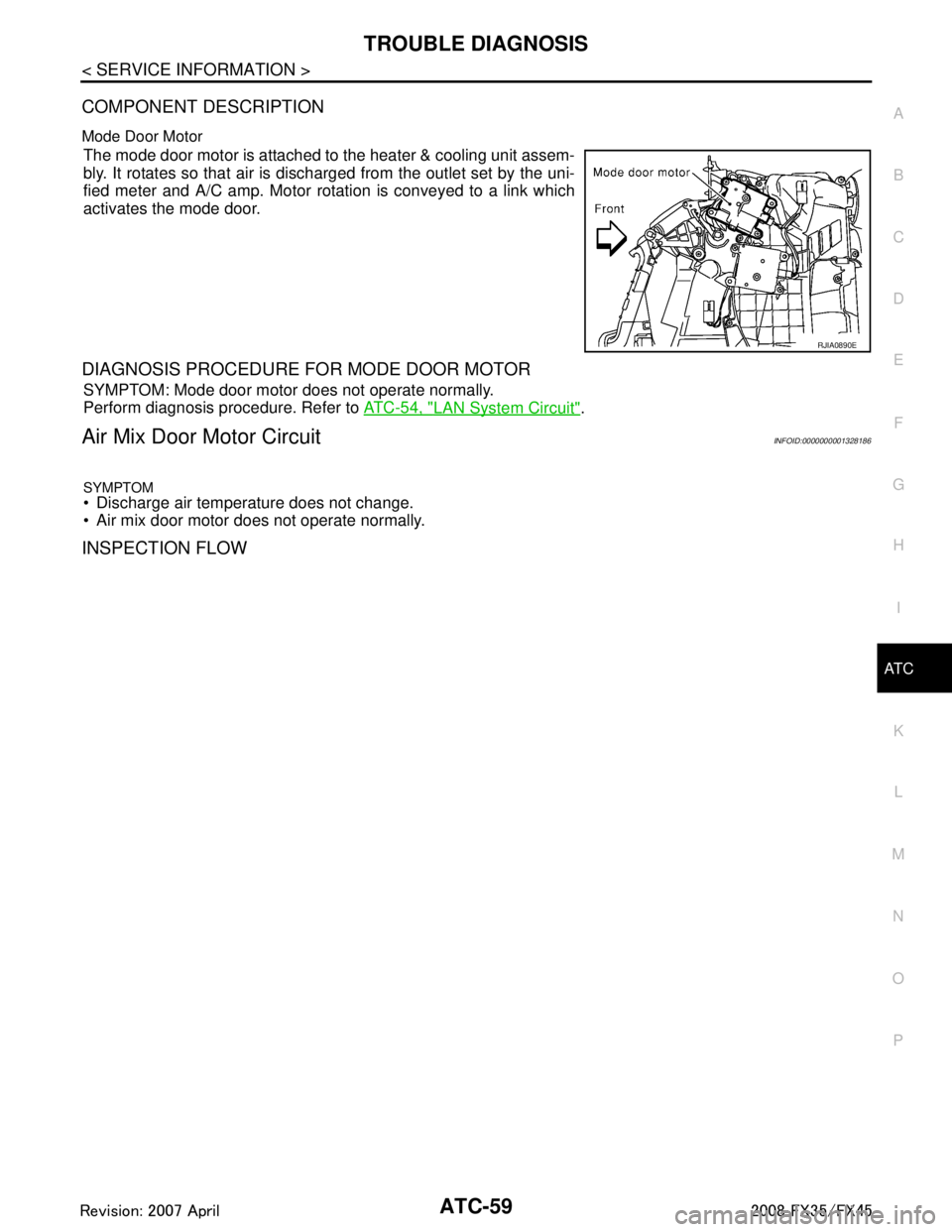
Mode Door Motor
The mode door motor is attached to the heater & cooling unit assem-
bly. It rotates so that air is discharged from the outlet set by the uni-
fied meter and A/C amp. Motor rotation is conveyed to a link which
activates the mode door.
DIAGNOSIS PROCEDURE FOR MODE DOOR MOTOR
SYMPTOM: Mode door motor does not operate normally.
Perform diagnosis procedure. Refer to ATC-54, "
LAN System Circuit".
Air Mix Door Motor CircuitINFOID:0000000001328186
SYMPTOM Discharge air temperature does not change.
Air mix door motor does not operate normally.
INSPECTION FLOW
RJIA0890E
3AA93ABC3ACD3AC03ACA3AC03AC63AC53A913A773A893A873A873A8E3A773A983AC73AC93AC03AC3
3A893A873A873A8F3A773A9D3AAF3A8A3A8C3A863A9D3AAF3A8B3A8C
Page 466 of 3924

TROUBLE DIAGNOSISATC-61
< SERVICE INFORMATION >
C
DE
F
G H
I
K L
M A
B
AT C
N
O P
Sunload sensor
Intake sensor
System Operation
The unified meter and A/C amp. receives data from each of the sensors. The unified meter and A/C amp.
sends air mix door, mode door and intake door motor opening angle data to the air mix door motor LCUs,
mode door motor LCU and intake door motor LCU.
The air mix door motors, mode door motor and intake door motor read their respective signals according to the
address signal. Opening angle indication signals receiv ed from the unified meter and A/C amp. and each of
the motor position sensors are compared by the LCUs in each door motor with the existing decision and open-
ing angles. Subsequently, HOT/COLD, DEF/VENT and FRE/REC operation is selected. The new selection
data are returned to the unified meter and A/C amp.
Air Mix Door Control Specification
COMPONENT DESCRIPTION
Air Mix Door Motor
The air mix door motors are attached to the heater & cooling unit
assembly. It rotates so that the air mix door is opened or closed to a
position set by the unified meter and A/C amp. Motor rotation is then
conveyed through a shaft and the air mix door position feedback is
then sent to the unified meter and A/C amp. by PBR built-in air mix
door motor.
RJIA1781E
RJIA1782E
RJIA0893E
3AA93ABC3ACD3AC03ACA3AC03AC63AC53A913A773A893A873A873A8E3A773A983AC73AC93AC03AC3
3A893A873A873A8F3A773A9D3AAF3A8A3A8C3A863A9D3AAF3A8B3A8C
Page 475 of 3924

ATC-70
< SERVICE INFORMATION >
TROUBLE DIAGNOSIS
SYSTEM DESCRIPTION
Unified meter and A/C amp. controls compressor operation by ambient temperature, intake air temperature
and signal from ECM.
Low Temperature Protection Control
Unified meter and A/C amp. will turn the compressor ON or OFF as determined by a signal detected by ambi-
ent sensor and intake sensor.
When ambient temperature is higher than −2 °C (28 °F), the compres-
sor turns ON. The compressor turns OFF when ambient temperature
is lower than −5 °C (23 °F).
When intake air temperature is higher than 1 °C (34 °F), the compres-
sor turns ON. The compressor turns OFF when intake air tempera-
ture is lower than −5 °C (23 °F).
DIAGNOSIS PROCEDURE FOR MAGNET CLUTCH
SYMPTOM: Magnet clutch does not engage when A/C switch is ON.
1.CHECK AMBIENT SENSOR AND INTAKE SENSOR CIRCUIT
Check ambient sensor and intake sensor. Refer to ATC-43, "
Self-Diagnosis Function", see No. 9 and 11.
*4 "DIAGNOSIS PROCEDURE FOR
MAGNET CLUTCH" *5
AT C - 7 5 , "Insufficient Cooling"*6AT C - 5 0 , "Operational Check"
*7AT C - 4 3 , "Self-Diagnosis Function",
see No. 4 to 6. *8
AT C - 3 2 , "How to Perform Trouble Di-
agnosis for Quick and Accurate Re-
pair"
RHA094GB
SJIA0267E
SJIA1608E
3AA93ABC3ACD3AC03ACA3AC03AC63AC53A913A773A893A873A873A8E3A773A983AC73AC93AC03AC3
3A893A873A873A8F3A773A9D3AAF3A8A3A8C3A863A9D3AAF3A8B3A8C
Page 480 of 3924
TROUBLE DIAGNOSISATC-75
< SERVICE INFORMATION >
C
DE
F
G H
I
K L
M A
B
AT C
N
O P
Insufficient CoolingINFOID:0000000001328191
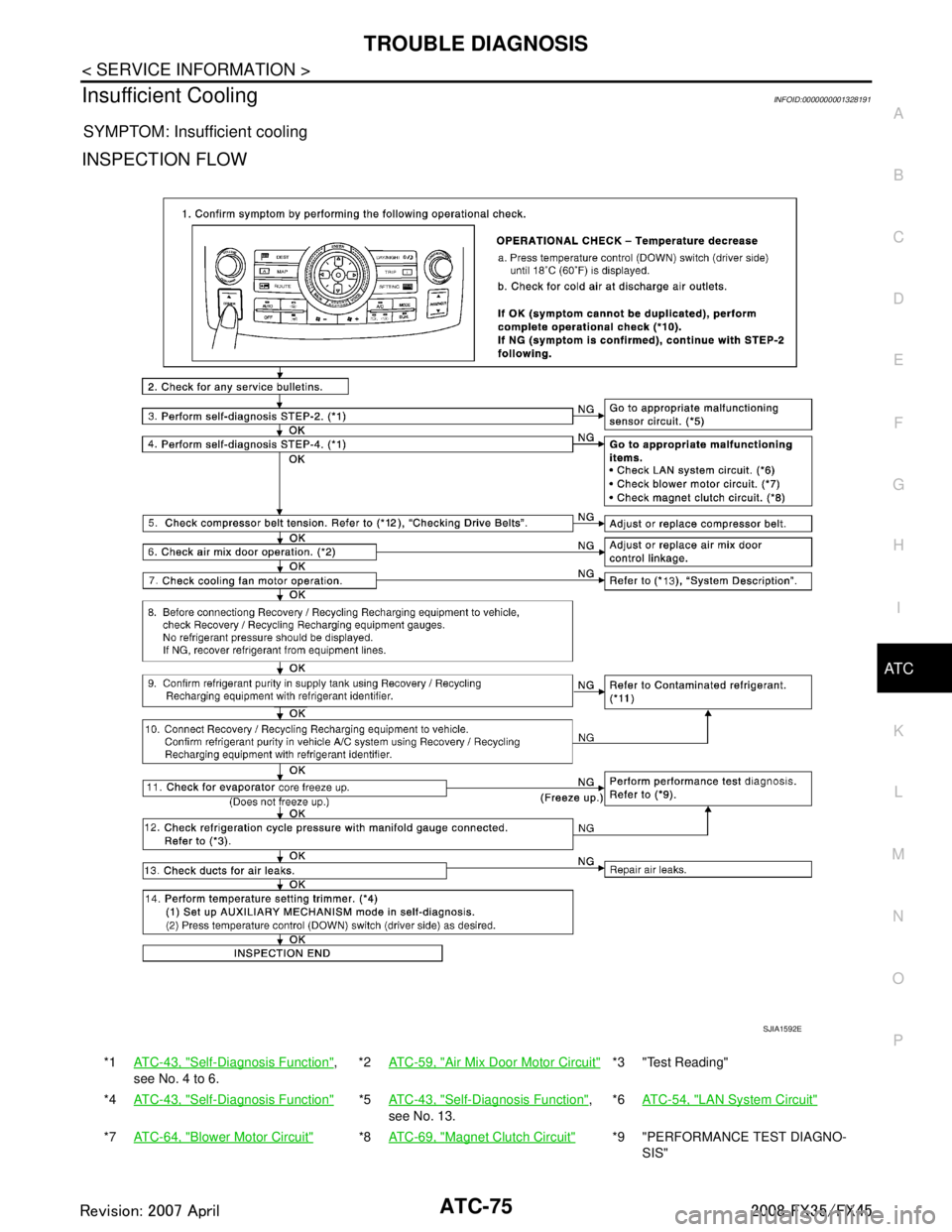
SYMPTOM: Insufficient cooling
INSPECTION FLOW
*1 AT C - 4 3 , "Self-Diagnosis Function",
see No. 4 to 6. *2
AT C - 5 9 , "Air Mix Door Motor Circuit"*3 "Test Reading"
*4 AT C - 4 3 , "
Self-Diagnosis Function"*5 AT C - 4 3 , "Self-Diagnosis Function",
see No. 13. *6
AT C - 5 4 , "LAN System Circuit"
*7AT C - 6 4 , "Blower Motor Circuit"*8 AT C - 6 9 , "Magnet Clutch Circuit"*9 "PERFORMANCE TEST DIAGNO-
SIS"
SJIA1592E
3AA93ABC3ACD3AC03ACA3AC03AC63AC53A913A773A893A873A873A8E3A773A983AC73AC93AC03AC3
3A893A873A873A8F3A773A9D3AAF3A8A3A8C3A863A9D3AAF3A8B3A8C
Page 484 of 3924

TROUBLE DIAGNOSISATC-79
< SERVICE INFORMATION >
C
DE
F
G H
I
K L
M A
B
AT C
N
O P
High-pressure Side is Too High and Low-pressure Side is Too Low
High-pressure Side is Too Low and Low-pressure Side is Too High
Both High- and Low-pressure Sides are Too Low
Gauge indication Refrigerant cycle Probable cause Corrective action
Both high- and low-pressure sides
are too high. The pressure returns to nor-
mal soon after water is
splashed on condenser.
Excessive refrigerant charge in
refrigeration cycle.
Reduce refrigerant until speci-
fied pressure is obtained.
Air suction by cooling fan is in-
sufficient. Insufficient condenser cooling
performance.
↓
1. Condenser fins are
clogged.
2. Improper fan rotation of cooling fan. Clean condenser.
Check and repair cooling fan
as necessary.
Low-pressure pipe is not cold.
When compressor is stopped high-pressure val-
ue quickly drops by approx-
imately 196 kPa (2 kg/cm
2,
28 psi). It then decreases
gradually thereafter. Poor heat exchange in con-
denser
(After compressor operation
stops, high-pressure decreas-
es too slowly.).
↓
Air in refrigeration cycle.
Evacuate repeatedly and re-
charge system.
Engine tends to overheat. Engine cooling systems mal-
function. Check and repair each engine
cooling system.
An area of the low-pressure pipe is colder than areas
near the evaporator outlet.
Low-pressure pipe is some- times covered with frost. Excessive liquid refrigerant
on low-pressure side.
Excessive refrigerant dis- charge flow.
Expansion valve is open a lit- tle compared with the speci-
fication.
↓
Improper expansion valve ad-
justment. Replace expansion valve.
AC359A
Gauge indication Refrigerant cycle Probable cause Corrective action
High-pressure side is too high and
low-pressure side is too low.
Upper side of condenser and
high-pressure side are hot,
however, liquid tank is not so
hot.High-pressure tube or parts lo-
cated between compressor
and condenser are clogged or
crushed. Check and repair or replace
malfunctioning parts.
Check lubricant for contami- nation.
AC360A
Gauge indication Refrigerant cycle Probable cause Corrective action
High-pressure side is too low and
low-pressure side is too high. High- and low-pressure sides
become equal soon after com-
pressor operation stops.Compressor pressure opera-
tion is improper.
↓
Damaged inside compressor
packings.
Replace compressor.
No temperature difference be-
tween high- and low-pressure
sides. Compressor pressure opera-
tion is improper.
↓
Damaged inside compressor
packings.
Replace compressor.
AC356A
3AA93ABC3ACD3AC03ACA3AC03AC63AC53A913A773A893A873A873A8E3A773A983AC73AC93AC03AC3
3A893A873A873A8F3A773A9D3AAF3A8A3A8C3A863A9D3AAF3A8B3A8C
Page 486 of 3924

TROUBLE DIAGNOSISATC-81
< SERVICE INFORMATION >
C
DE
F
G H
I
K L
M A
B
AT C
N
O P
DIAGNOSIS PROCEDURE FOR INSUFFICIENT COOLING
SYMPTOM: Insufficient cooling
1.CHECK POWER SUPPLY FOR ECV (ELECTRONIC CONTROL VALVE)
1. Disconnect compressor (ECV) connector.
2. Turn ignition switch ON.
3. Check voltage between compressor (ECV) harness connector F6 terminal 2 and ground.
OK or NG
OK >> GO TO 2.
NG >> Check power supply circuit and 10A fuse [No. 12, located in the fuse block (J/B)]. Refer to PG-77
.
If fuse is OK, check harness for open circuit. Repair or replace if necessary.
If fuse is NG, check harness for short circuit and replace fuse.
2.CHECK ECV CONTROL SIGNAL
1. Turn ignition switch OFF.
2. Reconnect compressor (ECV) connector.
3. Perform self-diagnosis. Refer to ATC-43, "
Self-Diagnosis Function".
4. Set in self-diagnosis STEP-4 (Code No. 45). Refer to ATC-43, "
Self-Diagnosis Function".
5. Confirm ECV control signal between unified meter and A/C amp. harness connector M57 terminal 45 and ground using an oscillo-
scope.
Gauge indication Refrigerant cycle Probable cause Corrective action
Low-pressure side becomes nega-
tive. Liquid tank or front/rear side of
expansion valve’s pipe is frost-
ed or wet with dew.High-pressure side is closed
and refrigerant does not flow.
↓
Expansion valve or liquid tank
is frosted.Leave the system at rest until
no frost is present. Start it
again to check whether or not
the malfunction is caused by
water or foreign particles.
If water is the cause, initially
cooling is okay. Then the wa-
ter freezes causing a block-
age. Drain water from
refrigerant or replace refrig-
erant.
If due to foreign particles, re-
move expansion valve and
remove the particles with dry
and compressed air (not
shop air).
If either of the above meth- ods cannot correct the mal-
function, replace expansion
valve.
Replace liquid tank.
Check lubricant for contami-
nation.
AC362A
2 – ground : Battery voltage
RJIA2294E
RJIA2295E
3AA93ABC3ACD3AC03ACA3AC03AC63AC53A913A773A893A873A873A8E3A773A983AC73AC93AC03AC3
3A893A873A873A8F3A773A9D3AAF3A8A3A8C3A863A9D3AAF3A8B3A8C