mount INFINITI FX35 2008 Workshop Manual
[x] Cancel search | Manufacturer: INFINITI, Model Year: 2008, Model line: FX35, Model: INFINITI FX35 2008Pages: 3924, PDF Size: 81.37 MB
Page 397 of 3924

AT-324
< SERVICE INFORMATION >
ASSEMBLY
5. Tighten oil pump mounting bolts to specified torque. Refer to AT-
249, "Component".
CAUTION:
Apply ATF to oil pump bushing.
6. Install O-ring to input clutch assembly. CAUTION:
Do not reuse O-ring.
Apply ATF to O-ring.
7. Install converter housing to transmission case, and then tighten converter housing mounting bolts (1) to the specified torque.
Refer to AT-249, "
Component".
: Bolt (8)
CAUTION:
Do not reuse self-sealing bolt (2).
8. Make sure that brake band does not close turbine revolution sensor hole.
9. Install control valve with TCM.
a. Connect TCM connector and park/neutral position switch con- nector.
SCIA2300E
SCIA5011E
SCIA7985E
SCIA5034E
SCIA5449E
3AA93ABC3ACD3AC03ACA3AC03AC63AC53A913A773A893A873A873A8E3A773A983AC73AC93AC03AC3
3A893A873A873A8F3A773A9D3AAF3A8A3A8C3A863A9D3AAF3A8B3A8C
Page 398 of 3924
ASSEMBLYAT-325
< SERVICE INFORMATION >
DE
F
G H
I
J
K L
M A
B
AT
N
O P
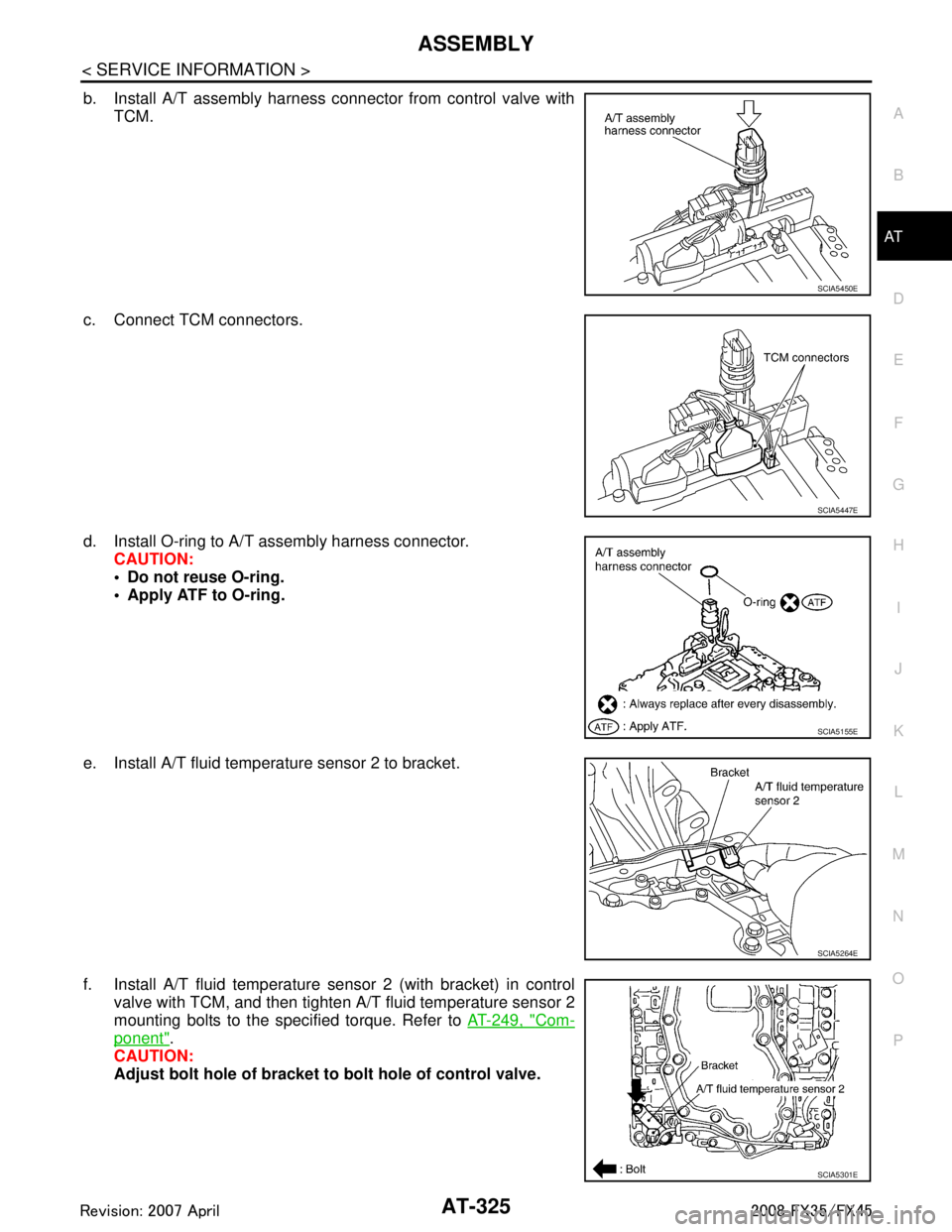
b. Install A/T assembly harness connector from control valve with TCM.
c. Connect TCM connectors.
d. Install O-ring to A/T assembly harness connector. CAUTION:
Do not reuse O-ring.
Apply ATF to O-ring.
e. Install A/T fluid temperature sensor 2 to bracket.
f. Install A/T fluid temperature sens or 2 (with bracket) in control
valve with TCM, and then tighten A/T fluid temperature sensor 2
mounting bolts to the specified torque. Refer to AT-249, "
Com-
ponent".
CAUTION:
Adjust bolt hole of bracket to bolt hole of control valve.
SCIA5450E
SCIA5447E
SCIA5155E
SCIA5264E
SCIA5301E
3AA93ABC3ACD3AC03ACA3AC03AC63AC53A913A773A893A873A873A8E3A773A983AC73AC93AC03AC3
3A893A873A873A8F3A773A9D3AAF3A8A3A8C3A863A9D3AAF3A8B3A8C
Page 401 of 3924
AT-328
< SERVICE INFORMATION >
ASSEMBLY
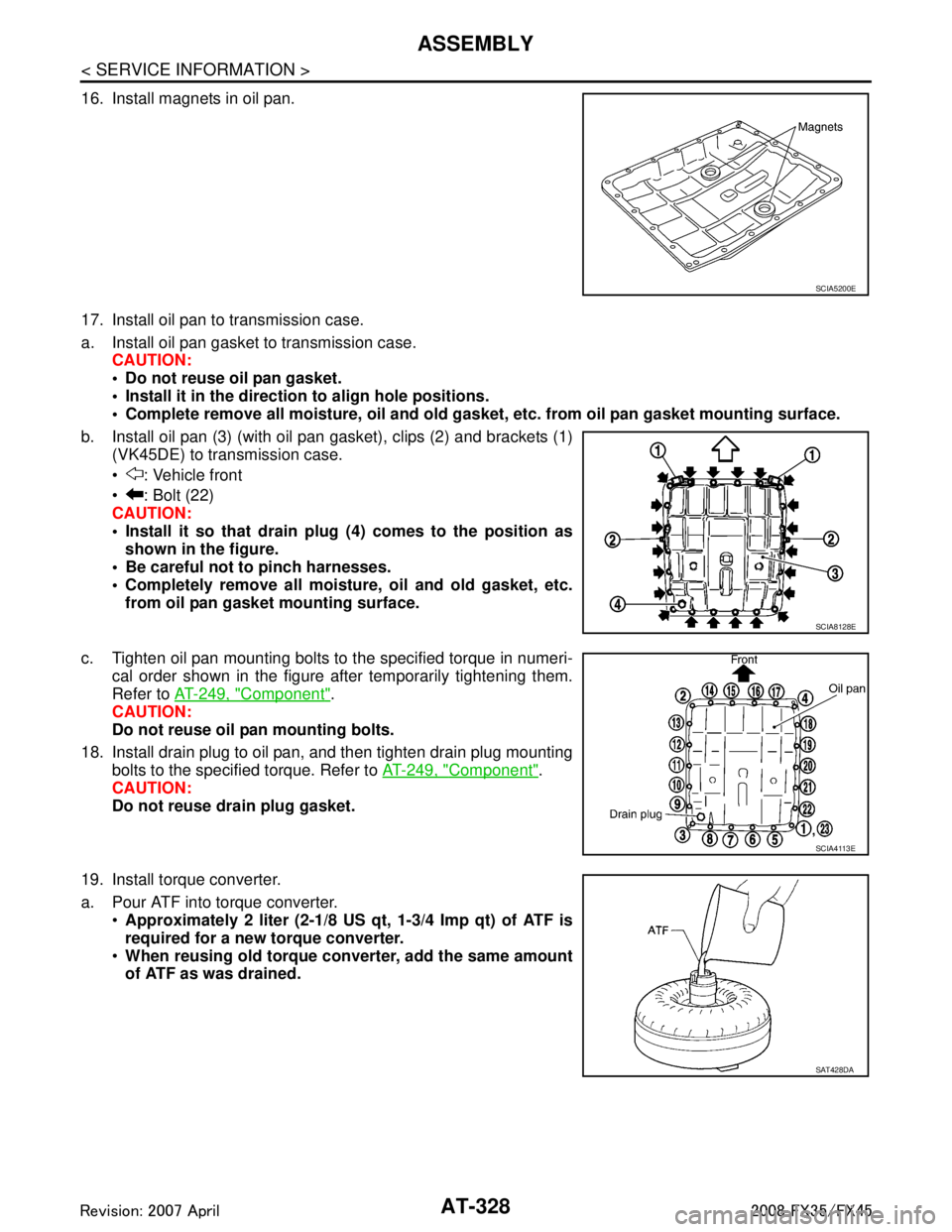
16. Install magnets in oil pan.
17. Install oil pan to transmission case.
a. Install oil pan gasket to transmission case.CAUTION:
Do not reuse oil pan gasket.
Install it in the direction to align hole positions.
Complete remove all moisture, oil and old gasket, etc. from oil pan gasket mounting surface.
b. Install oil pan (3) (with oil pan gasket), clips (2) and brackets (1) (VK45DE) to transmission case.
: Vehicle front
: Bolt (22)
CAUTION:
Install it so that drain plug (4) comes to the position as
shown in the figure.
Be careful not to pinch harnesses.
Completely remove all moisture, oil and old gasket, etc. from oil pan gasket mounting surface.
c. Tighten oil pan mounting bolts to the specified torque in numeri- cal order shown in the figure after temporarily tightening them.
Refer to AT-249, "
Component".
CAUTION:
Do not reuse oil pan mounting bolts.
18. Install drain plug to oil pan, and then tighten drain plug mounting bolts to the specified torque. Refer to AT-249, "
Component".
CAUTION:
Do not reuse drain plug gasket.
19. Install torque converter.
a. Pour ATF into torque converter. Approximately 2 liter (2-1/8 US qt, 1-3/4 Imp qt) of ATF is
required for a new torque converter.
When reusing old torque converter, add the same amount
of ATF as was drained.
SCIA5200E
SCIA8128E
SCIA4113E
SAT428DA
3AA93ABC3ACD3AC03ACA3AC03AC63AC53A913A773A893A873A873A8E3A773A983AC73AC93AC03AC3
3A893A873A873A8F3A773A9D3AAF3A8A3A8C3A863A9D3AAF3A8B3A8C
Page 414 of 3924

PRECAUTIONSATC-9
< SERVICE INFORMATION >
C
DE
F
G H
I
K L
M A
B
AT C
N
O P
CAUTION:
When replacing or cleaning refrigerant cycle components, observe the following.
When the compressor is removed, store it in the sam e way at it is when mounted on the car. Failure
to do so will cause lubricant to enter the low-pressure chamber.
When connecting tubes, always use a to rque wrench and a back-up wrench.
After disconnecting tubes, immediately plug all op enings to prevent entry of dust and moisture.
When installing an air conditioner in the vehicle, connect the pipes at the final stage of the operation.
Never remove the seal caps of pipes and other compon ents until just before required for connection.
Allow components stored in cool areas to warm to working area temperature before removing seal
caps. This prevents condensation from forming inside A/C components.
Thoroughly remove moisture from the refriger ation system before charging the refrigerant.
Always replace used O-rings.
When connecting tubes, apply lubricant to circle of the O-rings shown in illustration. Be careful not
to apply lubricant to threaded portion.
O-ring must be closely att ached to the groove of tube.
When replacing the O-ring, be careful not to damage O-ring and tube.
Connect tube until a click can be heard, then tighten the nut or bolt by hand. Make sure that the O-
ring is installed to tube correctly.
After connecting line, perform leak test and make sure that there is no leakage from connections.
When the refrigerant leaking point is found, disconnect that line and replace the O-ring. Then tighten
connections of seal seat to the specified torque.
Precaution for Service of CompressorINFOID:0000000001328156
Plug all openings to prevent moisture and foreign matter from entering.
When the compressor is removed, store it in th e same way at it is when mounted on the car.
When replacing or repairing compressor, follow “Maintenance of Lubricant Quantity in Compressor”
exactly. Refer to ATC-22, "
Maintenance of Lubricant Quantity in Compressor".
Keep friction surfaces between clut ch and pulley clean. If the surface is contaminated with lubricant,
wipe it off by using a clean w aste cloth moistened with thinner.
After compressor service operation, turn the compr essor shaft by hand more than five turns in both
directions. This will equally dist ribute lubricant inside the compressor. After the compressor is
installed, let the engine idle and operate the compressor for one hour.
After replacing the compressor magnet clutch, ap ply voltage to the new one and check for normal
operation.
Precaution for Service EquipmentINFOID:0000000001328157
RECOVERY/RECYCLING EQUIPMENT
Name : Nissan A/C System Oil Type S
RHA861F
3AA93ABC3ACD3AC03ACA3AC03AC63AC53A913A773A893A873A873A8E3A773A983AC73AC93AC03AC3
3A893A873A873A8F3A773A9D3AAF3A8A3A8C3A863A9D3AAF3A8B3A8C
Page 423 of 3924

ATC-18
< SERVICE INFORMATION >
REFRIGERATION SYSTEM
Evaporator intake air temperature is less than 20°C (68 °F).
Engine is running at speeds less than 1,500 rpm.
This is because the V-6 compressor prov ides a means of “capacity” control.
2. The V-6 variable compressor provides refrigerant c ontrol under varying conditions. During cold winters, it
may not produce high refrigerant pressure discharge (compared to previous units) when used with air
conditioning systems.
3. A “clanking” sound may occasionally be heard during re frigerant charge. The sound indicates that the tilt
angle of the wobble (swash) plate has changed and is not a malfunction.
4. For air conditioning systems with the V-6 compresso r, the clutch remains engaged unless: the system
main switch, fan switch or ignition switch is tur ned OFF. When ambient (outside) temperatures are low or
when the amount of refrigerant is insufficient, t he clutch is disengaged to protect the compressor.
DESCRIPTION
General
The variable compressor is a swash plate type that c hanges piston stroke in response to the required cooling
capacity.
The tilt of the wobble (swash) plate allows the piston’ s stroke to change so that refrigerant discharge continu-
ously change from 14.5 to 184 cm
3 (0.885 to 11.228 cu in).
RJIA1260E
3AA93ABC3ACD3AC03ACA3AC03AC63AC53A913A773A893A873A873A8E3A773A983AC73AC93AC03AC3
3A893A873A873A8F3A773A9D3AAF3A8A3A8C3A863A9D3AAF3A8B3A8C
Page 424 of 3924

REFRIGERATION SYSTEMATC-19
< SERVICE INFORMATION >
C
DE
F
G H
I
K L
M A
B
AT C
N
O P
Operation
1. Control Valve
- By changing high-pressure valve lift amount, built-in electronic control valve executes the following:
Controls high-pressure valve discharge amount.
Changes crankcase pressure in compressor.
Changes angle of wobble (swash) plate.
- Amount of high-pressure valve lift is determined by factors below.
Low-pressure applied to diaphragm
Spring load of set spring
Balance of magnetic force generated in magnet coil
- Electronic control valve (ECV) magnet coil receives
electric signal (duty control) from unified meter and A/
C amp. Then, magnetic force generated by electric cu rrent is changed to control high-pressure valve lift
amount.
2. Maximum Cooling
High-pressure valve is closed by magnetic force gener ated by electric signal sent from unified meter and
A/C amp. At this time, cylinder moves full stroke due to pressure balance between inside crankcase (Pc)
and suction line (Ps).
Under this condition, the wobble (swash) plat e is set to the maximum stroke position.
3. Capacity Control When no electric signal is sent from unified meter and A/C amp. (current: OFF), high-pressure valve is
opened by spring force.
Since suction pressure is low, it makes the su ction port close and the discharge port open. Thus, crank-
case pressure becomes high as high-pressure enters the crankcase.
- The force acts around the journal pin near the wobble (swash) plate, and is generated by the pressure dif-
ference before and behind the piston.
- The drive lug and journal pin are located where t he piston generates the highest pressure. Piston pres-
sure is between suction pressure Ps and discharge pressu re Pd, which is close to suction pressure Ps. If
crankcase pressure Pc rises due to capacity contro l, the force around the journal pin makes the wobble
(swash) plate angle decrease and also the piston stroke decrease. In other words, crankcase pressure
SJIA0547E
3AA93ABC3ACD3AC03ACA3AC03AC63AC53A913A773A893A873A873A8E3A773A983AC73AC93AC03AC3
3A893A873A873A8F3A773A9D3AAF3A8A3A8C3A863A9D3AAF3A8B3A8C
Page 427 of 3924

ATC-22
< SERVICE INFORMATION >
LUBRICANT
LUBRICANT
Maintenance of Lubricant Quantity in CompressorINFOID:0000000001328166
The lubricant in the compressor circulates through the system with the refrigerant. Add lubricant to compres-
sor when replacing any component or after a large refriger ant leakage occurred. It is important to maintain the
specified amount.
If lubricant quantity is not maintained properly, the following malfunctions may result:
Lack of lubricant: May lead to a seized compressor.
Excessive lubricant: Inadequate cooling (thermal exchange interference)
LUBRICANT
LUBRICANT RETURN OPERATION
Adjust the lubricant quantity according to the test group shown below.
1.CHECK LUBRICANT RETURN OPERATION
Can lubricant return operation be performed?
A/C system works properly.
There is no evidence of a lar ge amount of lubricant leakage.
CAUTION:
If excessive lubricant leakage is noted, never perform the lubricant return operation.
OK or NG
OK >> GO TO 2.
NG >> GO TO 3.
2.PERFORM LUBRICANT RETURN OPERATION, PROCEEDING AS FOLLOWS
1. Start the engine, and set to the following conditions:
- Engine speed: Idling to 1,200 rpm
- A/C switch: ON
- Blower speed: Max. position
- Temp. control: Optional [Set so that intake air temperature is 25 to 30 °C (77 to 86 °F).]
- Intake position: Recirculation (REC)
2. Perform lubricant return operation for about 10 minutes.
3. Stop the engine.
>> GO TO 3.
3.CHECK REPLACEMENT PART
Should the compressor be replaced?
YES >> Go to "LUBRICANT ADJUSTING PROCEDURE FOR COMPRESSOR REPLACEMENT".
NO >> Go to "LUBRICANT ADJUSTING PROCEDURE FOR COMPONENTS REPLACEMENT EXCEPT COMPRESSOR".
LUBRICANT ADJUSTING PROCEDURE FOR COMPONENTS REPLACEMENT EXCEPT COM-
PRESSOR
After replacing any of the followi ng major components, add the correct am ount of lubricant to the system.
Amount of lubricant to be added: Name : NISSAN A/C System Oil Type S
Part replaced
Lubricant to be added to system
Remarks
Amount of lubricant
m (US fl oz., Imp fl oz.)
Evaporator 75 (2.5, 2.6) —
Condenser 35 (1.2, 1.2) —
Liquid tank 10 (0.3, 0.4) —
3AA93ABC3ACD3AC03ACA3AC03AC63AC53A913A773A893A873A873A8E3A773A983AC73AC93AC03AC3
3A893A873A873A8F3A773A9D3AAF3A8A3A8C3A863A9D3AAF3A8B3A8C
Page 428 of 3924

LUBRICANTATC-23
< SERVICE INFORMATION >
C
DE
F
G H
I
K L
M A
B
AT C
N
O P
*1: If the refrigerant leak is small, no addition of lubricant is needed.
LUBRICANT ADJUSTING PROCEDURE FOR COMPRESSOR REPLACEMENT
1. Before connecting recovery/recycling recharging equipm ent to vehicle, check recovery/recycling recharg-
ing equipment gauges. No refrigerant pressure should be displayed. If NG, recover refrigerant from equip-
ment lines.
2. Connect recovery/recycling recharging equipment to vehicle. Confirm refrigerant purity in supply tank
using recovery/recycling recharging equipment and refrigerant identifier. If NG, refer to AT C - 4 , "
Precaution
for Working with HFC-134a (R-134a)".
3. Confirm refrigerant purity in vehicle A/C system us ing recovery/recycling recharging equipment and refrig-
erant identifier. If NG, refer to AT C - 4 , "
Precaution for Working with HFC-134a (R-134a)".
4. Discharge refrigerant into the refrigerant recove ry/recycling equipment. Measure lubricant discharged into
the recovery/recycling equipment.
5. Drain the lubricant from the old (removed) comp ressor into a graduated container and recover the amount
of lubricant drained.
6. Drain the lubricant from the new compressor into a separate, clean container.
7. Measure an amount of new lubricant installed equal to amount drained from old compressor. Add this
lubricant to new compressor through the suction port opening.
8. Measure an amount of new lubricant equal to the am ount recovered during discharging. Add this lubricant
to new compressor through the suction port opening.
9. If the liquid tank also needs to be replaced, add another 5 m (0.2 US fl oz., 0.2 Imp fl oz.) of lubricant at
this time.
Do not add this 5 m (0.2 US fl oz., 0.2 Imp fl oz.) of lubricant when replaces the compressor only.
In case of refrigerant leak 30 (1.0, 1.1) Large leak
— Small leak*1
Part replacedLubricant to be added to system
Remarks
Amount of lubricant
m (US fl oz., Imp fl oz.)
RJIA3578E
3AA93ABC3ACD3AC03ACA3AC03AC63AC53A913A773A893A873A873A8E3A773A983AC73AC93AC03AC3
3A893A873A873A8F3A773A9D3AAF3A8A3A8C3A863A9D3AAF3A8B3A8C
Page 431 of 3924

ATC-26
< SERVICE INFORMATION >
AIR CONDITIONER CONTROL
The air mix doors are automatically controlled so that in-vehicle temperature is maintained at a predetermined
value by the temperature setting, ambient temper ature, in-vehicle temperature and amount of sunload.
FAN SPEED CONTROL
Blower speed is automatically controlled by the temperature setting, ambient temperature, in-vehicle tempera-
ture, intake temperature, amount of sunload and air mix door position.
With pressing AUTO switch, the blower motor starts to gradually increase air flow volume.
When engine coolant temperature is low, the blower moto r operation is delayed to prevent cool air from flow-
ing.
INTAKE DOOR CONTROL
The intake doors are automatically controlled by the tem perature setting, ambient temperature, in-vehicle tem-
perature, intake temperature, amount of s unload and ON/OFF operation of the compressor.
MODE DOOR CONTROL
The mode door is automatically controlled by the temperat ure setting, ambient temperature, in-vehicle temper-
ature, intake temperature and amount of sunload.
MAGNET CLUTCH CONTROL
When A/C switch, AUTO switch or DEF switch is pr essed, unified meter and A/C amp. transmits compressor
ON signal to BCM.
BCM sends compressor ON signal to ECM, via CAN communication.
ECM judges whether compressor can be turned ON, based on each sensor status (refrigerant-pressure sen-
sor signal, throttle angle, etc.). If it judges compre ssor can be turned ON, it sends compressor ON signal to
IPDM E/R, via CAN communication.
Upon receipt of compressor ON signal from ECM, IPDM E/R turns air conditioner relay ON to operate com-
pressor.
When sending compressor ON signal to IPDM E/R via CAN communication, ECM simultaneously sends com-
pressor feedback signal to unified meter and A/C amp. via CAN communication.
Unified meter and A/C amp., then, uses input compressor feedback signal to control air inlet.
SELF-DIAGNOSIS SYSTEM
The self-diagnosis system is built into the unified mete r and A/C amp. to quickly locate the cause of malfunc-
tions.
RJIA1957E
3AA93ABC3ACD3AC03ACA3AC03AC63AC53A913A773A893A873A873A8E3A773A983AC73AC93AC03AC3
3A893A873A873A8F3A773A9D3AAF3A8A3A8C3A863A9D3AAF3A8B3A8C
Page 503 of 3924
ATC-98
< SERVICE INFORMATION >
AUTO AMP
AUTO AMP
Removal and Installation of Unified Meter and A/C AmpINFOID:0000000001328201
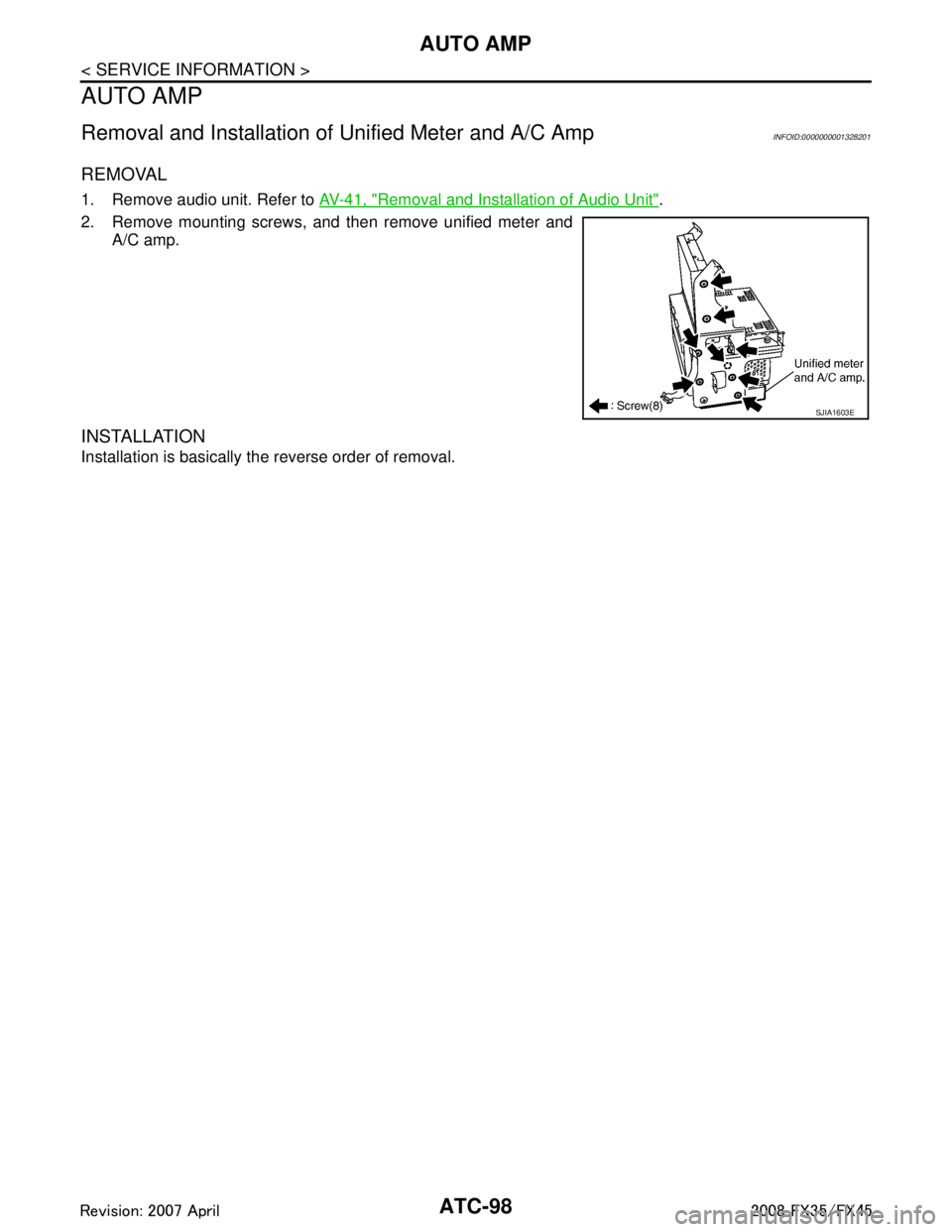
REMOVAL
1. Remove audio unit. Refer to AV-41, "Removal and Installation of Audio Unit".
2. Remove mounting screws, and then remove unified meter and A/C amp.
INSTALLATION
Installation is basically the reverse order of removal.
SJIA1603E
3AA93ABC3ACD3AC03ACA3AC03AC63AC53A913A773A893A873A873A8E3A773A983AC73AC93AC03AC3
3A893A873A873A8F3A773A9D3AAF3A8A3A8C3A863A9D3AAF3A8B3A8C