ESP INFINITI G35 2003 User Guide
[x] Cancel search | Manufacturer: INFINITI, Model Year: 2003, Model line: G35, Model: INFINITI G35 2003Pages: 256, PDF Size: 3.37 MB
Page 156 of 256

slippery surface. The brake LSD system
brakes the spinning wheel which distributes
the driving power to the other drive wheel. If
the vehicle is operated with the vehicle dynam-
ics control system turned off, all VDC and TCS
functions will be turned off. The brake LSD
system and ABS will still operate with the VDC
system off. If the brake LSD system or the ABS
is activated, the slip indicator light will blink and
you may hear a clunk noise and/or feel a
pulsation in the brake pedal. This is normal.
While the VDC system is operating, you may
feel a pulsation in the brake pedal and hear a
noise or vibration from under the hood. This is
normal and indicates that the VDC system is
working properly.
The computer has a built in diagnostic feature
that tests the system each time you start the
engine and move the vehicle forward or in
reverse at a slow speed. When the self-test
occurs, you may hear a clunk noise and/or feel
a pulsation in the brake pedal. This is normal
and is not an indication of a malfunction.
WARNINGO The vehicle dynamics control system
is designed to help improve driving stability but does not prevent acci-
dents due to abrupt steering opera-
tion at high speeds or by careless or
dangerous driving techniques. Re-
duce vehicle speed and be especially
careful when driving and cornering
on slippery surfaces and always drive
carefully.
O If suspension parts such as shock
absorbers, struts, springs and bush-
ings are not standard equipment or
are extremely deteriorated, the ve-
hicle dynamics control off indicator
light may come on.
O When driving on extremely inclined
surfaces such as higher banked cor-
ners, the vehicle dynamics control
system may not operate properly or
the vehicle dynamics control off indi-
cator light may come on. Do not drive
on these types of roads.
O If the tires other than the recom-
mended ones are used, the vehicle
dynamics control system may not op-
erate properly or the vehicle dynam- ics control off indicator light may
come on.
O The vehicle dynamics control system
is not a substitute for winter tires or
tire chains on a snow covered road.
5-22 Starting and driving
Z 02.7.29/V35-D/V5.0
X
Page 163 of 256
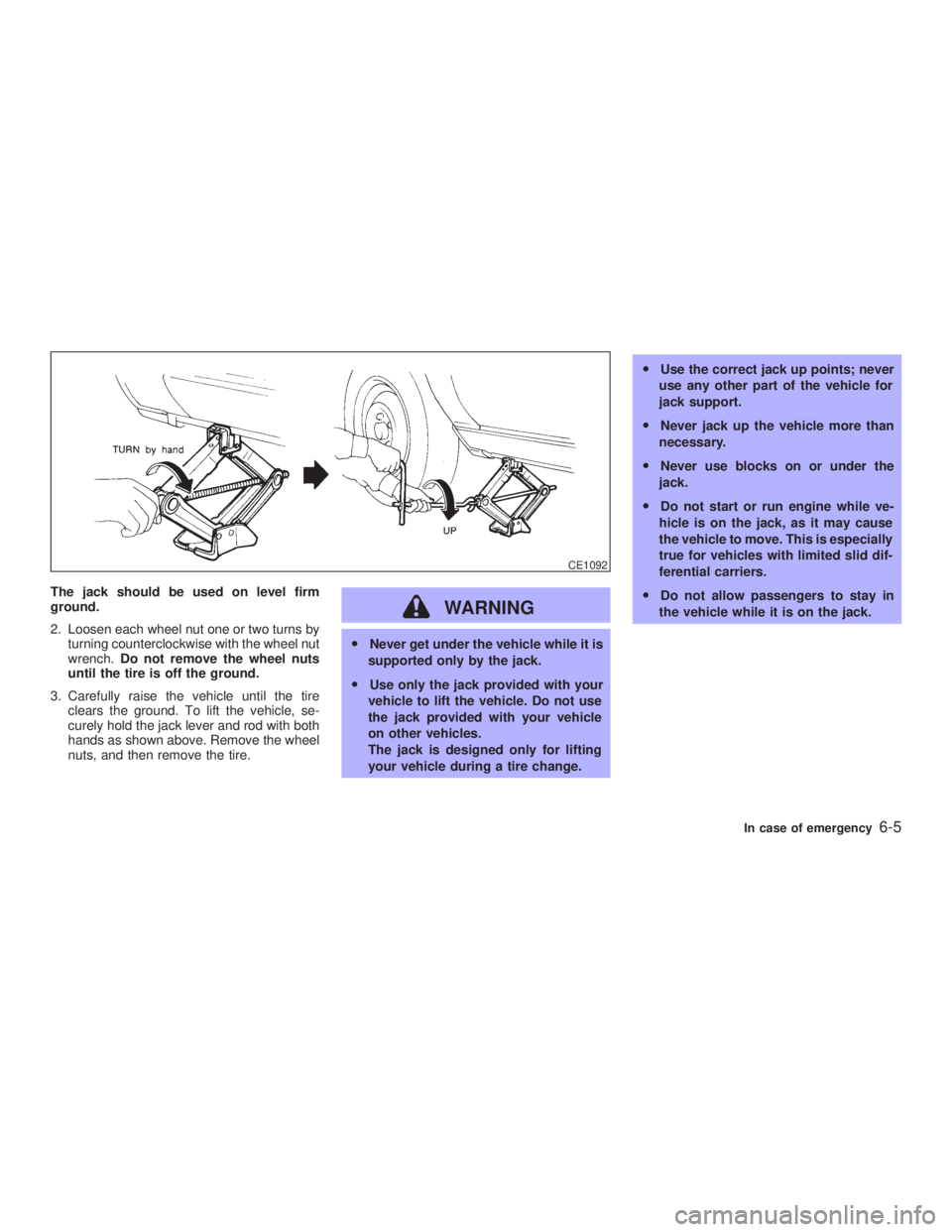
The jack should be used on level firm
ground.
2. Loosen each wheel nut one or two turns by
turning counterclockwise with the wheel nut
wrench. Do not remove the wheel nuts
until the tire is off the ground.
3. Carefully raise the vehicle until the tire
clears the ground. To lift the vehicle, se-
curely hold the jack lever and rod with both
hands as shown above. Remove the wheel
nuts, and then remove the tire.
WARNING O Never get under the vehicle while it is
supported only by the jack.
O Use only the jack provided with your
vehicle to lift the vehicle. Do not use
the jack provided with your vehicle
on other vehicles.
The jack is designed only for lifting
your vehicle during a tire change. O Use the correct jack up points; never
use any other part of the vehicle for
jack support.
O Never jack up the vehicle more than
necessary.
O Never use blocks on or under the
jack.
O Do not start or run engine while ve-
hicle is on the jack, as it may cause
the vehicle to move. This is especially
true for vehicles with limited slid dif-
ferential carriers.
O Do not allow passengers to stay in
the vehicle while it is on the jack. CE1092
In case of emergency
6-5
Z 02.7.29/V35-D/V5.0
X
Page 175 of 256

REMOVING SPOTS Remove tar and oil spots, industrial dust, in-
sects, and tree sap as quickly as possible from
the surface of the paint to avoid lasting dam-
age or staining. Special cleaning products are
available at your INFINITI retailer or any auto-
motive accessory store.
UNDERBODY In areas where road salt is used in winter, the
underbody must be cleaned regularly. This will
prevent dirt and salt from building up and
causing underbody and suspension corrosion.
Before the winter period and again in the
spring, the underseal must be checked and, if
necessary, re-treated.
GLASS Use glass cleaner to remove smoke and dust
film from the glass surfaces. It is normal for
glass to become coated with a film after the
vehicle is parked in the hot sun. Glass cleaner
and a soft cloth will easily remove this film.
CAUTIONWhen cleaning the inside of the window,
do not use sharp-edged tools, abrasive cleaners or chlorine based disinfectant
cleaners. They could damage the elec-
trical conductors, radio antenna ele-
ments or rear window defogger ele-
ments.
ALUMINUM ALLOY WHEELS Wash regularly, especially during winter
months in areas where road salt is used. Salt
could discolor the wheel if not removed.
CHROME PARTS Clean all chrome parts regularly with a non-
abrasive chrome polish to maintain the finish. Occasionally remove loose dust from the inte-
rior trim, plastic parts and seats using a
vacuum cleaner or soft brush. Wipe the vinyl
and leather surfaces with a clean, soft cloth
dampened in mild soap solution, then wipe
clean with a dry soft cloth. Before using any
fabric protector, read the manufacturer's rec-
ommendations. Some fabric protectors con-
tain chemicals that may stain or bleach the
seat material.
Use a cloth dampened only with water, to
clean the meter and gauge lens.
CAUTION O Never use gasoline, thinner, or any
similar material.
O The leather seats should be regularly
coated with a leather wax like saddle
soap. Never use car wax.
O Never use fabric protectors unless
recommended by the manufacturer.
O Do not use glass or plastic cleaner on
meter or gauge lens covers. It may
damage the lens cover.CLEANING INTERIOR
Appearance and care
7-3
Z 02.7.29/V35-D/V5.0
X
Page 177 of 256

MOST COMMON FACTORS
CONTRIBUTING TO VEHICLE
CORROSION: O The accumulation of moisture-retaining dirt
and debris in body panel sections, cavities,
and other areas.
O Damage to paint and other protective coat-
ings caused by gravel and stone chips or
minor traffic accidents.
ENVIRONMENTAL FACTORS
INFLUENCE THE RATE OF
CORROSION:
Moisture Accumulation of sand, dirt and water on the
vehicle body underside can accelerate corro-
sion. Wet floor coverings will not dry com-
pletely inside the vehicle, and should be re-
moved for drying to avoid floor panel
corrosion.
Relative humidity Corrosion will be accelerated in areas of high
relative humidity, especially those areas where
the temperatures stay above freezing and
where atmospheric pollution exists and road
salt is used. Temperature A temperature increase will accelerate the rate
of corrosion to those parts which are not well
ventilated.
Air pollution Industrial pollution, the presence of salt in the
air in coastal areas, or heavy road salt use will
accelerate the corrosion process. Road salt
will also accelerate the disintegration of paint
surfaces.
TO PROTECT YOUR VEHICLE
FROM CORROSION: O Wash and wax your vehicle often to keep
the vehicle clean.
O Always check for minor damage to the paint
and repair it as soon as possible.
O Keep drain holes at the bottom of the doors
open to avoid water accumulation.
O Check the underbody for accumulation of
sand, dirt or salt. If present, wash with water
as soon as possible. CAUTION O NEVER remove dirt, sand or other
debris from the passenger compart-
ment by washing it out with a hose.
Remove dirt with a vacuum cleaner or
broom.
O Never allow water or other liquids to
come in contact with electronic com-
ponents inside the vehicle as this
may damage them.
Chemicals used for road surface de-icing are
extremely corrosive. They accelerate corro-
sion and deterioration of underbody compo-
nents such as the exhaust system, fuel and
brake lines, brake cables, floor pan and fend-
ers.
In winter, the underbody must be cleaned
periodically.
For additional protection against rust and cor-
rosion, which may be required in some areas,
consult your local INFINITI retailer.CORROSION PROTECTION
Appearance and care
7-5
Z 02.7.29/V35-D/V5.0
X
Page 214 of 256

Your new INFINITI has been designed to have
minimum maintenance requirements with
longer service intervals to save you both time
and money. However, some day-to-day and
regular maintenance is essential to maintain
your INFINITI's good mechanical condition, as
well as its emission and engine performance.
It is the owner's responsibility to make sure
that the specified maintenance, as well as
general maintenance, is performed.
As the vehicle owner, you are the only one
who can ensure that your vehicle receives the
proper maintenance care. You are a vital link
in the maintenance chain.
General maintenance:
General maintenance includes those items
which should be checked during normal
day-to-day operation of the vehicle. They are
essential if your vehicle is to continue to
operate properly. It is your responsibility to
perform these procedures regularly as
prescribed.
These checks or inspections can be done by
yourself, a qualified technician or, if you prefer,
your INFINITI retailer.
Periodic maintenance:
The maintenance items listed in this part are required to be serviced at regular intervals.
However, under severe driving conditions, ad-
ditional or more frequent maintenance will be
required.
Where to go for service:
If maintenance service is required or your
vehicle appears to malfunction, have the sys-
tems checked and serviced by an authorized
INFINITI retailer.
INFINITI technicians are well-trained special-
ists and are kept up to date with the latest
service information through technical bulletins,
service tips, and in-dealership information sys-
tems. They are completely qualified to work on
INFINITI vehicles before work begins.
You can be confident that your INFINITI
retailer's service department performs the
best job to meet the maintenance
requirements on your vehicle Ð in a reliable
and economic way. During the normal day-to-day operation of the
vehicle, general maintenance should be per-
formed regularly as prescribed in this section.
If you detect any unusual sounds, vibrations or
smell, be sure to check for the cause or have
your INFINITI retailer do it promptly. In addi-
tion, you should notify your INFINITI retailer if
you think that repairs are required.
When performing any checks or maintenance
work, see ªMaintenance precautionsº in the ª8.
Do-it-yourselfº section.GENERAL MAINTENANCE
9-2 Maintenance
Z 02.7.29/V35-D/V5.0
X
Page 226 of 256
after using oxygenate-blend fuels, immediately
change to a non-oxygenate fuel or a fuel with
a low blend of MTBE.
Take care not to spill gasoline during refu-
eling. Gasoline containing oxygenates can
cause paint damage.
Aftermarket fuel additives INFINITI does not recommend the use of any
fuel additives (i.e. fuel injector cleaner, octane
booster, intake valve deposit removers, etc.)
which are sold commercially. Many of these
additives intended for gum, varnish or deposit
removal may contain active solvent or similar
ingredients that can be harmful to the fuel
system and engine.
Octane rating tips In most parts of North America, you should use
unleaded gasoline with an octane rating of at
least 87 or 91 AKI (Anti-Knock Index) number.
However, you may use unleaded gasoline with
an octane rating as low as 85 AKI number in
these high altitude areas [over 4,000 ft (1,219
m)] such as: Colorado, Montana, New Mexico,
Utah, Wyoming, northeastern Nevada, south-
ern Idaho, western South Dakota, western
Nebraska, and that part of Texas which is
directly south of New Mexico. Using unleaded gasoline with an octane
rating lower than stated above can cause
persistent, heavy spark knock. (Spark
knock is a metallic rapping noise.) If se-
vere, this can lead to engine damage. If you
detect a persistent heavy spark knock even
when using gasoline of the stated octane
rating, or if you hear steady spark knock
while holding a steady speed on level
roads, have your dealer correct the condi-
tion. Failure to correct the condition is
misuse of the vehicle, for which INFINITI is
not responsible.
Incorrect ignition timing will result in knocking,
after-run or overheating. This in turn may
cause excessive fuel consumption or damage
to the engine. If any of the above symptoms
are encountered, have your vehicle checked at
an INFINITI retailer or other competent service
facility.
However, now and then you may notice
light spark knock for a short time while
accelerating or driving up hills. This is no
cause for concern, because you get the
greatest fuel benefit when there is light
spark knock for a short time under heavy
engine load.
10-4 Technical and consumer information
Z 02.7.29/V35-D/V5.0
X
Page 231 of 256

When planning to travel in another country,
you should first find out if the fuel available is
suitable for your vehicle's engine.
Using fuel with too low an octane rating may
cause engine damage. All gasoline vehicles
must be operated with unleaded engine gaso-
line. Therefore, avoid taking your vehicle to
areas where appropriate fuel is not available.
When transferring the registration of your
vehicle to another country, state, province
or district, it may be necessary to modify the
vehicle to meet local laws and regulations.
The laws and regulations for motor vehicle
emission control and safety standards vary
according to the country, state, province or
district; therefore, vehicle specifications may
differ.
When any vehicle is to be taken into an-
other country, state, province or district
and registered, its modifications, transpor-
tation, and registration are the responsibil-
ity of the user. INFINITI is not responsible
for any inconvenience that may result.
VEHICLE IDENTIFICATION
NUMBER (VIN) PLATE The vehicle identification number plate is at-
tached as shown. This number is the identifi-
cation for your vehicle and is used in the
vehicle registration.
VEHICLE IDENTIFICATION
NUMBER (Chassis number) The number is stamped as shown. STI0038 STI0302
WHEN TRAVELING OR
REGISTERING YOUR VEHICLE IN
ANOTHER COUNTRY VEHICLE IDENTIFICATION
Technical and consumer information
10-9
Z 02.7.29/V35-D/V5.0
X
Page 241 of 256

the brakes to overheat, resulting in reduced
braking efficiency. Shift down and use en-
gine braking.
When towing a trailer, change transmission
oil more frequently.
See ªPeriodic maintenance schedulesº in
the ª9. Maintenanceº section. Shift down
and use engine braking. DOT (Department Of Transportation) Quality
Grades: All passenger car tires must conform
to federal safety requirements in addition to
these grades.
Quality grades can be found where applicable
on the tire sidewall between tread shoulder
and maximum section width. For example:
Treadwear 200 Traction AA Temperature A
Treadwear Treadwear grade is a comparative rating
based on tire wear rate when tested under
controlled conditions on specified government
test courses. For example, a tire graded 150
would wear one and a half (1-1/2) times as well
on the government course as a tire graded
100. However, relative tire performance de-
pends on actual driving conditions, and may
vary significantly from the norm due to varia-
tions in driving habits, service practices and
differences in road characteristics and climate.
Traction AA, A, B and C The traction grades, from highest to lowest,
are AA, A, B, and C. Those grades represent
the tire's ability to stop on wet pavement as
measured under controlled conditions on
specified government test surfaces of asphalt and concrete. A tire marked C may have poor
traction performance.
WARNING The traction grade assigned to your ve-
hicle tires is based on straight-ahead
braking traction tests, and does not in-
clude acceleration, cornering, hydro-
planing, or peak traction characteristics.
Temperature A, B and C Temperature grades are A (the highest), B,
and C. They represent a tire's resistance to
heat build-up, and its ability to dissipate heat
when tested under controlled conditions on a
specified indoor laboratory test wheel. Sus-
tained high temperature can cause tire mate-
rial to degenerate, reducing tire life. Excessive
temperatures can lead to sudden tire failure.
Grade C corresponds to a performance level
which all passenger car tires must meet under
the Federal Motor Vehicle Safety Standard No.
109. Grades A and B represent higher levels of
performance on laboratory test wheels than
the minimum required by law.UNIFORM TIRE QUALITY
GRADING
Technical and consumer information
10-19
Z 02.7.29/V35-D/V5.0
X