wheel INFINITI G35 2003 Owner's Manual
[x] Cancel search | Manufacturer: INFINITI, Model Year: 2003, Model line: G35, Model: INFINITI G35 2003Pages: 256, PDF Size: 3.37 MB
Page 157 of 256
FREEING A FROZEN DOOR LOCK To prevent a door lock from freezing, apply
de-icer or glycerin to it through the key hole. If
the lock becomes frozen, heat the key before
inserting it into the key hole.
ANTI-FREEZE In the winter when it is anticipated that the
temperature will drop below 32ÉF (0ÉC), check
anti-freeze to assure proper winter protection.
For additional information, see ªEngine Cool-
ing Systemº in the ª8. Do-it-yourselfº section.
BATTERY If the battery is not fully charged during ex-
tremely cold weather conditions, the battery
fluid may freeze and damage the battery. To
maintain maximum efficiency, the battery
should be checked regularly. For additional
information, see ªBatteryº in the ª8. Do-it-
yourselfº section.
DRAINING OF COOLANT WATER If the vehicle is to be left outside without
anti-freeze, drain the cooling system by open-
ing the drain plug located under the radiator.
Refill before operating the vehicle. See ªEn-
gine cooling systemº in the ª8. Do-it-yourselfº
section for changing engine coolant. TIRE EQUIPMENT 1. SUMMER tires are of a tread design to
provide superior performance on dry pave-
ment. However, the performance of these
tires will be substantially reduced in snowy
and icy conditions. If you operate your
vehicle on snowy or icy roads, INFINITI
recommends the use of MUD & SNOW or
ALL SEASON tires on all four wheels.
Please consult your INFINITI retailer for the
tire type, size, speed rating and availability
information.
2. For additional traction on icy roads, studded
tires may be used. However, some prov-
inces and states prohibit their use. Check
local, state and provincial laws before in-
stalling studded tires.
Skid and traction capabilities of studded
snow tires, on wet or dry surfaces, may be
poorer than that of non-studded snow tires.
3. Tire chains may be used if desired. Make
sure they are of proper size for the tires on
your vehicle and are installed according to
the chain manufacturer's suggestions. Use
of tire chains may be prohibited according
to location. Check the local laws before
installing tire chains. When installing tire
chains, make sure they are of proper size
for the tires on your vehicle and are in- stalled according to the chain manufactur-
er's suggestions. Use only SAE Class S
chains. Class ªSº chains are used on ve-
hicles with restricted tire to vehicle clear-
ance. Vehicles that can use Class ªSº
chains are designed to meet the SAE stan-
dard minimum clearances between the tire
and the closest vehicle suspension or body
component required to accommodate the
use of a winter traction device (tire chains
or cables). The minimum clearances are
determined using the factory equipped tire
size. Other types may damage your ve-
hicle. Use chain tensioners when recom-
mended by the tire chain manufacturer to
ensure a tight fit. Loose end links of the tire
chain must be secured or removed to pre-
vent the possibility of whipping action dam-
age to the fenders or underbody. If pos-
sible, avoid fully loading your vehicle when
using tire chains. In addition, drive at a
reduced speed. Otherwise, your vehicle
may be damaged and/or vehicle handling
and performance may be adversely af-
fected.
Never install tire chains on a T-type spare
tire. Do not use tire chains on dry roads.
SPECIAL WINTER EQUIPMENT It is recommended that the following items beCOLD WEATHER DRIVING
Starting and driving
5-23
Z 02.7.29/V35-D/V5.0
X
Page 158 of 256

carried in the vehicle during winter:
O a scraper and stiff-bristled brush to remove
ice and snow from the windows and wiper
blades.
O a sturdy, flat board to be placed under the
jack to give it firm support.
O a shovel to dig the vehicle out of snow-
drifts.
O extra window washer fluid to refill the res-
ervoir tank.
DRIVING ON SNOW OR ICE
WARNINGO Wet ice (32ÉF, 0ÉC and freezing rain),
very cold snow or ice can be slick and
very hard to drive on. The vehicle will
have a lot less traction or grip under
these conditions. Try to avoid driving
on wet ice until the road is salted or
sanded.
O Whatever the condition, drive with
caution. Accelerate and slow down
with care. If accelerating or down-
shifting too fast, the drive wheels will lose even more traction.
O Allow more stopping distance under
these conditions. Braking should be
started sooner than on dry pavement.
O Allow greater following distances on
slippery roads.
O Watch for slippery spots (glare ice).
These may appear on an otherwise
clear road in shaded areas. If a patch
of ice is seen ahead, brake before
reaching it. Try not to brake while
actually on the ice, and avoid any
sudden steering maneuvers.
O Do not use cruise control on slippery
roads.
O Snow can trap dangerous exhaust
gases under your vehicle. Keep snow
clear of the exhaust pipe and from
around your vehicle.
ENGINE BLOCK HEATER (if so
equipped) An engine block heater to assist extreme cold
temperature starting is available through your
INFINITI retailer. WARNING Do not use your heater with an un-
grounded electrical system or two-
pronged (cheater) adapters. You can be
injured by an electrical shock if you use
an ungrounded connection.
5-24 Starting and driving
Z 02.7.29/V35-D/V5.0
X
Page 161 of 256

Blocking wheels Place suitable blocks at both the front and
back of the wheel diagonally opposite the flat
tire to prevent the vehicle from rolling when it is
jacked up.
WARNINGBe sure to block the wheel as the vehicle
may move and could cause personal
injury. Getting the spare tire and tools Remove jacking tools 1 and spare tire 2 from
the storage area located inside the trunk as
illustrated.
If spacers are equipped, remove them before
removing the spare tire.MCE0001 SCE0382A
SCE0383A
In case of emergency
6-3
Z 02.7.29/V35-D/V5.0
X
Page 163 of 256
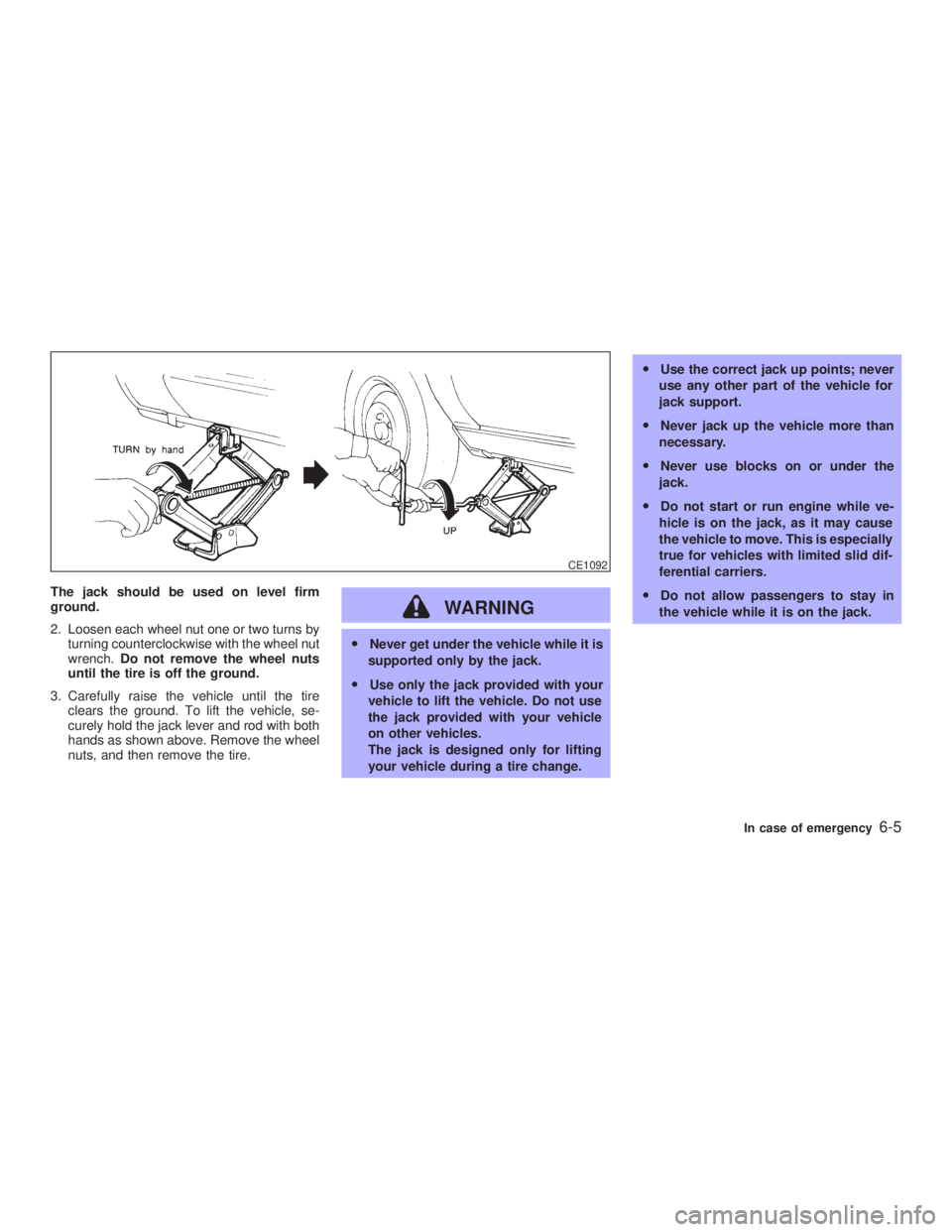
The jack should be used on level firm
ground.
2. Loosen each wheel nut one or two turns by
turning counterclockwise with the wheel nut
wrench. Do not remove the wheel nuts
until the tire is off the ground.
3. Carefully raise the vehicle until the tire
clears the ground. To lift the vehicle, se-
curely hold the jack lever and rod with both
hands as shown above. Remove the wheel
nuts, and then remove the tire.
WARNING O Never get under the vehicle while it is
supported only by the jack.
O Use only the jack provided with your
vehicle to lift the vehicle. Do not use
the jack provided with your vehicle
on other vehicles.
The jack is designed only for lifting
your vehicle during a tire change. O Use the correct jack up points; never
use any other part of the vehicle for
jack support.
O Never jack up the vehicle more than
necessary.
O Never use blocks on or under the
jack.
O Do not start or run engine while ve-
hicle is on the jack, as it may cause
the vehicle to move. This is especially
true for vehicles with limited slid dif-
ferential carriers.
O Do not allow passengers to stay in
the vehicle while it is on the jack. CE1092
In case of emergency
6-5
Z 02.7.29/V35-D/V5.0
X
Page 164 of 256

Installing the spare tire 1. Clean any mud or dirt from the surface
between the wheel and hub.
2. Carefully put the wheel on and tighten the
wheel nuts finger tight.
(Coupe models)
When replacing a front tire, make sure the
hole in the spare tire wheel is aligned with
the pin on the brake rotor.
3. With the wheel nut wrench, tighten wheel
nuts alternately and evenly until they are
tight. 4. Lower the vehicle slowly until the tire
touches the ground. Then, with the wheel
nut wrench, tighten the wheel nuts securely
in the sequence as illustrated.
WARNING O Incorrect wheel nuts or improperly
tightened wheel nuts can cause the
wheel to become loose or come off.
This could cause an accident.
O Do not use oil or grease on the wheel
studs or nuts. This could cause the
nuts to become loose.
As soon as possible tighten the wheel nuts
to the specified torque with a torque
wrench.
Wheel nut tightening torque:
80 ft-lb (108 N z m)
Adjust tire pressure to the COLD pressure.
COLD pressure:
After vehicle has been parked for three
hours or more or driven less than 1 mile
(1.6 km). COLD tire pressures are shown on the tire
placard affixed to the inside of the rear left
door opening (Sedan), the driver side cen-
ter pillar (Coupe).
WARNING Retighten the wheel nuts when the ve-
hicle has been driven for 600 miles
(1,000 km) (also in cases of a flat tire,
etc.).SCE0039
6-6 In case of emergency
Z 02.11.6/V35-D/V5.0
X
Page 165 of 256
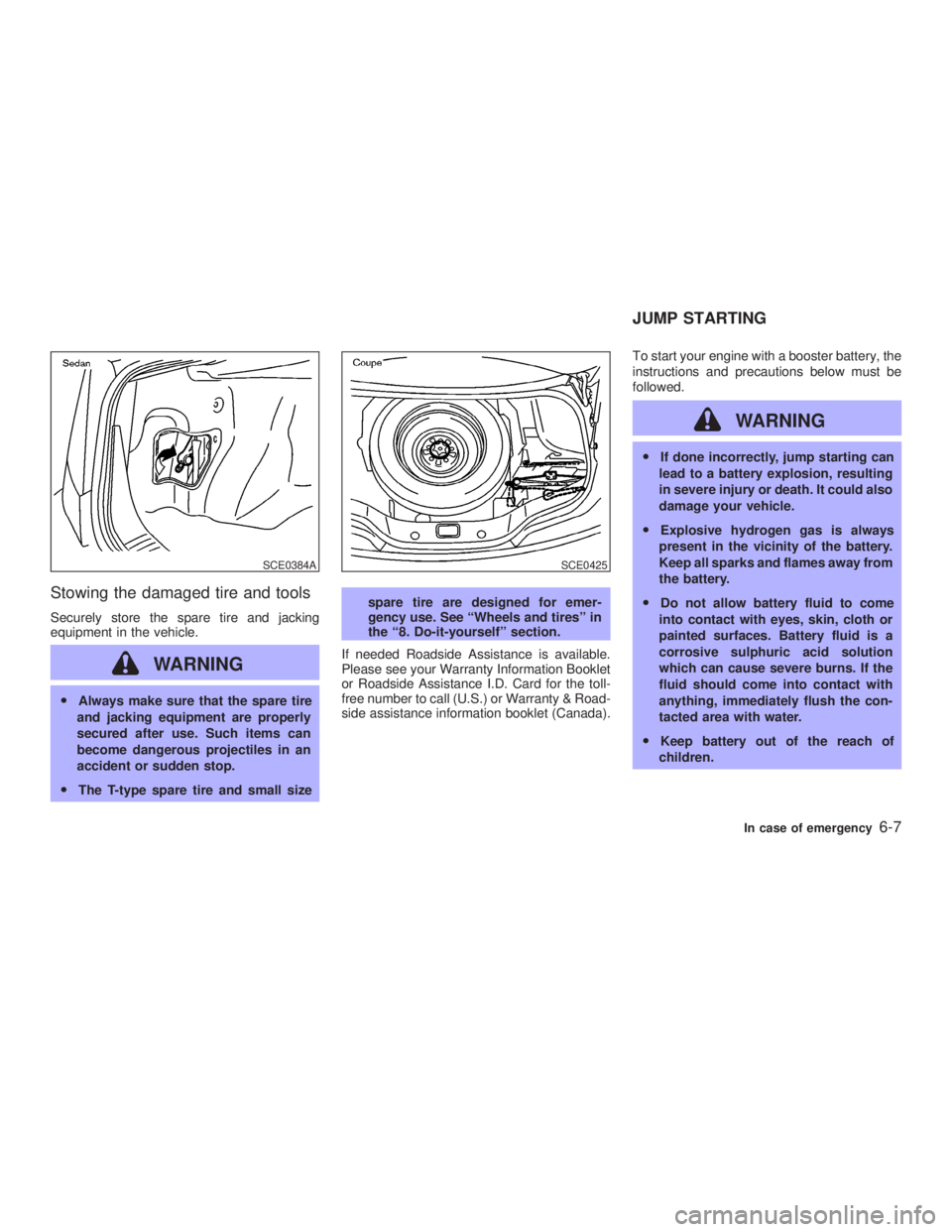
Stowing the damaged tire and tools Securely store the spare tire and jacking
equipment in the vehicle.
WARNINGO Always make sure that the spare tire
and jacking equipment are properly
secured after use. Such items can
become dangerous projectiles in an
accident or sudden stop.
O The T-type spare tire and small size spare tire are designed for emer-
gency use. See ªWheels and tiresº in
the ª8. Do-it-yourselfº section.
If needed Roadside Assistance is available.
Please see your Warranty Information Booklet
or Roadside Assistance I.D. Card for the toll-
free number to call (U.S.) or Warranty & Road-
side assistance information booklet (Canada). To start your engine with a booster battery, the
instructions and precautions below must be
followed.
WARNING O If done incorrectly, jump starting can
lead to a battery explosion, resulting
in severe injury or death. It could also
damage your vehicle.
O Explosive hydrogen gas is always
present in the vicinity of the battery.
Keep all sparks and flames away from
the battery.
O Do not allow battery fluid to come
into contact with eyes, skin, cloth or
painted surfaces. Battery fluid is a
corrosive sulphuric acid solution
which can cause severe burns. If the
fluid should come into contact with
anything, immediately flush the con-
tacted area with water.
O Keep battery out of the reach of
children.SCE0384A SCE0425
JUMP STARTING
In case of emergency
6-7
Z 02.7.29/V35-D/V5.0
X
Page 169 of 256

When towing your vehicle, all State (Provincial
in Canada) and local regulations for towing
must be followed. Incorrect towing equipment
could damage your vehicle. Towing instruc-
tions are available from an authorized INFINITI
retailer. Local service operators are generally
familiar with the applicable laws and proce-
dures for towing. To assure proper towing and
to prevent accidental damage to your vehicle,
INFINITI recommends having a service opera-
tor tow your vehicle. It is advisable to have the
service operator carefully read the following
precautions.
WARNINGO Never ride in a vehicle that is being
towed.
O Never get under your vehicle after it
has been lifted by a tow truck.
CAUTIONO When towing, make sure that the
transmission, axles, steering system and powertrain are in working condi-
tion. If any unit is damaged, dollies
must be used.
O Always attach safety chains before
towing.
If needed, Roadside Assistance is available.
Please see your Warranty Information Booklet
or Roadside Assistance I.D. Card for the toll-
free number to call (U.S.) or Warranty & Road-
side assistance information booklet (Canada).
TOWING RECOMMENDED BY
INFINITI INFINITI recommends that your vehicle be
towed with the driving (rear) wheels off the
ground or place the vehicle on a flat bed truck
as illustrated. SCE0386TOWING YOUR VEHICLE
In case of emergency
6-11
Z 02.7.29/V35-D/V5.0
X
Page 170 of 256

CAUTIONO Never tow automatic transmission
models with the rear wheels on the ground or four wheels on the ground
(forward or backward) as this may
cause serious and expensive damage
to the transmission.
If it is necessary to tow the vehicle
with the front wheels raised, always
use towing dollies under the rear
wheels.
O When towing rear wheel drive models
with the front wheels on the ground
or on towing dollies:
Turn the ignition key to the OFF posi-
tion, and secure the steering wheel in
a straight ahead position with a rope
or similar device. Never secure the
steering wheel by turning the ignition
key to the LOCK position. This may
damage the steering lock mecha-
nism.
O If you have to tow manual transmis-
sion models with the rear wheels on
the ground or four wheels on the
ground (if you do not use towing
dollies): O Always release the parking brake.
O Move the transmission shift lever
to the N (Neutral) position.
O Observe the following restricted tow-
ing speeds and distances for manual
transmission models only:
O Speed: Below 60 MPH (95 km/h)
O Distance: Less than 500 miles (800
km)
If the speed or distance must necessarily be
greater, remove the propeller shaft before tow-
ing to prevent damage to the transmission.SCE0387
6-12 In case of emergency
Z 02.7.29/V35-D/V5.0
X
Page 173 of 256

7 Appearance and care Cleaning exterior ....................................................... 7-2
Washing................................................................ 7-2
Waxing.................................................................. 7-2
Removing spots.................................................... 7-3
Underbody ............................................................ 7-3
Glass .................................................................... 7-3
Aluminum alloy wheels ......................................... 7-3
Chrome parts........................................................ 7-3
Cleaning interior ........................................................ 7-3 Floor mats ............................................................ 7-4
Seat belts ............................................................. 7-4
Corrosion protection .................................................. 7-5
Most common factors contributing to vehicle
corrosion ............................................................... 7-5
Environmental factors influence the rate of
corrosion ............................................................... 7-5
To protect your vehicle from corrosion ................ 7-5
Z 02.7.29/V35-D/V5.0
X
Page 174 of 256

In order to maintain the appearance of your
vehicle, it is important to take proper care of it.
In the following cases, please wash your ve-
hicle as soon as possible to protect the paint
surface.
O After a rainfall to prevent possible damage
from acid rain
O After driving on coastal roads
O When contaminants such as soot, bird
droppings, tree sap, metal particles or bugs
get on the paint surface
O When dust or mud builds up on the surface
Whenever possible, store or park your vehicle
inside a garage or in a covered area.
When it is necessary to park outside, park in a
shady area or protect the vehicle with a body
cover.
Be careful not to scratch the paint surface
when putting on or removing the body
cover.
WASHING Thoroughly rinse surface dirt off the vehicle
with a wet sponge and plenty of clean water.
Clean the vehicle thoroughly using a mild soap
such as Nissan Car Wash, or a general pur-
pose dishwashing liquid mixed with clean, lukewarm (never hot) water.
CAUTION O Do not use strong household soap,
strong chemical detergents, gasoline
or solvents.
O Do not wash the vehicle in direct
sunlight or while the vehicle body is
hot, as the surface may become
water-spotted.
O Avoid using tight-napped or rough
cloths, such as washing mitts. Care
must be taken when removing
caked-on dirt or other foreign sub-
stances so that the paint surface is
not scratched or damaged.
Rinse the vehicle again with plenty of clean
water.
Inside flanges, seams and folds on the doors,
hatches and hood are particularly vulnerable
to the effects of road salt. Therefore, these
areas must be regularly cleaned. Make sure
that the drain holes in the lower edge of the
door are open. Spray water under the body and in the wheel wells to loosen the dirt and
wash away road salt.
Avoid leaving water spots on the paint surface
by using a damp chamois to dry the vehicle.
WAXING Regular waxing protects the paint surface and
helps retain new vehicle appearance. Polish-
ing is recommended to remove built-up wax
residue and to avoid a weathered appearance
before re-applying wax.
If you wish to wax your vehicle, only use a wax
specified for use over clear coats, such as
Nissan Liquid or Spray Wax. Your INFINITI
retailer can assist you in choosing the proper
product.
O Wax your vehicle only after a thorough
washing. Follow the instructions supplied
with the wax.
O Do not use a wax containing any abrasives,
cutting compounds or cleaners that may
damage the vehicle finish.
O If the surface does not polish easily, use a
road tar remover and wax again.
Machine compounding or aggressive pol-
ishing on a base coat/clear coat paint finish
may dull the finish or leave swirl marks.CLEANING EXTERIOR
7-2 Appearance and care
Z 02.7.29/V35-D/V5.0
X