warning INFINITI G35 2006 Owners Manual
[x] Cancel search | Manufacturer: INFINITI, Model Year: 2006, Model line: G35, Model: INFINITI G35 2006Pages: 344, PDF Size: 6.81 MB
Page 245 of 344

O The booster battery must be rated at 12
volts. Use of an improperly rated battery
can damage your vehicle.
O Whenever working on or near a battery,
always wear suitable eye protectors (for
example, goggles or industrial safety
spectacles) and remove rings, metal
bands, or any other jewelry. Do not lean
over the battery when jump starting.
O Do not attempt to jump start a frozen
battery. It could explode and cause se-
rious injury.
If needed Roadside Assistance is available.
Please see your Warranty Information
Booklet or Roadside Assistance I.D. Card
for the toll-free number to call (U.S.) or War-
ranty Information Booklet (Canada).
WARNING Always follow the instructions below. Failure
to do so could result in damage to the charg-
ing system and cause personal injury.
1. If the booster battery is in another ve-
hicle
q B
, position the two vehicles
q A
and
q B
to bring their batteries into
close proximity to each other.
Do not allow the two vehicles to touch. 2. Apply parking brake. Move the shift
lever to the N (Neutral) position (On
automatic transmission models, move
the selector lever to the P (Park) posi-
tion). Switch off all unnecessary elec-
trical systems (light, heater, air condi-
tioner, etc.).
3. Remove vent caps on the battery (if so
equipped). Cover the battery with an
old cloth to reduce explosion hazard.
4. Connect jumper cables in the se-
quence as illustrated. SCE0539A
In case of emergency
6-9
w 06.1.4/V35-D/V5.0
X
Page 247 of 344
WARNINGO Do not continue to drive if your vehicle
overheats. Doing so could cause engine
damage or a vehicle fire.
O To avoid the danger of being scalded,
never remove the radiator cap while the
engine is still hot. When the radiator cap
is removed, pressurized hot water will
spurt out, possibly causing serious in-
jury.
O Do not open the hood if steam is coming
out.
If your vehicle is overheating (indicated
by an extremely high temperature gauge
reading), or if you feel a lack of engine
power, detect abnormal noise, etc., take
the following steps:
1. Move the vehicle safely off the road,
apply the parking brake and move the
shift lever to the N (Neutral) position
(automatic transmission to the P
(Park) position).
Do not stop the engine. 2. Turn off the air conditioner. Open all
the windows, and move the tempera-
ture control to maximum hot and the
fan control to high speed.
3. If engine overheating is caused by
climbing a long hill on a hot day, run
the engine at a fast idle (approximately
1,500 rpm) until the temperature gauge
indication returns to normal.
4. Get out of the vehicle. Look and listen
for steam or coolant escaping from the
radiator before opening the hood. (If
steam or coolant is escaping, turn off
the engine.) Do not open the hood fur-
ther until no steam or coolant can be
seen.
5. Open the engine hood.
WARNING If steam or water is coming from the engine,
stand clear to prevent getting burned.
6. Visually check if the cooling fan is run-
ning. The radiator hoses and radiator
should not leak water. If coolant is
leaking or the cooling fan does not
run, stop the engine. WARNING O Be careful not to allow your hands, hair,
jewelry or clothing to come into contact
with, or to get caught in, the engine
belts or the engine cooling fan.
O The engine cooling fan can start at any
time when the coolant temperature is
high.
7. After the engine cools down, check
the coolant level in the reservoir tank
with the engine running. Add coolant
to the reservoir tank if necessary.
Have your vehicle repaired at an
INFINITI dealer.
If needed, Roadside Assistance is avail-
able. Please see your Warranty Information
Booklet or Roadside Assistance I.D. Card
for the toll-free number to call (U.S.) or War-
ranty Information Booklet (Canada).IF YOUR VEHICLE OVERHEATS
In case of emergency
6-11
w 06.1.4/V35-D/V5.0
X
Page 248 of 344
When towing your vehicle, all State (Pro-
vincial in Canada) and local regulations
for towing must be followed. Incorrect
towing equipment could damage your ve-
hicle. Towing instructions are available
from an INFINITI dealer. Local service op-
erators are generally familiar with the ap-
plicable laws and procedures for towing.
To assure proper towing and to prevent
accidental damage to your vehicle,
INFINITI recommends having a service op-
erator tow your vehicle. It is advisable to
have the service operator carefully read
the following precautions.
WARNINGO Never ride in a vehicle that is being
towed.
O Never get under your vehicle after it has
been lifted by a tow truck.
CAUTIONO When towing, make sure that the trans-
mission, axles, steering system and powertrain are in working condition. If
any unit is damaged, dollies must be
used.
O Always attach safety chains before
towing.
For information about towing your vehicle
behind a recreational vehicle (RV), refer to
ªFlat towingº in the ª9. Technical and
consumer informationº section of this
manual.
If needed, Roadside Assistance is avail-
able. Please see your Warranty Informa-
tion Booklet or Roadside Assistance I.D.
Card for the toll-free number to call (U.S.)
or Warranty Information Booklet (Canada).
TOWING RECOMMENDED BY
INFINITI
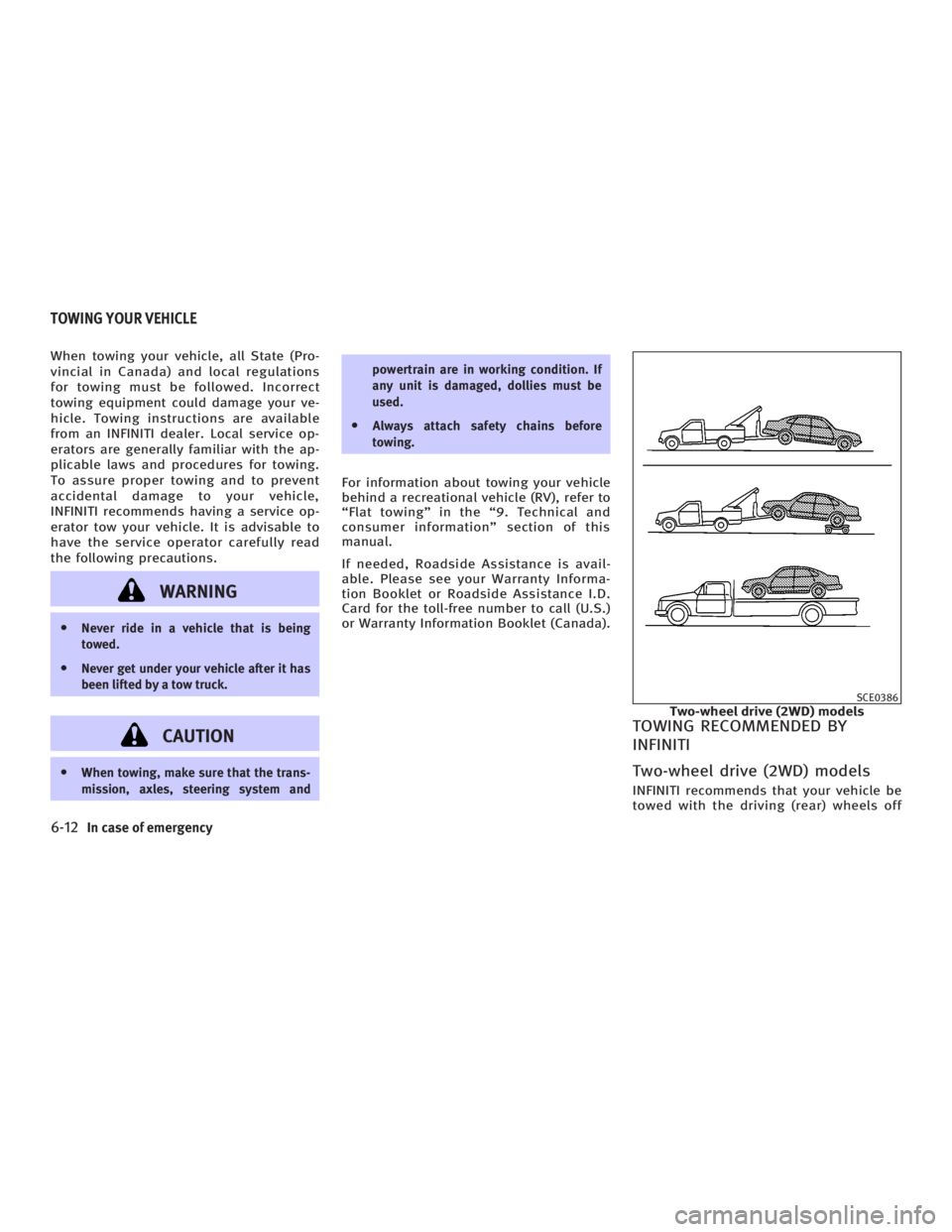
Two-wheel drive (2WD) models INFINITI recommends that your vehicle be
towed with the driving (rear) wheels off SCE0386
Two-wheel drive (2WD) modelsTOWING YOUR VEHICLE
6-12 In case of emergency
w 06.1.4/V35-D/V5.0
X
Page 251 of 344
VEHICLE RECOVERY (Freeing a
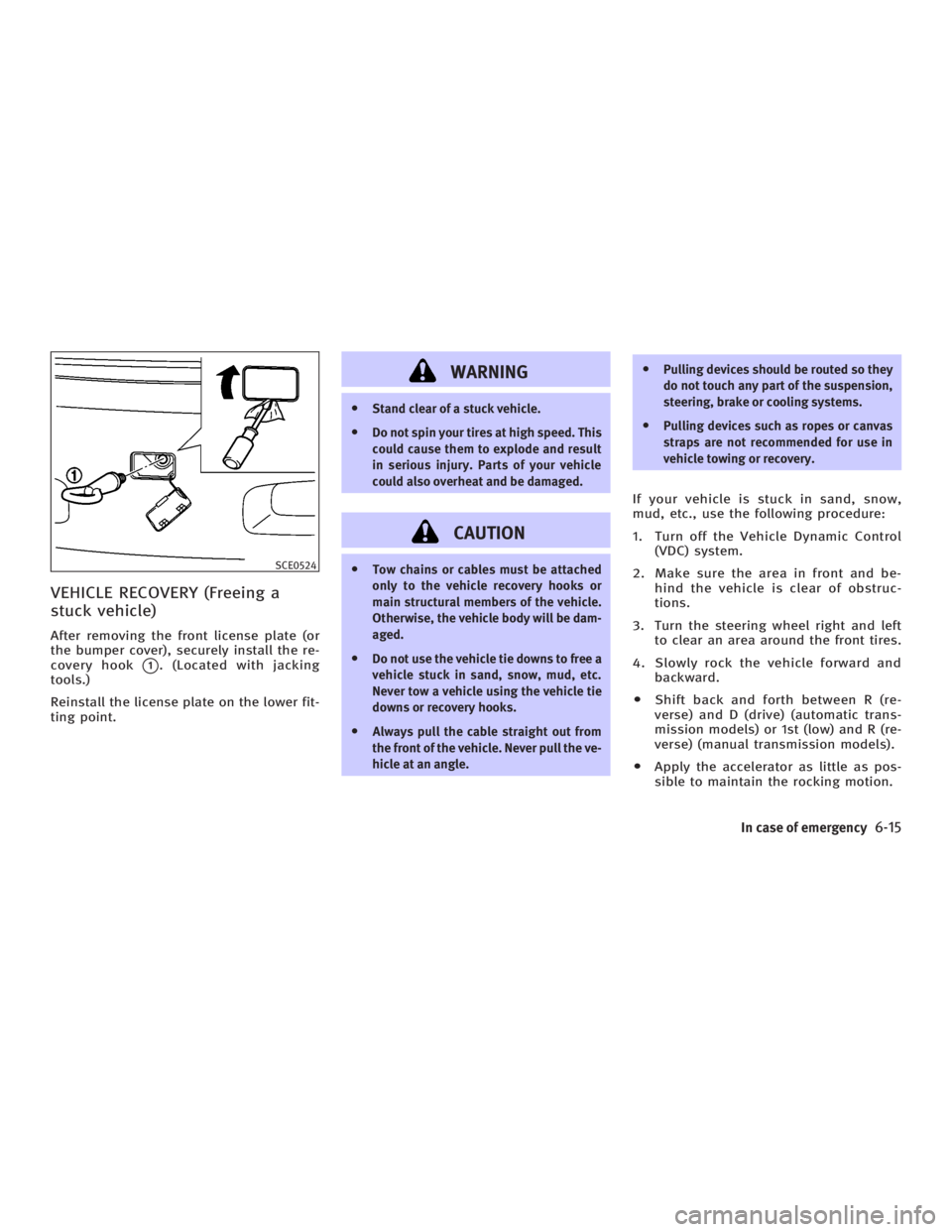
stuck vehicle) After removing the front license plate (or
the bumper cover), securely install the re-
covery hook
q 1
. (Located with jacking
tools.)
Reinstall the license plate on the lower fit-
ting point. WARNING O Stand clear of a stuck vehicle.
O Do not spin your tires at high speed. This
could cause them to explode and result
in serious injury. Parts of your vehicle
could also overheat and be damaged.
CAUTION O Tow chains or cables must be attached
only to the vehicle recovery hooks or
main structural members of the vehicle.
Otherwise, the vehicle body will be dam-
aged.
O Do not use the vehicle tie downs to free a
vehicle stuck in sand, snow, mud, etc.
Never tow a vehicle using the vehicle tie
downs or recovery hooks.
O Always pull the cable straight out from
the front of the vehicle. Never pull the ve-
hicle at an angle. O Pulling devices should be routed so they
do not touch any part of the suspension,
steering, brake or cooling systems.
O Pulling devices such as ropes or canvas
straps are not recommended for use in
vehicle towing or recovery.
If your vehicle is stuck in sand, snow,
mud, etc., use the following procedure:
1. Turn off the Vehicle Dynamic Control
(VDC) system.
2. Make sure the area in front and be-
hind the vehicle is clear of obstruc-
tions.
3. Turn the steering wheel right and left
to clear an area around the front tires.
4. Slowly rock the vehicle forward and
backward.
O Shift back and forth between R (re-
verse) and D (drive) (automatic trans-
mission models) or 1st (low) and R (re-
verse) (manual transmission models).
O Apply the accelerator as little as pos-
sible to maintain the rocking motion.SCE0524
In case of emergency
6-15
w 06.1.4/V35-D/V5.0
X
Page 257 of 344
SEAT BELTS The seat belts can be cleaned by wiping
them with a sponge dampened in a mild
soap solution. Allow the belts to dry com-
pletely before using them. See ªSeat belt
maintenanceº in the ª1. Safety Ð Seats,
seat belts and supplemental restraint sys-
temº section.
WARNINGDo not allow wet seat belts to roll up in the
retractor. NEVER use bleach, dye, or
chemical solvents to clean the seat belts,
since these materials may severely weaken
the seat belt webbing. MOST COMMON FACTORS
CONTRIBUTING TO VEHICLE
CORROSION O The accumulation of moisture-
retaining dirt and debris in body panel
sections, cavities, and other areas.
O Damage to paint and other protective
coatings caused by gravel and stone
chips or minor traffic accidents.
ENVIRONMENTAL FACTORS
INFLUENCE THE RATE OF
CORROSION
Moisture Accumulation of sand, dirt and water on
the vehicle body underside can accelerate
corrosion. Wet floor coverings will not dry
completely inside the vehicle, and should
be removed for drying to avoid floor panel
corrosion.
Relative humidity Corrosion will be accelerated in areas of
high relative humidity, especially those
areas where the temperatures stay above
freezing and where atmospheric pollution
exists and road salt is used. Temperature A temperature increase will accelerate the
rate of corrosion to those parts which are
not well ventilated.
Air pollution Industrial pollution, the presence of salt
in the air in coastal areas, or heavy road
salt use will accelerate the corrosion pro-
cess. Road salt will also accelerate the
disintegration of paint surfaces.
TO PROTECT YOUR VEHICLE FROM
CORROSION O Wash and wax your vehicle often to
keep it clean.
O Always check for minor damage to the
paint and repair it as soon as pos-
sible.
O Keep drain holes at the bottom of the
doors open to avoid water accumula-
tion.
O Check the underbody for accumulation
of sand, dirt or salt. If present, wash
with water as soon as possible.CORROSION PROTECTION
Appearance and care
7-5
w 06.1.4/V35-D/V5.0
X
Page 262 of 344
Inside the vehicle The maintenance items listed here should
be checked on a regular basis, such as
when performing periodic maintenance,
cleaning the vehicle, etc.
Accelerator pedal: Check the pedal for
smooth operation and make sure the
pedal does not catch or require uneven
effort. Keep the floor mat away from the
pedal.
Automatic transmission P (Park) mecha-
nism: On a fairly steep hill check that your
vehicle is held securely with the selector
lever in the P (Park) position without ap-
plying any brakes.
Brake pedal*: Check the pedal for smooth
operation and make sure it has the proper
distance under it when depressed fully.
Check the brake booster function. Be sure
to keep the floor mat away from the
pedal.
Brakes: Check that the brakes do not pull
the vehicle to one side when applied.
Parking brake*: Check that the pedal/
lever has the proper travel and confirm
that your vehicle is held securely on a
fairly steep hill with only the parking
brake applied. Seats: Check seat position controls such
as seat adjusters, seatback recliner, etc.
to ensure they operate smoothly and that
all latches lock securely in every position.
Check that the head restraints move up
and down smoothly and that the locks (if
so equipped) hold securely in all latched
positions.
Seat belts: Check that all parts of the seat
belt system (For example, buckles, an-
chors, adjusters and retractors) operate
properly and smoothly, and are installed
securely. Check the belt webbing for cuts,
fraying, wear or damage.
Steering wheel: Check for changes in the
steering conditions, such as excessive
free play, hard steering or strange noises.
Warning lights and chimes: Make sure
that all warning lights and chimes are op-
erating properly.
Windshield defroster: Check that the air
comes out of the defroster outlets prop-
erly and in sufficient quantity when oper-
ating the heater or air conditioner.
Windshield wiper and washer*: Check that
the wipers and washer operate properly
and that the wipers do not streak. Under the hood and the vehicle The maintenance items listed here should
be checked periodically (For example,
each time you check the engine oil or re-
fuel).
Battery*: Check the fluid level in each
cell. It should be between the MAX and
MIN lines. Vehicles operated in high tem-
peratures or under severe conditions re-
quire frequent checks of the battery fluid
level.
Brake and clutch fluid level*: Make sure
that the brake and clutch fluid levels are
between the MAX and MIN lines on the
reservoir.
Engine coolant level*: Check the coolant
level when the engine is cold.
Engine drive belts*: Make sure that no
belt is frayed, worn, cracked or oily.
Engine oil level*: Check the level after
parking the vehicle on a level location
and turning off the engine. (Wait at least
10 minutes for the oil to drain back into
the oil pan.)
Exhaust system: Make sure there are no
loose supports, cracks or holes. If the
sound of the exhaust seems unusual or
8-4 Maintenance and do-it-yourself
w 06.1.4/V35-D/V5.0
X
Page 263 of 344
there is a smell of exhaust fumes, imme-
diately locate the trouble and correct it.
See ªPrecautions when starting and
drivingº in the ª5. Starting and drivingº
section for exhaust gas (Carbon mon-
oxide).
Fluid leaks: Check under the vehicle for
fuel, oil, water or other fluid leaks after
the vehicle has been parked for a while.
Water dripping from the air conditioner
after use is normal. If you should notice
any leaks or if gasoline fumes are evi-
dent, check for the cause and have it cor-
rected immediately.
Power steering fluid level* and lines:
Check the level when the fluid is cold and
the engine is turned off. Check the lines
for proper attachment, leaks, cracks, etc.
Radiator and hoses: Check the front of the
radiator and clean off any dirt, insects,
leaves, etc., that may have accumulated.
Make sure the hoses have no cracks, de-
formation, deterioration or loose connec-
tions.
Underbody: The underbody is frequently
exposed to corrosive substances such as
those used on icy roads or to control
dust. It is very important to remove these
substances, otherwise rust will form on the floor pan, frame, fuel lines and
around the exhaust system. At the end of
winter, the underbody should be thor-
oughly flushed with plain water, being
careful to clean those areas where mud
and dirt may accumulate. For additional
information, see ªCleaning exteriorº in
the ª7. Appearance and careº section.
Windshield washer fluid*: Check that
there is adequate fluid in the tank. When performing any inspection or main-
tenance work on your vehicle, always take
care to prevent serious accidental injury
to yourself or damage to the vehicle. The
following are general precautions which
should be closely observed.
WARNING O Park the vehicle on a level surface, apply
the parking brake securely and block the
wheels to prevent the vehicle from
moving. For a manual transmission,
move the shift lever to N (Neutral) posi-
tion. For an automatic transmission
models, move the selector lever to P
(Park).
O Be sure the ignition key is in the OFF or
LOCK position when performing any
parts replacement or repairs.
O If you must work with the engine run-
ning, keep your hands, clothing, hair
and tools away from moving fans, belts
and any other moving parts.
O It is advisable to secure or remove any
loose clothing and remove any jewelry,MAINTENANCE PRECAUTIONS
Maintenance and do-it-yourself
8-5
w 06.1.4/V35-D/V5.0
X
Page 266 of 344
The engine cooling system is filled at the
factory with a high-quality, year-round,
anti-freeze coolant solution. The anti-
freeze solution contains rust and corro-
sion inhibitors, therefore additional
cooling system additives are not neces-
sary.
WARNINGO Never remove the radiator or coolant res-
ervoir cap when the engine is hot. Wait
until the engine and radiator cool down.
Serious burns could be caused by high
pressure fluid escaping from the ra-
diator. See precautions in ªIf your ve-
hicle overheatsº found in the ª6. In case
of emergencyº section.
O The radiator is equipped with a pressure
type radiator cap. To prevent engine
damage, use only a genuine NISSAN ra-
diator cap. CAUTION When adding or replacing coolant, be sure to
use only a Genuine Nissan Long Life
Antifreeze/Coolant or equivalent with the
proper mixture ratio of 50% antifreeze and
50% demineralized water/distilled water.
The use of other types of engine coolant may
damage your engine cooling system. Outside temperature
down to
Antifreeze Deminer-
alized
water/
distilled
waterÉC ÉF
þ35 þ30 50% 50%
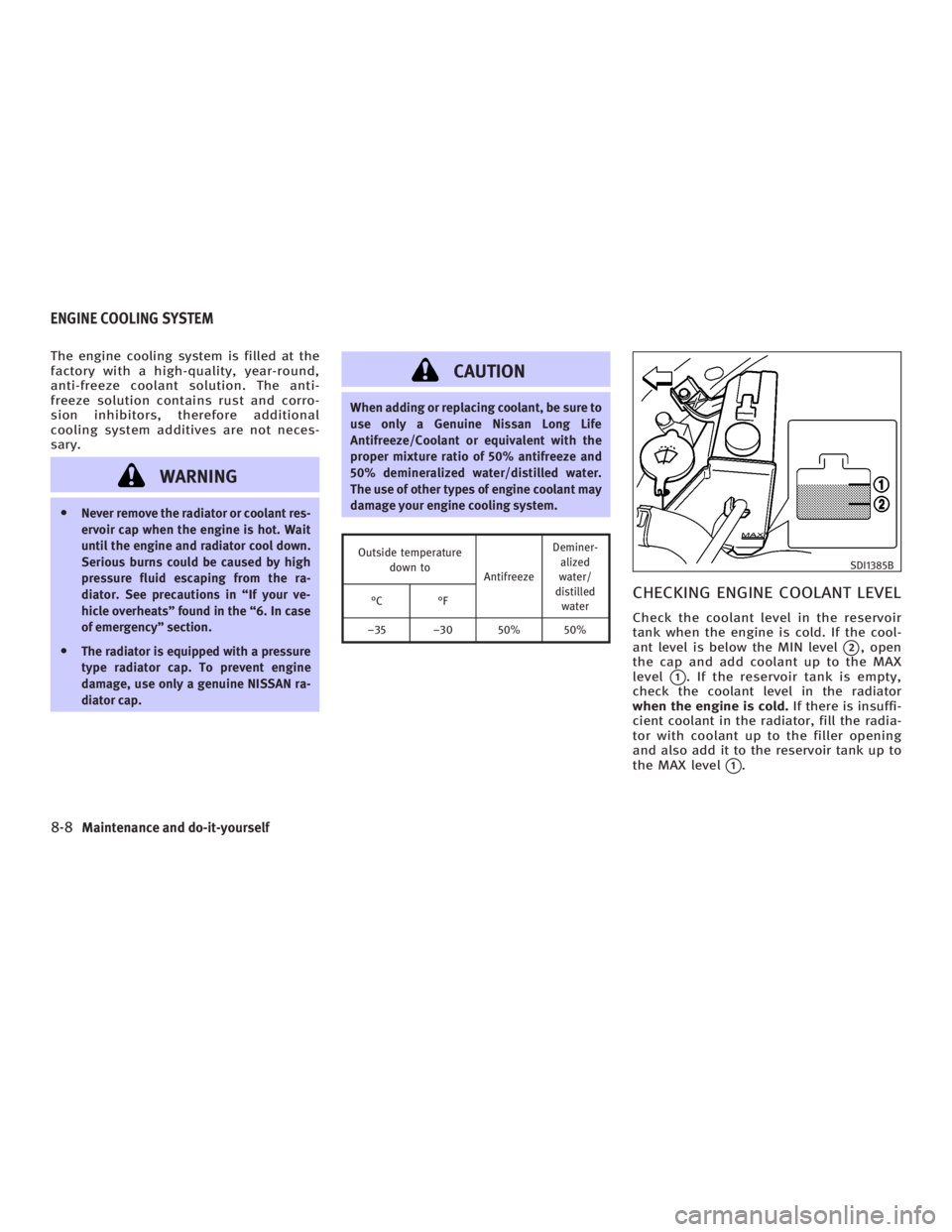
CHECKING ENGINE COOLANT LEVEL Check the coolant level in the reservoir
tank when the engine is cold. If the cool-
ant level is below the MIN level
q 2
, open
the cap and add coolant up to the MAX
level
q 1
. If the reservoir tank is empty,
check the coolant level in the radiator
when the engine is cold. If there is insuffi-
cient coolant in the radiator, fill the radia-
tor with coolant up to the filler opening
and also add it to the reservoir tank up to
the MAX level
q 1
. SDI1385B
ENGINE COOLING SYSTEM
8-8 Maintenance and do-it-yourself
w 06.1.4/V35-D/V5.0
X
Page 267 of 344
If the cooling system frequently requires
coolant, have it checked by an INFINITI
dealer.
CHANGING ENGINE COOLANT O Major cooling system repairs should be
performed by an INFINITI dealer. The
service procedures can be found in the
appropriate INFINITI Service Manual. O Improper servicing can result in re-
duced heater performance and engine
overheating.
WARNING O To avoid being scalded, never change
the coolant when the engine is hot.
O Never remove the radiator cap when the
engine is hot. Serious burns could be
caused by high pressure fluid escaping
from the radiator.
O Avoid direct skin contact with used cool-
ant. If skin contact is made, wash thor-
oughly with soap or hand cleaner as
soon as possible.
O Keep coolant out of reach of children and
pets.
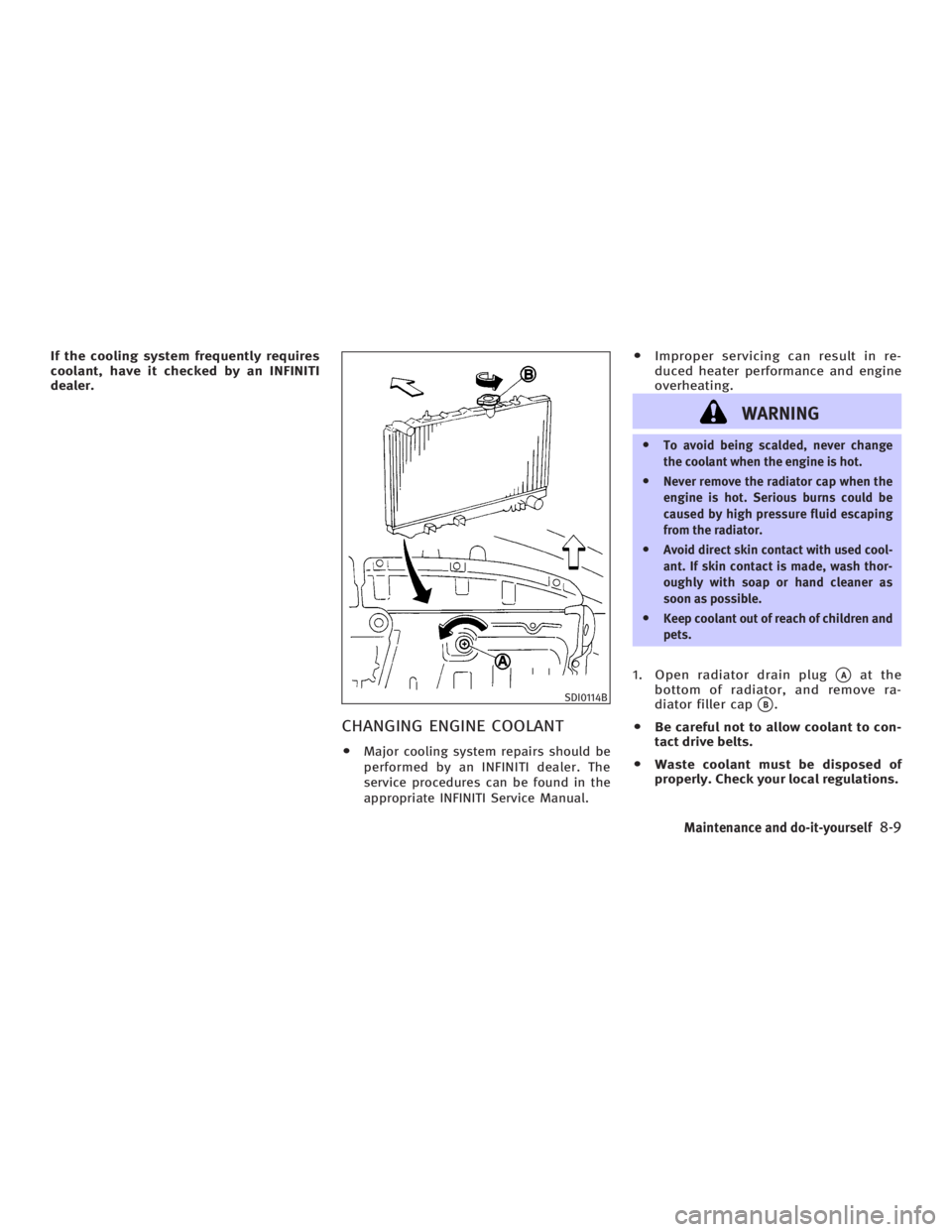
1. Open radiator drain plug
q A
at the
bottom of radiator, and remove ra-
diator filler cap
q B
.
O Be careful not to allow coolant to con-
tact drive belts.
O Waste coolant must be disposed of
properly. Check your local regulations. SDI0114B
Maintenance and do-it-yourself
8-9
w 06.1.4/V35-D/V5.0
X
Page 271 of 344
WARNINGO Prolonged and repeated contact with
used engine oil may cause skin cancer.
O Try to avoid direct skin contact with used
oil. If skin contact is made, wash thor-
oughly with soap or hand cleaner as
soon as possible.
O Keep used engine oil out of reach of
children. When checking or replacement is re-
quired, we recommend an INFINITI dealer
for servicing.
CAUTION O Use only Genuine NISSAN Matic J ATF. Do
not mix with other fluids.
O Using automatic transmission fluid
other than Genuine NISSAN Matic J ATF
will cause deterioration in driveability
and automatic transmission durability,
and may damage the automatic trans-
mission, which is not covered by the
INFINITI new vehicle limited warranty.
The specified automatic transmission
fluid is also described on caution labels
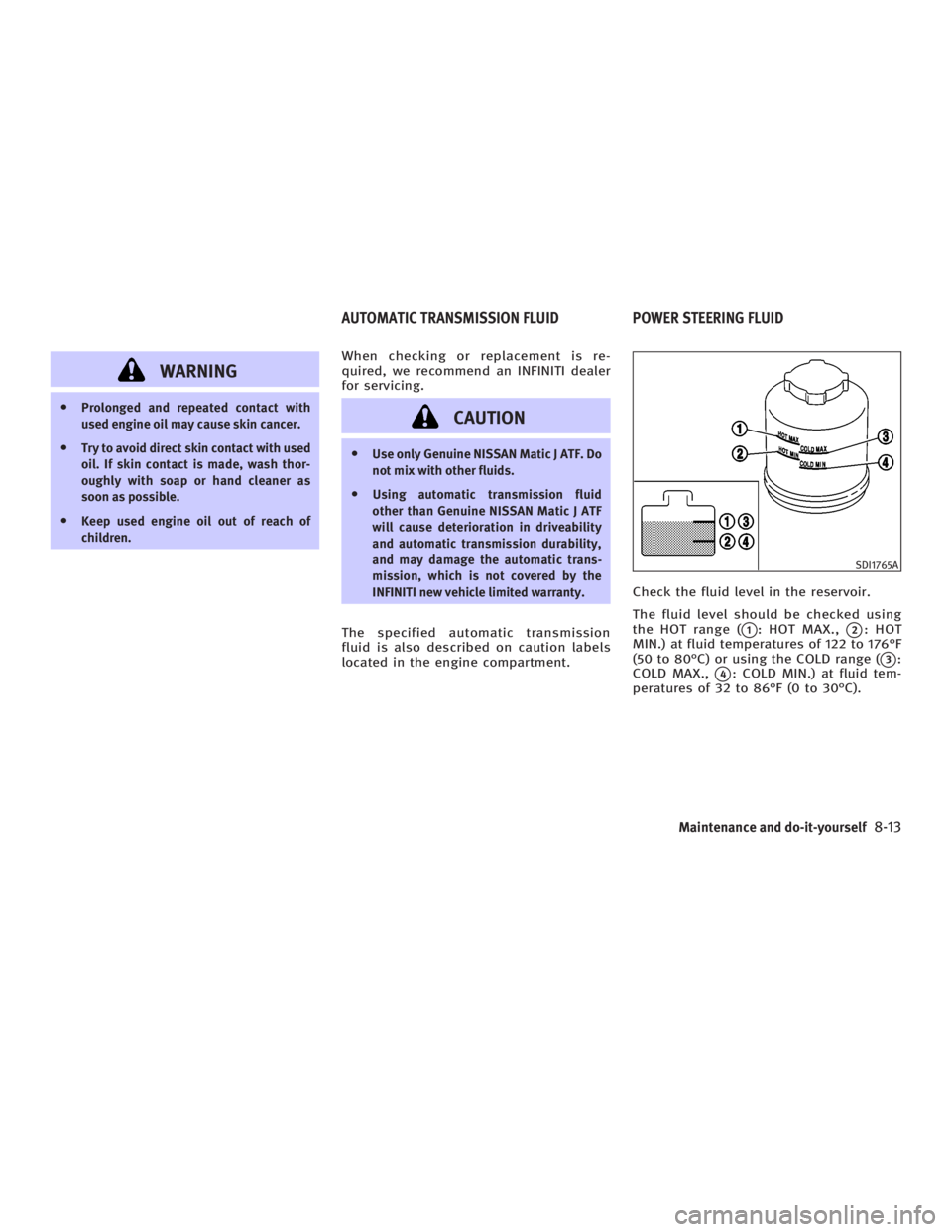
located in the engine compartment. Check the fluid level in the reservoir.
The fluid level should be checked using
the HOT range (
q 1
: HOT MAX.,
q 2
: HOT
MIN.) at fluid temperatures of 122 to 176ÉF
(50 to 80ÉC) or using the COLD range (
q 3
:
COLD MAX.,
q 4
: COLD MIN.) at fluid tem-
peratures of 32 to 86ÉF (0 to 30ÉC). SDI1765A
AUTOMATIC TRANSMISSION FLUID POWER STEERING FLUID
Maintenance and do-it-yourself
8-13
w 06.1.4/V35-D/V5.0
X