change wheel INFINITI G35 2006 User Guide
[x] Cancel search | Manufacturer: INFINITI, Model Year: 2006, Model line: G35, Model: INFINITI G35 2006Pages: 344, PDF Size: 6.81 MB
Page 242 of 344
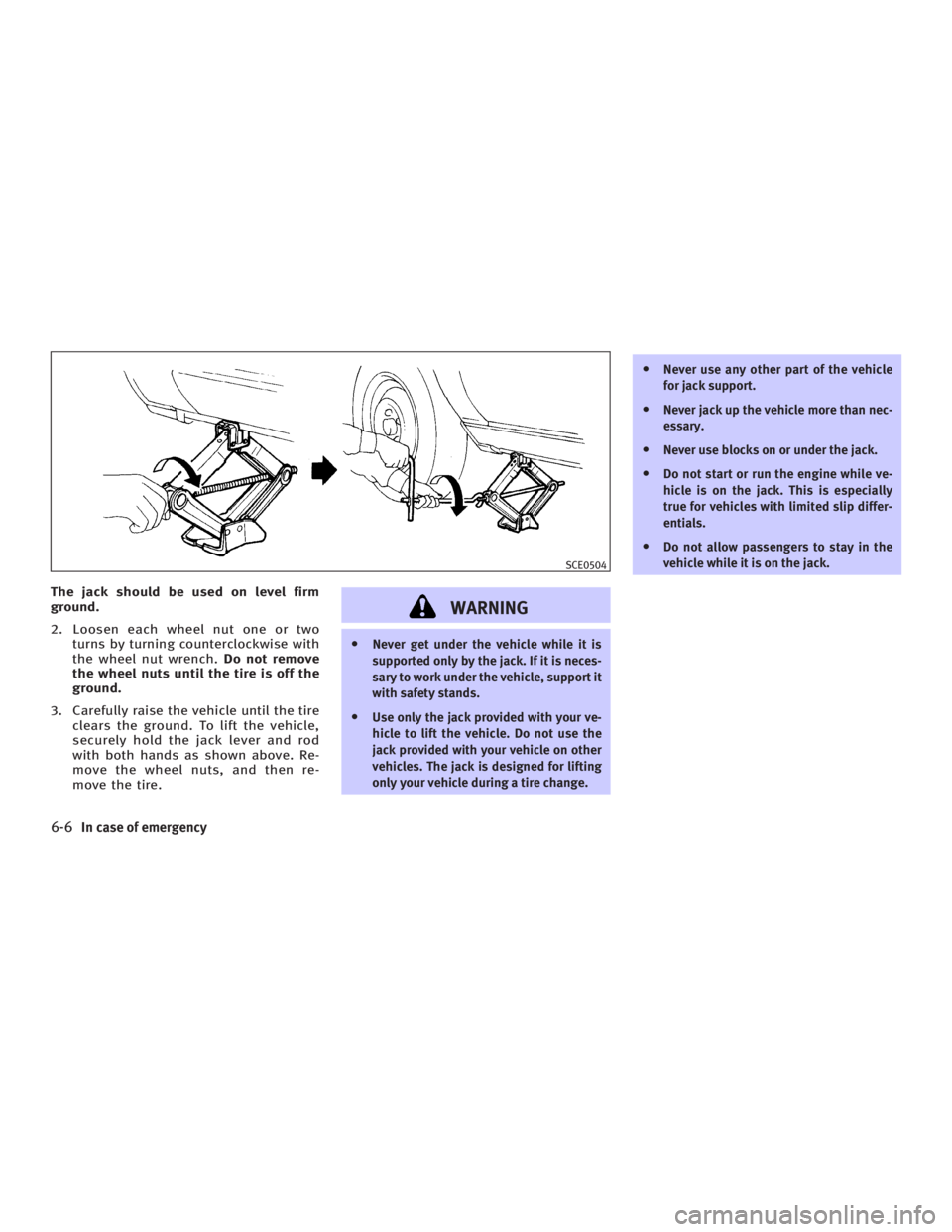
The jack should be used on level firm
ground.
2. Loosen each wheel nut one or two
turns by turning counterclockwise with
the wheel nut wrench. Do not remove
the wheel nuts until the tire is off the
ground.
3. Carefully raise the vehicle until the tire
clears the ground. To lift the vehicle,
securely hold the jack lever and rod
with both hands as shown above. Re-
move the wheel nuts, and then re-
move the tire.
WARNING O Never get under the vehicle while it is
supported only by the jack. If it is neces-
sary to work under the vehicle, support it
with safety stands.
O Use only the jack provided with your ve-
hicle to lift the vehicle. Do not use the
jack provided with your vehicle on other
vehicles. The jack is designed for lifting
only your vehicle during a tire change. O Never use any other part of the vehicle
for jack support.
O Never jack up the vehicle more than nec-
essary.
O Never use blocks on or under the jack.
O Do not start or run the engine while ve-
hicle is on the jack. This is especially
true for vehicles with limited slip differ-
entials.
O Do not allow passengers to stay in the
vehicle while it is on the jack. SCE0504
6-6 In case of emergency
w 06.1.4/V35-D/V5.0
X
Page 262 of 344
Inside the vehicle The maintenance items listed here should
be checked on a regular basis, such as
when performing periodic maintenance,
cleaning the vehicle, etc.
Accelerator pedal: Check the pedal for
smooth operation and make sure the
pedal does not catch or require uneven
effort. Keep the floor mat away from the
pedal.
Automatic transmission P (Park) mecha-
nism: On a fairly steep hill check that your
vehicle is held securely with the selector
lever in the P (Park) position without ap-
plying any brakes.
Brake pedal*: Check the pedal for smooth
operation and make sure it has the proper
distance under it when depressed fully.
Check the brake booster function. Be sure
to keep the floor mat away from the
pedal.
Brakes: Check that the brakes do not pull
the vehicle to one side when applied.
Parking brake*: Check that the pedal/
lever has the proper travel and confirm
that your vehicle is held securely on a
fairly steep hill with only the parking
brake applied. Seats: Check seat position controls such
as seat adjusters, seatback recliner, etc.
to ensure they operate smoothly and that
all latches lock securely in every position.
Check that the head restraints move up
and down smoothly and that the locks (if
so equipped) hold securely in all latched
positions.
Seat belts: Check that all parts of the seat
belt system (For example, buckles, an-
chors, adjusters and retractors) operate
properly and smoothly, and are installed
securely. Check the belt webbing for cuts,
fraying, wear or damage.
Steering wheel: Check for changes in the
steering conditions, such as excessive
free play, hard steering or strange noises.
Warning lights and chimes: Make sure
that all warning lights and chimes are op-
erating properly.
Windshield defroster: Check that the air
comes out of the defroster outlets prop-
erly and in sufficient quantity when oper-
ating the heater or air conditioner.
Windshield wiper and washer*: Check that
the wipers and washer operate properly
and that the wipers do not streak. Under the hood and the vehicle The maintenance items listed here should
be checked periodically (For example,
each time you check the engine oil or re-
fuel).
Battery*: Check the fluid level in each
cell. It should be between the MAX and
MIN lines. Vehicles operated in high tem-
peratures or under severe conditions re-
quire frequent checks of the battery fluid
level.
Brake and clutch fluid level*: Make sure
that the brake and clutch fluid levels are
between the MAX and MIN lines on the
reservoir.
Engine coolant level*: Check the coolant
level when the engine is cold.
Engine drive belts*: Make sure that no
belt is frayed, worn, cracked or oily.
Engine oil level*: Check the level after
parking the vehicle on a level location
and turning off the engine. (Wait at least
10 minutes for the oil to drain back into
the oil pan.)
Exhaust system: Make sure there are no
loose supports, cracks or holes. If the
sound of the exhaust seems unusual or
8-4 Maintenance and do-it-yourself
w 06.1.4/V35-D/V5.0
X
Page 305 of 344
tionsº in the ª9. Technical and consumer
informationº section for recommended
types and sizes of tires and wheels.
WARNINGO The use of tires other than those recom-
mended or the mixed use of tires of dif-
ferent brands, construction (bias, bias-
belted or radial), or tread patterns can ad-
versely affect the ride, braking, handling,
ground clearance, body-to-tire clearance,
tire chain clearance, speedometer calibra-
tion, headlight aim and bumper height.
Some of these effects may lead to accidents
and could result in serious personal injury.
O If the wheels are changed for any reason,
always replace with wheels which have
the same off-set dimension. Wheels of a
different off-set could cause premature
tire wear, degrade vehicle handling char-
acteristics and/or interference with the
brake discs. Such interference can lead
to decreased braking efficiency and/or
early brake pad wear.
O When a spare tire is mounted or a wheel
is replaced, tire pressure will not be indi-
cated, the TPMS will not function and the low tire pressure warning light will flash.
Contact your INFINITI dealer as soon as
possible for tire replacement and/or sys-
tem resetting.
O Replacing tires with those not originally
specified by INFINITI could affect the
proper operation of the TPMS.
O Do not install a deformed wheel or tire
even if it has been repaired. Such wheels
or tires could have structural damage
and could malfunction without warning.
O The use of retread tires is not recom-
mended.
O For additional information regarding tires,
refer to ªImportant Tire Safety Informationº
(US) or ªTire Safety Informationº (Canada)
in the Warranty Information Booklet.
CAUTION Always use tires of the same type, size,
brand, construction (bias, bias-belted or ra-
dial), and tread pattern on all four wheels.
Failure to do so may result in a circumference difference between tires on the front and
rear axles which will cause excessive tire
wear and may damage the transmission,
transfer case and differential gears (AWD
models).
Wheel balance Unbalanced wheels may affect vehicle han-
dling and tire life. Even with regular use,
wheels can get out of balance. Therefore,
they should be balanced as required.
Wheel balance service should be per-
formed with the wheels off the vehicle.
Spin balancing the wheels on the vehicle
could lead to transmission damage.
For additional information regarding tires,
refer to ªImportant Tire Safety Informa-
tionº (US) or ªTire Safety Informationº
(Canada) in the INFINITI Warranty Informa-
tion Booklet.
Care of wheels O Wash the wheels when washing the
vehicle to maintain their appearance.
O Clean the inner side of the wheels
when the wheel is changed or the un-
derside of the vehicle is washed.
Maintenance and do-it-yourself
8-47
w 06.1.5/V35-D/V5.0
X
Page 323 of 344
the vehicle. That weight may not
safely exceed the available cargo
and luggage load capacity calcu-
lated in Step 4.
6. If your vehicle will be towing a
trailer, load from your trailer will be
transferred to your vehicle. Consult
this manual to determine how this
reduces the available cargo and lug-
gage load capacity of your vehicle.
Before driving a loaded vehicle, confirm
that you do not exceed the Gross Ve-
hicle Weight Rating (GVWR) or the
Gross Axle Weight Rating (GAWR) for
your vehicle. See ``Measurement of
Weights'' later in this section.
Also check tires for proper inflation
pressures. See the Tire and Loading In-
formation label.
LOADING TIPS
O The GVW must not exceed GVWR or
GAWR as specified on the F.M.V.S.S./C.M.V.S.S. certification
label.
O Do not load the front and rear axle
to the GAWR. Doing so will exceed
the GVWR.
WARNINGO Properly secure all cargo with
ropes or straps to help prevent it
from sliding or shifting. Do not
place cargo higher than the seat-
backs. In a sudden stop or colli-
sion, unsecured cargo could cause
personal injury.
O Do not load your vehicle any
heavier than the GVWR or the
maximum front and rear GAWRs. If
you do, parts of your vehicle can
break, tire damage could occur, or
it can change the way your vehicle
handles. This could result in loss
of control and cause personal
injury. O Overloading not only can shorten
the life of your vehicle and the tire,
but can also cause unsafe vehicle
handling and longer braking dis-
tances. This may cause a prema-
ture tire failure which could result
in a serious accident and personal
injury. Failures caused by over-
loading are not covered by the ve-
hicle's warranty.
MEASUREMENT OF WEIGHTS
Secure loose items to prevent weight
shifts that could affect the balance of
your vehicle. When the vehicle is
loaded, drive to a scale and weigh the
front and the rear wheels separately to
determine axle loads. Individual axle
loads should not exceed either of the
gross axle weight ratings (GAWR). The
total of the axle loads should not ex-
ceed the gross vehicle weight rating
(GVWR). These ratings are given on the
vehicle certification label. If weight rat-
ings are exceeded, move or remove
items to bring all weights below the rat-
ings. Technical and consumer information
9-17
w 06.1.4/V35-D/V5.0
X
Page 327 of 344
WARNINGNever connect a trailer brake system directly
to the vehicle brake system.
Pre-towing tips O Be certain your vehicle maintains a
level position when a loaded and/or
unloaded trailer is hitched. Do not
drive the vehicle if it has an abnormal
nose-up or nose-down condition;
check for improper tongue load, over-
load, worn suspension or other pos-
sible causes of either condition.
O Always secure items in the trailer to
prevent load shifts while driving.
O Load the trailer so approximately 60%
of the trailer load is in the front half
and 40% is in the back half.
O Check your hitch, trailer tire pressure,
vehicle tire pressure, trailer light op-
eration, and trailer wheel lug nuts
every time you attach a trailer to the
vehicle.
O Be certain your rear view mirrors con-
form to all federal, state or local regula- tions. If not, install any mirrors required
for towing before driving the vehicle.
Trailer towing tips In order to gain skill and an under-
standing of the vehicle's behavior, you
should practice turning, stopping and
backing up in an area which is free from
traffic. Steering stability, and braking per-
formance will be somewhat different than
under normal driving conditions.
O Always secure items in the trailer to
prevent load shift while driving.
O Avoid abrupt starts, acceleration or
stops.
O Avoid sharp turns or lane changes.
O Always drive your vehicle at a mod-
erate speed. Some states or provinces
have specific speed limits for vehicles
that are towing trailers. Obey the local
speed limits.
O When backing up, hold the bottom of
the steering wheel with one hand.
Move your hand in the direction in
which you want the trailer to go. Make
small corrections and back up slowly.
If possible, have someone guide you
when you are backing up. O Always block the wheels on both vehicle
and trailer when parking. Parking on a
slope is not recommended; however, if
you must do so, and if your vehicle is
equipped with automatic transmission,
first apply the parking brake and block
the wheels, and then move the transmis-
sion selector lever into the P (Park) posi-
tion. If you move the selector lever to
the P (Park) position before applying the
parking brake and blocking the wheels,
transmission damage could occur.
O When going down a hill, shift into a
lower gear and use the engine braking
effect. When going up a long grade,
downshift the transmission to a lower
gear and reduce speed to reduce
chances of engine overloading and/or
overheating.
However, for long steep grades, do
not stay in 1st or 2nd gear when
driving above 35 MPH (56 km/h).
O If the engine coolant rises to an ex-
tremely high temperature when the air
conditioning system is on, turn off the
air conditioner. Coolant heat can be
additionally vented by opening the
windows, switching the fan control to
high and setting the temperature con-
trol to the HOT position.
Technical and consumer information
9-21
w 06.1.4/V35-D/V5.0
X
Page 328 of 344
O Trailer towing requires more fuel than
normal circumstances.
O Avoid towing a trailer for the first 500
miles (800 km).
O Have your vehicle serviced more often
than at intervals specified in the rec-
ommended maintenance schedule in
the INFINITI Service and Maintenance
Guide.
O When making a turn, your trailer
wheels will be closer to the inside of
the turn than your vehicle wheels. To
compensate for this, make a larger
than normal turning radius during the
turn.
O Crosswinds and rough roads will ad-
versely affect vehicle/trailer handling,
possibly causing vehicle sway. When
being passed by larger vehicles, be
prepared for possible changes in
crosswinds that could affect vehicle
handling. If swaying does occur, firmly
grip the steering wheel, steer straight
ahead, and immediately (but gradu-
ally) reduce vehicle speed. This combi-
nation will help stabilize the vehicle.
Never increase speed. O Be careful when passing other vehicles.
Passing while towing a trailer requires
considerably more distance than normal
passing. Remember the length of the
trailer must also pass the other vehicle
before you can safely change lanes.
O To maintain engine braking efficiency
and electrical charging performance,
do not use sixth gear (manual trans-
mission) or fifth position (automatic
transmission).
O Avoid holding the brake pedal down
too long or too frequently. This could
cause the brakes to overheat, re-
sulting in reduced braking efficiency.
O Increase your following distance to al-
low for greater stopping distances
while towing a trailer. Anticipate stops
and brake gradually.
O Do not use cruise control while towing
a trailer.
O Check your hitch, trailer wiring har-
ness connections, and trailer wheel
lug nuts after 50 miles (80 km) of
travel and at every break.
O When stopped in traffic for long pe-
riods of time in hot weather, put the
vehicle in the P (Park) position. When towing a trailer, transmission
oil/fluid should be changed more fre-
quently.
For additional information, see the ª8.
Maintenance and do-it-yourselfº section
earlier in this manual.
FLAT TOWING Towing your vehicle with all four wheels
on the ground is sometimes called flat
towing. This method is sometimes used
when towing a vehicle behind a recre-
ational vehicle, such as a motor home.
CAUTION O Failure to follow these guidelines can re-
sult in severe transmission damage.
O Whenever flat towing your vehicle, al-
ways tow forward, never backward.
O DO NOT tow any automatic transmission
vehicle with all four wheels on the
ground (flat towing). Doing so WILL
DAMAGE internal transmission parts due
to lack of transmission lubrication.
9-22 Technical and consumer information
w 06.1.4/V35-D/V5.0
X
Page 335 of 344
10 Index A
ABS (Anti-lock brake system) ........................... 5-26
Advanced air bag system ................................. 1-42
Air bag system
Front (See INFINITI advanced air bag
system) ..................................................... 1-42
Side and curtain (See supplemental side
air bag and curtain side-impact air bag
systems) ................................................... 1-48
Front passenger air bag and status light ... 1-44
Air bag warning labels ...................................... 1-51
Air bag warning light ................................ 1-51, 2-14
Air cleaner housing filter ................................. 8-20
Air conditioner
Air conditioner operation........................... 4-10
Air conditioner service ...................... 4-10, 4-14
Air conditioner specification label ............. 9-13
Air conditioning system refrigerant
and lubricant recommendations ......... 4-14, 9-7
Ambient temperature ................................. 4-13
Heater and air conditioner (automatic) ...... 4-10
In-cabin microfilter .................................... 4-13
Alcohol, drugs and driving ................................. 5-5
All-wheel drive (AWD)....................................... 5-23
All-wheel drive (AWD) warning light ................... 2-9
Anchor point locations
Top tether strap......................................... 1-27
Antenna ........................................................... 4-29 Anti-lock Brake System (ABS) .......................... 5-26
Anti-lock brake warning light ........................... 2-10
Appearance care
Exterior appearance care............................. 7-2
Interior appearance care ............................. 7-4
Armrest
Rear armrest pocket .................................. 2-37
Ashtray (See cigarette lighter and ashtray) ...... 2-30
Audible reminders ............................................ 2-16
Audio operation precautions ............................ 4-16
Audio system ................................................... 4-14
Steering wheel switch for audio control .... 4-28
Autochanger
Compact Disc (CD) .................................... 4-25
Autolight system.............................................. 2-22
Automatic
Anti-glare inside mirror ............................. 3-32
Automatic adjusting function ..................... 2-41
Automatic sunroof..................................... 2-42
Automatic transmission fluid (ATF)............. 8-13
Drive positioner ........................................ 3-34
Driving with automatic transmission ... 5-6, 5-12
Avoiding collision and rollover ........................... 5-5
B
Battery ............................................................. 8-16
Battery saver system................................. 2-23
Before starting the engine................................ 5-10 Belts (See drive belts) ...................................... 8-19
Bluetooth Hands-Free Phone System ............. 4-30
Booster seats ................................................... 1-31
Brake
Anti-lock brake system (ABS) .................... 5-26
Brake and clutch fluid ............................... 8-14
Brake booster ........................................... 8-24
Brake fluid ................................................ 8-14
Brake pedal .............................................. 8-23
Brake pedal check .................................... 8-23
Brake system ............................................ 5-26
Parking brake check ......................... 5-19, 8-23
Parking brake operation ............................ 5-19
Warning light ............................................ 2-10
Break-in schedule ............................................ 5-22
Brightness control, Instrument panel ............... 2-24
Bulb check/instrument panel............................. 2-9
Bulb replacement ............................................. 8-31
C
Capacities and recommended fuel/lubricants .... 9-2
Car phone or CB radio ..................................... 4-29
Card holder ..................................................... 2-38
CD care and cleaning ....................................... 4-27
Child restraints ................................................. 1-18
Booster seats ............................................. 1-31
Installation on front passenger seat .......... 1-28
w 06.1.5/V35-D/V5.0
X
Page 336 of 344
Installation on rear seat outboard or
center positions ........................................ 1-20
Precautions on child restraints .................. 1-18
Top tether strap anchor point locations ..... 1-27
Child safety ...................................................... 1-12
Child safety rear door lock................................. 3-5
Chimes
Audible reminders ..................................... 2-16
Seat belt warning light and chime ............. 2-13
Cigarette lighter and ashtray ........................... 2-30
Circuit breaker, Fusible link ............................. 8-26
Cleaning exterior and interior ..................... 7-2, 7-4
Clock ............................................................... 2-29
Clutch fluid ...................................................... 8-14
Coat hook ........................................................ 2-38
Cold weather driving........................................ 5-30
Command (See Bluetooth
Hands-Free Phone
System) ........................................................... 4-36
Compact Disc (CD) changer operation .............. 4-25
Compass display ............................................... 2-6
Console box .................................................... 2-36
Control panel buttons (models with navigation
system) ............................................................. 4-2
Controls
Control panel buttons (display with
navigation system)...................................... 4-2
Heater and air conditioner controls
(automatic) ................................................ 4-10
Steering wheel audio controls .................. 4-28
Coolant
Capacities and recommended fuel/
lubricants ................................................... 9-2
Changing engine coolant ............................ 8-9
Checking engine coolant level .................... 8-8 Corrosion protection .......................................... 7-5
Cruise control .................................................. 5-20
Cup holder....................................................... 2-32
Curtain side-impact air bag system (See
supplemental side air bag and curtain
side-impact air bag systems) ........................... 1-48
D
Daytime running light system .......................... 2-24
Defroster switch, Rear window and outside
mirror defroster switch .................................... 2-20
Dimensions and weights ................................... 9-9
Display controls (See control panel buttons),
With navigation system ..................................... 4-2
Door open warning light ................................... 2-11
Door Pockets .................................................... 2-31
Drive belts ....................................................... 8-19
Drive positioner, Automatic.............................. 3-34
Driving
All-wheel drive (AWD) safety precautions .... 5-6
Cold weather driving ................................. 5-30
Driving with automatic transmission ... 5-6, 5-12
Driving with manual transmission ....... 5-7, 5-16
Precautions when starting and driving ........ 5-2
E
Economy, Fuel.................................................. 5-22
Emission control information label ................... 9-12
Emission control system warranty ................... 9-24
Engine
Before starting the engine ......................... 5-10
Break-in schedule ..................................... 5-22 Capacities and recommended fuel/
lubricants ................................................... 9-2
Changing engine coolant ............................ 8-9
Changing engine oil and filter.................... 8-11
Checking engine coolant level .................... 8-8
Checking engine oil level .......................... 8-10
Coolant temperature gauge......................... 2-4
Engine block heater .................................. 5-32
Engine compartment check locations .......... 8-7
Engine cooling system ................................ 8-8
Engine oil .................................................. 8-10
Engine oil and oil filter recommendation..... 9-5
Engine oil viscosity ..................................... 9-5
Engine serial number ................................. 9-11
Engine specifications .................................. 9-8
If your vehicle overheats ............................ 6-11
Starting the engine .................................... 5-11
Entry/exit function, Automatic drive
positioner ........................................................ 3-34
Event data recorders........................................ 9-26
Exhaust gas (Carbon monoxide) ......................... 5-2
F
F.M.V.S.S./C.M.V.S.S. certification label ........... 9-11
Filter
Air cleaner housing filter .......................... 8-20
Changing engine oil and filter.................... 8-11
Flashers (See hazard warning flasher
switch) ............................................................. 2-25
Flat tire.............................................................. 6-2
Flat tire, Tire pressure monitoring system
(TPMS) ............................................................... 5-3
Flat towing....................................................... 9-22
10-2
w 06.1.5/V35-D/V5.0
X