warning INFINITI G35 2006 User Guide
[x] Cancel search | Manufacturer: INFINITI, Model Year: 2006, Model line: G35, Model: INFINITI G35 2006Pages: 344, PDF Size: 6.81 MB
Page 28 of 344
WARNINGO Every person who drives or rides in this
vehicle should use a seat belt at all
times. Children should be properly re-
strained in the rear seat and, if appropri-
ate, in a child restraint.
O The seat belt should be properly ad-
justed to a snug fit. Failure to do so may
reduce the effectiveness of the entire re-
straint system and increase the chance or severity of injury in an acci-
dent. Serious injury or death can occur if
the seat belt is not worn properly.
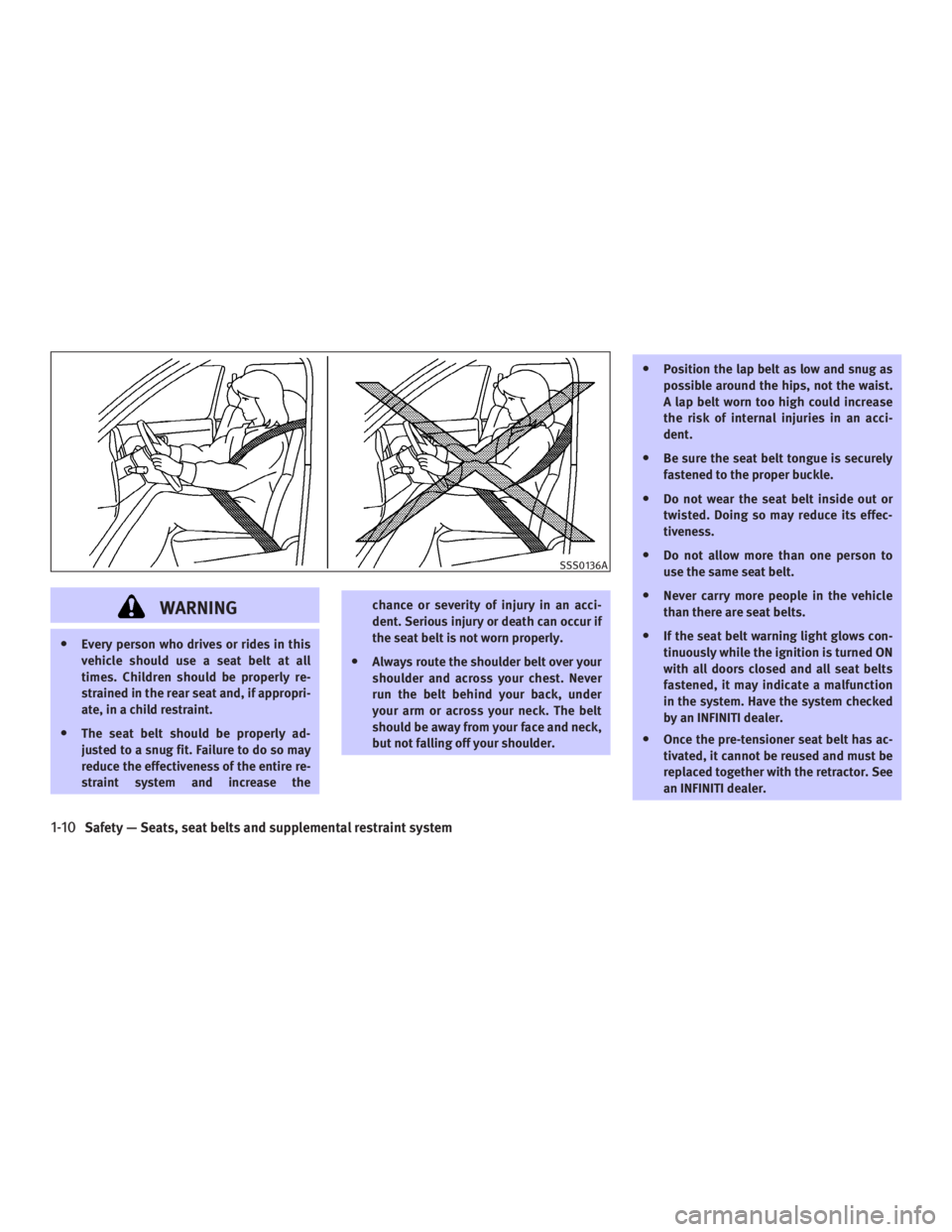
O Always route the shoulder belt over your
shoulder and across your chest. Never
run the belt behind your back, under
your arm or across your neck. The belt
should be away from your face and neck,
but not falling off your shoulder. O Position the lap belt as low and snug as
possible around the hips, not the waist.
A lap belt worn too high could increase
the risk of internal injuries in an acci-
dent.
O Be sure the seat belt tongue is securely
fastened to the proper buckle.
O Do not wear the seat belt inside out or
twisted. Doing so may reduce its effec-
tiveness.
O Do not allow more than one person to
use the same seat belt.
O Never carry more people in the vehicle
than there are seat belts.
O If the seat belt warning light glows con-
tinuously while the ignition is turned ON
with all doors closed and all seat belts
fastened, it may indicate a malfunction
in the system. Have the system checked
by an INFINITI dealer.
O Once the pre-tensioner seat belt has ac-
tivated, it cannot be reused and must be
replaced together with the retractor. See
an INFINITI dealer. SSS0136A
1-10 Safety Ð Seats, seat belts and supplemental restraint system
w 06.1.4/V35-D/V5.0
X
Page 30 of 344
CHILD SAFETY Children need adults to help protect them.
They need to be properly restrained.
In addition to the general information in
this manual, child safety information is
available from many other sources, in-
cluding doctors, teachers, government
traffic safety offices, and community orga-
nizations. Every child is different, so be
sure to learn the best way to transport
your child.
There are three basic types of child re-
straint systems:
O Rear-facing child restraint
O Front-facing child restraint
O Booster seat
The proper restraint depends on the
child's size. Generally, infants (up to
about 1 year and less than 20 lb (9 kg)
should be placed in rear-facing child re-
straints. Front-facing child restraints are
available for children who outgrow rear-
facing child restraints and are at least 1
year old. Booster seats are used to help
position a vehicle lap/shoulder belt on a
child who can no longer use a front-facing
child restraint. WARNING Infants and children need special protection.
The vehicle's seat belts may not fit them
properly. The shoulder belt may come too
close to the face or neck. The lap belt may
not fit over their small hip bones. In an acci-
dent, an improperly fitting seat belt could
cause serious or fatal injury. Always use ap-
propriate child restraints.
All US states and provinces of Canada re-
quire the use of approved child restraints
for infants and small children. (See ªChild
restraintsº later in this section.)
Also, there are other types of child re-
straints available for larger children for
additional protection.
INFINITI recommends that all pre-teens
and children be restrained in the rear seat
if possible. According to accident statis-
tics, children are safer when properly re-
strained in the rear seat than in the front
seat.
This is especially important because your
vehicle has a supplemental restraint
system (air bag system) for the front pas- senger. See ªSupplemental Restraint
Systemº later in this section for precau-
tions.
Infants Infants up to at least 1 year old should be
placed in a rear-facing child restraint.
INFINITI recommends that infants be
placed in child restraints that comply with
Federal Motor Vehicle Safety Standards or
Canadian Motor Vehicle Safety Standards.
You should choose a child restraint that
fits your vehicle and always follow the
manufacturer's instructions for installa-
tion and use.
Small children Children that are over 1 year old and
weigh between 20 lb (9 kg) and 40 lb (18
kg) can be placed in a forward facing
child restraint. Refer to the manufactur-
er's instructions for minimum and
maximum weight and height recommen-
dations. INFINITI recommends that small
children be placed in child restraints that
comply with Federal Motor Vehicle Safety
Standards or Canadian Motor Vehicle
Safety Standards. You should choose a
child restraint that fits your vehicle and
always follow the manufacturer's instruc-
tions for installation and use.
1-12 Safety Ð Seats, seat belts and supplemental restraint system
w 06.1.4/V35-D/V5.0
X
Page 31 of 344
Larger children Children who are too large for child re-
straints should be seated and restrained
by the seat belts which are provided. The
seat belt may not fit properly if the child
is less than 4 feet 9 inches (142.5 cm) tall
and weighs between 40 lb (18 kg) and 80
lb (36 kg). A booster seat should be used
to obtain proper seat belt fit.
INFINITI recommends that a child be
placed in a commercially available
booster seat if the shoulder belt in the
child's seating position fits close to the
face or neck or if the lap portion of the
seat belt goes across the abdomen. The
booster seat should raise the child so
that the shoulder belt is properly posi-
tioned across the top, middle portion of
the shoulder and the lap belt is low on
the hips. A booster seat can only be used
in seating positions that have a three-
point type seat belt. The booster seat
should fit the vehicle seat and have a
label certifying that it complies with Fed-
eral Motor Vehicle Safety Standards or
Canadian Motor Vehicle Safety Standards.
Once the child has grown so the shoulder
belt is no longer on or near the face and
neck, use the shoulder belt without the
booster seat. WARNING Never let a child stand or kneel on any seat
and do not allow a child in the cargo areas
while the vehicle is moving. The child could
be seriously injured or killed in an accident
or sudden stop.
PREGNANT WOMEN INFINITI recommends that pregnant
women use seat belts. The seat belt
should be worn snug, and always position
the lap belt as low as possible around the
hips, not the waist. Place the shoulder
belt over your shoulder and across your
chest. Never run the lap/shoulder belt
over your abdominal area. Contact your
doctor for specific recommendations.
INJURED PERSONS INFINITI recommends that injured persons
use seat belts, depending on the injury.
Check with your doctor for specific recom-
mendations. THREE-POINT TYPE SEAT BELT
WITH RETRACTOR
WARNING O Every person who drives or rides in this
vehicle should use a seat belt at all
times.
O Do not ride in a moving vehicle when the
seatback is reclined. This can be danger-
ous. The shoulder belt will not be
against your body. In an accident, you
could be thrown into it and receive neck
or other serious injuries. You could also
slide under the lap belt and receive se-
rious internal injuries.
O For the most effective protection when
the vehicle is in motion, the seat should
be upright. Always sit well back in the
seat and adjust the seat belt properly.
Safety Ð Seats, seat belts and supplemental restraint system
1-13
w 06.1.4/V35-D/V5.0
X
Page 33 of 344

from the buckle and fully retracted. For
additional information, see ªChild re-
straintsº later in this section.
The automatic locking mode should be
used only for child restraint installation.
During normal seat belt use by a pas-
senger, the locking mode should not be ac-
tivated. If it is activated it may cause un-
comfortable seat belt tension. It can also
change the operation of the front pas-
senger air bag. See ªFront passenger air
bag and status lightº later in this section. WARNING When fastening the seat belts, be certain
that the seatbacks are completely secured in
the latched position. If they are not com-
pletely secured, passengers may be injured
in an accident or sudden stop.
Unfastening the seat belts To unfasten the belt, push the button on
the buckle. The seat belt will automati-
cally retract.
Checking seat belt operation Your seat belt retractors are designed to
lock belt movement using two separate
methods:
O when the belt is pulled quickly from
the retractor.
O when the vehicle slows down rapidly.SSS0291A
Rear seat SSS0326
Safety Ð Seats, seat belts and supplemental restraint system
1-15
w 06.1.4/V35-D/V5.0
X
Page 34 of 344
You can check their operation as follows:
O grasp the shoulder belt and pull for-
ward quickly. The retractor should lock
and restrict further belt movement.
If the retractor does not lock during this
check or if you have any questions about
belt operation, see an INFINITI dealer.
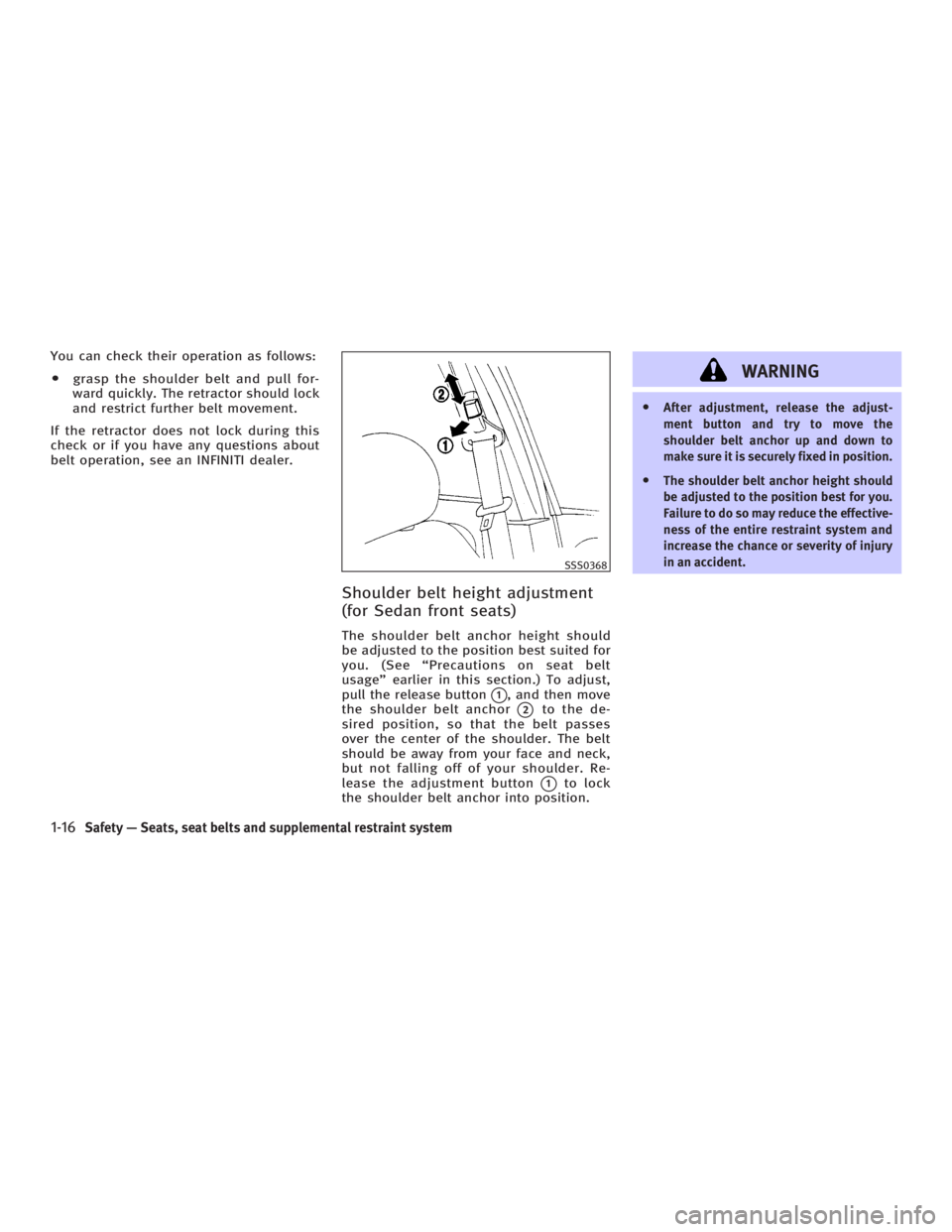
Shoulder belt height adjustment
(for Sedan front seats) The shoulder belt anchor height should
be adjusted to the position best suited for
you. (See ªPrecautions on seat belt
usageº earlier in this section.) To adjust,
pull the release button
q 1
, and then move
the shoulder belt anchor
q 2
to the de-
sired position, so that the belt passes
over the center of the shoulder. The belt
should be away from your face and neck,
but not falling off of your shoulder. Re-
lease the adjustment button
q 1
to lock
the shoulder belt anchor into position. WARNING O After adjustment, release the adjust-
ment button and try to move the
shoulder belt anchor up and down to
make sure it is securely fixed in position.
O The shoulder belt anchor height should
be adjusted to the position best for you.
Failure to do so may reduce the effective-
ness of the entire restraint system and
increase the chance or severity of injury
in an accident. SSS0368
1-16 Safety Ð Seats, seat belts and supplemental restraint system
w 06.1.4/V35-D/V5.0
X
Page 35 of 344
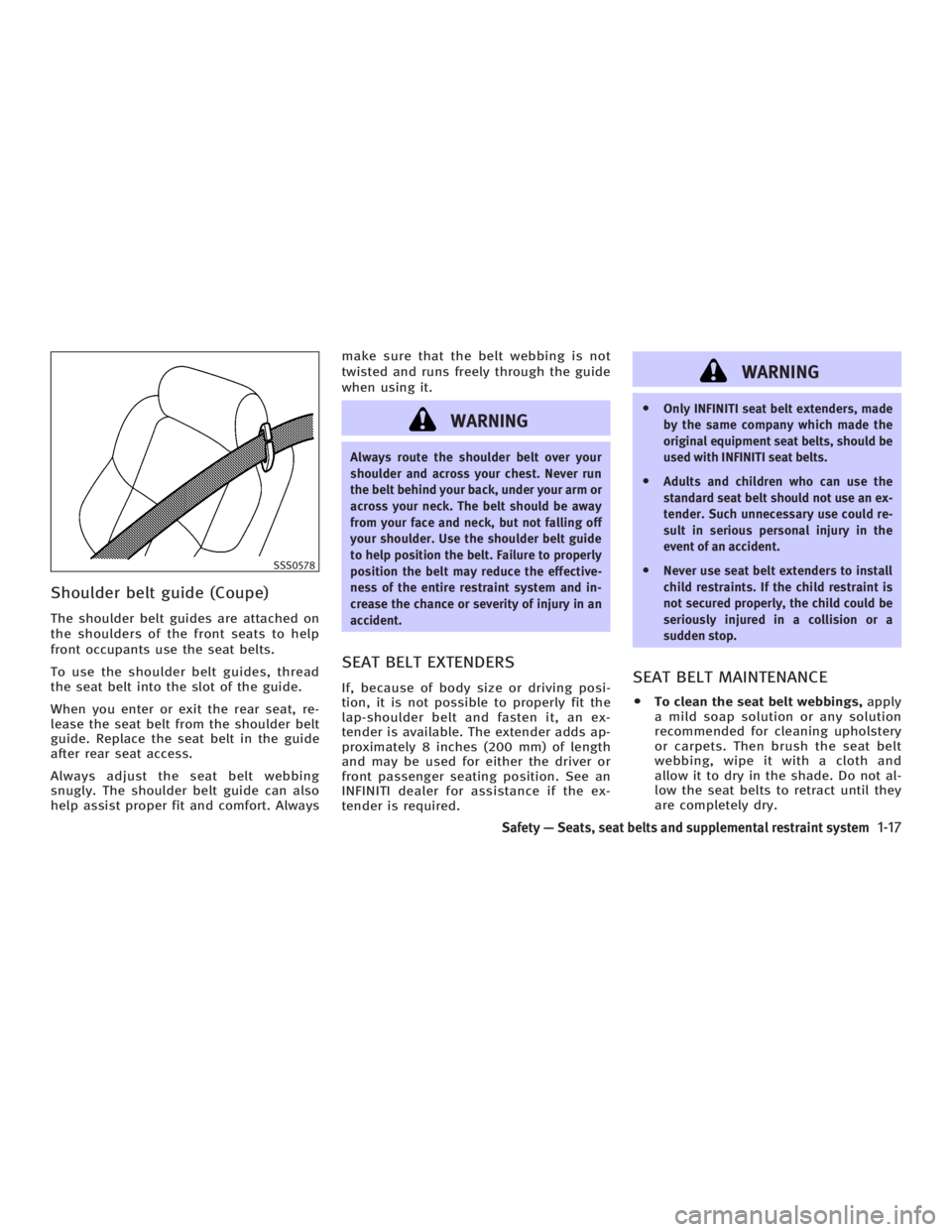
Shoulder belt guide (Coupe) The shoulder belt guides are attached on
the shoulders of the front seats to help
front occupants use the seat belts.
To use the shoulder belt guides, thread
the seat belt into the slot of the guide.
When you enter or exit the rear seat, re-
lease the seat belt from the shoulder belt
guide. Replace the seat belt in the guide
after rear seat access.
Always adjust the seat belt webbing
snugly. The shoulder belt guide can also
help assist proper fit and comfort. Always make sure that the belt webbing is not
twisted and runs freely through the guide
when using it.
WARNING Always route the shoulder belt over your
shoulder and across your chest. Never run
the belt behind your back, under your arm or
across your neck. The belt should be away
from your face and neck, but not falling off
your shoulder. Use the shoulder belt guide
to help position the belt. Failure to properly
position the belt may reduce the effective-
ness of the entire restraint system and in-
crease the chance or severity of injury in an
accident.
SEAT BELT EXTENDERS If, because of body size or driving posi-
tion, it is not possible to properly fit the
lap-shoulder belt and fasten it, an ex-
tender is available. The extender adds ap-
proximately 8 inches (200 mm) of length
and may be used for either the driver or
front passenger seating position. See an
INFINITI dealer for assistance if the ex-
tender is required. WARNING O Only INFINITI seat belt extenders, made
by the same company which made the
original equipment seat belts, should be
used with INFINITI seat belts.
O Adults and children who can use the
standard seat belt should not use an ex-
tender. Such unnecessary use could re-
sult in serious personal injury in the
event of an accident.
O Never use seat belt extenders to install
child restraints. If the child restraint is
not secured properly, the child could be
seriously injured in a collision or a
sudden stop.
SEAT BELT MAINTENANCE O To clean the seat belt webbings, apply
a mild soap solution or any solution
recommended for cleaning upholstery
or carpets. Then brush the seat belt
webbing, wipe it with a cloth and
allow it to dry in the shade. Do not al-
low the seat belts to retract until they
are completely dry.SSS0578
Safety Ð Seats, seat belts and supplemental restraint system
1-17
w 06.1.4/V35-D/V5.0
X
Page 36 of 344
O If dirt builds up in the shoulder belt
guide of the seat belt anchors, the
seat belts may retract slowly. Wipe the
shoulder belt guide with a clean, dry
cloth.
O Periodically check that the seat belt
and all the metal components, such as
buckles, tongues, retractors, flexible
wires and anchors, work properly. If
loose parts, deterioration, cuts or
other damage on the seat belt web-
bing is found, the entire belt assembly
should be replaced. PRECAUTIONS ON CHILD
RESTRAINTS
WARNING O Infants and small children should always
be placed in an appropriate child re-
straint while riding in the vehicle. Failure
to use a child restraint can result in seri-
ous injury or death.
O Infants and small children should never
be carried on your lap. It is not possible
for even the strongest adult to resist the
forces of a severe accident. The child
could be crushed between the adult and
parts of the vehicle. Also, do not put the
same seat belt around both your child
and yourself.
O Never install a rear-facing child restraint
in the front seat. An inflating supple-
mental air bag could seriously injure or
kill your child. A rear-facing child re-
straint must only be used in the rear
seat. O INFINITI recommends that the child re-
straint be installed in the rear seat. Ac-
cording to accident statistics, children
are safer when properly restrained in the
rear seat than in the front seat.
O An improperly installed child restraint
could lead to serious injury or death in
an accident.
In general, child restraints are designed
to be installed with the lap portion of a
lap/shoulder seat belt. In addition, this
vehicle is equipped with a universal child
restraint lower anchor system, referred to
as the LATCH (Lower Anchors and Tethers
for CHildren) system. Some child re-
straints include two rigid or webbing-
mounted attachments that can be con-
nected to these lower anchors. For de-
tails, see ªLATCH (Lower Anchors and
Tethers for CHildren) SYSTEMº later in
this section.
Child restraints for infants and children of
various sizes are offered by several manu-
facturers. When selecting any child re-
straint, keep the following points in mind:
O Choose only a restraint with a label
certifying that it complies with FederalCHILD RESTRAINTS
1-18 Safety Ð Seats, seat belts and supplemental restraint system
w 06.1.4/V35-D/V5.0
X
Page 37 of 344
Motor Vehicle Safety Standard 213 or
Canadian Motor Vehicle Safety Stan-
dard 213.
O Check the child restraint in your ve-
hicle to be sure it is compatible with
the vehicle's seat and seat belt
system.
O If the child restraint is compatible with
your vehicle, place your child in the
child restraint and check the various
adjustments to be sure the child re-
straint is compatible with your child.
Choose a child restraint that is de-
signed for your child's height and
weight. Always follow all recom-
mended procedures.
All US states and Canadian provinces re-
quire that infants and small children be re-
strained in approved child restraints at all
times while the vehicle is being operated.
WARNINGO Improper use of a child restraint can in-
crease the risk or severity of injury for
both the child and other occupants of
the vehicle. O Follow all of the child restraint manufac-
turer's instructions for installation and
use. When purchasing a child restraint,
be sure to select one which will fit your
child and vehicle. It may not be possible
to properly install some types of child re-
straints in your vehicle.
O If the child restraint is not anchored
properly, the risk of a child being injured
in a collision or a sudden stop greatly in-
creases.
O Adjustable seatbacks should be posi-
tioned to fit the child restraint, but as
upright as possible.
O After attaching the child restraint, test it
before you place the child in it. Push it
from side to side. Try to tug it forward
and check to see if the belt holds the re-
straint in place. The child restraint
should not move more than 1 in (25 mm).
If the restraint is not secure, tighten the
belt as necessary, or put the restraint in
another seat and test it again. You may
need to try a different child restraint. Not
all child restraints fit in all types
ofvehicles. O If you must install a front-facing child re-
straint in the front seat, see ªChild re-
straint installation on front passenger
seatº later in this section.
O When your child restraint is not in use,
keep it secured with a seat belt to pre-
vent it from being thrown around in case
of a sudden stop or accident.
CAUTION Remember that a child restraint left in a
closed vehicle can become very hot. Check
the seating surface and buckles before
placing your child in the child restraint.
Safety Ð Seats, seat belts and supplemental restraint system
1-19
w 06.1.4/V35-D/V5.0
X
Page 38 of 344
CHILD RESTRAINT INSTALLATION
ON REAR SEAT OUTBOARD OR
CENTER POSITIONS
WARNINGO The three-point seat belt in your vehicle
is equipped with an automatic locking
mode retractor which must be used
when installing a child restraint.
O Failure to use the automatic locking
mode will result in the child restraint not
being properly secured. The restraint
could tip over or otherwise be unsecured
and cause injury to the child in a sudden
stop or collision.
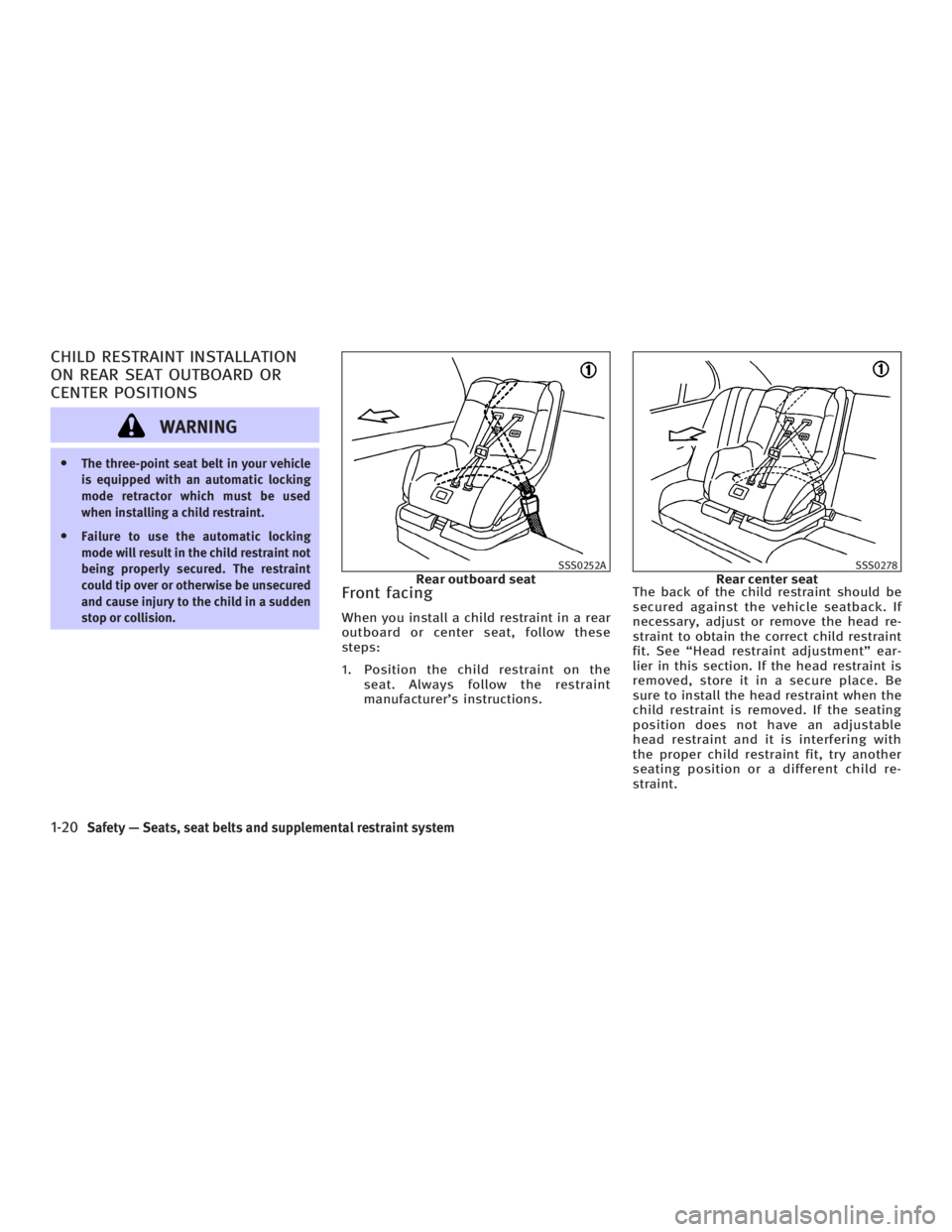
Front facing When you install a child restraint in a rear
outboard or center seat, follow these
steps:
1. Position the child restraint on the
seat. Always follow the restraint
manufacturer's instructions. The back of the child restraint should be
secured against the vehicle seatback. If
necessary, adjust or remove the head re-
straint to obtain the correct child restraint
fit. See ªHead restraint adjustmentº ear-
lier in this section. If the head restraint is
removed, store it in a secure place. Be
sure to install the head restraint when the
child restraint is removed. If the seating
position does not have an adjustable
head restraint and it is interfering with
the proper child restraint fit, try another
seating position or a different child re-
straint. SSS0252A
Rear outboard seat SSS0278
Rear center seat
1-20 Safety Ð Seats, seat belts and supplemental restraint system
w 06.1.4/V35-D/V5.0
X
Page 43 of 344

LATCH (Lower Anchors and
Tethers for CHildren) SYSTEM 1. LATCH lower anchor points (right)
2. LATCH lower anchor points (left)
3. LATCH label
The LATCH (Lower Anchors and Tethers for
CHildren) anchor points are located in the
seat cushions of the rear outboard
seating positions only. Do not attempt to
install a child restraint in the center posi-
tion using the LATCH anchors.
The LATCH system anchors are located at
the rear of the seat cushion near the seat-
back. A label is attached to the seatback to
help you locate the LATCH system anchors. WARNING O Attach LATCH system compatible child
restraints only at the locations shown. If
a child restraint is not secured properly,
your child could be seriously injured or
killed in an accident.
O Do not secure a child restraint in the
center rear seating position using the
LATCH system anchors. The child re-
straint will not be secured properly. O The LATCH system anchors are designed
to withstand only those loads imposed
by correctly fitted child restraints. Under
no circumstance are they to be used for
adult seat belts or harnesses.
Some child restraints include two rigid or
webbing-mounted attachments that can
be connected to two anchors located at
certain seating positions in your vehicle.
This system is known as the LATCH
system. This system may also be referred
to as the ISOFIX or ISOFIX compatible sys-
tem. With this system, you do not have to
use a vehicle seat belt to secure the child
restraint. Your vehicle is equipped with
special anchor points that are used with
LATCH system compatible child restraints.
Check your child restraint for a label stat-
ing that it is compatible with the LATCH
system. This information may also be in
the instructions provided by the child re-
straint manufacturer. If you have such a
child restraint, refer to the illustration for
the rear seating positions equipped with
LATCH system anchors which can be used
to secure the child restraint.SSS0369
Sedan SSS0370
Coupe
Safety Ð Seats, seat belts and supplemental restraint system
1-25
w 06.1.4/V35-D/V5.0
X