air condition INFINITI G35 2006 Repair Manual
[x] Cancel search | Manufacturer: INFINITI, Model Year: 2006, Model line: G35, Model: INFINITI G35 2006Pages: 344, PDF Size: 6.81 MB
Page 210 of 344
Remember, drinking and driving don't
mix!
And that's true for drugs too (over the
counter, prescription, and illegal drugs).
Don't drive if your ability to operate your
vehicle is impaired by alcohol, drugs, or
some other physical condition.
ALL-WHEEL DRIVE (AWD) DRIVING
SAFETY PRECAUTIONS (for AWD
models)
WARNINGO Do not drive beyond the performance ca-
pability of the tires, even with AWD en-
gaged. Accelerating quickly, sharp
steering maneuvers or sudden braking
may cause loss of control.
O Always use tires of the same type, size,
brand, construction (bias, bias-belted or
radial), and tread pattern on all four
wheels. Install tire chains on the rear
wheels when driving on slippery roads
and drive carefully. O This vehicle is not designed for off-road
(rough road) use. Do not drive on sandy
or muddy roads that tires may get stuck
in.
O Do not place an AWD equipped vehicle
on a two wheel dynamometer or raise
two wheels off the ground and shift the
transmission to any D (drive) or R (re-
verse) position. Doing so may result in
transmission damage or unexpected ve-
hicle movement which could result in se-
rious vehicle damage or personal injury.
O Never operate the accelerator pedal with
any wheels raised and the other wheels
on the ground while jacking up or with
any wheels on a roller and the other
wheels on the ground. Otherwise, the
vehicle could lurch forward or backward.
O When a wheel is off the ground due to an
unlevel surface, do not spin the wheel
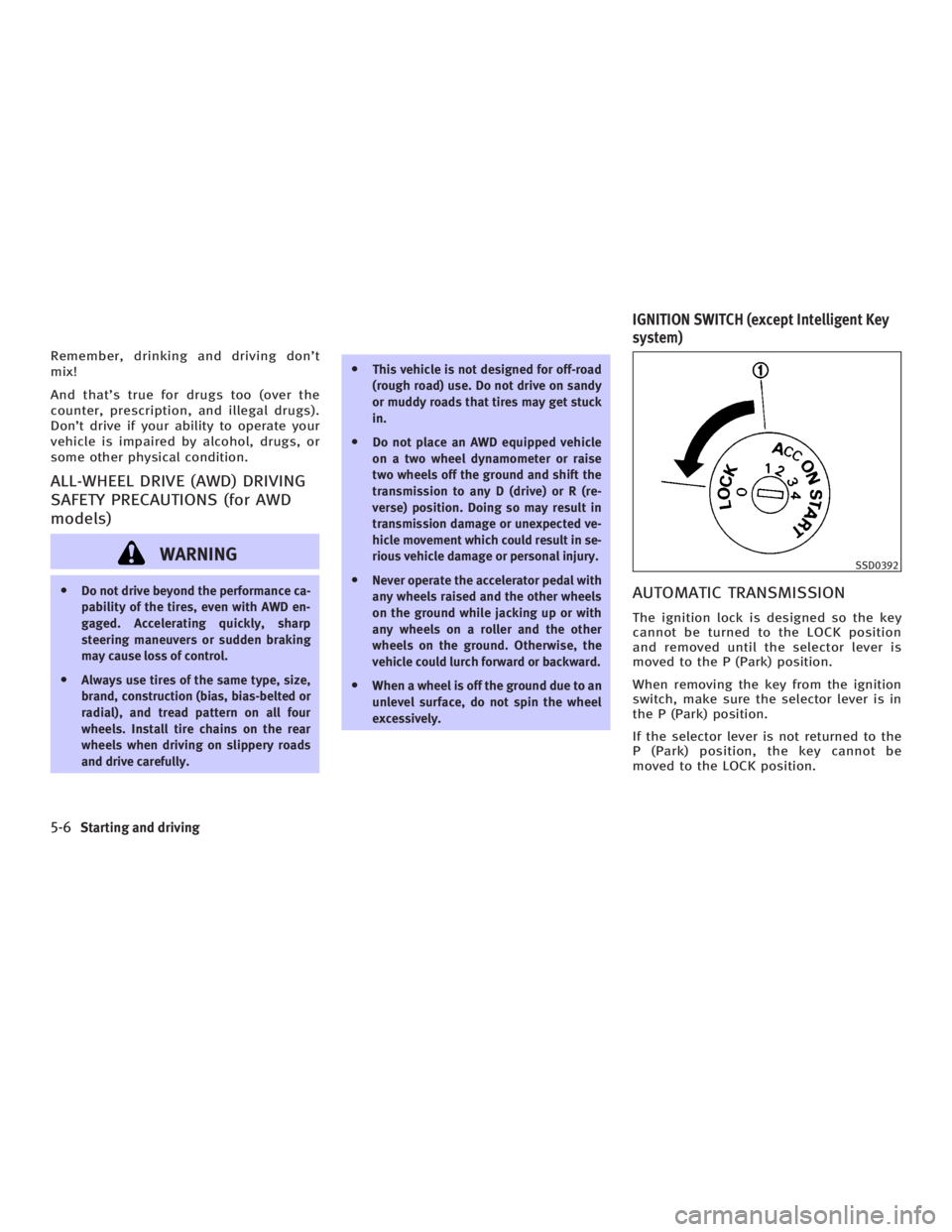
excessively. AUTOMATIC TRANSMISSION The ignition lock is designed so the key
cannot be turned to the LOCK position
and removed until the selector lever is
moved to the P (Park) position.
When removing the key from the ignition
switch, make sure the selector lever is in
the P (Park) position.
If the selector lever is not returned to the
P (Park) position, the key cannot be
moved to the LOCK position. SSD0392
IGNITION SWITCH (except Intelligent Key
system)
5-6 Starting and driving
w 06.1.4/V35-D/V5.0
X
Page 219 of 344
switch to the OFF position and wait for 3
seconds. Then turn the key back to the ON
position. The vehicle should return to its
normal operating condition. If it does not
return to its normal operating condition,
have an INFINITI dealer check the trans-
mission and repair if necessary.
Shift lock release If the battery charge is low or discharged,
the selector lever may not be moved from
the P (Park) position even with the brake
pedal depressed and the selector lever
button pushed.
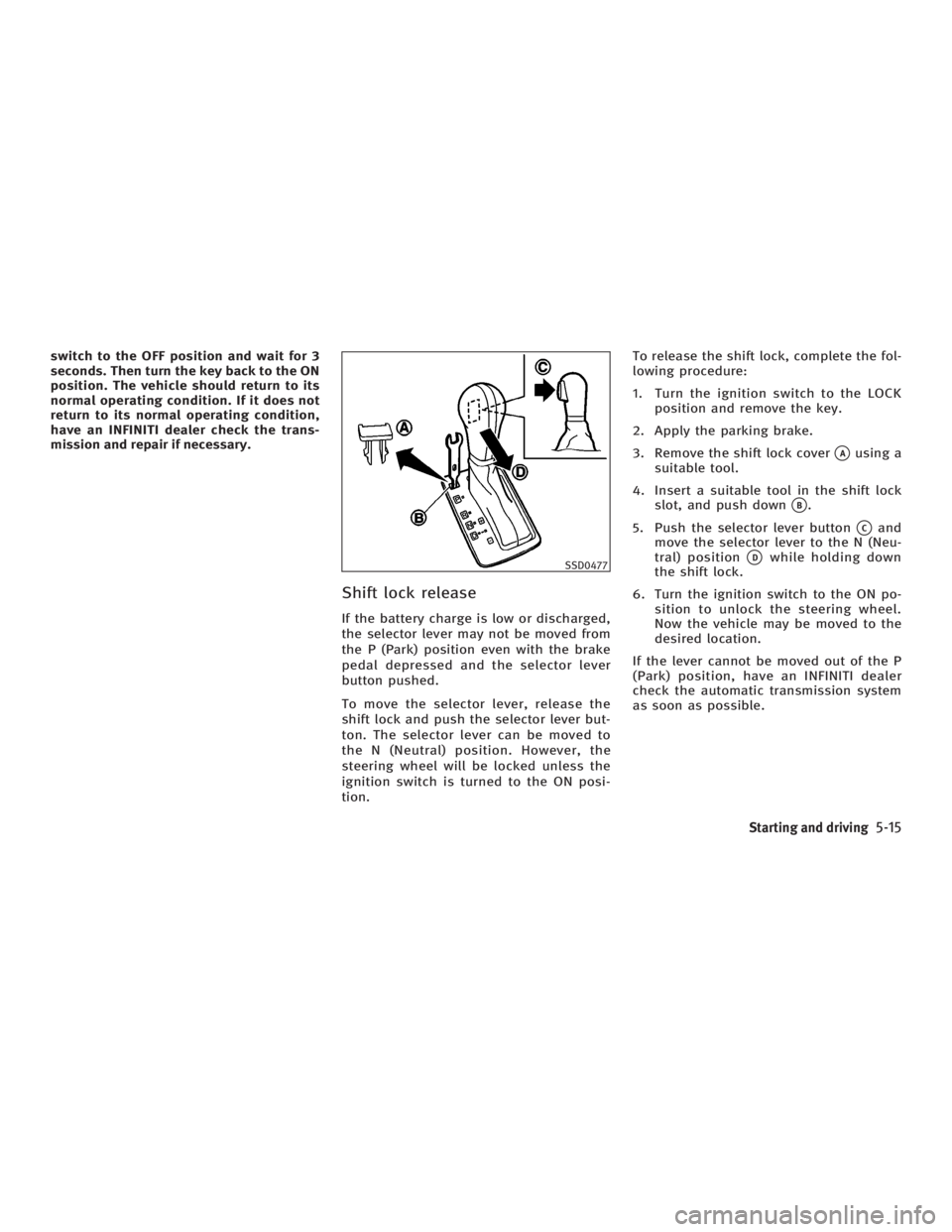
To move the selector lever, release the
shift lock and push the selector lever but-
ton. The selector lever can be moved to
the N (Neutral) position. However, the
steering wheel will be locked unless the
ignition switch is turned to the ON posi-
tion. To release the shift lock, complete the fol-
lowing procedure:
1. Turn the ignition switch to the LOCK
position and remove the key.
2. Apply the parking brake.
3. Remove the shift lock cover
q A
using a
suitable tool.
4. Insert a suitable tool in the shift lock
slot, and push down
q B
.
5. Push the selector lever button
q C
and
move the selector lever to the N (Neu-
tral) position
q D
while holding down
the shift lock.
6. Turn the ignition switch to the ON po-
sition to unlock the steering wheel.
Now the vehicle may be moved to the
desired location.
If the lever cannot be moved out of the P
(Park) position, have an INFINITI dealer
check the automatic transmission system
as soon as possible. SSD0477
Starting and driving
5-15
w 06.1.4/V35-D/V5.0
X
Page 226 of 344
CAUTIONDuring the first 1,200 miles (2,000 km),
follow these recommendations to obtain
maximum engine performance and ensure
the future reliability and economy of your
new vehicle. Failure to follow these recom-
mendations may result in shortened engine
life and reduced engine performance.
O Avoid driving for long periods at con-
stant speed, either fast or slow. Do
not run the engine over 4,000 rpm.
O Do not accelerate at full throttle in any
gear.
O Avoid quick starts.
O Avoid hard braking as much as pos-
sible.
O Do not tow a trailer or haul a heavy
load for the first 500 miles (800 km). O Accelerate slowly and smoothly. Main-
tain cruising speeds with a constant
accelerator position.
O Drive at moderate speeds on the high-
way. Driving at high speed will lower
fuel economy.
O Avoid unnecessary stopping and brak-
ing. Maintain a safe distance behind
other vehicles.
O Use a proper gear range which suits
road conditions. On level roads, shift
into high gear as soon as possible.
O Avoid unnecessary engine idling.
O Keep your engine tuned up.
O Follow the recommended periodic
maintenance schedule.
O Keep the tires inflated at the correct
pressure. Low pressure will increase
tire wear and waste fuel.
O Keep the front wheels in correct align-
ment. Improper alignment will cause
not only tire wear but also lower fuel
economy.
O Air conditioner operation lowers fuel
economy. Use the air conditioner only
when necessary. O When cruising at highway speeds, it is
more economical to use the air condi-
tioner and leave the windows closed
to reduce drag.
BREAK-IN SCHEDULE INCREASING FUEL ECONOMY
5-22 Starting and driving
w 06.1.4/V35-D/V5.0
X
Page 231 of 344

WARNINGDo not pump the brake pedal. Doing so may
result in increased stopping distances.
Normal operation The ABS will not operate at speeds below
3 to 6 MPH (5 to 10 km/h) to stop the ve-
hicle. (The speeds will vary according to
road conditions.) When the anti-lock
system senses that one or more wheels
are close to locking up, the actuator
(under the hood) rapidly applies and re-
leases hydraulic pressure (like pumping
the brakes very quickly). While the actua-
tor is working, you may feel a pulsation in
the brake pedal and hear a noise or vibra-
tion from the actuator under the hood.
This is normal and indicates that the ABS
is working properly. However, the ABS op-
eration may indicate that road conditions
are hazardous and extra care is required
while driving.
Self-test feature The anti-lock brake system consists of
electronic sensors, electric pumps, and
hydraulic solenoids controlled by a com- puter. The computer has a built-in diag-
nostic feature that tests the system each
time you start the engine and move the
vehicle at a low speed in forward or re-
verse. When the self-test occurs, you may
hear a clunk noise and/or feel a pulsation
in the brake pedal. This is normal and is
not an indication of any malfunction. If
the computer senses any malfunction, it
switches the ABS off and turns on the
ABS warning light in the instrument
panel. The brake system operates nor-
mally, but without anti-lock assistance.
If the light comes on during the self-test
or while driving, take the vehicle to an
INFINITI dealer for repair.
WARNING The anti-lock brake system is a sophisticated
device, but it cannot prevent accidents re-
sulting from careless or dangerous driving
techniques. It can help maintain vehicle con-
trol during braking on slippery surfaces, but
remember that the stopping distance on slip-
pery surfaces will be longer than on normal
surfaces even with the anti-lock brake system. Stopping distances may also be
longer on rough, gravel or snow covered
roads, or if you are using tire chains. Always
maintain a safe distance from the vehicle in
front of you. Ultimately, the responsibility
for safety of self and others rests in the
hands of the driver.
Tire type and condition of tires may also af-
fect braking effectiveness.
O When replacing tires, install the speci-
fied size of tires to the front and rear.
O When installing a spare tire, make sure it
is the proper size and type as specified
on the Tire and Loading Information
label. See ªVehicle identificationº in the
ª9. Technical and consumer informa-
tionº section for the Tire and Loading In-
formation label location.
Starting and driving
5-27
w 06.1.4/V35-D/V5.0
X
Page 247 of 344
WARNINGO Do not continue to drive if your vehicle
overheats. Doing so could cause engine
damage or a vehicle fire.
O To avoid the danger of being scalded,
never remove the radiator cap while the
engine is still hot. When the radiator cap
is removed, pressurized hot water will
spurt out, possibly causing serious in-
jury.
O Do not open the hood if steam is coming
out.
If your vehicle is overheating (indicated
by an extremely high temperature gauge
reading), or if you feel a lack of engine
power, detect abnormal noise, etc., take
the following steps:
1. Move the vehicle safely off the road,
apply the parking brake and move the
shift lever to the N (Neutral) position
(automatic transmission to the P
(Park) position).
Do not stop the engine. 2. Turn off the air conditioner. Open all
the windows, and move the tempera-
ture control to maximum hot and the
fan control to high speed.
3. If engine overheating is caused by
climbing a long hill on a hot day, run
the engine at a fast idle (approximately
1,500 rpm) until the temperature gauge
indication returns to normal.
4. Get out of the vehicle. Look and listen
for steam or coolant escaping from the
radiator before opening the hood. (If
steam or coolant is escaping, turn off
the engine.) Do not open the hood fur-
ther until no steam or coolant can be
seen.
5. Open the engine hood.
WARNING If steam or water is coming from the engine,
stand clear to prevent getting burned.
6. Visually check if the cooling fan is run-
ning. The radiator hoses and radiator
should not leak water. If coolant is
leaking or the cooling fan does not
run, stop the engine. WARNING O Be careful not to allow your hands, hair,
jewelry or clothing to come into contact
with, or to get caught in, the engine
belts or the engine cooling fan.
O The engine cooling fan can start at any
time when the coolant temperature is
high.
7. After the engine cools down, check
the coolant level in the reservoir tank
with the engine running. Add coolant
to the reservoir tank if necessary.
Have your vehicle repaired at an
INFINITI dealer.
If needed, Roadside Assistance is avail-
able. Please see your Warranty Information
Booklet or Roadside Assistance I.D. Card
for the toll-free number to call (U.S.) or War-
ranty Information Booklet (Canada).IF YOUR VEHICLE OVERHEATS
In case of emergency
6-11
w 06.1.4/V35-D/V5.0
X
Page 260 of 344

Your new INFINITI has been designed to
have minimum maintenance requirements
with longer service intervals to save you
both time and money. However, some day-
to-day and regular maintenance is essen-
tial to maintain your INFINITI's fine me-
chanical condition, as well as its emission
and engine performance.
It is the owner's responsibility to make
sure that the specified maintenance as
well as the general maintenance are per-
formed.
As the vehicle owner, you are the only
one who can ensure that your vehicle re-
ceives the proper maintenance care. You
are a vital link in the maintenance chain.
Scheduled maintenance:
For your convenience, both required and
optional scheduled maintenance items
are described and listed in your ªINFINITI
Service and Maintenance Guideº. You
must refer to that guide to ensure that
necessary maintenance is performed on
your INFINITI at regular intervals.
General maintenance:
General maintenance includes those
items which should be checked during
normal day-to-day operation. They are es- sential for proper vehicle operation. It is
your responsibility to perform these main-
tenance procedures regularly as pre-
scribed.
Performing general maintenance checks
requires minimal mechanical skill and
only a few general automotive tools.
These checks or inspections can be done
by you, a qualified technician, or, if you
prefer, an INFINITI dealer.
Where to go for service:
If maintenance service is required or your
vehicle appears to malfunction, have the
systems checked and serviced by an
INFINITI dealer.
INFINITI technicians are well-trained spe-
cialists and are kept up to date with the
latest service information through tech-
nical bulletins, service tips, and in-
dealership information systems. They are
completely qualified to work on INFINITI
vehicles before work begins.
You can be confident that an INFINITI
dealer's service department performs the
best job to meet the maintenance
requirements on your vehicle Ð in a
reliable and economic way. During the normal day-to-day operation of
the vehicle, general maintenance should
be performed regularly as prescribed in
this section. If you detect any unusual
sounds, vibrations or smell, be sure to
check for the cause or have an INFINITI
dealer perform it promptly. In addition,
you should notify an INFINITI dealer if you
think the repairs are required.
When performing any checks or mainte-
nance work, closely observe the ªMainte-
nance precautionsº later in this section.MAINTENANCE REQUIREMENTS GENERAL MAINTENANCE
8-2 Maintenance and do-it-yourself
w 06.1.4/V35-D/V5.0
X
Page 262 of 344
Inside the vehicle The maintenance items listed here should
be checked on a regular basis, such as
when performing periodic maintenance,
cleaning the vehicle, etc.
Accelerator pedal: Check the pedal for
smooth operation and make sure the
pedal does not catch or require uneven
effort. Keep the floor mat away from the
pedal.
Automatic transmission P (Park) mecha-
nism: On a fairly steep hill check that your
vehicle is held securely with the selector
lever in the P (Park) position without ap-
plying any brakes.
Brake pedal*: Check the pedal for smooth
operation and make sure it has the proper
distance under it when depressed fully.
Check the brake booster function. Be sure
to keep the floor mat away from the
pedal.
Brakes: Check that the brakes do not pull
the vehicle to one side when applied.
Parking brake*: Check that the pedal/
lever has the proper travel and confirm
that your vehicle is held securely on a
fairly steep hill with only the parking
brake applied. Seats: Check seat position controls such
as seat adjusters, seatback recliner, etc.
to ensure they operate smoothly and that
all latches lock securely in every position.
Check that the head restraints move up
and down smoothly and that the locks (if
so equipped) hold securely in all latched
positions.
Seat belts: Check that all parts of the seat
belt system (For example, buckles, an-
chors, adjusters and retractors) operate
properly and smoothly, and are installed
securely. Check the belt webbing for cuts,
fraying, wear or damage.
Steering wheel: Check for changes in the
steering conditions, such as excessive
free play, hard steering or strange noises.
Warning lights and chimes: Make sure
that all warning lights and chimes are op-
erating properly.
Windshield defroster: Check that the air
comes out of the defroster outlets prop-
erly and in sufficient quantity when oper-
ating the heater or air conditioner.
Windshield wiper and washer*: Check that
the wipers and washer operate properly
and that the wipers do not streak. Under the hood and the vehicle The maintenance items listed here should
be checked periodically (For example,
each time you check the engine oil or re-
fuel).
Battery*: Check the fluid level in each
cell. It should be between the MAX and
MIN lines. Vehicles operated in high tem-
peratures or under severe conditions re-
quire frequent checks of the battery fluid
level.
Brake and clutch fluid level*: Make sure
that the brake and clutch fluid levels are
between the MAX and MIN lines on the
reservoir.
Engine coolant level*: Check the coolant
level when the engine is cold.
Engine drive belts*: Make sure that no
belt is frayed, worn, cracked or oily.
Engine oil level*: Check the level after
parking the vehicle on a level location
and turning off the engine. (Wait at least
10 minutes for the oil to drain back into
the oil pan.)
Exhaust system: Make sure there are no
loose supports, cracks or holes. If the
sound of the exhaust seems unusual or
8-4 Maintenance and do-it-yourself
w 06.1.4/V35-D/V5.0
X
Page 263 of 344
there is a smell of exhaust fumes, imme-
diately locate the trouble and correct it.
See ªPrecautions when starting and
drivingº in the ª5. Starting and drivingº
section for exhaust gas (Carbon mon-
oxide).
Fluid leaks: Check under the vehicle for
fuel, oil, water or other fluid leaks after
the vehicle has been parked for a while.
Water dripping from the air conditioner
after use is normal. If you should notice
any leaks or if gasoline fumes are evi-
dent, check for the cause and have it cor-
rected immediately.
Power steering fluid level* and lines:
Check the level when the fluid is cold and
the engine is turned off. Check the lines
for proper attachment, leaks, cracks, etc.
Radiator and hoses: Check the front of the
radiator and clean off any dirt, insects,
leaves, etc., that may have accumulated.
Make sure the hoses have no cracks, de-
formation, deterioration or loose connec-
tions.
Underbody: The underbody is frequently
exposed to corrosive substances such as
those used on icy roads or to control
dust. It is very important to remove these
substances, otherwise rust will form on the floor pan, frame, fuel lines and
around the exhaust system. At the end of
winter, the underbody should be thor-
oughly flushed with plain water, being
careful to clean those areas where mud
and dirt may accumulate. For additional
information, see ªCleaning exteriorº in
the ª7. Appearance and careº section.
Windshield washer fluid*: Check that
there is adequate fluid in the tank. When performing any inspection or main-
tenance work on your vehicle, always take
care to prevent serious accidental injury
to yourself or damage to the vehicle. The
following are general precautions which
should be closely observed.
WARNING O Park the vehicle on a level surface, apply
the parking brake securely and block the
wheels to prevent the vehicle from
moving. For a manual transmission,
move the shift lever to N (Neutral) posi-
tion. For an automatic transmission
models, move the selector lever to P
(Park).
O Be sure the ignition key is in the OFF or
LOCK position when performing any
parts replacement or repairs.
O If you must work with the engine run-
ning, keep your hands, clothing, hair
and tools away from moving fans, belts
and any other moving parts.
O It is advisable to secure or remove any
loose clothing and remove any jewelry,MAINTENANCE PRECAUTIONS
Maintenance and do-it-yourself
8-5
w 06.1.4/V35-D/V5.0
X
Page 277 of 344

1. Power steering fluid pump
2. Fan
3. Alternator
4. Crankshaft pulley
5. Air conditioner compressor
D : Tension checking points WARNING Be sure the ignition key is in the OFF or LOCK
position. The engine could rotate unexpect-
edly.
1. Visually inspect each belt for signs of
unusual wear, cuts, fraying, oil adhe-
sion or looseness. If the belt is in poor
condition or loose, have it replaced or
adjusted by an INFINITI dealer.
2. Have the belts checked regularly for
condition and tension in accordance
with the maintenance schedule in the
INFINITI Service and Maintenance
Guide.
WARNING Be sure the engine and ignition switch are
off and that the parking brake is engaged se-
curely.
CAUTION Be sure to use the correct socket to remove
the spark plugs. An incorrect socket can
damage the spark plugs.SDI1389
DRIVE BELTS SPARK PLUGS
Maintenance and do-it-yourself
8-19
w 06.1.4/V35-D/V5.0
X
Page 284 of 344
2. Open the engine hood and remove the
cover on the battery and the
fuse/fusible link holder.
3. Remove the fuse/fusible link holder
cover.
4. Remove the fuse with the fuse puller.
The fuse puller is located in the pas-
senger compartment fuse box.
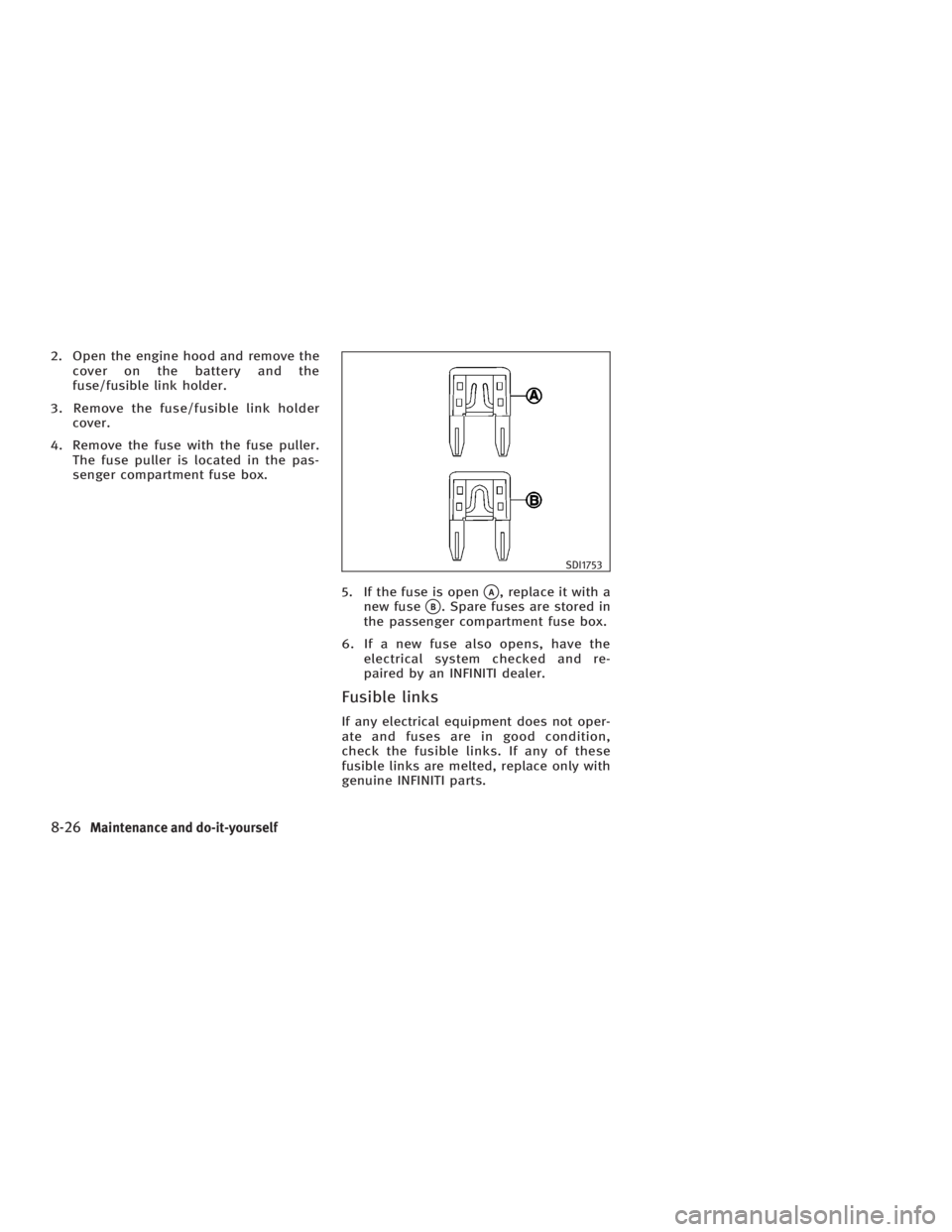
5. If the fuse is open
q A
, replace it with a
new fuse
q B
. Spare fuses are stored in
the passenger compartment fuse box.
6. If a new fuse also opens, have the
electrical system checked and re-
paired by an INFINITI dealer.
Fusible links If any electrical equipment does not oper-
ate and fuses are in good condition,
check the fusible links. If any of these
fusible links are melted, replace only with
genuine INFINITI parts. SDI1753
8-26 Maintenance and do-it-yourself
w 06.1.4/V35-D/V5.0
X