emergency towing INFINITI Q60 2014 Owners Manual
[x] Cancel search | Manufacturer: INFINITI, Model Year: 2014, Model line: Q60, Model: INFINITI Q60 2014Pages: 466, PDF Size: 3.2 MB
Page 360 of 466

6 In case of emergency
Hazard warning flasher switch............................. 6-2
Roadside assistance program .............................. 6-2
Emergency engine shut off .................................. 6-3
Flat tire................................................................ 6-3 Tire Pressure Monitoring System (TPMS).......... 6-3
Changing flat tire (for models with spare tire).... 6-4
Repairing flat tire (for models with emergency tire
puncture repair kit) ......................................... 6-8 Jump starting .................................................... 6-14
Push starting .................................................... 6-16
If your vehicle overheats ................................... 6-16
Towing your vehicle .......................................... 6-17
Towing recommended by INFINITI ................. 6-18
Vehicle recovery (Freeing a stuck vehicle) .... 6-19
Page 372 of 466
NOTE:
The compressor tire pressure gauge
may show a pressure reading of 87 psi
(600 kPa) for about 30 seconds while
inflating the tire. The pressure gauge is
indicating the pressure inside the
sealant can. When the sealant has
been injected into the tire the pressure
gauge will drop and indicate actual tire
pressure.
WARNING
.To avoid serious personal injury while
using the emergency tire puncture repair
kit:
—Securely tighten the compressor
hose to the tire valve. Failure to do
so can cause the sealant to spray
into the air and get into your eyes or
on the skin.
. Do not stand directly beside the da-
maged tire while it is being inflated
because of the risk of the rupture. If
there are any cracks or bumps, turn the
compressor off immediately.
If the tire pressure does not increase to 26 psi (180 kPa) within 10 minutes, the
tire may be seriously damaged and
the
tire cannot be repaired with this tire
repair kit. Contact an INFINITI retailer.
7. When the tire pressure is at the specified amount, turn the air compres-
sor off. If the pressure cannot be
inflated to the specified amount, the
air compressor can be turned off at the
minimum of 26 psi (180 kPa). Remove
the power plug from the power outlet
and quickly remove the hose from the
tire valve. Attach the protective cap and
valve cap. Properly stow the emergency
tire puncture repair kit in the trunk.
CAUTION
To avoid serious personal injury when
stowing the emergency tire puncture repair
kit:
. Keep the sealant bottle screwed into the
compressor. Failure to do so can cause
the sealant to spray into the air and get
into your eyes or on the skin.
8. Immediately drive the vehicle for 10
minutes or 2 miles (3 km) at a speed of 50 MPH (80 km/h) or less.
9. After driving, make sure that the air compressor switch is in the OFF posi-
tion, then screw the hose securely onto
the tire valve. Check the tire pressure
with the pressure gauge. The temporary
repair is completed if the tire pressure
does not drop.
Make sure the pressure is adjusted to
the pressure that is specified on the
tire and loading information label
before driving.
10. If the tire pressure drops, repeat the steps from 5 to 9. If the pressure drops
again or under 19 psi (130 kPa), the
tire cannot be repaired with this tire
repair kit. Contact an INFINITI retailer.
The sealant bottle and hose can not be
reused to repair another punctured tire.
Contact an INFINITI retailer to purchase
replacements.
After repairing tire
See an INFINITI retailer for tire repair/
replacement as soon as possible.
In case of emergency6-13
Page 375 of 466

6-16In case of emergency
9. After starting your engine, carefullydisconnect the negative cable and then
the positive cable (
*4?*3?*2?
*1).
10. Replace the vent caps (if so equipped). Be sure to dispose of the cloth used to
cover the vent holes as it may be
contaminated with corrosive acid. Do not attempt to start the engine by
pushing.CAUTION
.
Automatic transmission models cannot
be push-started or tow-started. Attempt-
ing to do so may cause transmission
damage.
. Three way catalyst equipped models
should not be started by pushing since
the three way catalyst may be damaged.
. Never try to start the vehicle by towing
it; when the engine starts, the forward
surge could cause the vehicle to collide
with the tow vehicle.
CAUTION
.Do not continue to drive if your vehicle
overheats. Doing so could cause engine
damage or a vehicle fire.
. To avoid the danger of being scalded,
never remove the radiator cap while the
engine is still hot. When the radiator cap
is removed, pressurized hot water will
spurt out, possibly causing serious
injury.
. Do not open the hood if steam is coming
out.
If your vehicle is overheating (indicated by
an extremely high temperature gauge
reading), or if you feel a lack of engine
power, detect abnormal noise, etc., take
the following steps:
1. Move the vehicle safely off the road,
apply the parking brake.
2. Automatic Transmission model:
Move the shift lever to the P (Park)
position.
Manual Transmission model:
Move the shift lever to the N (Neutral)
position.
PUSH STARTING IF YOUR VEHICLE OVERHEATS
Page 376 of 466

Do not stop the engine.
3. Turn off the air conditioner. Open all the windows, move the heater or air condi-
tioner temperature control to maximum
hot and fan control to high speed.
4. If engine overheating is caused by climbing a long hill on a hot day, run
the engine at a fast idle (approximately
1,500 rpm) until the temperature gauge
indication returns to normal.
5. Get out of the vehicle. Look and listen for steam or coolant escaping from the
radiator before opening the hood. (If
steam or coolant is escaping, turn off
the engine.) Do not open the hood
further until no steam or coolant can be
seen.
6. Open the engine hood.
WARNING
If steam or water is coming from the engine,
stand clear to prevent getting burned.
7. Visually check the drive belt for damage or looseness. Also check if the cooling
fan is running. The radiator hoses and
radiator should not leak water. If cool- ant is leaking or the cooling fan does
not run, stop the engine.
WARNING
Be careful not to allow your hands, hair,
jewelry or clothing to come into contact
with, or get caught in, engine belts or the
engine cooling fan. The engine cooling fan
can start at any time.
8. After the engine cools down, check the
coolant level in the reservoir with the
engine running. Add coolant to the
reservoir if necessary. Have your vehi-
cle repaired at the nearest INFINITI
retailer. When towing your vehicle, all State (Pro-
vincial in Canada) and local regulations for
towing must be followed. Incorrect towing
equipment could damage your vehicle.
Towing instructions are available from an
INFINITI retailer. Local service operators are
familiar with the applicable laws and
procedures for towing. To assure proper
towing and to prevent accidental damage
to your vehicle, INFINITI recommends that
you have a service operator tow your
vehicle. It is advisable to have the service
operator carefully read the following pre-
cautions.
WARNING
.
Never ride in a vehicle that is being
towed.
. Never get under your vehicle after it has
been lifted by a tow truck.
CAUTION
.When towing, make sure that the trans-
mission, axles, steering system and
drivetrain are in working condition. If
any unit is damaged, dollies must be
In case of emergency6-17
TOWING YOUR VEHICLE
Page 377 of 466
6-18In case of emergency
used.
. Always attach safety chains before tow-
ing.
For information about towing your vehicle
behind a recreational vehicle (RV), see
“Flat towing” (P.9-20) of this manual.
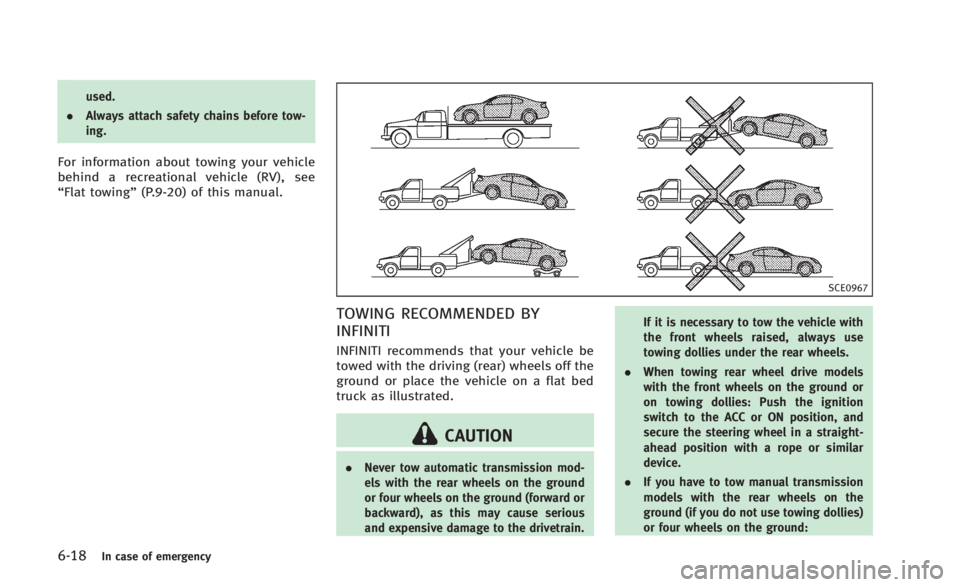
SCE0967
TOWING RECOMMENDED BY
INFINITI
INFINITI recommends that your vehicle be
towed with the driving (rear) wheels off the
ground or place the vehicle on a flat bed
truck as illustrated.
CAUTION
.Never tow automatic transmission mod-
els with the rear wheels on the ground
or four wheels on the ground (forward or
backward), as this may cause serious
and expensive damage to the drivetrain. If it is necessary to tow the vehicle with
the front wheels raised, always use
towing dollies under the rear wheels.
. When towing rear wheel drive models
with the front wheels on the ground or
on towing dollies: Push the ignition
switch to the ACC or ON position, and
secure the steering wheel in a straight-
ahead position with a rope or similar
device.
. If you have to tow manual transmission
models with the rear wheels on the
ground (if you do not use towing dollies)
or four wheels on the ground:
Page 378 of 466
—Push the ignition switch to the ONposition and turn off all accessories.
—Always release the parking brake.
—Move the transmission shift lever tothe N (Neutral) position.
—Observe the following restricted
towing speeds and distances for
manual transmission models only:
.Rear wheels on the ground:
Speed: Below 50 MPH (80 km/h)
Distance: Less than 50 miles (80
km)
.Four wheels on the ground:
Speed: Below 70 MPH (112 km/h)
Distance: Less than 500 miles
(800 km)
—If the speed or distance mustnecessarily be greater, remove the
propeller shaft before towing to
prevent damage to the drivetrain.
VEHICLE RECOVERY (Freeing a stuck
vehicle)
WARNING
. Stand clear of a stuck vehicle.
. Do not spin your tires at high speed. This
could cause them to explode and result
in serious injury. Parts of your vehicle
could also overheat and be damaged.
Pulling a stuck vehicle
If your vehicle is stuck in sand, snow, mud,
etc., use a tow strap or other device
designed specifically for vehicle recovery.
Always follow the manufacturer’s instruc-
tions for the recovery device.
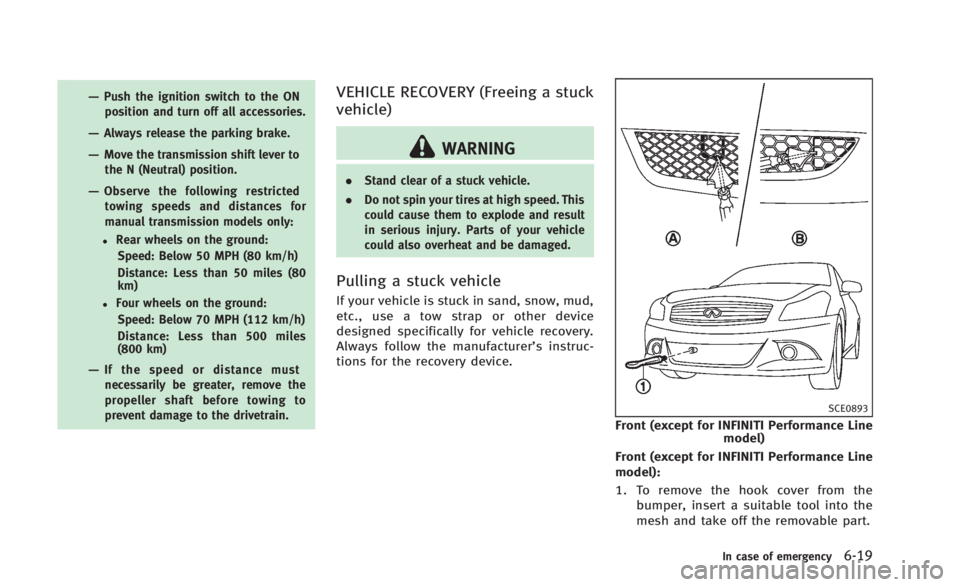
SCE0893
Front (except for INFINITI Performance Line
model)
Front (except for INFINITI Performance Line
model):
1. To remove the hook cover from the bumper, insert a suitable tool into the
mesh and take off the removable part.
In case of emergency6-19
Page 380 of 466

SCE0965
INFINITI Performance Line model
3. Securely install the vehicle recovery hook
*3stored with jacking tools as
illustrated. Attach the tow strap to the
recovery hook. Wrap the hook
*3and
strap with a cloth to avoid bumper
damage as illustrated. Make sure that
the hook is properly secured in the
original place after use.
SCE0894
Rear
Rear:
Do not use the tie down hook
*2for
towing or vehicle recovery.
CAUTION
. Tow chains or cables must be attached
only to the vehicle recovery hooks or
main structural members of the vehicle.
Otherwise, the vehicle body will be
damaged.
. Do not use the vehicle tie downs to free
a vehicle stuck in sand, snow, mud, etc.
In case of emergency6-21
Page 381 of 466
6-22In case of emergency
.Never tow a vehicle using the vehicle tie
downs or recovery hooks.
. Always pull the cable straight out from
the front of the vehicle. Never pull on the
vehicle at an angle.
. Pulling devices should be routed so they
do not touch any part of the suspension,
steering, brake or cooling systems.
. Pulling devices such as ropes or canvas
straps are not recommended for use in
vehicle towing or recovery.
Rocking a stuck vehicle
If your vehicle is stuck in sand, snow, mud,
etc., use the following procedure:
1. Turn off the Vehicle Dynamic Control
(VDC) system.
2. Make sure the area in front and behind the vehicle is clear of obstructions.
3. Turn the steering wheel right and left to clear an area around the front tires.
4. Slowly rock the vehicle forward and backward.
.Shift back and forth between R
(Reverse) and D (Drive) (automatic
transmission models) or 1st and R
(Reverse) (manual transmission models).
.Apply the accelerator as little as
possible to maintain the rocking
motion.
.Release the accelerator pedal beforeshifting between R (Reverse) and D
(Drive) (automatic transmission
models) or 1st and R (Reverse)
(manual transmission models).
.Do not spin the tires above 35 MPH(55 km/h).
5. If the vehicle cannot be freed after a few tries, contact a professional towing
service to remove the vehicle.
Page 451 of 466
9-20Technical and consumer information
MEASUREMENT OF WEIGHTS
Secure loose items to prevent weight
shifts that could affect the balance of
your vehicle. When the vehicle is
loaded, drive to a scale and weigh
the front and the rear wheels sepa-
rately to determine axle loads. In-
dividual axle loads should not
exceed either of the gross axle
weight ratings (GAWR). The total of
the axle loads should not exceed the
gross vehicle weight rating (GVWR).
These ratings are given on the
vehicle certification label. If weight
ratings are exceeded, move or re-
move items to bring all weights
below the ratings.Do not tow a trailer with your
vehicle.
FLAT TOWING
Towing your vehicle with all four wheels on
the ground is sometimes called flat towing.
This method is sometimes used when
towing a vehicle behind a recreational
vehicle, such as a motor home.
CAUTION
.
Failure to follow these guidelines can
result in severe transmission damage.
. Whenever flat towing your vehicle, al-
ways tow forward, never backward.
. DO NOT tow any automatic transmission
vehicle with all four wheels on the
ground (flat towing). Doing so WILL
DAMAGE internal transmission parts
due to lack of transmission lubrication.
. For emergency towing procedures refer
to“Towing recommended by INFINITI”
(P.6-18) of this manual.
Automatic transmission
To tow a vehicle equipped with an auto-
matic transmission, an appropriate vehicle
dolly MUST be placed under the towed
vehicle’s drive wheels. Alwaysfollow the
dolly manufacturer’ s recommendations
when using their product.
Manual transmission
. Always tow with the manual transmis-
sion in Neutral.
. Your vehicle speed should never exceed
70 MPH (112 km/h) when flat towing
your vehicle.
. After towing 500 miles, start and idle
the engine with the transmission in
Neutral for two minutes. Failure to idle
the engine after every 500 miles of
towing may cause damage to the
transmission’s internal parts.
TOWING A TRAILER
Page 457 of 466

10-2
Cleaning exterior and interior ....................... 7-2, 7-4
Climate control, Automatic climate control ........ 4-30
Clock ................................................................ 2-43
Closing the retractable hard top ....................... 3-24
Clutch fluid ....................................................... 8-13
Cockpit ............................................................... 2-3
Cold weather driving ......................................... 5-58
Compact Disc (CD) player (See audio system) ... 4-56
Compact spare tire ........................................... 8-39
Console box ...................................................... 2-47
Controller, Center multi-function control panel .... 4-5
ControlsControl panel button ...................................... 4-3
INFINITI Controller .......................................... 4-5
Coolant Capacities and
recommended fuel/lubricants ........................ 9-2
Changing engine coolant ............................... 8-9
Checking engine coolant level ........................ 8-9
Corrosion protection ........................................... 7-7
Cruise control ................................................... 5-21 Fixed speed cruise control (on ICC system) ... 5-41
Intelligent cruise control (ICC) system .......... 5-23
Cup holders ...................................................... 2-45
Current fuel consumption .................................. 2-26
D
Daytime running light system ........................... 2-37
Defroster switch, Rear window and outside mirror
defroster switch ................................................ 2-34
Dimensions ....................................................... 9-10 Distance to empty ............................................. 2-26
Door/trunk open warning .................................. 2-21
Dot matrix liquid crystal display ....................... 2-17
Drive belt .......................................................... 8-18
Drive positioner ................................................ 3-38
Driving
Cold weather driving .................................... 5-58
Driving with automatic transmission ............ 5-13
Driving with manual transmission ................ 5-18
Precautions when starting and driving ........... 5-3
DS (Drive Sport) mode ...................................... 5-15
DVD player operation ........................................ 4-57
E
Economy, Fuel ................................................... 5-47
Elapsed time ..................................................... 2-26
Elapsed time and trip odometer ........................ 2-26
Emergency tire puncture repair kit ...................... 6-8
Emission control information label .................... 9-12
Emission control system warranty ..................... 9-22
Engine Before starting the engine ........................... 5-12
Break-in schedule ........................................ 5-46
Capacities and
recommended fuel/lubricants ........................ 9-2
Changing engine coolant ............................... 8-9
Changing engine oil and filter ...................... 8-10
Checking engine coolant level ........................ 8-9
Checking engine oil level ............................. 8-10
Coolant temperature gauge ............................ 2-8
Emergency engine shut off ........................... 5-11 Engine block heater ..................................... 5-59
Engine compartment check locations ............. 8-7
Engine cooling system ................................... 8-8
Engine oil .................................................... 8-10
Engine oil and oil filter recommendation ........ 9-6
Engine oil replacement indicator .................. 2-24
Engine oil viscosity ........................................ 9-7
Engine serial number ................................... 9-12
Engine specifications ..................................... 9-8
Engine start operation indicator (Automatic
Transmission models) .................................. 2-20
Engine start operation indicator (Manual
Transmission models) .................................. 2-21
If your vehicle overheats .............................. 6-16
Starting the engine ...................................... 5-12
Event Data Recorders (EDR) ............................... 9-24
Exhaust gas (carbon monoxide) .......................... 5-3
F
F.M.V.S.S./C.M.V.S.S. certification label ............. 9-12
Filter
Air cleaner housing filter .............................. 8-19
Changing engine oil and filter ...................... 8-10
Flashers (See hazard warning flasher switch) ...... 6-2
Flat tire ............................................................... 6-3 Changing flat tire (with spare tire) ................. 6-4
Repairing flat tire (with emergency tire
puncture repair kit) ........................................ 6-8
Flat towing ........................................................ 9-20
Floor mat cleaning .............................................. 7-5