four wheel drive INFINITI QX60 2023 User Guide
[x] Cancel search | Manufacturer: INFINITI, Model Year: 2023, Model line: QX60, Model: INFINITI QX60 2023Pages: 636, PDF Size: 7.28 MB
Page 477 of 636

The VDC system is automatically reset to on
when the ignition switch is placed in the OFF
position then back to the ON position.
The computer has a built-in diagnostic fea-
ture that tests the system each time you start
the engine and move the vehicle forward or in
reverse at a slow speed. When the self-test
occurs, you may hear a clunk noise and/or
feel a pulsation in the brake pedal. This is
normal and is not an indication of a
malfunction.
WARNING
• The VDC system is designed to help the
driver maintain controllability but does
not prevent accidents due to abrupt
steering operation at high speeds or by
careless or dangerous driving tech-
niques. Reduce vehicle speed and be es-
pecially careful when driving and corner-
ing on slippery surfaces and always drive
carefully. •
Do not modify the vehicle's suspension.
If suspension parts such as shock ab-
sorbers, struts, springs, stabilizer bars,
bushings and wheels are not INFINITI
recommended for your vehicle or are ex-
tremely deteriorated, the VDC system
may not operate properly. This could ad-
versely affect vehicle handling perfor-
mance, and the
indicator light may
flash or both theandindicator
lights may illuminate.
• If brake related parts such as brake pads,
rotors and calipers are not INFINITI rec-
ommended or are extremely deterio-
rated, the VDC system may not operate
properly and both the
and theindicator lights may illuminate.
• If engine control related parts are not
INFINITI recommended or are extremely
deteriorated, both the
andindicator lights may illuminate.
• When driving on extremely inclined sur-
faces such as higher banked corners, the
VDC system may not operate properly
and the
indicator light may flash or
both theandindicator lights
may illuminate. Do not drive on these
types of roads. •
When driving on an unstable surface
such as a turntable, ferry, elevator or
ramp, the
indicator light may flash
or both theandindicator
lights may illuminate. This is not a mal-
function. Restart the engine after driv-
ing onto a stable surface.
• If wheels or tires other than the INFINITI
recommended ones are used, the VDC
system may not operate properly and
the
indicator light may flash or both
theandindicator lights may
illuminate.
• The VDC system is not a substitute for
winter tires or tire chains on a snow cov-
ered road.
BRAKE FORCE DISTRIBUTION
During braking while driving through turns,
the system optimizes the distribution of force
to each of the four wheels depending on the
radius of the turn.
Starting and driving5-169
Page 479 of 636

If the chassis control warning message ap-
pears in the vehicle information display, it
may indicate that the Active Trace Control is
not functioning properly. Have the system
checked as soon as possible. It is recom-
mended that you visit an INFINITI retailer for
this service. For additional information, see
“Vehicle information display warnings and in-
dicators” (P. 2-37) or (P. 2-60).
WARNING
The Active Trace Control may not be effec-
tive depending on the driving condition. Al-
ways drive carefully and attentively.
When the Active Trace Control is operating,
you may feel a pulsation in the brake pedal
and hear a noise. This is normal and indicates
that the Active Trace Control is operating
properly. You may also feel deceleration
when the Active Trace Control is operating.
However, this is not a malfunction.
ACTIVE RIDE CONTROL (if so
equipped)
This system senses upper body motion and
controls four wheel brake pressure. This will
enhance ride comfort in an effort to restrain
uncomfortable upper body movement when
passing over undulated road surfaces. When
the VDC system is turned off, the Active Ride
Control is also turned off.
If the chassis control warning message ap-
pears in the vehicle information display, it
may indicate that the Active Ride Control is
not functioning properly. Have the system
checked as soon as possible. It is recom-
mended that you visit an INFINITI retailer for
this service.
WARNING
The Active Ride Control may not be effec-
tive depending on the driving condition. Al-
ways drive carefully and attentively.
When the Active Ride Control is operating,
you may feel a pulsation in the brake pedal
and hear a noise. This is normal and indicates
that the Active Ride Control is operating
properly. You may also feel deceleration
when the Active Ride Control is operating.
However, this is not a malfunction.
WARNING
• Never rely solely on the hill start assist
system to prevent the vehicle from mov-
ing backward on a hill. Always drive
carefully and attentively. Depress the
brake pedal when the vehicle is stopped
on a steep hill. Be especially careful when
stopped on a hill on frozen or muddy
roads. Failure to prevent the vehicle
from rolling backwards may result in a
loss of control of the vehicle and possible
serious injury or death.
• The hill start assist system is not de-
signed to hold the vehicle at a standstill
on a hill. Depress the brake pedal when
the vehicle is stopped on a steep hill. Fail-
ure to do so may cause the vehicle to roll
backwards and may result in a collision or
serious personal injury.
• The hill start assist system may not pre-
vent the vehicle from rolling backwards
on a hill under all load or road conditions.
Always be prepared to depress the brake
pedal to prevent the vehicle from rolling
backwards. Failure to do so may result in
a collision or serious personal injury.
HILL START ASSIST SYSTEM
Starting and driving5-171
Page 493 of 636

TIRE EQUIPMENT
1. SUMMER tires have a tread designed toprovide superior performance on dry
pavement. However, the performance of
these tires will be substantially reduced in
snowy and icy conditions. If you operate
your vehicle on snowy or icy roads,
INFINITI recommends the use of MUD &
SNOW or ALL SEASON TIRES on all four
wheels. It is recommended that you visit
an INFINITI retailer for the tire type, size,
speed rating and availability information.
2. For additional traction on icy roads, stud- ded tires may be used. However, some
U.S. states and Canadian provinces pro-
hibit their use. Check local, state and pro-
vincial laws before installing studded tires.
Skid and traction capabilities of studded
snow tires on wet or dry surfaces may be
poorer than that of non-studded snow tires.
3. Tire chains may be used. For additional information, see “Tire chains” (P. 8-38).
All-Wheel Drive (AWD) model
If you install snow tires, they must also be the
same size, brand, construction and tread pat-
ter on all four wheels.
SPECIAL WINTER EQUIPMENT
It is recommended that the following items
be carried in the vehicle during winter:
• A scraper and stiff-bristled brush to re-move ice and snow from the windows and
wiper blades.
• A sturdy, flat board to be placed under the jack to give it firm support.
• A shovel to dig the vehicle out of snowdrifts.
• Extra washer fluid to refill the windshield- washer fluid reservoir.
DRIVING ON SNOW OR ICE
WARNING
• Wet ice (32°F, 0°C and freezing rain),
very cold snow or ice can be slick and very
hard to drive on. The vehicle will have
much less traction or “grip” under these
conditions. Try to avoid driving on wet
ice until the road is salted or sanded.
• Whatever the condition, drive with
caution. Accelerate and slow down with
care. If accelerating or downshifting too
fast, the drive wheels will lose even more
traction. •
Allow more stopping distance under
these conditions. Braking should be
started sooner than on dry pavement.
• Allow greater following distances on
slippery roads.
• Watch for slippery spots (glare ice).
These may appear on an otherwise clear
road in shaded areas. If a patch of ice is
seen ahead, brake before reaching it. Try
not to brake while on the ice, and avoid
any sudden steering maneuvers.
• Do not use the cruise control on slippery
roads.
• Snow can trap dangerous exhaust gases
under your vehicle. Keep snow clear of
the exhaust pipe and from around your
vehicle.
Starting and driving5-185
Page 497 of 636

To shut off the engine in an emergency situ-
ation while driving, perform the following
procedure:
– Rapidly push the push-button ignitionswitch three consecutive times in less than
1.5 seconds, or
– Push and hold the push-button ignition switch for more than 2 seconds.TIRE PRESSURE MONITORING
SYSTEM (TPMS)
This vehicle is equipped with Tire Pressure
Monitoring System (TPMS). It monitors tire
pressure of all tires except the spare. When
the low tire pressure warning light is lit, and
the “Tire Pressure Low - Add Air” warning
appears in the vehicle information display,
one or more of your tires is significantly
under-inflated. If equipped, the system also
displays pressure of all tires (except the spare
tire) on the display screen by sending a signal
from a sensor that is installed in each wheel. If
the vehicle is being driven with low tire pres-
sure, the TPMS will activate and warn you of
it by the low tire pressure warning light. This
system will activate only when the vehicle is
driven at speeds above 16 mph (25 km/h).
For additional information, see “Warning
lights, indicator lights and audible reminders”
(P. 2-12) and “Tire Pressure Monitoring Sys-
tem (TPMS)” (P. 5-5).
WARNING
• Radio waves could adversely affect elec-
tric medical equipment. Those who use a
pacemaker should contact the electric
medical equipment manufacturer for the
possible influences before use. •
If the low tire pressure warning light illu-
minates while driving, avoid sudden
steering maneuvers or abrupt braking,
reduce vehicle speed, pull off the road to
a safe location and stop the vehicle as
soon as possible. Driving with under-
inflated tires may permanently damage
the tires and increase the likelihood of
tire failure. Serious vehicle damage could
occur and may lead to an accident and
could result in serious personal injury.
Check the tire pressure for all four tires.
Adjust the tire pressure to the recom-
mended COLD tire pressure shown on
the Tire and Loading Information label to
turn the low tire pressure warning light
OFF. If the light still illuminates while
driving after adjusting the tire pressure,
a tire may be flat or the TPMS may be
malfunctioning. If you have a flat tire,
replace it with a spare tire as soon as
possible, If no tire is flat and all tires are
properly inflated, have the vehicle
checked. It is recommended that you
visit an INFINITI retailer for this service.
EMERGENCY ENGINE SHUT OFF FLAT TIRE
In case of emergency6-3
Page 511 of 636
NOTE:
If the battery is completely drained the
transmission will not manually shift to other
positions.
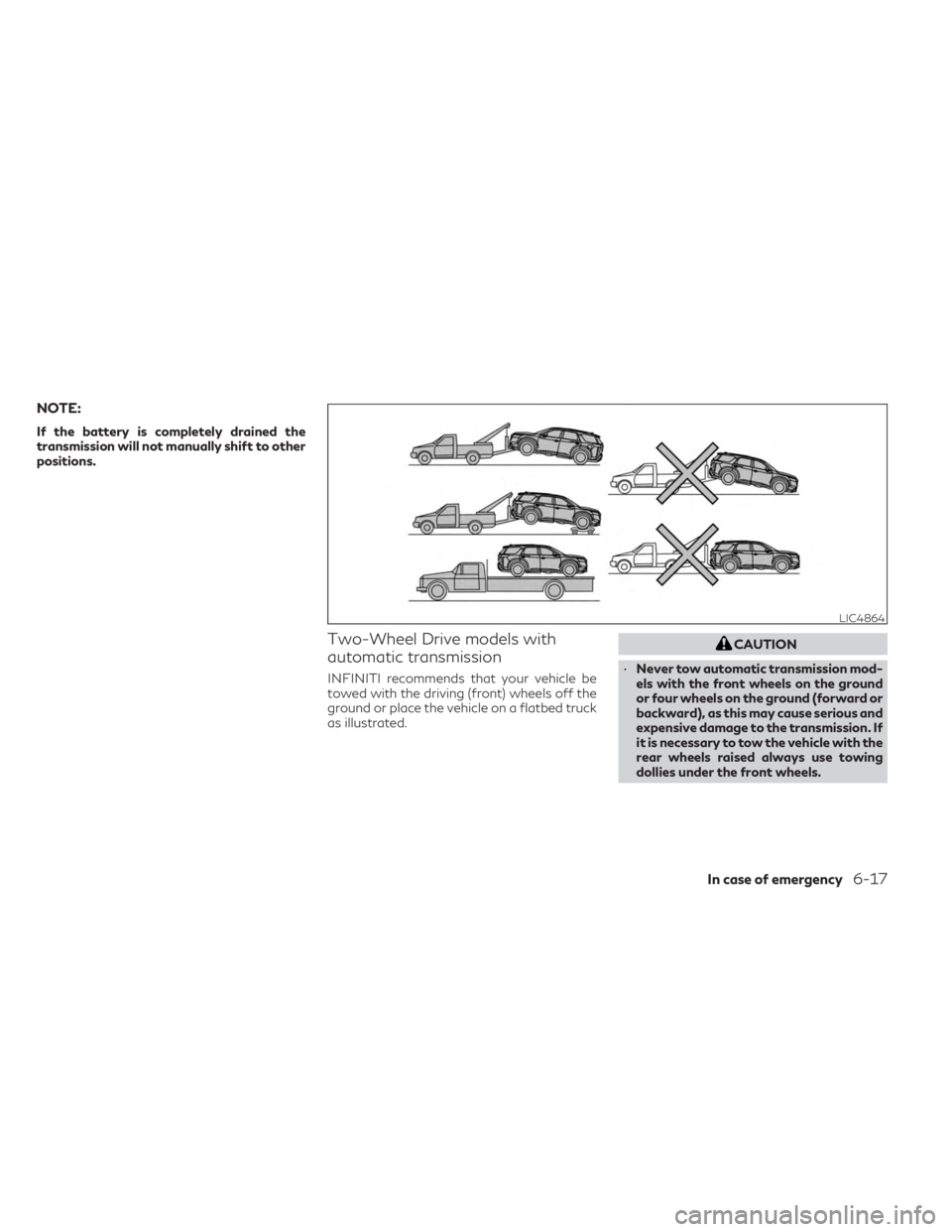
Two-Wheel Drive models with
automatic transmission
INFINITI recommends that your vehicle be
towed with the driving (front) wheels off the
ground or place the vehicle on a flatbed truck
as illustrated.
CAUTION
• Never tow automatic transmission mod-
els with the front wheels on the ground
or four wheels on the ground (forward or
backward), as this may cause serious and
expensive damage to the transmission. If
it is necessary to tow the vehicle with the
rear wheels raised always use towing
dollies under the front wheels.
LIC4864
In case of emergency6-17
Page 557 of 636
O7The word “radial”
The word “radial” is shown if the tire
has radial structure.
O8Manufacturer or brand name
Manufacturer or brand name is
shown.
Other Tire-related Terminology
In addition to the many terms that are
defined throughout this section, In-
tended Outboard Sidewall is (1) the
sidewall that contains a whitewall,
bears white lettering or bears manu-
facturer, brand, and/or model name
molding that is higher or deeper than
the same molding on the other side-
wall of the tire, or (2) the outward
facing sidewall of an asymmetrical tire
that has a particular side that must
always face outward when mounted
on a vehicle.
TYPES OF TIRES
WARNING
• When changing or replacing tires, be sure
all four tires are of the same type (i.e.,
Summer, All Season or Snow) and con-
struction. An INFINITI retailer may be
able to help you with information about
tire type, size, speed rating and
availability.
• Replacement tires may have a lower
speed rating than the factory equipped
tires, and may not match the potential
maximum vehicle speed. Never exceed
the maximum speed rating of the tire.
• Replacing tires with those not originally
specified by INFINITI could affect the
proper operation of the low tire pressure
warning system.
• Always use tires of the same type, size,
brand, construction and tread pattern on
all four wheels. Failure to do so may re-
sult in a circumference difference be-
tween tires on the front and rear axles
which can cause the Vehicle Dynamic
Control (VDC) system to malfunction re-
sulting in personal injury or death, exces-
sive tire wear and may damage the
transmission, transfer case and differen-
tial gears. •
For additional information regarding
tires, refer to “Important Tire Safety In-
formation” (US) or “Tire Safety Informa-
tion” (Canada) in the Warranty Informa-
tion Booklet.
All-Wheel Drive (AWD) models
CAUTION
• Always use tires of the same size, brand,
construction (bias, bias-belted or radial),
and tread pattern on all four wheels.
Failure to do so may result in a circumfer-
ence difference between tires on the
front and rear axles which will cause ex-
cessive tire wear and may damage the
transmission and drivetrain parts.
• ONLY use spare tires specified for the
AWD model.
If excessive tire wear is found, it is recom-
mended that all four tires be replaced with
tires of the same size, brand, construction
and tread pattern. The tire pressure and
wheel alignment should also be checked and
corrected as necessary. It is recommended
that you visit an INFINITI retailer for this
service.
Do-it-yourself8-37
Page 558 of 636
All season tires
INFINITI specifies All Season tires on some
models to provide good performance all year,
including snowy and icy road conditions. All
Season tires are identified by ALL SEASON
and/or M&S on the tire sidewall. Snow tires
have better snow traction than All Season
tires and may be more appropriate in some
areas.
Summer tires
INFINITI specifies summer tires on some
models to provide superior performance on
dry roads. Summer tire performance is sub-
stantially reduced in snow and ice. Summer
tires do not have the tire traction rating
“M&S” on the tire sidewall.
If you plan to operate your vehicle in snowy or
icy conditions, INFINITI recommends the use
of SNOW tires or ALL SEASON tires on all
four wheels.
Snow tires
If snow tires are needed, it is necessary to
select tires equivalent in size and load rating
to the original equipment tires. If you do not,
it can adversely affect the safety and han-
dling of your vehicle.Generally, snow tires have lower speed rat-
ings than factory equipped tires and may not
match the potential maximum vehicle speed.
Never exceed the maximum speed rating of
the tire.
If you install snow tires, they must be the
same size, brand, construction and tread pat-
tern on all four wheels.
For additional traction on icy roads, studded
tires may be used. However, some U.S. states
and Canadian provinces prohibit their use.
Check local, state and provincial laws before
installing studded tires. Skid and traction ca-
pabilities of studded snow tires on wet or dry
surfaces may be poorer than that of non-
studded snow tires.
TIRE CHAINS
Use of tire chains may be prohibited accord-
ing to location. Check the local laws before
installing tire chains. When installing tire
chains, make sure they are the proper size for
the tires on your vehicle and are installed
according to the chain manufacturer's sug-
gestions.
Use only SAE class “S” chains. Class
“S” chains are used on vehicles with restricted
tire to vehicle clearance. Vehicles that can use
Class “S” chains are designed to meet the
minimum clearances between the tire and the
closest vehicle suspension or body compo- nent required to accommodate the use of a
winter traction device (tire chains or cables).
The minimum clearances are determined us-
ing the factory equipped tire size. Other types
may damage your vehicle. Use chain tension-
ers when recommended by the tire chain
manufacturer to ensure a tight fit. Loose end
links of the tire chain must be secured or
removed to prevent the possibility of whip-
ping action damage to the fenders or under-
body. If possible, avoid fully loading your ve-
hicle when using tire chains. In addition, drive
at a reduced speed. Otherwise, your vehicle
may be damaged and/or vehicle handling
and performance may be adversely affected.
Do not use tire chains on dry roads. Driving
with chains in such conditions can cause
damage to the various mechanisms of the
vehicle due to some overstress.
8-38Do-it-yourself
Page 614 of 636

• Crosswinds and rough roads will adverselyaffect vehicle/trailer handling, possibly
causing vehicle sway. When being passed
by larger vehicles, be prepared for possible
changes in crosswinds that could affect
vehicle handling.
Do the following if the trailer begins to sway:
1. Take your foot off the accelerator pedal to allow the vehicle to coast and steer as
straight ahead as the road conditions al-
low. This combination will help stabilize
the vehicle.
– Do not correct trailer sway by steering or applying the brakes.
2. When the trailer sway stops, gently apply the brakes and pull to the side of the road
in a safe area.
3. Try to rearrange the trailer load so it is balanced. For additional information, see
“Pre-towing tips” (P. 10-28).
• Be careful when passing other vehicles. Passing while towing a trailer requires con-
siderably more distance than normal pass-
ing. Remember, the length of the trailer
must also pass the other vehicle before you
can safely change lanes. • Downshift the transmission to a lower gear
for engine braking when driving down
steep or long hills. This will help slow the
vehicle without applying the brakes.
• Avoid holding the brake pedal down too long or too frequently. This could cause the
brakes to overheat, resulting in reduced
braking efficiency.
• Increase your following distance to allow for greater stopping distances while tow-
ing a trailer. Anticipate stops and brake
gradually.
• INFINITI recommends that the cruise con- trol not be used while towing a trailer.
• Some states or provinces have specific regulations and speed limits for vehicles
that are towing trailers. Obey the local
speed limits.
• Check your hitch, trailer wiring harness connections, and trailer wheel lug nuts af-
ter 50 miles (80 km) of travel and at every
break.
• When launching a boat, don't allow the water level to go over the exhaust tail pipe
or rear bumper.
• Make sure you disconnect the trailer lights before backing the trailer into the water or
the trailer lights may burn out. When towing a trailer, differential gear oil,
transfer fluid and transmission oil/fluid
should be changed more frequently. For ad-
ditional information, see the “Maintenance
and schedules” section of this manual.
FLAT TOWING FOR ALL–WHEEL
DRIVE VEHICLE (if so equipped)
Towing your vehicle with all four wheels on
the ground is sometimes called flat towing.
This method is sometimes used when towing
a vehicle behind a recreational vehicle, such
as a motor home.
CAUTION
• Failure to follow these guidelines can re-
sult in severe transmission damage.
• Never flat tow your All-wheel drive
(AWD) vehicle.
• DO NOT tow your All-wheel drive
(AWD) vehicle with any wheels on the
ground. Doing so may cause serious and
expensive damage to the powertrain.
• For emergency towing procedures, see
“Towing recommended by INFINITI”
(P. 6-16).
10-30Technical and consumer information
Page 615 of 636
FLAT TOWING FOR FRONT
WHEEL DRIVE VEHICLE (if so
equipped)
Towing your vehicle with all four wheels on
the ground is sometimes called flat towing.
This method is sometimes used when towing
a vehicle behind a recreational vehicle, such
as a motor home.
CAUTION
• Failure to follow these guidelines can re-
sult in severe transmission damage.
• Whenever flat towing your vehicle, al-
ways tow forward, never backward.
• Never tow your front wheel drive vehicle
with the front tires on the ground. Doing
so may cause serious and expensive dam-
age to the powertrain.
• DO NOT tow your front wheel drive au-
tomatic transmission vehicle with all
four wheels on the ground (flat towing).
Doing so WILL DAMAGE internal trans-
mission parts due to lack of transmission
lubrication.
• For emergency towing procedures, see
“Towing recommended by INFINITI”
(P. 6-16).
Automatic transmission
To tow a vehicle equipped with an automatic
transmission, an appropriate vehicle dolly
MUST be placed under the towed vehicle's
drive wheels. Alwaysfollow the dolly manu-
facturer's recommendations when using their
product.
NOTE:
If the battery is completely drained the
transmission will not manually shift to other
positions. DOT (Department of Transportation) Quality
Grades: All passenger car tires must conform
to federal safety requirements in addition to
these grades.
Quality grades can be found where applicable
on the tire sidewall between tread shoulder
and maximum section width. For example:
Treadwear 200 Traction AA Temperature A
Treadwear
The treadwear grade is a comparative rating
based on the wear rate of the tire when tested
under controlled conditions on a specified gov-
ernment test course. For example, a tire graded
150 would wear one and one-half (1 1/2)
times as well on the government course as a
tire graded 100. The relative performance of
tires depends upon the actual conditions of
their use, however, and may depart signifi-
cantly from the norm due to variations in driv-
ing habits, service practices and differences in
road characteristics and climate.
Traction AA, A, B and C
The traction grades, from highest to lowest,
are AA, A, B, and C. Those grades represent
the tire's ability to stop on wet pavement as
measured under controlled conditions on
specified government test surfaces of as-
phalt and concrete. A tire marked C may have
poor traction performance.
UNIFORM TIRE QUALITY GRADING
Technical and consumer information10-31