oil change INFINITI QX60 2023 User Guide
[x] Cancel search | Manufacturer: INFINITI, Model Year: 2023, Model line: QX60, Model: INFINITI QX60 2023Pages: 636, PDF Size: 7.28 MB
Page 422 of 636
If the driver does not operate the steering
wheel after the warning has been displayed,
an audible alert sounds and the warning
flashes in the vehicle information display, fol-
lowed by a quick brake application to request
the driver to take control of the vehicle again.
If the driver still does not respond, the ProPI-
LOT Assist turns on the hazard flasher and
slows the vehicle to a complete stop.
The driver can cancel the deceleration at any
time by steering, braking, accelerating, or op-
erating the ProPILOT Assist switch.
WARNING
Steering Assist is not a system for hands-
free driving. Always keep your hands on
the steering wheel and drive your vehicle
safely. Failure to do so could cause a colli-
sion resulting in serious personal injury or
death.
NOTE:
If the driver lightly touches (instead of firmly
grips) the steering wheel, the steering
torque sensor may not detect the driver’s
hand(s) on the wheel and a sequence of
warnings may occur. When the driver holds
and operates the steering wheel again, the
warnings turn off.
Steering Assist limitations
WARNING
• In the following situations, the camera
may not detect lane markers correctly or
may detect lane markers incorrectly and
the Steering Assist may not operate
properly:
– When driving on roads where there
are multiple parallel lane markers,
lane markers that are faded or not
painted clearly, nonstandard lane
markers, or lane markers covered
with water, dirt, snow, etc.
– When driving on roads with discon-
tinued lane markers
– When driving on roads with a widen-
ing or narrowing lane width
– When driving on roads where there
are multiple lanes or unclear lane
markers due to road construction
– When driving on roads where there
are sharply contrasting objects, such
as shadows, snow, water, wheel ruts,
seams, or lines remaining after road
repairs (the Steering Assist could de-
tect these items as lane markers)
– When driving on roads where the
traveling lane merges or separates •
Do not use the Steering Assist under the
following conditions because the system
may not properly detect lane markers.
Doing so could cause a loss of vehicle
control and result in an accident.
– During bad weather (rain, fog, snow,
dust, etc.)
– When rain, snow, sand, etc., is thrown
up by the wheels of other vehicles
– When dirt, oil, ice, snow, water, or an-
other object adheres to the camera
unit
– When the lens of the camera unit is
foggy
– When strong light (for example, sun-
light or high beams from oncoming
vehicles) shines on the camera
– When the headlights are not bright
due to dirt on the lens or the head-
lights are off in tunnels or darkness
– When a sudden change in brightness
occurs (for example, when the vehicle
enters or exits a tunnel or is under a
bridge)
–
When driving on roads where the trav- eling lane merges or separates or
where there are temporary lane mark-
ers because of road construction
5-114Starting and driving
Page 468 of 636

Follow these easy-to-use Fuel Efficient Driv-
ing Tips to help you achieve the most fuel
economy from your vehicle.
1.Use Smooth Accelerator and Brake Pedal
Application
• Avoid rapid starts and stops.
• Use smooth, gentle accelerator and brake application whenever possible.
• Maintain constant speed while com- muting and coast whenever possible.
2. Maintain Constant Speed
• Look ahead to try and anticipate and minimize stops.
• Synchronizing your speed with traffic lights allows you to reduce your number
of stops.
• Maintaining a steady speed can mini- mize red light stops and improve fuel
efficiency.
3. Use Air Conditioning (A/C) at Higher Ve-
hicle Speeds
• Below 40 mph (64 km/h), it is more efficient to open windows to cool the
vehicle due to reduced engine load.
• Above 40 mph (64 km/h), it is more efficient to use A/C to cool the vehicle
due to increased aerodynamic drag. • Recirculating the cool air in the cabin
when the A/C is on reduces cooling
load.
4. Drive at Economical Speeds and
Distances
• Observing the speed limit and not ex- ceeding 60 mph (97 km/h) (where le-
gally allowed) can improve fuel effi-
ciency due to reduced aerodynamic
drag.
• Maintaining a safe following distance behind other vehicles reduces unneces-
sary braking.
• Safely monitoring traffic to anticipate changes in speed permits reduced brak-
ing and smooth acceleration changes.
• Select a gear range suitable to road conditions.
5. Use Cruise Control
• Using cruise control during highway driving helps maintain a steady speed.
• Cruise control is particularly effective in providing fuel savings when driving on
flat terrains.
6. Plan for the Shortest Route
• Utilize a map or navigation system to determine the best route to save time. 7.
Avoid Idling
• Shutting off your engine when safe for stops exceeding 30–60 seconds saves
fuel and reduces emissions.
8. Buy an Automated Pass for Toll Roads
• Automated passes permit drivers to use special lanes to maintain cruising speed
through the toll and avoid stopping and
starting.
9. Winter Warm Up
• Limit idling time to minimize impact to fuel economy.
• Vehicles typically need no more than 30 seconds of idling at start-up to effec-
tively circulate the engine oil before
driving.
• Your vehicle will reach its ideal operat- ing temperature more quickly while driv-
ing versus idling.
10. Keeping your Vehicle Cool
• Park your vehicle in a covered parking area or in the shade whenever possible.
• When entering a hot vehicle, opening the windows will help to reduce the in-
side temperature faster, resulting in re-
duced demand on your A/C system.
FUEL EFFICIENT DRIVING TIPS
5-160Starting and driving
Page 469 of 636

• Keep your engine tuned up.
• Follow the recommended scheduledmaintenance.
• Keep the tires inflated to the correct pres- sure. Low tire pressure increases tire wear
and lowers fuel economy.
• Keep all the wheels in correct alignment. Improper alignment increases tire wear and
lowers fuel economy.
• Use the recommended viscosity engine oil. For additional information, see “Engine oil
and oil filter recommendations” (P. 10-6).
If any malfunction occurs in the Intelligent
AWD system while the engine is running,
messages are displayed in the meter.
If the AWD error warning message is dis-
played, there may be a malfunction in the
Intelligent AWD system. Reduce vehicle
speed and have your vehicle checked as soon
as possible. It is recommended that you visit
an INFINITI retailer for this service. The AWD high temperature message may be
displayed when the oil temperature of the
powertrain parts increases due to the differ-
ence in rotation between the front and rear
wheels is large (wheel slip), such as when
driving on rough roads, driving through sand
or mud, or feeling a stuck vehicle. If this
warning is displayed, stop the vehicle with the
engine idling, as soon as it is safe to do so. In
these cases, the AWD changes to 2WD to
protect the powertrain parts. Then if the
warning turns off, you can continue AWD
driving.
LSD4536LSD4537
INCREASING FUEL ECONOMY INTELLIGENT ALL-WHEEL DRIVE
(AWD) (if so equipped)
Starting and driving5-161
Page 526 of 636

CHECKING ENGINE OIL LEVEL
1. Park the vehicle on a level surface andapply the parking brake.
2. Start the engine and let it idle until it reaches operating temperature.
3. Turn off the engine. Wait more than 10
minutes for the oil to drain back into the
oil pan.
4. Remove the dipstick and wipe it clean. Reinsert it all the way. 5. Remove the dipstick again and check the
oil level. It should be between the H (High)
and L (Low) marksOB. This is the normal
operating oil level range. If the oil level
is below the L (Low) mark
OA, remove the
oil filler cap and pour recommended oil
through the opening. Do not fill oil level
above H (High) mark
OC.
6. Recheck the oil level with the dipstick.
It is normal to add some oil between oil main-
tenance intervals or during the break-in pe-
riod, depending on the severity of operating
conditions.
CAUTION
Oil level should be checked regularly. Oper-
ating the engine with an insufficient
amount of oil can damage the engine, and
such damage is not covered by warranty.
CHANGING ENGINE OIL AND OIL
FILTER
For additional information on engine oil and
oil filter change, refer to the instructions out-
lined in this section.
Vehicle set-up
1. Park the vehicle on a level surface and apply the parking brake.
2. Run the engine until it reaches operating temperature.
3. Turn the engine off and wait for 15 minutes.
4. Raise and support the vehicle using a suit- able floor jack and safety jack stands.
• Place the safety jack stands under the ve- hicle jack-up points.
• A suitable adapter should be attached to the jack stand saddle.LDI3014WDI0214
ENGINE OIL
8-6Do-it-yourself
Page 566 of 636

Parking brake:Check the parking brake op-
eration regularly. The vehicle should be se-
curely held on a fairly steep hill with only the
parking brake applied. If the parking brake
needs adjustment, it is recommended that
you visit an INFINITI retailer for this service.
Seat belts: Check that all parts of the seat
belt system (for example, buckles, anchors,
adjusters and retractors) operate properly
and smoothly, and are installed securely.
Check the belt webbing for cuts, fraying,
wear or damage.
Seats: Check seat position controls such as
seat adjusters, seatback recliner, etc., to en-
sure they operate smoothly and all latches
lock securely in every position. Check that the
head restraints/headrests move up and
down smoothly and the locks (if so equipped)
hold securely in all latched positions.
Steering wheel: Check for changes in the
steering system, such as excessive free play,
hard steering or strange noises.
Warning lights and chimes: Make sure all
warning lights and chimes are operating
properly.
Windshield defroster: Check that the air
comes out of the defroster outlets properly
and in sufficient quantity when operating the
heater or air conditioner. Windshield wiper and washer*:
Check that
the wipers and washer operate properly and
that the wipers do not streak.
Under the hood and vehicle
The maintenance items listed here should be
checked periodically (for example, each time
you check the engine oil or refuel).
Battery (for maintenance free batteries)*:
This vehicle is equipped with a sealed main-
tenance free battery. It is recommended that
you visit an INFINITI retailer for this service.
NOTE:
Care should be taken to avoid situations
that can lead to potential battery discharge
and potential no-start conditions such as:
1. Installation or extended use of electronic accessories that consume battery power
when the engine is not running (Phone
chargers, GPS, DVD players, etc.).
2. Vehicle is not driven regularly and/or only driven short distances.
In these cases, the battery may need to be
charged to maintain battery health.
Brake fluid level*: Make sure that the brake
fluid level is between the MAX and MIN lines
on the reservoir. Engine coolant level*:
Check the coolant level
when the engine is cold.
Engine drive belt*: Make sure the drive belt is
not frayed, worn, cracked or oily.
Engine oil level*: Check the level after parking
the vehicle on a level spot and turning off the
engine. Wait more than 15 minutes for the oil
to drain back into the oil pan.
Exhaust system: Make sure there are no
loose supports, cracks or holes. If the sound
of the exhaust seems unusual or there is a
smell of exhaust fumes, immediately have the
exhaust system inspected. It is recommended
that you visit an INFINITI retailer for this
service. For additional information, see “Ex-
haust gas (carbon monoxide)” (P. 5-4).
Fluid leaks: Check under the vehicle for fuel,
oil, water or other fluid leaks after the vehicle
has been parked for a while. Water dripping
from the air conditioner after use is normal. If
you should notice any leaks or if fuel fumes
are evident, check for the cause and have it
corrected immediately.
Radiator and hoses: Check the front of the
radiator and clean off any dirt, insects, leaves,
etc., that may have accumulated. Make sure
the hoses have no cracks, deformation, rot or
loose connections.
9-4Maintenance and schedules
Page 569 of 636

To help ensure smooth, safe and economical
driving, INFINITI provides two maintenance
schedules that may be used, depending upon
the conditions in which you usually drive.
These schedules contain both distance and
time intervals, up to 120,000 miles
(192,000 km)/144 months. For most
people, the odometer reading will indicate
when service is needed. However, if you drive
very little, your vehicle should be serviced at
the regular time intervals shown in the
schedule.
After 120,000 miles (192,000 km)/144
months, continue maintenance at the same
mileage/time intervals.
ADDITIONAL MAINTENANCE
ITEMS FOR SEVERE OPERATING
CONDITIONS
Additional maintenance items for severe op-
erating conditionsshould be performed on
vehicles that are driven under especially de-
manding conditions. Additional maintenance
items should be performed if you primarily
operate your vehicle under the following
conditions:
• Repeated short trips of less than 5 miles (8 km). • Repeated short trips of less than 10 miles
(16 km) with outside temperatures remain-
ing below freezing.
• Operating in hot weather in stop-and-go “rush hour” traffic.
• Extensive idling and/or low speed driving for long distances, such as police, taxi or
door-to-door delivery use.
• Driving in dusty conditions.
• Driving on rough, muddy or salt spread roads.
• Towing a trailer, using a camper or using a car-top carrier.
If your vehicle is mainly operated under the
severe conditions, follow the severe use
maintenance intervals shown in the mainte-
nance schedule.
OIL CONTROL SYSTEM
Your vehicle is equipped with oil control sys-
tem. It calculates engine oil and filter change
intervals based on driving conditions. Driving
in the following severe conditions will shorten
the engine oil and filter change interval.
MAINTENANCE SCHEDULES
Maintenance and schedules9-7
Page 570 of 636
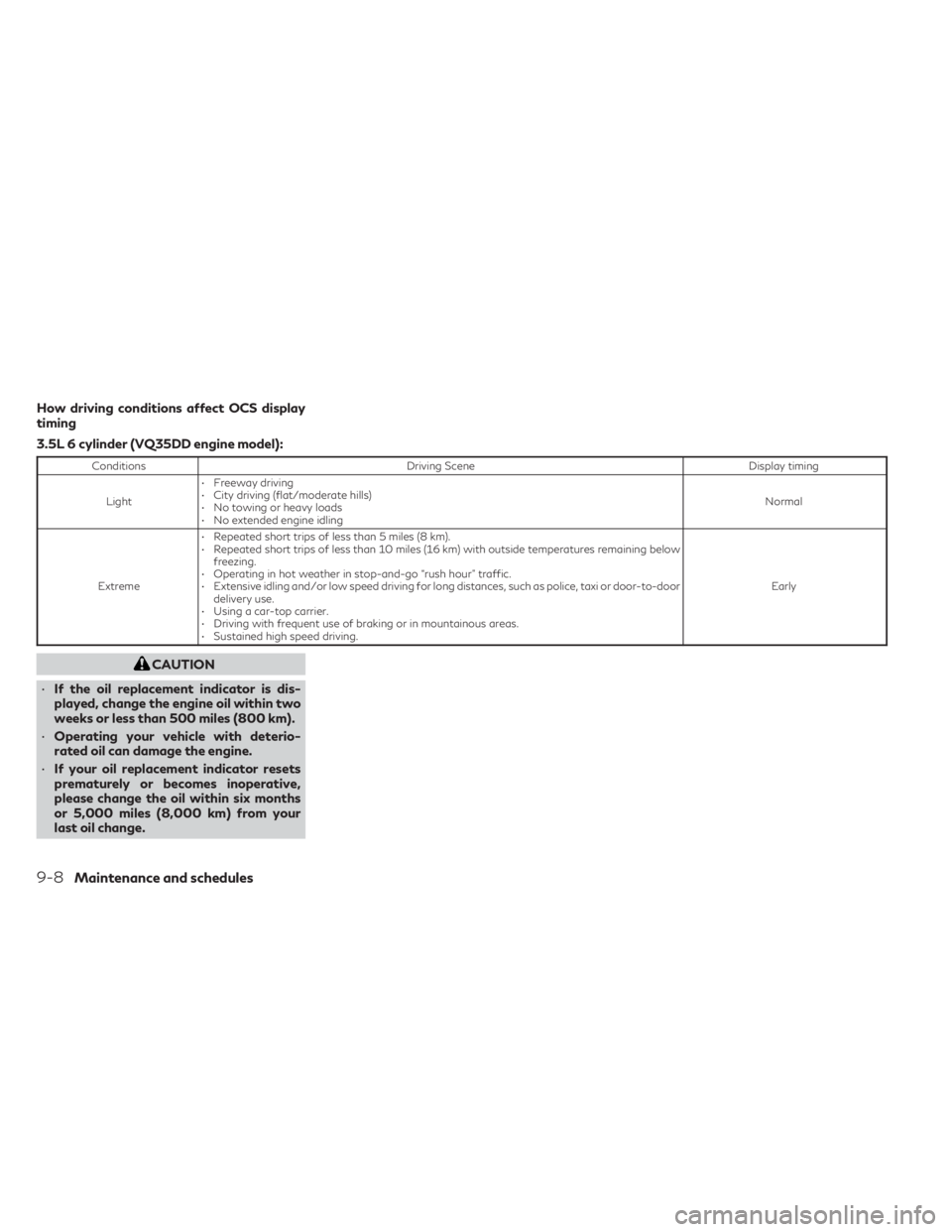
How driving conditions affect OCS display
timing
3.5L 6 cylinder (VQ35DD engine model):
ConditionsDriving Scene Display timing
Light • Freeway driving
• City driving (flat/moderate hills)
• No towing or heavy loads
• No extended engine idling Normal
Extreme • Repeated short trips of less than 5 miles (8 km).
• Repeated short trips of less than 10 miles (16 km) with outside temperatures remaining below
freezing.
• Operating in hot weather in stop-and-go “rush hour” traffic.
• Extensive idling and/or low speed driving for long distances, such as police, taxi or door-to-door delivery use.
• Using a car-top carrier.
• Driving with frequent use of braking or in mountainous areas.
• Sustained high speed driving. Early
CAUTION
• If the oil replacement indicator is dis-
played, change the engine oil within two
weeks or less than 500 miles (800 km).
• Operating your vehicle with deterio-
rated oil can damage the engine.
• If your oil replacement indicator resets
prematurely or becomes inoperative,
please change the oil within six months
or 5,000 miles (8,000 km) from your
last oil change.
9-8Maintenance and schedules
Page 572 of 636
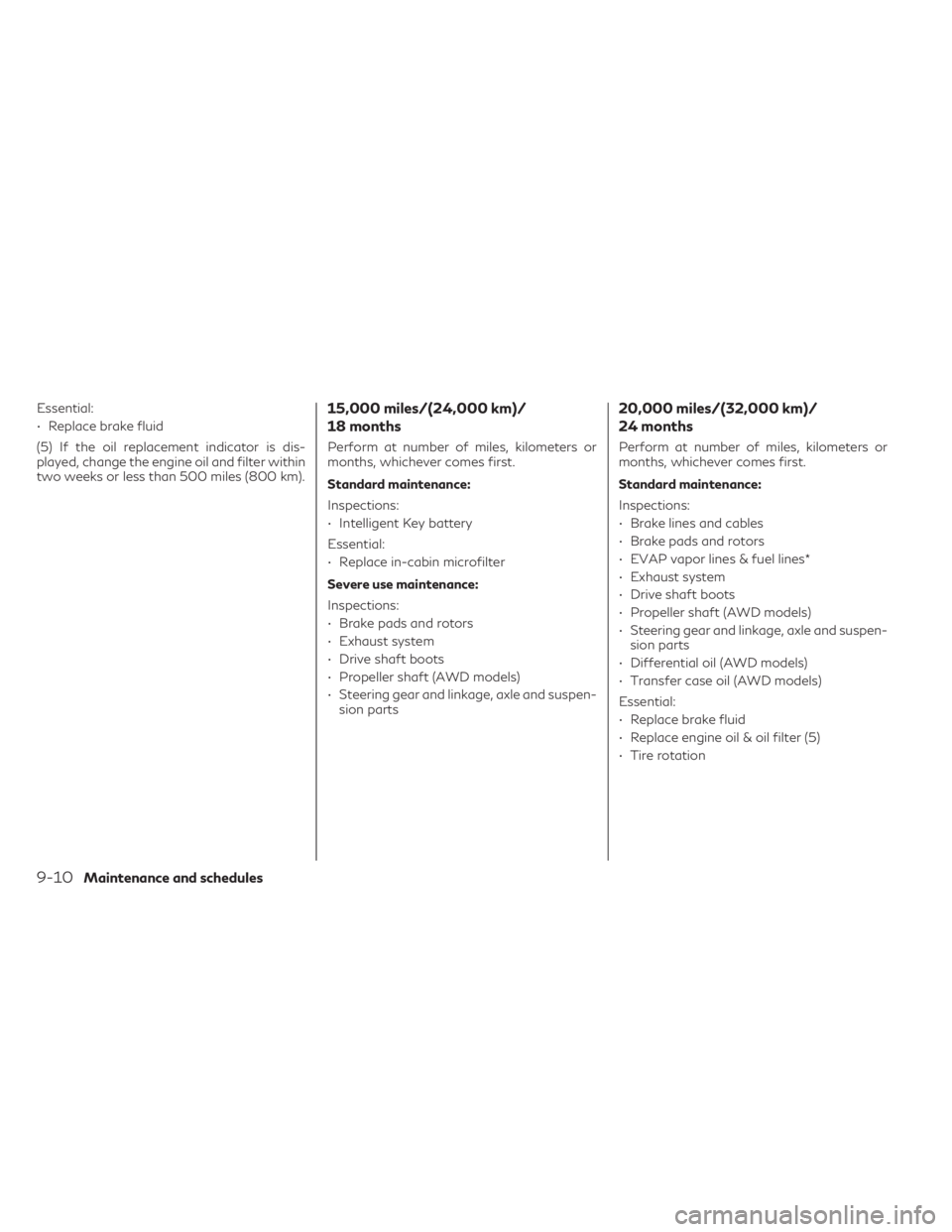
Essential:
• Replace brake fluid
(5) If the oil replacement indicator is dis-
played, change the engine oil and filter within
two weeks or less than 500 miles (800 km).15,000 miles/(24,000 km)/
18 months
Perform at number of miles, kilometers or
months, whichever comes first.
Standard maintenance:
Inspections:
• Intelligent Key battery
Essential:
• Replace in-cabin microfilter
Severe use maintenance:
Inspections:
• Brake pads and rotors
• Exhaust system
• Drive shaft boots
• Propeller shaft (AWD models)
• Steering gear and linkage, axle and suspen-sion parts
20,000 miles/(32,000 km)/
24 months
Perform at number of miles, kilometers or
months, whichever comes first.
Standard maintenance:
Inspections:
• Brake lines and cables
• Brake pads and rotors
• EVAP vapor lines & fuel lines*
• Exhaust system
• Drive shaft boots
• Propeller shaft (AWD models)
• Steering gear and linkage, axle and suspen-sion parts
• Differential oil (AWD models)
• Transfer case oil (AWD models)
Essential:
• Replace brake fluid
• Replace engine oil & oil filter (5)
• Tire rotation
9-10Maintenance and schedules
Page 573 of 636
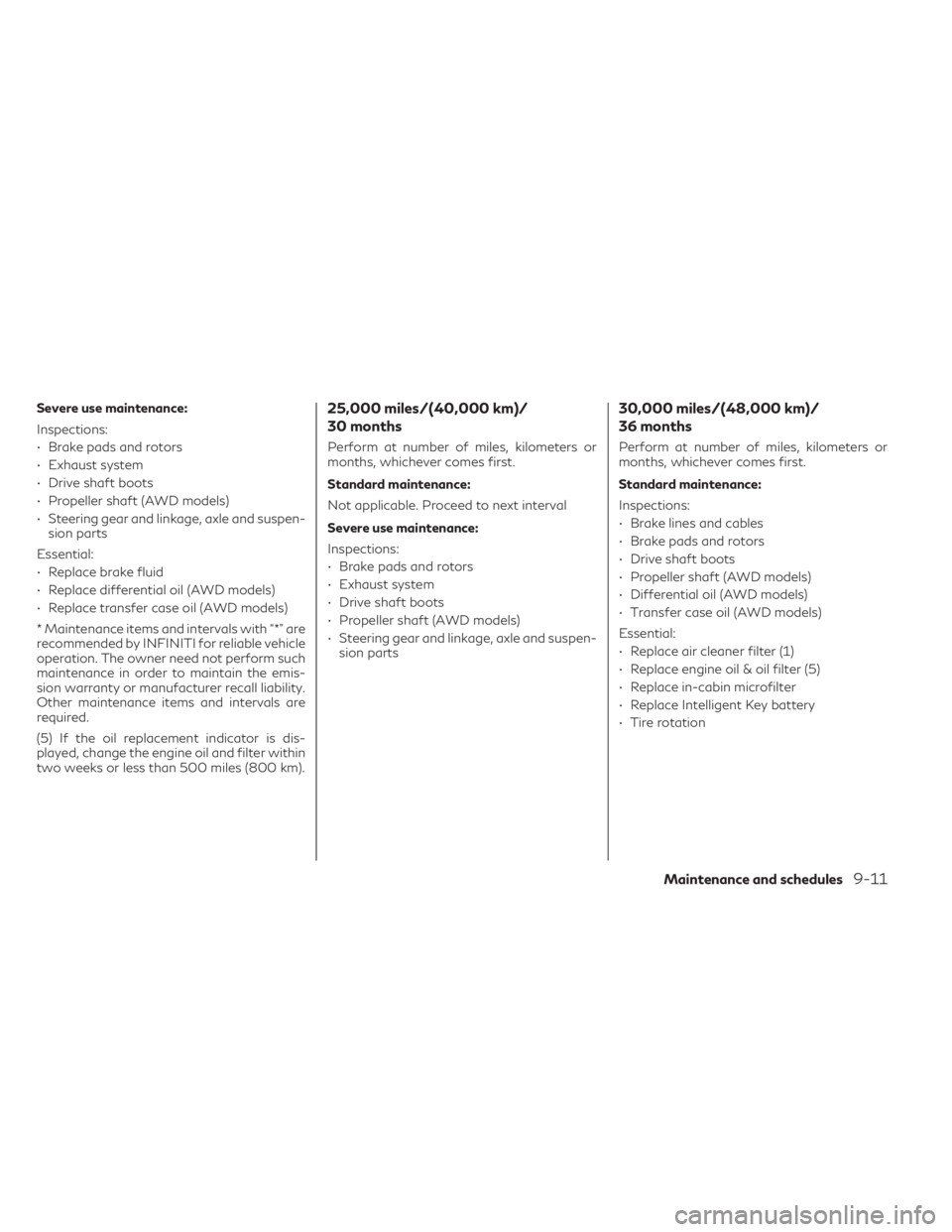
Severe use maintenance:
Inspections:
• Brake pads and rotors
• Exhaust system
• Drive shaft boots
• Propeller shaft (AWD models)
• Steering gear and linkage, axle and suspen-sion parts
Essential:
• Replace brake fluid
• Replace differential oil (AWD models)
• Replace transfer case oil (AWD models)
* Maintenance items and intervals with “*” are
recommended by INFINITI for reliable vehicle
operation. The owner need not perform such
maintenance in order to maintain the emis-
sion warranty or manufacturer recall liability.
Other maintenance items and intervals are
required.
(5) If the oil replacement indicator is dis-
played, change the engine oil and filter within
two weeks or less than 500 miles (800 km).25,000 miles/(40,000 km)/
30 months
Perform at number of miles, kilometers or
months, whichever comes first.
Standard maintenance:
Not applicable. Proceed to next interval
Severe use maintenance:
Inspections:
• Brake pads and rotors
• Exhaust system
• Drive shaft boots
• Propeller shaft (AWD models)
• Steering gear and linkage, axle and suspen- sion parts
30,000 miles/(48,000 km)/
36 months
Perform at number of miles, kilometers or
months, whichever comes first.
Standard maintenance:
Inspections:
• Brake lines and cables
• Brake pads and rotors
• Drive shaft boots
• Propeller shaft (AWD models)
• Differential oil (AWD models)
• Transfer case oil (AWD models)
Essential:
• Replace air cleaner filter (1)
• Replace engine oil & oil filter (5)
• Replace in-cabin microfilter
• Replace Intelligent Key battery
• Tire rotation
Maintenance and schedules9-11
Page 574 of 636
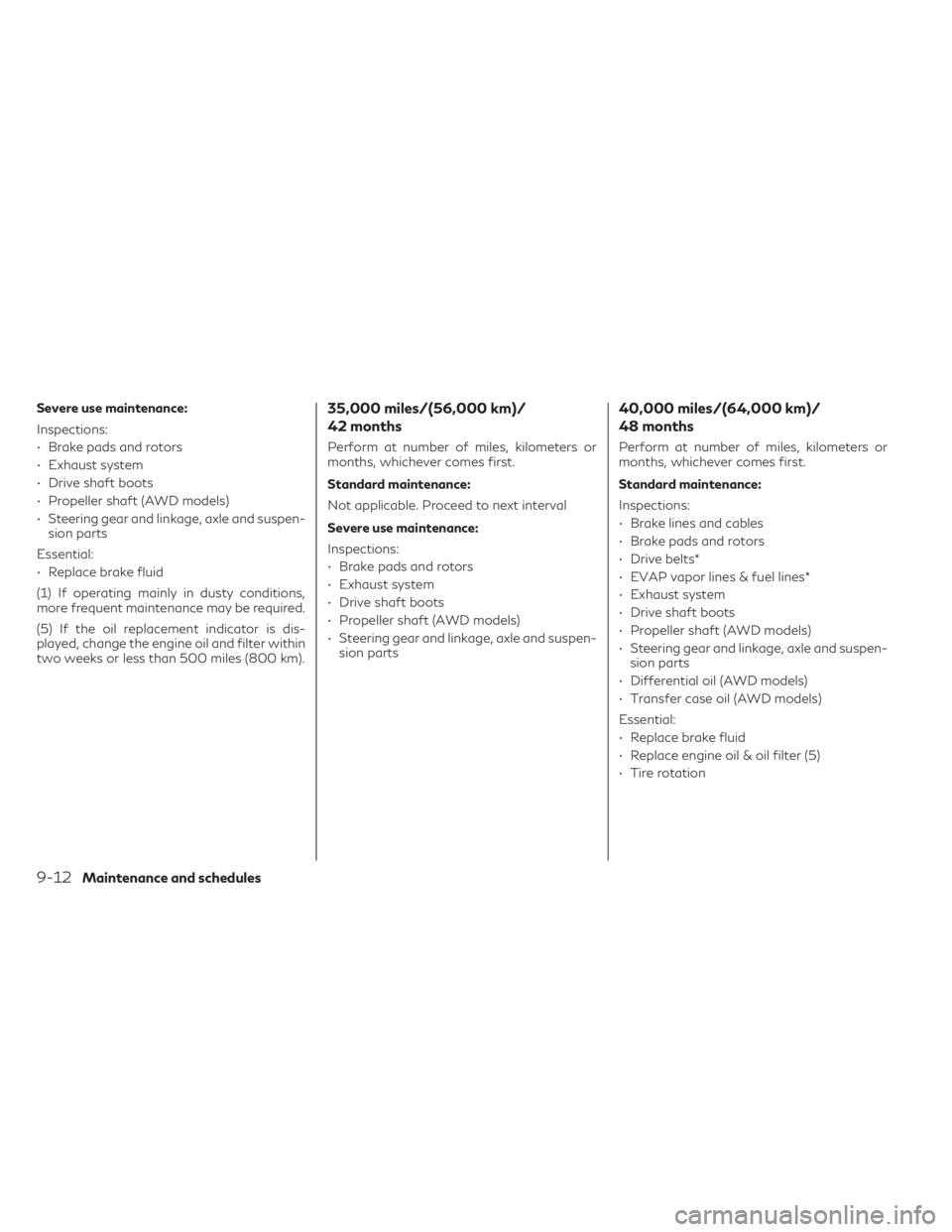
Severe use maintenance:
Inspections:
• Brake pads and rotors
• Exhaust system
• Drive shaft boots
• Propeller shaft (AWD models)
• Steering gear and linkage, axle and suspen-sion parts
Essential:
• Replace brake fluid
(1) If operating mainly in dusty conditions,
more frequent maintenance may be required.
(5) If the oil replacement indicator is dis-
played, change the engine oil and filter within
two weeks or less than 500 miles (800 km).35,000 miles/(56,000 km)/
42 months
Perform at number of miles, kilometers or
months, whichever comes first.
Standard maintenance:
Not applicable. Proceed to next interval
Severe use maintenance:
Inspections:
• Brake pads and rotors
• Exhaust system
• Drive shaft boots
• Propeller shaft (AWD models)
• Steering gear and linkage, axle and suspen- sion parts
40,000 miles/(64,000 km)/
48 months
Perform at number of miles, kilometers or
months, whichever comes first.
Standard maintenance:
Inspections:
• Brake lines and cables
• Brake pads and rotors
• Drive belts*
• EVAP vapor lines & fuel lines*
• Exhaust system
• Drive shaft boots
• Propeller shaft (AWD models)
• Steering gear and linkage, axle and suspen-sion parts
• Differential oil (AWD models)
• Transfer case oil (AWD models)
Essential:
• Replace brake fluid
• Replace engine oil & oil filter (5)
• Tire rotation
9-12Maintenance and schedules