capacities INFINITI QX60 2023 Owners Manual
[x] Cancel search | Manufacturer: INFINITI, Model Year: 2023, Model line: QX60, Model: INFINITI QX60 2023Pages: 636, PDF Size: 7.28 MB
Page 530 of 636

CAUTION
Be sure to remove any old gasket material
remaining on the sealing surface of the en-
gine. Failure to do so could lead to an oil
leak and engine damage.
• The dipstick must be inserted in place to
prevent oil spillage from the dipstick hole
when filling the engine with oil.
6. Coat the gasket on the new filter with clean engine oil.
7. Screw in the oil filter clockwise until a slight resistance is felt, then tighten addi-
tionally more than 2/3 turn.
Oil filter tightening torque: 11 to 15 ft-lb (15.0 to 21.0 N·m)
8. Clean and re-install the drain plug with a new washer. Securely tighten the drain
plug with a wrench. Do not use excessive
force.
Drain plug tightening torque: 22 to 29 ft-lb (29.4 to 39.2 N·m)
9. Refill the engine with the recommended oil through the oil filler opening, and install
the oil filler cap securely. For additional information about drain and
refill capacity, see “Recommended fluids/
lubricants and capacities” (P. 10-2). The drain
and refill capacity depends on the oil tem-
perature and drain time. Use these specifica-
tions for reference only. Always use the dip-
stick to determine the proper amount of oil in
the engine.
10. Start the engine and check for leakage
around the drain plug and the oil filter.
Correct as required. Turn the engine off
and wait more than 15 minutes. Check
the oil level with the dipstick. Add engine
oil if necessary.
After the operation
1. Reinstall engine protectors in reverse or-der of removal.
2. Lower the vehicle carefully to the ground.
3. Reset oil control system. For additional information, see “Vehicle information dis-
play 7 inch (18 cm) Type A” (P. 2-22) or
“Vehicle information display 12.3 inch (31
cm) Type B” (P. 2-44).
• Dispose of waste oil and filter properly.
• Check your local regulations. When checking or replacement is required, it
is recommended that you visit an INFINITI
retailer for this service.
CAUTION
• INFINITI recommends using Genuine
NISSAN Matic R ATF. Do not mix with
other fluids.
• Do not use CVT fluid or manual transmis-
sion fluid in this transmission. Damage
caused by the use of fluids other than as
recommended is not covered under
INFINITI’s New Vehicle Limited War-
ranty outlined in your Warranty Infor-
mation Booklet.
• Using fluids that are not equivalent to
Genuine NISSAN Matic R ATF may also
damage the transmission. Damage
caused by the use of fluids other than as
recommended is not covered under
INFINITI’s New Vehicle Limited War-
ranty outlined in your Warranty Infor-
mation Booklet.
The specified automatic transmission fluid is
also described on caution labels located in the
engine compartment.
AUTOMATIC TRANSMISSION FLUID
(ATF)
8-10Do-it-yourself
Page 531 of 636

WARNING
• Use only new fluid from a sealed con-
tainer. Old, inferior or contaminated
fluid may damage the brake system. The
use of improper fluids can damage the
brake system and affect the vehicle's
stopping ability.
• Clean the filler cap before removing.
• Brake fluid is poisonous and should be
stored carefully in marked containers
out of reach of children.
CAUTION
Do not spill the fluid on any painted sur-
faces. This will damage the paint. If fluid is
spilled, immediately wash the surface with
water.
Check the fluid level in the reservoir. If the
brake fluid is below the MIN line
OB, the
brake warning light will illuminate. Add brake
fluid up to the MAX line
OA. For additional
information on the recommended type of
brake fluid, see “Recommended fluids/
lubricants and capacities” (P. 10-2).
If the brake fluid must be added frequently,
the brake system should be thoroughly
checked. It is recommended that you visit an
INFINITI retailer for this service.
For additional information on the location of
the brake fluid reservoir, see “Engine com-
partment check locations” (P. 8-3).
WINDSHIELD-WASHER FLUID
RESERVOIR
Fill the windshield-washer fluid reservoir pe-
riodically. Add windshield-washer fluid when
the “Low Washer Fluid” warning message
shows on the vehicle information display.
To fill the windshield-washer fluid reservoir,
lift the cap off the reservoir and pour the
windshield-washer fluid into the reservoir
opening.
LDI3213LDI2583
BRAKE FLUID WINDSHIELD-WASHER FLUID
Do-it-yourself8-11
Page 567 of 636

Underbody:The underbody is frequently ex-
posed to corrosive substances such as those
used on icy roads or to control dust. It is very
important to remove these substances, oth-
erwise rust may form on the floor pan, frame,
fuel lines and around the exhaust system. At
the end of winter, the underbody should be
thoroughly flushed with plain water, being
careful to clean those areas where mud and
dirt may accumulate. For additional informa-
tion, see “Cleaning exterior” (P. 7-2).
Windshield-washer fluid*: Check that there
is adequate fluid in the reservoir. The following descriptions are provided to
give you a better understanding of the sched-
uled maintenance items that should be regu-
larly checked or replaced. The maintenance
schedule indicates at which mileage/time in-
tervals each item requires service.
In addition to scheduled maintenance, your
vehicle requires that some items be checked
during normal day-to-day operation. For ad-
ditional information, see “General mainte-
nance” (P. 9-2).
Items marked with
“*”are recommended by
INFINITI for reliable vehicle operation. You
are not required to perform maintenance on
these items in order to maintain the warran-
ties which come with your INFINITI. Other
maintenance items and intervals are required.
When applicable, additional information can
be found in the “Do-it-yourself” section of
this manual.NOTE:
INFINITI does not advocate the use of non-
OEM approved aftermarket flushing sys-
tems and strongly advises against perform-
ing these services on an INFINITI product.
Many of the aftermarket flushing systems
use non-OEM approved chemicals or sol-
vents, the use of which has not been vali-
dated by INFINITI.
For recommended fuel, lubricants, fluids,
grease, and refrigerant, see “Recommended
fluids/lubricants and capacities” (P. 10-2).
EMISSION CONTROL SYSTEM
MAINTENANCE:
Drive belt*: Check engine drive belt for wear,
fraying or cracking and for proper tension.
Replace any damaged drive belt.
Engine air filter: Replace at specified inter-
vals. When driving for prolonged periods in
dusty conditions, check/replace the filter
more frequently.
EXPLANATION OF SCHEDULED
MAINTENANCE ITEMS
Maintenance and schedules9-5
Page 585 of 636

10 Technical and consumer information
Recommended fluids/lubricants and capacities . . 10-2Fuel recommendation ....................... 10-4
Engine oil and oil filter recommendations .....10-6
Air conditioner system refrigerant and oil
recommendations ........................... 10-7
Specifications .................................. 10-8
Engine ...................................... 10-8
Wheels and tires ............................ 10-9
Dimensions and weights ....................10-9
When traveling or registering in another
country ....................................... 10-10
Vehicle identification .......................... 10-10
Vehicle Identification Number (VIN) plate . . . 10-10
Vehicle identification number
(chassis number) ........................... 10-10
Engine serial number ....................... 10-11
F.M.V.S.S./C.M.V.S.S. certification label .....10-11
Emission control information label ..........10-12
Tire and Loading Information label ..........10-12
Air conditioner specification label ...........10-12
Installing front license plate ....................10-13
Vehicle loading information ....................10-15
Terms ..................................... 10-15
Vehicle load capacity ....................... 10-16Securing the load
.......................... 10-18
Loading tips ............................... 10-19
Measurement of weights ...................10-19
Towing a trailer ............................... 10-20
Maximum load limits ....................... 10-20
Towing load/specification ..................10-23
Towing safety ............................. 10-24
Flat towing for all–wheel drive vehicle
(if so equipped) ............................ 10-30
Flat towing for front wheel drive vehicle
(if so equipped) ............................ 10-31
Uniform tire quality grading ...................10-31
Emission control system warranty .............10-32
Reporting safety defects ......................10-33
Readiness for Inspection/Maintenance (I/M)
test .......................................... 10-34
Event Data Recorders (EDR) ..................
10-34
Additional
Data Recording (on vehicles
equipped with optional ProPILOT Assist) . . . 10-35
Owner's Manual/Service Manual order
information ................................... 10-36
Intelligent key system ......................... 10-36
Page 586 of 636

The following are approximate capacities. The actual refill capacities may be slightly different. When refilling, follow the procedure described
in the “Do-it-yourself” section to determine the proper refill capacity.
Fluid TypeCapacity (approximate)
Recommended Fluids/Lubricants
Metric
Measure US
Measure Imperial
Measure
Fuel 70 L 18-1/2 gal 15-3/8 gal • For additional information, see “Fuel recommendation” (P. 10-4).
Engine oil*
Drain and refill
* For additional informa-
tion, see “Engine oil”
(P. 8-6). With oil filter
change 4.8 L
5-1/8 qt 4-1/4 qt • Genuine “NISSAN Motor Oil 0W-20 SP” (or equivalent) is rec-
ommended.
• If the above motor oil (or engine oil) is not available, a synthetic
0W-20 GF-6 SP motor oil (or engine oil) may be used. Damage
caused by the use of motor oil (or engine oil) other than as recom-
mended is not covered under INFINITI’s New Vehicle Limited
Warranty. For additional information, see “Engine oil and oil filter
recommendations” (P. 10-6).
Without oil filter
change 4.5 L
4-3/4 qt 4 qt
Engine coolant
with reservoir With tow
package 11.9 L 3-1/8 gal 2-5/8 gal
• Pre-diluted Genuine NISSAN Long Life Antifreeze/Coolant
(blue) or equivalent
without tow
package 11.6 L 3-1/8 gal 2-1/2 gal
Automatic Transmission Fluid (ATF) —— —• Genuine NISSAN Matic R ATF
• INFINITI recommends using Genuine NISSAN Matic R ATF
ONLY in INFINITI automatic transmissions. Do not mix with other
fluids. Using fluids that are not equivalent to Genuine NISSAN
Matic R ATF may damage the automatic transmission. Damage
caused by the use of fluids other than as recommended is not
covered under the INFINITI’s New Vehicle Limited Warranty.
Differential gear oil —— —• Genuine NISSAN Differential Oil Hypoid Super Semi-synthetic
API GL-5, Viscosity SAE 75W-90
• The use of differential gear oil other than the specified may
cause vehicle malfunctions and result in non-warranty vehicle
repairs.
Coupling oil —— —• Genuine NISSAN LSC Coupling Transmission Fluid 12-301 or
equivalent
RECOMMENDED FLUIDS/
LUBRICANTS AND CAPACITIES
10-2Technical and consumer information
Page 590 of 636
Octane rating tips
Using unleaded gasoline with an octane rat-
ing lower than recommended can cause per-
sistent, heavy “spark knock.” (“Spark knock”
is a metallic rapping noise.) If severe, this can
lead to engine damage. If you detect a per-
sistent heavy spark knock even when using
gasoline of the stated octane rating, or if you
hear steady spark knock while holding a
steady speed on level roads, it is recom-
mended that you have an INFINITI retailer
correct the condition. Failure to correct the
condition is misuse of the vehicle, for which
INFINITI is not responsible.
Incorrect ignition timing may result in spark
knock, after-run and/or overheating, which
may cause excessive fuel consumption or en-
gine damage. If any of the above symptoms
are encountered, have your vehicle checked.
It is recommended that you visit an INFINITI
retailer.
However, now and then you may notice light
spark knock for a short time while accelerat-
ing or driving up hills. This is not a cause for
concern, because you get the greatest fuel
benefit when there is light spark knock for a
short time under heavy engine load.
ENGINE OIL AND OIL FILTER
RECOMMENDATIONS
Selecting the correct oil
It is essential to choose the correct grade,
quality and viscosity engine oil to ensure sat-
isfactory engine life and performance. For
additional information, see "Recommended
fluids/lubricants and capacities" (P. 10-2).
INFINITI recommends the use of an energy
conserving oil in order to improve fuel
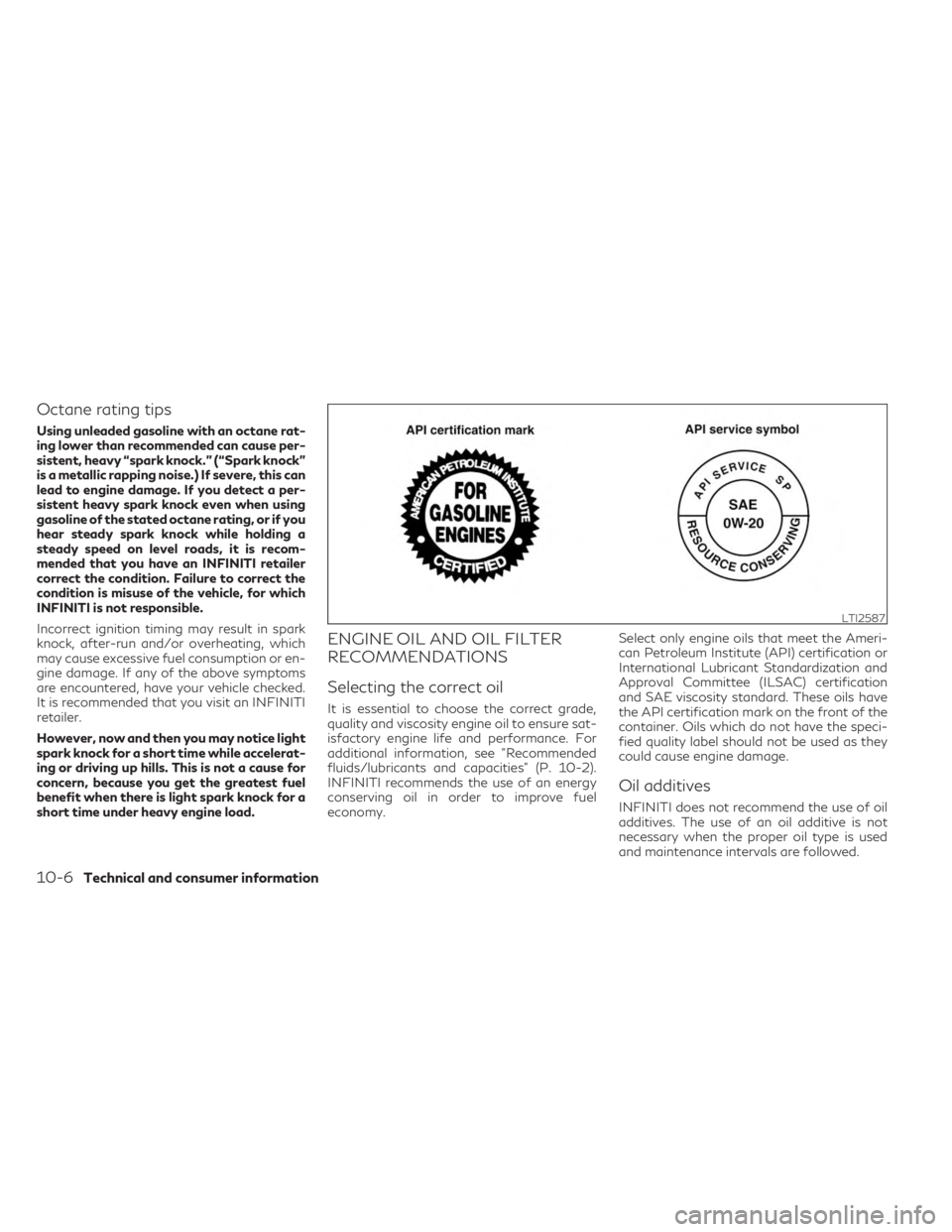
economy.Select only engine oils that meet the Ameri-
can Petroleum Institute (API) certification or
International Lubricant Standardization and
Approval Committee (ILSAC) certification
and SAE viscosity standard. These oils have
the API certification mark on the front of the
container. Oils which do not have the speci-
fied quality label should not be used as they
could cause engine damage.
Oil additives
INFINITI does not recommend the use of oil
additives. The use of an oil additive is not
necessary when the proper oil type is used
and maintenance intervals are followed.
LTI2587
10-6Technical and consumer information
Page 606 of 636
Towing capacities are calculated assuming a
base vehicle with driver and any options re-
quired to achieve the rating. Additional pas-
sengers, cargo and/or optional equipment,
such as the trailer hitch, will add weight to the
vehicle and reduce your vehicle’s maximum
towing capacity and trailer tongue load.
The vehicle and trailer need to be weighed to
confirm the vehicle is within the GVWR,
Front GAWR, Rear GAWR, Gross Combined
Weight Rating (GCWR) and Towing capacity.
All vehicle and trailer weights can be mea-
sured using platform type scales commonly
found at truck stops, highway weigh stations,
building supply centers or salvage yards.
To determine the available payload capacity
for tongue/king pin load, use the following
procedure.
1. Locate the GVWR on the F.M.V.S.S./C.M.V.S.S. certification label.
2. Weigh your vehicle on the scale with all of the passengers and cargo that are nor-
mally in the vehicle when towing a trailer.
3. Subtract the actual vehicle weight from the GVWR. The remaining amount is the
available maximum tongue/king pin load.
To determine the available towing capacity,
use the following procedure. 1. Find the GCWR for your vehicle on the
"Towing Load/Specification" chart found
in this section.
2. Subtract the actual vehicle weight from the GCWR. The remaining amount is the
available maximum towing capacity.
To determine the Gross Trailer Weight, weigh
your trailer on a scale with all equipment and
cargo, that are normally in the trailer when it
is towed. Make sure the Gross trailer weight
is not more than the Gross Trailer Weight
Rating shown on the trailer and is not more
than the calculated available maximum tow-
ing capacity.
Also weigh the front and rear axles on the
scale to make sure the Front Gross Axle
Weight and Rear Gross Axle Weight are not
more than Front Gross Axle Weight and Rear
Gross Axle Weight on the F.M.V.S.S./
C.M.V.S.S. certification label. The cargo in the
trailer and vehicle may need to be moved or
removed to meet the specified ratings.
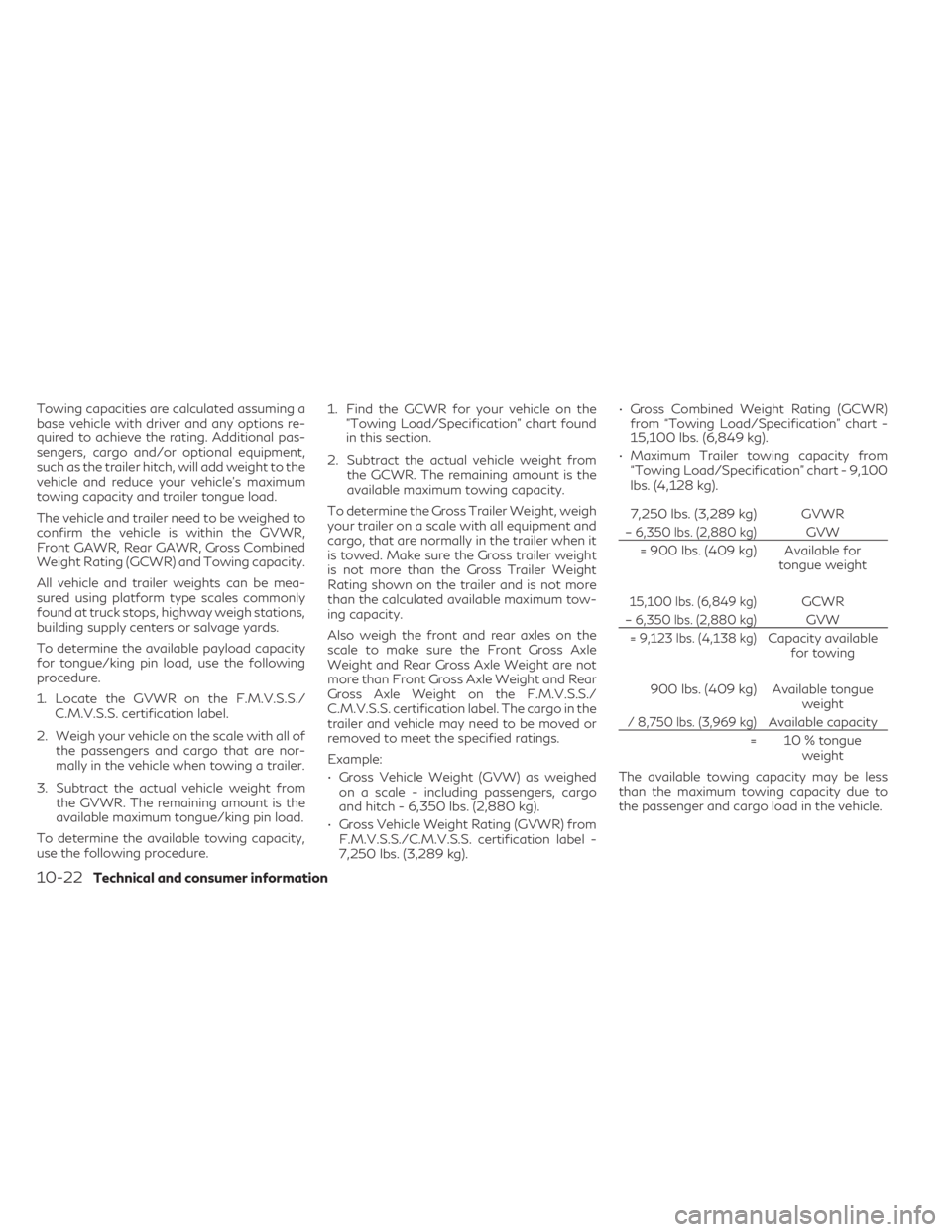
Example:
• Gross Vehicle Weight (GVW) as weighed on a scale - including passengers, cargo
and hitch - 6,350 lbs. (2,880 kg).
• Gross Vehicle Weight Rating (GVWR) from F.M.V.S.S./C.M.V.S.S. certification label -
7,250 lbs. (3,289 kg). • Gross Combined Weight Rating (GCWR)
from “Towing Load/Specification" chart -
15,100 lbs. (6,849 kg).
• Maximum Trailer towing capacity from “Towing Load/Specification" chart - 9,100
lbs. (4,128 kg).
7,250 lbs. (3,289 kg) GVWR
– 6,350 lbs. (2,880 kg)GVW
= 900 lbs. (409 kg) Available for tongue weight
15,100 lbs. (6,849 kg)GCWR
– 6,350 lbs. (2,880 kg)GVW
= 9,123 lbs. (4,138 kg)Capacity availablefor towing
900 lbs. (409 kg) Available tongue weight
/ 8,750 lbs. (3,969 kg)Available capacity
= 10 % tongue weight
The available towing capacity may be less
than the maximum towing capacity due to
the passenger and cargo load in the vehicle.
10-22Technical and consumer information
Page 607 of 636
Remember to keep trailer tongue weight be-
tween 10 - 15% of the trailer weight or within
the trailer tongue load specification recom-
mended by the trailer manufacturer. If the
tongue load becomes excessive, rearrange
the cargo to obtain the proper tongue load.
Do not exceed the maximum tongue weight
specification shown in the “Towing Load/
Specification” chart even if the calculated
available tongue weight is greater than 15%.
If the calculated tongue weight is less than
10%, reduce the total trailer weight to match
the available tongue weight.
Always verify that available capacities are
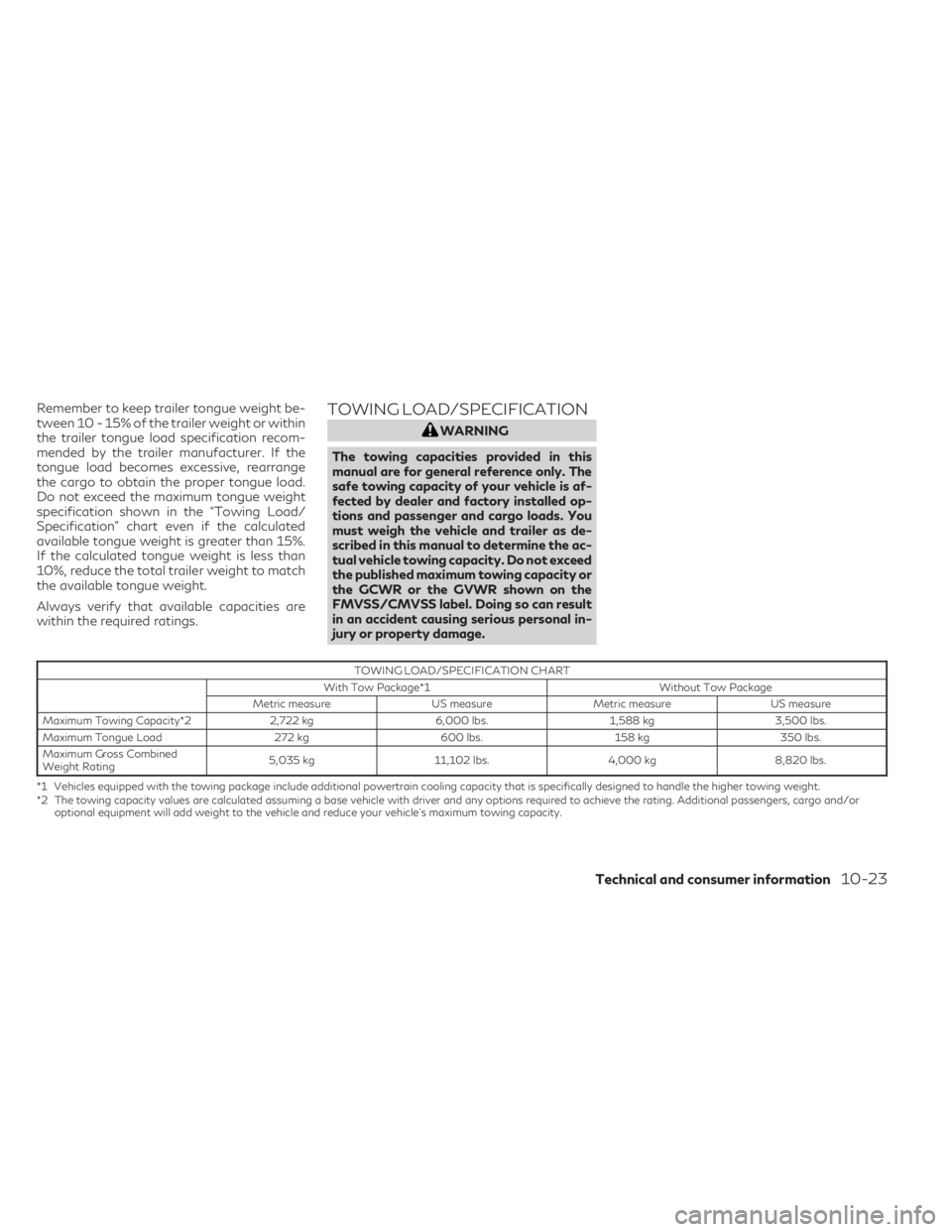
within the required ratings.TOWING LOAD/SPECIFICATION
WARNING
The towing capacities provided in this
manual are for general reference only. The
safe towing capacity of your vehicle is af-
fected by dealer and factory installed op-
tions and passenger and cargo loads. You
must weigh the vehicle and trailer as de-
scribed in this manual to determine the ac-
tual vehicle towing capacity. Do not exceed
the published maximum towing capacity or
the GCWR or the GVWR shown on the
FMVSS/CMVSS label. Doing so can result
in an accident causing serious personal in-
jury or property damage.
TOWING LOAD/SPECIFICATION CHART
With Tow Package*1 Without Tow Package
Metric measure US measureMetric measure US measure
Maximum Towing Capacity*2 2,722 kg6,000 lbs. 1,588 kg3,500 lbs.
Maximum Tongue Load 272 kg600 lbs. 158 kg350 lbs.
Maximum Gross Combined
Weight Rating 5,035 kg
11,102 lbs. 4,000 kg8,820 lbs.
*1 Vehicles equipped with the towing package include additional powertrain cooling capacity that is specifically designed to handle the higher towing weight.
*2 The towing capacity values are calculated assuming a base vehicle with driver and any options required to achieve the rating. Additional passengers, cargo and/or optional equipment will add weight to the vehicle and reduce your vehicle's maximum towing capacity.
Technical and consumer information10-23
Page 623 of 636

11 Index
A
Active Brake Limited Slip (ABLS)
system....................5-167Active Ride Control.............5-171Active Trace Control............5-170Aiming control, headlights.........2-82Air bag (See supplemental restraint
system).................... .1-54Air bag system
Front (See supplemental front impact air
bag system)
............... .1-62Air bag warning labels............1-74Air bag warning light.........1-75, 2-16Air bag warning light,
supplemental............ .1-75, 2-16Air cleaner.................. .8-17Air cleaner housing filter..........8-17Air conditioner
Air conditioner operation........4-30Air conditioner specification label. .10-12Air conditioner system refrigerant
recommendations............ .10-7Air conditioner system refrigerant and oil
recommendations.............10-7Heater and air conditioner (automatic)
(if so equipped)............. .4-29Heater and air conditioner controls. .4-30Servicing air conditioner.........4-36Alarm system (See vehicle security
system).................... .2-71
Anchor point locations...........1-36Antenna................... .4-36Anti-lock brake warning light........2-17Anti-lock Braking System (ABS).....5-166Antifreeze..................5-184Armrests.................... .1-8Around View® Monitor...........4-10Autolight switch.............. .2-78Automatic
Automatic power window switch. .2-110Driving with automatic transmission. .5-18Automatic anti-glare inside
mirror................ .3-33, 3-34Automatic brake hold............5-27Automatic door locks............ .3-6
B
Battery............... .5-184, 8-13Charge warning light...........2-15Battery replacement............ .8-24INFINITI Intelligent Key.........8-24Key fob.................. .8-24Before starting the engine.........5-16Belt (See drive belt).............8-15Blind Spot Intervention® (BSI).......5-61Blind Spot Warning (BSW).........5-49Booster seats................ .1-51Brake
Anti-lock Braking System (ABS). . .5-166
Brake fluid................ .8-11Brake light (See stop light).......8-26Brake system...............5-165Brake warning light............2-14Brake wear indicators......2-22, 8-20Parking brake operation.........5-25Self-adjusting brakes..........8-20Brake Assist................ .5-167Brake fluid.................. .8-11Brake system................5-165Brakes.................... .8-20Break-in schedule..............5-159Brightness control
Instrument panel............ .2-83Bulb check/instrument panel........2-14Bulb replacement............. .8-26
C
C.M.V.S.S. certification label.......10-11Capacities and recommended
fuel/lubricants............... .10-2Car phone or CB radio...........4-37Cargo (See vehicle loading
information)................ .10-15Cargo area storage bin..........2-106Cargo light................. .2-115Chassis control...............5-170Check tire pressure..........2-41, 2-67Child restraint with top tether strap. . . .1-35
Page 624 of 636

Child restraints.....1-25, 1-26, 1-28, 1-30LATCH (Lower Anchors and Tethers for
CHildren) System.............1-30Precautions on child
restraints...........1-39, 1-45, 1-51Top tether strap anchor point
locations.................. .1-36Child safety rear door lock...........3-6Cleaning exterior and interior......7-2, 7-4Climate-controlled seat switches......2-84Cold weather driving........... .5-184Console box................ .2-102Console light.................2-114Controls
Heater and air conditioner controls. . .4-30CoolantCapacities and recommended
fuel/lubricants
.............. .10-2Changing engine coolant..........8-5Checking engine coolant level.......8-5Engine coolant temperature gauge. . . .2-9Corrosion protection..............7-7Cruise control................ .5-83Cup holders.................2-104
D
Defroster switch
Rear window and outside mirror defroster
switch
................... .2-77Dimensions and weights...........10-9Dimmer switch for instrument panel. . . .2-83Door locks................... .3-4
Drive belt....................8-15Driver Attention Alert............5-156Driving
Cold weather driving..........5-184Driving with automatic transmission. .5-18Precautions when starting and
driving................ .5-4, 5-10Driving the vehicle...............5-18Dual panel moonroof............2-111
E
E-call (SOS) Button............. .2-92Eco Drive Report.............. .5-33Economy - fuel............... .5-161Emergency engine shutoff.......5-14, 6-3Emission control information label. . . .10-12Emission control system warranty. . . .10-32Engine
Before starting the engine........5-16Capacities and recommended
fuel/lubricants.............. .10-2Changing engine coolant..........8-5Changing engine oil.............8-6Changing engine oil filter..........8-6Checking engine coolant level.......8-5Checking engine oil level..........8-6Engine coolant temperature gauge. . . .2-9Engine cooling system...........8-4Engine oil.................. .8-6Engine oil and oil filter
recommendation..............10-6Engine oil pressure warning light. . . .2-15
Engine oil viscosity.............10-7Engine serial number...........10-11Engine specifications...........10-8Starting the engine............ .5-16Engine coolant temperature gauge. . . . .2-9Event Data recorders.......10-34, 10-35Exhaust gas (Carbon monoxide).......5-4Explanation of maintenance items......9-2Explanation of scheduled maintenance
items...................... .9-5Extended storage switch...........2-99
F
F.M.V.S.S. certification label........10-11Flashers (See hazard warning flasher
switch)..................... .6-2Flat tire...................6-3, 6-4Floor mat positioning aid...........7-6Fluid
Brake fluid................. .8-11Capacities and recommended
fuel/lubricants...............10-2Engine coolant............... .8-4Engine oil.................. .8-6Windshield-washer fluid.........8-11Forward Emergency Braking (FEB) with
Pedestrian Detection system. . .2-17, 5-128Front air bag system
(See supplemental restraint system). . . .1-62Front and rear sonar system........5-172Front power seat adjustment.........1-3Front seats................... .1-2
11-2