DTC CHECK ISUZU KB P190 2007 Workshop Repair Manual
[x] Cancel search | Manufacturer: ISUZU, Model Year: 2007, Model line: KB P190, Model: ISUZU KB P190 2007Pages: 6020, PDF Size: 70.23 MB
Page 1704 of 6020

ENGINE CONTROL SYSTEM (4JK1/4JJ1) 6E-87
DTC P0091 or P0092 (Flash Code 247)
Circuit Description
The fuel rail pressure (FRP) regulator is installed to the
fuel supply pump and controls the suction fuel quantity
into the fuel rail. The FRP regulator is fully opened in
the normal state and larger drive current results in
smaller opening. The ECM calculates desired fuel rail
pressure and fuel flow rate and it compares the
calculated desired fuel rail pressure to the actual value
to determine the FRP regulator position. When the
actual fuel rail pressure is higher than the desired
value, the FRP regulator is closed to decease the flow
rate. If the ECM detects an excessively low or high FRP
regulator feedback current, DTC P0091 or P0092 will
set.
Condition for Running the DTC • The battery voltage is more than 9 volts.
• The ignition switch is ON.
Condition for Setting the DTC • The ECM detects that the FRP regulator feedback current is less than 100mA, or more than 1000mA
below the desired current. (DTC P0091)
• The ECM detects that the FRP regulator feedback current is more than 2450mA, or more than
1000mA over the desired current. (DTC P0092) Action Taken When the DTC Sets
• The ECM illuminates the MIL when the diagnostic runs and fails. Refer to DTC Type Definitions for
Action Taken When the DTC Sets - Type A.
• The ECM limits fuel injection quantity.
• The ECM inhibits pilot injection.
• The ECM inhibits cruise control.
Condition for Clearing the DTC • Refer to DTC Type Definitions for Condition for Clearing the MIL/ DTC - Type A.
Diagnostic Aids • If an intermittent condition is suspected, refer to Intermittent Conditions in this section.
Test Description
The number below refers to the step number on the
Circuit/ System Testing.
8. If the FRP regulator high side circuit is shorted to
voltage, engine stalls and will not start.
9. If the FRP regulator low side circuit is shorted to
ground, this DTC may not set. This will cause engine
stall or no engine start.
Schematic Reference: Engine Controls Schematics
Connector End View Reference: Engine Controls
Connector End Views or ECM Connector End Views
Circuit/ System Testing DTC P0091 or P0092
Step Action Value(s)Yes No
1 Did you perform the Diagnostic System Check -
Engine Controls? —
Go to Step 2 Go to Diagnostic
System Check -
Engine Controls
2 1. Install a scan tool.
2. Turn OFF the ignition for 30 seconds.
3. Turn ON the ignition, with the engine OFF.
4. Monitor the DTC Information with a scan tool.
Does the DTC fail this ignition? —
Go to Step 3 Go to Diagnostic
Aids
3 Is DTC P1064 also set? — Go to DTC P1064 Go to Step 4
4 Observe the Fuel Rail Pressure (FRP) Regulator
Feedback parameter with a scan tool.
Does the scan tool indicate more than the specified
value? 300 mA
Go to Step 5 Go to Step 6
5 Does the scan tool indicate more than the specified
value at Step 4? 1300 mA
Go to Step 8 Go to Step 9
BACK TO CHAPTER INDEX
TO MODEL INDEX
ISUZU KB P190 2007
Page 1707 of 6020
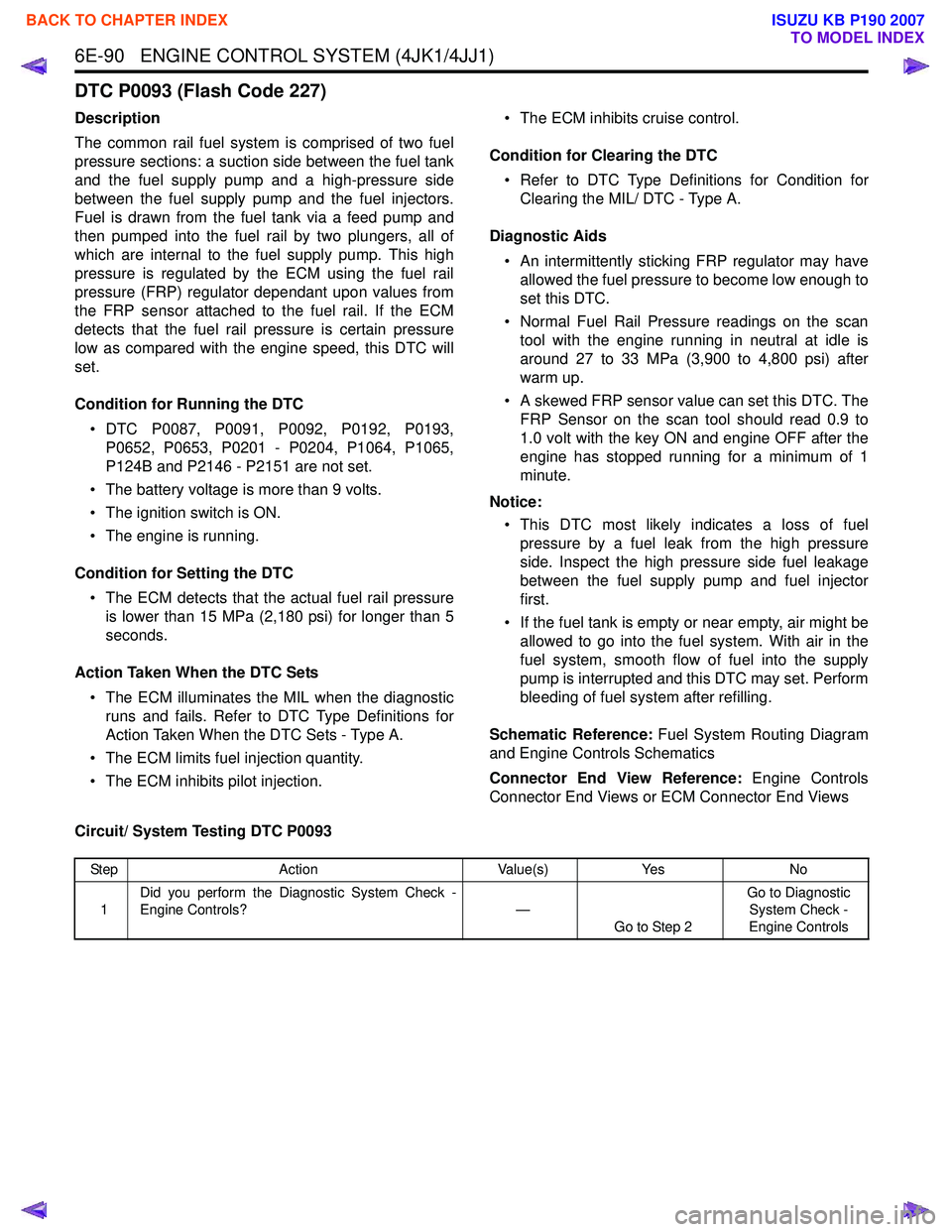
6E-90 ENGINE CONTROL SYSTEM (4JK1/4JJ1)
DTC P0093 (Flash Code 227)
Description
The common rail fuel system is comprised of two fuel
pressure sections: a suction side between the fuel tank
and the fuel supply pump and a high-pressure side
between the fuel supply pump and the fuel injectors.
Fuel is drawn from the fuel tank via a feed pump and
then pumped into the fuel rail by two plungers, all of
which are internal to the fuel supply pump. This high
pressure is regulated by the ECM using the fuel rail
pressure (FRP) regulator dependant upon values from
the FRP sensor attached to the fuel rail. If the ECM
detects that the fuel rail pressure is certain pressure
low as compared with the engine speed, this DTC will
set.
Condition for Running the DTC • DTC P0087, P0091, P0092, P0192, P0193, P0652, P0653, P0201 - P0204, P1064, P1065,
P124B and P2146 - P2151 are not set.
• The battery voltage is more than 9 volts.
• The ignition switch is ON.
• The engine is running.
Condition for Setting the DTC • The ECM detects that the actual fuel rail pressure is lower than 15 MPa (2,180 psi) for longer than 5
seconds.
Action Taken When the DTC Sets • The ECM illuminates the MIL when the diagnostic runs and fails. Refer to DTC Type Definitions for
Action Taken When the DTC Sets - Type A.
• The ECM limits fuel injection quantity.
• The ECM inhibits pilot injection. • The ECM inhibits cruise control.
Condition for Clearing the DTC • Refer to DTC Type Definitions for Condition for Clearing the MIL/ DTC - Type A.
Diagnostic Aids • An intermittently sticking FRP regulator may have allowed the fuel pressure to become low enough to
set this DTC.
• Normal Fuel Rail Pressure readings on the scan tool with the engine running in neutral at idle is
around 27 to 33 MPa (3,900 to 4,800 psi) after
warm up.
• A skewed FRP sensor value can set this DTC. The FRP Sensor on the scan tool should read 0.9 to
1.0 volt with the key ON and engine OFF after the
engine has stopped running for a minimum of 1
minute.
Notice: • This DTC most likely indicates a loss of fuel pressure by a fuel leak from the high pressure
side. Inspect the high pressure side fuel leakage
between the fuel supply pump and fuel injector
first.
• If the fuel tank is empty or near empty, air might be allowed to go into the fuel system. With air in the
fuel system, smooth flow of fuel into the supply
pump is interrupted and this DTC may set. Perform
bleeding of fuel system after refilling.
Schematic Reference: Fuel System Routing Diagram
and Engine Controls Schematics
Connector End View Reference: Engine Controls
Connector End Views or ECM Connector End Views
Circuit/ System Testing DTC P0093
Step Action Value(s)Yes No
1 Did you perform the Diagnostic System Check -
Engine Controls? —
Go to Step 2 Go to Diagnostic
System Check -
Engine Controls
BACK TO CHAPTER INDEX
TO MODEL INDEX
ISUZU KB P190 2007
Page 1709 of 6020

6E-92 ENGINE CONTROL SYSTEM (4JK1/4JJ1)
61. Turn OFF the ignition.
2. Place the transmission in Neutral and set the parking brake.
3. Start the engine.
4. Perform the Cylinder Balance Test with a scan tool.
5. Command each injector OFF and verify an engine speed change for each injector.
Is there an injector that does not change engine
speed when commanded OFF? —
Go to Step 14 Go to Step 7
7 1. Check the fuel system line connections
between the fuel tank and the fuel supply
pump for tightness and all fuel hoses for cuts,
cracks and for the use of proper clamps.
Notice: Air in the fuel system will cause fuel rail
pressure fluctuations especially at high engine
speed and load, which may set this DTC.
2. Repair or replace as necessary.
Did you find and correct the condition? —
Go to Step 16 Go to Step 8
8 Notice:
Make sure the in-tank fuel pump operation
before performing the following procedures. Refer
to In-tank Fuel Pump System Check in this section.
1. Turn OFF the ignition.
2. Disconnect the fuel hose from the fuel supply pump suction side. In order to measure the
discharged fuel amount, put the hose into a
bottle or a container with a scale. (The inlet of
a bottle or a container must be larger than the
diameter of hose.)
3. Turn ON the ignition for 20 seconds, with the engine OFF.
4. Turn OFF the ignition for 10 seconds.
5. Perform 3 and 4 three times. The accumulated fuel of three ignition cycles must be more than
300 cc. (Normal amount is more than 100 cc
per one ignition cycle.)
Notice: If there is a leak or a restriction on the
suction side, the fuel from the hose will not flow out
sufficiently that is most likely caused by fuel
leakage, clogged fuel filter, kinked or crushed fuel
hose or pipe. Also inside the fuel tank for any
foreign materials may be getting drawn into the fuel
line pickup.
6. Repair fuel system leaking or restrictions as necessary.
Did you find and correct the condition? —
Go to Step 16 Go to Step 9
Step
Action Value(s)Yes No
BACK TO CHAPTER INDEX
TO MODEL INDEX
ISUZU KB P190 2007
Page 1712 of 6020

ENGINE CONTROL SYSTEM (4JK1/4JJ1) 6E-95
DTC P0101 (Flash Code 92)
Circuit Description
The mass air flow (MAF) sensor is an air flow meter
that measures the amount of air that enters the engine.
It is fitted between the air cleaner and turbocharger. A
small quantity of air that enters the engine indicates
deceleration or idle speed. A large quantity of air that
enters the engine indicates acceleration or a high load
condition. The ECM will calculate a predicted MAF
value and compares the actual MAF sensor voltage
signal to the predicted MAF value. This comparison will
determine if the signal is stuck, or is too low or too high
for a given operating condition. If the ECM detects that
the actual MAF sensor signal voltage is not within a
predetermined range of the calculated MAF value, this
DTC will set.
Condition for Running the DTC • DTCs P0045, P0102, P0103, P0107, P0108, P 0 11 2 , P 0 11 3 , P 0 11 6 , P 0 11 7 , P 0 11 8 , P 0 1 2 2 ,
P0123, P0234, P0403, P0404, P0405, P0406,
P0638, P0652, P0653, P0698, P0699, P1404,
P2100, P2101, P2103, P2227, P2228 and P2229
are not set.
AND following conditions are met longer than 10
seconds.
• The battery voltage is between 10.0 to 16.0 volts.
• The ignition switch is ON.
• The intake air temperature is less than 110 °C
(230 °F).
• The engine coolant temperature is between 0 to 11 0 °C (32 to 230 °F).
• The engine speed is between 850 to 3700 RPM.
• The EGR control is commanded OFF.
• The intake throttle control is commanded OFF.
• The commanded fuel injection quantity is OFF (accelerator pedal is not depressed).
• The engine run time is longer than 5 seconds. Condition for Setting the DTC
• The ECM detects that the MAF sensor signal voltage is not within a predetermined range of the
calculated MAF value for longer than 10 seconds.
Action Taken When the DTC Sets • The ECM illuminates the MIL when the diagnostic runs and fails. Refer to DTC Type Definitions for
Action Taken When the DTC Sets - Type A.
• The ECM limits fuel injection quantity.
• The ECM inhibits pilot injection.
• The ECM inhibits EGR control.
• The ECM inhibits cruise control.
Condition for Clearing the DTC • Refer to DTC Type Definitions for Condition for Clearing the MIL/ DTC - Type A.
Diagnostic Aids • Any unmetered air that enters the engine downstream of the MAF sensor will cause this
DTC to set.
• High resistance in the MAF sensor circuit will set this DTC.
• A short between the signal circuit of the MAF sensor and the signal circuit of the intake air
temperature (IAT) sensor will skew the MAF
sensor lower than normal at higher air flows.
Notice: • The MAF Sensor parameter on scan tool will only update with engine running or one time after the
key is cycled when the ignition has been turned
OFF for longer than 10 seconds.
Schematic Reference : Engine Controls Schematics
Connector End View Reference : Engine Controls
Connector End Views or ECM Connector End Views
Circuit/ System Testing DTC P0101
Step Action Value(s)Yes No
1 Did you perform the Diagnostic System Check -
Engine Controls? —
Go to Step 2 Go to Diagnostic
System Check -
Engine Controls
BACK TO CHAPTER INDEX
TO MODEL INDEX
ISUZU KB P190 2007
Page 1715 of 6020
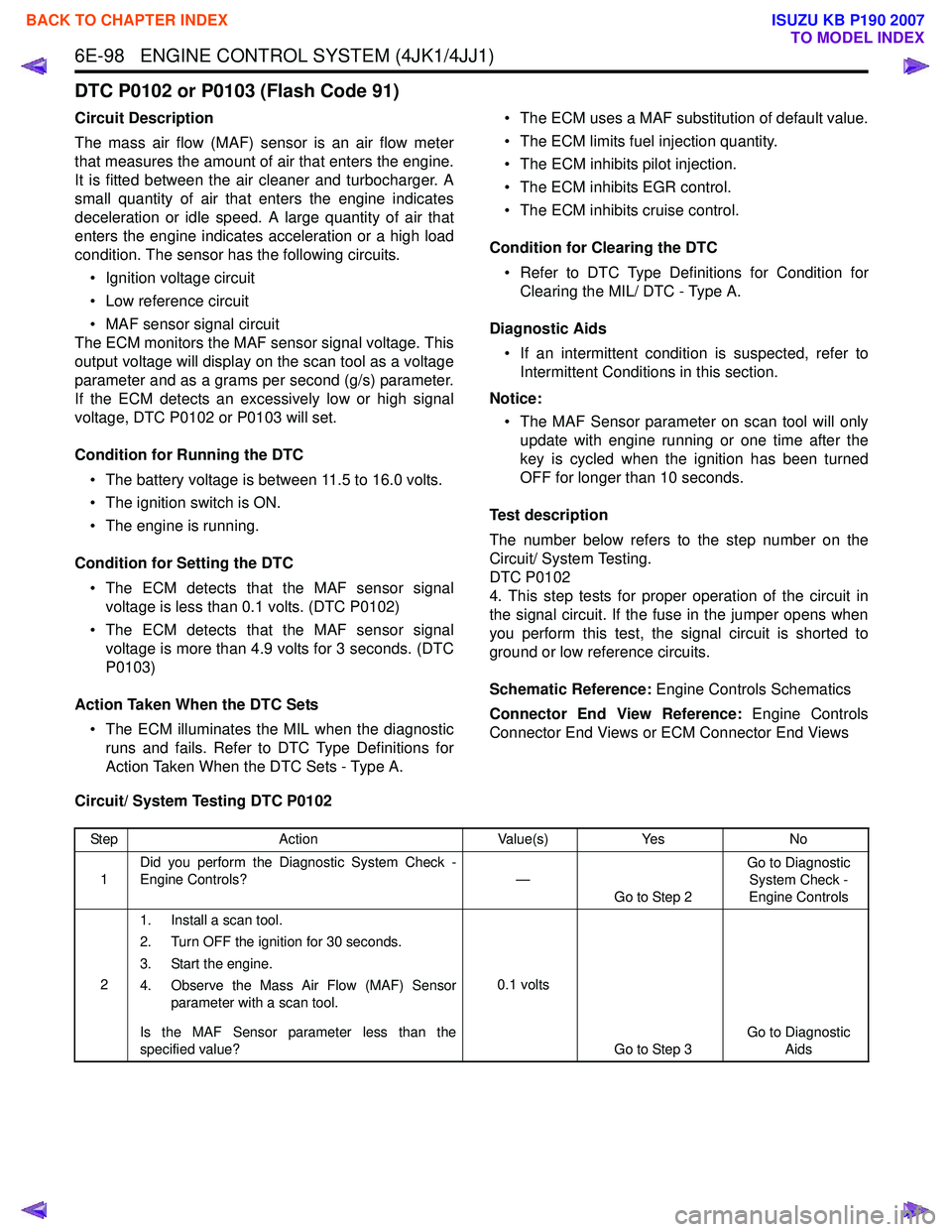
6E-98 ENGINE CONTROL SYSTEM (4JK1/4JJ1)
DTC P0102 or P0103 (Flash Code 91)
Circuit Description
The mass air flow (MAF) sensor is an air flow meter
that measures the amount of air that enters the engine.
It is fitted between the air cleaner and turbocharger. A
small quantity of air that enters the engine indicates
deceleration or idle speed. A large quantity of air that
enters the engine indicates acceleration or a high load
condition. The sensor has the following circuits.
• Ignition voltage circuit
• Low reference circuit
• MAF sensor signal circuit
The ECM monitors the MAF sensor signal voltage. This
output voltage will display on the scan tool as a voltage
parameter and as a grams per second (g/s) parameter.
If the ECM detects an excessively low or high signal
voltage, DTC P0102 or P0103 will set.
Condition for Running the DTC • The battery voltage is between 11.5 to 16.0 volts.
• The ignition switch is ON.
• The engine is running.
Condition for Setting the DTC • The ECM detects that the MAF sensor signal voltage is less than 0.1 volts. (DTC P0102)
• The ECM detects that the MAF sensor signal voltage is more than 4.9 volts for 3 seconds. (DTC
P0103)
Action Taken When the DTC Sets • The ECM illuminates the MIL when the diagnostic runs and fails. Refer to DTC Type Definitions for
Action Taken When the DTC Sets - Type A. • The ECM uses a MAF substitution of default value.
• The ECM limits fuel injection quantity.
• The ECM inhibits pilot injection.
• The ECM inhibits EGR control.
• The ECM inhibits cruise control.
Condition for Clearing the DTC • Refer to DTC Type Definitions for Condition for Clearing the MIL/ DTC - Type A.
Diagnostic Aids • If an intermittent condition is suspected, refer to Intermittent Conditions in this section.
Notice: • The MAF Sensor parameter on scan tool will only update with engine running or one time after the
key is cycled when the ignition has been turned
OFF for longer than 10 seconds.
Test description
The number below refers to the step number on the
Circuit/ System Testing.
DTC P0102
4. This step tests for proper operation of the circuit in
the signal circuit. If the fuse in the jumper opens when
you perform this test, the signal circuit is shorted to
ground or low reference circuits.
Schematic Reference: Engine Controls Schematics
Connector End View Reference: Engine Controls
Connector End Views or ECM Connector End Views
Circuit/ System Testing DTC P0102
Step Action Value(s)Yes No
1 Did you perform the Diagnostic System Check -
Engine Controls? —
Go to Step 2 Go to Diagnostic
System Check -
Engine Controls
2 1. Install a scan tool.
2. Turn OFF the ignition for 30 seconds.
3. Start the engine.
4. Observe the Mass Air Flow (MAF) Sensor parameter with a scan tool.
Is the MAF Sensor parameter less than the
specified value? 0.1 volts
Go to Step 3 Go to Diagnostic
Aids
BACK TO CHAPTER INDEX
TO MODEL INDEX
ISUZU KB P190 2007
Page 1717 of 6020

6E-100 ENGINE CONTROL SYSTEM (4JK1/4JJ1)
Circuit/ System Testing DTC P0103
111. Reconnect all previously disconnected fuse,
relay or harness connector(s).
2. Clear the DTCs with a scan tool.
3. Turn OFF the ignition for 30 seconds.
4. Start the engine.
5. Operate the vehicle within the Conditions for Running the DTC. You may also operate the
vehicle within the conditions that you
observed from the Freeze Frame/ Failure
Records.
Did the DTC fail this ignition? —
Go to Step 2 Go to Step 12
12 Observe the DTC Information with a scan tool.
Are there any DTCs that you have not diagnosed? —
Go to DTC List System OK
Step
Action Value(s)Yes No
Step Action Value(s)Yes No
1 Did you perform the Diagnostic System Check -
Engine Controls? —
Go to Step 2 Go to Diagnostic
System Check -
Engine Controls
2 1. Install a scan tool.
2. Turn OFF the ignition for 30 seconds.
3. Start the engine.
4. Observe the Mass Air Flow (MAF) Sensor parameter with a scan tool.
Is the MAF Sensor parameter more than the
specified value? 4.9 volts
Go to Step 3 Go to Diagnostic
Aids
3 1. Turn OFF the ignition for 30 seconds.
2. Disconnect the MAF sensor harness connector.
3. Turn ON the ignition, with the engine OFF.
Is the MAF Sensor parameter less than the
specified value? 0.1 volts
Go to Step 4 Go to Step 5
4 Connect a test lamp between the low reference
circuit (pin 2 of E-47) and battery voltage.
Does the test lamp illuminate? —
Go to Step 7 Go to Step 6
5 1. Test the signal circuit between the ECM (pin
40 of E-90) and the MAF sensor (pin 3 of E-
47) for the following conditions:
• A short to battery or ignition voltage
• A short to any 5 volts reference
2. Repair the circuit(s) as necessary.
Did you find and correct the condition? —
Go to Step 11 Go to Step 10
6 1. Test the low reference circuit between the
ECM (pin 43 of E-90) and the MAF sensor (pin
2 of E-47) for an open circuit or high
resistance.
2. Repair the circuit(s) as necessary.
Did you find and correct the condition? —
Go to Step 11 Go to Step 8
BACK TO CHAPTER INDEX
TO MODEL INDEX
ISUZU KB P190 2007
Page 1719 of 6020
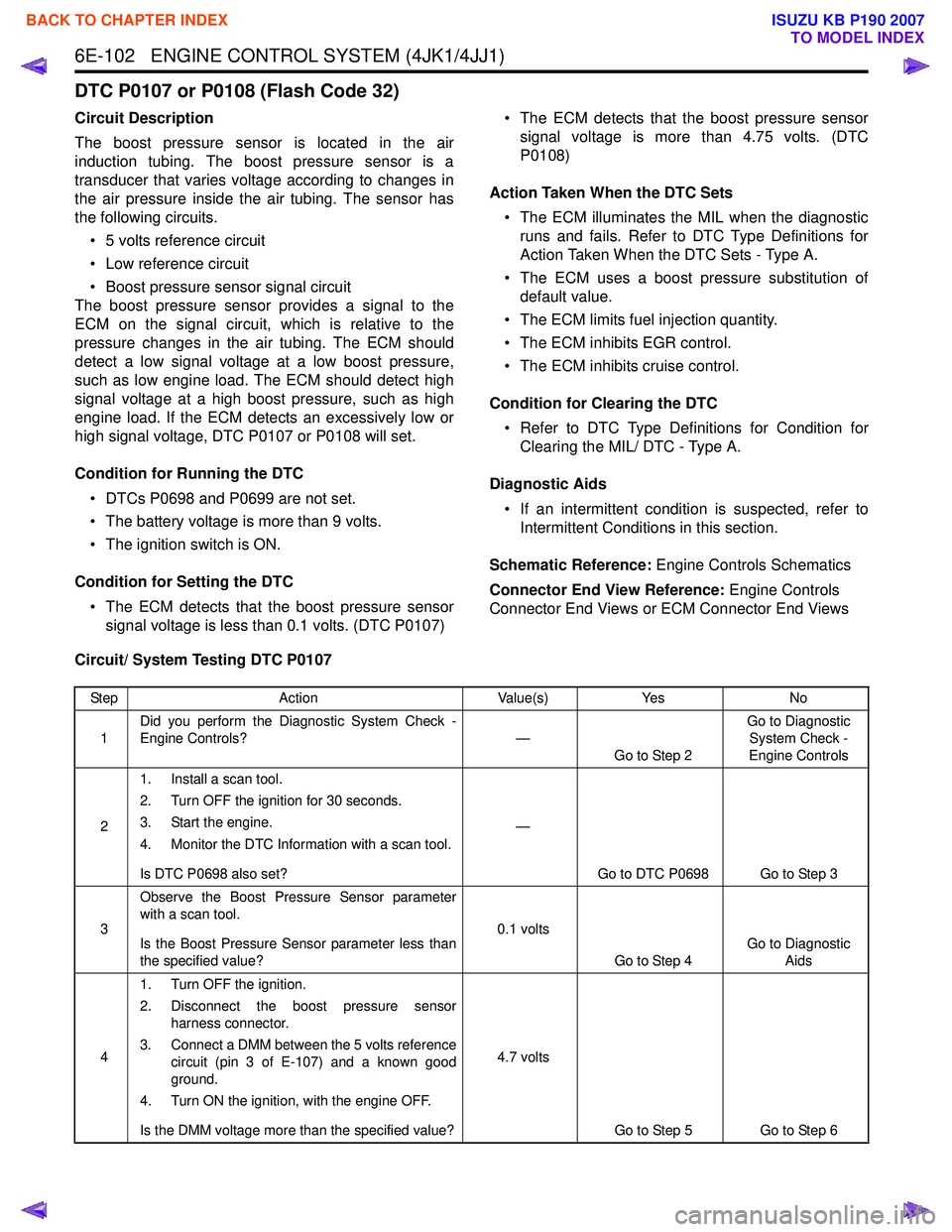
6E-102 ENGINE CONTROL SYSTEM (4JK1/4JJ1)
DTC P0107 or P0108 (Flash Code 32)
Circuit Description
The boost pressure sensor is located in the air
induction tubing. The boost pressure sensor is a
transducer that varies voltage according to changes in
the air pressure inside the air tubing. The sensor has
the following circuits.
• 5 volts reference circuit
• Low reference circuit
• Boost pressure sensor signal circuit
The boost pressure sensor provides a signal to the
ECM on the signal circuit, which is relative to the
pressure changes in the air tubing. The ECM should
detect a low signal voltage at a low boost pressure,
such as low engine load. The ECM should detect high
signal voltage at a high boost pressure, such as high
engine load. If the ECM detects an excessively low or
high signal voltage, DTC P0107 or P0108 will set.
Condition for Running the DTC • DTCs P0698 and P0699 are not set.
• The battery voltage is more than 9 volts.
• The ignition switch is ON.
Condition for Setting the DTC • The ECM detects that the boost pressure sensor signal voltage is less than 0.1 volts. (DTC P0107) • The ECM detects that the boost pressure sensor
signal voltage is more than 4.75 volts. (DTC
P0108)
Action Taken When the DTC Sets • The ECM illuminates the MIL when the diagnostic runs and fails. Refer to DTC Type Definitions for
Action Taken When the DTC Sets - Type A.
• The ECM uses a boost pressure substitution of default value.
• The ECM limits fuel injection quantity.
• The ECM inhibits EGR control.
• The ECM inhibits cruise control.
Condition for Clearing the DTC • Refer to DTC Type Definitions for Condition for Clearing the MIL/ DTC - Type A.
Diagnostic Aids • If an intermittent condition is suspected, refer to Intermittent Conditions in this section.
Schematic Reference: Engine Controls Schematics
Connector End View Reference: Engine Controls
Connector End Views or ECM Connector End Views
Circuit/ System Testing DTC P0107
Step Action Value(s)Yes No
1 Did you perform the Diagnostic System Check -
Engine Controls? —
Go to Step 2 Go to Diagnostic
System Check -
Engine Controls
2 1. Install a scan tool.
2. Turn OFF the ignition for 30 seconds.
3. Start the engine.
4. Monitor the DTC Information with a scan tool.
Is DTC P0698 also set? —
Go to DTC P0698 Go to Step 3
3 Observe the Boost Pressure Sensor parameter
with a scan tool.
Is the Boost Pressure Sensor parameter less than
the specified value? 0.1 volts
Go to Step 4 Go to Diagnostic
Aids
4 1. Turn OFF the ignition.
2. Disconnect the boost pressure sensor harness connector.
3. Connect a DMM between the 5 volts reference circuit (pin 3 of E-107) and a known good
ground.
4. Turn ON the ignition, with the engine OFF.
Is the DMM voltage more than the specified value? 4.7 volts
Go to Step 5 Go to Step 6
BACK TO CHAPTER INDEX
TO MODEL INDEX
ISUZU KB P190 2007
Page 1721 of 6020

6E-104 ENGINE CONTROL SYSTEM (4JK1/4JJ1)
Circuit/ System Testing DTC P0108
13Observe the DTC Information with a scan tool.
Are there any DTCs that you have not diagnosed? —
Go to DTC List System OK
Step
Action Value(s)Yes No
Step Action Value(s)Yes No
1 Did you perform the Diagnostic System Check -
Engine Controls? —
Go to Step 2 Go to Diagnostic
System Check -
Engine Controls
2 1. Install a scan tool.
2. Turn OFF the ignition for 30 seconds.
3. Start the engine.
4. Observe the Boost Pressure Sensor parameter with a scan tool.
Is the Boost Pressure Sensor parameter more than
the specified value? 4.7 volts
Go to Step 3 Go to Diagnostic
Aids
3 Monitor the DTC Information with a scan tool.
Is DTC P0699 also set? —
Go to Step 4 Go to Step 5
4 1. Turn OFF the ignition.
2. Disconnect the boost pressure sensor harness connector.
3. Turn ON the ignition, with the engine OFF.
Is the Boost Pressure Sensor parameter less than
the specified value? 0.1 volts
Go to DTC P0699 Go to Step 7
5 1. Turn OFF the ignition.
2. Disconnect the boost pressure sensor harness connector.
3. Turn ON the ignition, with the engine OFF.
Is the Boost Pressure Sensor parameter less than
the specified value? 0.1 volts
Go to Step 6 Go to Step 7
6 Connect a test lamp between the low reference
circuit (pin 2 of E-107) and battery voltage.
Does the test lamp illuminate? —
Go to Step 9 Go to Step 8
7 Important:
The boost pressure sensor may be
damaged if the sensor signal circuit is shorted to a
voltage source.
1. Test the signal circuit between the ECM (pin 21 of E-90) and the boost pressure sensor
(pin 1 of E-107) for the following conditions:
• A short to battery or ignition voltage
• A short to any 5 volts reference
2. Repair the circuit(s) as necessary.
Did you find and correct the condition? —
Go to Step 13 Go to Step 12
8 1. Test the low reference circuit between the
ECM (pin 23 of E-90) and the boost pressure
sensor (pin 2 of E-107) for an open circuit or
high resistance.
2. Repair the circuit(s) as necessary.
Did you find and correct the condition? —
Go to Step 13 Go to Step 10
BACK TO CHAPTER INDEX
TO MODEL INDEX
ISUZU KB P190 2007
Page 1723 of 6020

6E-106 ENGINE CONTROL SYSTEM (4JK1/4JJ1)
DTC P0112 or P0113 (Flash Code 22)
Circuit Description
The intake air temperature (IAT) sensor is fitted
between the air cleaner and turbocharger. It is internal
to the mass air flow (MAF) sensor. The IAT sensor is a
variable resistor and it measures the temperature of the
air entering the engine. The sensor has a signal circuit
and a low reference circuit. The ECM supplies 5 volts to
the signal circuit and a ground for the low reference
circuit. When the IAT sensor is cold, the sensor
resistance is high. When the air temperature increases,
the sensor resistance decreases. With high sensor
resistance, the ECM detects a high voltage on the
signal circuit. With lower sensor resistance, the ECM
detects a lower voltage on the signal circuit. If the ECM
detects an excessively low or high signal voltage, DTC
P0112 or P0113 will set.
Condition for Running the DTC • The battery voltage is more than 9 volts.
• The ignition switch is ON.
• The engine run time is longer than 3 minutes. (DTC P0113)
Condition for Setting the DTC • The ECM detects that the IAT sensor signal voltage is less than 0.1 volts for 3 seconds. (DTC
P0112) • The ECM detects that the IAT sensor signal
voltage is more than 4.75 volts for 3 seconds.
(DTC P0113)
Action Taken When the DTC Sets • The ECM illuminates the MIL when the diagnostic runs and fails. Refer to DTC Type Definitions for
Action Taken When the DTC Sets - Type A.
• The ECM uses an IAT substitution of default value.
• The ECM limits fuel injection quantity.
• The ECM inhibits EGR control.
• The ECM inhibits cruise control.
Condition for Clearing the DTC • Refer to DTC Type Definitions for Condition for Clearing the MIL/ DTC - Type A.
Diagnostic Aids • If an intermittent condition is suspected, refer to Intermittent Conditions in this section.
• Use the Temperature vs. Resistance table to test the IAT sensor at various temperature levels to
evaluate the possibility of a skewed sensor. A
skewed sensor could result in poor driveability
concerns.
Schematic Reference: Engine Controls Schematics
Connector End View Reference: Engine Controls
Connector End Views or ECM Connector End Views
Circuit/ System Testing DTC P0112
Step Action Value(s)Yes No
1 Did you perform the Diagnostic System Check -
Engine Controls? —
Go to Step 2 Go to Diagnostic
System Check -
Engine Controls
2 1. Install a scan tool.
2. Turn OFF the ignition for 30 seconds.
3. Turn ON the ignition, with the engine OFF.
4. Observe the Intake Air Temperature (IAT) Sensor parameter with a scan tool.
Is the IAT Sensor parameter less than the specified
value? 0.1 volts
Go to Step 3 Go to Diagnostic
Aids
3 1. Turn OFF the ignition.
2. Disconnect the mass air flow/ intake air temperature (MAF/ IAT) sensor harness
connector.
3. Turn ON the ignition, with the engine OFF.
Is the IAT Sensor parameter more than the
specified value? 4.7 volts
Go to Step 5 Go to Step 4
BACK TO CHAPTER INDEX
TO MODEL INDEX
ISUZU KB P190 2007
Page 1724 of 6020

ENGINE CONTROL SYSTEM (4JK1/4JJ1) 6E-107
Circuit/ System Testing DTC P0113
41. Test the signal circuit between the ECM (pin
41 of E-90) and the IAT sensor (pin 4 of E-47)
for the following conditions:
• A short to ground
• A short to the low reference circuit
2. Repair the circuit(s) as necessary.
Did you find and correct the condition? —
Go to Step 8 Go to Step 6
5 Replace the MAF sensor. Refer to MAF Sensor
Replacement. (IAT sensor is internal to MAF
sensor)
Did you complete the replacement? —
Go to Step 8
—
61. Turn OFF the ignition.
2. Disconnect the ECM harness connector.
3. Inspect connections at the harness connector of the ECM (pins 41 and 61 of E-90) for
corrosion.
4. Repair or clean the connection(s) as necessary.
Did you find and correct the condition? —
Go to Step 8 Go to Step 7
7 Important:
Replacement ECM must be
programmed and learned.
Replace the ECM. Refer to ECM Replacement.
Did you complete the replacement? —
Go to Step 8
—
81. Reconnect all previously disconnected
harness connector(s).
2. Clear the DTCs with a scan tool.
3. Turn OFF the ignition for 30 seconds.
4. Start the engine.
5. Operate the vehicle within the Conditions for Running the DTC. You may also operate the
vehicle within the conditions that you
observed from the Freeze Frame/ Failure
Records.
Did the DTC fail this ignition? —
Go to Step 2 Go to Step 9
9 Observe the DTC Information with a scan tool.
Are there any DTCs that you have not diagnosed? —
Go to DTC List System OK
Step
Action Value(s)Yes No
Step Action Value(s)Yes No
1 Did you perform the Diagnostic System Check -
Engine Controls? —
Go to Step 2 Go to Diagnostic
System Check -
Engine Controls
2 1. Install a scan tool.
2. Turn OFF the ignition for 30 seconds.
3. Turn ON the ignition, with the engine OFF.
4. Observe the Intake Air Temperature (IAT) Sensor parameter with a scan tool.
Is the IAT Sensor parameter more than the
specified value? 4.7 volts
Go to Step 3 Go to Diagnostic
Aids
BACK TO CHAPTER INDEX
TO MODEL INDEX
ISUZU KB P190 2007