flash code ISUZU KB P190 2007 Workshop Repair Manual
[x] Cancel search | Manufacturer: ISUZU, Model Year: 2007, Model line: KB P190, Model: ISUZU KB P190 2007Pages: 6020, PDF Size: 70.23 MB
Page 1839 of 6020

6E-222 ENGINE CONTROL SYSTEM (4JK1/4JJ1)
DTC P1064 or P1065 (Flash Code 247)
Circuit Description
The fuel rail pressure (FRP) regulator is installed to the
fuel supply pump and controls the suction fuel quantity
into the fuel rail. The FRP regulator is fully opened in
the normal state and larger drive current results in
smaller opening. The ECM calculates desired fuel rail
pressure and fuel flow rate and it compares the
calculated desired fuel rail pressure to the actual value
to determine the FRP regulator position. When the
actual fuel rail pressure is higher than the desired
value, the FRP regulator is closed to decease the flow
rate.
If the ECM detects an over current condition on the
FRP regulator feedback circuit, DTC P1064 will set.
If the ECM detects an improper voltage level on the
FRP regulator control high side circuit, DTC P1065 will
set.
Condition for Running the DTC • DTC P1064 is not set. (DTC P1065)
• The battery voltage is more than 9 volts.
• The ignition switch is ON.
Condition for Setting the DTC • The ECM detects an over current condition on the FRP regulator feedback circuit. (DTC P1064) • The ECM detects a low or high voltage condition
on the FRP regulator high side circuit. (DTC
P1065)
Action Taken When the DTC Sets • The ECM illuminates the MIL when the diagnostic runs and fails. Refer to DTC Type Definitions for
Action Taken When the DTC Sets - Type A.
• The ECM limits fuel injection quantity.
• The ECM inhibits pilot injection.
• The ECM inhibits cruise control.
Condition for Clearing the DTC • Refer to DTC Type Definitions for Condition for Clearing the MIL/ DTC - Type A.
Diagnostic Aids • If an intermittent condition is suspected, refer to Intermittent Conditions in this section.
Schematic Reference: Engine Controls Schematics
Connector End View Reference: Engine Controls
Connector End Views or ECM Connector End Views
Circuit/ System Testing DTC P1064
Step Action Value(s)Yes No
1 Did you perform the Diagnostic System Check -
Engine Controls? —
Go to Step 2 Go to Diagnostic
System Check -
Engine Controls
2 1. Install a scan tool.
2. Turn OFF the ignition for 30 seconds.
3. Turn ON the ignition, with the engine OFF.
4. Monitor the DTC Information with a scan tool.
Does the DTC fail this ignition? —
Go to Step 3 Go to Diagnostic
Aids
3 Important:
The ECM may be damaged if the FRP
regulator low side circuit is shorted to a voltage
source.
1. Test the low side circuits between the ECM (pins 50 and 70 of E-90) and the FRP
regulator (pin 2 of E-50) for a short to battery
or ignition voltage.
2. Repair the circuit(s) as necessary.
Did you find and correct the condition? —
Go to Step 5 Go to Step 4
4 Important:
Replacement ECM must be
programmed and learned.
Replace the ECM. Refer to ECM Replacement.
Did you complete the replacement? —
Go to Step 5
—
BACK TO CHAPTER INDEX
TO MODEL INDEX
ISUZU KB P190 2007
Page 1843 of 6020
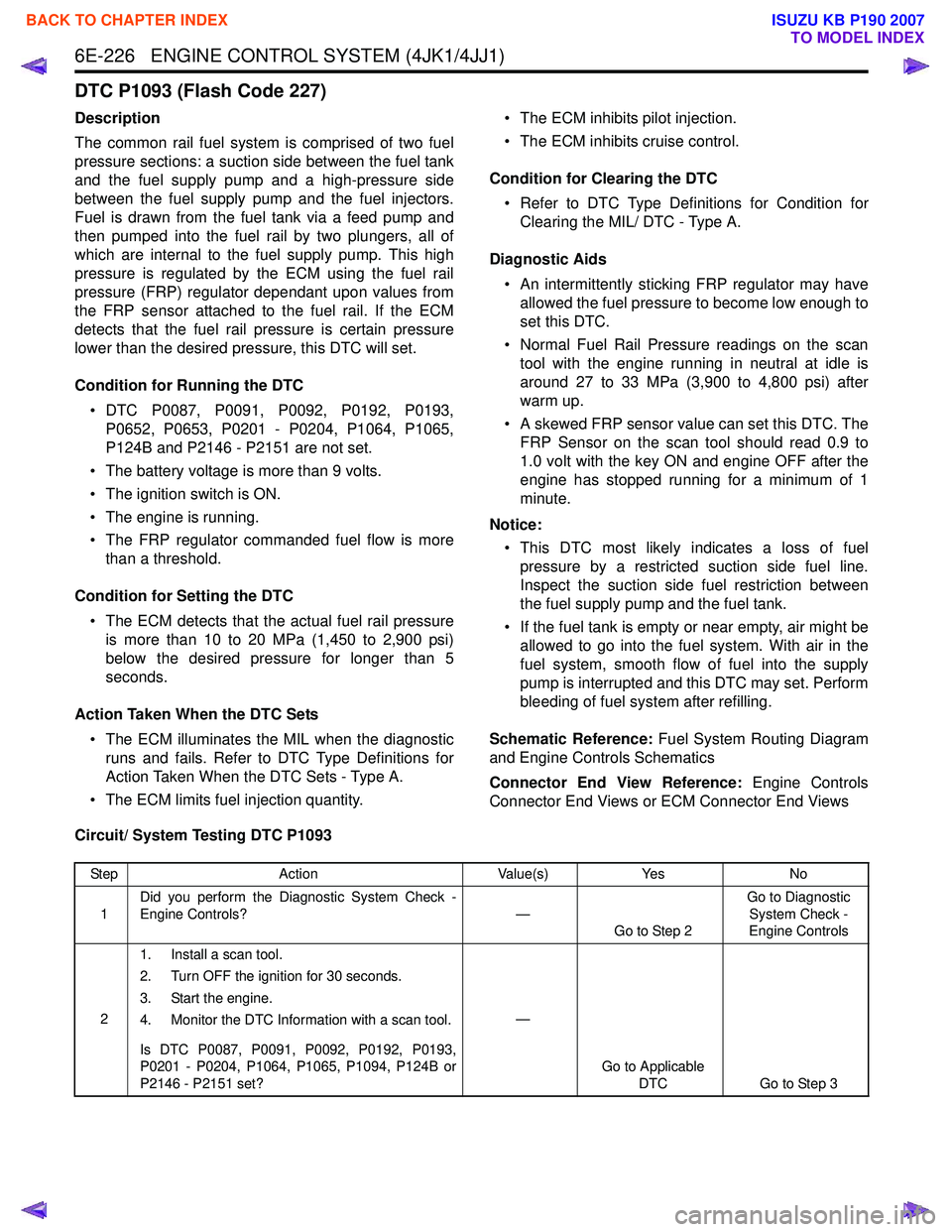
6E-226 ENGINE CONTROL SYSTEM (4JK1/4JJ1)
DTC P1093 (Flash Code 227)
Description
The common rail fuel system is comprised of two fuel
pressure sections: a suction side between the fuel tank
and the fuel supply pump and a high-pressure side
between the fuel supply pump and the fuel injectors.
Fuel is drawn from the fuel tank via a feed pump and
then pumped into the fuel rail by two plungers, all of
which are internal to the fuel supply pump. This high
pressure is regulated by the ECM using the fuel rail
pressure (FRP) regulator dependant upon values from
the FRP sensor attached to the fuel rail. If the ECM
detects that the fuel rail pressure is certain pressure
lower than the desired pressure, this DTC will set.
Condition for Running the DTC • DTC P0087, P0091, P0092, P0192, P0193, P0652, P0653, P0201 - P0204, P1064, P1065,
P124B and P2146 - P2151 are not set.
• The battery voltage is more than 9 volts.
• The ignition switch is ON.
• The engine is running.
• The FRP regulator commanded fuel flow is more than a threshold.
Condition for Setting the DTC • The ECM detects that the actual fuel rail pressure is more than 10 to 20 MPa (1,450 to 2,900 psi)
below the desired pressure for longer than 5
seconds.
Action Taken When the DTC Sets • The ECM illuminates the MIL when the diagnostic runs and fails. Refer to DTC Type Definitions for
Action Taken When the DTC Sets - Type A.
• The ECM limits fuel injection quantity. • The ECM inhibits pilot injection.
• The ECM inhibits cruise control.
Condition for Clearing the DTC • Refer to DTC Type Definitions for Condition for Clearing the MIL/ DTC - Type A.
Diagnostic Aids • An intermittently sticking FRP regulator may have allowed the fuel pressure to become low enough to
set this DTC.
• Normal Fuel Rail Pressure readings on the scan tool with the engine running in neutral at idle is
around 27 to 33 MPa (3,900 to 4,800 psi) after
warm up.
• A skewed FRP sensor value can set this DTC. The FRP Sensor on the scan tool should read 0.9 to
1.0 volt with the key ON and engine OFF after the
engine has stopped running for a minimum of 1
minute.
Notice: • This DTC most likely indicates a loss of fuel pressure by a restricted suction side fuel line.
Inspect the suction side fuel restriction between
the fuel supply pump and the fuel tank.
• If the fuel tank is empty or near empty, air might be allowed to go into the fuel system. With air in the
fuel system, smooth flow of fuel into the supply
pump is interrupted and this DTC may set. Perform
bleeding of fuel system after refilling.
Schematic Reference: Fuel System Routing Diagram
and Engine Controls Schematics
Connector End View Reference: Engine Controls
Connector End Views or ECM Connector End Views
Circuit/ System Testing DTC P1093
Step Action Value(s)Yes No
1 Did you perform the Diagnostic System Check -
Engine Controls? —
Go to Step 2 Go to Diagnostic
System Check -
Engine Controls
2 1. Install a scan tool.
2. Turn OFF the ignition for 30 seconds.
3. Start the engine.
4. Monitor the DTC Information with a scan tool.
Is DTC P0087, P0091, P0092, P0192, P0193,
P0201 - P0204, P1064, P1065, P1094, P124B or
P2146 - P2151 set? —
Go to Applicable DTC Go to Step 3
BACK TO CHAPTER INDEX
TO MODEL INDEX
ISUZU KB P190 2007
Page 1848 of 6020

ENGINE CONTROL SYSTEM (4JK1/4JJ1) 6E-231
DTC P1094 (Flash Code 226)
Description
The common rail fuel system is comprised of two fuel
pressure sections: a suction side between the fuel tank
and the fuel supply pump and a high-pressure side
between the fuel supply pump and the fuel injectors.
Fuel is drawn from the fuel tank via a feed pump and
then pumped into the fuel rail by two plungers, all of
which are internal to the fuel supply pump. This high
pressure is regulated by the ECM using the fuel rail
pressure (FRP) regulator dependant upon values from
the FRP sensor attached to the fuel rail.
If the ECM detects that the difference between the
actual and the desired fuel pressure is small at low
engine speed but the FRP regulator commanded fuel
flow is certain amount high, this DTC will set. (FRP
Regulator Commanded High DTC)
If the ECM detects that the fuel rail pressure is sharply
decreased when fuel cut, this DTC will also set. (Fuel
Pressure Drop DTC)
Condition for Running the DTC
FRP Regulator Commanded High DTC • DTCs P0087, P0091, P0092, P0117, P0118, P0182, P0183, P0192, P0193, P0500, P0501,
P0652, P0653, P0201 - P0204, P1064, P1065,
P124B and P2146 - P2151 are not set.
• The battery voltage is more than 9 volts.
• The ignition switch is ON.
• The accelerator pedal is not depressed.
• The engine coolant temperature is more than 50 °C
(122 °F).
• The vehicle speed is less than 3km/h (2MPH).
Fuel Pressure Drop DTC
• DTCs P0087, P0091, P0092, P0182, P0183, P0192, P0193, P0652, P0653, P0201 - P0204,
P1064, P1065, P124B and P2146 - P2151 are not
set.
• The battery voltage is more than 9 volts.
• The ignition switch is ON.
• The accelerator pedal is not depressed.
• The engine speed is more than 1500RPM.
• The vehicle speed is more than 3km/h (2MPH).
Condition for Setting the DTC
FRP Regulator Commanded High DTC • The ECM detects that the FRP regulator commanded fuel flow is more than a
predetermined range for longer than 10 seconds
when the engine speed is near idle speed.
Fuel Pressure Drop DTC
• The ECM detects that the fuel rail pressure is dropped more than a threshold when the
commanded fuel is cut. Action Taken When the DTC Sets
FRP Regulator Commanded High DTC • The ECM illuminates the MIL when the diagnostic runs and fails. Refer to DTC Type Definitions for
Action Taken When the DTC Sets - Type A.
• The ECM limits fuel injection quantity.
• The ECM inhibits pilot injection.
• The ECM inhibits cruise control.
Fuel Pressure Drop DTC
• The ECM illuminates the SVS lamp when the diagnostic runs and fails. Refer to DTC Type
Definitions for Action Taken When the DTC Sets -
Type C. (Euro 4 Specification)
• The ECM illuminates the MIL when the diagnostic runs and fails. Refer to DTC Type Definitions for
Action Taken When the DTC Sets - Type A.
(Except Euro 4 Specification)
• The ECM limits fuel injection quantity.
• The ECM inhibits pilot injection.
• The ECM inhibits cruise control.
• The ECM stops engine running when the vehicle speed is lower than 5 km/h (3 MPH) for 5 seconds.
The engine will run after the key is cycled when the
ignition has been tuned OFF for longer than 10
seconds.
Condition for Clearing the DTC
FRP Regulator Commanded High DTC • Refer to DTC Type Definitions for Condition for Clearing the MIL/ DTC - Type A.
Fuel Pressure Drop DTC
• Refer to DTC Type Definitions for Condition for Clearing the SVS Lamp/ DTC - Type C. (Euro 4
Specification)
• Refer to DTC Type Definitions for Condition for Clearing the MIL/ DTC - Type A. (Except Euro 4
Specification)
Diagnostic Aids • An intermittently sticking FRP regulator may have allowed the fuel pressure to become low enough to
set this DTC.
• Normal Fuel Rail Pressure readings on the scan tool with the engine running in neutral at idle is
around 27 to 33 MPa (3,900 to 4,800 psi) after
warm up.
• A skewed FRP sensor value can set this DTC. The FRP Sensor on the scan tool should read 0.9 to
1.0 volt with the key ON and engine OFF after the
engine has stopped running for a minimum of 1
minute.
BACK TO CHAPTER INDEX
TO MODEL INDEX
ISUZU KB P190 2007
Page 1854 of 6020

ENGINE CONTROL SYSTEM (4JK1/4JJ1) 6E-237
DTC P1196, P1197 or P1198 (Flash Code 461)
Circuit Description
The ECM controls the intake throttle valve opening
based on the engine running condition and by
controlling the intake throttle solenoid. The intake
throttle valve position is detected by the position
sensor, and relayed to the ECM. If the ECM detects an
excessively high temperature condition in its internal
intake throttle solenoid drive circuit for certain length of
time, DTC P1196, P1197 or P1198 will set.
Condition for Running the DTC • The battery voltage is more than 9 volts.
• The ignition switch is ON.
Condition for Setting the DTC • The ECM detects an excessively high temperature in its internal intake throttle solenoid drive circuit
for longer than 30 seconds. (DTC P1196)
• The ECM detects an excessively high temperature in its internal intake throttle solenoid drive circuit
for longer than 60 seconds in accumulation time
during same ignition cycle. (DTC P1197) • The ECM detects an excessively high temperature
in its internal intake throttle solenoid drive circuit
for longer than 120 seconds in accumulation time
exceeding ignition cycle. (DTC P1198)
Action Taken When the DTC Sets • The ECM illuminates the MIL when the diagnostic runs and fails. Refer to DTC Type Definitions for
Action Taken When the DTC Sets - Type A.
• The ECM limits fuel injection quantity.
• The ECM inhibits pilot injection.
• The ECM inhibits cruise control.
Condition for Clearing the DTC • Refer to DTC Type Definitions for Condition for Clearing the MIL/ DTC - Type A.
Diagnostic Aids • If an intermittent condition is suspected, refer to Intermittent Conditions in this section.
• A sticking or intermittently sticking intake throttle valve may set this DTC.
Circuit/ System Testing DTC P1196, P1197 or P1198
Step Action Value(s)Yes No
1 Did you perform the Diagnostic System Check -
Engine Controls? —
Go to Step 2 Go to Diagnostic
System Check -
Engine Controls
2 1. Install a scan tool.
2. Turn OFF the ignition for 30 seconds.
3. Start the engine.
4. Monitor the DTC Information with a scan tool.
Is DTC P0638 also set? —
Go to DTC P0638 Go to Step 3
3 1. Perform the Intake Throttle Solenoid Control
with a scan tool several times.
2. Command the Desired Intake Throttle Position Increase and Decrease while observing the
Intake Throttle Position.
Does the Intake Throttle Position parameter follow
within the specified value quick enough (compare
with a similar unit if available)? ±
5%
Go to Diagnostic Aids Go to Step 4
BACK TO CHAPTER INDEX
TO MODEL INDEX
ISUZU KB P190 2007
Page 1856 of 6020

ENGINE CONTROL SYSTEM (4JK1/4JJ1) 6E-239
DTC P124B (Flash Code 157)
Circuit Description
The ECM calculates the optimum fuel injection ON time
using data sent from various engine sensors. The
common 1 and common 2 fuel injector charge voltage
circuit is a high-voltage supply which drives fuel
injectors for each cylinder in conjunction with the ECM
grounding the fuel injector solenoid control circuit. If the
fuel injector charge voltage circuit or solenoid control
circuit is shorted across the bank, this DTC will set.
Condition for Running the DTC • The battery voltage is more than 9 volts.
• The ignition switch is ON.
• The engine speed is lower than 2000RPM.
Condition for Setting the DTC • The ECM detects that the fuel injector charge voltage circuit or solenoid control circuit is shorted
across the bank.
Action Taken When the DTC Sets • The ECM illuminates the SVS lamp when the diagnostic runs and fails. Refer to DTC Type
Definitions for Action Taken When the DTC Sets -
Type C. (Euro 4 Specification) • The ECM illuminates the MIL when the diagnostic
runs and fails. Refer to DTC Type Definitions for
Action Taken When the DTC Sets - Type A.
(Except Euro 4 Specification)
Condition for Clearing the DTC • Refer to DTC Type Definitions for Condition for Clearing the SVS Lamp/ DTC - Type C. (Euro 4
Specification)
• Refer to DTC Type Definitions for Condition for Clearing the MIL/ DTC - Type A. (Except Euro 4
Specification)
Diagnostic Aids • If an intermittent condition is suspected, refer to Intermittent Conditions in this section.
Schematic Reference : Engine Controls Schematics
Connector End View Reference: Engine Controls
Connector End Views or ECM Connector End Views
Circuit/ System Testing DTC P124B
Step Action Value(s)Yes No
1 Did you perform the Diagnostic System Check -
Engine Controls? —
Go to Step 2 Go to Diagnostic
System Check -
Engine Controls
2 1. Install a scan tool.
2. Turn OFF the ignition for 30 seconds.
3. Start the engine.
4. Monitor the DTC Information with a scan tool.
Does the DTC fail this ignition? —
Go to Step 3 Go to Diagnostic
Aids
BACK TO CHAPTER INDEX
TO MODEL INDEX
ISUZU KB P190 2007
Page 1859 of 6020

6E-242 ENGINE CONTROL SYSTEM (4JK1/4JJ1)
DTC P1261 (Flash Code 34)
Circuit Description
The charge up circuit in the ECM steps up the voltage
for fuel injectors and is divided into two banks, common
1 and common 2. The common 1 covers fuel injectors
in cylinders #1 and #4, and the common 2 covers fuel
injectors in cylinders #2 and #3.
If the common 1 fuel injector charge up circuit in the
ECM is an insufficient charge or an overcharge, this
DTC will set. (Charge Up Voltage DTC)
If the supply voltage to the common 1 and common 2
fuel injector charge up circuits is an excessively low or
high voltage, this DTC will also set. (Supply Voltage
Low or High DTC)
Condition for Running the DTC
Charge Up Voltage DTC • The battery voltage is more than 9 volts.
• The ignition switch is ON.
• The engine is not running.
Supply Voltage Low or High DTC
• The battery voltage is more than 9 volts.
• The ignition switch is ON.
Condition for Setting the DTC
Charge Up Voltage DTC • The ECM detects that the common 1 fuel injector charge up circuit is an insufficient charge or an
overcharge.
Supply Voltage Low or High DTC
• The ECM detects that the supply voltage to the common 1 and common 2 fuel injector charge up
circuits is an excessively low or high voltage.
Action Taken When the DTC Sets
Charge Up Voltage DTC & Supply Voltage Low DTC • The ECM illuminates the MIL when the diagnostic
runs and fails. Refer to DTC Type Definitions for
Action Taken When the DTC Sets - Type A.
• The ECM limits fuel injection quantity.
• The ECM inhibits cruise control.
Supply Voltage High DTC
• The ECM illuminates the SVS lamp when the diagnostic runs and fails. Refer to DTC Type
Definitions for Action Taken When the DTC Sets -
Type C. (Euro 4 Specification)
• The ECM illuminates the MIL when the diagnostic runs and fails. Refer to DTC Type Definitions for
Action Taken When the DTC Sets - Type A.
(Except Euro 4 Specification)
• The ECM limits fuel injection quantity.
• The ECM inhibits cruise control.
Condition for Clearing the DTC
Charge Up Voltage DTC & Supply Voltage Low DTC • Refer to DTC Type Definitions for Condition for Clearing the MIL/ DTC - Type A
Supply Voltage High DTC
• Refer to DTC Type Definitions for Condition for Clearing the SVS Lamp/ DTC - Type C. (Euro 4
Specification)
• Refer to DTC Type Definitions for Condition for Clearing the MIL/ DTC - Type A. (Except Euro 4
Specification)
Diagnostic Aids • If an intermittent condition is suspected, refer to Intermittent Conditions in this section.
Schematic Reference: Engine Controls Schematics
Connector End View Reference: Engine Controls
Connector End Views or ECM Connector End Views
Circuit/ System Testing DTC P1261
Step Action Value(s)Yes No
1 Did you perform the Diagnostic System Check -
Engine Controls? —
Go to Step 2 Go to Diagnostic
System Check -
Engine Controls
2 1. Install a scan tool.
2. Turn OFF the ignition for 30 seconds.
3. Start the engine.
4. Monitor the DTC Information with a scan tool.
Does the DTC fail this ignition? —
Go to Step 3 Go to Step 8
BACK TO CHAPTER INDEX
TO MODEL INDEX
ISUZU KB P190 2007
Page 1861 of 6020

6E-244 ENGINE CONTROL SYSTEM (4JK1/4JJ1)
DTC P1262 (Flash Code 34)
Circuit Description
The charge up circuit in the ECM steps up the voltage
for fuel injectors and is divided into two banks, common
1 and common 2. The common 1 covers fuel injectors
in cylinders #1 and #4, and the common 2 covers fuel
injectors in cylinders #2 and #3. If the common 2 fuel
injector charge up circuit in the ECM is an insufficient
charge or an overcharge, this DTC will set.
Condition for Running the DTC • The battery voltage is more than 9 volts.
• The ignition switch is ON.
• The engine is not running.
Condition for Setting the DTC • The ECM detects that the common 2 fuel injector charge up circuit is an insufficient charge or an
overcharge. Action Taken When the DTC Sets
• The ECM illuminates the MIL when the diagnostic runs and fails. Refer to DTC Type Definitions for
Action Taken When the DTC Sets - Type A.
• The ECM limits fuel injection quantity.
• The ECM inhibits cruise control.
Condition for Clearing the DTC • Refer to DTC Type Definitions for Condition for Clearing the MIL/ DTC - Type A.
Diagnostic Aids • If an intermittent condition is suspected, refer to Intermittent Conditions in this section.
Schematic Reference: Engine Controls Schematics
Connector End View Reference: Engine Controls
Connector End Views or ECM Connector End Views
Circuit/ System Testing DTC P1262
Step Action Value(s)Yes No
1 Did you perform the Diagnostic System Check -
Engine Controls? —
Go to Step 2 Go to Diagnostic
System Check -
Engine Controls
2 1. Install a scan tool.
2. Turn OFF the ignition for 30 seconds.
3. Start the engine.
4. Monitor the DTC Information with a scan tool.
Does the DTC fail this ignition? —
Go to Step 3 Go to Step 8
3 1. Inspect for an intermittent, for poor tightening
and corrosion at the engine ground terminal
(E-10).
2. Repair the tightening or clean the corrosion as necessary.
Did you find and correct the condition? —
Go to Step 8 Go to Step 4
4 1. Test ground circuit between the ECM (pin 73
of E-90) and the engine ground terminal (E-
10) for an intermittently open circuit or high
resistance.
2. Repair the circuit(s) as necessary.
Did you find and correct the condition? —
Go to Step 8 Go to Step 5
5 1. Test the battery voltage feed circuit between
the ECM (pin 73 of E-90) and the ECM main
relay (pin 1 of X-12) for an intermittently open
circuit or high resistance.
2. Repair the circuit(s) as necessary.
Did you find and correct the condition? —
Go to Step 8 Go to Step 6
BACK TO CHAPTER INDEX
TO MODEL INDEX
ISUZU KB P190 2007
Page 1863 of 6020

6E-246 ENGINE CONTROL SYSTEM (4JK1/4JJ1)
DTC P1404 (Flash Code 45)
Circuit Description
The ECM controls the EGR valve opening based on the
engine running condition and by controlling the EGR
solenoid. The EGR valve position is detected by the
position sensor, and relayed to the ECM.
If the ECM detects that the actual EGR position is
higher than certain amount, this DTC will set. (Closed
Position Error DTC)
If the ECM detects a variance between the learned
closed position and actual closed position, this DTC will
also set. (Learned Position Error DTC)
Condition for Running the DTC
Closed Position Error DTC • DTCs P0112, P0113, P0116, P0117, P0118, P0404 P0405, P0406, P0652, P0653, P2227,
P2228 and P2229 are not set.
• The battery voltage is between 10 to 16 volts.
• The ignition switch is ON.
• The engine coolant temperature is between 20 to 11 0 °C (68 to 230 °F).
• The intake air temperature is between 0 to 110 °C
(32 to 230 °F).
• The barometric pressure is between 60 to 120 kPa (8.7 to 17.4 psi)
Learned Position Error DTC
• DTCs P0404, P0405 and P0406 are not set.
Condition for Setting the DTC
Closed Position Error DTC • The ECM detects that the actual EGR position is
more than 20% for 5 seconds when the EGR
control is commanded OFF.
Learned Position Error DTC
• The ECM detects that the EGR learned minimum position is more than 10% or less than -10% when
the ignition switch is OFF.
Action Taken When the DTC Sets • The ECM illuminates the MIL when the diagnostic runs and fails. Refer to DTC Type Definitions for
Action Taken When the DTC Sets - Type A.
• The ECM limits fuel injection quantity.
• The ECM inhibits pilot injection.
• The ECM inhibits EGR control. (Closed Position Error DTC)
• The ECM inhibits cruise control.
Condition for Clearing the DTC • Refer to DTC Type Definitions for Condition for Clearing the MIL/ DTC - Type A.
Diagnostic Aids • If an intermittent condition is suspected, refer to Intermittent Conditions in this section.
• A sticking or intermittently sticking EGR valve may set this DTC.
Schematic Reference: Engine Controls Schematics
Connector End View Reference: Engine Controls
Connector End Views or ECM Connector End Views
Circuit/ System Testing DTC P1404
Step Action Value(s)Yes No
1 Did you perform the Diagnostic System Check -
Engine Controls? —
Go to Step 2 Go to Diagnostic
System Check -
Engine Controls
2 1. Install a scan tool.
2. Turn OFF the ignition for 30 seconds.
3. Start the engine.
4. Monitor the DTC Information with a scan tool.
Is DTC P0403, P0405 or P0406 also set? —
Go to Applicable DTC Go to Step 3
3 1. Remove the EGR valve assembly from the
engine.
2. Inspect the EGR valve for the following conditions:
• Restricted EGR valve by foreign materials
• Excessive deposits at valve
• Bent valve shaft
3. Repair or replace as necessary.
Did you find and correct the condition? —
Go to Step 6 Go to Step 4
BACK TO CHAPTER INDEX
TO MODEL INDEX
ISUZU KB P190 2007
Page 1865 of 6020

6E-248 ENGINE CONTROL SYSTEM (4JK1/4JJ1)
DTC P1411, P1412 or P1413 (Flash Code 445)
Circuit Description
The ECM controls the EGR valve opening based on the
engine running condition and by controlling the EGR
solenoid. The EGR valve position is detected by the
position sensor, and relayed to the ECM. If the ECM
detects an excessively high temperature condition in its
internal EGR solenoid drive circuit for certain length of
time, DTC P1411, P1412 or P1413 will set.
Condition for Running the DTC • The battery voltage is more than 9 volts.
• The ignition switch is ON.
Condition for Setting the DTC • The ECM detects an excessively high temperature in its internal EGR solenoid drive circuit for longer
than 30 seconds. (DTC P1411)
• The ECM detects an excessively high temperature in its internal EGR solenoid drive circuit for longer
than 60 seconds in accumulation time during same
ignition cycle. (DTC P1412) • The ECM detects an excessively high temperature
in its internal EGR solenoid drive circuit for longer
than 120 seconds in accumulation time exceeding
ignition cycle. (DTC P1413)
Action Taken When the DTC Sets • The ECM illuminates the MIL when the diagnostic runs and fails. Refer to DTC Type Definitions for
Action Taken When the DTC Sets - Type A.
• The ECM limits fuel injection quantity.
• The ECM inhibits pilot injection.
• The ECM inhibits cruise control.
Condition for Clearing the DTC • Refer to DTC Type Definitions for Condition for Clearing the MIL/ DTC - Type A.
Diagnostic Aids • If an intermittent condition is suspected, refer to Intermittent Conditions in this section.
• A sticking or intermittently sticking EGR valve may set this DTC.
Circuit/ System Testing DTC P1411, P1412 or P1413
Step Action Value(s)Yes No
1 Did you perform the Diagnostic System Check -
Engine Controls? —
Go to Step 2 Go to Diagnostic
System Check -
Engine Controls
2 1. Install a scan tool.
2. Turn OFF the ignition for 30 seconds.
3. Start the engine.
4. Monitor the DTC Information with a scan tool.
Is DTC P0404 or P1404 also set? —
Go to Applicable DTC Go to Step 3
3 1. Perform the EGR Solenoid Control with a scan
tool several times.
2. Command the Desired EGR Position Increase and Decrease while observing the EGR
Position.
Does the EGR Position parameter follow within the
specified value quick enough (compare with a
similar unit if available)? ±
5%
Go to Diagnostic Aids Go to Step 4
4 1. Remove the EGR valve assembly from the
engine.
2. Inspect the EGR valve for the following conditions:
• Restricted EGR valve by foreign materials
• Excessive deposits at valve
• Bent valve shaft
3. Repair or replace as necessary.
Did you find and correct the condition? —
Go to Step 6 Go to Step 5
BACK TO CHAPTER INDEX
TO MODEL INDEX
ISUZU KB P190 2007
Page 1867 of 6020

6E-250 ENGINE CONTROL SYSTEM (4JK1/4JJ1)
DTC P156A or P156B (Flash Code 135)
Circuit Description
The ECM monitors the battery voltage on the ECM
main relay voltage feed terminal to make sure that the
voltage stays within the proper range. If the ECM
detects an excessively low or high battery voltage, DTC
P156A or P156B will set.
Condition for Running the DTC • The ignition voltage is more than 9 volts. (DTC P156B)
Condition for Setting the DTC • The ECM detects that the battery voltage feed circuit is less than 8 volts for 20 seconds. (DTC
P156A)
• The ECM detects that the battery voltage feed circuit is more than 16 volts for 5 seconds. (DTC
P156B)
Action Taken When the DTC Sets • The ECM illuminates the SVS lamp when the diagnostic runs and fails. Refer to DTC Type
Definitions for Action Taken When the DTC Sets -
Type C. (Euro 4 Specification) • The ECM illuminates the MIL when the diagnostic
runs and fails. Refer to DTC Type Definitions for
Action Taken When the DTC Sets - Type A.
(Except Euro 4 Specification)
• The ECM limits fuel injection quantity. (DTC P156B)
• The ECM inhibits pilot injection. (DTC P156B)
• The ECM inhibits cruise control. (DTC P156B)
Condition for Clearing the DTC • Refer to DTC Type Definitions for Condition for Clearing the SVS Lamp/ DTC - Type C. (Euro 4
Specification)
• Refer to DTC Type Definitions for Condition for Clearing the MIL/ DTC - Type A. (Except Euro 4
Specification)
Diagnostic Aids • A charging system problem may set this DTC.
• The weakened battery may set DTC P156A.
• Jump starting the vehicle or a battery charger may have set DTC P156B.
Schematic Reference: Engine Controls Schematics
Connector End View Reference: Engine Controls
Connector End Views or ECM Connector End Views
Circuit/ System Testing DTC P156A
Step Action Value(s)Yes No
1 Did you perform the Diagnostic System Check -
Engine Controls? —
Go to Step 2 Go to Diagnostic
System Check -
Engine Controls
2 1. Install a scan tool.
2. Turn OFF the ignition for 30 seconds.
3. Start the engine and let idle.
4. Load the electrical system by turning ON the headlights, A/C, etc. while observing the
Battery Voltage parameter with a scan tool.
Does the scan tool indicate more than the specified
value? 10.0 volts
Go to Diagnostic Aids Go to Step 3
3 Test the charging system. Refer to Diagnosis of
The Charging System in the Charging System
Section.
Did you find a charging system problem? —
Go to Step 4 Go to Step 5
4 Repair the charging system. Refer to Diagnosis of
The Charging System in the Charging System
Section.
Did you complete the repair? —
Go to Step 6
—
BACK TO CHAPTER INDEX
TO MODEL INDEX
ISUZU KB P190 2007