battery replacement ISUZU KB P190 2007 Workshop Owner's Manual
[x] Cancel search | Manufacturer: ISUZU, Model Year: 2007, Model line: KB P190, Model: ISUZU KB P190 2007Pages: 6020, PDF Size: 70.23 MB
Page 1211 of 6020

Engine Control System (4JH1) 6E-177
Step Action Value(s) Yes No
6 1. Turn OFF the ignition.
2. Remove the A/C compressor relay.
3. Connect a test lamp between the voltage feed circuit of the A/C compressor relay coil side (pin
3 of X-14 connector) and a known good ground.
4. Turn ON the ignition, with the engine OFF.
Does the test lamp illuminate?
Go to Step 7 Go to Step 9
7 1. Turn OFF the ignition. 2. Connect a test lamp between the A/C compressor relay control circuit (pin 5 of X-14
connector) and battery voltage.
3. Turn ON the ignition, with the engine OFF.
Does the test lamp illuminate?
Go to Step 10 Go to Step 8
8 1. Keep the test lamp with connected. 2. Start the engine.
3. Turn ON the blower motor switch and the A/C compressor switch.
Does the test lamp illuminate when the A/C
Compressor Relay parameter is ON?
Go to Step 12 Go to Step 11
9 Repair the open circuit or high resistance on the voltage feed circuit between the ECM (10A) fuse
(EB-4) and the A/C compressor relay (pin 3 of X-14
connector).
Did you complete the repair?
Go to Step 16
10 1. Test the control circuit of the A/C compressor
relay between the ECM (pin 41 of C-56
connector) and the A/C compressor relay (pin 5
of X-14 connector) for a short to ground.
2. Repair the circuit(s) as necessary.
Did you find and correct the condition?
Go to Step 16 Go to Step 15
11 1. Test the control circuit of the A/C compressor relay between the engine control module (ECM)
(pin 41 of C-56 connector) and A/C compressor
relay (pin 5 of X-14 connector) for an open circuit
or high resistance.
2. Repair the circuit(s) as necessary.
Did you find and correct the condition?
Go to Step 16 Go to Step 13
12 1. Turn OFF the ignition. 2. Inspect for an intermittent and for poor connections on the A/C compressor relay
terminal (pins 3 and 5 of X-14 connector).
3. Repair the connection(s) as necessary.
Did you find and correct the condition?
Go to Step 16 Go to Step 14
13 1. Turn OFF the ignition. 2. Disconnect the ECM harness connector.
3. Inspect for an intermittent and for a poor connection on the A/C compressor relay control
circuit at the harness connector of the ECM (pin
41 of C-56 connector).
4. Repair the connection (s) as necessary.
Did you find and correct the condition?
Go to Step 16 Go to Step 15
14 Replace the A/C compressor relay. Did you complete the replacement?
Go to Step 16
BACK TO CHAPTER INDEX
TO MODEL INDEX
ISUZU KB P190 2007
Page 1213 of 6020

Engine Control System (4JH1) 6E-179
DTC P0645 (Symptom Code 8) (Flash Code 46)
Circuit Description
The engine control module (ECM) controls the ai
r
conditioning (A/C) compressor relay, which supplies
power to the A/C compressor clutch based on A/C
request input to the ECM from the heating, ventilation
and air conditioning (HVAC) controls. The ECM
commands the A/C compressor relay ON at engine run.
If the ECM detects a short to battery or ignition voltage
on the A/C compressor relay control circuit, this DTC
will set.
Condition for Running the DTC
• The ignition switch is ON.
• The A/C compressor relay is once commanded
ON.
Condition for Setting the DTC • The ECM detects a high voltage condition on the
A/C compressor relay control circuit for longer than
3 seconds when the relay is commanded ON.
Action Taken When the DTC Sets • The ECM illuminates the malfunction indicato
r
lamp (MIL) when the diagnostic runs and fails.
Condition for Clearing the MIL/DTC
• The ECM turns OFF the MIL when the diagnostic
runs and does not fail.
• A history DTC clears after 40 consecutive driving
cycles without a fault. Or clear with the scan tool.
Diagnostic Aids • If an intermittent condition is suspected, refer to
Intermittent Conditions in this section.
Notice: • The A/C compressor relay is commanded OFF
when the engine coolant temperature is reached
around 105°C (221°F) and it commanded ON
again below 100°C (212°F).
DTC P0645 (Symptom Code 8) (Flash Code 46)
Schematic Reference: Engine Controls Schematics
Connector End View Reference: Engine Controls
Connector End Views or Engine Control Module (ECM)
Connector End Views
Step Action Value(s) Yes No
1 Did you perform the Diagnostic System Check-
Engine Controls?
Go to Step 2 Go to Diagnostic
System Check-
Engine Controls
2 1. Install the scan tool. 2. Turn OFF the ignition for 30 seconds.
3. Start the engine.
4. Turn ON the blower motor switch and the A/C compressor switch.
5. Monitor the Diagnostic Trouble Code (DTC) Information with the scan tool when the A/C
Relay Command parameter is ON.
Does the DTC fail this ignition?
Go to Step 3 Go to Diagnostic
Aids
3 1. Turn OFF the ignition. 2. Replace the A/C compressor relay with the tail relay or replace with a known good relay.
3. Start the engine.
4. Turn ON the blower motor switch and the A/C compressor switch.
5. Monitor the DTC Information with the scan tool when the A/C Relay Command parameter is ON.
Does the DTC fail this ignition?
Go to Step 4 Go to Step 5
4 1. Test the control circuit of the A/C compressor relay between the ECM (pin 41 of C-56
connector) and the A/C compressor relay (pin 5
of X-14 connector) for a short to battery or
ignition voltage.
2. Repair the circuit(s) as necessary.
Did you find and correct the condition?
Go to Step 7 Go to Step 6
5 Replace the A/C compressor relay. Did you complete the replacement?
Go to Step 7
BACK TO CHAPTER INDEX
TO MODEL INDEX
ISUZU KB P190 2007
Page 1217 of 6020
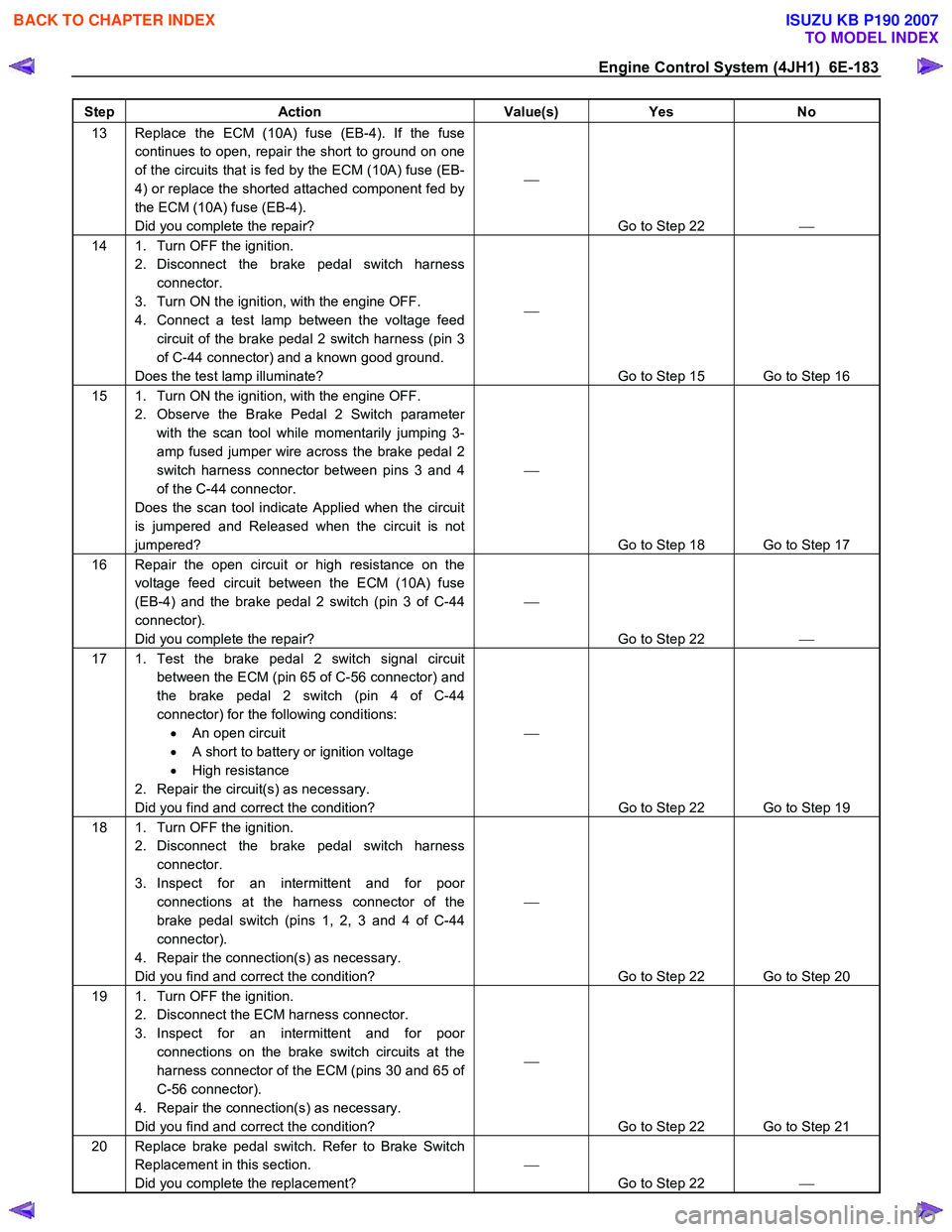
Engine Control System (4JH1) 6E-183
Step Action Value(s) Yes No
13 Replace the ECM (10A) fuse (EB-4). If the fuse
continues to open, repair the short to ground on one
of the circuits that is fed by the ECM (10A) fuse (EB-
4) or replace the shorted attached component fed by
the ECM (10A) fuse (EB-4).
Did you complete the repair?
Go to Step 22
14 1. Turn OFF the ignition.
2. Disconnect the brake pedal switch harness connector.
3. Turn ON the ignition, with the engine OFF.
4. Connect a test lamp between the voltage feed circuit of the brake pedal 2 switch harness (pin 3
of C-44 connector) and a known good ground.
Does the test lamp illuminate?
Go to Step 15 Go to Step 16
15 1. Turn ON the ignition, with the engine OFF. 2. Observe the Brake Pedal 2 Switch parameter with the scan tool while momentarily jumping 3-
amp fused jumper wire across the brake pedal 2
switch harness connector between pins 3 and 4
of the C-44 connector.
Does the scan tool indicate Applied when the circuit
is jumpered and Released when the circuit is not
jumpered?
Go to Step 18 Go to Step 17
16 Repair the open circuit or high resistance on the voltage feed circuit between the ECM (10A) fuse
(EB-4) and the brake pedal 2 switch (pin 3 of C-44
connector).
Did you complete the repair?
Go to Step 22
17 1. Test the brake pedal 2 switch signal circuit
between the ECM (pin 65 of C-56 connector) and
the brake pedal 2 switch (pin 4 of C-44
connector) for the following conditions: • An open circuit
• A short to battery or ignition voltage
• High resistance
2. Repair the circuit(s) as necessary.
Did you find and correct the condition?
Go to Step 22 Go to Step 19
18 1. Turn OFF the ignition. 2. Disconnect the brake pedal switch harness connector.
3. Inspect for an intermittent and for poor connections at the harness connector of the
brake pedal switch (pins 1, 2, 3 and 4 of C-44
connector).
4. Repair the connection(s) as necessary.
Did you find and correct the condition?
Go to Step 22 Go to Step 20
19 1. Turn OFF the ignition. 2. Disconnect the ECM harness connector.
3. Inspect for an intermittent and for poor connections on the brake switch circuits at the
harness connector of the ECM (pins 30 and 65 of
C-56 connector).
4. Repair the connection(s) as necessary.
Did you find and correct the condition?
Go to Step 22 Go to Step 21
20 Replace brake pedal switch. Refer to Brake Switch Replacement in this section.
Did you complete the replacement?
Go to Step 22
BACK TO CHAPTER INDEX
TO MODEL INDEX
ISUZU KB P190 2007
Page 1225 of 6020

Engine Control System (4JH1) 6E-191
Step Action Value(s) Yes No
6 Is the DMM voltage less than the specified value at
step 5? 5.5 volts
Go to Step 7 Go to Step 10
7 Important: The APP sensor may be damaged if the
sensor signal circuit is shorted to a voltage source.
1. Test the signal circuit between the engine control module (ECM) (pin 38 of C-56 connector) and
the APP sensor (pin 2 of E-22 connector) for the
following conditions: • A short to battery or ignition voltage
• A short to any 5 volts reference
2. Repair the circuit(s) as necessary.
Did you find and correct the condition?
Go to Step 15 Go to Step 14
8 . Test the low reference circuit between the 1ECM (pin 49 of C-56 connector) and the APP sensor
(pin 1 of E-22 connector) for an open circuit or
high resistance.
2. Repair the circuit(s) as necessary.
Did you find and correct the condition?
Go to Step 15 Go to Step 12
9 1. Test the 5 volts reference circuit between the ECM (pin 57 of C-56 connector) and the APP
sensor (pin 3 of E-22 connector) for the following
conditions: • A short to ground
• A short to the low reference circuit
2. Repair the circuit(s) as necessary.
Did you find and correct the condition?
Go to Step 15 Go to Step 14
10 1. Test the 5 volts reference circuit between the ECM (pin 57 of C-56 connector) and the APP
sensor (pin 3 of E-22 connector) for a short to
battery or ignition voltage.
2. Repair the circuit(s) as necessary.
Did you find and correct the condition?
Go to Step 15 Go to Step 14
11 1. Turn OFF the ignition. 2. Inspect for an intermittent and for a poor connection at the harness connector of the APP
sensor (pin 1 of E-22 connector).
3. Repair the connection(s) as necessary.
Did you find and correct the condition?
Go to Step 15 Go to Step 13
12 1. Turn OFF the ignition. 2. Disconnect the ECM harness connector.
3. Inspect for an intermittent and for a poor connection on the APP sensor circuit at the
harness connector of the ECM (pin 49 of C-56
connector).
4. Repair the connection(s) as necessary.
Did you find and correct the condition?
Go to Step 15 Go to Step 14
13 Replace APP sensor. Refer to Accelerator Pedal Position (APP) Sensor Replacement in this section.
Did you complete the replacement?
Go to Step 15
14 Important: Replacement ECM must be
programmed.
Replace the ECM. Refer to Engine Control Module
(ECM) Replacement in this section.
Did you complete the replacement?
Go to Step 15
BACK TO CHAPTER INDEX
TO MODEL INDEX
ISUZU KB P190 2007
Page 1227 of 6020

Engine Control System (4JH1) 6E-193
DTC P1120 (Symptom Code 7) (Flash Code 21)
Circuit Description
The accelerator pedal position (APP) sensor is mounted
on the intake throttle assembly. The engine control
module (ECM) uses the APP sensors to determine the
amount of acceleration or deceleration desired by the
person driving the vehicle via the fuel injection control.
The APP sensor has the following circuits.
• 5 volts reference circuit
• Low reference circuit
• APP sensor signal circuit
The ECM provides 5 volts reference voltage through the
reference circuit to the APP sensor. The ECM monitors
the voltage on the 5 volts reference circuit. If the ECM
detects an excessively high APP sensor 5 volts
reference voltage, this DTC will set.
Condition for Running the DTC
• The ignition switch is ON.
Condition for Setting the DTC
• The ECM detects that the APP sensor voltage
supply circuit is more than 5.2 volts for 0.5
seconds.
Action Taken When the DTC Sets
• The ECM illuminates the malfunction indicato
r
lamp (MIL) when the diagnostic runs and fails.
• The ECM uses an engine speed substitution o
f
1400 RPM.
Condition for Clearing the MIL/DTC • The ECM turns OFF the MIL when the diagnostic
runs and does not fail.
• A history DTC clears after 40 consecutive driving
cycles without a fault. Or clear with the scan tool.
Diagnostic Aids • If an intermittent condition is suspected, refer to
Intermittent Conditions in this section.
DTC P1120 (Symptom Code 7) (Flash Code 21)
Schematic Reference: Engine Controls Schematics
Connector End View Reference: Engine Controls
Connector End Views or Engine Control Module (ECM)
Connector End Views
Step Action Value(s) Yes No
1 Did you perform the Diagnostic System Check-
Engine Controls?
Go to Step 2 Go to Diagnostic
System Check-
Engine Controls
2 1. Install the scan tool. 2. Turn OFF the ignition for 30 seconds.
3. Start the engine.
4. Monitor the Diagnostic Trouble Code (DTC) Information with the scan tool.
Does the DTC fail this ignition?
Go to Step 3 Go to Diagnostic
Aids
3 1. Test the 5 volts reference circuit between 1the engine control module (ECM) (pin 57 of C-56
connector) and the accelerator pedal position
(APP) sensor (pin 3 of E-22 connector) for a
short to battery or ignition voltage.
2. Repair the circuit(s) as necessary.
Did you find and correct the condition?
Go to Step 5 Go to Step 4
4 Important: Replacement ECM must be
programmed.
Replace the ECM. Refer to Engine Control Module
(ECM) Replacement in this section.
Did you complete the replacement?
Go to Step 5
5 1. Reconnect all previously disconnected harness
connector(s).
2. Clear the DTCs with the scan tool.
3. Turn OFF the ignition for 30 seconds.
4. Turn ON the ignition, with the engine OFF.
5. Fully depress and release the accelerator pedal many times.
6. Monitor the DTC Information with the scan tool.
Did the DTC fail this ignition?
Go to Step 3 Go to Step 6
BACK TO CHAPTER INDEX
TO MODEL INDEX
ISUZU KB P190 2007
Page 1232 of 6020
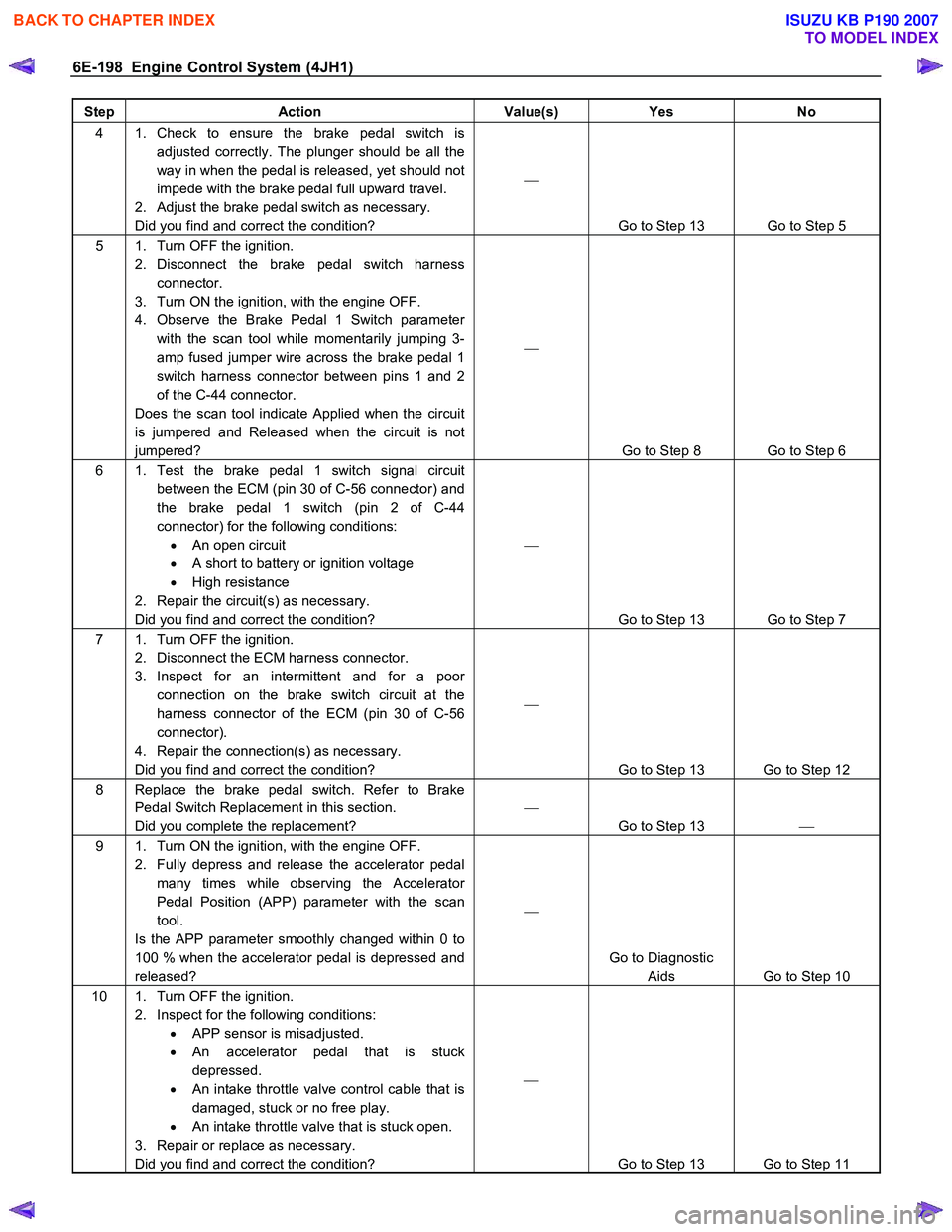
6E-198 Engine Control System (4JH1)
Step Action Value(s) Yes No
4 1. Check to ensure the brake pedal switch is
adjusted correctly. The plunger should be all the
way in when the pedal is released, yet should not
impede with the brake pedal full upward travel.
2. Adjust the brake pedal switch as necessary.
Did you find and correct the condition?
Go to Step 13 Go to Step 5
5 1. Turn OFF the ignition. 2. Disconnect the brake pedal switch harness connector.
3. Turn ON the ignition, with the engine OFF.
4. Observe the Brake Pedal 1 Switch parameter with the scan tool while momentarily jumping 3-
amp fused jumper wire across the brake pedal 1
switch harness connector between pins 1 and 2
of the C-44 connector.
Does the scan tool indicate Applied when the circuit
is jumpered and Released when the circuit is not
jumpered?
Go to Step 8 Go to Step 6
6 1. Test the brake pedal 1 switch signal circuit between the ECM (pin 30 of C-56 connector) and
the brake pedal 1 switch (pin 2 of C-44
connector) for the following conditions: • An open circuit
• A short to battery or ignition voltage
• High resistance
2. Repair the circuit(s) as necessary.
Did you find and correct the condition?
Go to Step 13 Go to Step 7
7 1. Turn OFF the ignition. 2. Disconnect the ECM harness connector.
3. Inspect for an intermittent and for a poor connection on the brake switch circuit at the
harness connector of the ECM (pin 30 of C-56
connector).
4. Repair the connection(s) as necessary.
Did you find and correct the condition?
Go to Step 13 Go to Step 12
8 Replace the brake pedal switch. Refer to Brake Pedal Switch Replacement in this section.
Did you complete the replacement?
Go to Step 13
9 1. Turn ON the ignition, with the engine OFF.
2. Fully depress and release the accelerator pedal many times while observing the Accelerator
Pedal Position (APP) parameter with the scan
tool.
Is the APP parameter smoothly changed within 0 to
100 % when the accelerator pedal is depressed and
released?
Go to Diagnostic Aids Go to Step 10
10 1. Turn OFF the ignition. 2. Inspect for the following conditions: • APP sensor is misadjusted.
• An accelerator pedal that is stuck
depressed.
• An intake throttle valve control cable that is
damaged, stuck or no free play.
• An intake throttle valve that is stuck open.
3. Repair or replace as necessary.
Did you find and correct the condition?
Go to Step 13 Go to Step 11
BACK TO CHAPTER INDEX
TO MODEL INDEX
ISUZU KB P190 2007
Page 1242 of 6020

6E-208 Engine Control System (4JH1)
Step Action Value(s) Yes No
5 1. Test the CKP sensor signal output circuit
between the ECM (pin 91 of C-57 connector) and
the fuel injection pump control unit (PCU) (pin 8
of E-6 connector) for a short to battery or ignition
voltage.
Notice:
Perform this by connecting a test lamp between the
ECM harness connector (pin 91 of C-57 connector)
and a known good ground. If the test lamp
illuminate, circuit is short to battery or ignition
voltage.
2. Repair the circuit(s) as necessary.
Did you find and correct the condition?
Go to Step 10 Go to Step 7
6 1. Turn OFF the ignition. 2. Disconnect the PCU harness connector.
3. Inspect for an intermittent and for a poor connection on the CKP sensor signal circuit at
the harness connector of the PCU (pin 8 of E-6
connector).
4. Repair the connection(s) as necessary.
Did you find and correct the condition?
Go to Step 10 Go to Step 8
7 1. Turn OFF the ignition. 2. Disconnect the ECM harness connector.
3. Inspect for an intermittent and for a poor connection on the CKP sensor signal output
circuit at the harness connector of the ECM (pin
92 of C-57 connector).
4. Repair the connection(s) as necessary.
Did you find and correct the condition?
Go to Step 10 Go to Step 9
8 Important: The fuel injection pump must be timed to
the engine.
Replace the fuel injection pump. Refer to Fuel
Injection Pump Replacement in engine mechanical
section.
Did you complete the replacement?
Go to Step 10
9 Important: Replacement ECM must be
programmed.
Replace the ECM. Refer to Engine Control Module
(ECM) Replacement in this section.
Did you complete the replacement?
Go to Step 10
10 1. Reconnect all previously disconnected harness
connector(s).
2. Clear the DTCs with the scan tool.
3. Turn OFF the ignition for 30 seconds.
4. Start the engine.
5. Monitor the DTC Information with the scan tool.
Did the DTC fail this ignition?
Go to Step 2 Go to Step 11
11 Observe the DTC Information with the scan tool. Are there any DTCs that you have not diagnosed? Go to Diagnostic
Trouble Code (DTC) List System OK
BACK TO CHAPTER INDEX
TO MODEL INDEX
ISUZU KB P190 2007
Page 1246 of 6020

6E-212 Engine Control System (4JH1)
Step Action Value(s) Yes No
4 1. Check to ensure the inhibitor switch is adjusted
correctly.
2. Adjust the inhibitor switch as necessary. Refer to Inhibitor Switch Adjustment in Automatic
Transmission Section.
Did you find and correct the condition?
Go to Step 7 Go to Step 5
5 1. Test the P & N position switch signal circuit between the engine control module (ECM) (pin
87 of C-57 connector) and the diode (pin 2 of X-
16 connector) for a short to battery or ignition
voltage.
2. Repair the circuit(s) as necessary.
Did you find and correct the condition?
Go to Step 7 Go to Step 6
6 Important: Replacement ECM must be
programmed.
Replace the ECM. Refer to Engine Control Module
(ECM) Replacement in this section.
Did you complete the replacement?
Go to Step 7
7 1. Reconnect all previously disconnected harness
connector(s).
2. Clear the DTCs with the scan tool.
Important: Following conditions must be met two
consecutive driving cycles before clear with the scan
tool. (One driving cycle: Ignition switch ON > Engine
run > Vehicle run > Ignition switch OFF for 10
seconds) • The engine speed is higher than 1500 RPM
• The vehicle speed is higher than 78 km/h
(49 MPH)
• Other than P/N range
3. Turn ON the ignition, with the engine OFF.
4. Observe the Neutral Switch parameter with the scan tool while shift to P or N and other
positions.
Does the scan tool indicate ON when the position is
P or N and OFF when other than the P or N?
Go to Step 8 Go to Step 2
8 Observe the DTC Information with the scan tool. Are there any DTCs that you have not diagnosed? Go to Diagnostic
Trouble Code (DTC) List System OK
BACK TO CHAPTER INDEX
TO MODEL INDEX
ISUZU KB P190 2007
Page 1256 of 6020
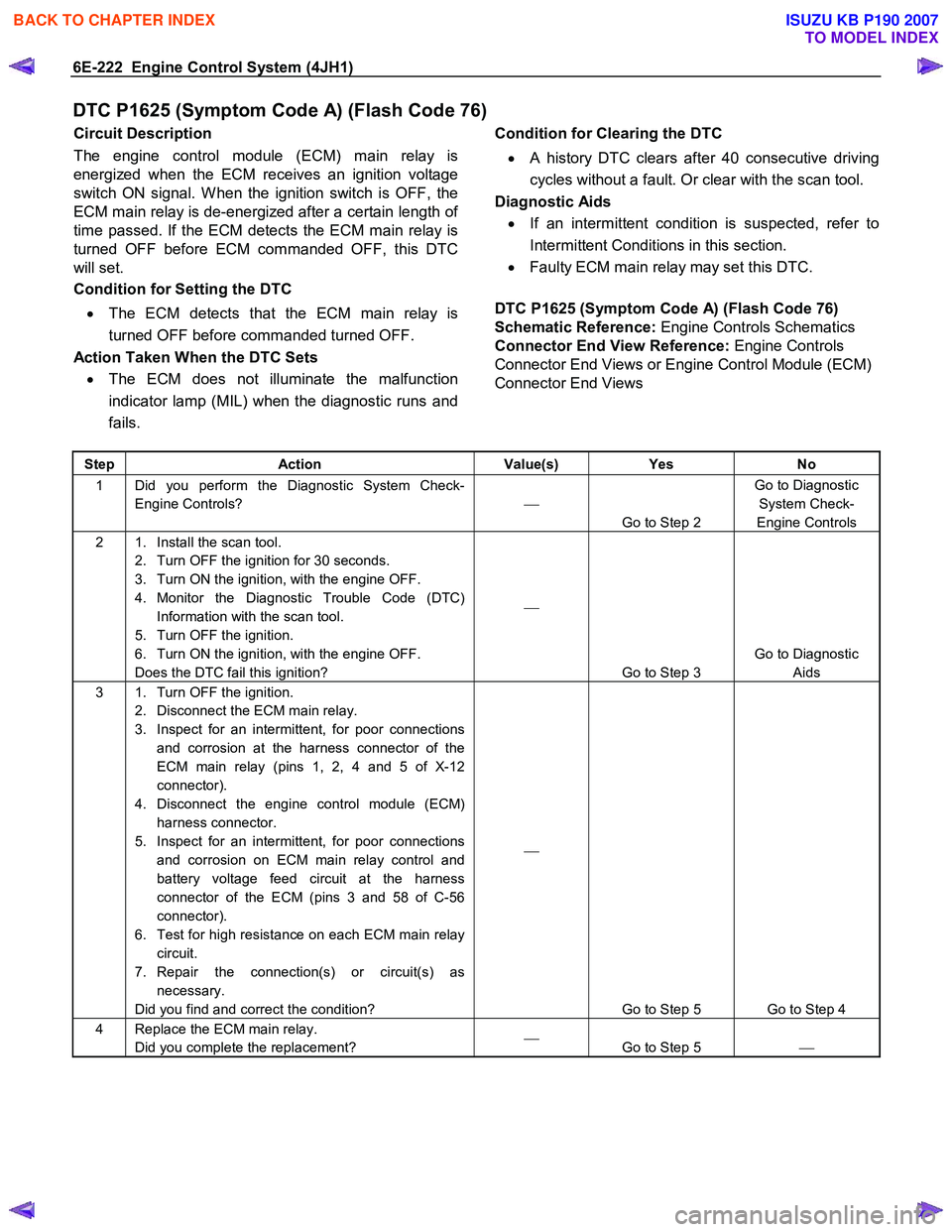
6E-222 Engine Control System (4JH1)
DTC P1625 (Symptom Code A) (Flash Code 76)
Circuit Description
The engine control module (ECM) main relay is
energized when the ECM receives an ignition voltage
switch ON signal. W hen the ignition switch is OFF, the
ECM main relay is de-energized after a certain length o
f
time passed. If the ECM detects the ECM main relay is
turned OFF before ECM commanded OFF, this DTC
will set.
Condition for Setting the DTC
• The ECM detects that the ECM main relay is
turned OFF before commanded turned OFF.
Action Taken When the DTC Sets • The ECM does not illuminate the malfunction
indicator lamp (MIL) when the diagnostic runs and
fails.
Condition for Clearing the DTC
• A history DTC clears after 40 consecutive driving
cycles without a fault. Or clear with the scan tool.
Diagnostic Aids
• If an intermittent condition is suspected, refer to
Intermittent Conditions in this section.
• Faulty ECM main relay may set this DTC.
DTC P1625 (Symptom Code A) (Flash Code 76)
Schematic Reference: Engine Controls Schematics
Connector End View Reference: Engine Controls
Connector End Views or Engine Control Module (ECM)
Connector End Views
Step Action Value(s) Yes No
1 Did you perform the Diagnostic System Check-
Engine Controls?
Go to Step 2 Go to Diagnostic
System Check-
Engine Controls
2 1. Install the scan tool. 2. Turn OFF the ignition for 30 seconds.
3. Turn ON the ignition, with the engine OFF.
4. Monitor the Diagnostic Trouble Code (DTC) Information with the scan tool.
5. Turn OFF the ignition.
6. Turn ON the ignition, with the engine OFF.
Does the DTC fail this ignition?
Go to Step 3 Go to Diagnostic
Aids
3 1. Turn OFF the ignition. 2. Disconnect the ECM main relay.
3. Inspect for an intermittent, for poor connections and corrosion at the harness connector of the
ECM main relay (pins 1, 2, 4 and 5 of X-12
connector).
4. Disconnect the engine control module (ECM) harness connector.
5. Inspect for an intermittent, for poor connections and corrosion on ECM main relay control and
battery voltage feed circuit at the harness
connector of the ECM (pins 3 and 58 of C-56
connector).
6. Test for high resistance on each ECM main relay circuit.
7. Repair the connection(s) or circuit(s) as necessary.
Did you find and correct the condition?
Go to Step 5 Go to Step 4
4 Replace the ECM main relay. Did you complete the replacement?
Go to Step 5
BACK TO CHAPTER INDEX
TO MODEL INDEX
ISUZU KB P190 2007
Page 1258 of 6020
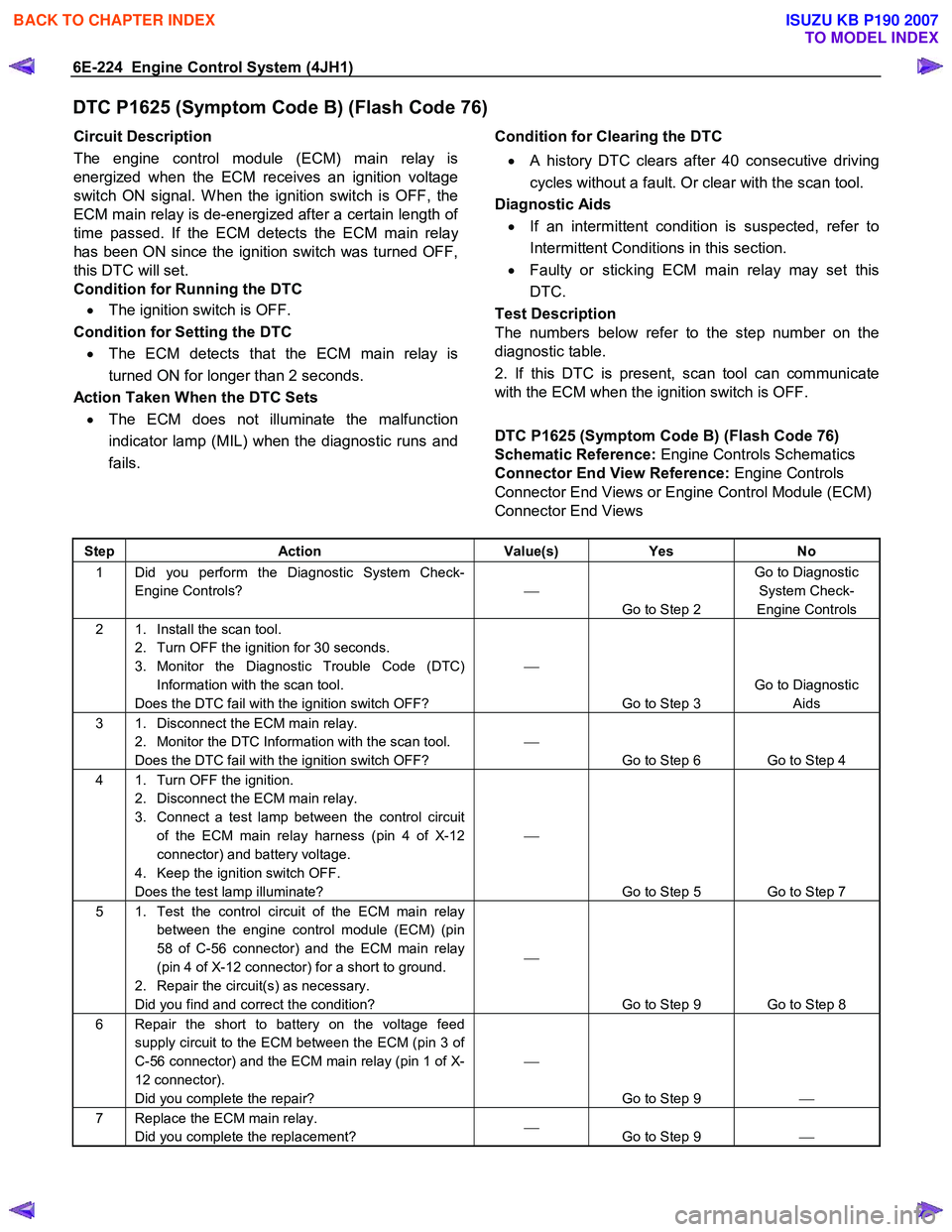
6E-224 Engine Control System (4JH1)
DTC P1625 (Symptom Code B) (Flash Code 76)
Circuit Description
The engine control module (ECM) main relay is
energized when the ECM receives an ignition voltage
switch ON signal. W hen the ignition switch is OFF, the
ECM main relay is de-energized after a certain length o
f
time passed. If the ECM detects the ECM main relay
has been ON since the ignition switch was turned OFF,
this DTC will set.
Condition for Running the DTC
• The ignition switch is OFF.
Condition for Setting the DTC • The ECM detects that the ECM main relay is
turned ON for longer than 2 seconds.
Action Taken When the DTC Sets • The ECM does not illuminate the malfunction
indicator lamp (MIL) when the diagnostic runs and
fails.
Condition for Clearing the DTC
• A history DTC clears after 40 consecutive driving
cycles without a fault. Or clear with the scan tool.
Diagnostic Aids
• If an intermittent condition is suspected, refer to
Intermittent Conditions in this section.
• Faulty or sticking ECM main relay may set this
DTC.
Test Description
The numbers below refer to the step number on the
diagnostic table.
2. If this DTC is present, scan tool can communicate
with the ECM when the ignition switch is OFF.
DTC P1625 (Symptom Code B) (Flash Code 76)
Schematic Reference: Engine Controls Schematics
Connector End View Reference: Engine Controls
Connector End Views or Engine Control Module (ECM)
Connector End Views
Step Action Value(s) Yes No
1 Did you perform the Diagnostic System Check-
Engine Controls?
Go to Step 2 Go to Diagnostic
System Check-
Engine Controls
2 1. Install the scan tool. 2. Turn OFF the ignition for 30 seconds.
3. Monitor the Diagnostic Trouble Code (DTC) Information with the scan tool.
Does the DTC fail with the ignition switch OFF?
Go to Step 3 Go to Diagnostic
Aids
3 1. Disconnect the ECM main relay. 2. Monitor the DTC Information with the scan tool.
Does the DTC fail with the ignition switch OFF?
Go to Step 6 Go to Step 4
4 1. Turn OFF the ignition. 2. Disconnect the ECM main relay.
3. Connect a test lamp between the control circuit of the ECM main relay harness (pin 4 of X-12
connector) and battery voltage.
4. Keep the ignition switch OFF.
Does the test lamp illuminate?
Go to Step 5 Go to Step 7
5 1. Test the control circuit of the ECM main relay between the engine control module (ECM) (pin
58 of C-56 connector) and the ECM main relay
(pin 4 of X-12 connector) for a short to ground.
2. Repair the circuit(s) as necessary.
Did you find and correct the condition?
Go to Step 9 Go to Step 8
6 Repair the short to battery on the voltage feed supply circuit to the ECM between the ECM (pin 3 of
C-56 connector) and the ECM main relay (pin 1 of X-
12 connector).
Did you complete the repair?
Go to Step 9
7 Replace the ECM main relay.
Did you complete the replacement?
Go to Step 9
BACK TO CHAPTER INDEX
TO MODEL INDEX
ISUZU KB P190 2007