ECU ISUZU TROOPER 1998 Service User Guide
[x] Cancel search | Manufacturer: ISUZU, Model Year: 1998, Model line: TROOPER, Model: ISUZU TROOPER 1998Pages: 3573, PDF Size: 60.36 MB
Page 278 of 3573
1D Ð 22 COMPRESSOR OVERHAUL
COMPRESSOR SHAFT SEAL
Service Precaution
When replacing the shaft seal assembly, pressure relief
valve or control switches, it will be necessary to recover
the refrigerant. Other than clutch repair procedures, the
same holds true for any disassembly of the compressor.
A clean workbench covered with a sheet of clean
paper, and a place (clean trays, etc) for all parts being
removed and replaced is important, as is the use of
proper clean service tools.
CAUTION: Any attempt to use makeshift or
inadequate service tools or equipment may result
in damage and/or improper compressor operation.
All parts required for servicing the internal compressor
are protected by a preservative process and packaged
in a manner which will eliminate the necessity of
cleaning, washing or flushing of the parts. The parts
can be used in the internal assembly just as they are
removed from the service package. Seals and
protective packaging should be left intact until just
prior to installation.
If the compressor rear head, front head or cylinder and
shaft assembly is to be serviced or replaced, the oil in
the compressor must be drained, measured, recorded
and replaced.
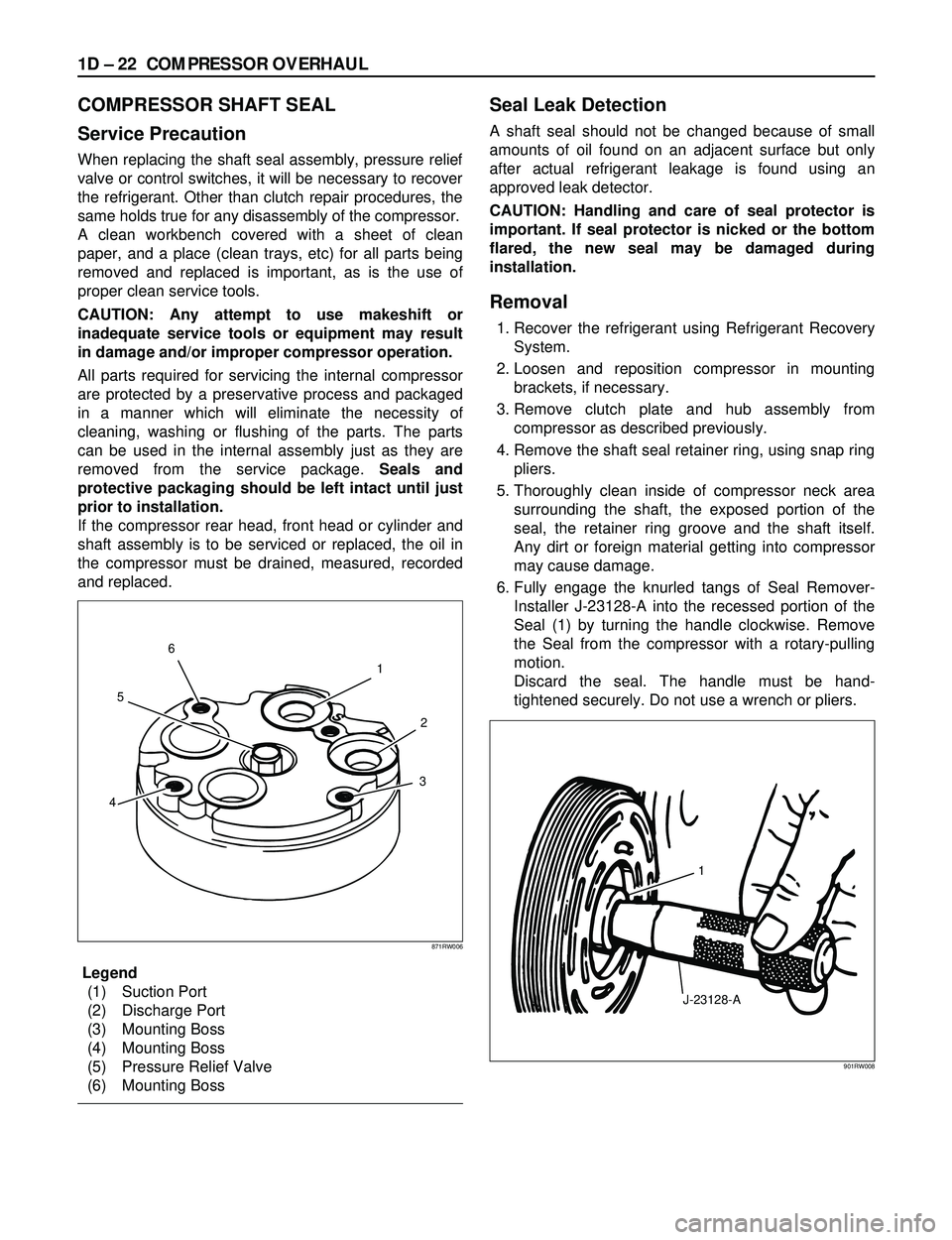
Legend
(1) Suction Port
(2) Discharge Port
(3) Mounting Boss
(4) Mounting Boss
(5) Pressure Relief Valve
(6) Mounting Boss
Seal Leak Detection
A shaft seal should not be changed because of small
amounts of oil found on an adjacent surface but only
after actual refrigerant leakage is found using an
approved leak detector.
CAUTION: Handling and care of seal protector is
important. If seal protector is nicked or the bottom
flared, the new seal may be damaged during
installation.
Removal
1. Recover the refrigerant using Refrigerant Recovery
System.
2. Loosen and reposition compressor in mounting
brackets, if necessary.
3. Remove clutch plate and hub assembly from
compressor as described previously.
4. Remove the shaft seal retainer ring, using snap ring
pliers.
5. Thoroughly clean inside of compressor neck area
surrounding the shaft, the exposed portion of the
seal, the retainer ring groove and the shaft itself.
Any dirt or foreign material getting into compressor
may cause damage.
6. Fully engage the knurled tangs of Seal Remover-
Installer J-23128-A into the recessed portion of the
Seal (1) by turning the handle clockwise. Remove
the Seal from the compressor with a rotary-pulling
motion.
Discard the seal. The handle must be hand-
tightened securely. Do not use a wrench or pliers.
1
2
3
456
871RW006
J-23128-A1
901RW008
Page 295 of 3573
SERVICE INFORMATION 00 – 13
STEERING
INSPECTION
Visual check
Check the following parts:
• Oil leakage.
• Steering system for looseness or damage.
• Steering function
• Joint ball for oil leakage or damage.
• Joint ball rubber boot for damage.
MAINTENANCE
The hydraulic system should be kept clean and fluid level
in the reservoir should be checked at regular intervals and
fluid added when required. Refer to "MAINTENANCE AND
LUBRICATION" in section 0B of the manual for type of
fluid to be used and intervals for filling.
If the system contains some dirt, flush it as detailed later
in this section. If it is exceptionally dirty, both the pump
and the gear must be completely disassembled before
further usage.
All tubes, hoses, and fittings should be inspected for
leakage at regular intervals. Fittings must be tight. Make
sure the clips, clamps and supporting tubes and hoses are
in place and properly secured.
Power steering hoses and lines must not be twisted,
kinked or tightly bent. Air in the system will cause spongy
action and noisy operation. When a hose is disconnected
or when fluid is lost, for any reason, the system must be
bled after refilling. Refer to "Bleeding the Power Steering
System" in this section.
FLUID LEVEL
1. Run the engine until the power steering fluid reaches
normal operating temperature, about 55°C (130°F),
then shut the engine off.
2. Check the level of fluid in the reservoir.
3. If the fluid level is low, add power steering fluid as
specified in "MAINTENANCE AND LUBRICATION" in
section 0B to the proper level and install the receiver
cap.
4. When checking the fluid level after the steering
system has been serviced, air must be bled from the
system. Refer to "Bleeding the Power Steering
System" in this section.
SERVICING
Page 358 of 3573
2A – 56 SUPPLEMENTAL RESTRAINT SYSTEM STEERING WHEEL & COLUMN
3
41
2
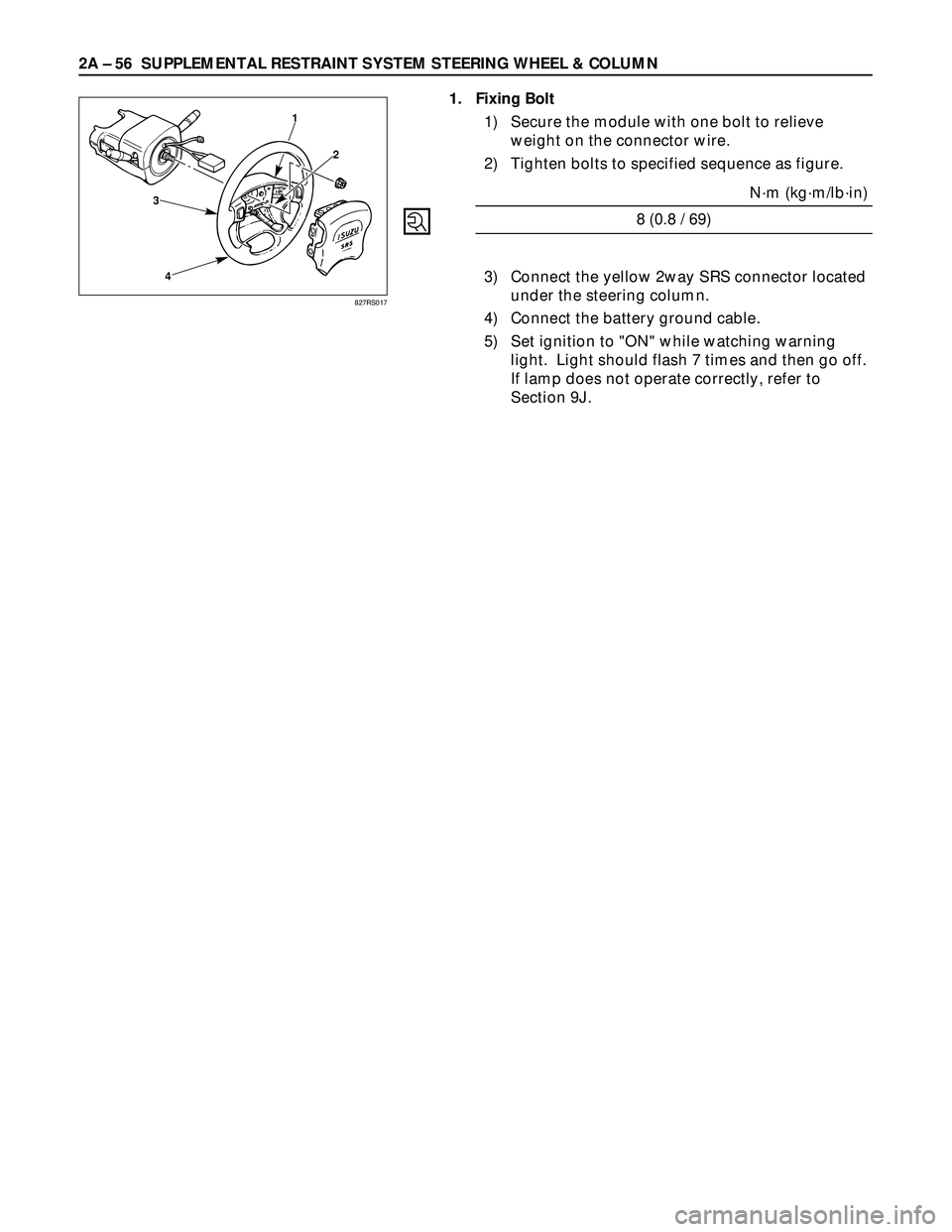
1. Fixing Bolt
1) Secure the module with one bolt to relieve
weight on the connector wire.
2) Tighten bolts to specified sequence as figure.
N·m (kg·m/lb·in)
8 (0.8 / 69)
3) Connect the yellow 2way SRS connector located
under the steering column.
4) Connect the battery ground cable.
5) Set ignition to "ON" while watching warning
light. Light should flash 7 times and then go off.
If lamp does not operate correctly, refer to
Section 9J.
827RS017
Page 361 of 3573
SUPPLEMENTAL RESTRAINT SYSTEM STEERING WHEEL & COLUMN 2A Ð 59
INSTALLATION
4. Steering Wheel
Align the setting marks made when removing.
CAUTION:
Never apply force to the setting wheel in direction of the
shaft by using a hammer or other impact tools in an
attempt to install the steering wheel. The setting shaft is
designed as an energy absorbing unit.
3. Steering Wheel Fixing Nut
Steering Wheel Nut Torque Nám (kgám/lbáft)
34 (3.5 / 25)
2. Horn Lead
1. Inflator Module
1) Support the module and carefully connect the
module connector.
CAUTION:
·Never use the air bag assembly from another vehicle.
Use only the air bag assembly for "UBS".
·When replace the inflator module, use only same parts
number assembly. If different parts number assembly is
installed, the air bag system can not function correctly
because it has different characteristic.
NOTE:
Pass the lead wire through the tabs on the plastic
cover (wire protector) of inflator to prevent lead wire
from being pinches.
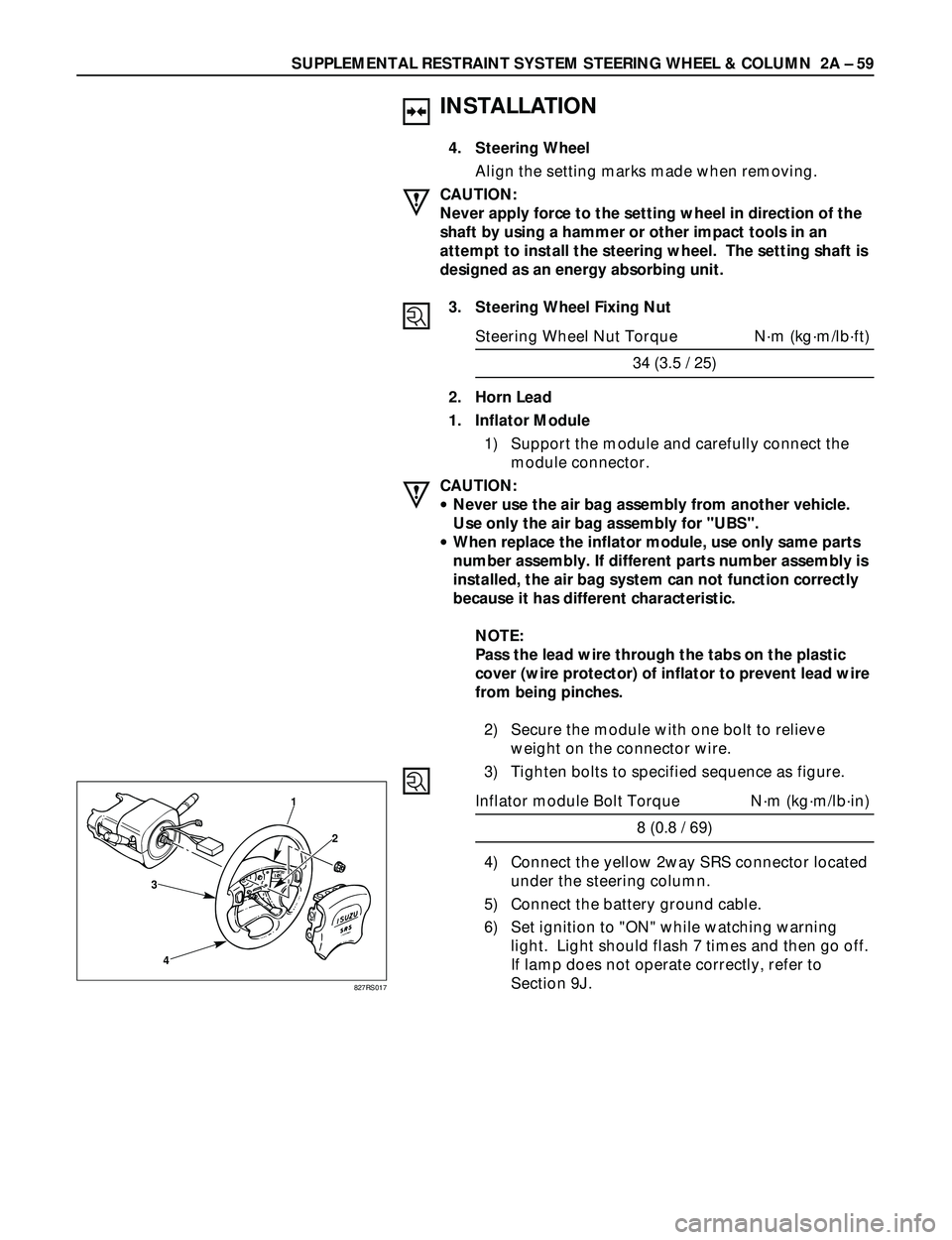
2) Secure the module with one bolt to relieve
weight on the connector wire.
3) Tighten bolts to specified sequence as figure.
Inflator module Bolt Torque Nám (kgám/lbáin)
8 (0.8 / 69)
4) Connect the yellow 2way SRS connector located
under the steering column.
5) Connect the battery ground cable.
6) Set ignition to "ON" while watching warning
light. Light should flash 7 times and then go off.
If lamp does not operate correctly, refer to
Section 9J.
3
41
2
827RS017
Page 365 of 3573
SUPPLEMENTAL RESTRAINT SYSTEM STEERING WHEEL & COLUMN 2A Ð 63
5. Steering Wheel
Align the setting marks made when removing.
CAUTION:
Never apply force to the steering wheel in direction of the
shaft by using a hammer or other impact tools in an
attempt to remove the steering wheel. The steering shaft
is designed as an energy absorbing unit.
Tighten the steering wheel fixing nut to the specified
torque.
Steering Wheel Nut Torque Nám (kgám/lbáft)
34 (3.5 / 25)
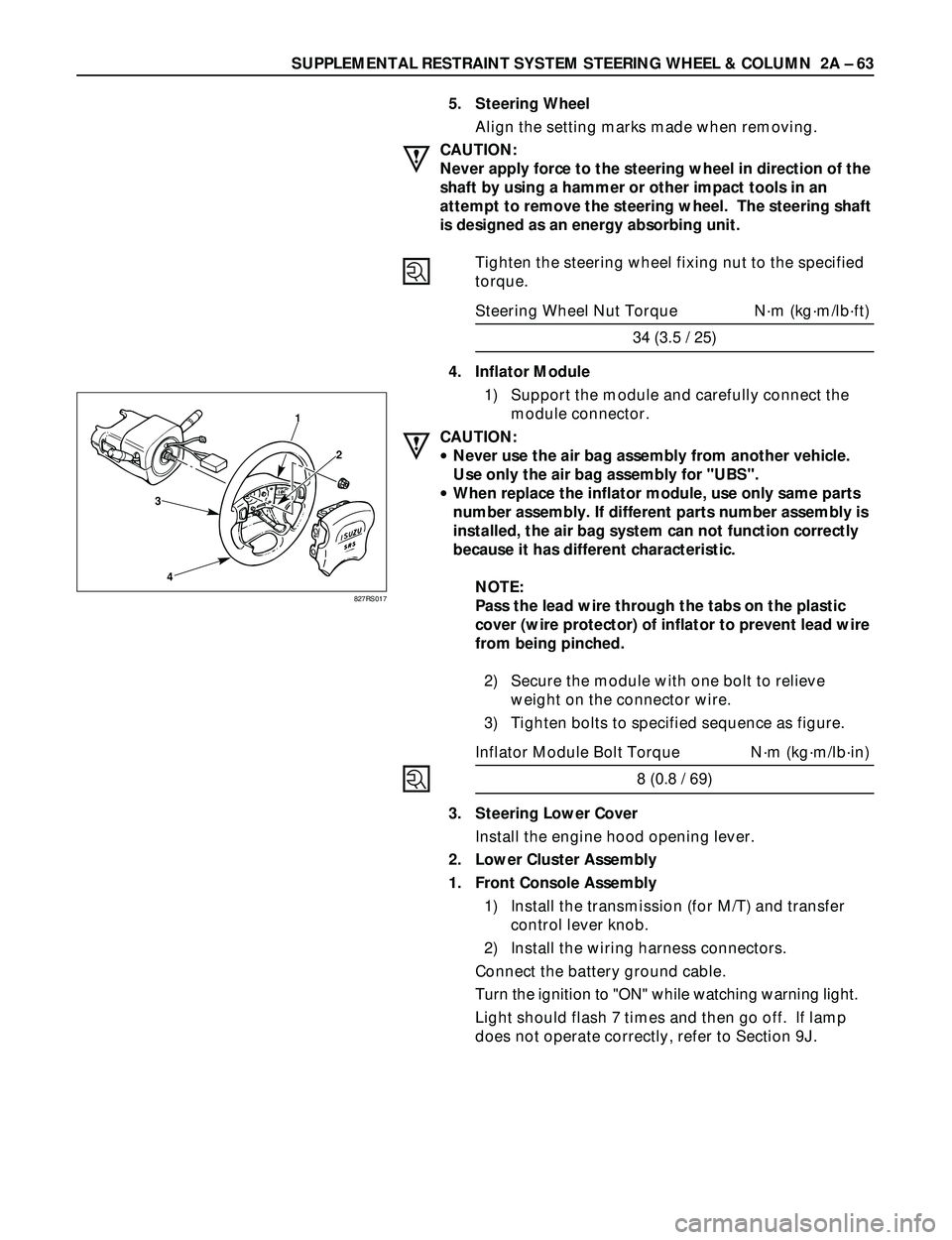
4. Inflator Module
1) Support the module and carefully connect the
module connector.
CAUTION:
·Never use the air bag assembly from another vehicle.
Use only the air bag assembly for "UBS".
·When replace the inflator module, use only same parts
number assembly. If different parts number assembly is
installed, the air bag system can not function correctly
because it has different characteristic.
NOTE:
Pass the lead wire through the tabs on the plastic
cover (wire protector) of inflator to prevent lead wire
from being pinched.
2) Secure the module with one bolt to relieve
weight on the connector wire.
3) Tighten bolts to specified sequence as figure.
Inflator Module Bolt Torque Nám (kgám/lbáin)
8 (0.8 / 69)
3. Steering Lower Cover
Install the engine hood opening lever.
2. Lower Cluster Assembly
1. Front Console Assembly
1) Install the transmission (for M/T) and transfer
control lever knob.
2) Install the wiring harness connectors.
Connect the battery ground cable.
Turn the ignition to "ON" while watching warning light.
Light should flash 7 times and then go off. If lamp
does not operate correctly, refer to Section 9J.
3
41
2
827RS017
Page 370 of 3573
2A Ð 68 SUPPLEMENTAL RESTRAINT SYSTEM STEERING WHEEL & COLUMN
3
41
2
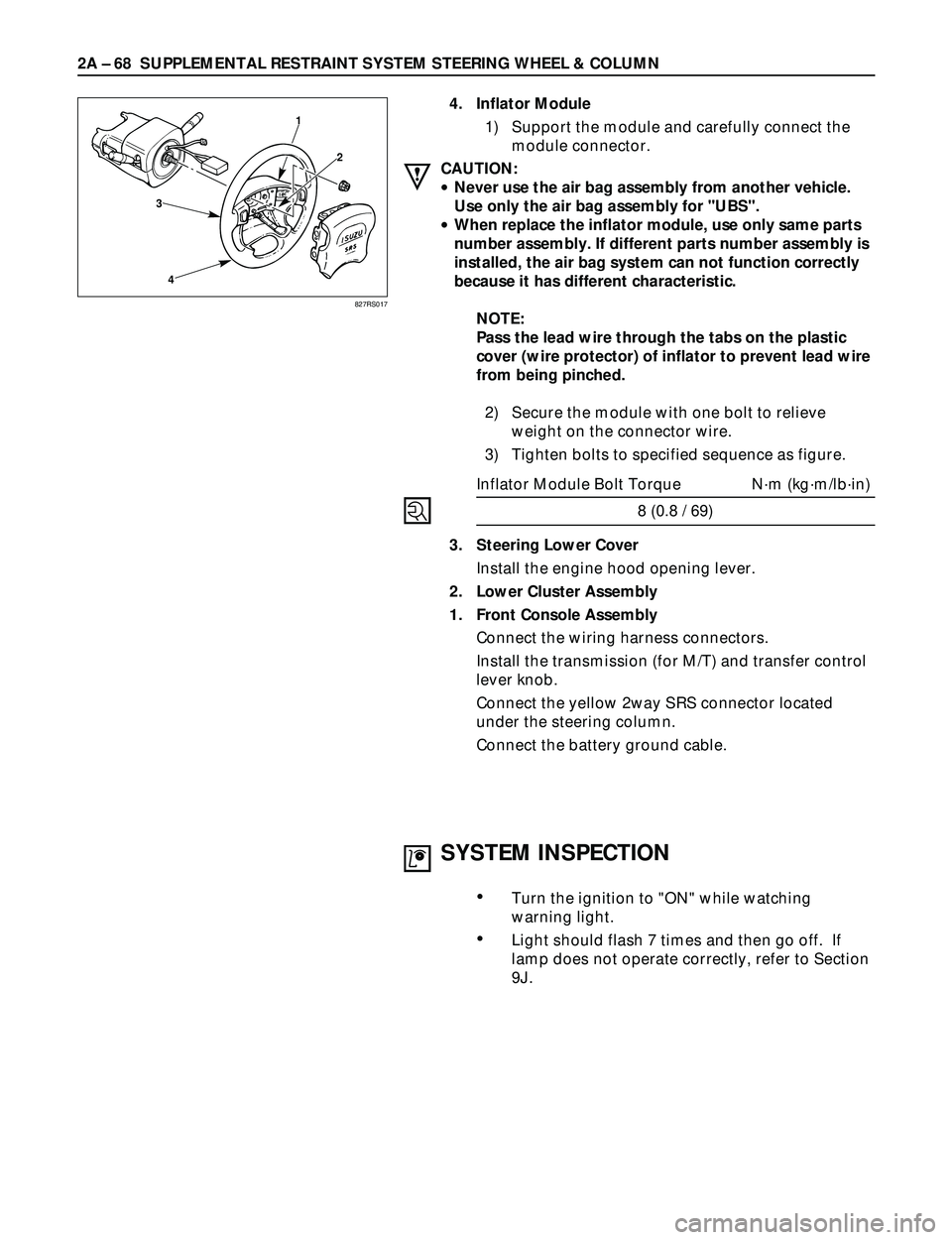
4. Inflator Module
1) Support the module and carefully connect the
module connector.
CAUTION:
·Never use the air bag assembly from another vehicle.
Use only the air bag assembly for "UBS".
·When replace the inflator module, use only same parts
number assembly. If different parts number assembly is
installed, the air bag system can not function correctly
because it has different characteristic.
NOTE:
Pass the lead wire through the tabs on the plastic
cover (wire protector) of inflator to prevent lead wire
from being pinched.
2) Secure the module with one bolt to relieve
weight on the connector wire.
3) Tighten bolts to specified sequence as figure.
Inflator Module Bolt Torque Nám (kgám/lbáin)
8 (0.8 / 69)
3. Steering Lower Cover
Install the engine hood opening lever.
2. Lower Cluster Assembly
1. Front Console Assembly
Connect the wiring harness connectors.
Install the transmission (for M/T) and transfer control
lever knob.
Connect the yellow 2way SRS connector located
under the steering column.
Connect the battery ground cable.
827RS017
SYSTEM INSPECTION
¥Turn the ignition to "ON" while watching
warning light.
¥Light should flash 7 times and then go off. If
lamp does not operate correctly, refer to Section
9J.
Page 375 of 3573
SUPPLEMENTAL RESTRAINT SYSTEM STEERING WHEEL & COLUMN 2A Ð 73
Starter switch
harness
Combination
switch harness
Inflator module
harness
Setting cowl
(Lower)
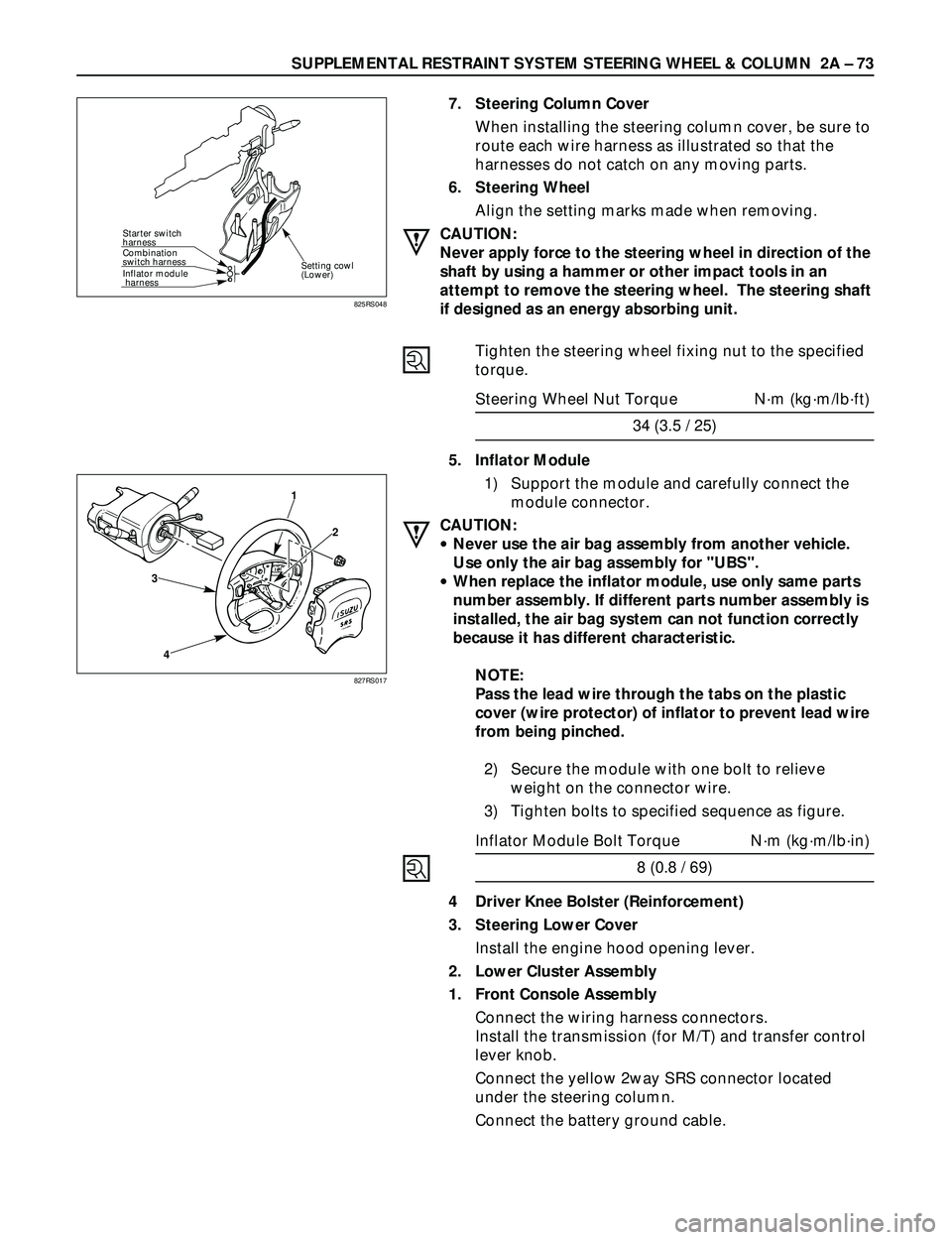
7. Steering Column Cover
When installing the steering column cover, be sure to
route each wire harness as illustrated so that the
harnesses do not catch on any moving parts.
6. Steering Wheel
Align the setting marks made when removing.
CAUTION:
Never apply force to the steering wheel in direction of the
shaft by using a hammer or other impact tools in an
attempt to remove the steering wheel. The steering shaft
if designed as an energy absorbing unit.
Tighten the steering wheel fixing nut to the specified
torque.
Steering Wheel Nut Torque Nám (kgám/lbáft)
34 (3.5 / 25)
5. Inflator Module
1) Support the module and carefully connect the
module connector.
CAUTION:
·Never use the air bag assembly from another vehicle.
Use only the air bag assembly for "UBS".
·When replace the inflator module, use only same parts
number assembly. If different parts number assembly is
installed, the air bag system can not function correctly
because it has different characteristic.
NOTE:
Pass the lead wire through the tabs on the plastic
cover (wire protector) of inflator to prevent lead wire
from being pinched.
2) Secure the module with one bolt to relieve
weight on the connector wire.
3) Tighten bolts to specified sequence as figure.
Inflator Module Bolt Torque Nám (kgám/lbáin)
8 (0.8 / 69)
4 Driver Knee Bolster (Reinforcement)
3. Steering Lower Cover
Install the engine hood opening lever.
2. Lower Cluster Assembly
1. Front Console Assembly
Connect the wiring harness connectors.
Install the transmission (for M/T) and transfer control
lever knob.
Connect the yellow 2way SRS connector located
under the steering column.
Connect the battery ground cable.
825RS048
3
41
2
827RS017
Page 390 of 3573
3C – 2 FRONT SUSPENSION
GENERAL DESCRIPTION
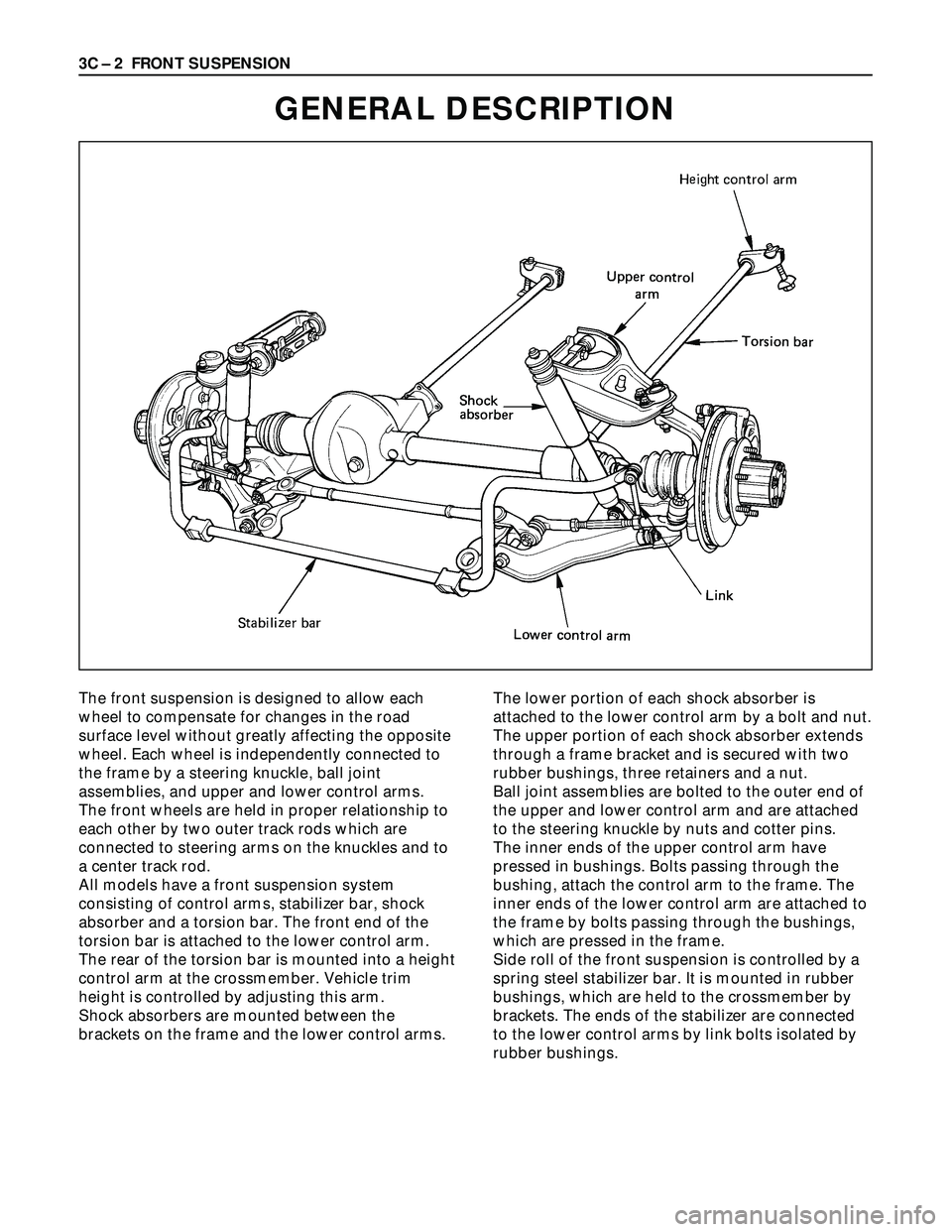
The front suspension is designed to allow each
wheel to compensate for changes in the road
surface level without greatly affecting the opposite
wheel. Each wheel is independently connected to
the frame by a steering knuckle, ball joint
assemblies, and upper and lower control arms.
The front wheels are held in proper relationship to
each other by two outer track rods which are
connected to steering arms on the knuckles and to
a center track rod.
All models have a front suspension system
consisting of control arms, stabilizer bar, shock
absorber and a torsion bar. The front end of the
torsion bar is attached to the lower control arm.
The rear of the torsion bar is mounted into a height
control arm at the crossmember. Vehicle trim
height is controlled by adjusting this arm.
Shock absorbers are mounted between the
brackets on the frame and the lower control arms.The lower portion of each shock absorber is
attached to the lower control arm by a bolt and nut.
The upper portion of each shock absorber extends
through a frame bracket and is secured with two
rubber bushings, three retainers and a nut.
Ball joint assemblies are bolted to the outer end of
the upper and lower control arm and are attached
to the steering knuckle by nuts and cotter pins.
The inner ends of the upper control arm have
pressed in bushings. Bolts passing through the
bushing, attach the control arm to the frame. The
inner ends of the lower control arm are attached to
the frame by bolts passing through the bushings,
which are pressed in the frame.
Side roll of the front suspension is controlled by a
spring steel stabilizer bar. It is mounted in rubber
bushings, which are held to the crossmember by
brackets. The ends of the stabilizer are connected
to the lower control arms by link bolts isolated by
rubber bushings.
Page 461 of 3573
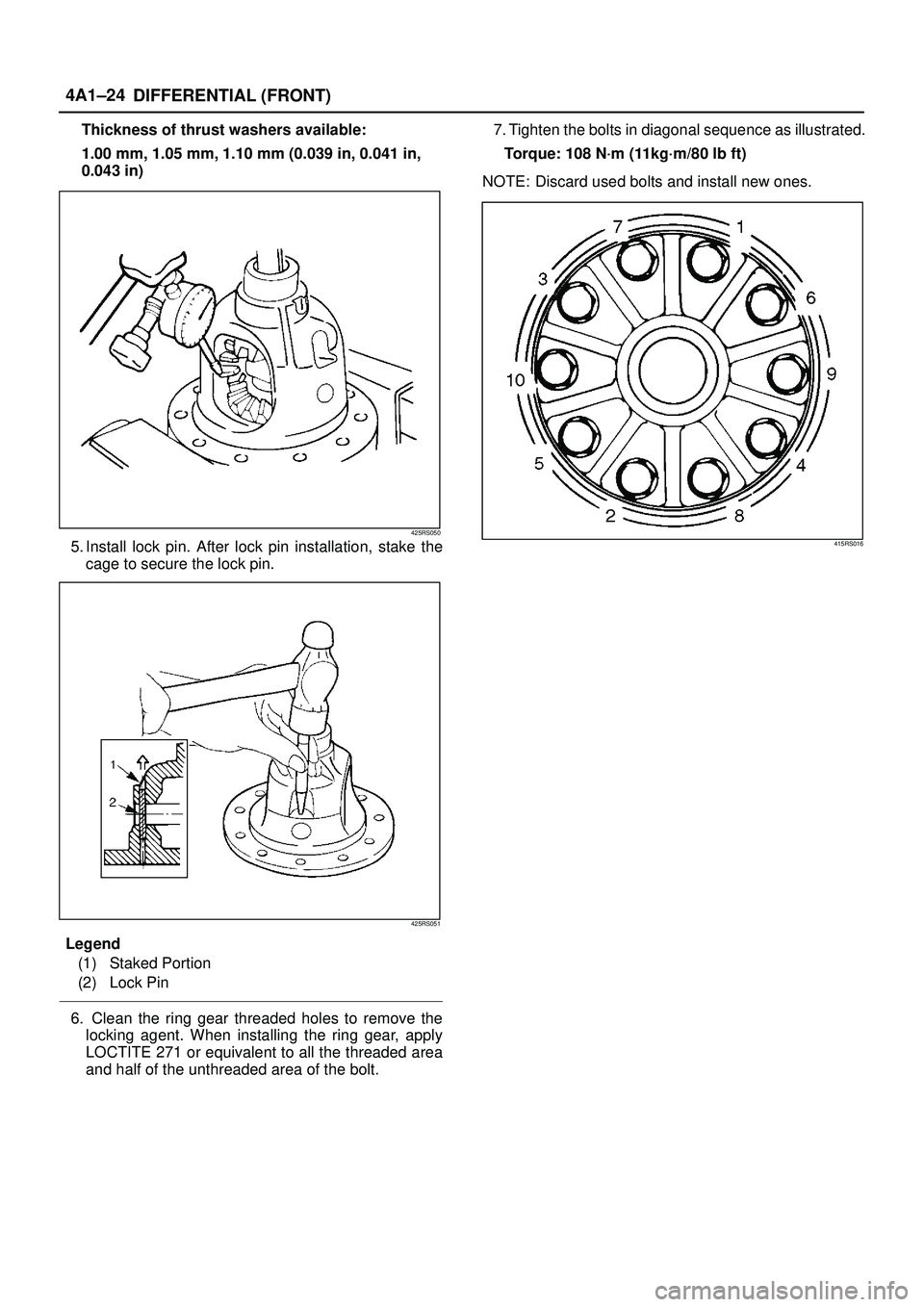
DIFFERENTIAL (FRONT) 4A1±24
Thickness of thrust washers available:
1.00 mm, 1.05 mm, 1.10 mm (0.039 in, 0.041 in,
0.043 in)
425RS050
5. Install lock pin. After lock pin installation, stake the
cage to secure the lock pin.
425RS051
Legend
(1) Staked Portion
(2) Lock Pin
6. Clean the ring gear threaded holes to remove the
locking agent. When installing the ring gear, apply
LOCTITE 271 or equivalent to all the threaded area
and half of the unthreaded area of the bolt.7. Tighten the bolts in diagonal sequence as illustrated.
Torque: 108 N´m (11kg´m/80 lb ft)
NOTE: Discard used bolts and install new ones.
415RS016
Page 491 of 3573
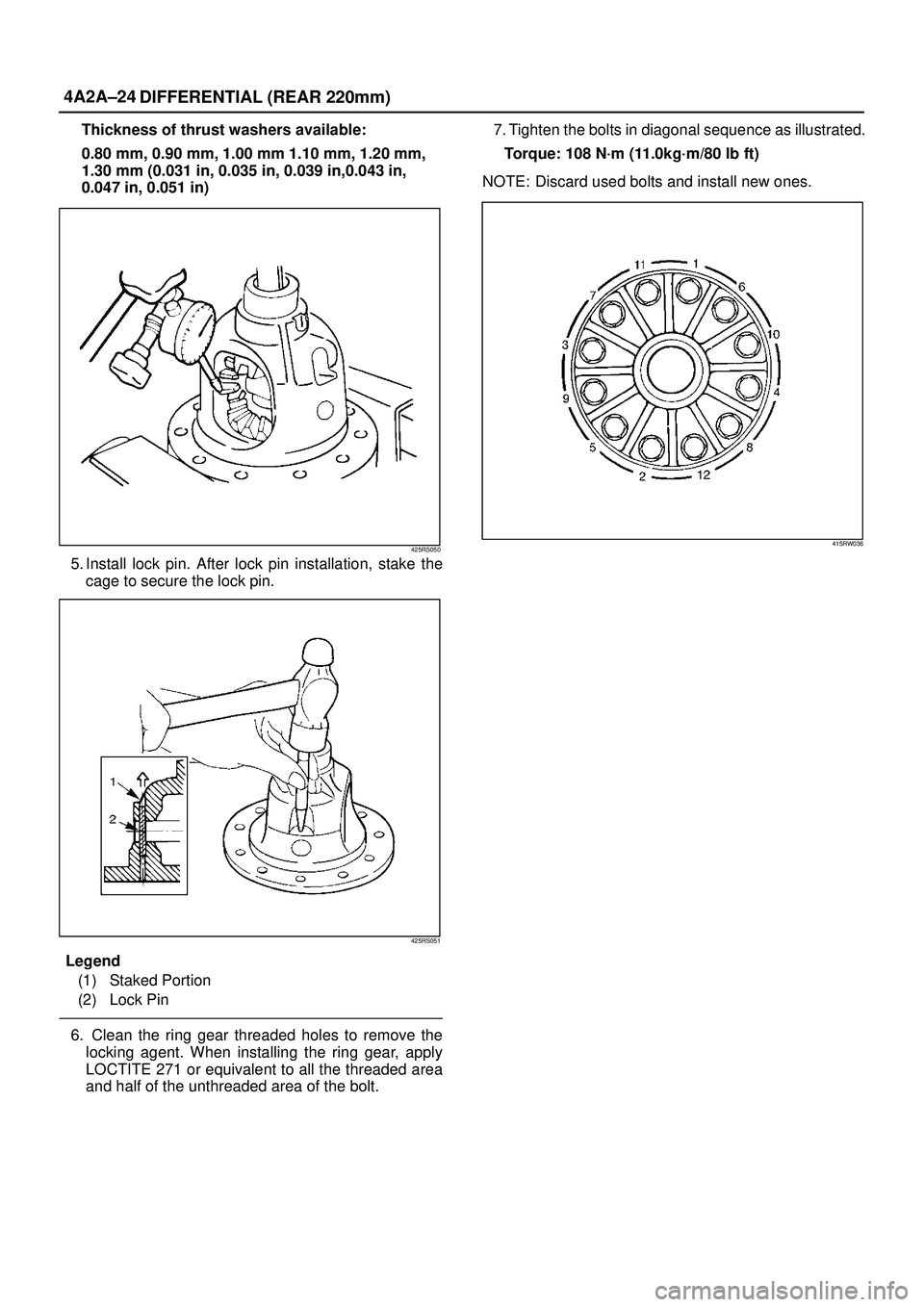
4A2A±24
DIFFERENTIAL (REAR 220mm)
Thickness of thrust washers available:
0.80 mm, 0.90 mm, 1.00 mm 1.10 mm, 1.20 mm,
1.30 mm (0.031 in, 0.035 in, 0.039 in,0.043 in,
0.047 in, 0.051 in)
425RS050
5. Install lock pin. After lock pin installation, stake the
cage to secure the lock pin.
425RS051
Legend
(1) Staked Portion
(2) Lock Pin
6. Clean the ring gear threaded holes to remove the
locking agent. When installing the ring gear, apply
LOCTITE 271 or equivalent to all the threaded area
and half of the unthreaded area of the bolt.7. Tighten the bolts in diagonal sequence as illustrated.
Torque: 108 N´m (11.0kg´m/80 lb ft)
NOTE: Discard used bolts and install new ones.
415RW036