boot ISUZU TROOPER 1998 Service User Guide
[x] Cancel search | Manufacturer: ISUZU, Model Year: 1998, Model line: TROOPER, Model: ISUZU TROOPER 1998Pages: 3573, PDF Size: 60.36 MB
Page 403 of 3573
FRONT SUSPENSION 3C – 15
REMOVAL
Preparation:
1) Raise the vehicle and support the frame with suitable
safety stands.
2) Remove wheel and tire assembly. Refer to “Wheels
and Tires” in section 3E.
3) Remove the brake caliper and disconnect flexible hose.
Refer to “Brakes” in section 5.
4) Support lower control arm with a jack.
1. Speed Sensor Cable (if equipped with ABS)
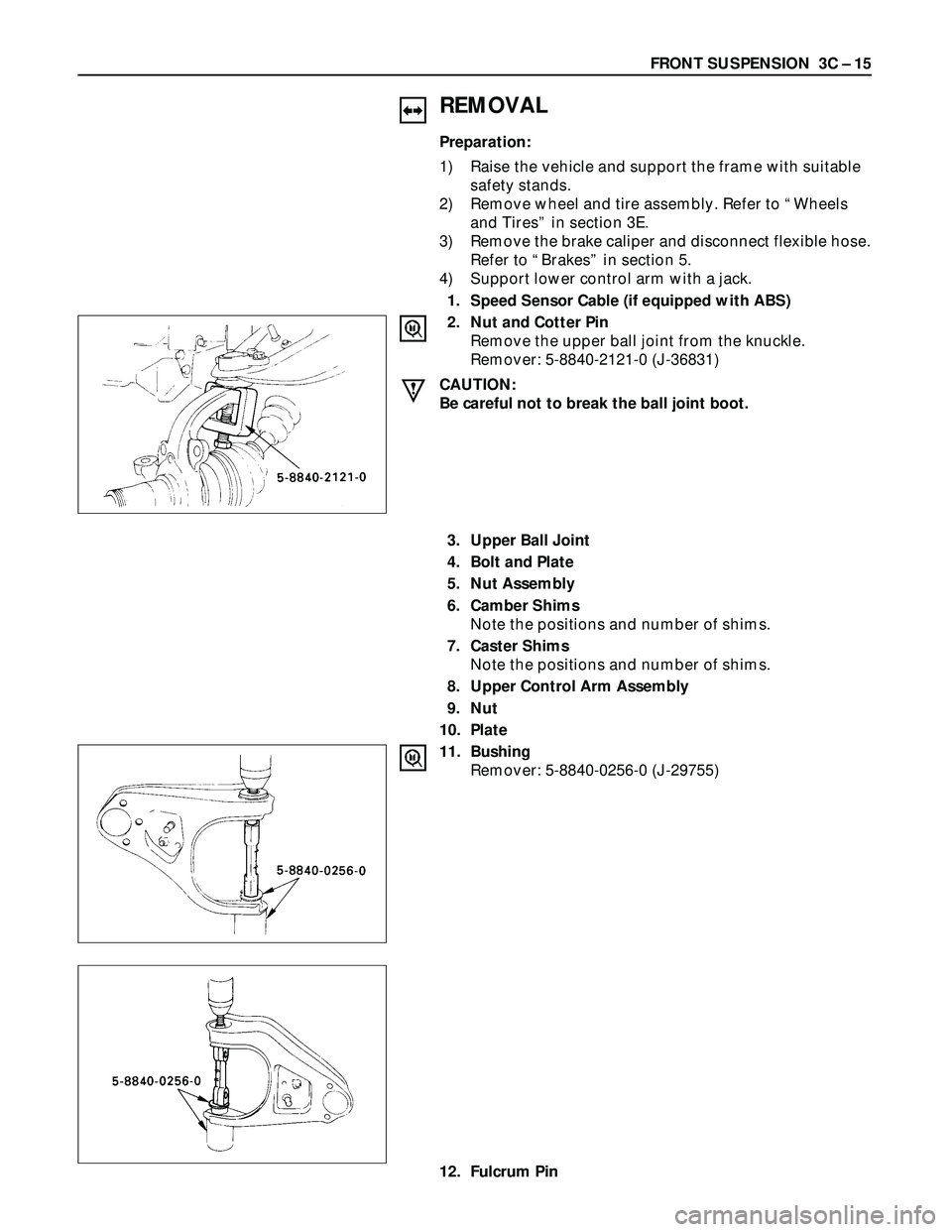
2. Nut and Cotter Pin
Remove the upper ball joint from the knuckle.
Remover: 5-8840-2121-0 (J-36831)
CAUTION:
Be careful not to break the ball joint boot.
3. Upper Ball Joint
4. Bolt and Plate
5. Nut Assembly
6. Camber Shims
Note the positions and number of shims.
7. Caster Shims
Note the positions and number of shims.
8. Upper Control Arm Assembly
9. Nut
10. Plate
11. Bushing
Remover: 5-8840-0256-0 (J-29755)
12. Fulcrum Pin
Page 411 of 3573
FRONT SUSPENSION 3C – 23
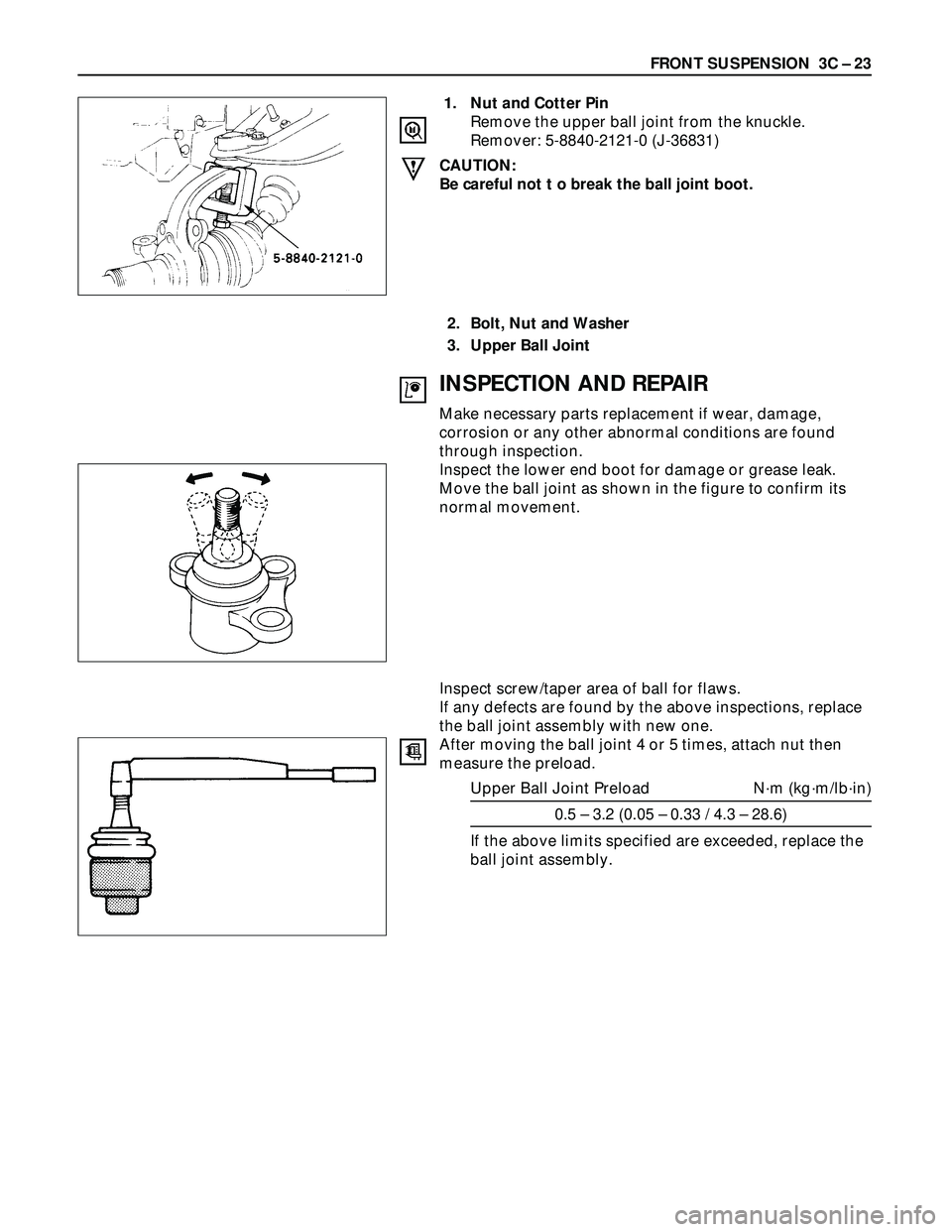
1. Nut and Cotter Pin
Remove the upper ball joint from the knuckle.
Remover: 5-8840-2121-0 (J-36831)
CAUTION:
Be careful not t o break the ball joint boot.
2. Bolt, Nut and Washer
3. Upper Ball Joint
INSPECTION AND REPAIR
Make necessary parts replacement if wear, damage,
corrosion or any other abnormal conditions are found
through inspection.
Inspect the lower end boot for damage or grease leak.
Move the ball joint as shown in the figure to confirm its
normal movement.
Inspect screw/taper area of ball for flaws.
If any defects are found by the above inspections, replace
the ball joint assembly with new one.
After moving the ball joint 4 or 5 times, attach nut then
measure the preload.
Upper Ball Joint Preload N·m (kg·m/lb·in)
0.5 – 3.2 (0.05 – 0.33 / 4.3 – 28.6)
If the above limits specified are exceeded, replace the
ball joint assembly.
Page 414 of 3573
3C – 26 FRONT SUSPENSION
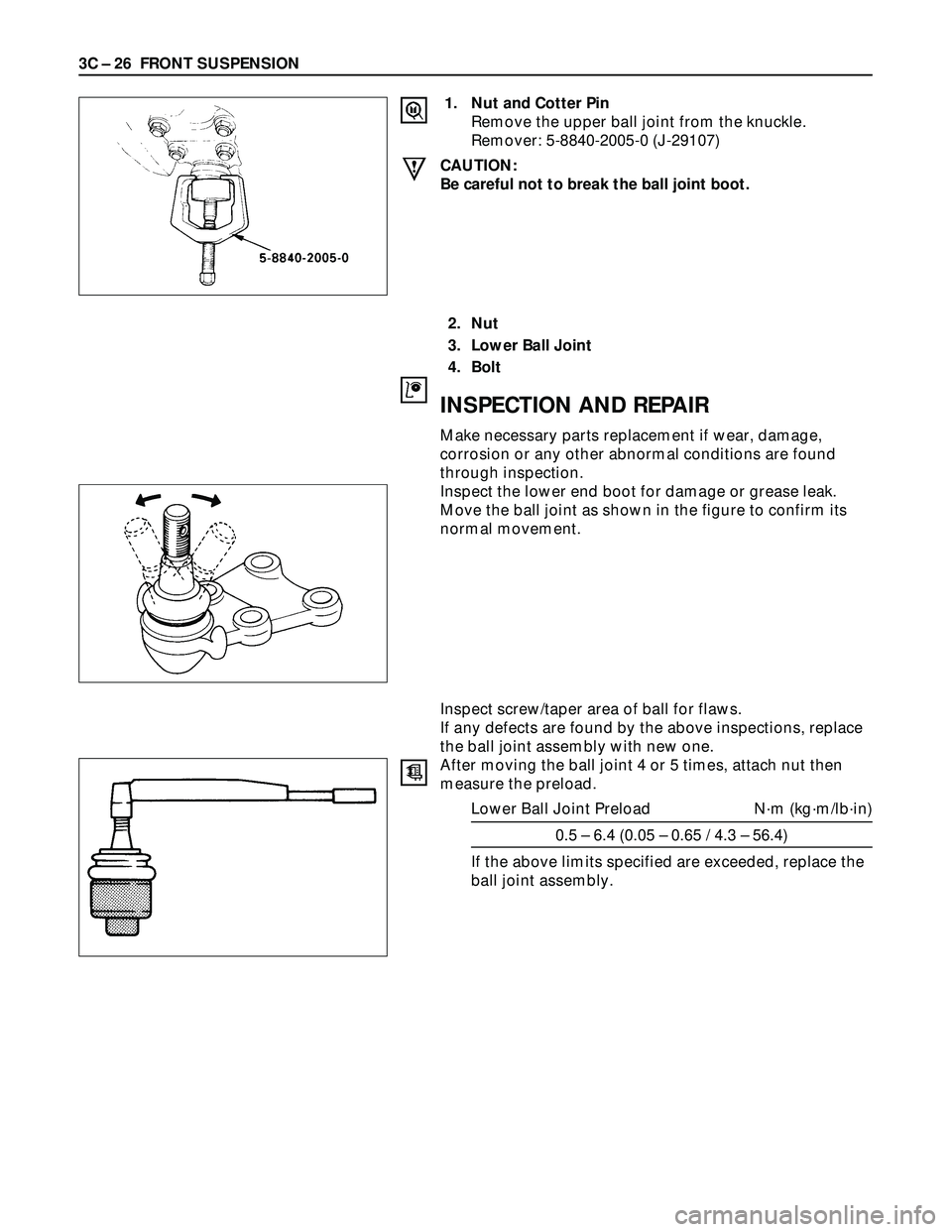
1. Nut and Cotter Pin
Remove the upper ball joint from the knuckle.
Remover: 5-8840-2005-0 (J-29107)
CAUTION:
Be careful not to break the ball joint boot.
2. Nut
3. Lower Ball Joint
4. Bolt
INSPECTION AND REPAIR
Make necessary parts replacement if wear, damage,
corrosion or any other abnormal conditions are found
through inspection.
Inspect the lower end boot for damage or grease leak.
Move the ball joint as shown in the figure to confirm its
normal movement.
Inspect screw/taper area of ball for flaws.
If any defects are found by the above inspections, replace
the ball joint assembly with new one.
After moving the ball joint 4 or 5 times, attach nut then
measure the preload.
Lower Ball Joint Preload N·m (kg·m/lb·in)
0.5 – 6.4 (0.05 – 0.65 / 4.3 – 56.4)
If the above limits specified are exceeded, replace the
ball joint assembly.
Page 430 of 3573
REAR SUSPENSION; COIL SPRING 3D – 15
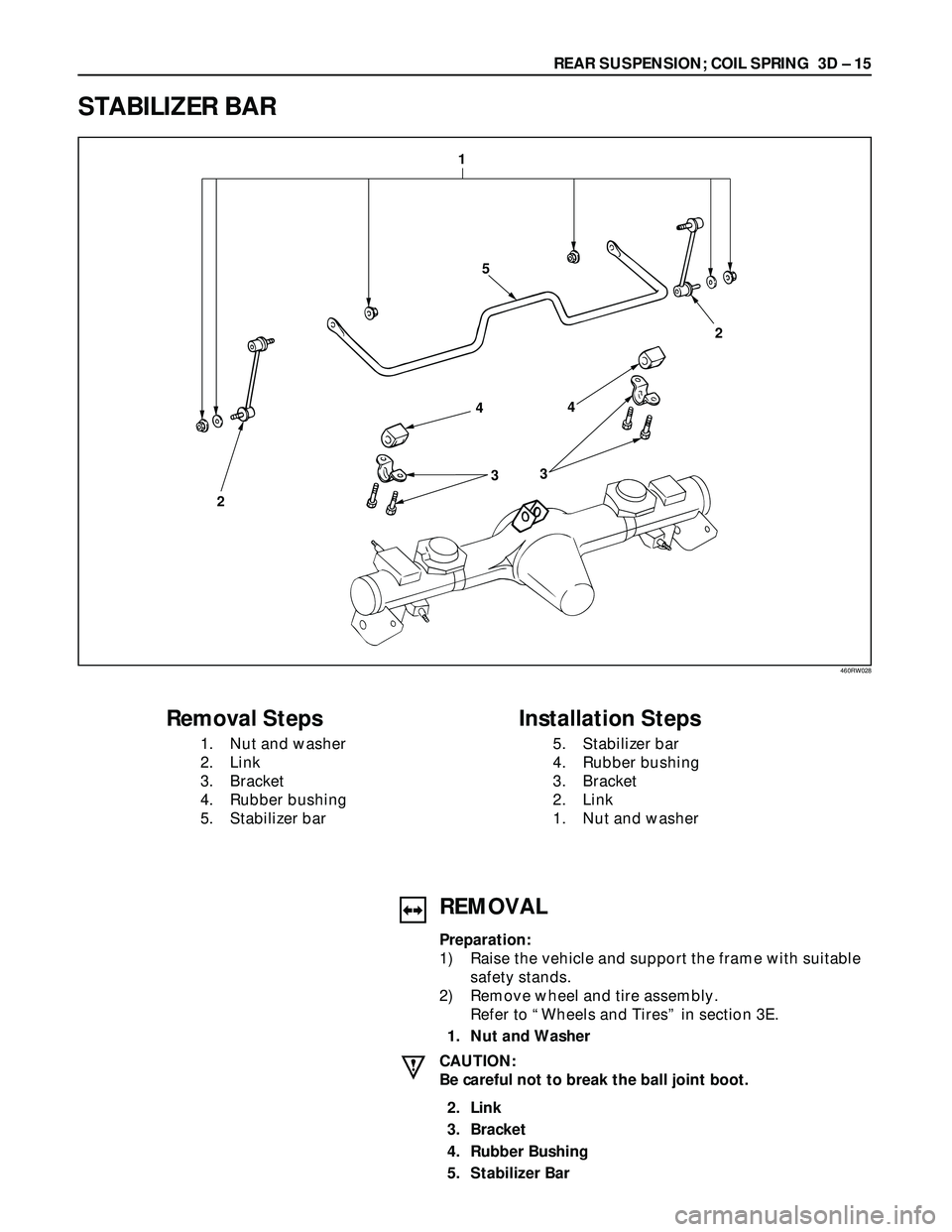
STABILIZER BAR
1
5
2
44
33
2
Removal Steps
1. Nut and washer
2. Link
3. Bracket
4. Rubber bushing
5. Stabilizer bar
Installation Steps
5. Stabilizer bar
4. Rubber bushing
3. Bracket
2. Link
1. Nut and washer
REMOVAL
Preparation:
1) Raise the vehicle and support the frame with suitable
safety stands.
2) Remove wheel and tire assembly.
Refer to “Wheels and Tires” in section 3E.
1. Nut and Washer
CAUTION:
Be careful not to break the ball joint boot.
2. Link
3. Bracket
4. Rubber Bushing
5. Stabilizer Bar
460RW028
Page 705 of 3573
4C±39 DRIVE SHAFT SYSTEM
401RW053
401RW052
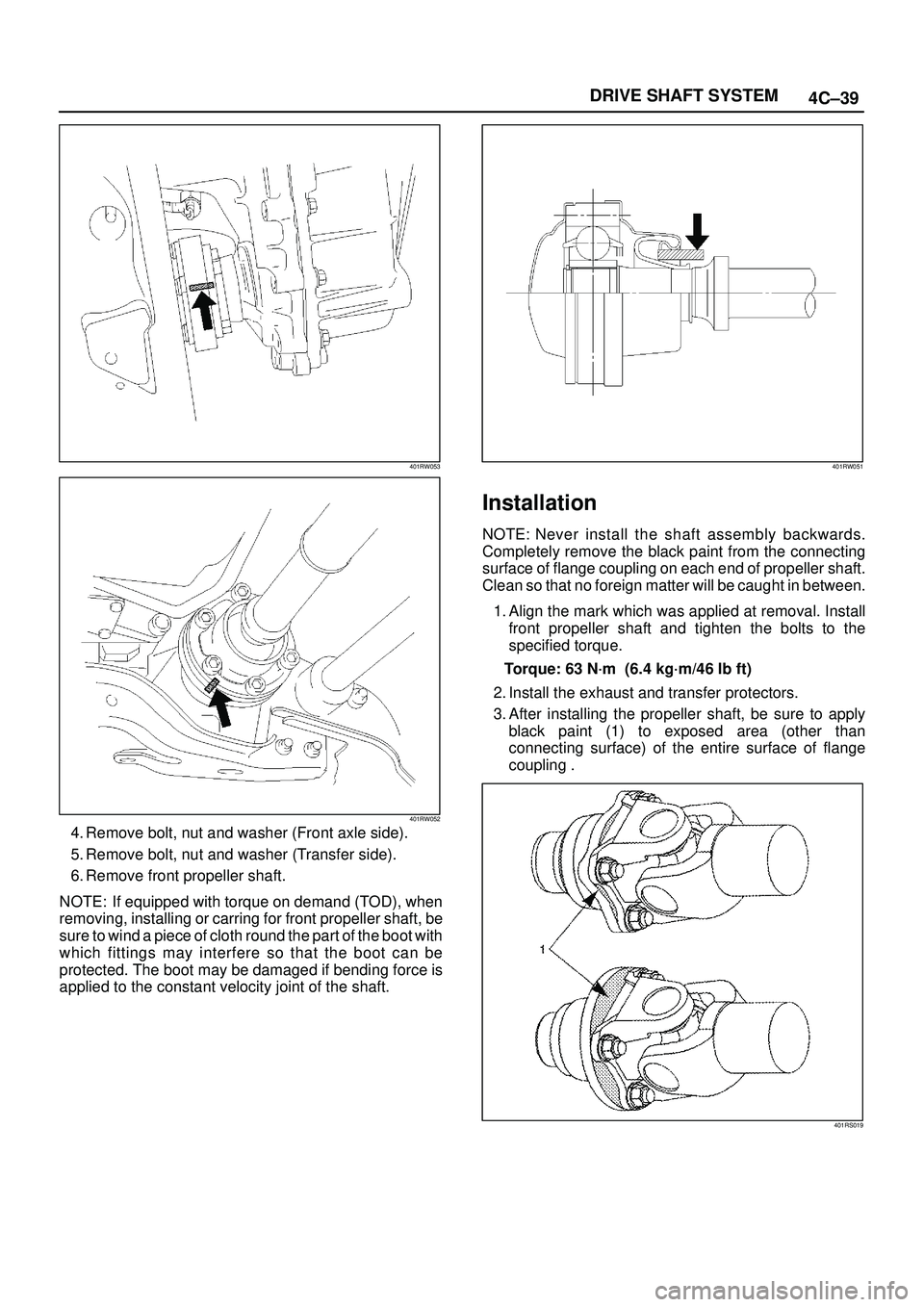
4. Remove bolt, nut and washer (Front axle side).
5. Remove bolt, nut and washer (Transfer side).
6. Remove front propeller shaft.
NOTE: If equipped with torque on demand (TOD), when
removing, installing or carring for front propeller shaft, be
sure to wind a piece of cloth round the part of the boot with
which fittings may interfere so that the boot can be
protected. The boot may be damaged if bending force is
applied to the constant velocity joint of the shaft.
401RW051
Installation
NOTE: Never install the shaft assembly backwards.
Completely remove the black paint from the connecting
surface of flange coupling on each end of propeller shaft.
Clean so that no foreign matter will be caught in between.
1. Align the mark which was applied at removal. Install
front propeller shaft and tighten the bolts to the
specified torque.
Torque: 63 N´m (6.4 kg´m/46 lb ft)
2. Install the exhaust and transfer protectors.
3. After installing the propeller shaft, be sure to apply
black paint (1) to exposed area (other than
connecting surface) of the entire surface of flange
coupling .
401RS019
Page 709 of 3573
4C±43 DRIVE SHAFT SYSTEM
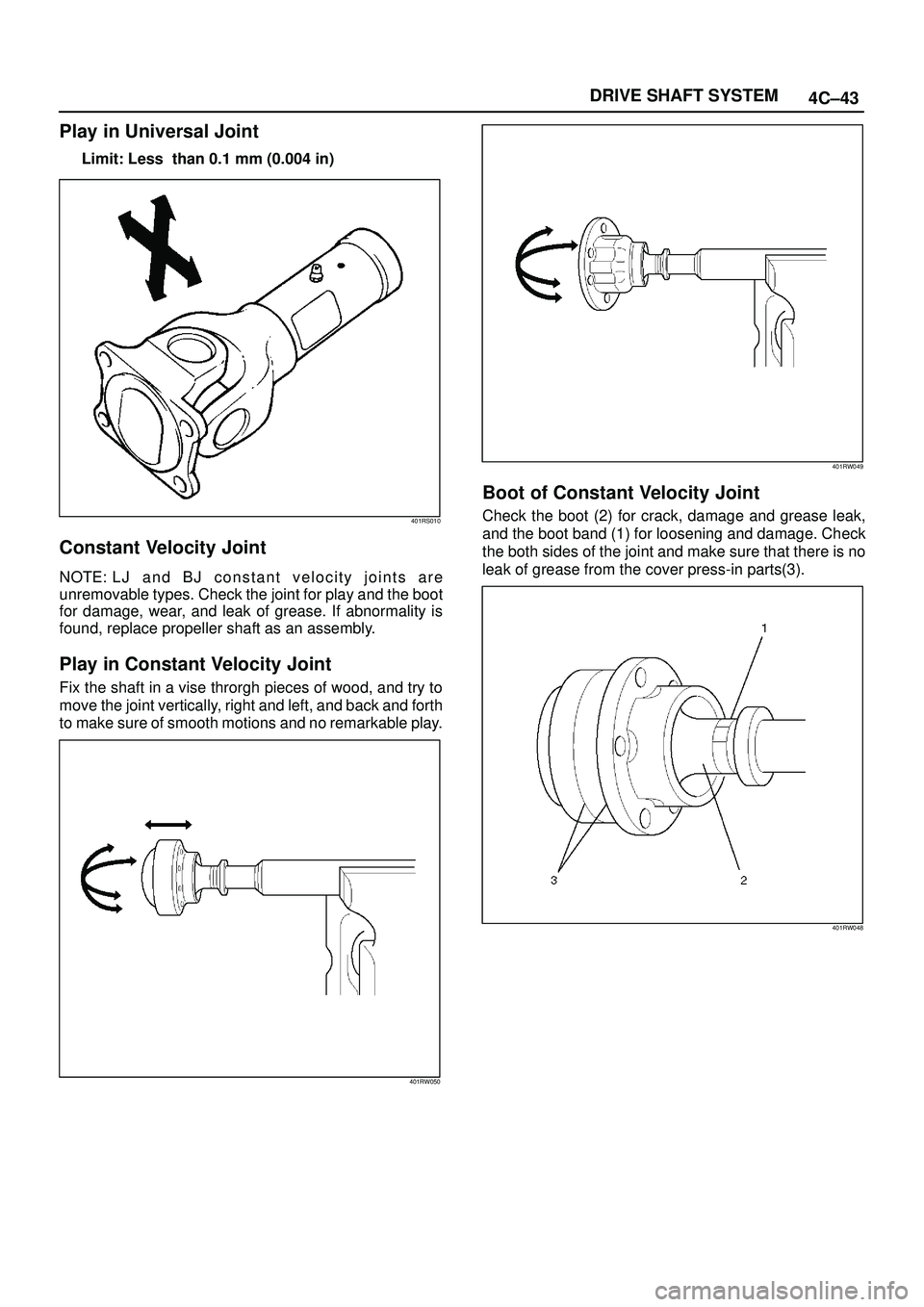
Play in Universal Joint
Limit: Less than 0.1 mm (0.004 in)
401RS010
Constant Velocity Joint
NOTE: L J a n d B J constant velocity joints are
unremovable types. Check the joint for play and the boot
for damage, wear, and leak of grease. If abnormality is
found, replace propeller shaft as an assembly.
Play in Constant Velocity Joint
Fix the shaft in a vise throrgh pieces of wood, and try to
move the joint vertically, right and left, and back and forth
to make sure of smooth motions and no remarkable play.
401RW050
401RW049
Boot of Constant Velocity Joint
Check the boot (2) for crack, damage and grease leak,
and the boot band (1) for loosening and damage. Check
the both sides of the joint and make sure that there is no
leak of grease from the cover press-in parts(3).
401RW048
Page 927 of 3573
POWER ASSISTED BRAKE SYSTEM 5C – 49
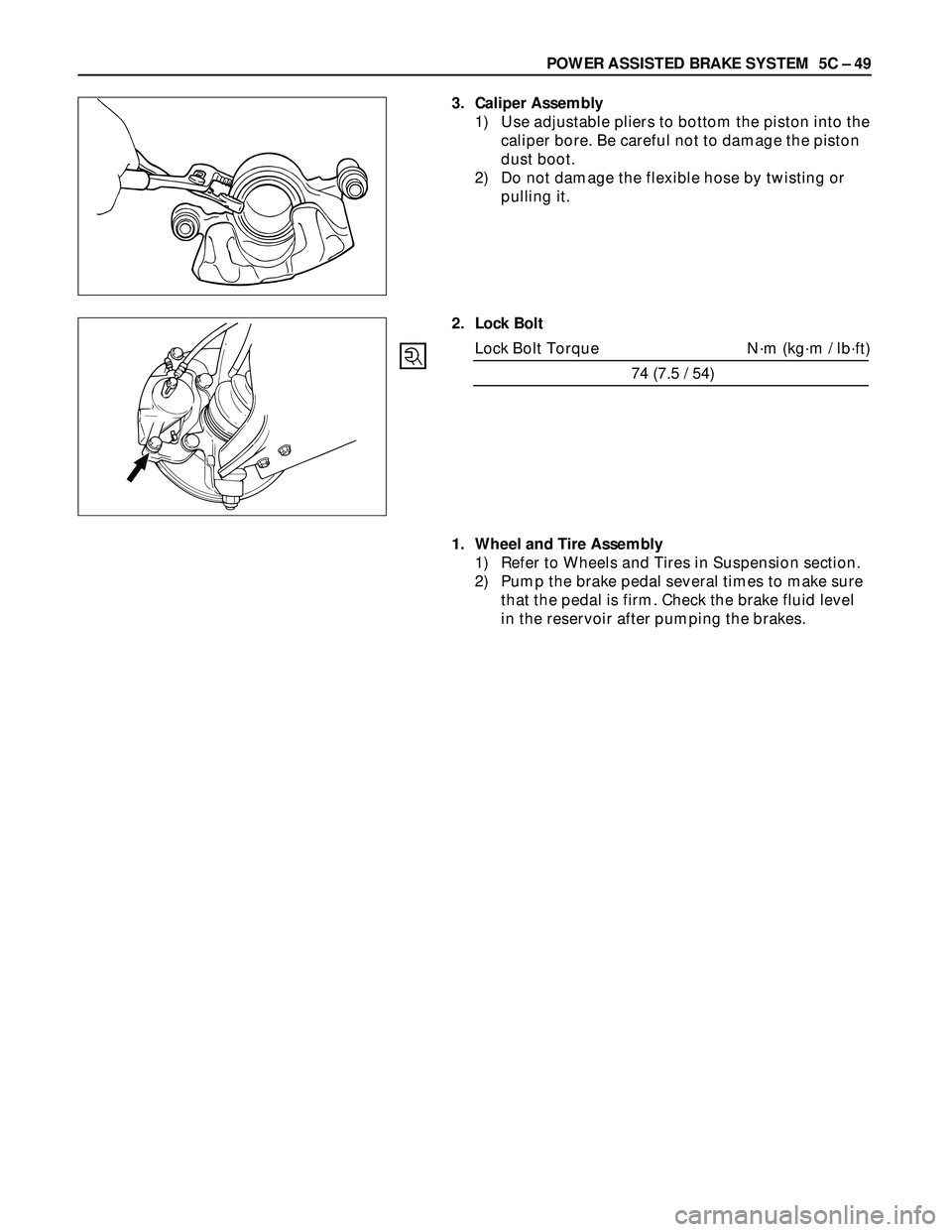
3. Caliper Assembly
1) Use adjustable pliers to bottom the piston into the
caliper bore. Be careful not to damage the piston
dust boot.
2) Do not damage the flexible hose by twisting or
pulling it.
2. Lock Bolt
Lock Bolt Torque N·m (kg·m / lb·ft)
74 (7.5 / 54)
1. Wheel and Tire Assembly
1) Refer to Wheels and Tires in Suspension section.
2) Pump the brake pedal several times to make sure
that the pedal is firm. Check the brake fluid level
in the reservoir after pumping the brakes.
Page 931 of 3573
POWER ASSISTED BRAKE SYSTEM 5C – 53
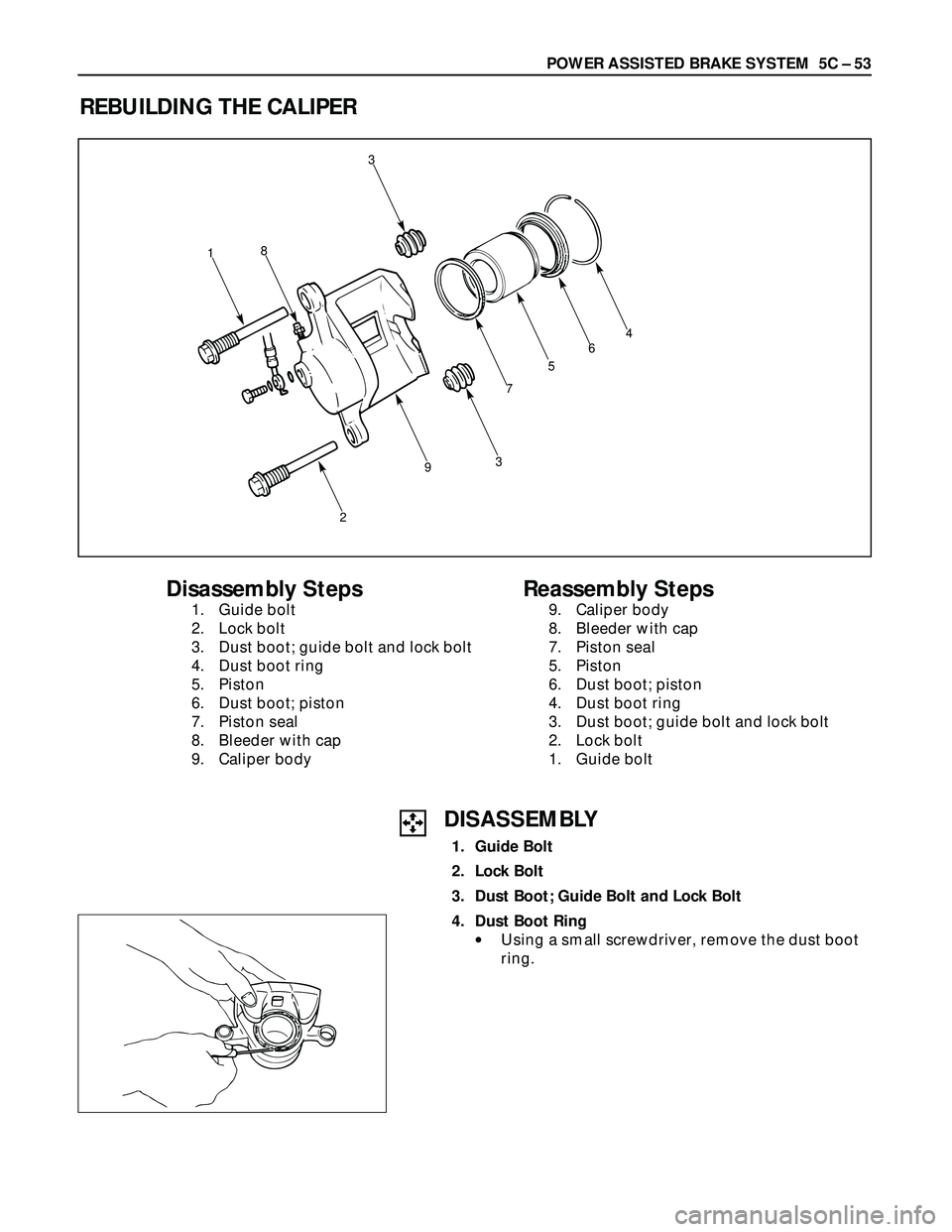
DISASSEMBLY
1. Guide Bolt
2. Lock Bolt
3. Dust Boot; Guide Bolt and Lock Bolt
4. Dust Boot Ring
•Using a small screwdriver, remove the dust boot
ring.
REBUILDING THE CALIPER
4
6
5
7
3 8
3
2
1
9
Disassembly Steps
1. Guide bolt
2. Lock bolt
3. Dust boot; guide bolt and lock bolt
4. Dust boot ring
5. Piston
6. Dust boot; piston
7. Piston seal
8. Bleeder with cap
9. Caliper body
Reassembly Steps
9. Caliper body
8. Bleeder with cap
7. Piston seal
5. Piston
6. Dust boot; piston
4. Dust boot ring
3. Dust boot; guide bolt and lock bolt
2. Lock bolt
1. Guide bolt
Page 932 of 3573
5C – 54 POWER ASSISTED BRAKE SYSTEM
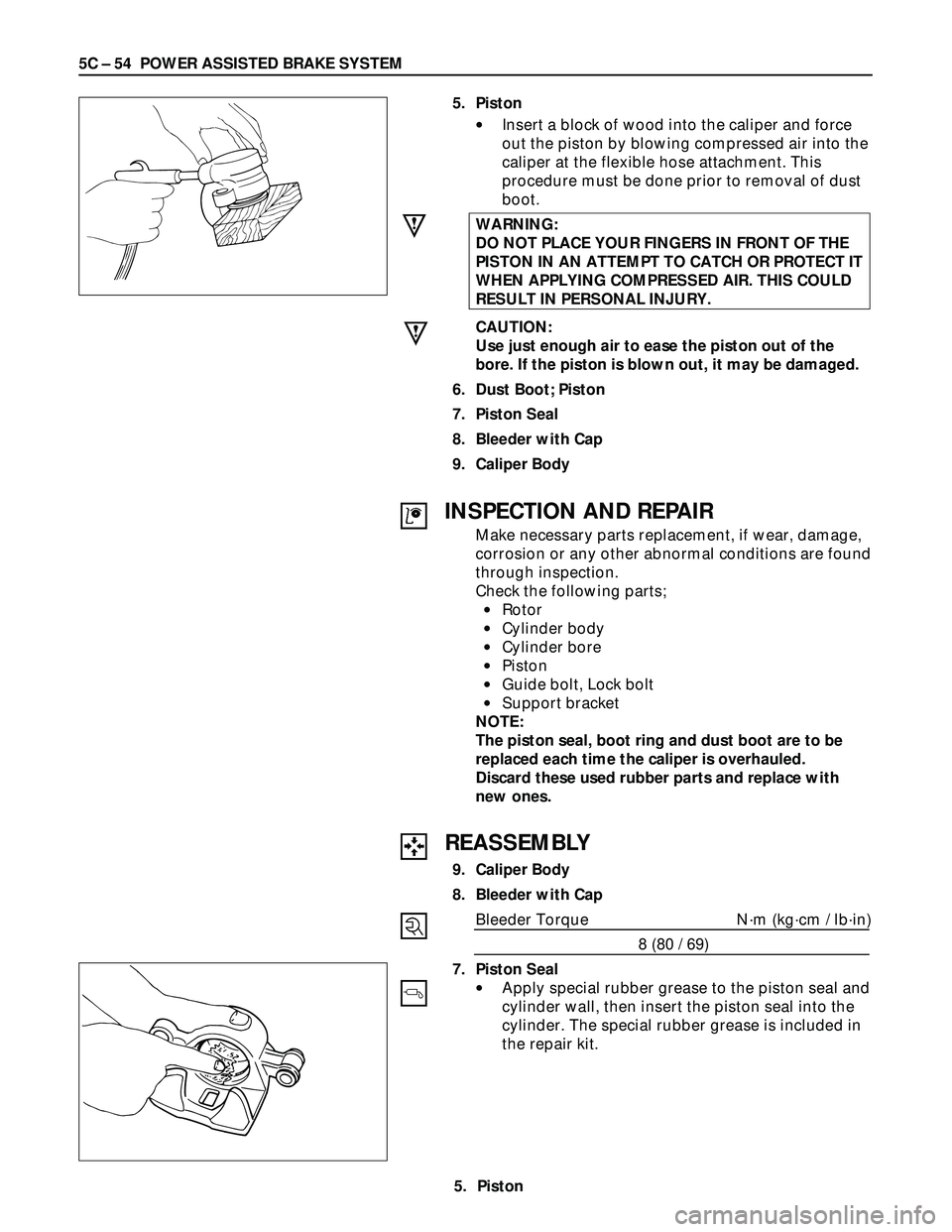
5. Piston
•Insert a block of wood into the caliper and force
out the piston by blowing compressed air into the
caliper at the flexible hose attachment. This
procedure must be done prior to removal of dust
boot.
WARNING:
DO NOT PLACE YOUR FINGERS IN FRONT OF THE
PISTON IN AN ATTEMPT TO CATCH OR PROTECT IT
WHEN APPLYING COMPRESSED AIR. THIS COULD
RESULT IN PERSONAL INJURY.
CAUTION:
Use just enough air to ease the piston out of the
bore. If the piston is blown out, it may be damaged.
6. Dust Boot; Piston
7. Piston Seal
8. Bleeder with Cap
9. Caliper Body
REASSEMBLY
9. Caliper Body
8. Bleeder with Cap
Bleeder Torque N·m (kg·cm / lb·in)
8 (80 / 69)
7. Piston Seal
•Apply special rubber grease to the piston seal and
cylinder wall, then insert the piston seal into the
cylinder. The special rubber grease is included in
the repair kit.
INSPECTION AND REPAIR
Make necessary parts replacement, if wear, damage,
corrosion or any other abnormal conditions are found
through inspection.
Check the following parts;
•Rotor
•Cylinder body
•Cylinder bore
•Piston
•Guide bolt, Lock bolt
•Support bracket
NOTE:
The piston seal, boot ring and dust boot are to be
replaced each time the caliper is overhauled.
Discard these used rubber parts and replace with
new ones.
5. Piston
Page 933 of 3573
POWER ASSISTED BRAKE SYSTEM 5C – 55
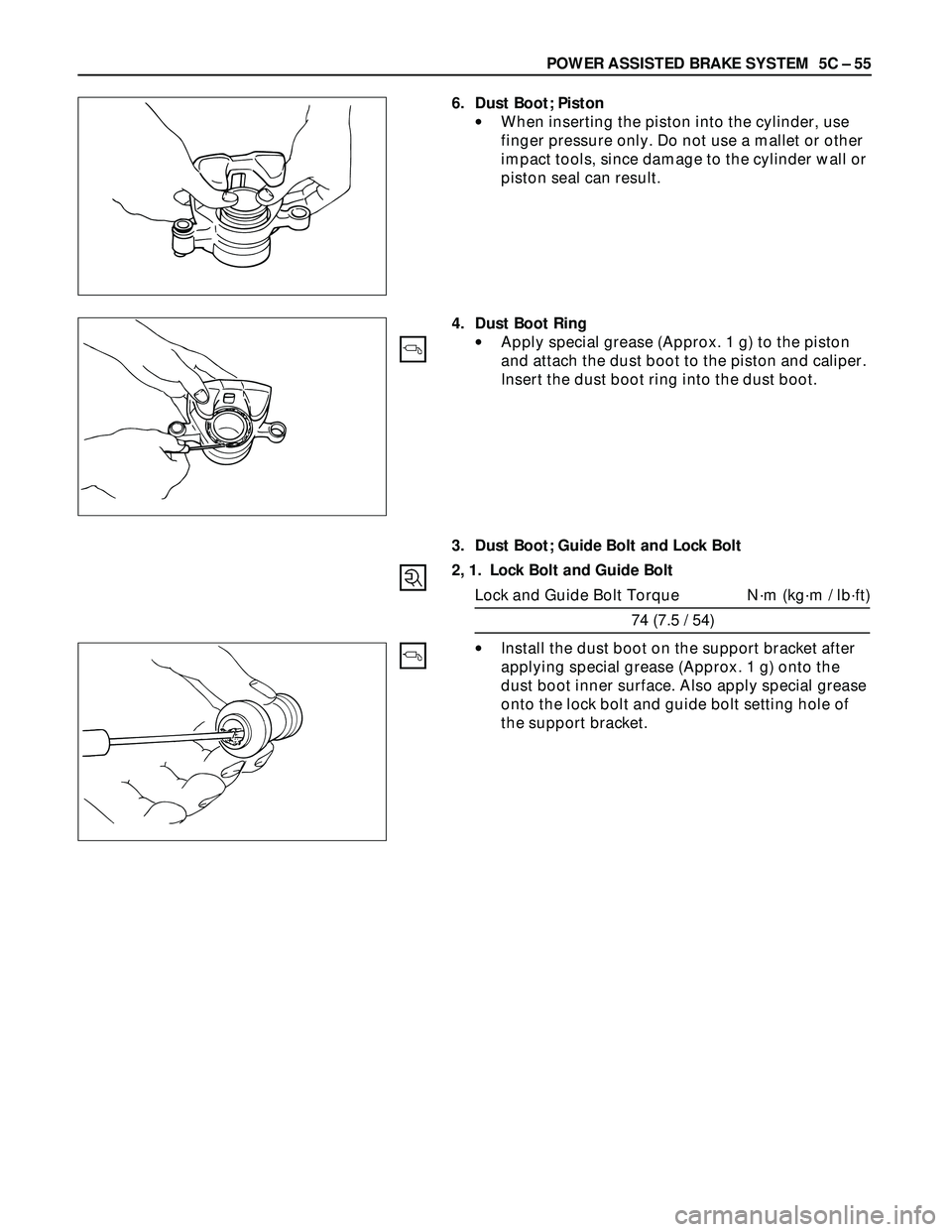
6. Dust Boot; Piston
•When inserting the piston into the cylinder, use
finger pressure only. Do not use a mallet or other
impact tools, since damage to the cylinder wall or
piston seal can result.
4. Dust Boot Ring
•Apply special grease (Approx. 1 g) to the piston
and attach the dust boot to the piston and caliper.
Insert the dust boot ring into the dust boot.
3. Dust Boot; Guide Bolt and Lock Bolt
2, 1. Lock Bolt and Guide Bolt
Lock and Guide Bolt Torque N·m (kg·m / lb·ft)
74 (7.5 / 54)
•Install the dust boot on the support bracket after
applying special grease (Approx. 1 g) onto the
dust boot inner surface. Also apply special grease
onto the lock bolt and guide bolt setting hole of
the support bracket.