service ISUZU TROOPER 1998 Service Repair Manual
[x] Cancel search | Manufacturer: ISUZU, Model Year: 1998, Model line: TROOPER, Model: ISUZU TROOPER 1998Pages: 3573, PDF Size: 60.36 MB
Page 3472 of 3573
SUPPLEMENTAL RESTRAINT SYSTEM9J±35
Driver Air Bag Assembly
Service Precautions
WARNING: S A F E T Y P R ECAUTIONS MUST BE
FOLLOWED WHEN HANDLING A DEPLOYED AIR
BAG ASSEMBLY. AFTER DEPLOYMENT, THE AIR
BAG ASSEMBLY SURFACE MAY CONTAIN A SMALL
AMOUNT OF SODIUM HYDROXIDE, A BY±PRODUCT
OF THE DEPLOYMENT REACTION, THAT IS
IRRITATING TO THE SKIN AND EYES. MOST OF THE
POWER ON THE AIR BAG ASSEMBLY IS
HARMLESS. AS A PRECAUTION, WEAR GLOVES
AND SAFETY GLASSES WHEN HANDLING A
DEPLOYED AIR BAG ASSEMBLY, AND WASH YOUR
HANDS WITH MILD SOAP AND WATER
AFTERWARDS.
WARNING: W H E N C A R RY I N G A L I V E A I R B A G
ASSEMBLY, MAKE SURE THE BAG AND TRIM
COVER ARE POINTED AWAY FROM YOU. NEVER
CARRY AIR BAG ASSEMBLY BY THE WIRES OR
CONNECTOR ON THE UNDERSIDE OF MODULE. IN
THE CASE OF AN ACCIDENTAL DEPLOYMENT, THE
BAG WILL THEN DEPLOY WITH MINIMAL CHANCE
OF INJURY. WHEN PLACING ALIVE AIR BAG
ASSEMBLY ON A BENCH OR OTHER SURFACE,
ALWAYS FACE BAG AND TRIM COVER UP, AWAY
FROM THE SURFACE. NEVER REST A STEERING
COLUMN ASSEMBLY ON THE STEERING WHEEL
WITH THE AIR BAG ASSEMBLY FACE DOWN AND
COLUMN VERTICAL. THIS IS NECESSARY SO THAT
A FREE SPACE IS PROVIDED TO ALLOW THE AIR
BAG ASSEMBLY TO EXPAND IN THE UNLIKELY
EVENT OF ACCIDENTAL DEPLOYMENT.
OTHERWISE, PERSONAL INJURY COULD RESULT.
NOTE: In the event deployment has occurred, inspect
coil assembly wire for any signs of scorching, melting or
any other damage due to excessive heat. If the coil has
been damaged, replace it.
Removal
1. Disable the SRS (Refer to ªDisabling the SRSº in this
section).
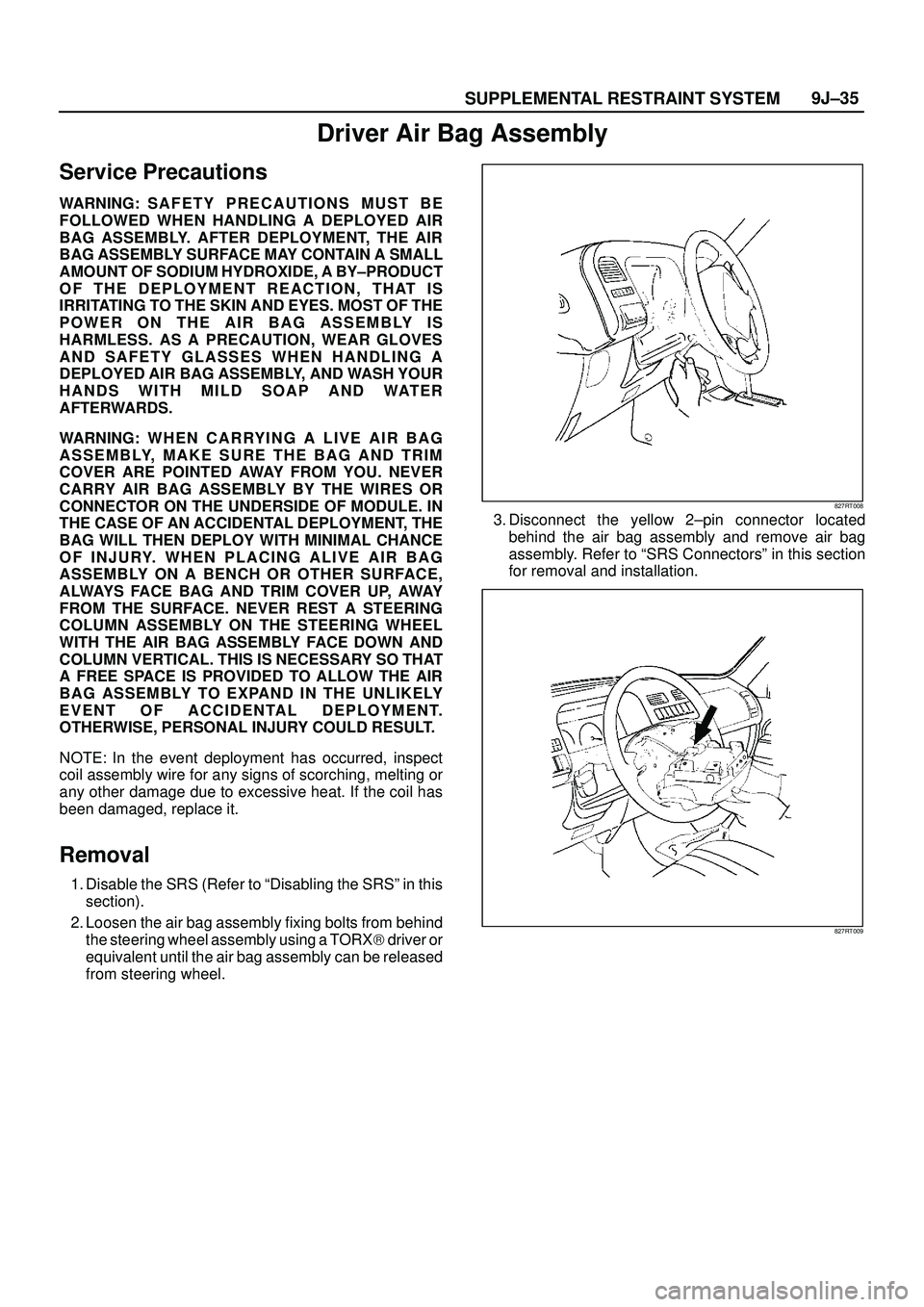
2. Loosen the air bag assembly fixing bolts from behind
the steering wheel assembly using a TORX) driver or
equivalent until the air bag assembly can be released
from steering wheel.
827RT008
3. Disconnect the yellow 2±pin connector located
behind the air bag assembly and remove air bag
assembly. Refer to ªSRS Connectorsº in this section
for removal and installation.
827RT009
Page 3474 of 3573

SUPPLEMENTAL RESTRAINT SYSTEM9J±37
Steering Wheel
Service Precautions
WARNING: S A F E T Y P R ECAUTIONS MUST BE
FOLLOWED WHEN HANDLING A DEPLOYED AIR
BAG ASSEMBLY. AFTER DEPLOYMENT, THE AIR
BAG ASSEMBLY SURFACE MAY CONTAIN A SMALL
AMOUNT OF SODIUM HYDROXIDE, A BY±PRODUCT
OF THE DEPLOYMENT REACTION, THAT IS
IRRITATING TO THE SKIN AND EYES. MOST OF THE
POWER ON THE AIR BAG ASSEMBLY IS
HARMLESS. AS A PRECAUTION, WEAR GLOVES
AND SAFETY GLASSES WHEN HANDLING A
DEPLOYED AIR BAG ASSEMBLY, AND WASH YOUR
HANDS WITH MILD SOAP AND WATER
AFTERWARDS.
WARNING: W H E N C A R RY I N G A L I V E A I R B A G
ASSEMBLY, MAKE SURE THE BAG AND TRIM
COVER ARE POINTED AWAY FROM YOU. NEVER
CARRY AIR BAG ASSEMBLY BY THE WIRES OR
CONNECTOR ON THE UNDERSIDE OF MODULE. IN
THE CASE OF AN ACCIDENTAL DEPLOYMENT, THE
BAG WILL THEN DEPLOY WITH MINIMAL CHANCE
OF INJURY. WHEN PLACING ALIVE AIR BAG
ASSEMBLY ON A BENCH OR OTHER SURFACE,
ALWAYS FACE BAG AND RIM COVER UP, AWAY
FROM THE SURFACE. NEVER REST A STEERING
COLUMN ASSEMBLY ON THE STEERING WHEEL
WITH THE AIR BAG ASSEMBLY FACE DOWN AND
COLUMN VERTICAL. THIS IS NECESSARY SO THAT
A FREE SPACE IS PROVIDED TO ALLOW THE AIR
BAG ASSEMBLY TO EXPAND IN THE UNLIKELY
EVENT OF ACCIDENTAL DEPLOYMENT.
OTHERWISE, PERSONAL INJURY COULD RESULT.
NOTE: In the event deployment has occurred, inspect
coil assembly wire for any signs of scorching, melting or
any other damage due to excessive heat. If the coil has
been damaged, replace it.
Removal
1. Disable the SRS (Refer to ªDisabling the SRSº in this
section).
2. Loosen the air bag assembly fixing bolts from behind
the steering wheel assembly using a TORX) driver or
equivalent until the air bag assembly can be released
from steering wheel.
827RT008
3. Disconnect the yellow 2±pin connector located
behind the air bag assembly and remove air bag
assembly.Refer to ªSRS Connectorsº in this section
for removal and installation.
4. Disconnect horn lead.
827RT009
5. Remove steering wheel attachment nut.
Page 3476 of 3573
SUPPLEMENTAL RESTRAINT SYSTEM9J±39
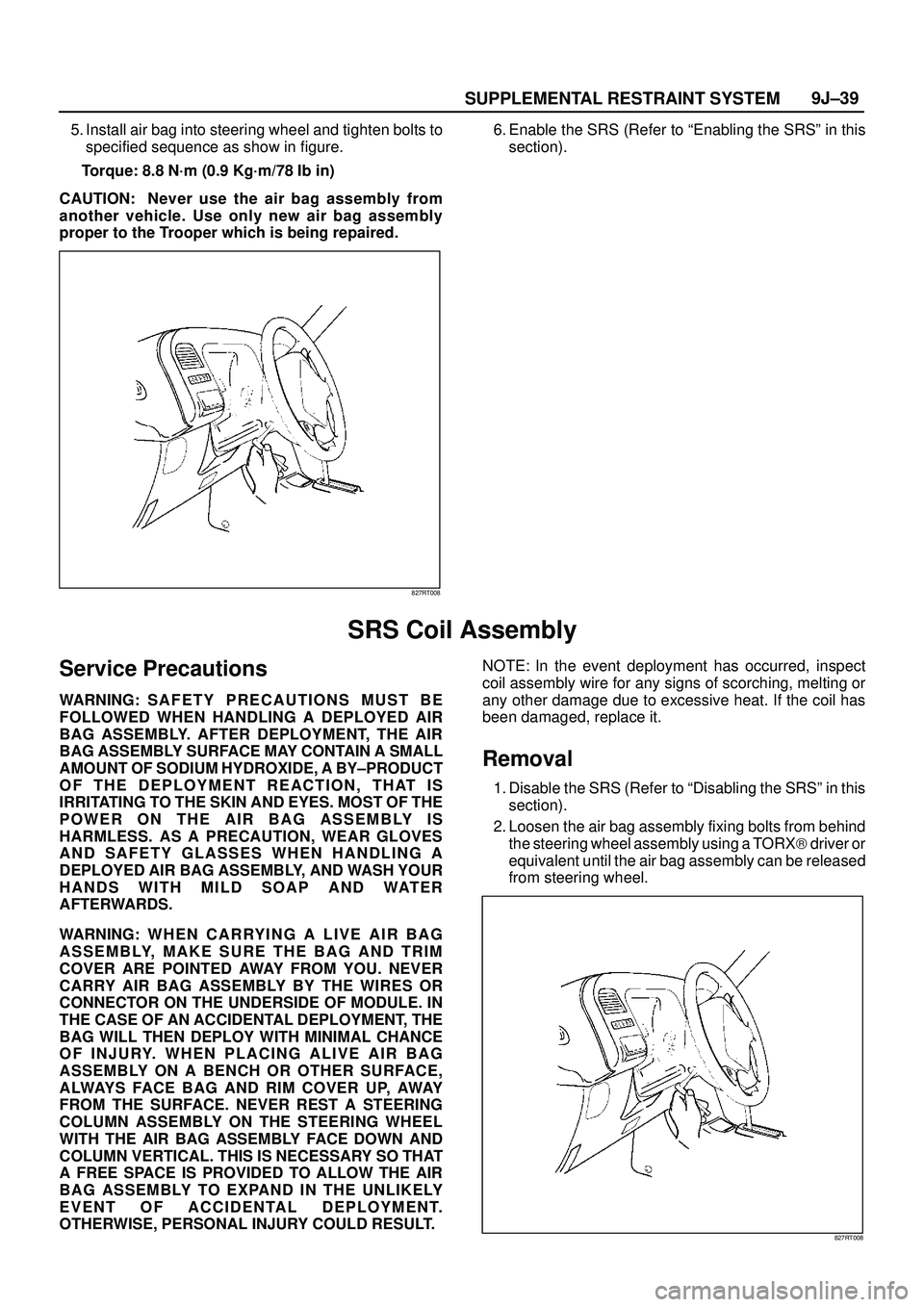
5. Install air bag into steering wheel and tighten bolts to
specified sequence as show in figure.
Torque: 8.8 N´m (0.9 Kg´m/78 Ib in)
CAUTION: Never use the air bag assembly from
another vehicle. Use only new air bag assembly
proper to the Trooper which is being repaired.
827RT008
6. Enable the SRS (Refer to ªEnabling the SRSº in this
section).
SRS Coil Assembly
Service Precautions
WARNING: S A F E T Y P R ECAUTIONS MUST BE
FOLLOWED WHEN HANDLING A DEPLOYED AIR
BAG ASSEMBLY. AFTER DEPLOYMENT, THE AIR
BAG ASSEMBLY SURFACE MAY CONTAIN A SMALL
AMOUNT OF SODIUM HYDROXIDE, A BY±PRODUCT
OF THE DEPLOYMENT REACTION, THAT IS
IRRITATING TO THE SKIN AND EYES. MOST OF THE
POWER ON THE AIR BAG ASSEMBLY IS
HARMLESS. AS A PRECAUTION, WEAR GLOVES
AND SAFETY GLASSES WHEN HANDLING A
DEPLOYED AIR BAG ASSEMBLY, AND WASH YOUR
HANDS WITH MILD SOAP AND WATER
AFTERWARDS.
WARNING: W H E N C A R RY I N G A L I V E A I R B A G
ASSEMBLY, MAKE SURE THE BAG AND TRIM
COVER ARE POINTED AWAY FROM YOU. NEVER
CARRY AIR BAG ASSEMBLY BY THE WIRES OR
CONNECTOR ON THE UNDERSIDE OF MODULE. IN
THE CASE OF AN ACCIDENTAL DEPLOYMENT, THE
BAG WILL THEN DEPLOY WITH MINIMAL CHANCE
OF INJURY. WHEN PLACING ALIVE AIR BAG
ASSEMBLY ON A BENCH OR OTHER SURFACE,
ALWAYS FACE BAG AND RIM COVER UP, AWAY
FROM THE SURFACE. NEVER REST A STEERING
COLUMN ASSEMBLY ON THE STEERING WHEEL
WITH THE AIR BAG ASSEMBLY FACE DOWN AND
COLUMN VERTICAL. THIS IS NECESSARY SO THAT
A FREE SPACE IS PROVIDED TO ALLOW THE AIR
BAG ASSEMBLY TO EXPAND IN THE UNLIKELY
EVENT OF ACCIDENTAL DEPLOYMENT.
OTHERWISE, PERSONAL INJURY COULD RESULT.NOTE: In the event deployment has occurred, inspect
coil assembly wire for any signs of scorching, melting or
any other damage due to excessive heat. If the coil has
been damaged, replace it.
Removal
1. Disable the SRS (Refer to ªDisabling the SRSº in this
section).
2. Loosen the air bag assembly fixing bolts from behind
the steering wheel assembly using a TORX) driver or
equivalent until the air bag assembly can be released
from steering wheel.
827RT008
Page 3481 of 3573
SUPPLEMENTAL RESTRAINT SYSTEM 9J±44
Installation
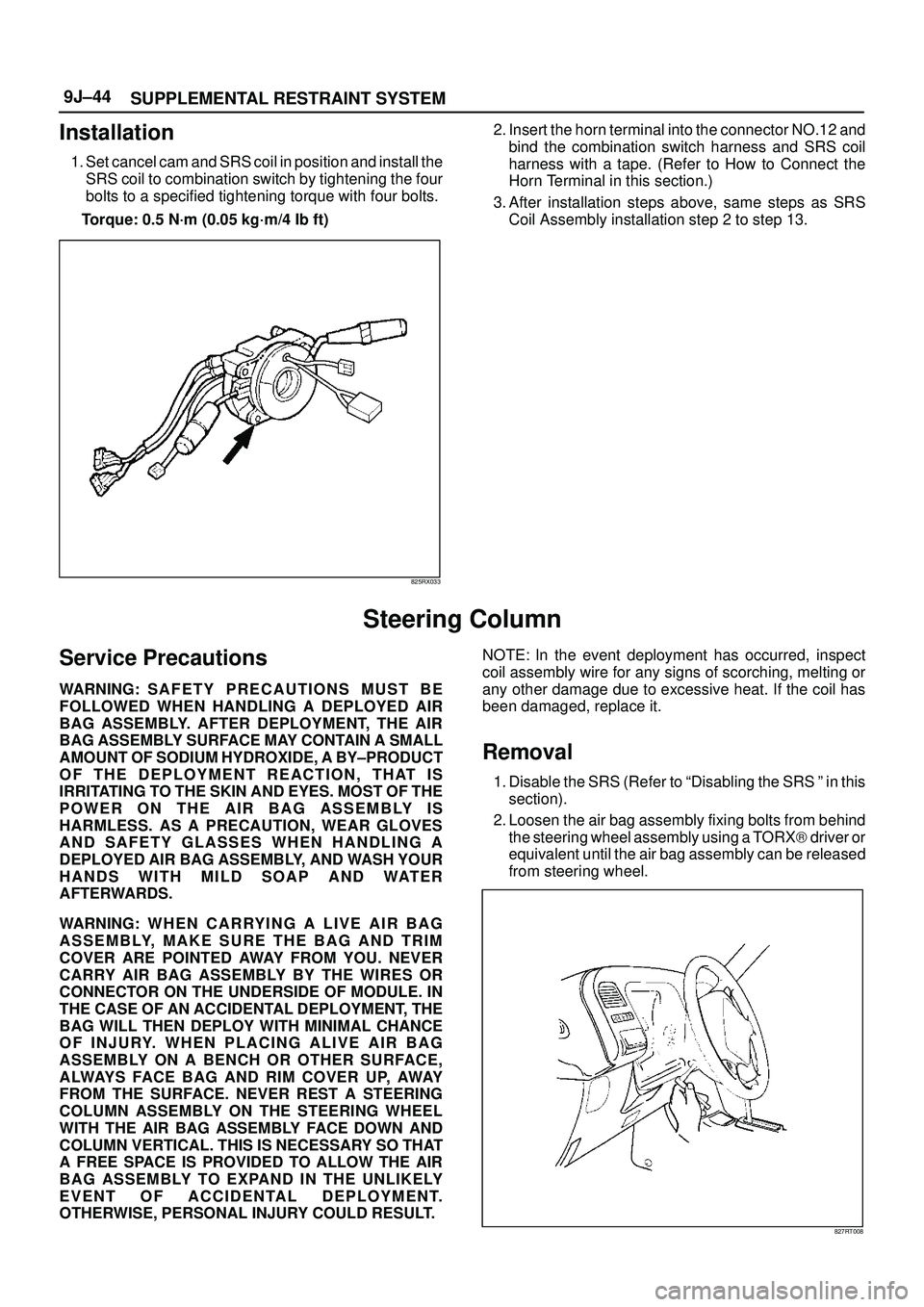
1. Set cancel cam and SRS coil in position and install the
SRS coil to combination switch by tightening the four
bolts to a specified tightening torque with four bolts.
Torque: 0.5 N´m (0.05 kg´m/4 Ib ft)
825RX033
2. Insert the horn terminal into the connector NO.12 and
bind the combination switch harness and SRS coil
harness with a tape. (Refer to How to Connect the
Horn Terminal in this section.)
3. After installation steps above, same steps as SRS
Coil Assembly installation step 2 to step 13.
Steering Column
Service Precautions
WARNING: S A F E T Y P R ECAUTIONS MUST BE
FOLLOWED WHEN HANDLING A DEPLOYED AIR
BAG ASSEMBLY. AFTER DEPLOYMENT, THE AIR
BAG ASSEMBLY SURFACE MAY CONTAIN A SMALL
AMOUNT OF SODIUM HYDROXIDE, A BY±PRODUCT
OF THE DEPLOYMENT REACTION, THAT IS
IRRITATING TO THE SKIN AND EYES. MOST OF THE
POWER ON THE AIR BAG ASSEMBLY IS
HARMLESS. AS A PRECAUTION, WEAR GLOVES
AND SAFETY GLASSES WHEN HANDLING A
DEPLOYED AIR BAG ASSEMBLY, AND WASH YOUR
HANDS WITH MILD SOAP AND WATER
AFTERWARDS.
WARNING: W H E N C A R RY I N G A L I V E A I R B A G
ASSEMBLY, MAKE SURE THE BAG AND TRIM
COVER ARE POINTED AWAY FROM YOU. NEVER
CARRY AIR BAG ASSEMBLY BY THE WIRES OR
CONNECTOR ON THE UNDERSIDE OF MODULE. IN
THE CASE OF AN ACCIDENTAL DEPLOYMENT, THE
BAG WILL THEN DEPLOY WITH MINIMAL CHANCE
OF INJURY. WHEN PLACING ALIVE AIR BAG
ASSEMBLY ON A BENCH OR OTHER SURFACE,
ALWAYS FACE BAG AND RIM COVER UP, AWAY
FROM THE SURFACE. NEVER REST A STEERING
COLUMN ASSEMBLY ON THE STEERING WHEEL
WITH THE AIR BAG ASSEMBLY FACE DOWN AND
COLUMN VERTICAL. THIS IS NECESSARY SO THAT
A FREE SPACE IS PROVIDED TO ALLOW THE AIR
BAG ASSEMBLY TO EXPAND IN THE UNLIKELY
EVENT OF ACCIDENTAL DEPLOYMENT.
OTHERWISE, PERSONAL INJURY COULD RESULT.NOTE: In the event deployment has occurred, inspect
coil assembly wire for any signs of scorching, melting or
any other damage due to excessive heat. If the coil has
been damaged, replace it.
Removal
1. Disable the SRS (Refer to ªDisabling the SRS º in this
section).
2. Loosen the air bag assembly fixing bolts from behind
the steering wheel assembly using a TORX) driver or
equivalent until the air bag assembly can be released
from steering wheel.
827RT008
Page 3485 of 3573
SUPPLEMENTAL RESTRAINT SYSTEM 9J±48
Passenger Air Bag Assembly
Service Precautions
WARNING: S A F E T Y P R ECAUTIONS MUST BE
FOLLOWED WHEN HANDLING A DEPLOYED AIR
BAG ASSEMBLY. AFTER DEPLOYMENT, THE AIR
BAG ASSEMBLY SURFACE MAY CONTAIN A SMALL
AMOUNT OF SODIUM HYDROXIDE, A BY±PRODUCT
OF THE DEPLOYMENT REACTION, THAT IS
IRRITATING TO THE SKIN AND EYES. MOST OF THE
POWER ON THE AIR BAG ASSEMBLY IS
HARMLESS. AS A PRECAUTION, WEAR GLOVES
AND SAFETY GLASSES WHEN HANDLING A
DEPLOYED AIR BAG ASSEMBLY, AND WASH YOUR
HANDS WITH MILD SOAP AND WATER
AFTERWARDS.
WARNING: W H E N C A R RY I N G A L I V E A I R B A G
ASSEMBLY, MAKE SURE THE BAG AND TRIM
COVER ARE POINTED AWAY FROM YOU. NEVER
CARRY AIR BAG ASSEMBLY BY THE WIRES OR
CONNECTOR ON THE UNDERSIDE OF MODULE. IN
THE CASE OF AN ACCIDENTAL DEPLOYMENT, THE
BAG WILL THEN DEPLOY WITH MINIMAL CHANCE
OF INJURY. WHEN PLACING ALIVE AIR BAG
ASSEMBLY ON A BENCH OR OTHER SURFACE,
ALWAYS FACE BAG AND RIM COVER UP, AWAY
FROM THE SURFACE. NEVER REST A STEERING
COLUMN ASSEMBLY ON THE STEERING WHEEL
WITH THE AIR BAG ASSEMBLY FACE DOWN AND
COLUMN VERTICAL. THIS IS NECESSARY SO THAT
A FREE SPACE IS PROVIDED TO ALLOW THE AIR
BAG ASSEMBLY TO EXPAND IN THE UNLIKELY
EVENT OF ACCIDENTAL DEPLOYMENT.
OTHERWISE, PERSONAL INJURY COULD RESULT.
NOTE: IN THE EVENT DEPLOYMENT HAS
OCCURRED, INSPECT COIL ASSEMBLY WIRE FOR
ANY SIGNS OF SCORCHING, MELTING OR ANY
OTHER DAMAGE DUE TO EXCESSIVE HEAT. IF THE
COIL HAS BEEN DAMAGED, REPLACE IT.
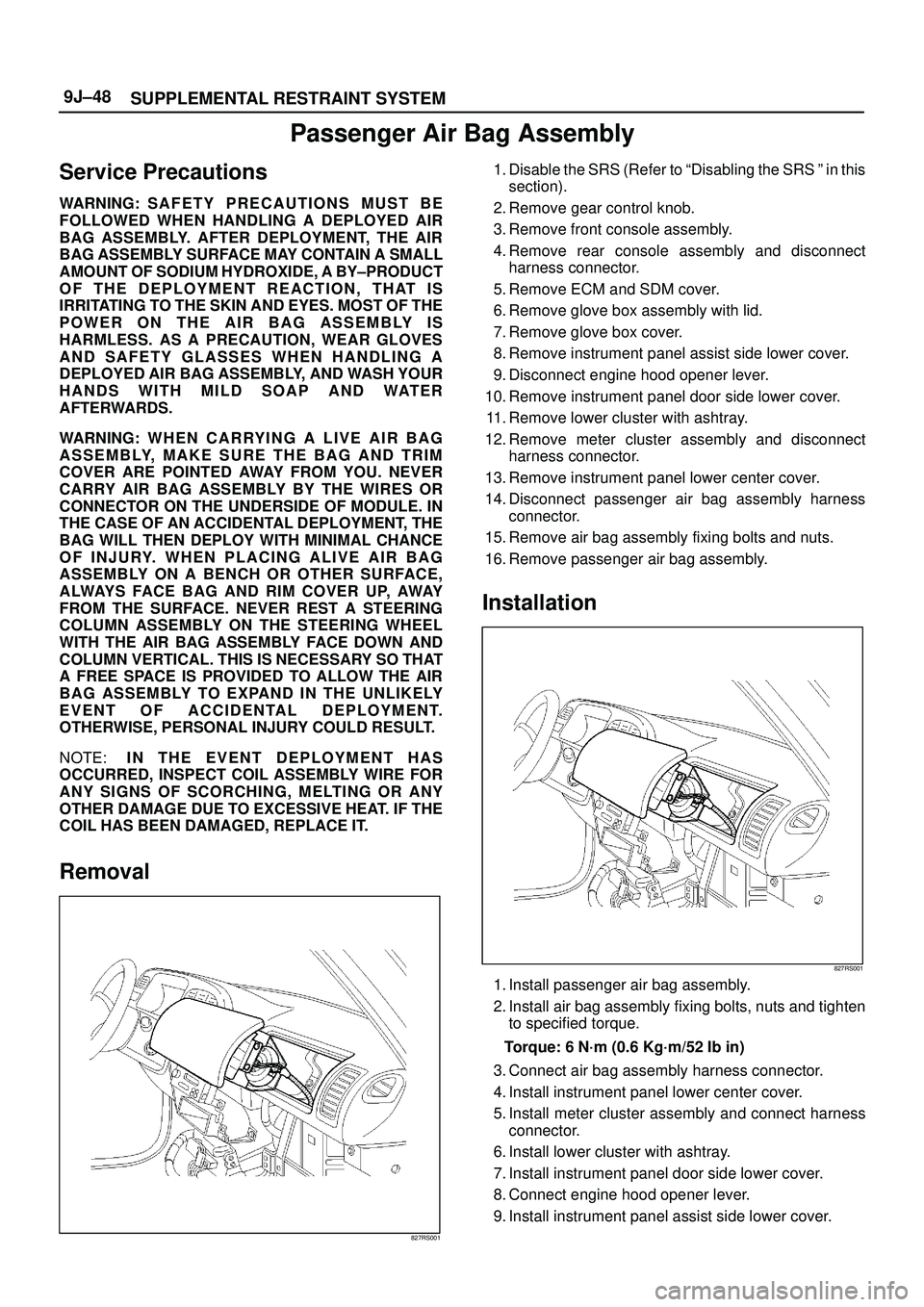
Removal
827RS001
1. Disable the SRS (Refer to ªDisabling the SRS º in this
section).
2. Remove gear control knob.
3. Remove front console assembly.
4. Remove rear console assembly and disconnect
harness connector.
5. Remove ECM and SDM cover.
6. Remove glove box assembly with lid.
7. Remove glove box cover.
8. Remove instrument panel assist side lower cover.
9. Disconnect engine hood opener lever.
10. Remove instrument panel door side lower cover.
11. Remove lower cluster with ashtray.
12. Remove meter cluster assembly and disconnect
harness connector.
13. Remove instrument panel lower center cover.
14. Disconnect passenger air bag assembly harness
connector.
15. Remove air bag assembly fixing bolts and nuts.
16. Remove passenger air bag assembly.
Installation
827RS001
1. Install passenger air bag assembly.
2. Install air bag assembly fixing bolts, nuts and tighten
to specified torque.
Torque: 6 N´m (0.6 Kg´m/52 Ib in)
3. Connect air bag assembly harness connector.
4. Install instrument panel lower center cover.
5. Install meter cluster assembly and connect harness
connector.
6. Install lower cluster with ashtray.
7. Install instrument panel door side lower cover.
8. Connect engine hood opener lever.
9. Install instrument panel assist side lower cover.
Page 3486 of 3573
SUPPLEMENTAL RESTRAINT SYSTEM9J±49
10. Install glove box cover.
11. Install glove box assembly with lid.
12. Install ECM and SDM cover.
13. Install rear console assembly and connect harness
connector.14. Install front console assembly.
15. Install gear control knob.
16. Enable the SRS (Refer to ªEnabling the SRSº in this
section).
Pretensioner Seat Belt (If so equipped)
Service Precaution
WARNING: WHEN PERFORMING SERVICE ON OR
AROUND THE PRETENSIONER SEAT BELT OR THE
PRETENSIONER SEAT BELT WIRING, FOLLOW THE
PROCEDURES LISTED BELOW TO TEMPORARILY
DISABLE THE PRETENSIONER SEAT BELT.
FAILURE TO FOLLOW PROCEDURES COULD
RESULT IN POSSIBLE THE PRETENSIONER SEAT
BELT DEPLOYMENT, PERSONAL INJURY OR
OTHERWISE UNNEEDED THE PRETENSIONER
SEAT BELT REPAIR.
AS A PRECAUTION, WEAR GLOVES AND SAFETY
GLASSES WHEN PERFORMING THE
PRETENSIONER SEAT BELT. WHEN DEPLOY A LIVE
PRETENSIONER SEAT BELT AT OUTSIDE THE
VEHICLE, DEPLOYMENT HARNESS SHALL REMAIN
SHORTED AND NOT BE CONNECTED TO A POWER
SOURCE UNTIL THE PRETENSIONER SEAT BELT IS
TO BE DEPLOYED. THE PRETENSIONER SEAT
BELT WILL IMMEDIATELY DEPLOY WHEN A POWER
SOURCE IS CONNECTED TO IT. CONNECTING THE
DEPLOYMENT HARNESS SHOULED ALWAYS BE
THE FINAL STEP IN THE PRETENSIONER SEAT
BELT DEPLOYMENT PROCEDURE. FAILURE TO
FOLLOW PROCEDURES IN THE ORDER LISTED
COULD RESULT IN PERSONAL INJURY.
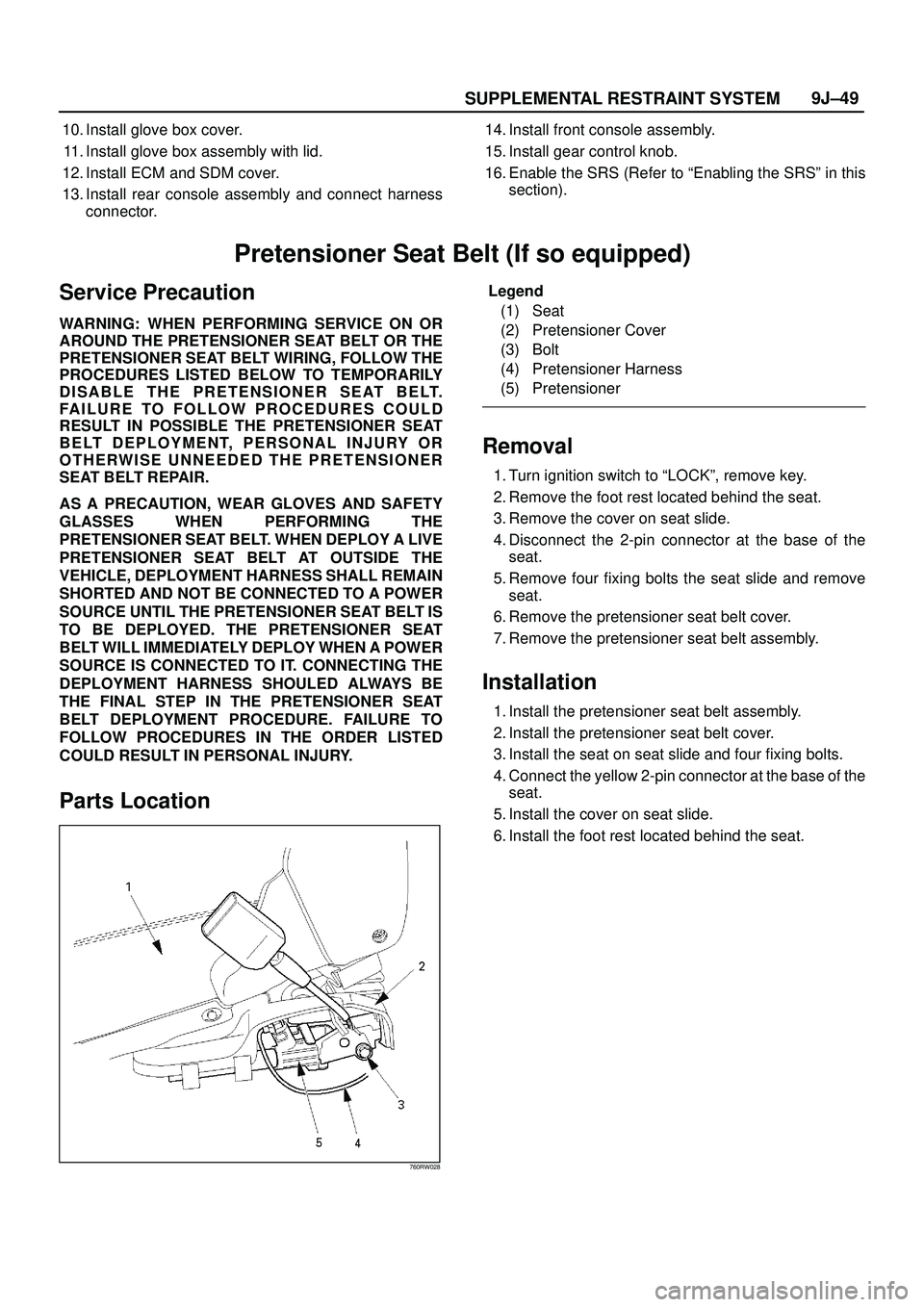
Parts Location
760RW028
Legend
(1) Seat
(2) Pretensioner Cover
(3) Bolt
(4) Pretensioner Harness
(5) Pretensioner
Removal
1. Turn ignition switch to ªLOCKº, remove key.
2. Remove the foot rest located behind the seat.
3. Remove the cover on seat slide.
4. Disconnect the 2-pin connector at the base of the
seat.
5. Remove four fixing bolts the seat slide and remove
seat.
6. Remove the pretensioner seat belt cover.
7. Remove the pretensioner seat belt assembly.
Installation
1. Install the pretensioner seat belt assembly.
2. Install the pretensioner seat belt cover.
3. Install the seat on seat slide and four fixing bolts.
4. Connect the yellow 2-pin connector at the base of the
seat.
5. Install the cover on seat slide.
6. Install the foot rest located behind the seat.
Page 3488 of 3573
9J1±1
RESTRAINT CONTROL SYSTEM
RESTRAINT CONTROL SYSTEM
CONTENTS
Service Precaution 9J1±1. . . . . . . . . . . . . . . . . . . . . .
Diagnostic Information 9J1±2. . . . . . . . . . . . . . . . . . .
System Schematic 9J1±4. . . . . . . . . . . . . . . . . . . . . .
SRS Diagnostic System Check 9J1±4. . . . . . . . . . . .
Chart A SDM Integrity Check 9J1±6. . . . . . . . . . . . .
Chart B ªAIR BAGº Warning Lamp
Comes ªONº Steady 9J1±8. . . . . . . . . . . . . . . . . . . .
Chart C ªAIR BAGº Warning Lamp
Does Not Come ªONº Steady 9J1±10. . . . . . . . . . . . .
DTC 15 Passenger Deployment Loop
Resistance High 9J1±13. . . . . . . . . . . . . . . . . . . . . . . .
DTC 16 Passenger Deployment loop
Resistance Low 9J1±15. . . . . . . . . . . . . . . . . . . . . . . .
DTC 17 Passenger Deployment Loop
Open 9J1±17. . . . . . . . . . . . . . . . . . . . . . . . . . . . . . . . . .
DTC 18 Passenger Deployment Loop
Short To Ground 9J1±19. . . . . . . . . . . . . . . . . . . . . . . .
DTC 19 Passenger Deployment Loop
Short To B+ 9J1±21. . . . . . . . . . . . . . . . . . . . . . . . . . . .
DTC 21 Driver Deployment Loop
Resistance High 9J1±23. . . . . . . . . . . . . . . . . . . . . . . .
DTC 22 Driver Deployment Loop
Resistance Low 9J1±26. . . . . . . . . . . . . . . . . . . . . . . .
DTC 24 Driver Deployment Loop
Short To Ground 9J1±29. . . . . . . . . . . . . . . . . . . . . . . .
DTC 25 Driver Deployment Loop
Short To B+ 9J1±31. . . . . . . . . . . . . . . . . . . . . . . . . . . .
DTC 26 Driver Deployment Loop Open 9J1±33. . . . DTC 51 Air Bag Deployment Event
Commanded 9J1±35. . . . . . . . . . . . . . . . . . . . . . . . . . .
DTC 53 Deployment Commanded With
Deployment Loop Fault Or Energy
Reserves Out Of Range 9J1±37. . . . . . . . . . . . . . . . .
DTC 61 Warning Lamp Circuit Failure 9J1±39. . . . .
DTC 71 Internal SDM Fault 9J1±41. . . . . . . . . . . . . .
DTC 29 Passenger Pretensioner Loop
Short To Ground 9J1±43. . . . . . . . . . . . . . . . . . . . . . . .
DTC 31 Passenger Pretensioner Loop
Resistance High 9J1±45. . . . . . . . . . . . . . . . . . . . . . . .
DTC 32 Passenger Pretensioner loop
Resistance Low 9J1±47. . . . . . . . . . . . . . . . . . . . . . . .
DTC 33 Passenger Pretensioner Loop
Short To Voltage 9J1±49. . . . . . . . . . . . . . . . . . . . . . . .
DTC 34 Passenger Pretensioner Loop
Open 9J1±51. . . . . . . . . . . . . . . . . . . . . . . . . . . . . . . . . .
DTC 41 Driver Pretensioner Loop
Resistance High 9J1±53. . . . . . . . . . . . . . . . . . . . . . . .
DTC 42 Driver Pretensioner Loop
Resistance Low 9J1±55. . . . . . . . . . . . . . . . . . . . . . . .
DTC 44 Driver Pretensioner Loop
Open 9J1±57. . . . . . . . . . . . . . . . . . . . . . . . . . . . . . . . . .
DTC 45 Driver Pretensioner Loop
Short To Ground 9J1±59. . . . . . . . . . . . . . . . . . . . . . . .
DTC 46 Driver Pretensioner Loop
Short To Voltage 9J1±61. . . . . . . . . . . . . . . . . . . . . . . .
DTC 52 Pretensioner Deployment
Event Commanded 9J1±63. . . . . . . . . . . . . . . . . . . . .
Service Precaution
WARNING: I F S O E Q U IPPED WITH A
SUPPLEMENTAL RESTRAINT SYSTEM (SRS),
REFER TO THE SRS COMPONENT AND WIRING
LOCATION VIEW IN ORDER TO DETERMINE
WHETHER YOU ARE PERFORMING SERVICE ON OR
NEAR THE SRS COMPONENTS OR THE SRS
WIRING. WHEN YOU ARE PERFORMING SERVICE
ON OR NEAR THE SRS COMPONENTS OR THE SRS
WIRING, REFER TO THE SRS SERVICE
INFORMATION. FAILURE TO FOLLOW WARNINGS
COULD RESULT IN POSSIBLE AIR BAG
DEPLOYMENT, PERSONAL INJURY, OR
OTHERWISE UNNEEDED SRS SYSTEM REPAIRS.CAUTION: Always use the correct fastener in the
proper location. When you replace a fastener, use
ONLY the exact part number for that application.
ISUZU will call out those fasteners that require a
replacement after removal. ISUZU will also call out
the fasteners that require thread lockers or thread
sealant. UNLESS OTHERWISE SPECIFIED, do not
use supplemental coatings (Paints, greases, or other
corrosion inhibitors) on threaded fasteners or
fastener joint interfaces. Generally, such coatings
adversely affect the fastener torque and the joint
clamping force, and may damage the fastener. When
you install fasteners, use the correct tightening
sequence and specifications. Following these
instructions can help you avoid damage to parts and
systems.
Page 3489 of 3573
RESTRAINT CONTROL SYSTEM 9J1±2
Diagnostic Information
CAUTION: When fasteners are removed, always
reinstall them at the same location from which they
were removed. if a fastener needs to be replaced, use
the correct part number fastener for that application.
if the correct part number fastener is not available, a
fastener of equal size and strength (or stronger) may
be used. fasteners that are not reused, and those
requiring thread locking compound will be called
out. the correct torque value must be used when
installing fasteners that require it. if the above
conditions are not followed, parts or system damage
could result.
Diagnostic Procedures
WARNING: T O AV O I D D E P L O Y M E N T W H E N
TROUBLESHOOTING THE SRS, DO NOT USE
ELECTRICAL TEST EQUIPMENT SUCH AS A
BATTERY±POWERED OR AC±POWERED
VOLTMETER, OHMMETER, ETC., OR ANY TYPE OF
ELECTRICAL EQUIPMENT OTHER THAN THAT
SPECIFIED IN THIS MANUAL. DO NOT USE A NON
POWERED, PROBE±TYPE TESTER.
INSTRUCTIONS IN THIS MANUAL MUST BE
FOLLOWED CAREFULLY, OTHERWISE PERSONAL
INJURY MAY RESULT.
The diagnostic procedures used in this section are
designed to aid in finding and repairing SRS problems.
Outlined below are the steps to find and repair SRS
problems quickly and effectively. Failure to carefully
follow these procedures may result in extended
diagnostic time, incorrect diagnosis and incorrect parts
replacement.
1.Perform The ªSRS Diagnostic System Checkº.
The ªSRS Diagnostic System Checkº should always
be the starting point of any SRS diagnostics. The
ªSRS Diagnostic System Checkº checks for proper
ªAIR BAGº warning lamp operation and checks for
SRS trouble codes using both ªFlash Codeº and
ªScan Toolº Methods.
2.Refer To The Proper Diagnostic Chart As Directed
By The ªSRS Diagnostic System Checkº.
The ªSRS Diagnostic System Checkº will lead you to
the correct chart to diagnose any SRS problems.
Bypassing these procedures may result in extended
diagnostic time, incorrect diagnosis and incorrect
parts replacement.
3.Repeat The ªSRS Diagnostic System Checkº
After Any Repair Or Diagnostic Procedures Have
Been Performed.
Preforming the ªSRS Diagnostic System Checkº after
all repair or diagnostic procedures will assure that the
repair has been made correctly and that no other
conditions exist.
Diagnostic Codes
The Sensing and Diagnostic Module (SDM) maintains a
history record of all diagnostic codes that have beendetected since the SRS codes were last cleared during
service.
1. Active Codes Ð Faults that are presently detected
this ignition cycle. Active codes are stored in RAM
(Random Access Memory).
2. History Codes Ð All faults detected since the last
time the history fault memory was cleared. History
codes are stored in EEPROM. (Electronically
Erasable Programmable Read only Memory)
How To Read Trouble Codes
All codes (Active and history) can be read (or cleared) by
using a scan tool or equivalent.
If a PDT is not available, have the vehicle serviced by
ISUZU dealer.
How To Clear Trouble Codes
Trouble codes can only be cleared by using a Scan Tool.
If a ªscan toolº is not available then inform the owner of the
stored codes and suggest that the codes are cleared
upon the next visit to an Isuzu dealership.
Scan Tool Diagnostics
A scan tool can be used to read current and history codes
and to clear all history codes after a repair is complete.
The scan tool must be updated to communicate with the
SRS through a memory card or a manufacturer's update
before it can be used for SRS diagnostics. To use the
scan tool, connect it to the DLC connector and turn the
ignition switch ªONº. Then follow the manufacturer's
directions for communication with the SRS. The scan tool
reads serial data from the SDM ªSerial Dataº output
(terminal 24) to the DLC connector (terminal 9).
Basic Knowledge Required
Before using this section of the Service Manual, there is
some basic knowledge which will be required. Without
this knowledge, you will have trouble using the diagnostic
procedures in this section. Use care to prevent harm or
unwanted deployment. Read all cautions in the service
manual and on warning labels attached to SRS
components.
Basic Electrical Circuits
You should understand the basic theory of electricity
including series and parallel circuits, and understand the
voltage drops across series resistors. You should know
the meaning of voltage (volts), current (amps), and
resistance (ohms). You should understand what happens
in a circuit with an open or a shorted wire. You should be
able to read and understand a wiring diagram.
ªFlash Codeº Diagnostics
Flash code diagnostics can be used to read active codes
and to determine if history codes are present but cannot
be used to clear codes or read history codes. Flash code
diagnostics is enabled by grounding by terminal 4
shorting to terminal 13 of the DLC connector with the
ignition switch ªONº. Grounding terminal 4 of the DLC
connector pulls the ªDiagnostics Requestº input (Terminal
1) of the SDM low and signals the SDM to enter the flash
code diagnostic display mode.
Page 3494 of 3573
9J1±7
RESTRAINT CONTROL SYSTEM
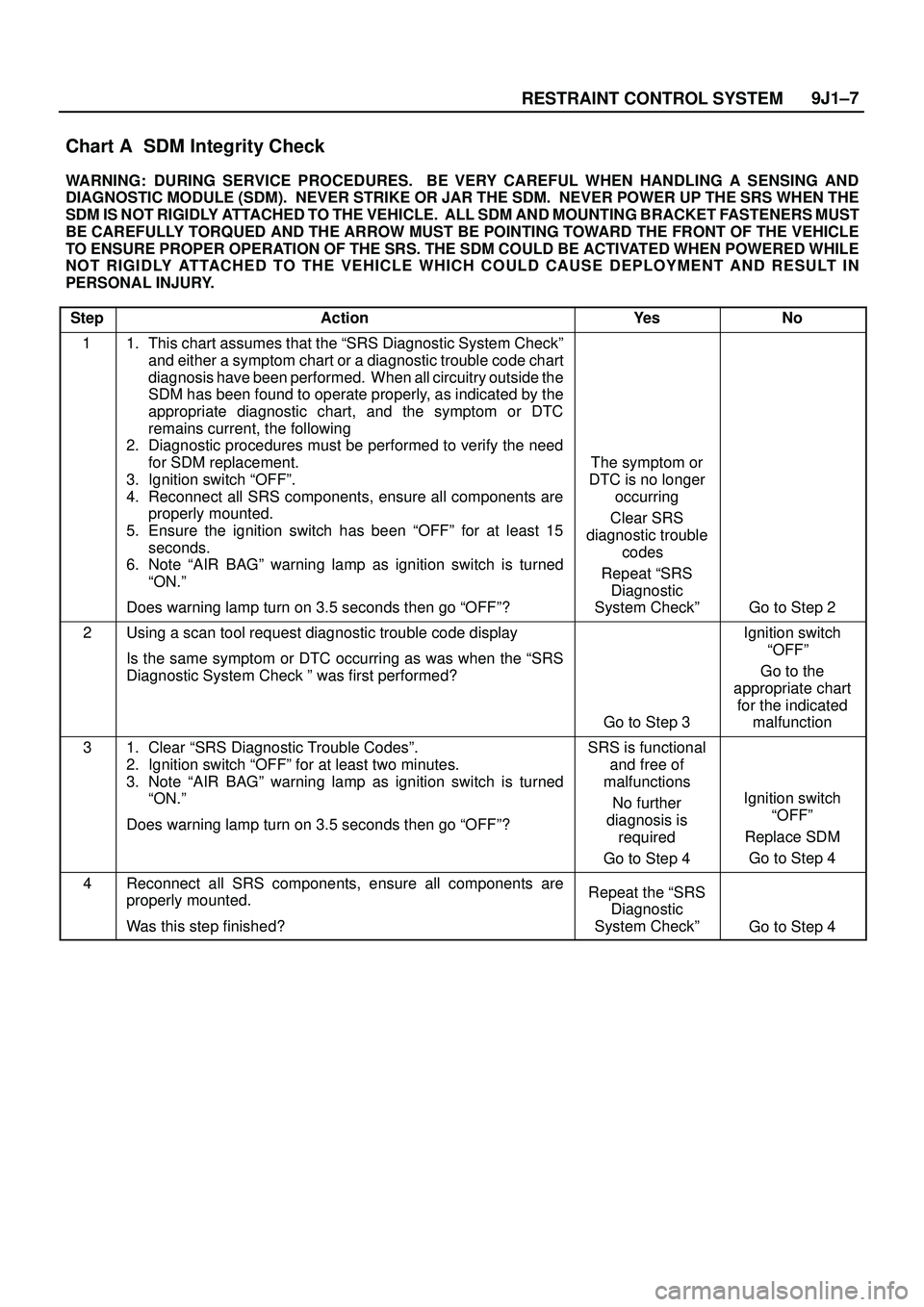
Chart A SDM Integrity Check
WARNING: DURING SERVICE PROCEDURES. BE VERY CAREFUL WHEN HANDLING A SENSING AND
DIAGNOSTIC MODULE (SDM). NEVER STRIKE OR JAR THE SDM. NEVER POWER UP THE SRS WHEN THE
SDM IS NOT RIGIDLY ATTACHED TO THE VEHICLE. ALL SDM AND MOUNTING BRACKET FASTENERS MUST
BE CAREFULLY TORQUED AND THE ARROW MUST BE POINTING TOWARD THE FRONT OF THE VEHICLE
TO ENSURE PROPER OPERATION OF THE SRS. THE SDM COULD BE ACTIVATED WHEN POWERED WHILE
NOT RIGIDLY ATTACHED TO THE VEHICLE WHICH COULD CAUSE DEPLOYMENT AND RESULT IN
PERSONAL INJURY.
Step
ActionYe sNo
11. This chart assumes that the ªSRS Diagnostic System Checkº
and either a symptom chart or a diagnostic trouble code chart
diagnosis have been performed. When all circuitry outside the
SDM has been found to operate properly, as indicated by the
appropriate diagnostic chart, and the symptom or DTC
remains current, the following
2. Diagnostic procedures must be performed to verify the need
for SDM replacement.
3. Ignition switch ªOFFº.
4. Reconnect all SRS components, ensure all components are
properly mounted.
5. Ensure the ignition switch has been ªOFFº for at least 15
seconds.
6. Note ªAIR BAGº warning lamp as ignition switch is turned
ªON.º
Does warning lamp turn on 3.5 seconds then go ªOFFº?
The symptom or
DTC is no longer
occurring
Clear SRS
diagnostic trouble
codes
Repeat ªSRS
Diagnostic
System Checkº
Go to Step 2
2Using a scan tool request diagnostic trouble code display
Is the same symptom or DTC occurring as was when the ªSRS
Diagnostic System Check º was first performed?
Go to Step 3
Ignition switch
ªOFFº
Go to the
appropriate chart
for the indicated
malfunction
31. Clear ªSRS Diagnostic Trouble Codesº.
2. Ignition switch ªOFFº for at least two minutes.
3. Note ªAIR BAGº warning lamp as ignition switch is turned
ªON.º
Does warning lamp turn on 3.5 seconds then go ªOFFº?SRS is functional
and free of
malfunctions
No further
diagnosis is
required
Go to Step 4
Ignition switch
ªOFFº
Replace SDM
Go to Step 4
4Reconnect all SRS components, ensure all components are
properly mounted.
Was this step finished?Repeat the ªSRS
Diagnostic
System Checkº
Go to Step 4
Page 3498 of 3573
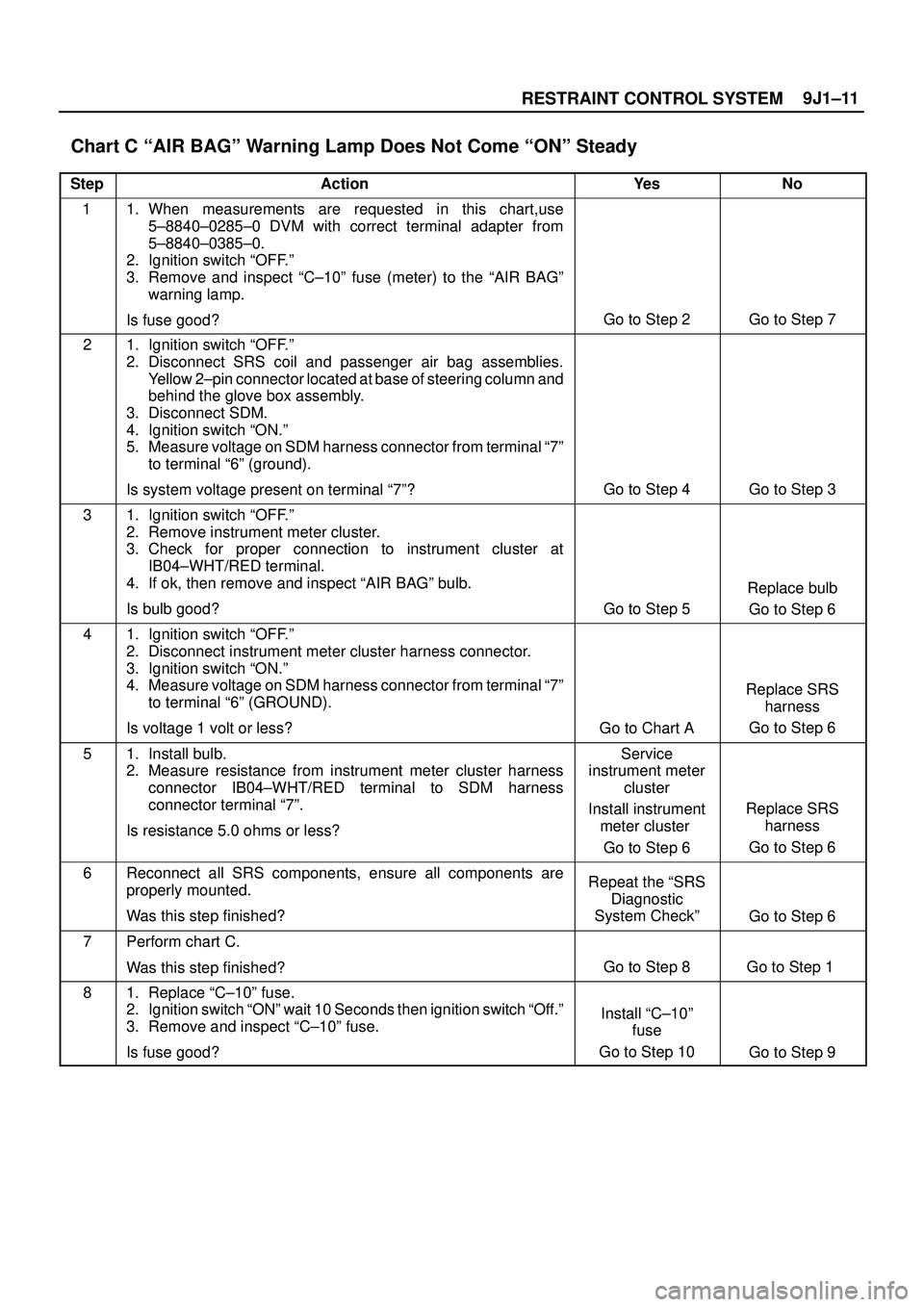
9J1±11
RESTRAINT CONTROL SYSTEM
Chart C ªAIR BAGº Warning Lamp Does Not Come ªONº Steady
StepActionYe sNo
11. When measurements are requested in this chart,use
5±8840±0285±0 DVM with correct terminal adapter from
5±8840±0385±0.
2. Ignition switch ªOFF.º
3. Remove and inspect ªC±10º fuse (meter) to the ªAIR BAGº
warning lamp.
Is fuse good?
Go to Step 2Go to Step 7
21. Ignition switch ªOFF.º
2. Disconnect SRS coil and passenger air bag assemblies.
Yellow 2±pin connector located at base of steering column and
behind the glove box assembly.
3. Disconnect SDM.
4. Ignition switch ªON.º
5. Measure voltage on SDM harness connector from terminal ª7º
to terminal ª6º (ground).
Is system voltage present on terminal ª7º?
Go to Step 4Go to Step 3
31. Ignition switch ªOFF.º
2. Remove instrument meter cluster.
3. Check for proper connection to instrument cluster at
IB04±WHT/RED terminal.
4. If ok, then remove and inspect ªAIR BAGº bulb.
Is bulb good?
Go to Step 5
Replace bulb
Go to Step 6
41. Ignition switch ªOFF.º
2. Disconnect instrument meter cluster harness connector.
3. Ignition switch ªON.º
4. Measure voltage on SDM harness connector from terminal ª7º
to terminal ª6º (GROUND).
Is voltage 1 volt or less?
Go to Chart A
Replace SRS
harness
Go to Step 6
51. Install bulb.
2. Measure resistance from instrument meter cluster harness
connector IB04±WHT/RED terminal to SDM harness
connector terminal ª7º.
Is resistance 5.0 ohms or less?Service
instrument meter
cluster
Install instrument
meter cluster
Go to Step 6
Replace SRS
harness
Go to Step 6
6Reconnect all SRS components, ensure all components are
properly mounted.
Was this step finished?Repeat the ªSRS
Diagnostic
System Checkº
Go to Step 6
7Perform chart C.
Was this step finished?
Go to Step 8Go to Step 1
81. Replace ªC±10º fuse.
2. Ignition switch ªONº wait 10 Seconds then ignition switch ªOff.º
3. Remove and inspect ªC±10º fuse.
Is fuse good?
Install ªC±10º
fuse
Go to Step 10
Go to Step 9