engine ISUZU TROOPER 1998 Service Repair Manual
[x] Cancel search | Manufacturer: ISUZU, Model Year: 1998, Model line: TROOPER, Model: ISUZU TROOPER 1998Pages: 3573, PDF Size: 60.36 MB
Page 1696 of 3573
6D2 Ð 2 STARTING SYSTEM
the plunger returns, the pinion is disengaged from ring
gear, and the armature stops rotation. When the engine
speed is higher than the pinion, the pinion idles, so that
the armature is not driven.
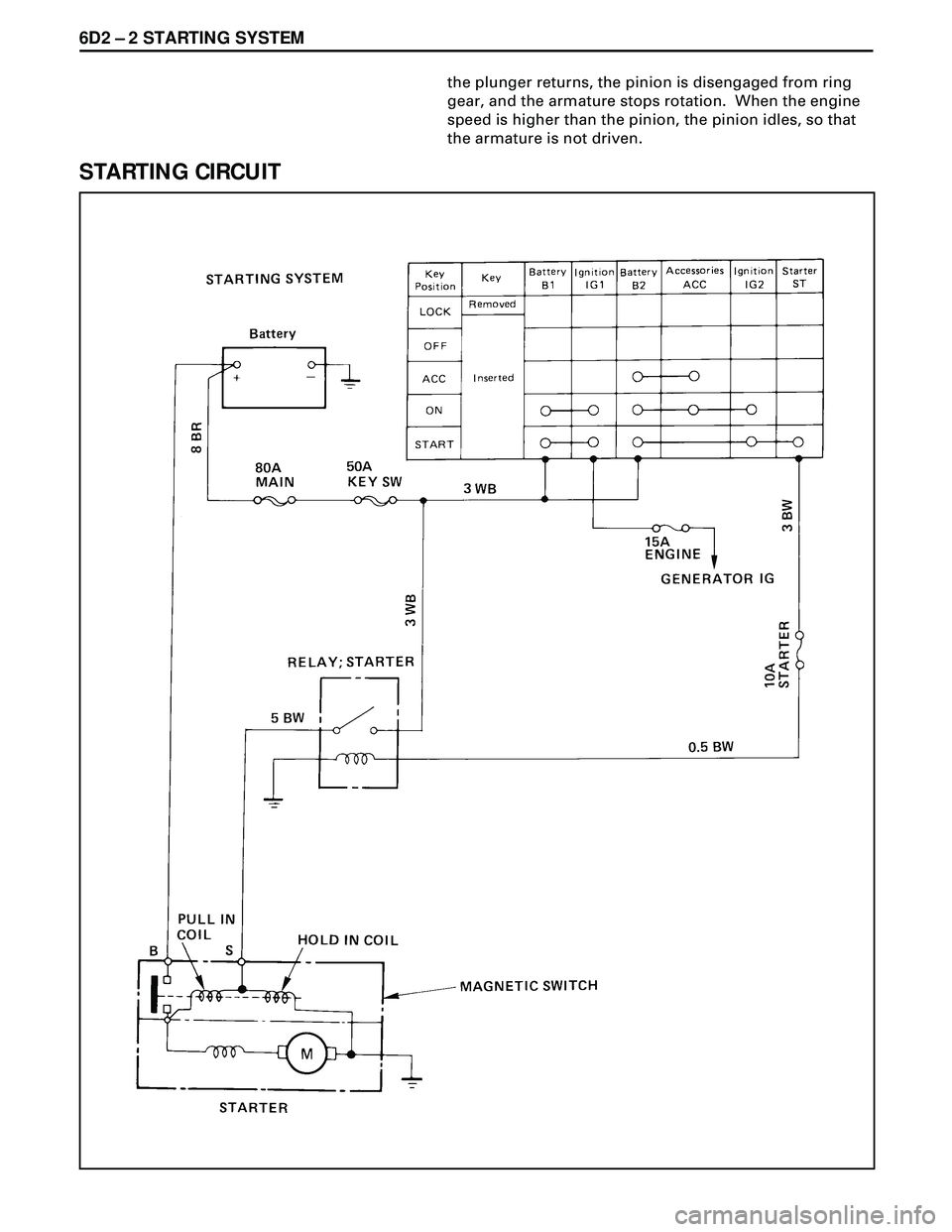
STARTING CIRCUIT
Page 1710 of 3573
6D3 Ð 4 CHARGING SYSTEM
DIAGNOSIS
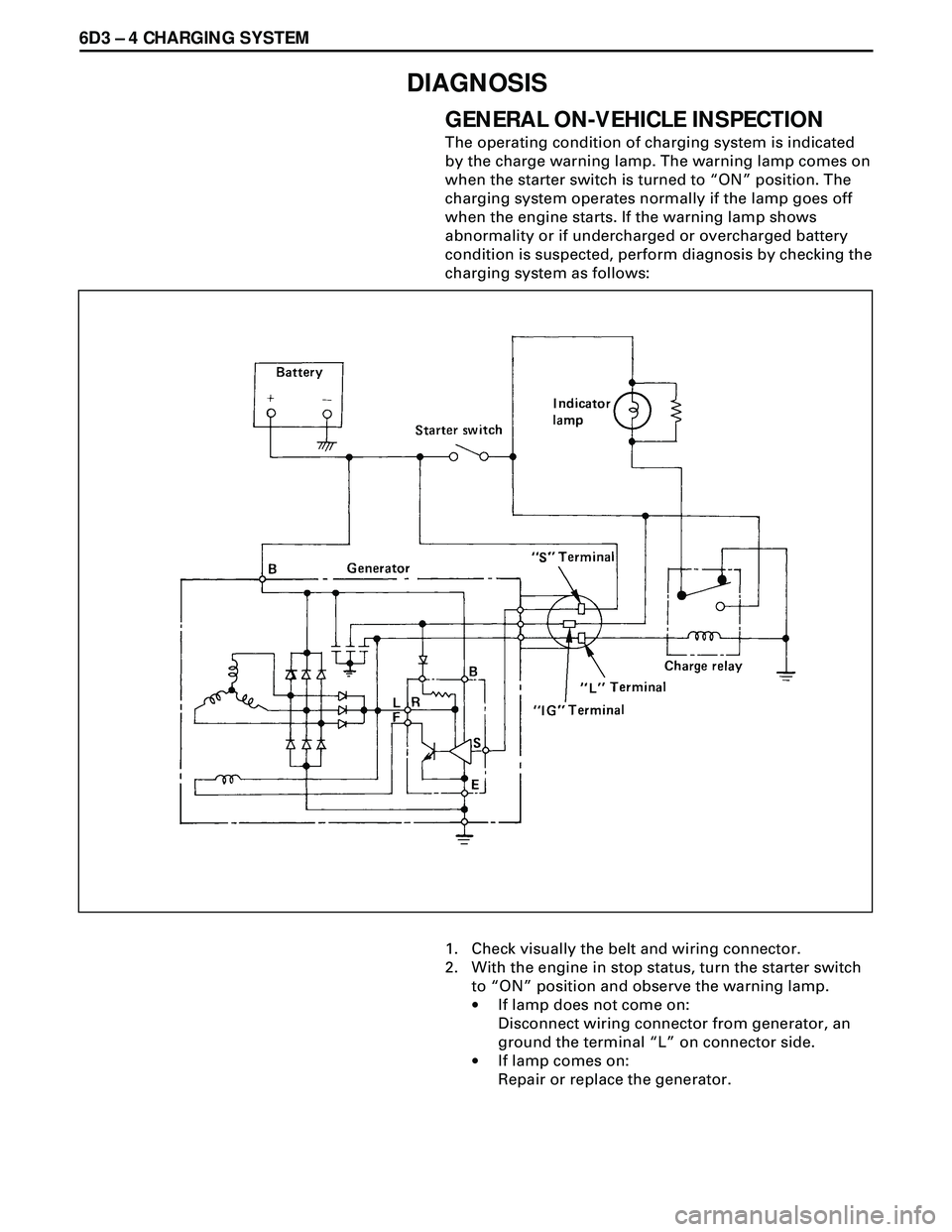
GENERAL ON-VEHICLE INSPECTION
The operating condition of charging system is indicated
by the charge warning lamp. The warning lamp comes on
when the starter switch is turned to ÒONÓ position. The
charging system operates normally if the lamp goes off
when the engine starts. If the warning lamp shows
abnormality or if undercharged or overcharged battery
condition is suspected, perform diagnosis by checking the
charging system as follows:
1. Check visually the belt and wiring connector.
2. With the engine in stop status, turn the starter switch
to ÒONÓ position and observe the warning lamp.
·If lamp does not come on:
Disconnect wiring connector from generator, an
ground the terminal ÒLÓ on connector side.
·If lamp comes on:
Repair or replace the generator.
Page 1717 of 3573
CHARGING SYSTEM 6D3 Ð 11
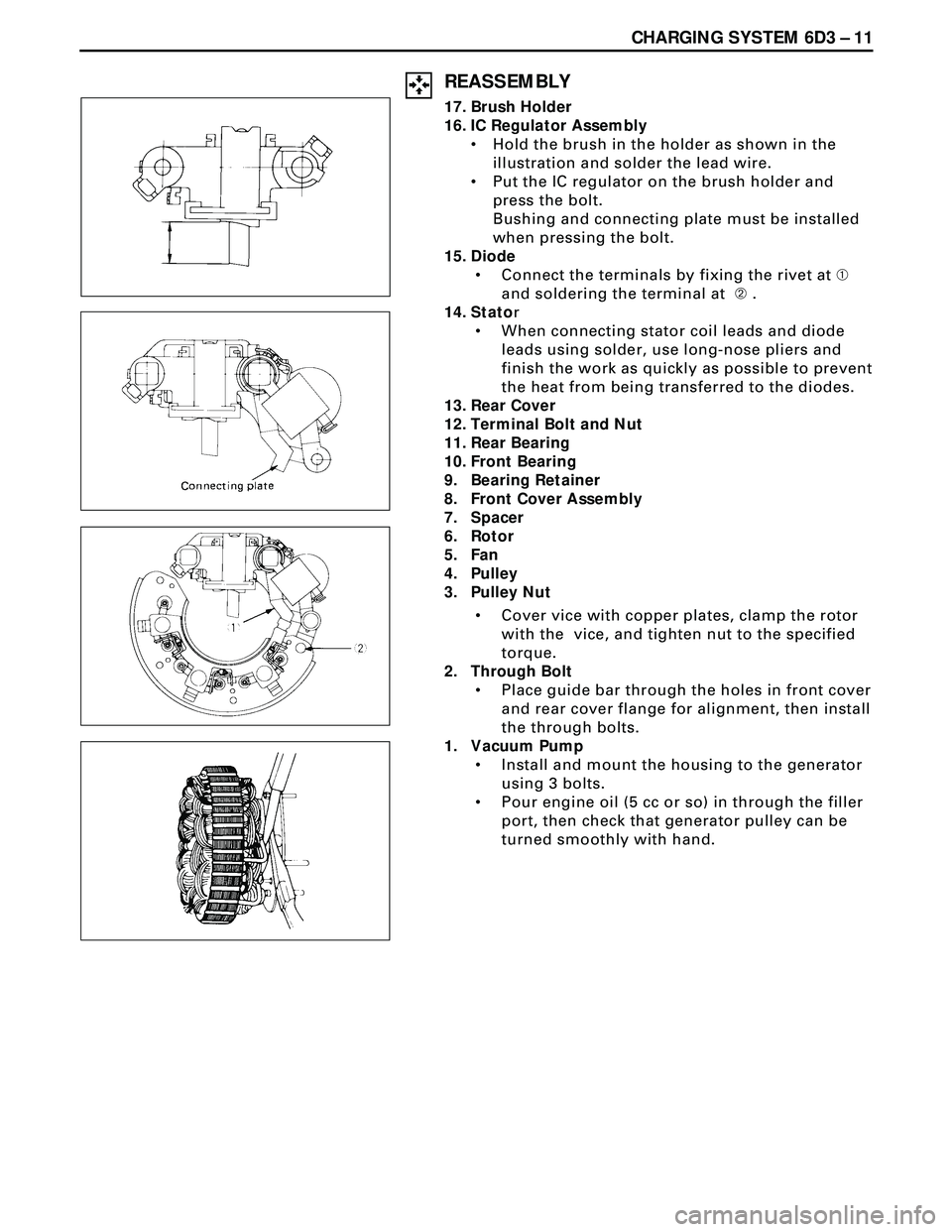
REASSEMBLY
17. Brush Holder
16. IC Regulator Assembly
¥ Hold the brush in the holder as shown in the
illustration and solder the lead wire.
¥ Put the IC regulator on the brush holder and
press the bolt.
Bushing and connecting plate must be installed
when pressing the bolt.
15. Diode
¥ Connect the terminals by fixing the rivet at À
and soldering the terminal at Á .
14. Stator
¥ When connecting stator coil leads and diode
leads using solder, use long-nose pliers and
finish the work as quickly as possible to prevent
the heat from being transferred to the diodes.
13. Rear Cover
12. Terminal Bolt and Nut
11. Rear Bearing
10. Front Bearing
9. Bearing Retainer
8. Front Cover Assembly
7. Spacer
6. Rotor
5. Fan
4. Pulley
3. Pulley Nut
¥ Cover vice with copper plates, clamp the rotor
with the vice, and tighten nut to the specified
torque.
2. Through Bolt
¥ Place guide bar through the holes in front cover
and rear cover flange for alignment, then install
the through bolts.
1. Vacuum Pump
¥ Install and mount the housing to the generator
using 3 bolts.
¥ Pour engine oil (5 cc or so) in through the filler
port, then check that generator pulley can be
turned smoothly with hand.
Page 1719 of 3573
QOS III PREHEATING SYSTEM 6D6 Ð 1
PAGE
General Description ........................................................................................................ 6D6- 1
System Diagram .............................................................................................................. 6D6- 2
GENERAL DESCRIPTION
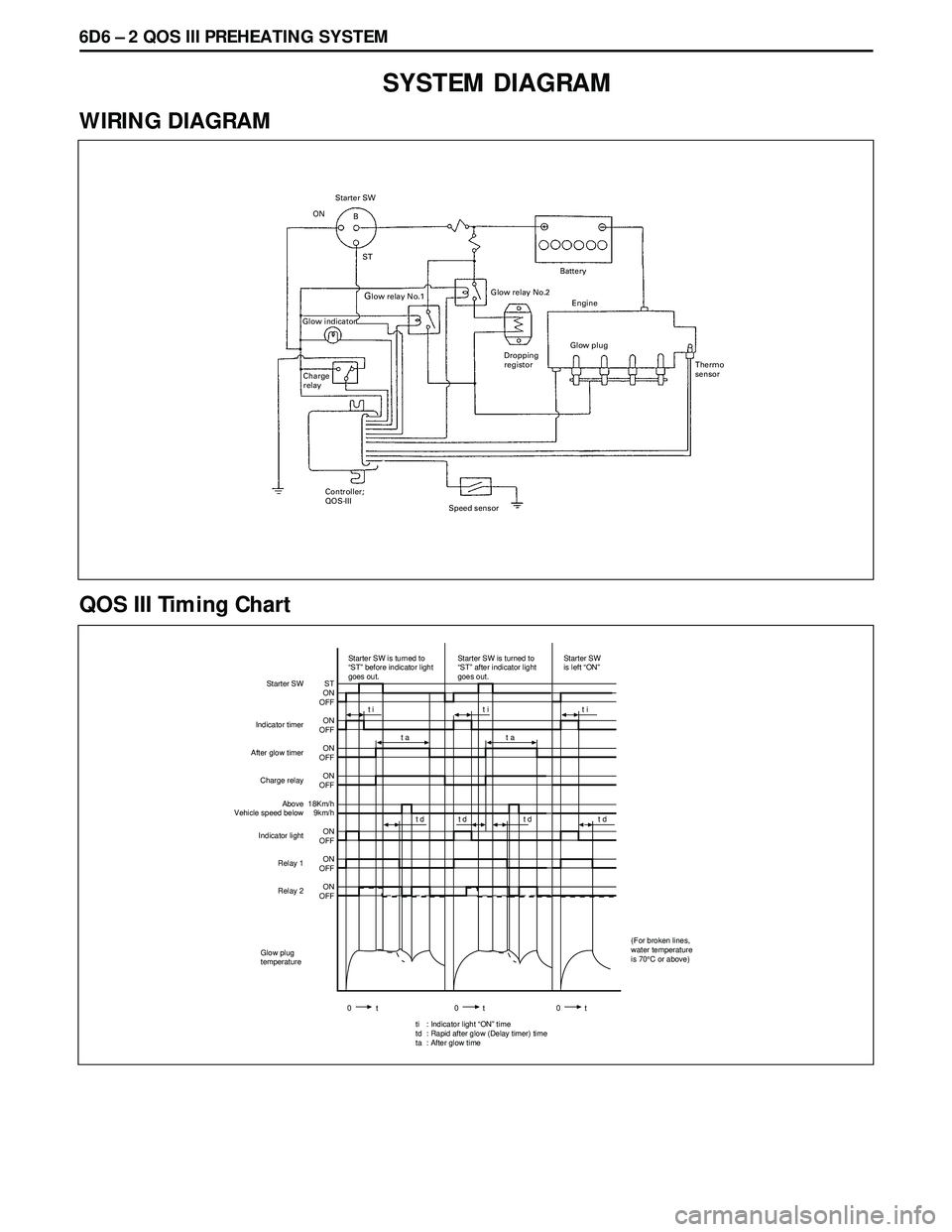
QOS III preheating system features a quick-on glow
plug with thermometer control of the glowing time
and the afterglow time function.
The system consists of a controller, indicator lamp,
thermosensor, vehicle speedsensor, dropping
resistor, relay (2 pcs), and temperature self-control
type glow plug (4 pcs).With the employment of the thermosensor, the
glow time changes according to the engine coolant
temperature, thus allowing optimum starting
conditions to be obtained.
The afterglow time function is controlled by
thermosensor, vehicle speed sensor, and the
engine runstall sensor (charge relay).
SECTION 6D6
QOSIII PREHEATING SYSTEM
CONTENTS
Page 1720 of 3573
6D6 Ð 2 QOS III PREHEATING SYSTEM
SYSTEM DIAGRAM
WIRING DIAGRAM
ON
B
ST
Glow relay No.1 Starter SW
Battery
Engine Glow relay No.2
Glow indicator
Charge
relayGlow plug
Thermo
sensor
Controller;
QOS-III
Speed sensorDropping
registor
QOS III Timing Chart
ST
ON
OFF
ON
OFF
ON
OFF
ON
OFF
18Km/h
9km/h
ON
OFF
ON
OFF
ON
OFF Starter SW
Starter SW is turned to
“ST” before indicator light
goes out.Starter SW is turned to
“ST” after indicator light
goes out.Starter SW
is left “ON”
Indicator timer
After glow timer
Charge relay
Indicator light
Relay 1
Relay 2Above
Vehicle speed below
t i t i t i
t a t a
t d t d t d t d
Glow plug
temperature
0t 0t 0t
: Indicator light “ON” time
: Rapid after glow (Delay timer) time
: After glow time
ti
td
ta
(For broken lines,
water temperature
is 70¡C or above)
Page 1723 of 3573
QOS III PREHEATING SYSTEM 6D6 Ð 5
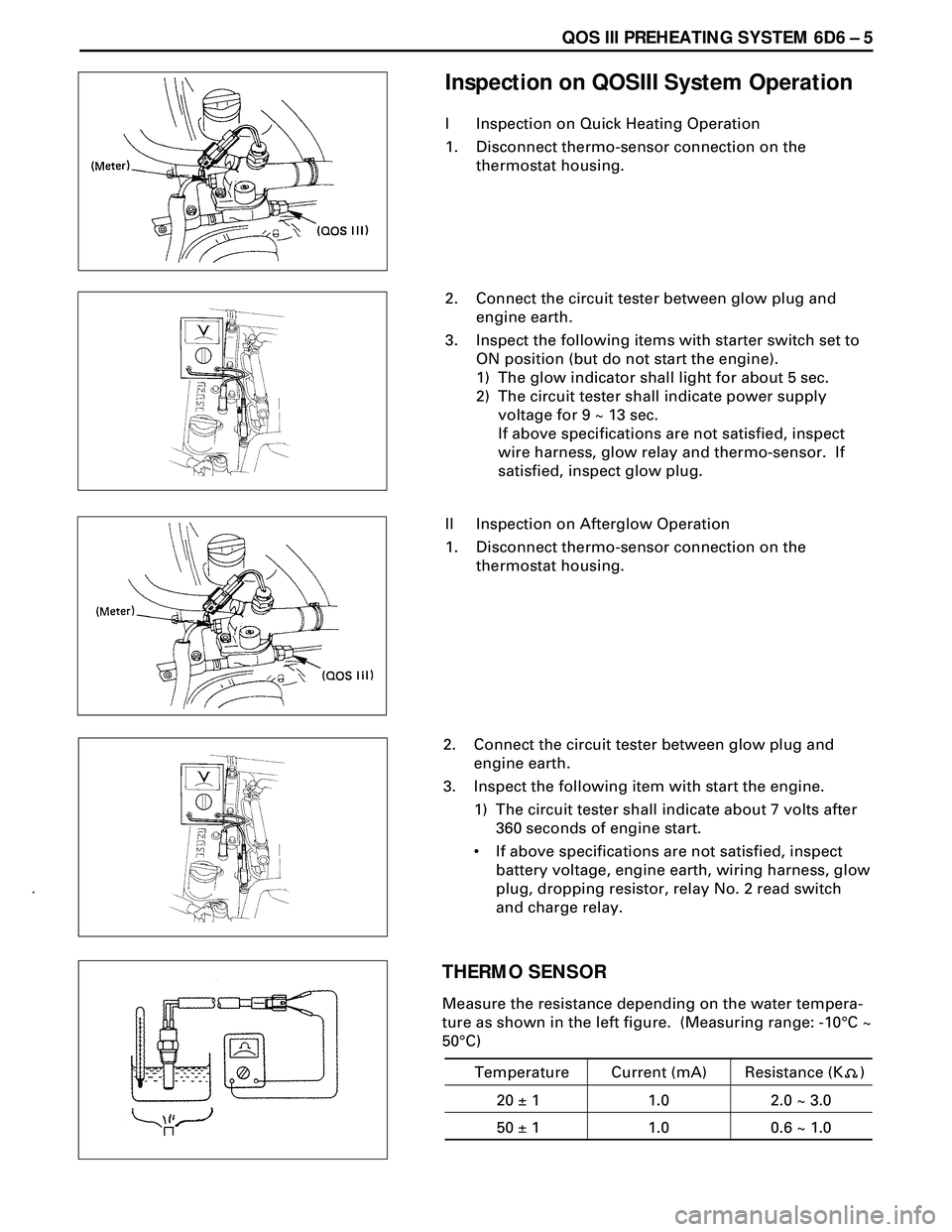
Inspection on QOSIII System Operation
I Inspection on Quick Heating Operation
1. Disconnect thermo-sensor connection on the
thermostat housing.
2. Connect the circuit tester between glow plug and
engine earth.
3. Inspect the following items with starter switch set to
ON position (but do not start the engine).
1) The glow indicator shall light for about 5 sec.
2) The circuit tester shall indicate power supply
voltage for 9 ~ 13 sec.
If above specifications are not satisfied, inspect
wire harness, glow relay and thermo-sensor. If
satisfied, inspect glow plug.
II Inspection on Afterglow Operation
1. Disconnect thermo-sensor connection on the
thermostat housing.
2. Connect the circuit tester between glow plug and
engine earth.
3. Inspect the following item with start the engine.
1) The circuit tester shall indicate about 7 volts after
360 seconds of engine start.
¥ If above specifications are not satisfied, inspect
battery voltage, engine earth, wiring harness, glow
plug, dropping resistor, relay No. 2 read switch
and charge relay.
THERMO SENSOR
Measure the resistance depending on the water tempera-
ture as shown in the left figure. (Measuring range: -10¡C ~
50¡C)
Current (mA)
20 ± 1 1.0
50 ± 1Resistance (K )
1.0
2.0 ~ 3.0
0.6 ~ 1.0 Temperature
Page 1725 of 3573
ENGINE EXHAUST 6F Ð 1
SECTION 6F
ENGINE EXHAUST
CAUTION:
overheating of the floor pan and possible damage
to the passenger compartment, insulation and trim
materials. Exhaust system components must have enough
clearance from the underbody to prevent
CONTENTS
PAGE
General Description ........................................................................................................ 6F-2
Hangers ........................................................................................................................6F-2
Gasket .......................................................................................................................... 6F-2
On-Vehicle Service .......................................................................................................... 6F-3
Front Exhaust Pipe ...................................................................................................... 6F-3
Center Exhaust Pipe .................................................................................................... 6F-5
Exhaust Silencer .......................................................................................................... 6F-7
Rear Exhaust Pipe ....................................................................................................... 6F-9
Page 1726 of 3573
6F Ð 2 ENGINE EXHAUST
GENERAL DESCRIPTION
150RV013
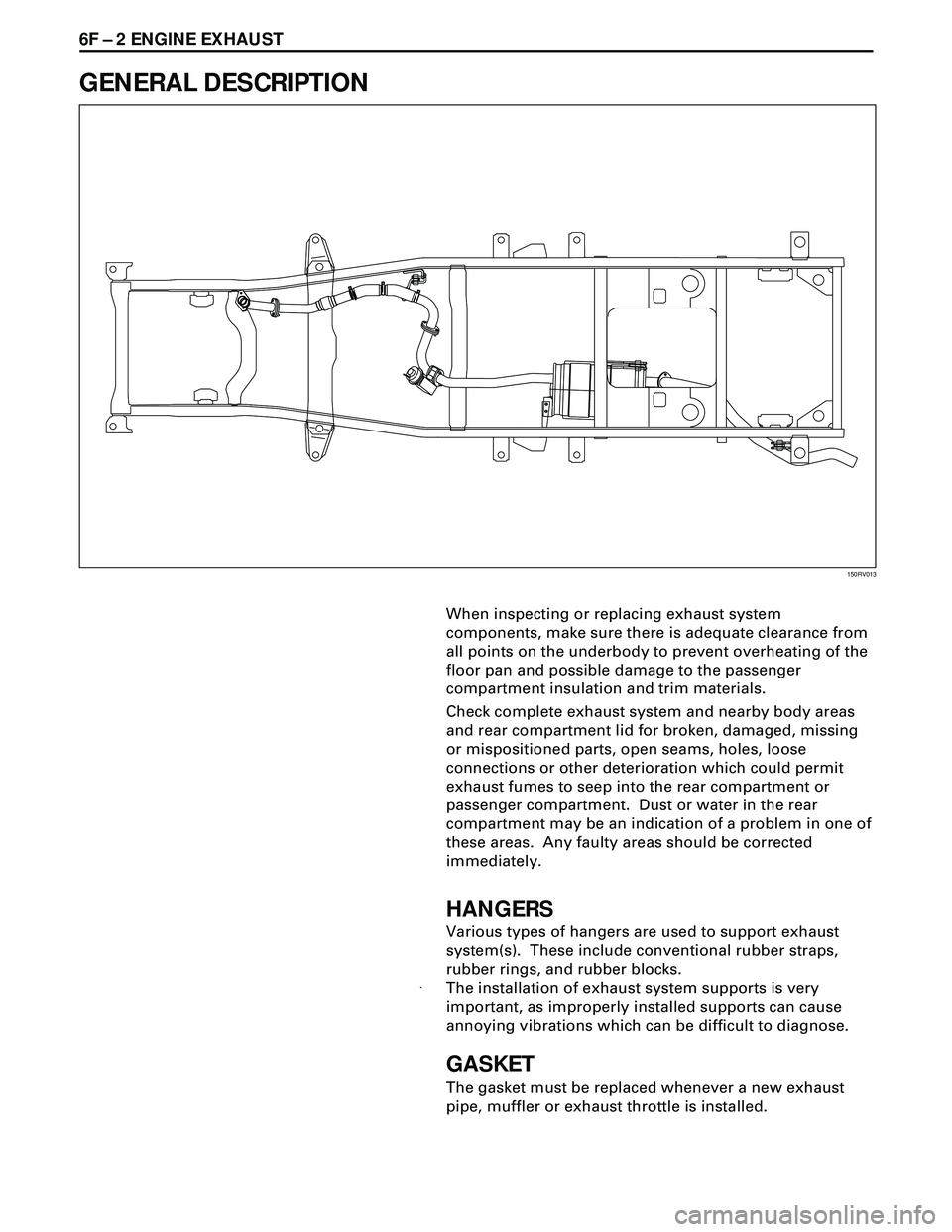
When inspecting or replacing exhaust system
components, make sure there is adequate clearance from
all points on the underbody to prevent overheating of the
floor pan and possible damage to the passenger
compartment insulation and trim materials.
Check complete exhaust system and nearby body areas
and rear compartment lid for broken, damaged, missing
or mispositioned parts, open seams, holes, loose
connections or other deterioration which could permit
exhaust fumes to seep into the rear compartment or
passenger compartment. Dust or water in the rear
compartment may be an indication of a problem in one of
these areas. Any faulty areas should be corrected
immediately.
HANGERS
Various types of hangers are used to support exhaust
system(s). These include conventional rubber straps,
rubber rings, and rubber blocks.
The installation of exhaust system supports is very
important, as improperly installed supports can cause
annoying vibrations which can be difficult to diagnose.
GASKET
The gasket must be replaced whenever a new exhaust
pipe, muffler or exhaust throttle is installed.
Page 1727 of 3573
ENGINE EXHAUST 6F Ð 3
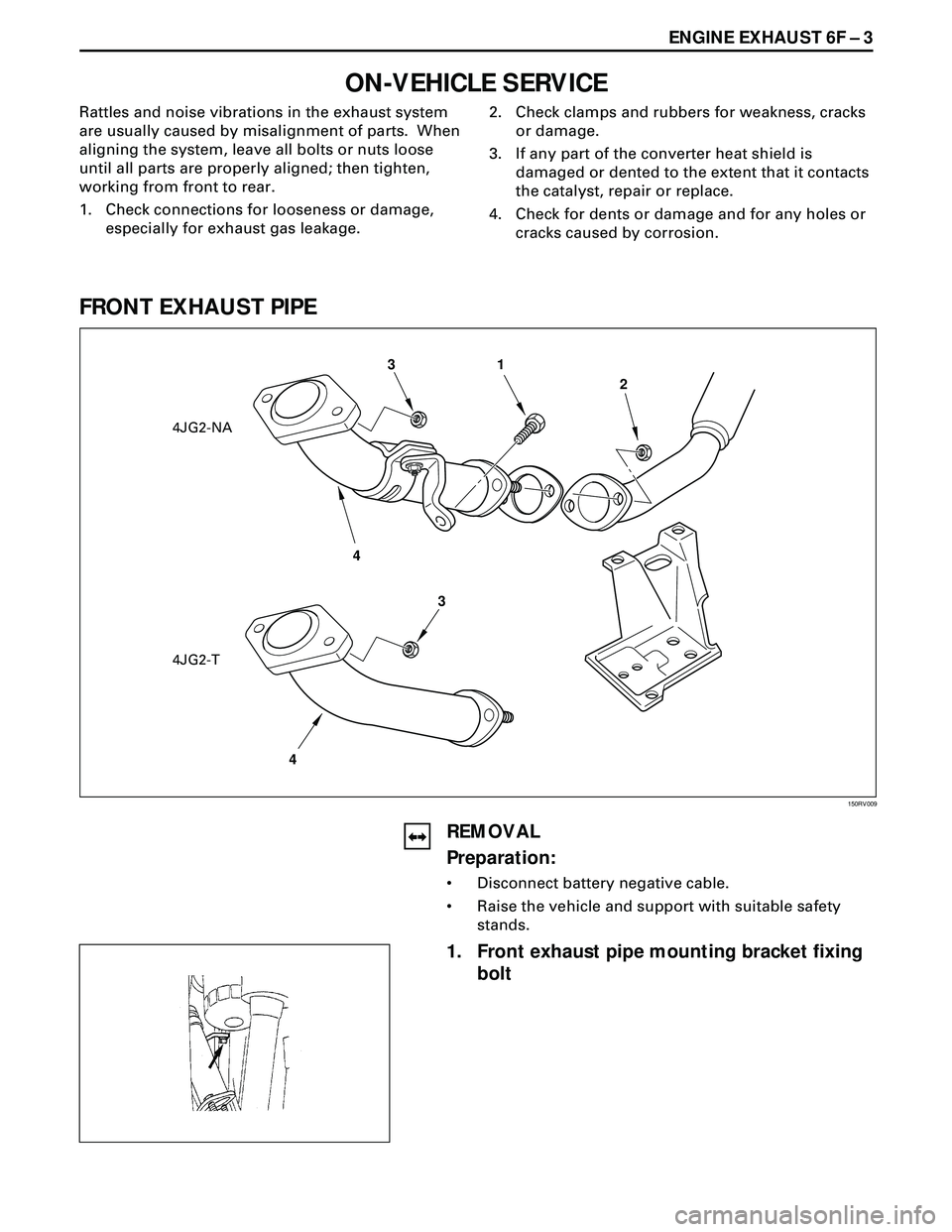
ON-VEHICLE SERVICE
Rattles and noise vibrations in the exhaust system
are usually caused by misalignment of parts. When
aligning the system, leave all bolts or nuts loose
until all parts are properly aligned; then tighten,
working from front to rear.
1. Check connections for looseness or damage,
especially for exhaust gas leakage.2. Check clamps and rubbers for weakness, cracks
or damage.
3. If any part of the converter heat shield is
damaged or dented to the extent that it contacts
the catalyst, repair or replace.
4. Check for dents or damage and for any holes or
cracks caused by corrosion.
REMOVAL
Preparation:
¥ Disconnect battery negative cable.
¥ Raise the vehicle and support with suitable safety
stands.
1. Front exhaust pipe mounting bracket fixing
bolt
150RV009
FRONT EXHAUST PIPE
4JG2-NA
4JG2-T3
31
4
42
Page 1728 of 3573
6F Ð 4 ENGINE EXHAUST
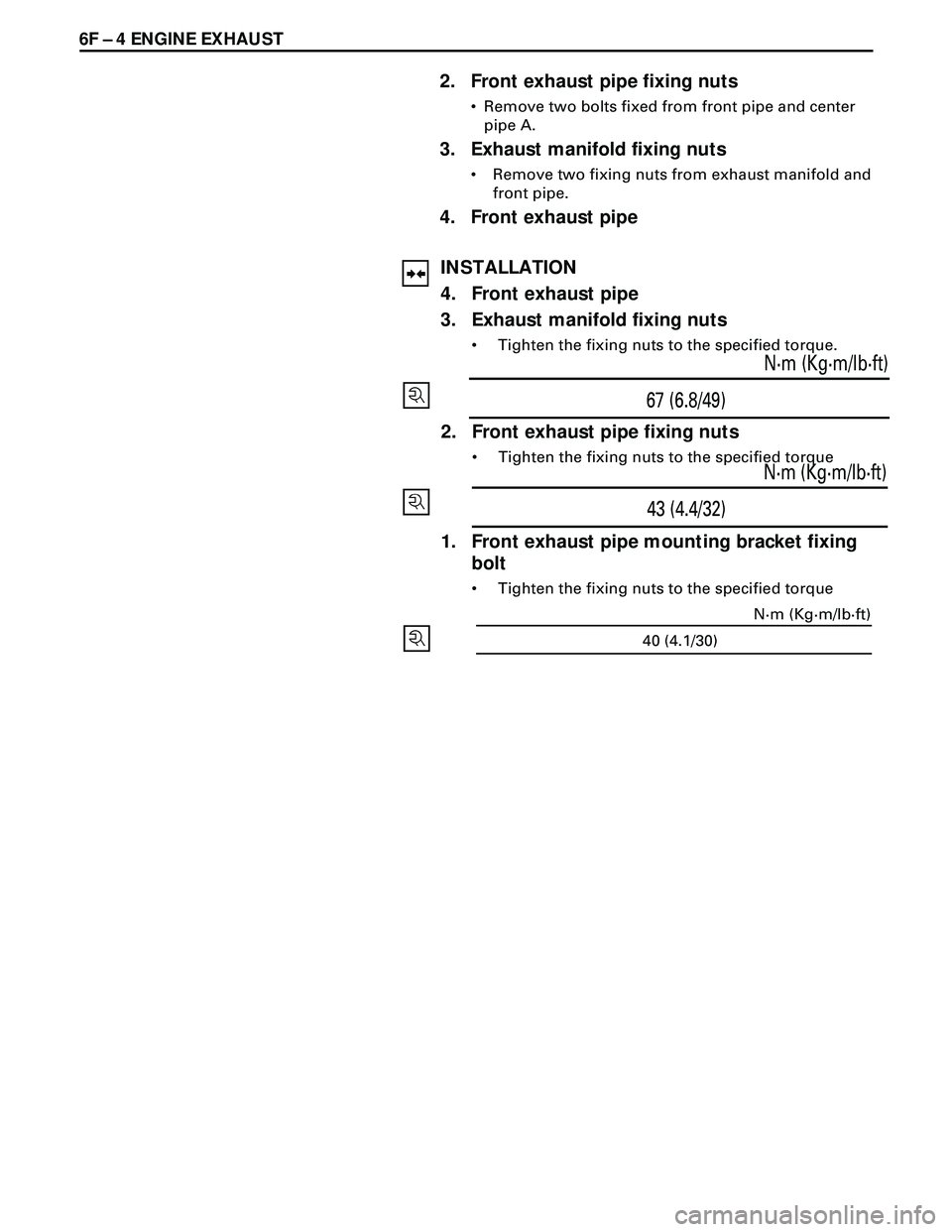
2. Front exhaust pipe fixing nuts
¥ Remove two bolts fixed from front pipe and center
pipe A.
3. Exhaust manifold fixing nuts
¥ Remove two fixing nuts from exhaust manifold and
front pipe.
4. Front exhaust pipe
INSTALLATION
4. Front exhaust pipe
3. Exhaust manifold fixing nuts
¥ Tighten the fixing nuts to the specified torque.
67 (6.8/49)N·m (Kg·m/lb·ft)
2. Front exhaust pipe fixing nuts
¥ Tighten the fixing nuts to the specified torque
43 (4.4/32)N·m (Kg·m/lb·ft)
1. Front exhaust pipe mounting bracket fixing
bolt
¥ Tighten the fixing nuts to the specified torque
40 (4.1/30)N·m (Kg·m/lb·ft)