Electrical JAGUAR XFR 2010 1.G User Guide
[x] Cancel search | Manufacturer: JAGUAR, Model Year: 2010, Model line: XFR, Model: JAGUAR XFR 2010 1.GPages: 3039, PDF Size: 58.49 MB
Page 67 of 3039

Do not empty fuel while working in a workshop or a pit
Ensure that working area is well ventilated
Ensure that any work on the fuel system is only carried out by experienced and well qualified maintenance personnel
Ensure that fume extraction equipment is used where appropriate
Fume extraction equipment must be in operation when solvents are used e.g. Trichloroethane, white spirit, sbp3,
methylene chloride, perchlorethylene. Do not smoke in the vicinity of volatile degreasing agents.
Whenever possible, use a ramp or pit whilst working beneath a vehicle, in preference to jacking. Position chocks at the wheels
as well as applying the parking brake. Never rely on a jack alone to support a vehicle. Use axle stands, or blocks carefully
placed at the jacking points, to provide a rigid location. Check that any lifting equipment used has adequate capacity and is
fully serviceable. Ensure that a suitable form of fire extinguisher is conveniently located. When using electrical tools and
equipment, inspect the power lead for damage and check that it is properly earthed. Disconnect the earth (grounded) terminal
of the vehicle battery. Do not disconnect any pipes of the air conditioning refrigeration system unless you are trained and
instructed to do so. A refrigerant is used which can cause blindness if allowed to come into contact with the eyes. Ensure that
adequate ventilation is provided when volatile degreasing agents are being used.
Adhere strictly to handling and safety instructions given on containers and labels. Keep oils and solvents away from naked
flames and other sources of ignition. Do not apply heat in an attempt to free seized nuts or fittings; as well as causing
damage to protective coatings, there is a risk of damage from stray heat to electronic equipment and brake lines. Do not leave
tools, equipment, spilt oil etc. around the work area. Wear protective overalls and use barrier cream when necessary.
Environmental Protection
In some countries it is illegal to pour used oil onto the ground, down sewers or drains, or into water courses. The burning of
used engine oil in small space heaters or boilers is not recommended unless emission control equipment is installed. Dispose
of used oil through authorized waste disposal contractors, to licensed waste disposal sites or to the waste oil reclamation
trade. If in doubt, contact the Local Authority for advice on disposal facilities.
Page 68 of 3039

General Information - How To Use This Manual
Description and Operation
Workshop Manual Organization Published: 08-Dec-2012
This manual covers descriptive, diagnostic (including OBD), and repair aspects to service the vehicle effectively.
The manual is arranged in sections, each section dealing with a specific part of a vehicle system. For example, Section 412-03
[Air Conditioning] covers air conditioning, which is part of the climate control system.
The first digit of the section number indicates the group (in the above example this being Electrical). There are five groups:
General Information.
Chassis.
Powertrain.
Electrical. Body
and Paint.
The second and third digits of the section number indicate the vehicle system (12 in the above example being Climate
Control).
The last two digits of the section number indicate the part of the system covered by the section (03 in the example denotes
Air Conditioning).
Page 73 of 3039
Supplementary Restraint System (SRS) Precautions
WARNING: Do not install rear facing child seats in the front passenger seat.
The SRS contains components which are potentially hazardous to service personnel if not handled correctly. The following
guidelines and precautions are intended to alert personnel to potential sources of danger and emphasise the importance of
ensuring the integrity of the SRS components installed to the vehicle.
WARNING: The following precautions MUST be adhered to when working on the SRS system:
The correct procedures must always be used when working on SRS components.
Persons working on the SRS system must be fully trained and have been issued with the safety guidelines.
The airbag modules contain extremely flammable and hazardous compounds. Contact with water, acids or heavy
metals may produce harmful or explosive results. Do not dismantle, incinerate or bring into contact with electricity
before the unit has been deployed.
Always replace a seat belt assembly that has withstood the strain of a severe vehicle impact or if the webbing
shows signs of fraying.
Always disconnect the vehicle battery before carrying out any electric welding on a vehicle installed with an SRS
system.
CAUTION: Do not expose airbag modules or seat belt pre-tensioners to temperatures exceeding 85° C (185° F).
It should be noted that these precautions are not restricted to operations performed when servicing the SRS system. The same
care should be exercised when working on ancillary systems and components located in the vicinity of SRS components; these
include but are not limited to:
Steering wheel airbag, rotary coupler.
Passenger front airbag.
Head airbag modules - front and rear.
Seat belt pre-tensioners.
SRS harnesses, link leads and connectors.
Side (thorax) air bags.
Making the system safe
Before working on or in the vicinity of SRS components, make sure the system is rendered safe by performing the following
operations:
Remove the ignition key.
Disconnect battery, earth lead first.
Wait 2 minutes for the SRS power circuit to discharge before commencing work.
NOTE: The SRS uses energy reserve capacitors to keep the system active in the event of electrical supply failure under
crash conditions. It is necessary to allow the capacitors sufficient time to discharge (2 minutes) in order to avoid the risk of
accidental deployment.
Installation
In order to make sure system integrity, it is essential that the SRS system is regularly checked and maintained so that it is
ready for effective operation in the event of a collision. Carefully inspect SRS components before installation. Do not install a
part that shows signs of being dropped or improperly handled, such as dents, cracks or deformation.
WARNING: The integrity of the SRS systems is critical for safety reasons. Make sure the following precautions are always
adhered to:
Do not install accessories or other objects to trim panels which cover ITS airbags.
Never install used SRS components from another vehicle or attempt to repair an SRS component.
When repairing an SRS system, only use genuine new parts.
Never apply electrical power to an SRS component unless instructed to do so as part of an approved test
procedure.
Special fixings are necessary for installing an airbag module – do not use other fixings and make sure that all
fixings are tightened to the correct torque.
Always use new fixings when replacing an SRS component.
CAUTIONS:
Take care not to trap airbag modules when installing interior trim components.
Make sure SRS components are not contaminated by oil or grease.
NOTES:
Following seat belt pre-tensioner deployment, the seat belts can still be used as conventional seat belts but will need to
Page 74 of 3039
be replaced as soon as possible to make sure full SRS protection.
If the SRS components are to be replaced, the part number/bar code of the new unit must be recorded.
SRS component testing precautions
The SRS components are triggered using relatively low operating currents, always adhere to the following :
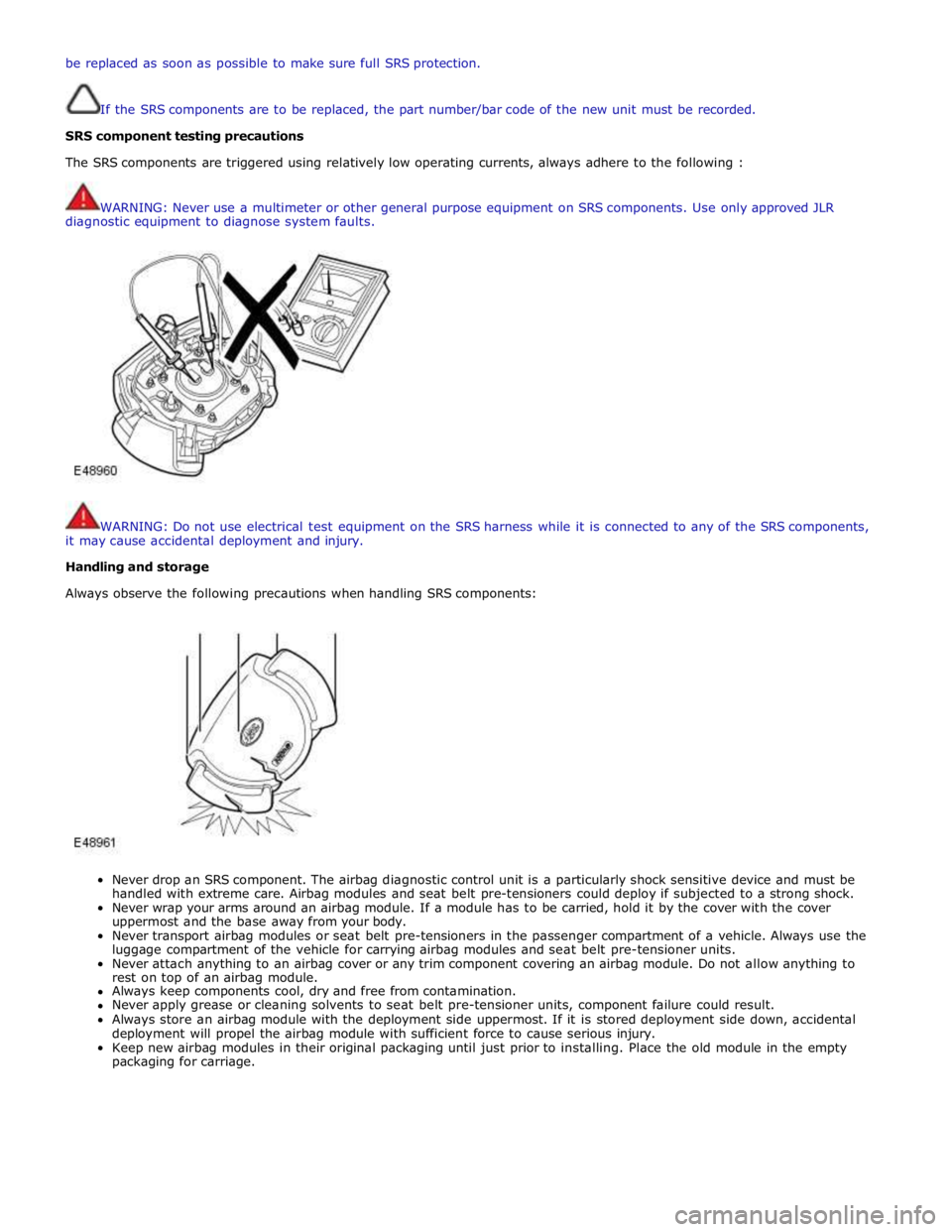
WARNING: Never use a multimeter or other general purpose equipment on SRS components. Use only approved JLR
diagnostic equipment to diagnose system faults.
WARNING: Do not use electrical test equipment on the SRS harness while it is connected to any of the SRS components,
it may cause accidental deployment and injury.
Handling and storage
Always observe the following precautions when handling SRS components:
Never drop an SRS component. The airbag diagnostic control unit is a particularly shock sensitive device and must be
handled with extreme care. Airbag modules and seat belt pre-tensioners could deploy if subjected to a strong shock.
Never wrap your arms around an airbag module. If a module has to be carried, hold it by the cover with the cover
uppermost and the base away from your body.
Never transport airbag modules or seat belt pre-tensioners in the passenger compartment of a vehicle. Always use the
luggage compartment of the vehicle for carrying airbag modules and seat belt pre-tensioner units.
Never attach anything to an airbag cover or any trim component covering an airbag module. Do not allow anything to
rest on top of an airbag module.
Always keep components cool, dry and free from contamination.
Never apply grease or cleaning solvents to seat belt pre-tensioner units, component failure could result.
Always store an airbag module with the deployment side uppermost. If it is stored deployment side down, accidental
deployment will propel the airbag module with sufficient force to cause serious injury.
Keep new airbag modules in their original packaging until just prior to installing. Place the old module in the empty
packaging for carriage.
Page 75 of 3039
WARNINGS:
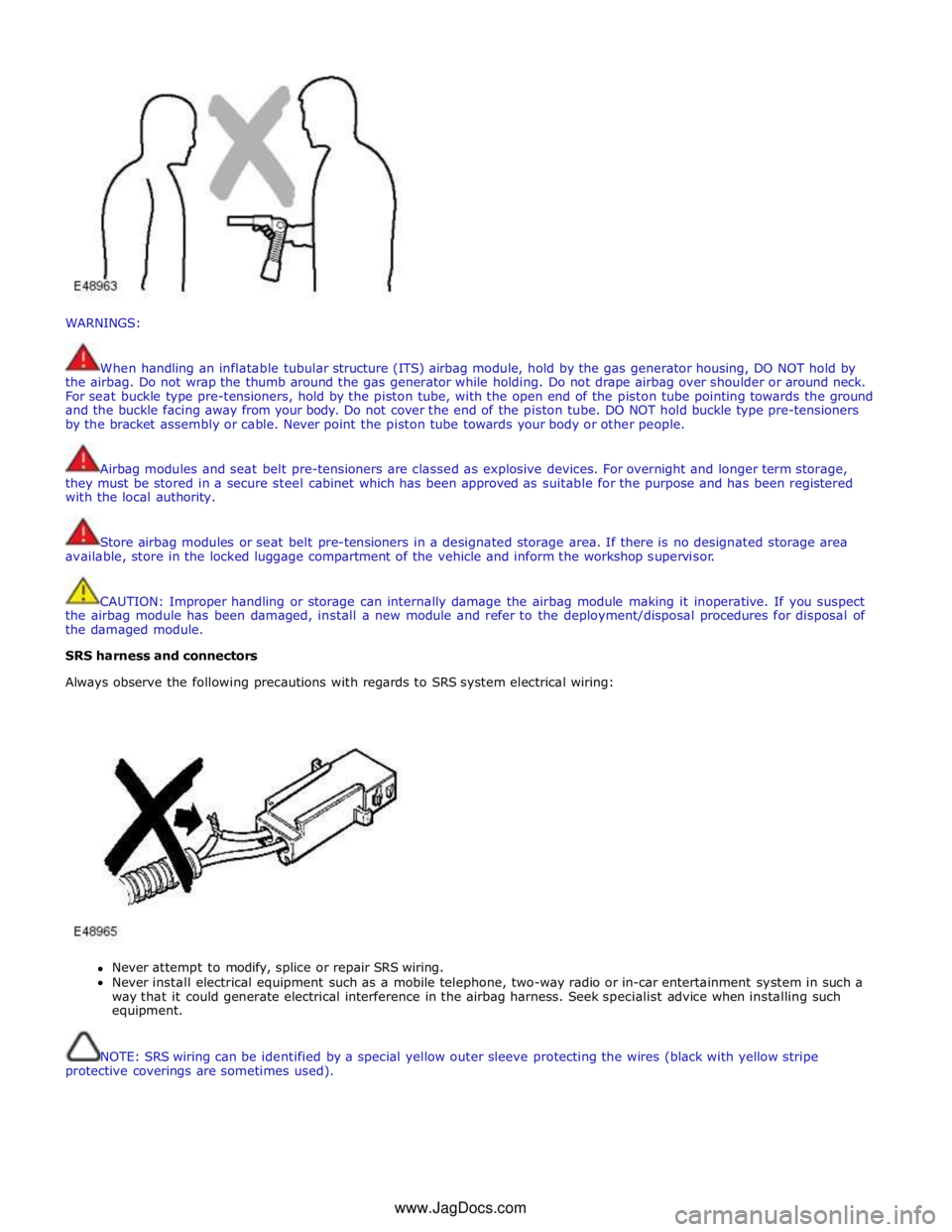
When handling an inflatable tubular structure (ITS) airbag module, hold by the gas generator housing, DO NOT hold by
the airbag. Do not wrap the thumb around the gas generator while holding. Do not drape airbag over shoulder or around neck.
For seat buckle type pre-tensioners, hold by the piston tube, with the open end of the piston tube pointing towards the ground
and the buckle facing away from your body. Do not cover the end of the piston tube. DO NOT hold buckle type pre-tensioners
by the bracket assembly or cable. Never point the piston tube towards your body or other people.
Airbag modules and seat belt pre-tensioners are classed as explosive devices. For overnight and longer term storage,
they must be stored in a secure steel cabinet which has been approved as suitable for the purpose and has been registered
with the local authority.
Store airbag modules or seat belt pre-tensioners in a designated storage area. If there is no designated storage area
available, store in the locked luggage compartment of the vehicle and inform the workshop supervisor.
CAUTION: Improper handling or storage can internally damage the airbag module making it inoperative. If you suspect
the airbag module has been damaged, install a new module and refer to the deployment/disposal procedures for disposal of
the damaged module.
SRS harness and connectors
Always observe the following precautions with regards to SRS system electrical wiring:
Never attempt to modify, splice or repair SRS wiring.
Never install electrical equipment such as a mobile telephone, two-way radio or in-car entertainment system in such a
way that it could generate electrical interference in the airbag harness. Seek specialist advice when installing such
equipment.
NOTE: SRS wiring can be identified by a special yellow outer sleeve protecting the wires (black with yellow stripe
protective coverings are sometimes used). www.JagDocs.com
Page 99 of 3039
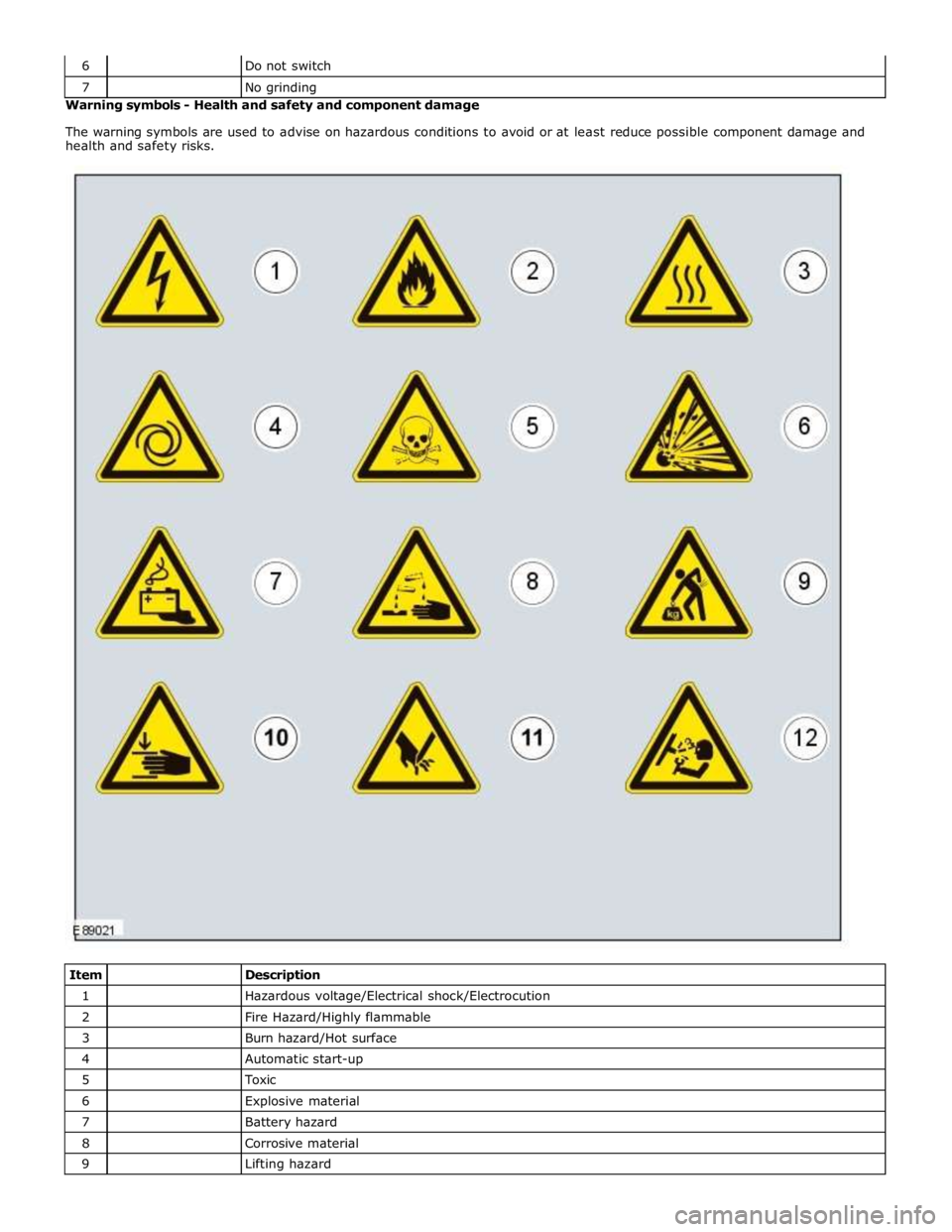
7
No grinding Warning symbols - Health and safety and component damage
The warning symbols are used to advise on hazardous conditions to avoid or at least reduce possible component damage and
health and safety risks.
Item
Description 1
Hazardous voltage/Electrical shock/Electrocution 2
Fire Hazard/Highly flammable 3
Burn hazard/Hot surface 4
Automatic start-up 5
Toxic 6
Explosive material 7
Battery hazard 8
Corrosive material 9
Lifting hazard
Page 101 of 3039
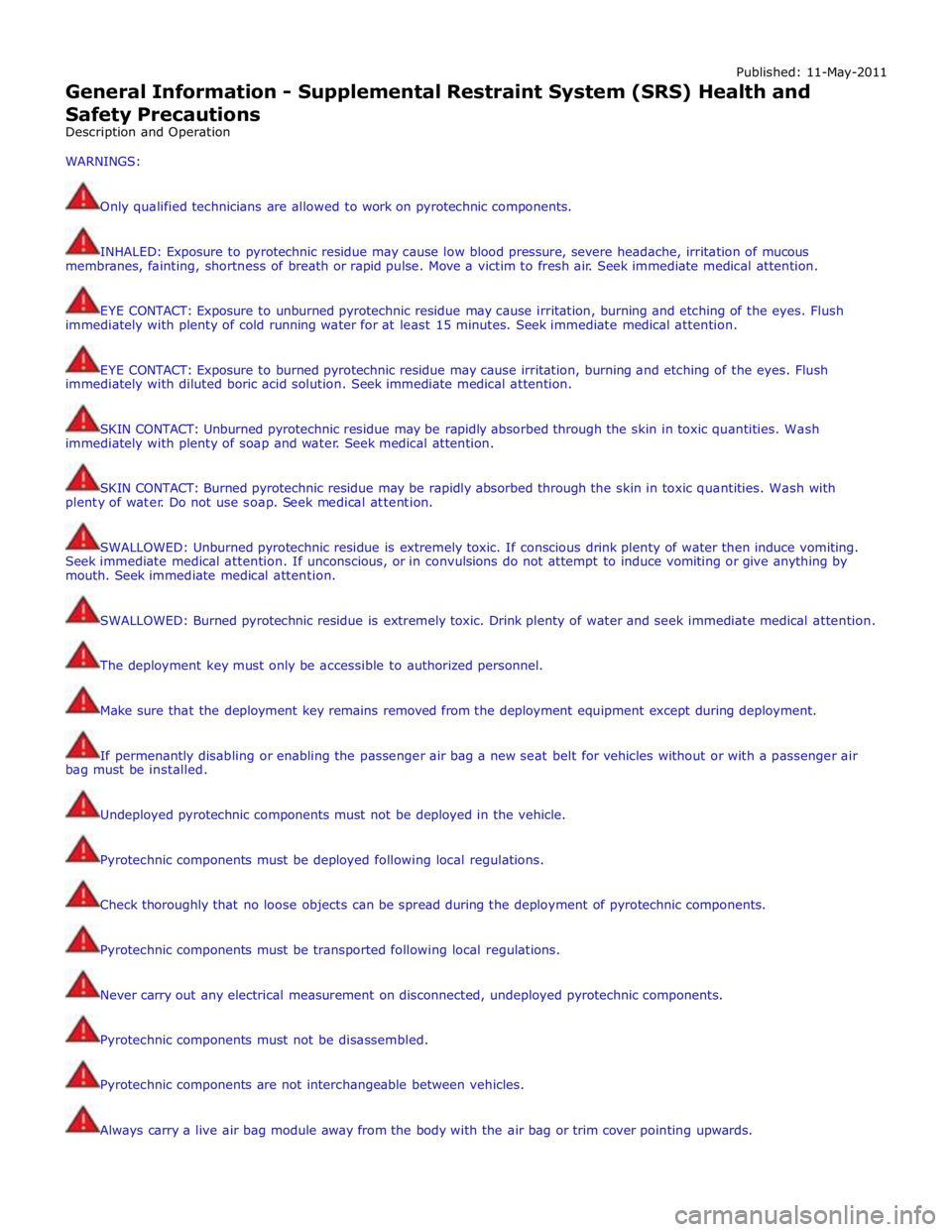
Published: 11-May-2011
General Information - Supplemental Restraint System (SRS) Health and
Safety Precautions
Description and Operation
WARNINGS:
Only qualified technicians are allowed to work on pyrotechnic components.
INHALED: Exposure to pyrotechnic residue may cause low blood pressure, severe headache, irritation of mucous
membranes, fainting, shortness of breath or rapid pulse. Move a victim to fresh air. Seek immediate medical attention.
EYE CONTACT: Exposure to unburned pyrotechnic residue may cause irritation, burning and etching of the eyes. Flush
immediately with plenty of cold running water for at least 15 minutes. Seek immediate medical attention.
EYE CONTACT: Exposure to burned pyrotechnic residue may cause irritation, burning and etching of the eyes. Flush
immediately with diluted boric acid solution. Seek immediate medical attention.
SKIN CONTACT: Unburned pyrotechnic residue may be rapidly absorbed through the skin in toxic quantities. Wash
immediately with plenty of soap and water. Seek medical attention.
SKIN CONTACT: Burned pyrotechnic residue may be rapidly absorbed through the skin in toxic quantities. Wash with
plenty of water. Do not use soap. Seek medical attention.
SWALLOWED: Unburned pyrotechnic residue is extremely toxic. If conscious drink plenty of water then induce vomiting.
Seek immediate medical attention. If unconscious, or in convulsions do not attempt to induce vomiting or give anything by
mouth. Seek immediate medical attention.
SWALLOWED: Burned pyrotechnic residue is extremely toxic. Drink plenty of water and seek immediate medical attention.
The deployment key must only be accessible to authorized personnel.
Make sure that the deployment key remains removed from the deployment equipment except during deployment.
If permenantly disabling or enabling the passenger air bag a new seat belt for vehicles without or with a passenger air
bag must be installed.
Undeployed pyrotechnic components must not be deployed in the vehicle.
Pyrotechnic components must be deployed following local regulations.
Check thoroughly that no loose objects can be spread during the deployment of pyrotechnic components.
Pyrotechnic components must be transported following local regulations.
Never carry out any electrical measurement on disconnected, undeployed pyrotechnic components.
Pyrotechnic components must not be disassembled.
Pyrotechnic components are not interchangeable between vehicles.
Always carry a live air bag module away from the body with the air bag or trim cover pointing upwards.
Page 106 of 3039
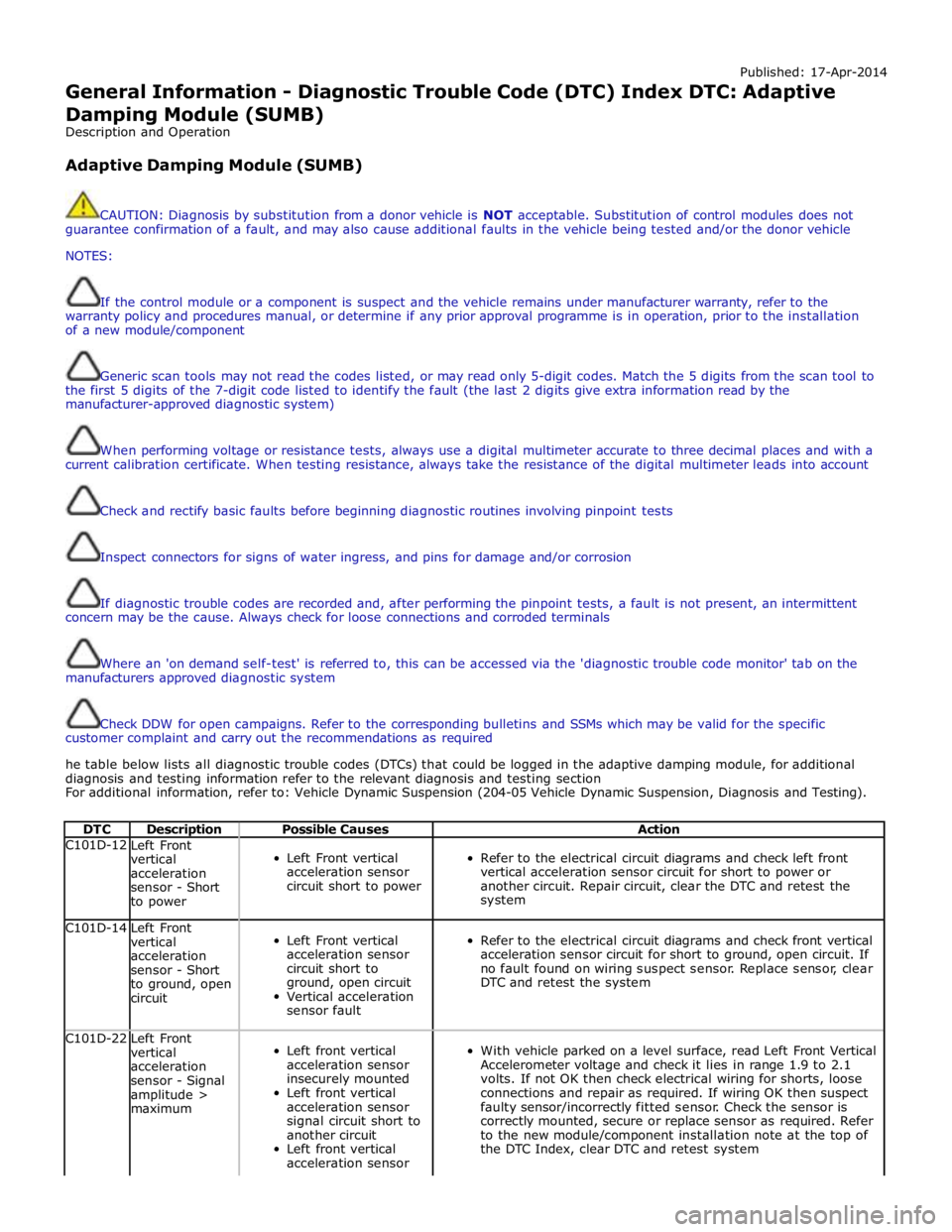
Published: 17-Apr-2014
General Information - Diagnostic Trouble Code (DTC) Index DTC: Adaptive
Damping Module (SUMB)
Description and Operation
Adaptive Damping Module (SUMB)
CAUTION: Diagnosis by substitution from a donor vehicle is NOT acceptable. Substitution of control modules does not
guarantee confirmation of a fault, and may also cause additional faults in the vehicle being tested and/or the donor vehicle
NOTES:
If the control module or a component is suspect and the vehicle remains under manufacturer warranty, refer to the
warranty policy and procedures manual, or determine if any prior approval programme is in operation, prior to the installation
of a new module/component
Generic scan tools may not read the codes listed, or may read only 5-digit codes. Match the 5 digits from the scan tool to
the first 5 digits of the 7-digit code listed to identify the fault (the last 2 digits give extra information read by the
manufacturer-approved diagnostic system)
When performing voltage or resistance tests, always use a digital multimeter accurate to three decimal places and with a
current calibration certificate. When testing resistance, always take the resistance of the digital multimeter leads into account
Check and rectify basic faults before beginning diagnostic routines involving pinpoint tests
Inspect connectors for signs of water ingress, and pins for damage and/or corrosion
If diagnostic trouble codes are recorded and, after performing the pinpoint tests, a fault is not present, an intermittent
concern may be the cause. Always check for loose connections and corroded terminals
Where an 'on demand self-test' is referred to, this can be accessed via the 'diagnostic trouble code monitor' tab on the
manufacturers approved diagnostic system
Check DDW for open campaigns. Refer to the corresponding bulletins and SSMs which may be valid for the specific
customer complaint and carry out the recommendations as required
he table below lists all diagnostic trouble codes (DTCs) that could be logged in the adaptive damping module, for additional
diagnosis and testing information refer to the relevant diagnosis and testing section
For additional information, refer to: Vehicle Dynamic Suspension (204-05 Vehicle Dynamic Suspension, Diagnosis and Testing).
DTC Description Possible Causes Action C101D-12
Left Front
vertical
acceleration
sensor - Short
to power
Left Front vertical
acceleration sensor
circuit short to power
Refer to the electrical circuit diagrams and check left front
vertical acceleration sensor circuit for short to power or
another circuit. Repair circuit, clear the DTC and retest the
system C101D-14
Left Front
vertical
acceleration
sensor - Short
to ground, open
circuit
Left Front vertical
acceleration sensor
circuit short to
ground, open circuit
Vertical acceleration
sensor fault
Refer to the electrical circuit diagrams and check front vertical
acceleration sensor circuit for short to ground, open circuit. If
no fault found on wiring suspect sensor. Replace sensor, clear
DTC and retest the system C101D-22
Left Front
vertical
acceleration
sensor - Signal
amplitude >
maximum
Left front vertical
acceleration sensor
insecurely mounted
Left front vertical
acceleration sensor
signal circuit short to
another circuit
Left front vertical
acceleration sensor
With vehicle parked on a level surface, read Left Front Vertical
Accelerometer voltage and check it lies in range 1.9 to 2.1
volts. If not OK then check electrical wiring for shorts, loose
connections and repair as required. If wiring OK then suspect
faulty sensor/incorrectly fitted sensor. Check the sensor is
correctly mounted, secure or replace sensor as required. Refer
to the new module/component installation note at the top of
the DTC Index, clear DTC and retest system
Page 107 of 3039

DTC Description Possible Causes Action internal fault
C101D-26
Left Front
vertical
acceleration
sensor - Signal
rate of change
below threshold
Left front vertical
acceleration sensor
signal circuit short to
another circuit
Left front vertical
acceleration sensor
internal fault
Refer to the electrical circuit diagrams and check Left Front
Vertical Accelerometer signal circuit for faults, if circuit is
correct suspect faulty sensor, refer to the new
module/component installation note at the top of the DTC
Index. Replace the sensor, clear the DTC and retest the
system C101D-78
Left Front
vertical
acceleration
sensor -
Alignment or
adjustment
incorrect
Left front vertical
acceleration sensor
bracket bent
Left front vertical
acceleration sensor
damaged
Check Left Front Vertical Accelerometer for location and
security, if correct suspect faulty Accelerometer, refer to the
new module installation note at the top of the DTC Index.
Replace the sensor/bracket as required, clear the DTC and
retest the system C101E-12
Right Front
vertical
acceleration
sensor - Short
to power
Right Front vertical
acceleration sensor
circuit short to power
Refer to the electrical circuit diagrams and check right front
vertical acceleration sensor circuit for short to power or
another circuit. Repair circuit, clear the DTC and retest the
system C101E-14
Right Front
vertical
acceleration
sensor - Short
to ground, open
circuit
Right Front vertical
acceleration sensor
circuit short to
ground, open circuit
Vertical acceleration
sensor fault
Refer to the electrical circuit diagrams and check right front
vertical acceleration sensor circuit for short to ground, open
circuit. If no fault found on wiring suspect sensor. Replace
sensor, clear DTC and retest the system C101E-22
Right Front
vertical
acceleration
sensor - Signal
amplitude >
maximum
Right front vertical
acceleration sensor
insecurely mounted
Right front vertical
acceleration sensor
signal circuit short to
another circuit
Right front vertical
acceleration sensor
internal fault
With vehicle parked on a level surface, read Right Front
Vertical Accelerometer voltage and check it lies in range 1.9 to
2.1 volts. If not OK then check electrical wiring for shorts,
loose connections and repair as required. If wiring OK then
suspect faulty sensor/incorrectly fitted sensor. Check the
sensor is correctly mounted, secure or replace sensor as
required. Refer to the new module/component installation
note at the top of the DTC Index, clear DTC and retest system C101E-26
Right Front
vertical
acceleration
sensor - Signal
rate of change
below threshold
Right front vertical
acceleration sensor
signal circuit short to
another circuit
Right front vertical
acceleration sensor
internal fault
Refer to the electrical circuit diagrams and check Right Front
Vertical Accelerometer signal circuit for faults, if circuit is
correct suspect faulty sensor, refer to the new
module/component installation note at the top of the DTC
Index. Replace the sensor, clear the DTC and retest the
system C101E-78 Right Front
Right front vertical
Check Right Front Vertical Accelerometer for location and vertical acceleration acceleration sensor security, if correct suspect faulty Accelerometer, refer to the sensor - bracket bent new module installation note at the top of the DTC Index. Alignment or Right front vertical Replace the sensor/bracket as required, clear the DTC and adjustment acceleration sensor retest the system incorrect damaged C1024-00
System Temporarily
Disabled Due To
Power
Interruption
During Driving -
No sub type
information
Loss of power to
control module whilst
driving
Refer to the electrical circuit diagrams and check power and
ground circuits to Adaptive Damping Control Module for
intermittent or poor connection. Repair wiring circuits as
required, clear DTC and retest the system C1030-12
Left Rear
vertical
acceleration
sensor - Short
to power
Left Rear vertical
acceleration sensor
circuit short to power
Refer to the electrical circuit diagrams and check left Rear
vertical acceleration sensor circuit for short to power or
another circuit. Repair circuit, clear the DTC and retest the
system
Page 108 of 3039

DTC Description Possible Causes Action C1030-14
Left Rear
vertical
acceleration
sensor - Short
to ground, open
circuit
Left rear vertical
acceleration sensor
circuit short to
ground, open circuit
Vertical acceleration
sensor fault
Refer to the electrical circuit diagrams and check left Rear
vertical acceleration sensor circuit for short to ground, open
circuit. If no fault found on wiring suspect sensor. Replace
sensor, clear DTC and retest the system C1030-22
Left Rear
vertical
acceleration
sensor - Signal
amplitude >
maximum
Left Rear vertical
acceleration sensor
insecurely mounted
Left Rear vertical
acceleration sensor
signal circuit short to
another circuit
Left Rear vertical
acceleration sensor
internal fault
With vehicle parked on a level surface, read Left Rear Vertical
Accelerometer voltage and check it lies in range 1.9 to 2.1
volts. If not OK then check electrical wiring for shorts, loose
connections and repair as required. If wiring OK then suspect
faulty sensor/incorrectly fitted sensor. Check the sensor is
correctly mounted, secure or replace sensor as required. Refer
to the new module/component installation note at the top of
the DTC Index, clear DTC and retest system C1030-26
Left Rear
vertical
acceleration
sensor - Signal
rate of change
below threshold
Left Rear vertical
acceleration sensor
signal circuit short to
another circuit
Left Rear vertical
acceleration sensor
internal fault
Refer to the electrical circuit diagrams and check Left Rear
Vertical Accelerometer signal circuit for faults, if circuit is
correct suspect faulty sensor, refer to the new
module/component installation note at the top of the DTC
Index. Replace the sensor, clear the DTC and retest the
system C1030-78
Left Rear
vertical
acceleration
sensor -
Alignment or
adjustment
incorrect
Left Rear vertical
acceleration sensor
bracket bent
Left Rear vertical
acceleration sensor
damaged
Check Left Rear Vertical Accelerometer for location and
security, if correct suspect faulty Accelerometer, refer to the
new module installation note at the top of the DTC Index.
Replace the sensor/bracket as required, clear the DTC and
retest the system C1A03-12
Left Front
Height Sensor -
Circuit short to
power
Height sensor circuit
shorted to another
cable
Height sensor internal
fault
Refer to the electrical circuit diagrams and check Front Left
Height Sensor circuit for short to power, If circuit correct
suspect Sensor internal fault, replace as required C1A03-14
Left Front
Height Sensor -
Circuit short to
ground or open
Wiring to sensor
(signal) open circuit
Wiring to height
sensor partial short to
ground
Wiring to height
sensor short to other
cable
Height sensor internal
electrical fault
Disconnect electrical connector to height sensor and inspect
connector pins & terminals for evidence of corrosion or water
ingress. If no corrosion found, disconnect harness at Control
Module. A: Check for short circuits between any of the 3
terminals and vehicle ground. B: Check for electrical continuity
between the two connectors for each of the 3 terminals.
Reconnect electrical connector at Control Module only. C:
Check voltages at terminals within height sensor connector
(sensor not connected), with respect to vehicle body. •
Voltage to sensor ground connection should be ~0v • Voltage
to sensor signal connection should be ~0v • Voltage to sensor
supply connection should be ~5v All voltages should be within
± 0.15v C1A03-21
Left Front
Height Sensor -
Signal amplitude
< minimum
Height sensor linkage
not connected
Height sensor or
bracket loose
Height sensor bracket
bent
Incorrect height
calibration
Height sensor linkage
toggled
Height sensor water
ingress
Wiring to height
sensor partial short to
ground
Wiring to height
sensor short to other
cable
Height sensor
Inspect for damage or loose fixings. NOTE If any height
sensor fixings were slackened or found to be loose or if a
height sensor was changed, the vehicle ride height MUST be
re-calibrated. Confirm that the correct height sensor part
number is fitted, as specified in the service parts database.
To check height sensor: Disconnect electrical connector to
height sensor and inspect connecter pins & terminals for
evidence of corrosion or water ingress. If no corrosion found,
disconnect harness at Control Module. A: Check for short
circuits between any of the 3 terminals and vehicle ground. B:
Check for electrical continuity between the two connectors for
each of the 3 terminals. Reconnect electrical connector at
Control Module only. C: Check voltages at terminals within
height sensor connector (sensor not connected), with respect
to vehicle body. • Voltage to sensor ground connection should
be ~0v • Voltage to sensor signal connection should be ~0v •
Voltage to sensor supply connection should be ~5v All
voltages should be within ± 0.15v. To check sensor operation
on the vehicle: Check for water ingress around the height